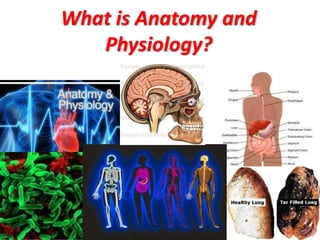
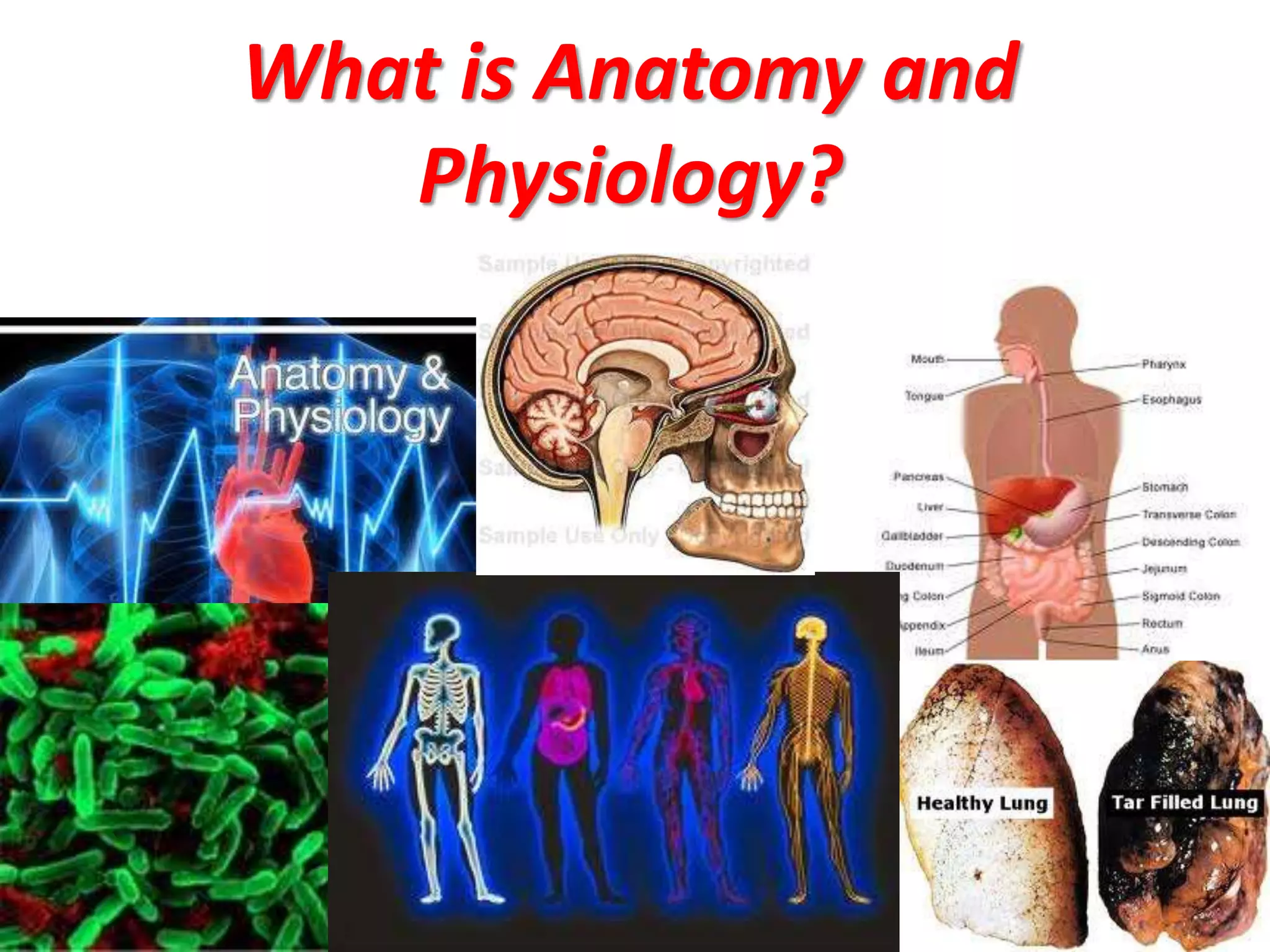
What is Anatomy and
Physiology?
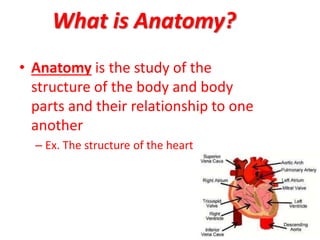
What is Anatomy?
• Anatomy is the study of the
structure of the body and body
parts and their relationship to one
another
– Ex. The structure of the heart
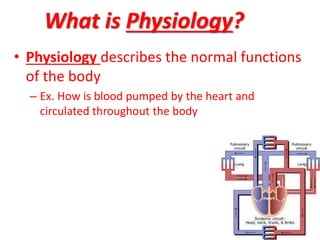
What is Physiology?
• Physiology describes the normal functions
of the body
– Ex. How is blood pumped by the heart and
circulated throughout the body
Anatomy & Physiology Relationship
• In the real world, anatomy and physiology are
always related.
• The each of the body parts have a job to do
based on their structure.
Heart??
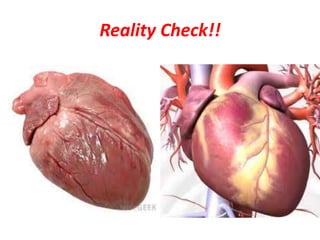
Reality Check!!
Try and write down as many organ
systems as you can!
(There are 11)
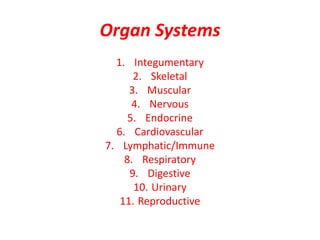
Organ Systems
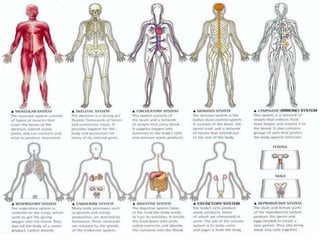
1. Integumentary
2. Skeletal
3. Muscular
4. Nervous
5. Endocrine
6. Cardiovascular
7. Lymphatic/Immune
8. Respiratory
9. Digestive
10. Urinary
11. Reproductive
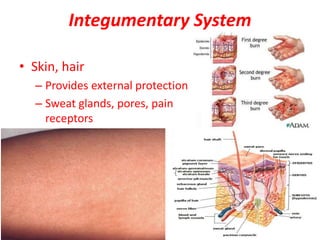
Integumentary System
• Skin, hair
– Provides external protection
– Sweat glands, pores, pain
receptors
Skeletal System
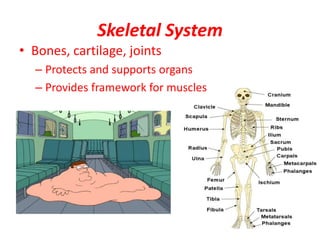
• Bones, cartilage, joints
– Protects and supports organs
– Provides framework for muscles
Muscular System
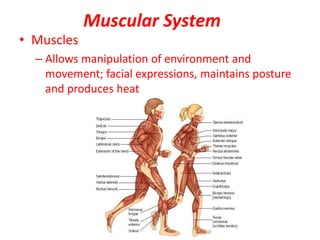
• Muscles
– Allows manipulation of environment and
movement; facial expressions, maintains posture
and produces heat
Nervous System
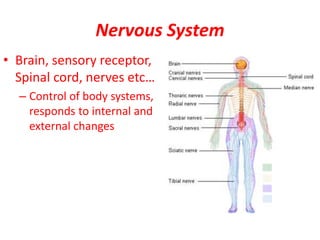
• Brain, sensory receptor,
Spinal cord, nerves etc…
– Control of body systems,
responds to internal and
external changes
Endocrine System
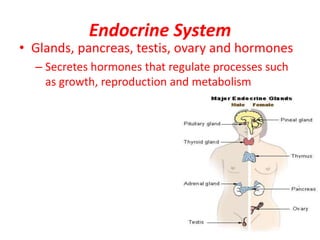
• Glands, pancreas, testis, ovary and hormones
– Secretes hormones that regulate processes such
as growth, reproduction and metabolism
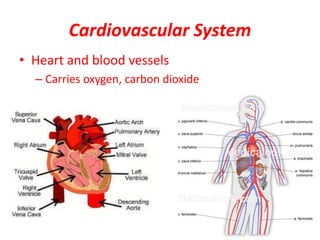
Cardiovascular System
• Heart and blood vessels
– Carries oxygen, carbon dioxide
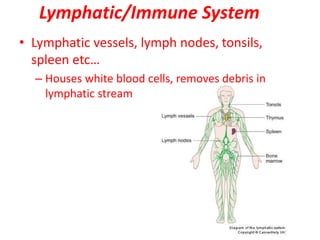
Lymphatic/Immune System
• Lymphatic vessels, lymph nodes, tonsils,
spleen etc…
– Houses white blood cells, removes debris in
lymphatic stream
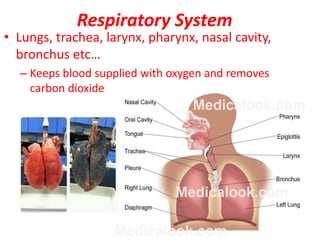
Respiratory System
• Lungs, trachea, larynx, pharynx, nasal cavity,
bronchus etc…
– Keeps blood supplied with oxygen and removes
carbon dioxide
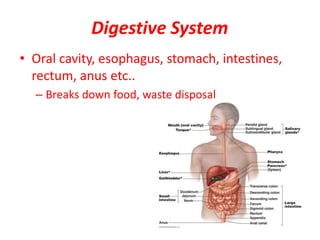
Digestive System
• Oral cavity, esophagus, stomach, intestines,
rectum, anus etc..
– Breaks down food, waste disposal
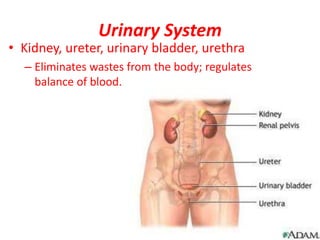
Urinary System
• Kidney, ureter, urinary bladder, urethra
– Eliminates wastes from the body; regulates
balance of blood.
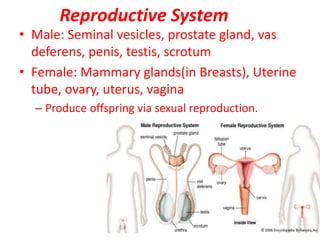
Reproductive System
• Male: Seminal vesicles, prostate gland, vas
deferens, penis, testis, scrotum
• Female: Mammary glands(in Breasts), Uterine
tube, ovary, uterus, vagina
– Produce offspring via sexual reproduction.
If you had to pick one body system to
live without, what would it be and
why?
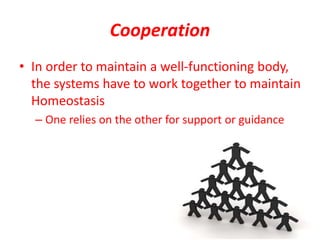
Cooperation
• In order to maintain a well-functioning body,
the systems have to work together to maintain
Homeostasis
– One relies on the other for support or guidance
Homeostasis
• The body’s ability to maintain a relatively
stable internal environment despite the
constant external changes.
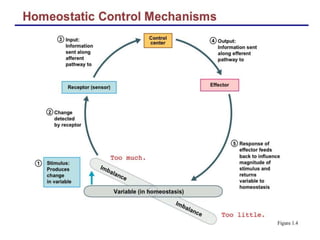
Homeostasis
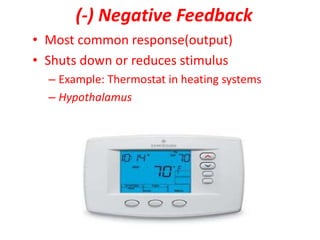
(-) Negative Feedback
• Most common response(output)
• Shuts down or reduces stimulus
– Example: Thermostat in heating systems
– Hypothalamus
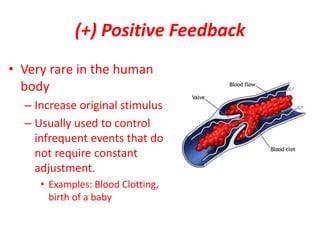
(+) Positive Feedback
• Very rare in the human
body
– Increase original stimulus
– Usually used to control
infrequent events that do
not require constant
adjustment.
• Examples: Blood Clotting,
birth of a baby
www.kahoot.it

Intro to Anatomy and Physiology

  • 1.
    What is Anatomyand Physiology?
  • 2.
    What is Anatomy? •Anatomy is the study of the structure of the body and body parts and their relationship to one another – Ex. The structure of the heart
  • 3.
    What is Physiology? •Physiology describes the normal functions of the body – Ex. How is blood pumped by the heart and circulated throughout the body
  • 4.
    Anatomy & PhysiologyRelationship • In the real world, anatomy and physiology are always related. • The each of the body parts have a job to do based on their structure.
  • 5.
  • 6.
  • 8.
    Try and writedown as many organ systems as you can! (There are 11)
  • 9.
    Organ Systems 1. Integumentary 2.Skeletal 3. Muscular 4. Nervous 5. Endocrine 6. Cardiovascular 7. Lymphatic/Immune 8. Respiratory 9. Digestive 10. Urinary 11. Reproductive
  • 11.
    Integumentary System • Skin,hair – Provides external protection – Sweat glands, pores, pain receptors
  • 12.
    Skeletal System • Bones,cartilage, joints – Protects and supports organs – Provides framework for muscles
  • 13.
    Muscular System • Muscles –Allows manipulation of environment and movement; facial expressions, maintains posture and produces heat
  • 14.
    Nervous System • Brain,sensory receptor, Spinal cord, nerves etc… – Control of body systems, responds to internal and external changes
  • 15.
    Endocrine System • Glands,pancreas, testis, ovary and hormones – Secretes hormones that regulate processes such as growth, reproduction and metabolism
  • 16.
    Cardiovascular System • Heartand blood vessels – Carries oxygen, carbon dioxide
  • 17.
    Lymphatic/Immune System • Lymphaticvessels, lymph nodes, tonsils, spleen etc… – Houses white blood cells, removes debris in lymphatic stream
  • 18.
    Respiratory System • Lungs,trachea, larynx, pharynx, nasal cavity, bronchus etc… – Keeps blood supplied with oxygen and removes carbon dioxide
  • 19.
    Digestive System • Oralcavity, esophagus, stomach, intestines, rectum, anus etc.. – Breaks down food, waste disposal
  • 20.
    Urinary System • Kidney,ureter, urinary bladder, urethra – Eliminates wastes from the body; regulates balance of blood.
  • 21.
    Reproductive System • Male:Seminal vesicles, prostate gland, vas deferens, penis, testis, scrotum • Female: Mammary glands(in Breasts), Uterine tube, ovary, uterus, vagina – Produce offspring via sexual reproduction.
  • 22.
    If you hadto pick one body system to live without, what would it be and why?
  • 23.
    Cooperation • In orderto maintain a well-functioning body, the systems have to work together to maintain Homeostasis – One relies on the other for support or guidance
  • 24.
    Homeostasis • The body’sability to maintain a relatively stable internal environment despite the constant external changes.
  • 25.
  • 26.
    (-) Negative Feedback •Most common response(output) • Shuts down or reduces stimulus – Example: Thermostat in heating systems – Hypothalamus
  • 27.
    (+) Positive Feedback •Very rare in the human body – Increase original stimulus – Usually used to control infrequent events that do not require constant adjustment. • Examples: Blood Clotting, birth of a baby
  • 28.

Editor's Notes

  • #3 Comes from the Greek words tomy which means to cut & ana which means apart. The initial studies in anatomy were done by cutting, preserving and dissecting body parts (still happens)
  • #5 Heart is muscular which allows it to pump blood through the body. Lungs are thin walls which allow gas exchange and diffusion
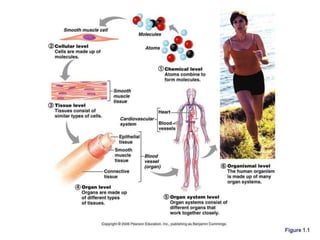
  • #8 Levels of cellular organization
  • #18 Food allergies?? Debris = Things left over from cardiovascular system, partially developed cells.
  • #19 Larynx holds vocal cords - laryngitis
  • #21 Only need one kidney – one has ability to serve all of our needs
  • #22 Semen production. Protects uterus
  • #26 Afferent pathway approaches control center. Efferent- info exits control center.
  • #27 positive feedback mechanisms enhance the original stimulus and negative feedback mechanisms inhibit it. Go signal or stop signal.
  • #28 Once a vessel is damaged, platelets start to cling to the injured site and release chemicals that attract more platelets. The platelets continue to pile up and release chemicals until a clot is formed. During labor, a hormone called oxytocin is released that intensifies and speeds up contractions. The increase in contractions causes more oxytocin to be released and the cycle goes on until the baby is born.