Foldable List all 11 body systems on the flaps of your foldable Inside the flaps, write information about each of the body systems Include the basic function of the system and any major organs of that system
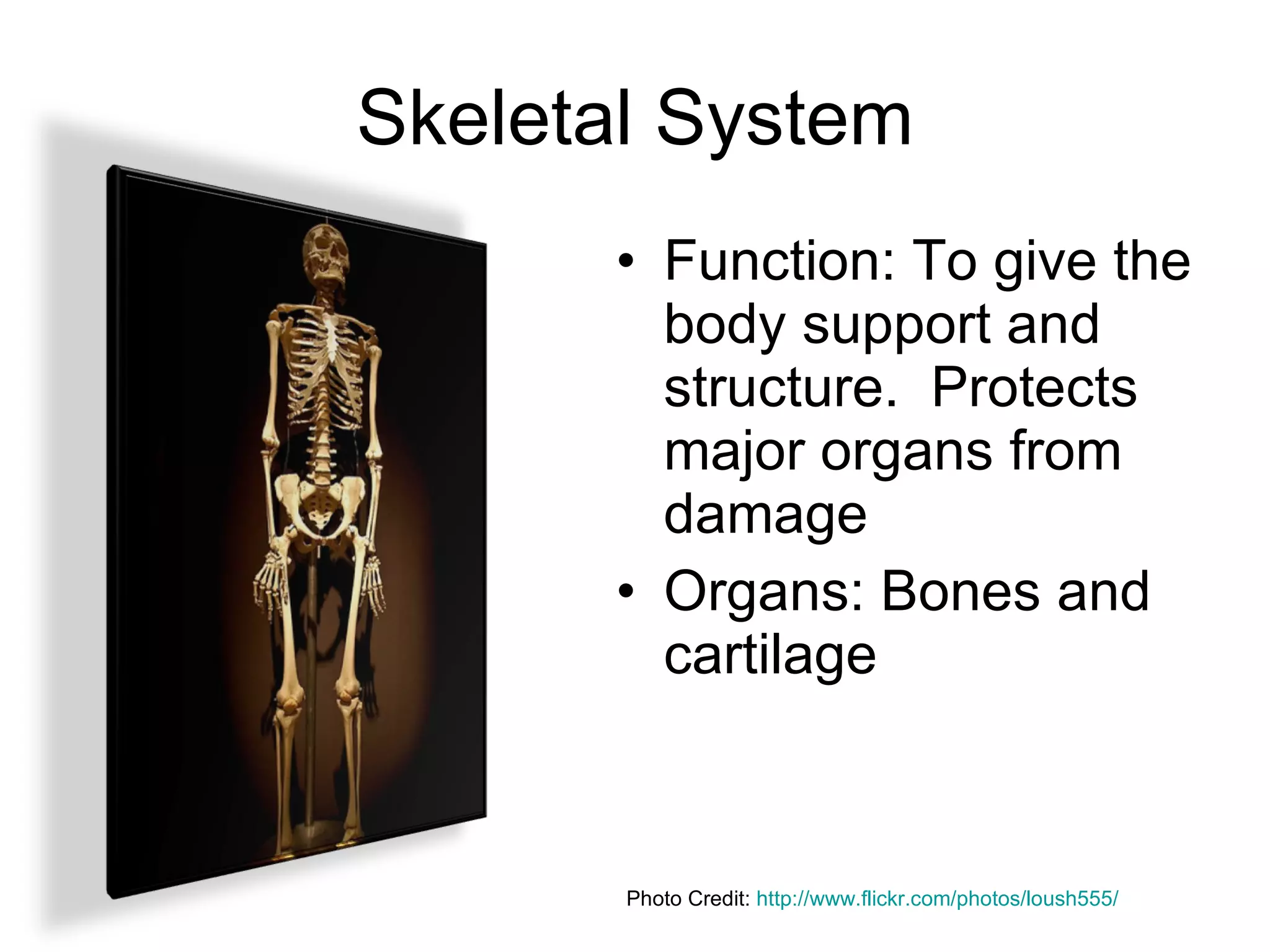
Skeletal System Function: To give the body support and structure.  Protects major organs from damage Organs: Bones and cartilage Photo Credit:  http://www.flickr.com/photos/loush555/
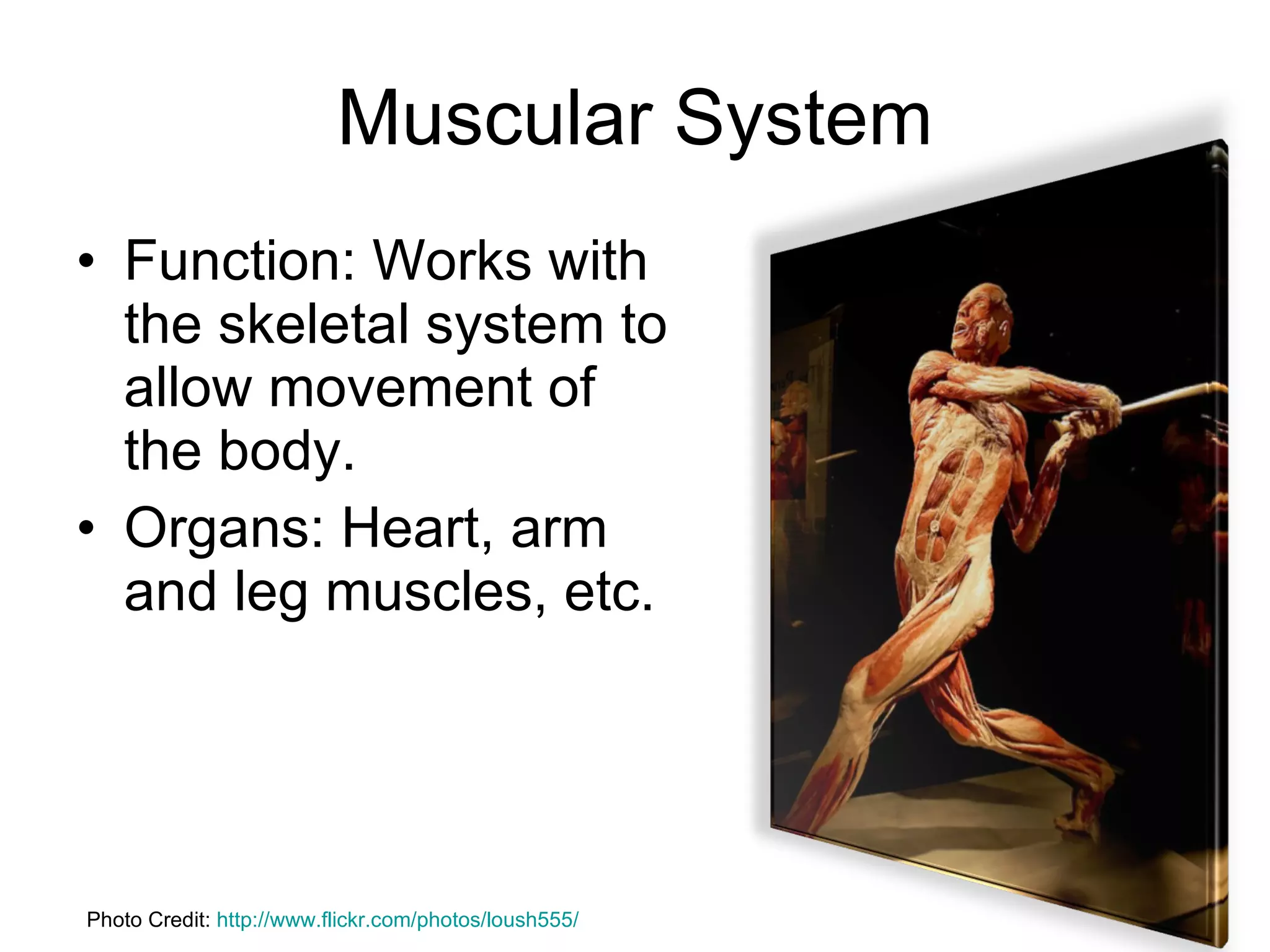
Muscular System Function: Works with the skeletal system to allow movement of the body. Organs: Heart, arm and leg muscles, etc. Photo Credit:  http://www.flickr.com/photos/loush555/
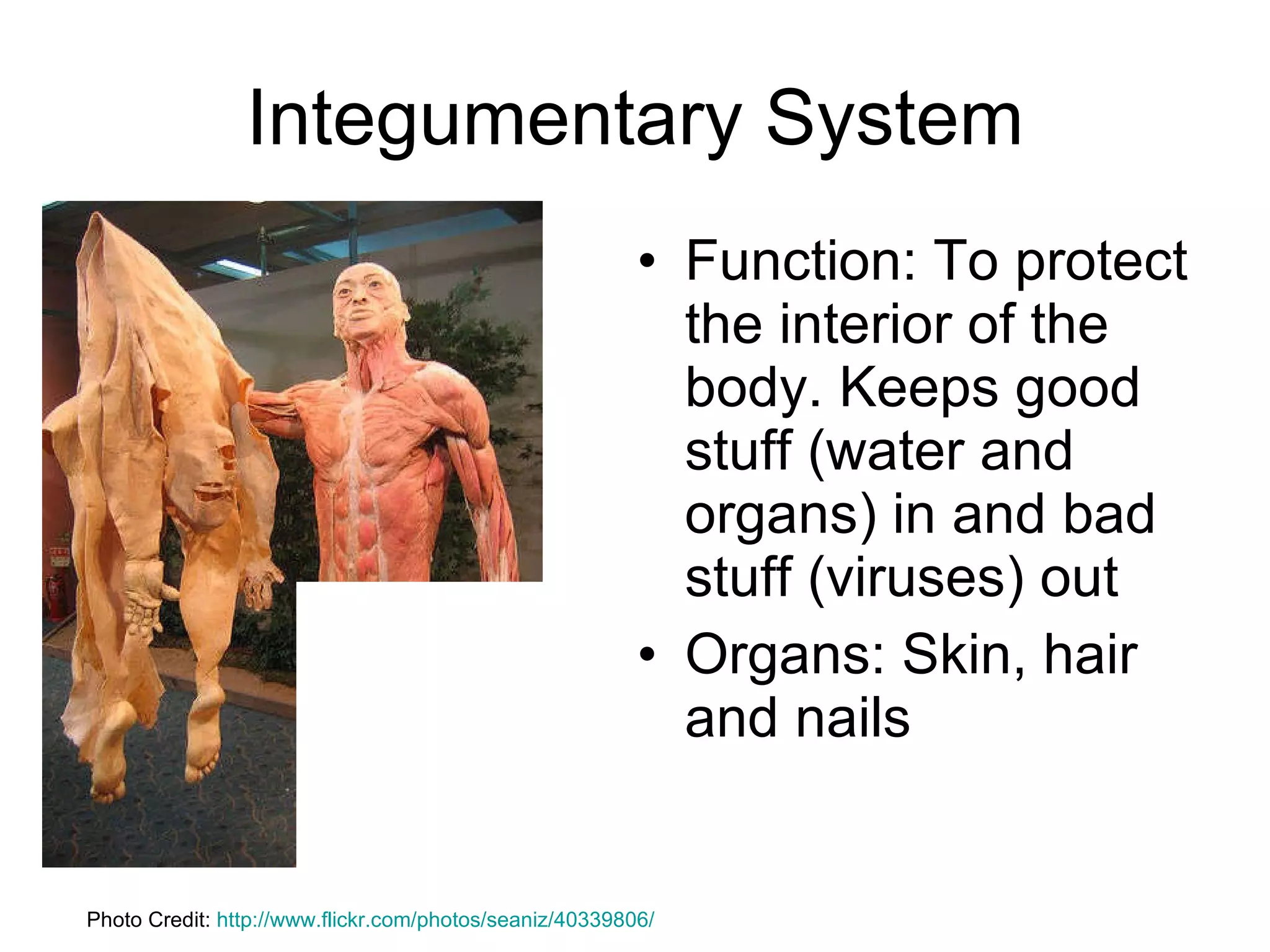
Integumentary System Function: To protect the interior of the body. Keeps good stuff (water and organs) in and bad stuff (viruses) out Organs: Skin, hair and nails Photo Credit:  http://www.flickr.com/photos/seaniz/40339806/
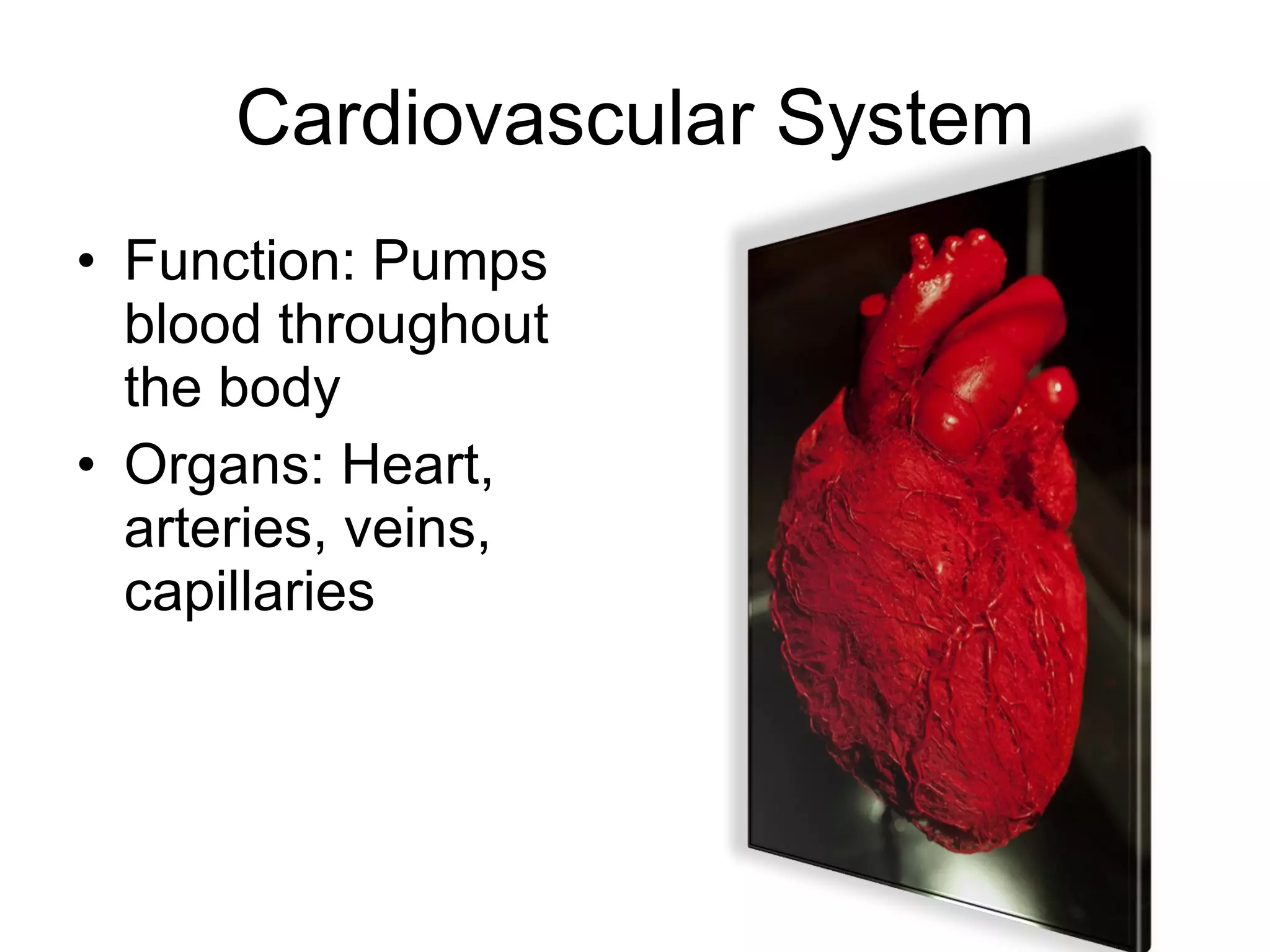
Cardiovascular System Function: Pumps blood throughout the body Organs: Heart, arteries, veins, capillaries
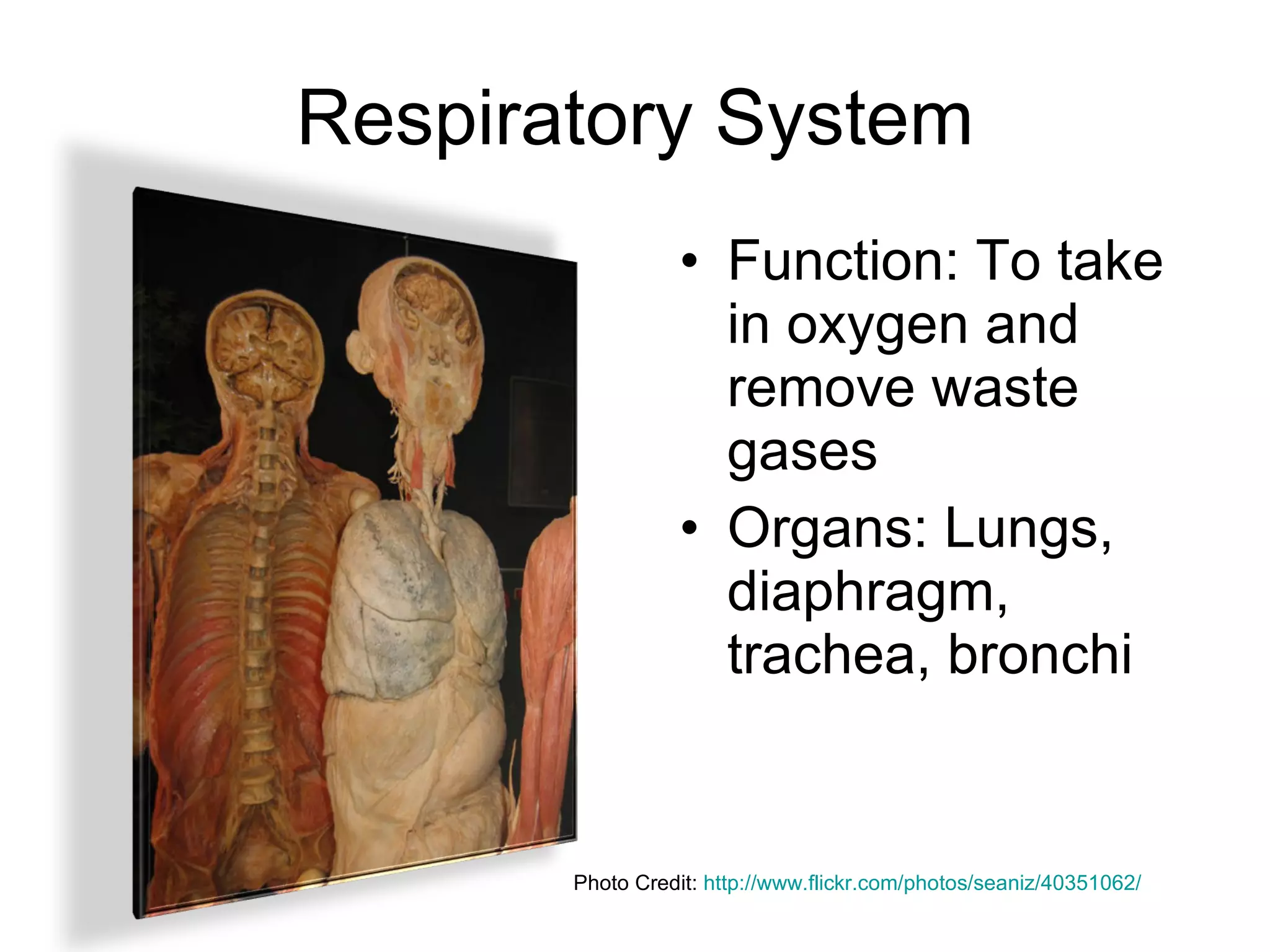
Respiratory System Function: To take in oxygen and remove waste gases Organs: Lungs, diaphragm, trachea, bronchi Photo Credit:  http://www.flickr.com/photos/seaniz/40351062/
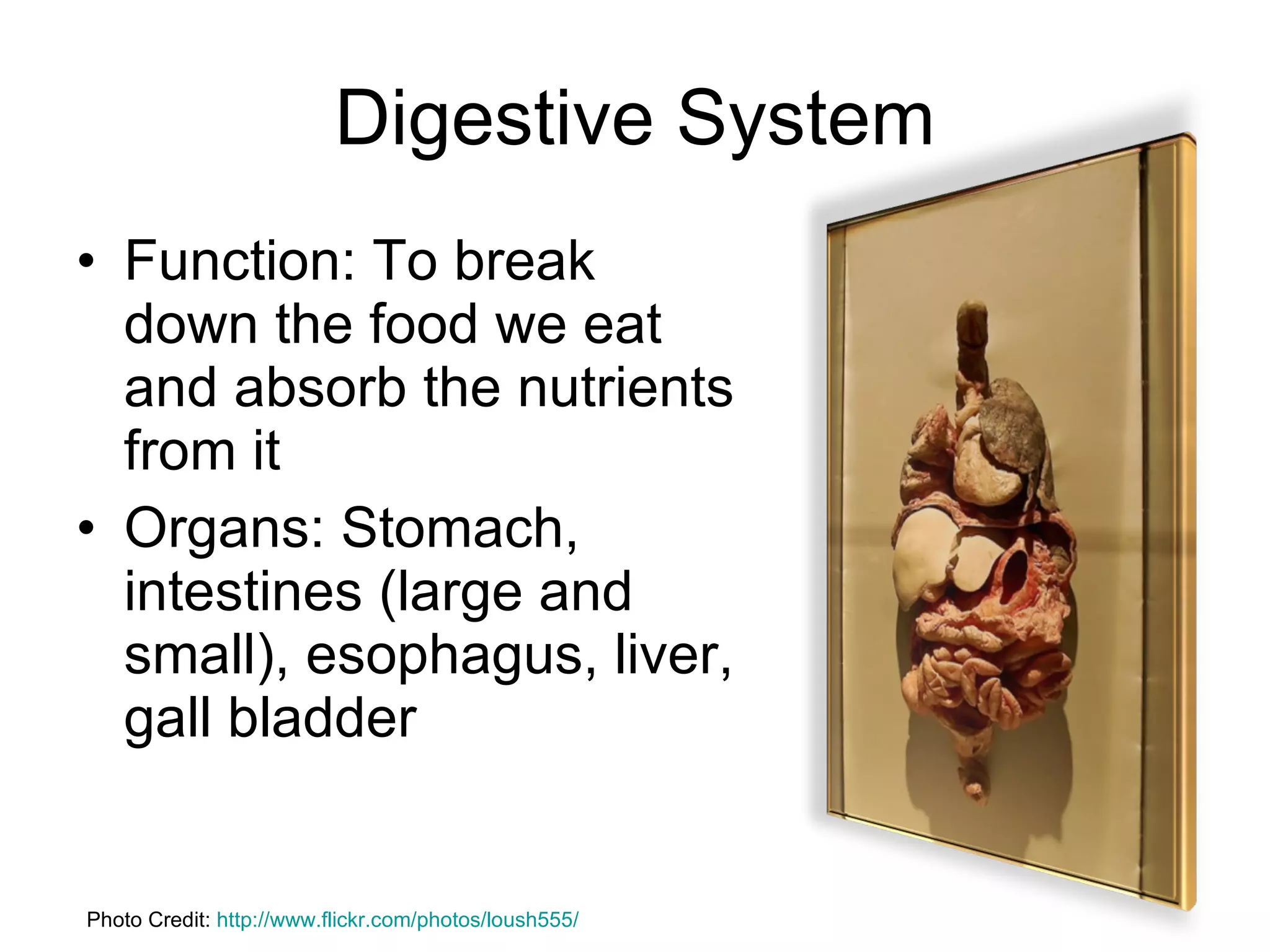
Digestive System Function: To break down the food we eat and absorb the nutrients from it Organs: Stomach, intestines (large and small), esophagus, liver, gall bladder Photo Credit:  http://www.flickr.com/photos/loush555/
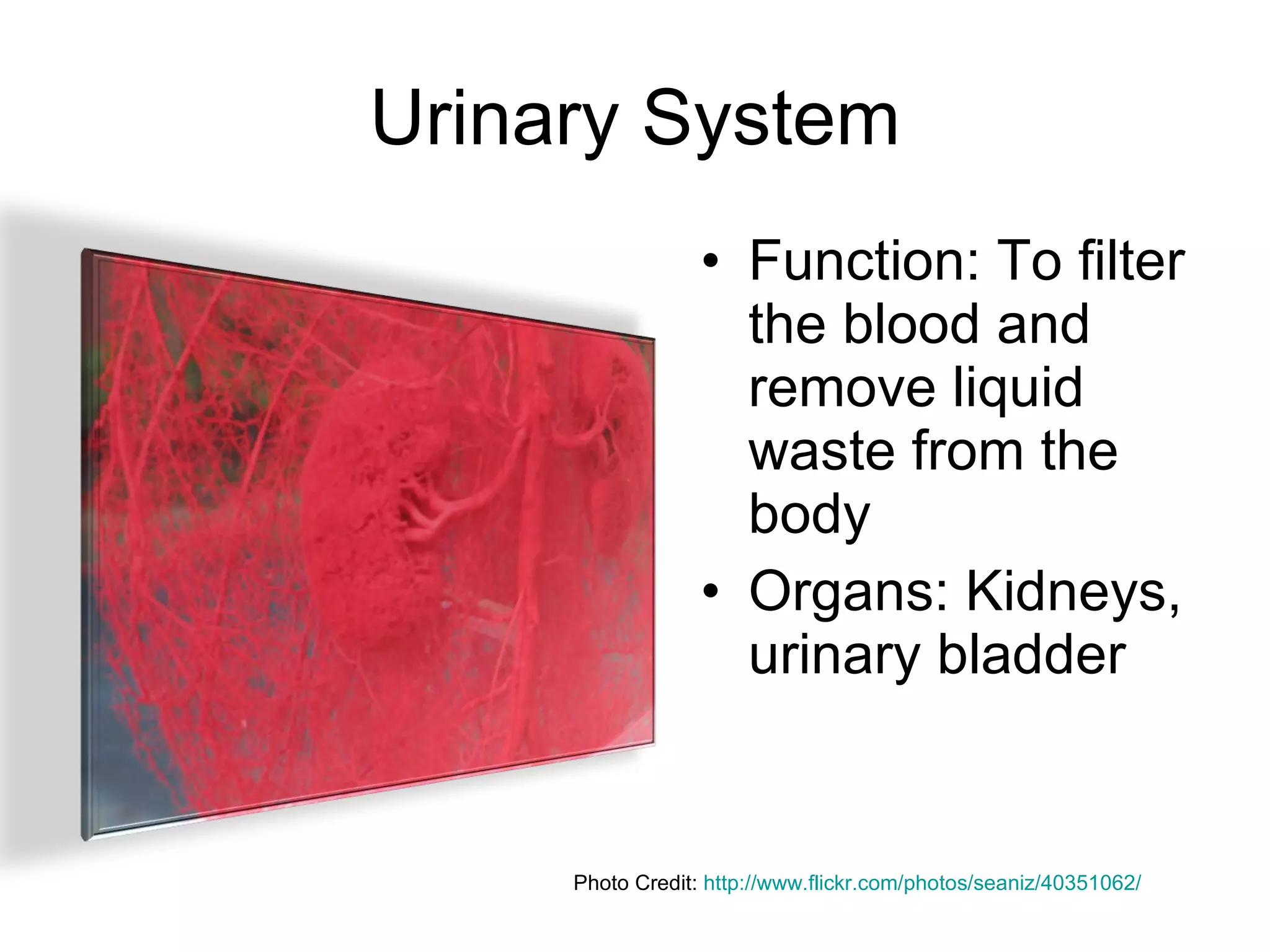
Urinary System Function: To filter the blood and remove liquid waste from the body Organs: Kidneys, urinary bladder Photo Credit:  http://www.flickr.com/photos/seaniz/40351062/
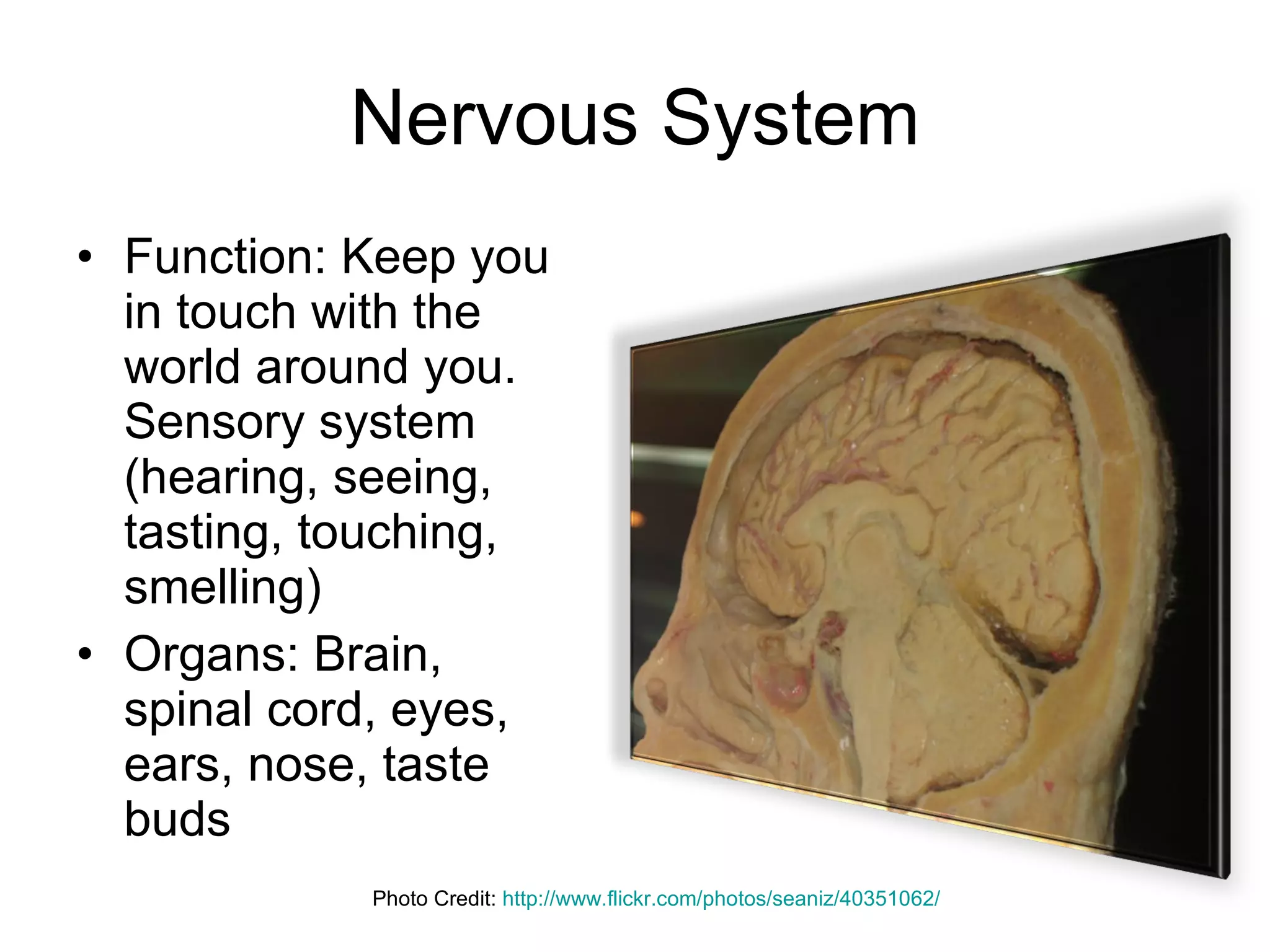
Nervous System Function: Keep you in touch with the world around you. Sensory system (hearing, seeing, tasting, touching, smelling) Organs: Brain, spinal cord, eyes, ears, nose, taste buds Photo Credit:  http://www.flickr.com/photos/seaniz/40351062/
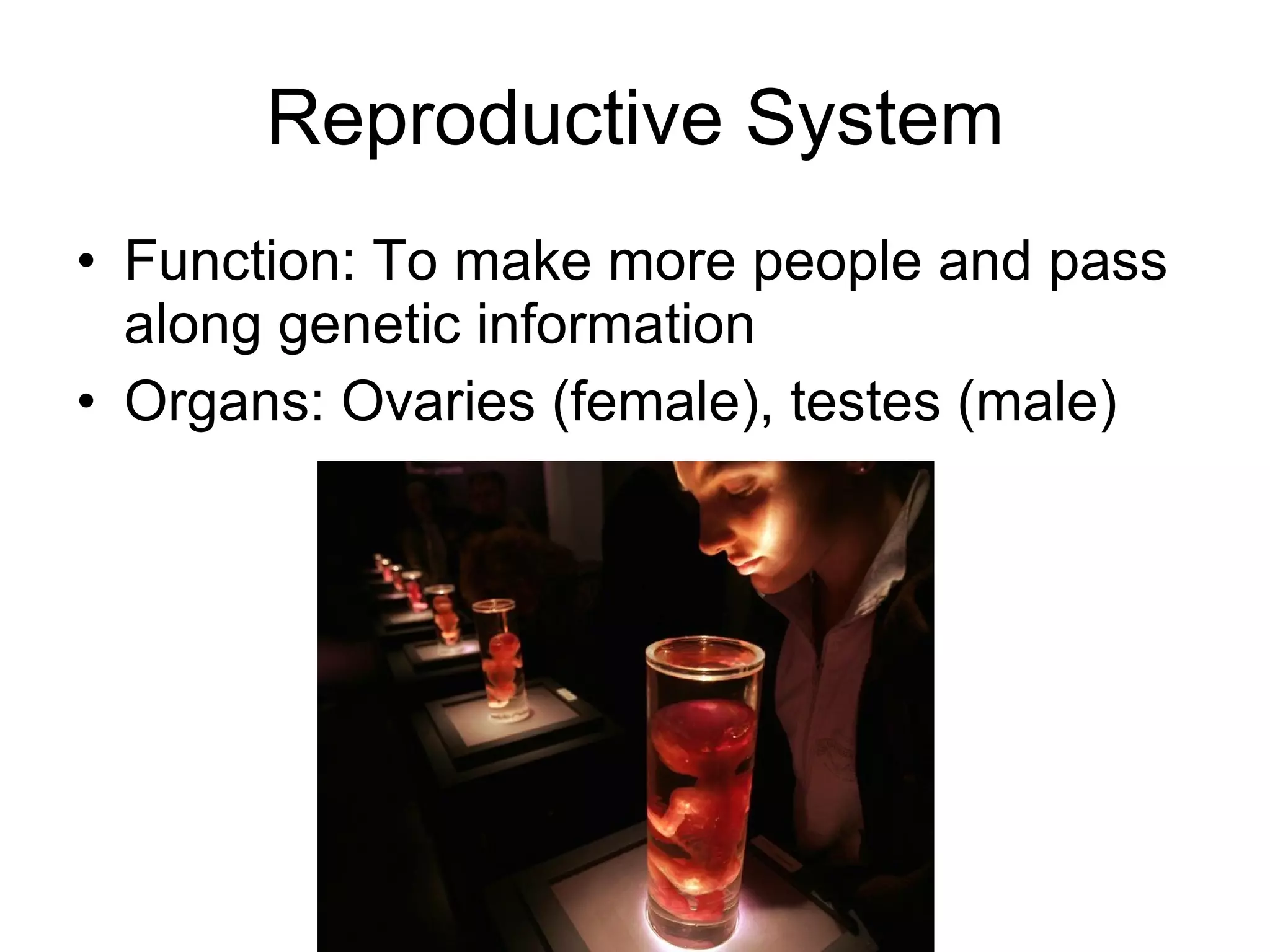
Reproductive System Function: To make more people and pass along genetic information Organs: Ovaries (female), testes (male)
Endocrine System Function: To create chemical messengers (hormones) to be sent throughout the body Organs: Pancreas, Pituitary gland, Thyroid gland, Adrenal glands
Lymphatic System Function: Helps with fluid movement throughout the body and fights disease Organs: Spleen, Tonsils, Lymph Nodes and vessels
Body Systems EQs (p. 64)  1.  What is  homeostasis  and how do the systems of the human body help to maintain it?
Body Systems EQs 2.  (BIG Question) For each of the body systems listed, explain how the system provides for the needs of humans as organisms as well as describing the major organs of that system: Skeletal, Muscular, Integumentary, Cardiovascular, Respiratory, Digestive, Nervous, Reproductive, Endocrine.
Body Systems EQs 3.  Give four examples (from different systems) of how the structure of an organ is related to its function in the human body.
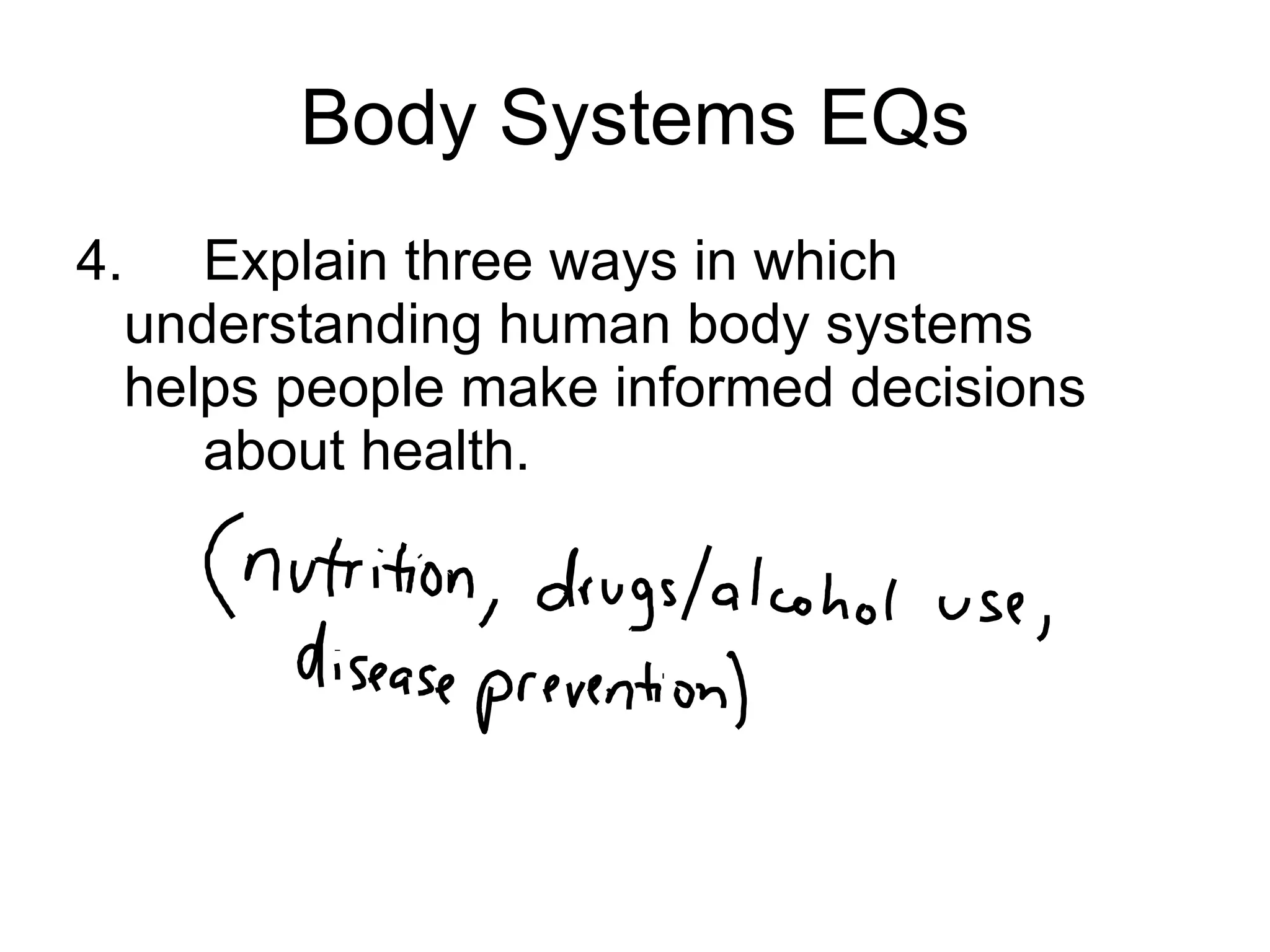
Body Systems EQs 4. Explain three ways in which  understanding human body systems  helps people make informed decisions  about health.
Body Systems Title Page On page 65 in your notebook, you need to make a title page for HUMAN BODY SYSTEMS Look through pages 144 – 327 to get ideas for images to include in your title page.  Be sure to include questions you have about the human body

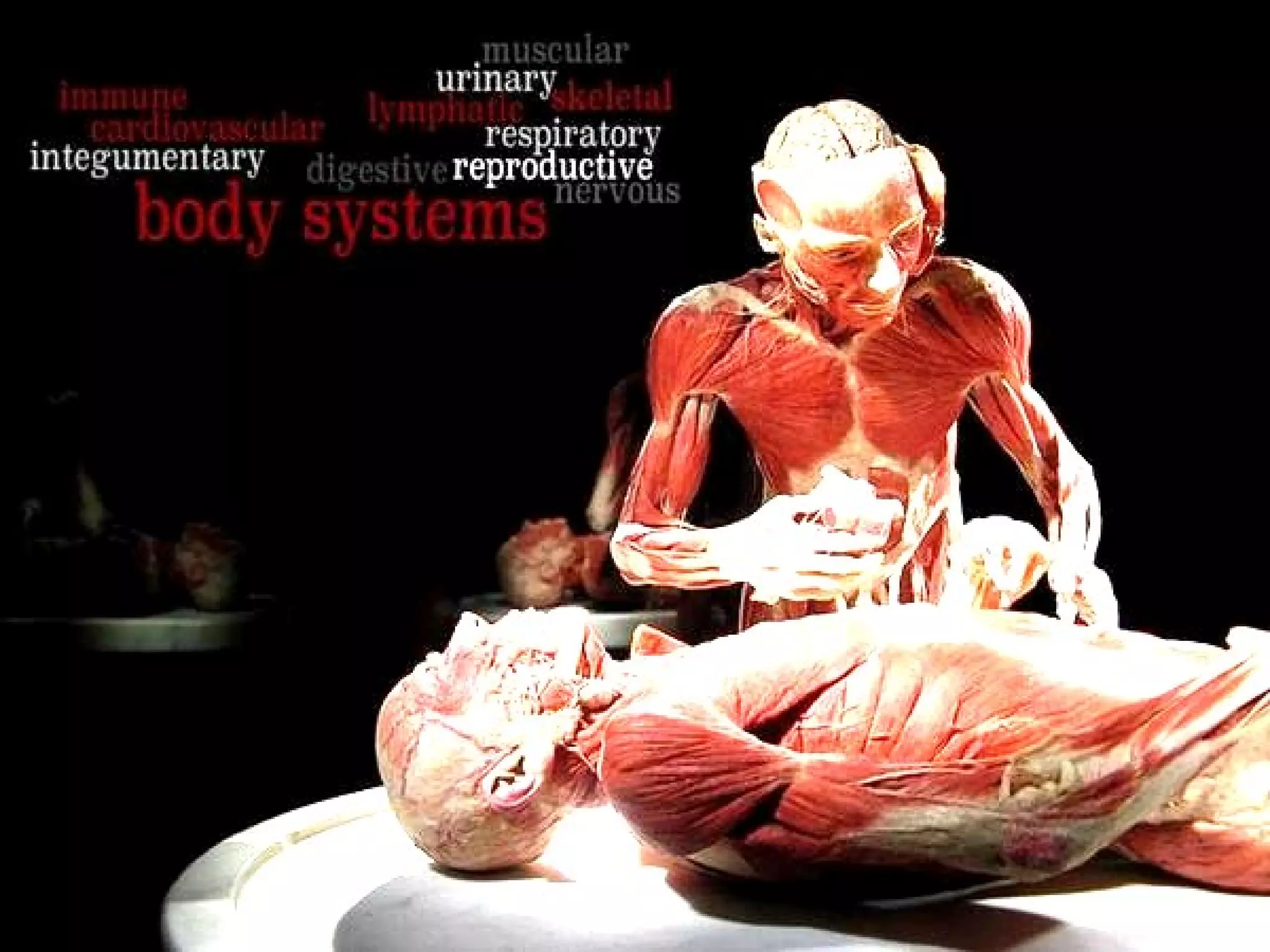
Body System Basics

  • 1.
  • 2.
    Foldable List all11 body systems on the flaps of your foldable Inside the flaps, write information about each of the body systems Include the basic function of the system and any major organs of that system
  • 3.
    Skeletal System Function:To give the body support and structure. Protects major organs from damage Organs: Bones and cartilage Photo Credit: http://www.flickr.com/photos/loush555/
  • 4.
    Muscular System Function:Works with the skeletal system to allow movement of the body. Organs: Heart, arm and leg muscles, etc. Photo Credit: http://www.flickr.com/photos/loush555/
  • 5.
    Integumentary System Function:To protect the interior of the body. Keeps good stuff (water and organs) in and bad stuff (viruses) out Organs: Skin, hair and nails Photo Credit: http://www.flickr.com/photos/seaniz/40339806/
  • 6.
    Cardiovascular System Function:Pumps blood throughout the body Organs: Heart, arteries, veins, capillaries
  • 7.
    Respiratory System Function:To take in oxygen and remove waste gases Organs: Lungs, diaphragm, trachea, bronchi Photo Credit: http://www.flickr.com/photos/seaniz/40351062/
  • 8.
    Digestive System Function:To break down the food we eat and absorb the nutrients from it Organs: Stomach, intestines (large and small), esophagus, liver, gall bladder Photo Credit: http://www.flickr.com/photos/loush555/
  • 9.
    Urinary System Function:To filter the blood and remove liquid waste from the body Organs: Kidneys, urinary bladder Photo Credit: http://www.flickr.com/photos/seaniz/40351062/
  • 10.
    Nervous System Function:Keep you in touch with the world around you. Sensory system (hearing, seeing, tasting, touching, smelling) Organs: Brain, spinal cord, eyes, ears, nose, taste buds Photo Credit: http://www.flickr.com/photos/seaniz/40351062/
  • 11.
    Reproductive System Function:To make more people and pass along genetic information Organs: Ovaries (female), testes (male)
  • 12.
    Endocrine System Function:To create chemical messengers (hormones) to be sent throughout the body Organs: Pancreas, Pituitary gland, Thyroid gland, Adrenal glands
  • 13.
    Lymphatic System Function:Helps with fluid movement throughout the body and fights disease Organs: Spleen, Tonsils, Lymph Nodes and vessels
  • 14.
    Body Systems EQs(p. 64) 1. What is homeostasis and how do the systems of the human body help to maintain it?
  • 15.
    Body Systems EQs2. (BIG Question) For each of the body systems listed, explain how the system provides for the needs of humans as organisms as well as describing the major organs of that system: Skeletal, Muscular, Integumentary, Cardiovascular, Respiratory, Digestive, Nervous, Reproductive, Endocrine.
  • 16.
    Body Systems EQs3. Give four examples (from different systems) of how the structure of an organ is related to its function in the human body.
  • 17.
    Body Systems EQs4. Explain three ways in which understanding human body systems helps people make informed decisions about health.
  • 18.
    Body Systems TitlePage On page 65 in your notebook, you need to make a title page for HUMAN BODY SYSTEMS Look through pages 144 – 327 to get ideas for images to include in your title page. Be sure to include questions you have about the human body