



Dhanwantari Education
     Programme
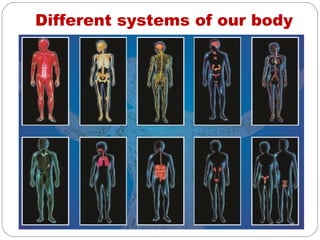
Different systems of our body
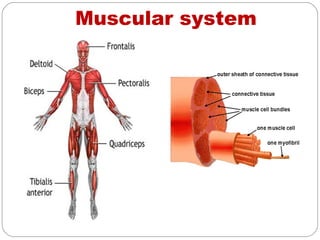
Muscular system
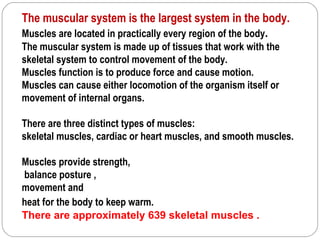
The muscular system is the largest system in the body.
Muscles are located in practically every region of the body.
The muscular system is made up of tissues that work with the
skeletal system to control movement of the body.
Muscles function is to produce force and cause motion.
Muscles can cause either locomotion of the organism itself or
movement of internal organs.

There are three distinct types of muscles:
skeletal muscles, cardiac or heart muscles, and smooth muscles.

Muscles provide strength,
balance posture ,
movement and
heat for the body to keep warm.
There are approximately 639 skeletal muscles .
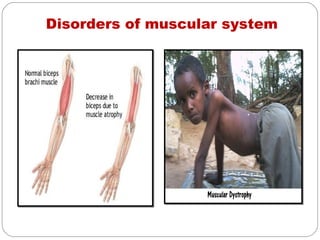
Disorders of muscular system
Symptoms of Muscular diseases

        Stiffness,
        Muscle pull,
        Cramp ,
        Spasm,
        Pain,
        Reduction in
        size,
        Loss of function
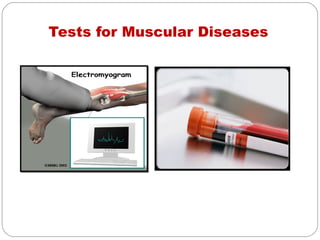
Tests for Muscular Diseases
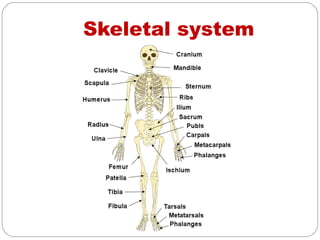
Skeletal system
T h e S k e le t a l S y s t e m
The human skeleton consists of both fused and
individual bones supported and supplemented by
ligaments, tendons, muscles and cartilage.
An average adult skeleton consists of 208 bones.
                                   There are five general
classifications of bones,                    These are
Long bones, Short bones, Flat bones, Irregular bones,
and Sesamoid bones.
Function: The Skeletal System serves many important
functions; it provides the shape and form for our bodies
in addition to supporting, protecting, allowing bodily
movement, producing blood for the body, and storing
minerals.
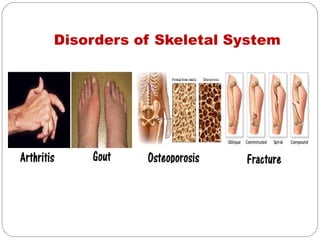
Disorders of Skeletal System
Symptoms of Skeletal System

    Pain in joint
    Swelling of joints
    Redness at joint
    Morning stiffness
    Rubbing sounds in joints
    Low joint activity
    Pain in long bones
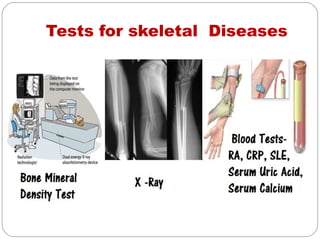
Tests for skeletal Diseases
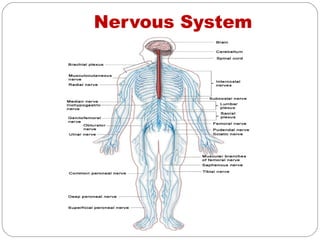
Nervous System
The nervous system
 is a network of specialized cells that communicate information about an
organism's surroundings and itself.
The nervous system is divided broadly into two categories:
          the peripheral nervous system and the central nervous system.
               Neurons generate and conduct impulses between and within
the two systems.
 The peripheral nervous system is composed of sensory neurons and the
neurons that connect them to the nerve cord, spinal cord and brain, which
make up the central nervous system.
In response to stimuli, sensory neurons generate and propagate signals to
the central nervous system which then processes and conducts signals back
to the muscles and glands.
 The neuron is the functional unit of the nervous system.
     H u m a n s h a v e a b o u t 10 0
b illio n n e u r o n s in t h e ir b r a in
a lo n e !
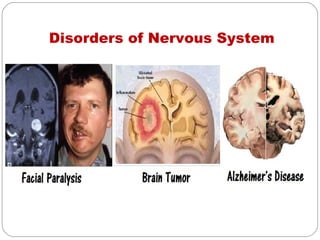
Disorders of Nervous System
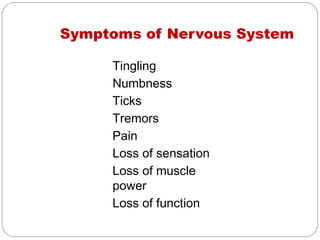
Symptoms of Nervous System

     Tingling
     Numbness
     Ticks
     Tremors
     Pain
     Loss of sensation
     Loss of muscle
     power
     Loss of function
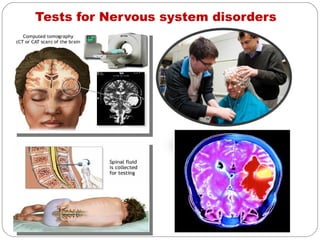
Tests for Nervous system disorders
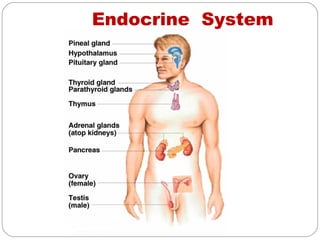
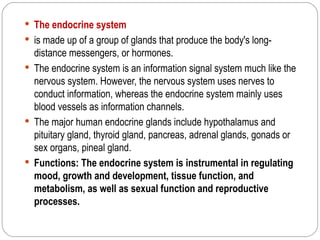
Endocrine System
ļ‚— The endocrine system
ļ‚— is made up of a group of glands that produce the body's long-
  distance messengers, or hormones.
ļ‚— The endocrine system is an information signal system much like the
  nervous system. However, the nervous system uses nerves to
  conduct information, whereas the endocrine system mainly uses
  blood vessels as information channels.
ļ‚— The major human endocrine glands include hypothalamus and
  pituitary gland, thyroid gland, pancreas, adrenal glands, gonads or
  sex organs, pineal gland.
ļ‚— Functions: The endocrine system is instrumental in regulating
  mood, growth and development, tissue function, and
  metabolism, as well as sexual function and reproductive
  processes.
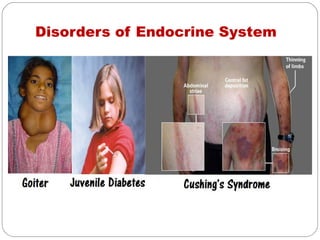
Disorders of Endocrine System
Symptoms of Endocrine Disorders
       Shortness of height
       Bone pain
       Hyper pigmentation
       Upper body obesity
       Dry skin
       Sudden loss of hairs
       Excessive eating
       Excessive thirst
       Excessive urination
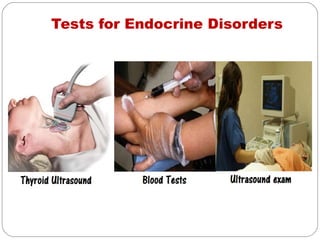
Tests for Endocrine Disorders
Cardiovascular System
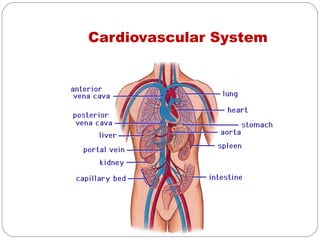
The Cardiovascular System
is an organ system that passes nutrients (such as amino acids and
electrolytes), gases, hormones, blood cells, nitrogen waste products, etc. to
and from cells in the body to help fight diseases and help stabilize body
temperature and pH to maintain homeostasis.
                             This system may be seen strictly as a blood
distribution network, but some consider the circulatory system as composed of
the cardiovascular system, which distributes blood, and the lymphatic system,
which distributes lymph.
On average, your body has about 5 liters of blood continually traveling through
it by way of the circulatory system.
                               The heart, the lungs, and the blood vessels work
together to form the circle part of the circulatory system.
                                       The pumping of the heart forces the blood
on its journey.
Two types of fluids move through the circulatory system: blood and lymph.
                    The blood, heart, and blood vessels form the cardiovascular
system.                                  The lymph, lymph nodes, and lymph
vessels form the lymphatic system.                              The
cardiovascular system and the lymphatic system collectively make up the
circulatory system.
The circulatory system is divided into three major parts:
             heart, blood and blood vessels.
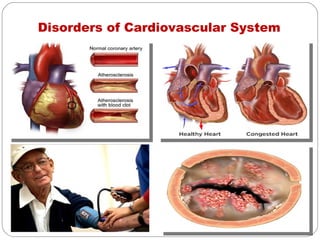
Disorders of Cardiovascular System
Symptoms of
Car diovascular
Disor der s
 Fullness of breath on
 exertion
 Chest pain
 Oedema on feet
 Claudication of feet
 Nasal bleeding
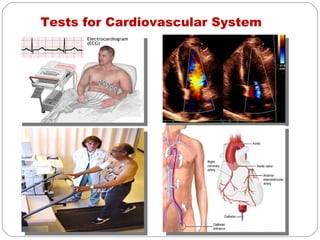
Tests for Cardiovascular System
Respiratory System
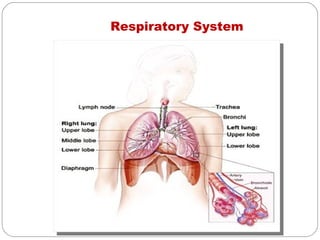
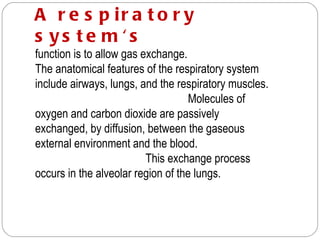
A r e s p ir a t o r y
s ys te m 's
function is to allow gas exchange.
The anatomical features of the respiratory system
include airways, lungs, and the respiratory muscles.
                                   Molecules of
oxygen and carbon dioxide are passively
exchanged, by diffusion, between the gaseous
external environment and the blood.
                          This exchange process
occurs in the alveolar region of the lungs.
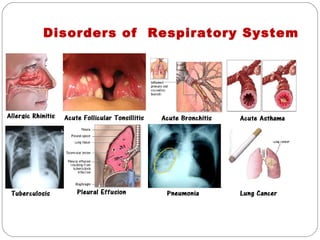
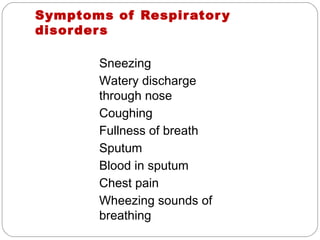
Disorders of Respiratory System
Symptoms of Respirator y
disor der s

       Sneezing
       Watery discharge
       through nose
       Coughing
       Fullness of breath
       Sputum
       Blood in sputum
       Chest pain
       Wheezing sounds of
       breathing
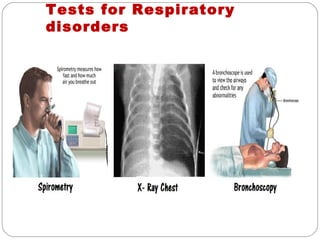
Tests for Respiratory
disorders
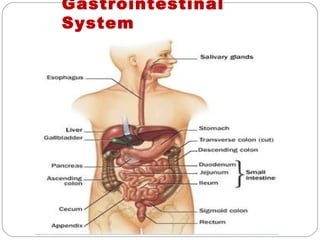
Gastrointestinal
System
The digestive system
is one of the most complex systems of the body.
      The digestive system is made up of organs that break down food into
vitamins, minerals, protein, carbohydrates, and fats, which the body needs for
energy, growth, and repair.
The main organs of the digestive system are mouth, esophagus, stomach, small
and large intestines, anus, appendix. Accessory organs to the alimentary canal
include the liver, gallbladder, and pancreas.
Digestion involves mixing food with digestive juices, moving it through the
digestive tract, and breaking down large molecules of food into smaller molecules.
 Digestion begins in the mouth, when you chew and swallow, and is completed in
the small intestine.
In human body, food enters the mouth, being chewed by teeth, and broken down
by the saliva from the salivary glands. Then it travels down the esophagus into the
stomach, where acid begins physical break down of some food, and chemical
alteration of some. The "leftovers" go through the small intestine, through the
large intestine, and are excreted during defecation.
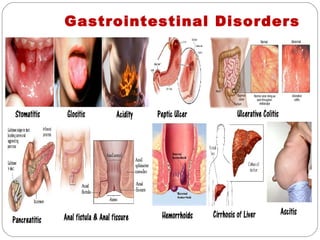
Gastrointestinal Disorders
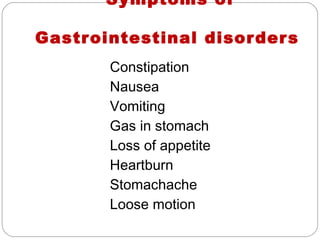
Symptoms of

Gastr ointestinal disor der s
        Constipation
        Nausea
        Vomiting
        Gas in stomach
        Loss of appetite
        Heartburn
        Stomachache
        Loose motion
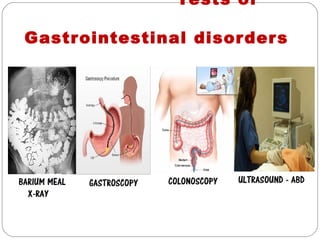
Tests of

Gastr ointestinal disor der s
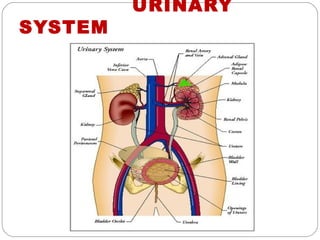
URINARY
SYSTEM
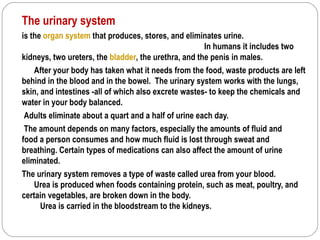
The urinary system
is the organ system that produces, stores, and eliminates urine.
                                                      In humans it includes two
kidneys, two ureters, the bladder, the urethra, and the penis in males.
    After your body has taken what it needs from the food, waste products are left
behind in the blood and in the bowel. The urinary system works with the lungs,
skin, and intestines -all of which also excrete wastes- to keep the chemicals and
water in your body balanced.
 Adults eliminate about a quart and a half of urine each day.
 The amount depends on many factors, especially the amounts of fluid and
food a person consumes and how much fluid is lost through sweat and
breathing. Certain types of medications can also affect the amount of urine
eliminated.
The urinary system removes a type of waste called urea from your blood.
    Urea is produced when foods containing protein, such as meat, poultry, and
certain vegetables, are broken down in the body.
      Urea is carried in the bloodstream to the kidneys.
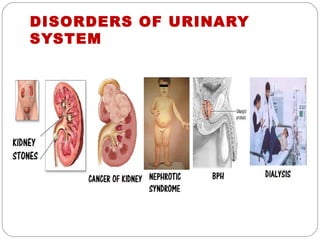
DISORDERS OF URINARY
SYSTEM
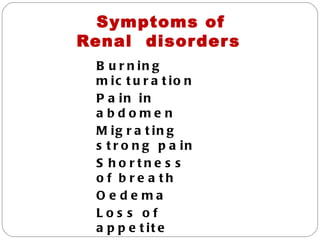
Symptoms of
Renal disor der s
  B u r n in g
  m ic t u r a t io n
  P a in in
  a bdome n
  M ig r a t in g
  s t r o n g p a in
  S ho rtne s s
  o f b re a th
  Oe de ma
  Los s of
  a p p e t it e
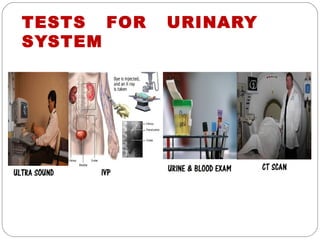
TESTS FOR   URINARY
SYSTEM
REPRODUCTIVE
SYSTEM
Th e h u m a n                   r e p r o d u c t iv e
s ys te m
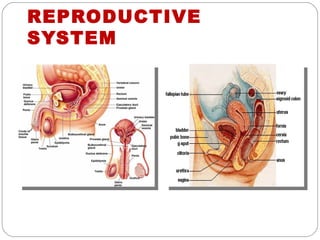
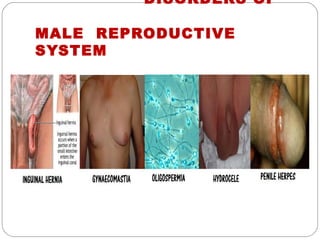
The main male sex organs are the penis and the testes which produce
semen and sperm,
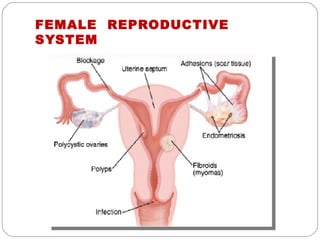
      A female's internal reproductive organs are the vagina, uterus,
fallopian tubes, and ovaries.
Both the male and female reproductive systems play a role in
pregnancy. Problems with these systems can affect fertility and the
ability to have children. There are many such problems in men and
women. Reproductive health problems can also be harmful to overall
health and impair a person's ability to enjoy a sexual relationship.
Your reproductive health is influenced by many factors. These include
your age, lifestyle, habits, genetics, use of medicines and exposure to
chemicals in the environment.
FEMALE REPRODUCTIVE
SYSTEM
DISORDERS OF

MALE REPRODUCTIVE
SYSTEM
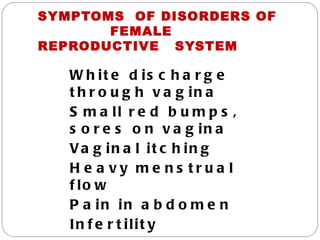
SYMPTOMS OF DISORDERS OF
       FEMALE
REPRODUCTIVE SYSTEM

   W h it e d is c h a r g e
   t h r o u g h v a g in a
   S m a ll r e d b u m p s ,
   s o r e s o n v a g in a
   Va g in a l it c h in g
   H e a vy me ns tru a l
   f lo w
   P a in in a b d o m e n
   In f e r t ilit y
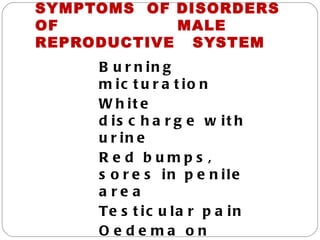
SYMPTOMS OF DISORDERS
OF          MALE
REPRODUCTIVE SYSTEM
     B u r n in g
     m ic t u r a t io n
     W h it e
     d is c h a r g e w it h
     u r in e
     Re d bumps ,
     s o r e s in p e n ile
     a re a
     Te s t i c u l a r p a i n
     O e de ma on
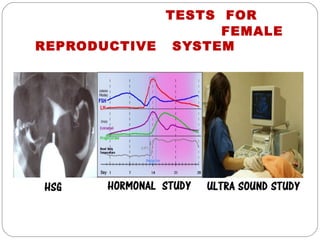
TESTS FOR
                   FEMALE
REPRODUCTIVE SYSTEM
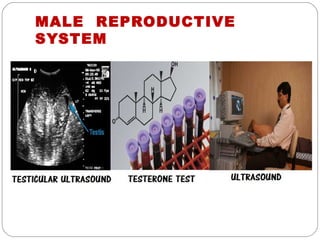
MALE REPRODUCTIVE
SYSTEM
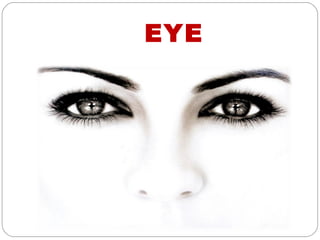
EYE
The human eye
 is an organ which reacts to light for several purposes.
Before you finish reading this sentence, approximately one hundred
billion (100,000,000,000) operations will have been completed inside your
eyes.
The eye is not properly a sphere, rather it is a fused two-piece unit.
The smaller, less curved unit called the cornea, is linked to the larger unit
called the sclera. The cornea and sclera are connected by a ring called
the limbus. The iris and its black center, the pupil, are seen instead of the
cornea due to the cornea's transparency.
The eye is made up of three coats, enclosing three transparent
structures. The outermost layer is composed of the cornea and sclera.
The middle layer consists of the choroid, ciliary body, and iris. The
innermost is the retina, which gets its circulation from the vessels of the
choroid as well as the retinal vessels, which can be seen in an
opthalmoscope.
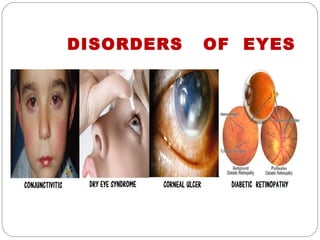
DISORDERS   OF EYES
SYMPTOMS OF EYE
DISORDERS

     E y e p a in
     E y e it c h in g
     R e d c o lo u r
     e ye s
     W a t e r in g o f
     e ye s
     D is c h a r g e
     fr o m e ye s
     S w e llin g o f
     e y e lid s
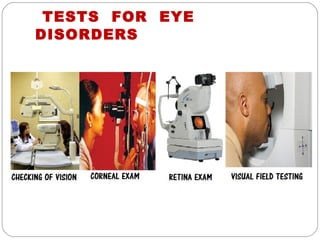
TESTS FOR EYE
DISORDERS
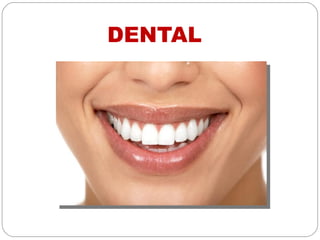
DENTAL
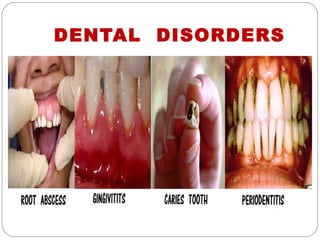
DENTAL DISORDERS
DENTAL
DISORDERS
  To o t h a c h e
  To o t h
  d is c o lo r a t i
  on
  Loos e
  to o th
  S w o lle n
  g ums
  B le e d in g
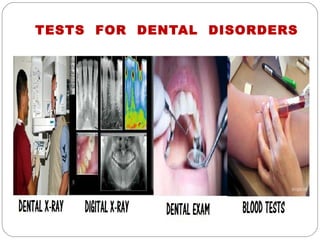
TESTS FOR DENTAL DISORDERS
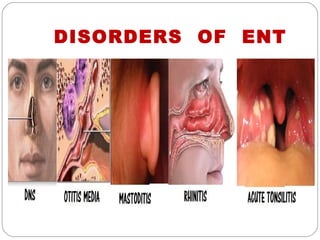
DISORDERS OF ENT
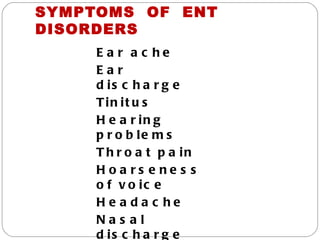
SYMPTOMS OF ENT
DISORDERS
     E a r a c he
     Ear
     d is c h a r g e
     Tin it u s
     H e a r in g
     p r o b le m s
     T h r o a t p a in
     Hoa rs e ne s s
     o f v o ic e
     He a da c he
     Nas al
     d is c h a r g e
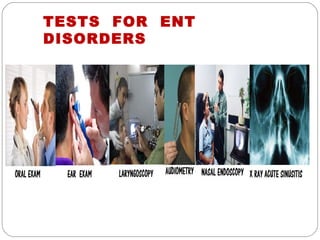
TESTS FOR ENT
DISORDERS
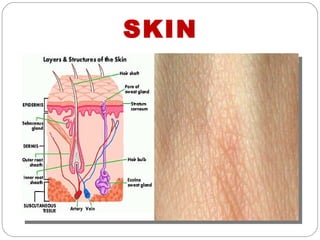
SKIN
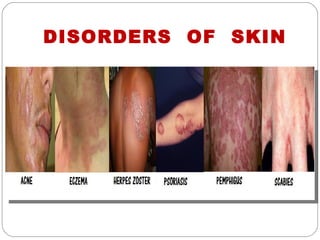
DISORDERS OF SKIN
SYMPTOMS OF
                SKIN
DISORDERS
     D r y s k in
     R e dne s s of
     s k in
     B umps
     P u s t u le s
     Ras h
     It c h in g
     O o z in g
     Oe de ma
     Los s of
TESTS FOR SKIN
DISORDERS
DISORDERS OF
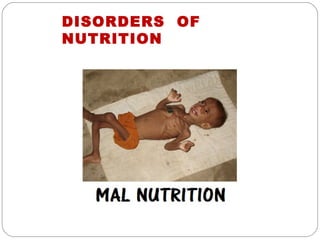
NUTRITION
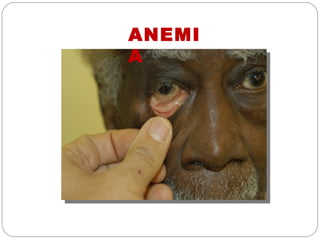
ANEMI
A
-: Contact Detail :-

    Manish Rathod
   +91 99798 78990
dhanwantari@india.com
     Vadodara.

Dhanwantari education programme 1

  • 2.
  • 5.
  • 6.
  • 7.
    The muscular systemis the largest system in the body. Muscles are located in practically every region of the body. The muscular system is made up of tissues that work with the skeletal system to control movement of the body. Muscles function is to produce force and cause motion. Muscles can cause either locomotion of the organism itself or movement of internal organs. There are three distinct types of muscles: skeletal muscles, cardiac or heart muscles, and smooth muscles. Muscles provide strength, balance posture , movement and heat for the body to keep warm. There are approximately 639 skeletal muscles .
  • 8.
  • 9.
    Symptoms of Musculardiseases Stiffness, Muscle pull, Cramp , Spasm, Pain, Reduction in size, Loss of function
  • 10.
  • 11.
  • 12.
    T h eS k e le t a l S y s t e m The human skeleton consists of both fused and individual bones supported and supplemented by ligaments, tendons, muscles and cartilage. An average adult skeleton consists of 208 bones. There are five general classifications of bones, These are Long bones, Short bones, Flat bones, Irregular bones, and Sesamoid bones. Function: The Skeletal System serves many important functions; it provides the shape and form for our bodies in addition to supporting, protecting, allowing bodily movement, producing blood for the body, and storing minerals.
  • 13.
  • 14.
    Symptoms of SkeletalSystem Pain in joint Swelling of joints Redness at joint Morning stiffness Rubbing sounds in joints Low joint activity Pain in long bones
  • 15.
  • 16.
  • 17.
    The nervous system is a network of specialized cells that communicate information about an organism's surroundings and itself. The nervous system is divided broadly into two categories: the peripheral nervous system and the central nervous system. Neurons generate and conduct impulses between and within the two systems. The peripheral nervous system is composed of sensory neurons and the neurons that connect them to the nerve cord, spinal cord and brain, which make up the central nervous system. In response to stimuli, sensory neurons generate and propagate signals to the central nervous system which then processes and conducts signals back to the muscles and glands. The neuron is the functional unit of the nervous system. H u m a n s h a v e a b o u t 10 0 b illio n n e u r o n s in t h e ir b r a in a lo n e !
  • 18.
  • 19.
    Symptoms of NervousSystem Tingling Numbness Ticks Tremors Pain Loss of sensation Loss of muscle power Loss of function
  • 20.
    Tests for Nervoussystem disorders
  • 21.
  • 22.
    ļ‚— The endocrinesystem ļ‚— is made up of a group of glands that produce the body's long- distance messengers, or hormones. ļ‚— The endocrine system is an information signal system much like the nervous system. However, the nervous system uses nerves to conduct information, whereas the endocrine system mainly uses blood vessels as information channels. ļ‚— The major human endocrine glands include hypothalamus and pituitary gland, thyroid gland, pancreas, adrenal glands, gonads or sex organs, pineal gland. ļ‚— Functions: The endocrine system is instrumental in regulating mood, growth and development, tissue function, and metabolism, as well as sexual function and reproductive processes.
  • 23.
  • 24.
    Symptoms of EndocrineDisorders Shortness of height Bone pain Hyper pigmentation Upper body obesity Dry skin Sudden loss of hairs Excessive eating Excessive thirst Excessive urination
  • 25.
  • 26.
  • 27.
    The Cardiovascular System isan organ system that passes nutrients (such as amino acids and electrolytes), gases, hormones, blood cells, nitrogen waste products, etc. to and from cells in the body to help fight diseases and help stabilize body temperature and pH to maintain homeostasis. This system may be seen strictly as a blood distribution network, but some consider the circulatory system as composed of the cardiovascular system, which distributes blood, and the lymphatic system, which distributes lymph. On average, your body has about 5 liters of blood continually traveling through it by way of the circulatory system. The heart, the lungs, and the blood vessels work together to form the circle part of the circulatory system. The pumping of the heart forces the blood on its journey. Two types of fluids move through the circulatory system: blood and lymph. The blood, heart, and blood vessels form the cardiovascular system. The lymph, lymph nodes, and lymph vessels form the lymphatic system. The cardiovascular system and the lymphatic system collectively make up the circulatory system. The circulatory system is divided into three major parts: heart, blood and blood vessels.
  • 28.
  • 29.
    Symptoms of Car diovascular Disorder s Fullness of breath on exertion Chest pain Oedema on feet Claudication of feet Nasal bleeding
  • 30.
  • 31.
  • 32.
    A r es p ir a t o r y s ys te m 's function is to allow gas exchange. The anatomical features of the respiratory system include airways, lungs, and the respiratory muscles. Molecules of oxygen and carbon dioxide are passively exchanged, by diffusion, between the gaseous external environment and the blood. This exchange process occurs in the alveolar region of the lungs.
  • 33.
  • 34.
    Symptoms of Respiratory disor der s Sneezing Watery discharge through nose Coughing Fullness of breath Sputum Blood in sputum Chest pain Wheezing sounds of breathing
  • 35.
  • 36.
  • 37.
    The digestive system isone of the most complex systems of the body. The digestive system is made up of organs that break down food into vitamins, minerals, protein, carbohydrates, and fats, which the body needs for energy, growth, and repair. The main organs of the digestive system are mouth, esophagus, stomach, small and large intestines, anus, appendix. Accessory organs to the alimentary canal include the liver, gallbladder, and pancreas. Digestion involves mixing food with digestive juices, moving it through the digestive tract, and breaking down large molecules of food into smaller molecules. Digestion begins in the mouth, when you chew and swallow, and is completed in the small intestine. In human body, food enters the mouth, being chewed by teeth, and broken down by the saliva from the salivary glands. Then it travels down the esophagus into the stomach, where acid begins physical break down of some food, and chemical alteration of some. The "leftovers" go through the small intestine, through the large intestine, and are excreted during defecation.
  • 38.
  • 39.
    Symptoms of Gastr ointestinaldisor der s Constipation Nausea Vomiting Gas in stomach Loss of appetite Heartburn Stomachache Loose motion
  • 40.
  • 41.
  • 42.
    The urinary system isthe organ system that produces, stores, and eliminates urine. In humans it includes two kidneys, two ureters, the bladder, the urethra, and the penis in males. After your body has taken what it needs from the food, waste products are left behind in the blood and in the bowel. The urinary system works with the lungs, skin, and intestines -all of which also excrete wastes- to keep the chemicals and water in your body balanced. Adults eliminate about a quart and a half of urine each day. The amount depends on many factors, especially the amounts of fluid and food a person consumes and how much fluid is lost through sweat and breathing. Certain types of medications can also affect the amount of urine eliminated. The urinary system removes a type of waste called urea from your blood. Urea is produced when foods containing protein, such as meat, poultry, and certain vegetables, are broken down in the body. Urea is carried in the bloodstream to the kidneys.
  • 43.
  • 44.
    Symptoms of Renal disorder s B u r n in g m ic t u r a t io n P a in in a bdome n M ig r a t in g s t r o n g p a in S ho rtne s s o f b re a th Oe de ma Los s of a p p e t it e
  • 45.
    TESTS FOR URINARY SYSTEM
  • 46.
  • 47.
    Th e hu m a n r e p r o d u c t iv e s ys te m The main male sex organs are the penis and the testes which produce semen and sperm, A female's internal reproductive organs are the vagina, uterus, fallopian tubes, and ovaries. Both the male and female reproductive systems play a role in pregnancy. Problems with these systems can affect fertility and the ability to have children. There are many such problems in men and women. Reproductive health problems can also be harmful to overall health and impair a person's ability to enjoy a sexual relationship. Your reproductive health is influenced by many factors. These include your age, lifestyle, habits, genetics, use of medicines and exposure to chemicals in the environment.
  • 48.
  • 49.
  • 50.
    SYMPTOMS OF DISORDERSOF FEMALE REPRODUCTIVE SYSTEM W h it e d is c h a r g e t h r o u g h v a g in a S m a ll r e d b u m p s , s o r e s o n v a g in a Va g in a l it c h in g H e a vy me ns tru a l f lo w P a in in a b d o m e n In f e r t ilit y
  • 51.
    SYMPTOMS OF DISORDERS OF MALE REPRODUCTIVE SYSTEM B u r n in g m ic t u r a t io n W h it e d is c h a r g e w it h u r in e Re d bumps , s o r e s in p e n ile a re a Te s t i c u l a r p a i n O e de ma on
  • 52.
    TESTS FOR FEMALE REPRODUCTIVE SYSTEM
  • 53.
  • 54.
  • 55.
    The human eye is an organ which reacts to light for several purposes. Before you finish reading this sentence, approximately one hundred billion (100,000,000,000) operations will have been completed inside your eyes. The eye is not properly a sphere, rather it is a fused two-piece unit. The smaller, less curved unit called the cornea, is linked to the larger unit called the sclera. The cornea and sclera are connected by a ring called the limbus. The iris and its black center, the pupil, are seen instead of the cornea due to the cornea's transparency. The eye is made up of three coats, enclosing three transparent structures. The outermost layer is composed of the cornea and sclera. The middle layer consists of the choroid, ciliary body, and iris. The innermost is the retina, which gets its circulation from the vessels of the choroid as well as the retinal vessels, which can be seen in an opthalmoscope.
  • 56.
    DISORDERS OF EYES
  • 57.
    SYMPTOMS OF EYE DISORDERS E y e p a in E y e it c h in g R e d c o lo u r e ye s W a t e r in g o f e ye s D is c h a r g e fr o m e ye s S w e llin g o f e y e lid s
  • 58.
  • 59.
  • 60.
  • 61.
    DENTAL DISORDERS Too t h a c h e To o t h d is c o lo r a t i on Loos e to o th S w o lle n g ums B le e d in g
  • 62.
  • 64.
  • 65.
    SYMPTOMS OF ENT DISORDERS E a r a c he Ear d is c h a r g e Tin it u s H e a r in g p r o b le m s T h r o a t p a in Hoa rs e ne s s o f v o ic e He a da c he Nas al d is c h a r g e
  • 66.
  • 67.
  • 68.
  • 69.
    SYMPTOMS OF SKIN DISORDERS D r y s k in R e dne s s of s k in B umps P u s t u le s Ras h It c h in g O o z in g Oe de ma Los s of
  • 70.
  • 71.
  • 72.
  • 74.
    -: Contact Detail:- Manish Rathod +91 99798 78990 dhanwantari@india.com Vadodara.