Bloodborne
Pathogens
Training
ST. CLOUD SURGICAL CENTER
Objectives
Introduction
Pathogens
How are Bloodborne Pathogens Spread
Reducing your risk
What to do if you are exposed
Test your knowledge
What are Bloodborne
Pathogens?
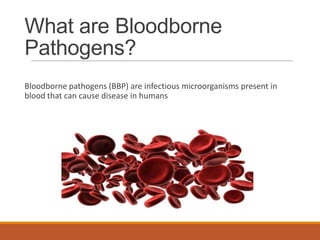
Bloodborne pathogens (BBP) are infectious microorganisms present in
blood that can cause disease in humans
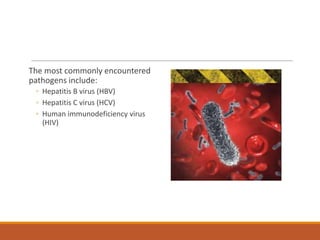
The most commonly encountered
pathogens include:
◦ Hepatitis B virus (HBV)
◦ Hepatitis C virus (HCV)
◦ Human immunodeficiency virus
(HIV)
Other potentially infectious
materials (OPIM)
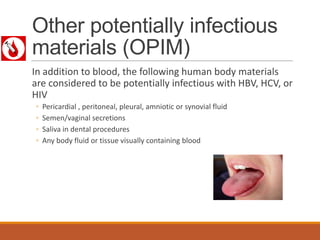
In addition to blood, the following human body materials
are considered to be potentially infectious with HBV, HCV, or
HIV
◦ Pericardial , peritoneal, pleural, amniotic or synovial fluid
◦ Semen/vaginal secretions
◦ Saliva in dental procedures
◦ Any body fluid or tissue visually containing blood
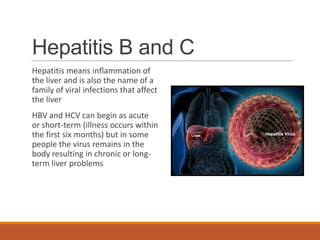
Hepatitis B and C
Hepatitis means inflammation of
the liver and is also the name of a
family of viral infections that affect
the liver
HBV and HCV can begin as acute
or short-term (illness occurs within
the first six months) but in some
people the virus remains in the
body resulting in chronic or long-
term liver problems
HBV
Hepatitis B is a contagious and serious liver disease that can result in
long-term health problems, including liver damage, liver failure, liver
cancer, or even death
30% of adults and children over the age of 5 infected with acute HBV
will not develop symptoms and many recover
Most individuals with chronic HBV may remain symptom free for as long
as 20-30 years
For individuals 5 years of age old and older the risk for chronic infection
is between 6-10%
Hepatitis B can be prevented by getting the hepatitis B vaccine through
a series of three injections
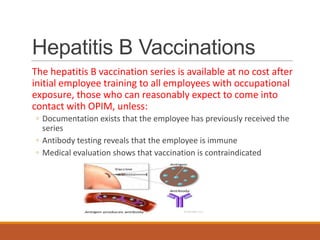
Hepatitis B Vaccinations
The hepatitis B vaccination series is available at no cost after
initial employee training to all employees with occupational
exposure, those who can reasonably expect to come into
contact with OPIM, unless:
◦ Documentation exists that the employee has previously received the
series
◦ Antibody testing reveals that the employee is immune
◦ Medical evaluation shows that vaccination is contraindicated
HCV
Hepatitis C is a contagious and serious liver disease that can result in long-
term health problems, including liver damage, liver failure, liver cancer, or
even death
75-85% of people will develop a chronic infection
Many people who are infected with HCV do not know they are because they
do not look or feel sick, however, damage is still occurring
Hepatitis C is often detected during routine blood tests
There is currently no vaccine available that can prevent HCV
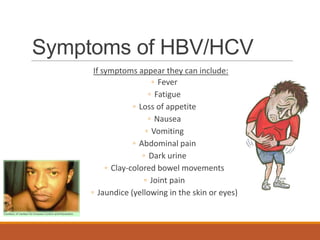
Symptoms of HBV/HCV
If symptoms appear they can include:
◦ Fever
◦ Fatigue
◦ Loss of appetite
◦ Nausea
◦ Vomiting
◦ Abdominal pain
◦ Dark urine
◦ Clay-colored bowel movements
◦ Joint pain
◦ Jaundice (yellowing in the skin or eyes)
HIV
HIV stands for human immunodeficiency virus. It is the virus that
can lead to acquired immunodeficiency syndrome, or AIDS.
Today, an estimated 1.1 million people are living with HIV in the
United States. Thanks to better treatments, people with HIV are
now living longer—and with a better quality of life—than ever
before. If you are living with HIV, it’s important to make choices
that keep you healthy and protect others.
Occupational transmission of HIV to health care workers is
extremely rare.
CDC recommends proper use of safety devices and barriers to
prevent exposure to HIV in the health care setting.
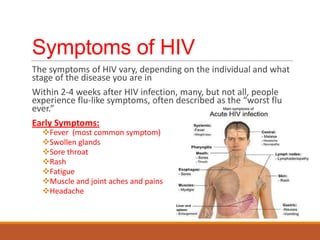
Symptoms of HIV
The symptoms of HIV vary, depending on the individual and what
stage of the disease you are in
Within 2-4 weeks after HIV infection, many, but not all, people
experience flu-like symptoms, often described as the “worst flu
ever.”
Early Symptoms:
Fever (most common symptom)
Swollen glands
Sore throat
Rash
Fatigue
Muscle and joint aches and pains
Headache
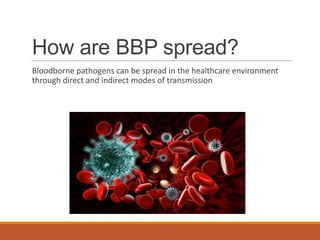
How are BBP spread?
Bloodborne pathogens can be spread in the healthcare environment
through direct and indirect modes of transmission
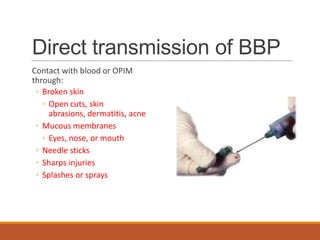
Direct transmission of BBP
Contact with blood or OPIM
through:
◦ Broken skin
◦ Open cuts, skin
abrasions, dermatitis, acne
◦ Mucous membranes
◦ Eyes, nose, or mouth
◦ Needle sticks
◦ Sharps injuries
◦ Splashes or sprays
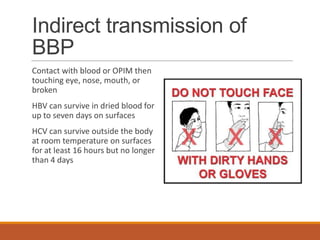
Indirect transmission of
BBP
Contact with blood or OPIM then
touching eye, nose, mouth, or
broken
HBV can survive in dried blood for
up to seven days on surfaces
HCV can survive outside the body
at room temperature on surfaces
for at least 16 hours but no longer
than 4 days
Who is at risk?
OSHA’s Bloodborne Pathogens standard Title 29 of
the Code of Federal Regulations states
requirements employers must do to protect all
workers who can reasonably be anticipated to
come into contact with blood or OPIM as a result of
doing their job duties are at risk for serious or life-
threatening illnesses.
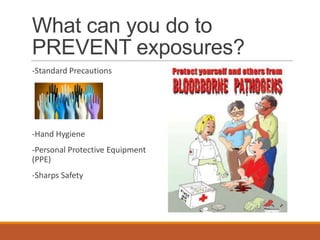
What can you do to
PREVENT exposures?
-Standard Precautions
-Hand Hygiene
-Personal Protective Equipment
(PPE)
-Sharps Safety
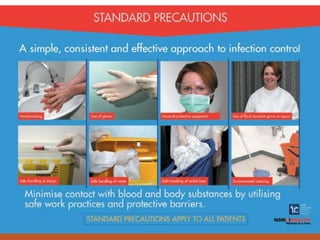
Standard precautions
Involves treating all human blood and OPIM as if to
be infectious for bloodborne pathogens
Standard precautions include:
◦ Hand hygiene
◦ Use of personal protective equipment (PPE)
◦ Safe injection practices
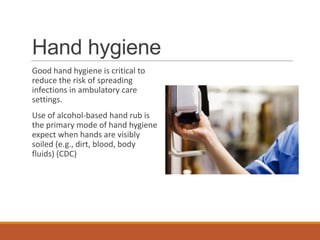
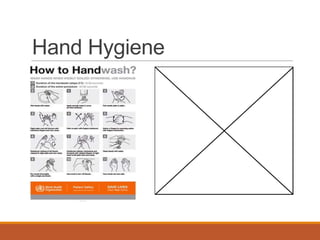
Hand hygiene
Good hand hygiene is critical to
reduce the risk of spreading
infections in ambulatory care
settings.
Use of alcohol-based hand rub is
the primary mode of hand hygiene
expect when hands are visibly
soiled (e.g., dirt, blood, body
fluids) (CDC)
Hand Hygiene
Key Recommendations
Key situations where hand hygiene should be performed
include:
◦ Before touching a patient, even if gloves will be worn
◦ Before exiting the patient’s care area after touching the patient or the
patient’s immediate environment
◦ After contact with blood, body fluids or excretions, or wound dressings
◦ Prior to performing an aseptic task (e.g., placing an IV, preparing an
injection)
◦ If hands will be moving from a contaminated-body site to a clean-body site
during patient care
◦ After glove removal
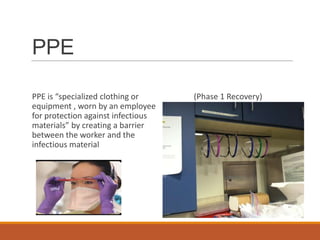
PPE
PPE is “specialized clothing or
equipment , worn by an employee
for protection against infectious
materials” by creating a barrier
between the worker and the
infectious material
(Phase 1 Recovery)
Types of PPE
Gloves- protect hands
Wear gloves for potential contact with blood, body fluids, mucous
membranes, non-intact skin or contaminated equipment
◦ Do not wear the same pair of gloves for the care of more than one patient
◦ Do not wash gloves for the purpose of reuse
◦ Perform hand hygiene immediately after removing gloves
◦ Inspect glove before use
◦ Double gloving can provide an additional layer of protection
Types of PPE
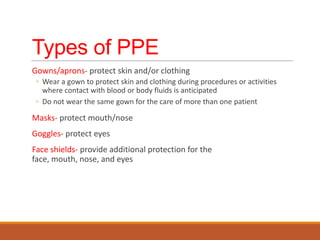
Gowns/aprons- protect skin and/or clothing
◦ Wear a gown to protect skin and clothing during procedures or activities
where contact with blood or body fluids is anticipated
◦ Do not wear the same gown for the care of more than one patient
Masks- protect mouth/nose
Goggles- protect eyes
Face shields- provide additional protection for the
face, mouth, nose, and eyes
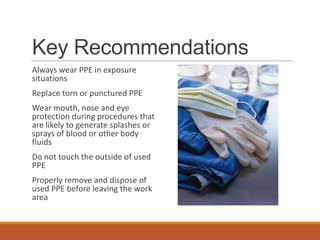
Key Recommendations
Always wear PPE in exposure
situations
Replace torn or punctured PPE
Wear mouth, nose and eye
protection during procedures that
are likely to generate splashes or
sprays of blood or other body
fluids
Do not touch the outside of used
PPE
Properly remove and dispose of
used PPE before leaving the work
area
PPE Use Review
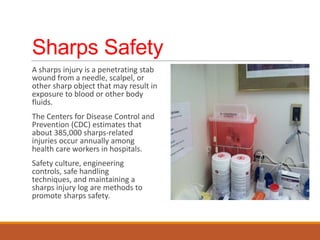
Sharps Safety
A sharps injury is a penetrating stab
wound from a needle, scalpel, or
other sharp object that may result in
exposure to blood or other body
fluids.
The Centers for Disease Control and
Prevention (CDC) estimates that
about 385,000 sharps-related
injuries occur annually among
health care workers in hospitals.
Safety culture, engineering
controls, safe handling
techniques, and maintaining a
sharps injury log are methods to
promote sharps safety.
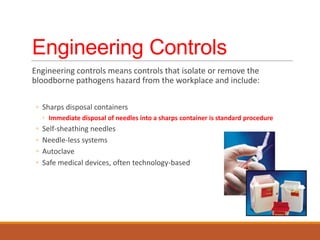
Engineering Controls
Engineering controls means controls that isolate or remove the
bloodborne pathogens hazard from the workplace and include:
◦ Sharps disposal containers
◦ Immediate disposal of needles into a sharps container is standard procedure
◦ Self-sheathing needles
◦ Needle-less systems
◦ Autoclave
◦ Safe medical devices, often technology-based
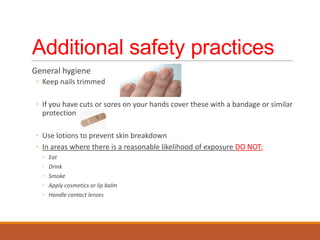
Additional safety practices
General hygiene
◦ Keep nails trimmed
◦ If you have cuts or sores on your hands cover these with a bandage or similar
protection
◦ Use lotions to prevent skin breakdown
◦ In areas where there is a reasonable likelihood of exposure DO NOT:
◦ Eat
◦ Drink
◦ Smoke
◦ Apply cosmetics or lip balm
◦ Handle contact lenses
Maintenance/Housekeepin
g
Facility’s policy for cleaning
Surfaces and coverings
Laundry
Regulated waste
Warning signs
General Housekeeping
The employer shall determine and implement an appropriate written
schedule for cleaning and method of decontamination based upon the
location within the facility, type of surface to be cleaned, type of soil
present, and tasks or procedures being performed in the area.
All equipment and environmental and working surfaces shall be cleaned
and decontaminated after contact with blood or other potentially
infectious materials.
Broken glassware which may be contaminated shall not be picked up
directly with the hands. It shall be cleaned up using mechanical
means, such as a brush and dust pan, tongs, or forceps.
See facility policies for additional information
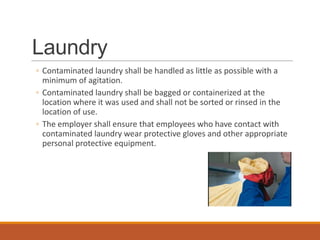
Laundry
◦ Contaminated laundry shall be handled as little as possible with a
minimum of agitation.
◦ Contaminated laundry shall be bagged or containerized at the
location where it was used and shall not be sorted or rinsed in the
location of use.
◦ The employer shall ensure that employees who have contact with
contaminated laundry wear protective gloves and other appropriate
personal protective equipment.
Regulated Waste
Refers to:
◦ Any liquid or semi-liquid blood or other potentially infectious materials
◦ Contaminated items that would release blood or other potentially infectious
materials in a liquid or semi-liquid state if compressed
◦ Items that are caked with dried blood or other potentially infectious
materials and are capable of releasing these materials during handling
◦ Contaminated sharps
◦ Pathological and microbiological wastes containing blood or other potentially
infectious materials
All regulated waste must be disposed in properly labeled containers or
red biohazard bags.
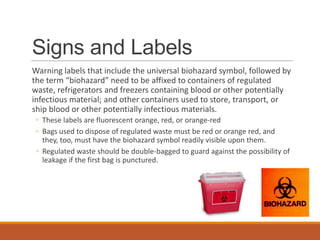
Signs and Labels
Warning labels that include the universal biohazard symbol, followed by
the term “biohazard” need to be affixed to containers of regulated
waste, refrigerators and freezers containing blood or other potentially
infectious material; and other containers used to store, transport, or
ship blood or other potentially infectious materials.
◦ These labels are fluorescent orange, red, or orange-red
◦ Bags used to dispose of regulated waste must be red or orange red, and
they, too, must have the biohazard symbol readily visible upon them.
◦ Regulated waste should be double-bagged to guard against the possibility of
leakage if the first bag is punctured.
Exposure Control Plan
This is a written plan to eliminate or minimize occupational exposures
that must be prepared by the employer
Employers must update this plan annually to reflect any changes
BBP training must be offered upon initial employment and at least
annually thereafter
Exposure Control Plan at
SCSC
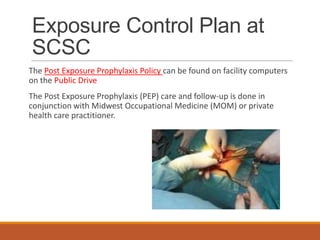
The Post Exposure Prophylaxis Policy can be found on facility computers
on the Public Drive
The Post Exposure Prophylaxis (PEP) care and follow-up is done in
conjunction with Midwest Occupational Medicine (MOM) or private
health care practitioner.
What to do if you are exposed?
1. Notify one of the following people:
◦ TeamLeader/Manager/MedicalDirector/ or Anesthesia Charge
2. Attend to wound care immediately
3. Sign the St. Cloud Surgical Center exposure consent to
indicate if you will participate in the PEP program
4. Fill out the appropriate paperwork per the Team Leader
5. If you chose to participate in PEP, MOM is notified and an
appointment is set up as soon as possible. MOM will
determine the risk of exposure and counseling is provided by
MOM. There is no cost to the employee for follow up blood
draws.
What to do-Continued
6. RCU staff that is exposed will go to the St. Cloud Hospital
ER for treatment.
7. Medical Staff may choose to go to MOM or private
healthcare practitioner for care and counseling.
8. Sharps injury log, employee’s health records, and OSHA
300 log are maintained following an employee exposure.
9. St. Cloud Surgical Center will issue a letter to exposed
individual containing a copy of recommendations from
MOM within 15 days.
If exposed remember…
*Do not panic
*Infection due to exposure is not automatic
◦ HBV infected blood needlestick or cut exposure risk is between 6-30%
◦ HCV infected blood needlestick or cut exposure risk is 1.8%
◦ HIV infected blood needlestick or cut exposure risk is 0.3%
Test Your Knowledge
The following slides will test your knowledge regarding:
◦ Pathogens
◦ How are Bloodborne Pathogens Spread
◦ Reducing your risk
◦ What to do if you are exposed
Record your answers and check with corresponding answers following
completion of the questions
Question 1
1. Bloodborne pathogens are microorganisms which causes disease and
are present in:
A. Human blood and body fluids that may contain blood
B. Sweat, tears, and saliva
C. River water and certain kinds of soil
D. None of the above
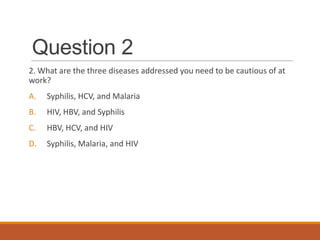
Question 2
2. What are the three diseases addressed you need to be cautious of at
work?
A. Syphilis, HCV, and Malaria
B. HIV, HBV, and Syphilis
C. HBV, HCV, and HIV
D. Syphilis, Malaria, and HIV
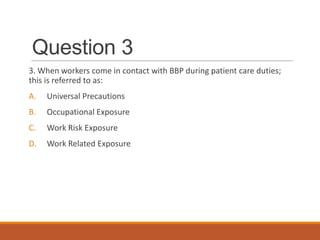
Question 3
3. When workers come in contact with BBP during patient care duties;
this is referred to as:
A. Universal Precautions
B. Occupational Exposure
C. Work Risk Exposure
D. Work Related Exposure
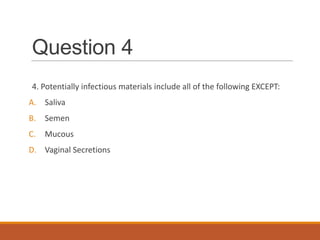
Question 4
4. Potentially infectious materials include all of the following EXCEPT:
A. Saliva
B. Semen
C. Mucous
D. Vaginal Secretions
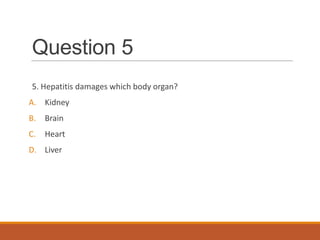
Question 5
5. Hepatitis damages which body organ?
A. Kidney
B. Brain
C. Heart
D. Liver
Question 6
6. It is recommended that health care workers get the vaccine for which
form of Hepatitis?
A. Hepatitis A
B. Hepatitis B
C. Hepatitis C
D. Hepatitis E
Question 7
7. True or False:
HIV Transmission to health care workers if fairly common.
Question 8
8. Name 3 ways you can prevent exposures.
Question 9
9. If you are exposed put the following steps in order:
A. Wash the wound
B. Notify your supervisor
C. Schedule and appointment with your health care provider or MOM
D. Fill out the necessary paperwork
Question 10
10. Where can you find the Exposure Control Plan at St. Cloud Surgical
Center?
A. On each computer in the public drive
B. A copy is posted in each locker room
C. The employee handbook
D. It is posted outside the lunchroom
Question 11
11. What are some additional safety practices:
A. Trimmed nails, wearing hair off shoulders, use lotion
B. Use lotion, trim nails, cover cuts or sores with bandages
C. Apply lip balm, cover cuts or sores with bandages, trim nails
Question 12
12. True or False:
Personal protective equipment (PPE) will protect you from all exposure
incidents.
Question 13
13. Bloodborne pathogens may enter your system through:
A. Mucous membranes
B. Skin abrasions
C. Open cuts
D. Dermatitis
E. All of the above
Question 14
14. True or False
You should always treat all body fluids as if they are infectious and avoid
direct skin contact with them.
Question 15
15. What is the most important hygiene precaution that prevents
exposure to bloodborne pathogens?
A. Wearing gloves when touching patients
B. Washing hands
C. Wearing a mask when near patients
D. Wearing glasses when near patients
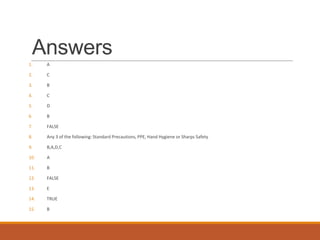
Answers
1. A
2. C
3. B
4. C
5. D
6. B
7. FALSE
8. Any 3 of the following: Standard Precautions, PPE, Hand Hygiene or Sharps Safety
9. B,A,D,C
10. A
11. B
12. FALSE
13. E
14. TRUE
15. B
Resources
https://www.osha.gov/SLTC/bloodbornepathogens/gen_guidance.html
http://www.nlm.nih.gov/medlineplus/ency/patientinstructions/000453.
htm
http://www.cdc.gov/hai/pdfs/ppe/ppeslides6-29-04.pdf
https://www.osha.gov/OshDoc/data_BloodborneFacts/bbfact01.pdf
http://www.cdc.gov/HAI/settings/outpatient/outpatient-care-gl-
standared-precautions.html
http://www.cdc.gov/hepatitis/c/cfaq.htm#cFAQ13

Bloodborne pathogens training

  • 1.
  • 2.
    Objectives Introduction Pathogens How are BloodbornePathogens Spread Reducing your risk What to do if you are exposed Test your knowledge
  • 3.
    What are Bloodborne Pathogens? Bloodbornepathogens (BBP) are infectious microorganisms present in blood that can cause disease in humans
  • 4.
    The most commonlyencountered pathogens include: ◦ Hepatitis B virus (HBV) ◦ Hepatitis C virus (HCV) ◦ Human immunodeficiency virus (HIV)
  • 5.
    Other potentially infectious materials(OPIM) In addition to blood, the following human body materials are considered to be potentially infectious with HBV, HCV, or HIV ◦ Pericardial , peritoneal, pleural, amniotic or synovial fluid ◦ Semen/vaginal secretions ◦ Saliva in dental procedures ◦ Any body fluid or tissue visually containing blood
  • 6.
    Hepatitis B andC Hepatitis means inflammation of the liver and is also the name of a family of viral infections that affect the liver HBV and HCV can begin as acute or short-term (illness occurs within the first six months) but in some people the virus remains in the body resulting in chronic or long- term liver problems
  • 7.
    HBV Hepatitis B isa contagious and serious liver disease that can result in long-term health problems, including liver damage, liver failure, liver cancer, or even death 30% of adults and children over the age of 5 infected with acute HBV will not develop symptoms and many recover Most individuals with chronic HBV may remain symptom free for as long as 20-30 years For individuals 5 years of age old and older the risk for chronic infection is between 6-10% Hepatitis B can be prevented by getting the hepatitis B vaccine through a series of three injections
  • 8.
    Hepatitis B Vaccinations Thehepatitis B vaccination series is available at no cost after initial employee training to all employees with occupational exposure, those who can reasonably expect to come into contact with OPIM, unless: ◦ Documentation exists that the employee has previously received the series ◦ Antibody testing reveals that the employee is immune ◦ Medical evaluation shows that vaccination is contraindicated
  • 9.
    HCV Hepatitis C isa contagious and serious liver disease that can result in long- term health problems, including liver damage, liver failure, liver cancer, or even death 75-85% of people will develop a chronic infection Many people who are infected with HCV do not know they are because they do not look or feel sick, however, damage is still occurring Hepatitis C is often detected during routine blood tests There is currently no vaccine available that can prevent HCV
  • 10.
    Symptoms of HBV/HCV Ifsymptoms appear they can include: ◦ Fever ◦ Fatigue ◦ Loss of appetite ◦ Nausea ◦ Vomiting ◦ Abdominal pain ◦ Dark urine ◦ Clay-colored bowel movements ◦ Joint pain ◦ Jaundice (yellowing in the skin or eyes)
  • 11.
    HIV HIV stands forhuman immunodeficiency virus. It is the virus that can lead to acquired immunodeficiency syndrome, or AIDS. Today, an estimated 1.1 million people are living with HIV in the United States. Thanks to better treatments, people with HIV are now living longer—and with a better quality of life—than ever before. If you are living with HIV, it’s important to make choices that keep you healthy and protect others. Occupational transmission of HIV to health care workers is extremely rare. CDC recommends proper use of safety devices and barriers to prevent exposure to HIV in the health care setting.
  • 12.
    Symptoms of HIV Thesymptoms of HIV vary, depending on the individual and what stage of the disease you are in Within 2-4 weeks after HIV infection, many, but not all, people experience flu-like symptoms, often described as the “worst flu ever.” Early Symptoms: Fever (most common symptom) Swollen glands Sore throat Rash Fatigue Muscle and joint aches and pains Headache
  • 13.
    How are BBPspread? Bloodborne pathogens can be spread in the healthcare environment through direct and indirect modes of transmission
  • 14.
    Direct transmission ofBBP Contact with blood or OPIM through: ◦ Broken skin ◦ Open cuts, skin abrasions, dermatitis, acne ◦ Mucous membranes ◦ Eyes, nose, or mouth ◦ Needle sticks ◦ Sharps injuries ◦ Splashes or sprays
  • 15.
    Indirect transmission of BBP Contactwith blood or OPIM then touching eye, nose, mouth, or broken HBV can survive in dried blood for up to seven days on surfaces HCV can survive outside the body at room temperature on surfaces for at least 16 hours but no longer than 4 days
  • 16.
    Who is atrisk? OSHA’s Bloodborne Pathogens standard Title 29 of the Code of Federal Regulations states requirements employers must do to protect all workers who can reasonably be anticipated to come into contact with blood or OPIM as a result of doing their job duties are at risk for serious or life- threatening illnesses.
  • 17.
    What can youdo to PREVENT exposures? -Standard Precautions -Hand Hygiene -Personal Protective Equipment (PPE) -Sharps Safety
  • 18.
    Standard precautions Involves treatingall human blood and OPIM as if to be infectious for bloodborne pathogens Standard precautions include: ◦ Hand hygiene ◦ Use of personal protective equipment (PPE) ◦ Safe injection practices
  • 20.
    Hand hygiene Good handhygiene is critical to reduce the risk of spreading infections in ambulatory care settings. Use of alcohol-based hand rub is the primary mode of hand hygiene expect when hands are visibly soiled (e.g., dirt, blood, body fluids) (CDC)
  • 21.
  • 22.
    Key Recommendations Key situationswhere hand hygiene should be performed include: ◦ Before touching a patient, even if gloves will be worn ◦ Before exiting the patient’s care area after touching the patient or the patient’s immediate environment ◦ After contact with blood, body fluids or excretions, or wound dressings ◦ Prior to performing an aseptic task (e.g., placing an IV, preparing an injection) ◦ If hands will be moving from a contaminated-body site to a clean-body site during patient care ◦ After glove removal
  • 23.
    PPE PPE is “specializedclothing or equipment , worn by an employee for protection against infectious materials” by creating a barrier between the worker and the infectious material (Phase 1 Recovery)
  • 24.
    Types of PPE Gloves-protect hands Wear gloves for potential contact with blood, body fluids, mucous membranes, non-intact skin or contaminated equipment ◦ Do not wear the same pair of gloves for the care of more than one patient ◦ Do not wash gloves for the purpose of reuse ◦ Perform hand hygiene immediately after removing gloves ◦ Inspect glove before use ◦ Double gloving can provide an additional layer of protection
  • 25.
    Types of PPE Gowns/aprons-protect skin and/or clothing ◦ Wear a gown to protect skin and clothing during procedures or activities where contact with blood or body fluids is anticipated ◦ Do not wear the same gown for the care of more than one patient Masks- protect mouth/nose Goggles- protect eyes Face shields- provide additional protection for the face, mouth, nose, and eyes
  • 26.
    Key Recommendations Always wearPPE in exposure situations Replace torn or punctured PPE Wear mouth, nose and eye protection during procedures that are likely to generate splashes or sprays of blood or other body fluids Do not touch the outside of used PPE Properly remove and dispose of used PPE before leaving the work area
  • 27.
  • 28.
    Sharps Safety A sharpsinjury is a penetrating stab wound from a needle, scalpel, or other sharp object that may result in exposure to blood or other body fluids. The Centers for Disease Control and Prevention (CDC) estimates that about 385,000 sharps-related injuries occur annually among health care workers in hospitals. Safety culture, engineering controls, safe handling techniques, and maintaining a sharps injury log are methods to promote sharps safety.
  • 29.
    Engineering Controls Engineering controlsmeans controls that isolate or remove the bloodborne pathogens hazard from the workplace and include: ◦ Sharps disposal containers ◦ Immediate disposal of needles into a sharps container is standard procedure ◦ Self-sheathing needles ◦ Needle-less systems ◦ Autoclave ◦ Safe medical devices, often technology-based
  • 30.
    Additional safety practices Generalhygiene ◦ Keep nails trimmed ◦ If you have cuts or sores on your hands cover these with a bandage or similar protection ◦ Use lotions to prevent skin breakdown ◦ In areas where there is a reasonable likelihood of exposure DO NOT: ◦ Eat ◦ Drink ◦ Smoke ◦ Apply cosmetics or lip balm ◦ Handle contact lenses
  • 31.
    Maintenance/Housekeepin g Facility’s policy forcleaning Surfaces and coverings Laundry Regulated waste Warning signs
  • 32.
    General Housekeeping The employershall determine and implement an appropriate written schedule for cleaning and method of decontamination based upon the location within the facility, type of surface to be cleaned, type of soil present, and tasks or procedures being performed in the area. All equipment and environmental and working surfaces shall be cleaned and decontaminated after contact with blood or other potentially infectious materials. Broken glassware which may be contaminated shall not be picked up directly with the hands. It shall be cleaned up using mechanical means, such as a brush and dust pan, tongs, or forceps. See facility policies for additional information
  • 33.
    Laundry ◦ Contaminated laundryshall be handled as little as possible with a minimum of agitation. ◦ Contaminated laundry shall be bagged or containerized at the location where it was used and shall not be sorted or rinsed in the location of use. ◦ The employer shall ensure that employees who have contact with contaminated laundry wear protective gloves and other appropriate personal protective equipment.
  • 34.
    Regulated Waste Refers to: ◦Any liquid or semi-liquid blood or other potentially infectious materials ◦ Contaminated items that would release blood or other potentially infectious materials in a liquid or semi-liquid state if compressed ◦ Items that are caked with dried blood or other potentially infectious materials and are capable of releasing these materials during handling ◦ Contaminated sharps ◦ Pathological and microbiological wastes containing blood or other potentially infectious materials All regulated waste must be disposed in properly labeled containers or red biohazard bags.
  • 35.
    Signs and Labels Warninglabels that include the universal biohazard symbol, followed by the term “biohazard” need to be affixed to containers of regulated waste, refrigerators and freezers containing blood or other potentially infectious material; and other containers used to store, transport, or ship blood or other potentially infectious materials. ◦ These labels are fluorescent orange, red, or orange-red ◦ Bags used to dispose of regulated waste must be red or orange red, and they, too, must have the biohazard symbol readily visible upon them. ◦ Regulated waste should be double-bagged to guard against the possibility of leakage if the first bag is punctured.
  • 36.
    Exposure Control Plan Thisis a written plan to eliminate or minimize occupational exposures that must be prepared by the employer Employers must update this plan annually to reflect any changes BBP training must be offered upon initial employment and at least annually thereafter
  • 37.
    Exposure Control Planat SCSC The Post Exposure Prophylaxis Policy can be found on facility computers on the Public Drive The Post Exposure Prophylaxis (PEP) care and follow-up is done in conjunction with Midwest Occupational Medicine (MOM) or private health care practitioner.
  • 38.
    What to doif you are exposed? 1. Notify one of the following people: ◦ TeamLeader/Manager/MedicalDirector/ or Anesthesia Charge 2. Attend to wound care immediately 3. Sign the St. Cloud Surgical Center exposure consent to indicate if you will participate in the PEP program 4. Fill out the appropriate paperwork per the Team Leader 5. If you chose to participate in PEP, MOM is notified and an appointment is set up as soon as possible. MOM will determine the risk of exposure and counseling is provided by MOM. There is no cost to the employee for follow up blood draws.
  • 39.
    What to do-Continued 6.RCU staff that is exposed will go to the St. Cloud Hospital ER for treatment. 7. Medical Staff may choose to go to MOM or private healthcare practitioner for care and counseling. 8. Sharps injury log, employee’s health records, and OSHA 300 log are maintained following an employee exposure. 9. St. Cloud Surgical Center will issue a letter to exposed individual containing a copy of recommendations from MOM within 15 days.
  • 40.
    If exposed remember… *Donot panic *Infection due to exposure is not automatic ◦ HBV infected blood needlestick or cut exposure risk is between 6-30% ◦ HCV infected blood needlestick or cut exposure risk is 1.8% ◦ HIV infected blood needlestick or cut exposure risk is 0.3%
  • 41.
    Test Your Knowledge Thefollowing slides will test your knowledge regarding: ◦ Pathogens ◦ How are Bloodborne Pathogens Spread ◦ Reducing your risk ◦ What to do if you are exposed Record your answers and check with corresponding answers following completion of the questions
  • 42.
    Question 1 1. Bloodbornepathogens are microorganisms which causes disease and are present in: A. Human blood and body fluids that may contain blood B. Sweat, tears, and saliva C. River water and certain kinds of soil D. None of the above
  • 43.
    Question 2 2. Whatare the three diseases addressed you need to be cautious of at work? A. Syphilis, HCV, and Malaria B. HIV, HBV, and Syphilis C. HBV, HCV, and HIV D. Syphilis, Malaria, and HIV
  • 44.
    Question 3 3. Whenworkers come in contact with BBP during patient care duties; this is referred to as: A. Universal Precautions B. Occupational Exposure C. Work Risk Exposure D. Work Related Exposure
  • 45.
    Question 4 4. Potentiallyinfectious materials include all of the following EXCEPT: A. Saliva B. Semen C. Mucous D. Vaginal Secretions
  • 46.
    Question 5 5. Hepatitisdamages which body organ? A. Kidney B. Brain C. Heart D. Liver
  • 47.
    Question 6 6. Itis recommended that health care workers get the vaccine for which form of Hepatitis? A. Hepatitis A B. Hepatitis B C. Hepatitis C D. Hepatitis E
  • 48.
    Question 7 7. Trueor False: HIV Transmission to health care workers if fairly common.
  • 49.
    Question 8 8. Name3 ways you can prevent exposures.
  • 50.
    Question 9 9. Ifyou are exposed put the following steps in order: A. Wash the wound B. Notify your supervisor C. Schedule and appointment with your health care provider or MOM D. Fill out the necessary paperwork
  • 51.
    Question 10 10. Wherecan you find the Exposure Control Plan at St. Cloud Surgical Center? A. On each computer in the public drive B. A copy is posted in each locker room C. The employee handbook D. It is posted outside the lunchroom
  • 52.
    Question 11 11. Whatare some additional safety practices: A. Trimmed nails, wearing hair off shoulders, use lotion B. Use lotion, trim nails, cover cuts or sores with bandages C. Apply lip balm, cover cuts or sores with bandages, trim nails
  • 53.
    Question 12 12. Trueor False: Personal protective equipment (PPE) will protect you from all exposure incidents.
  • 54.
    Question 13 13. Bloodbornepathogens may enter your system through: A. Mucous membranes B. Skin abrasions C. Open cuts D. Dermatitis E. All of the above
  • 55.
    Question 14 14. Trueor False You should always treat all body fluids as if they are infectious and avoid direct skin contact with them.
  • 56.
    Question 15 15. Whatis the most important hygiene precaution that prevents exposure to bloodborne pathogens? A. Wearing gloves when touching patients B. Washing hands C. Wearing a mask when near patients D. Wearing glasses when near patients
  • 57.
    Answers 1. A 2. C 3.B 4. C 5. D 6. B 7. FALSE 8. Any 3 of the following: Standard Precautions, PPE, Hand Hygiene or Sharps Safety 9. B,A,D,C 10. A 11. B 12. FALSE 13. E 14. TRUE 15. B
  • 58.