A S E M I N A R
ANTIVIRUS SOFTWARE
INTRODUCTION
 Antivirus software is defined as a software used to
prevent, detect and remove all sorts of malware such
as computer viruses, hijackers, Trojan horses, etc.
HISTORY
 Most of the viruses in early and mid 1980’s had
limited self-reproduction and spread initially by
storage devices such as floppy disks, before internet
connection was wide spread.
 The first anti-virus introduced was Flushshot plus
and Anti4us in 1987.
 John McAfee and Eugene Kaspersky found their own
antivirus software and later setup their companies in
1988.
IDENTIFICATION METHODS
There are various methods used by antivirus software
to identify malware:
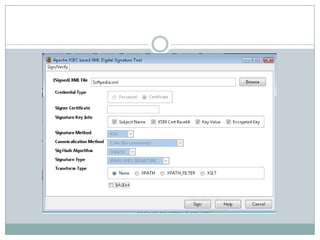
 Signature based tools: Most commonly used method
to identify viruses and other malware, antivirus
software compares the contents of a file to a
directory of virus signatures. The entire file is
searched both as whole as well as in pieces.
They are considered very basic and insufficient to
be counter today’s malware practices.
IDENTIFICATION METHODS
 Heuristics: It is the most required detection method
present in antivirus software.
Heuristic is a technique designed for solving a
problem more quickly when classic methods are too
slow or fail.
Some anti-viruses are difficult to detect as they
start of as a single infection and later change into
many variants. Heuristics is a method invented to
counter them.
IDENTIFICATION METHODS
 Root kit detection: Root kit is one of the dangerous
malware designed to gain administration-level
control over the computer without detection.
They change the way operating systems function
and tamper the antivirus software, leaving it
ineffective.
The latest antivirus software are being added with
root kit detection.
IDENTIFICATION METHODS
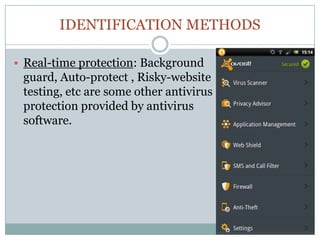
 Real-time protection: Background
guard, Auto-protect , Risky-website
testing, etc are some other antivirus
protection provided by antivirus
software.
POPULAR ANTIVIRUSES
 Kaspersky Lab
 McAfee Virus Scan
 Avira Antivirus Software
 Avast! Antivirus Software
 AVG Antivirus and Internet Security
 Norton Antivirus Software
 Panda Antivirus Software
PROS OF ANTIVIRUS SOFTWARE
Protection from Malware.
Protection from Spyware and Identity Theft.
Protection from Spam.
Protects Important Documents.
Provides legal implication.
ISSUES OF ANTIVIRUS SOFTWARE
Unexpected renewal costs: Some commercial
antivirus software end-user license agreements
include a clause that the subscription will be
automatically renewed, and the purchaser’s credit
card automatically billed, at the renewal time
without explicit approval.
For e.g., McAfee requires users to unsubscribe at
least 60 days before the expiration of the present
subscription.
ISSUES OF ANTIVIRUS SOFTWARE
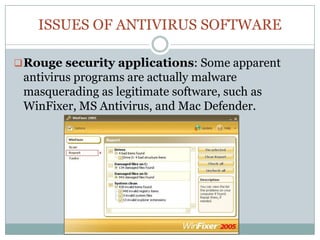
Rouge security applications: Some apparent
antivirus programs are actually malware
masquerading as legitimate software, such as
WinFixer, MS Antivirus, and Mac Defender.
ISSUES OF ANTIVIRUS SOFTWARE
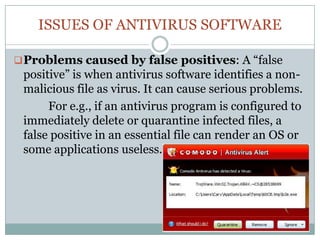
Problems caused by false positives: A “false
positive” is when antivirus software identifies a non-
malicious file as virus. It can cause serious problems.
For e.g., if an antivirus program is configured to
immediately delete or quarantine infected files, a
false positive in an essential file can render an OS or
some applications useless.
ISSUES OF ANTIVIRUS SOFTWARE
System and interoperability related issues:
Running multiple antivirus programs concurrently
can degrade performance and create conflicts.
However, using a concept called multi-
scanning, several companies (including G Data and
Microsoft) have created applications which can
multiple engines concurrently.
ISSUES OF ANTIVIRUS SOFTWARE
Effectiveness: The effectiveness of antivirus
software has decreased. Detection rates for threats
had dropped from 40-50% in 2006 to 20-30% in
2007.
The problem is magnified by changing intent of
the authors.
ISSUES OF ANTIVIRUS SOFTWARE
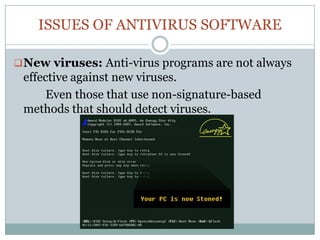
New viruses: Anti-virus programs are not always
effective against new viruses.
Even those that use non-signature-based
methods that should detect viruses.
ISSUES OF ANTIVIRUS SOFTWARE
Root-kits: Root-kits have full administrative access to
the computer and are invisible to users and are hidden
from running processes in the task manager.
Root-kits can modify the inner workings of an
operating system and tamper with anti-virus programs.
ISSUES OF ANTIVIRUS SOFTWARE
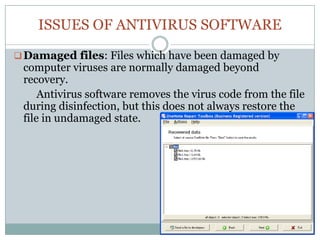
Damaged files: Files which have been damaged by
computer viruses are normally damaged beyond
recovery.
Antivirus software removes the virus code from the file
during disinfection, but this does not always restore the
file in undamaged state.
ISSUES OF ANTIVIRUS SOFTWARE
Firmware Issues:
Active antivirus
software can interfere
with a firmware update
process.
Any writable firmware
in the computer can be
infected with a
malicious code.
CONCLUSION
 Anti-virus software is very useful to day-to-day users
to protect their storage devices and computers from
malware.
 There is much antivirus software available in the
market with it’s own pros and cons.
 The antivirus software has many issues that need to
be dealt with.
 Other than antivirus software, there are many other
methods available to protect devices such as network
firewall, specialist tools, etc.
REFERENCES
 Antivirus Software, Wikipedia.
 Comparison of Antivirus Software, Wikipedia.
 The Art of Computer Virus Research and
Defense, Peter Szor.
THANK YOU

Antivirus software

  • 1.
    A S EM I N A R ANTIVIRUS SOFTWARE
  • 2.
    INTRODUCTION  Antivirus softwareis defined as a software used to prevent, detect and remove all sorts of malware such as computer viruses, hijackers, Trojan horses, etc.
  • 3.
    HISTORY  Most ofthe viruses in early and mid 1980’s had limited self-reproduction and spread initially by storage devices such as floppy disks, before internet connection was wide spread.  The first anti-virus introduced was Flushshot plus and Anti4us in 1987.  John McAfee and Eugene Kaspersky found their own antivirus software and later setup their companies in 1988.
  • 4.
    IDENTIFICATION METHODS There arevarious methods used by antivirus software to identify malware:  Signature based tools: Most commonly used method to identify viruses and other malware, antivirus software compares the contents of a file to a directory of virus signatures. The entire file is searched both as whole as well as in pieces. They are considered very basic and insufficient to be counter today’s malware practices.
  • 6.
    IDENTIFICATION METHODS  Heuristics:It is the most required detection method present in antivirus software. Heuristic is a technique designed for solving a problem more quickly when classic methods are too slow or fail. Some anti-viruses are difficult to detect as they start of as a single infection and later change into many variants. Heuristics is a method invented to counter them.
  • 8.
    IDENTIFICATION METHODS  Rootkit detection: Root kit is one of the dangerous malware designed to gain administration-level control over the computer without detection. They change the way operating systems function and tamper the antivirus software, leaving it ineffective. The latest antivirus software are being added with root kit detection.
  • 10.
    IDENTIFICATION METHODS  Real-timeprotection: Background guard, Auto-protect , Risky-website testing, etc are some other antivirus protection provided by antivirus software.
  • 11.
    POPULAR ANTIVIRUSES  KasperskyLab  McAfee Virus Scan  Avira Antivirus Software  Avast! Antivirus Software  AVG Antivirus and Internet Security  Norton Antivirus Software  Panda Antivirus Software
  • 13.
    PROS OF ANTIVIRUSSOFTWARE Protection from Malware. Protection from Spyware and Identity Theft. Protection from Spam. Protects Important Documents. Provides legal implication.
  • 14.
    ISSUES OF ANTIVIRUSSOFTWARE Unexpected renewal costs: Some commercial antivirus software end-user license agreements include a clause that the subscription will be automatically renewed, and the purchaser’s credit card automatically billed, at the renewal time without explicit approval. For e.g., McAfee requires users to unsubscribe at least 60 days before the expiration of the present subscription.
  • 16.
    ISSUES OF ANTIVIRUSSOFTWARE Rouge security applications: Some apparent antivirus programs are actually malware masquerading as legitimate software, such as WinFixer, MS Antivirus, and Mac Defender.
  • 17.
    ISSUES OF ANTIVIRUSSOFTWARE Problems caused by false positives: A “false positive” is when antivirus software identifies a non- malicious file as virus. It can cause serious problems. For e.g., if an antivirus program is configured to immediately delete or quarantine infected files, a false positive in an essential file can render an OS or some applications useless.
  • 18.
    ISSUES OF ANTIVIRUSSOFTWARE System and interoperability related issues: Running multiple antivirus programs concurrently can degrade performance and create conflicts. However, using a concept called multi- scanning, several companies (including G Data and Microsoft) have created applications which can multiple engines concurrently.
  • 20.
    ISSUES OF ANTIVIRUSSOFTWARE Effectiveness: The effectiveness of antivirus software has decreased. Detection rates for threats had dropped from 40-50% in 2006 to 20-30% in 2007. The problem is magnified by changing intent of the authors.
  • 21.
    ISSUES OF ANTIVIRUSSOFTWARE New viruses: Anti-virus programs are not always effective against new viruses. Even those that use non-signature-based methods that should detect viruses.
  • 22.
    ISSUES OF ANTIVIRUSSOFTWARE Root-kits: Root-kits have full administrative access to the computer and are invisible to users and are hidden from running processes in the task manager. Root-kits can modify the inner workings of an operating system and tamper with anti-virus programs.
  • 23.
    ISSUES OF ANTIVIRUSSOFTWARE Damaged files: Files which have been damaged by computer viruses are normally damaged beyond recovery. Antivirus software removes the virus code from the file during disinfection, but this does not always restore the file in undamaged state.
  • 24.
    ISSUES OF ANTIVIRUSSOFTWARE Firmware Issues: Active antivirus software can interfere with a firmware update process. Any writable firmware in the computer can be infected with a malicious code.
  • 25.
    CONCLUSION  Anti-virus softwareis very useful to day-to-day users to protect their storage devices and computers from malware.  There is much antivirus software available in the market with it’s own pros and cons.  The antivirus software has many issues that need to be dealt with.  Other than antivirus software, there are many other methods available to protect devices such as network firewall, specialist tools, etc.
  • 26.
    REFERENCES  Antivirus Software,Wikipedia.  Comparison of Antivirus Software, Wikipedia.  The Art of Computer Virus Research and Defense, Peter Szor.
  • 27.