Cyrena De Ramos 
St. Cloud State University 
November 12, 2014
• Understand data supporting the significance 
of VTE prophylaxis for medical patients 
• Recognize 3 core measures related to VTE 
prophylaxis 
• Understand correct use and contraindications 
for pharmaceutical VTE prophylaxis 
• Understand correct use, fit, and 
contraindications for mechanical VTE 
prophylaxis 
• Identify various ways to improve patient 
compliance/use of VTE prophylaxis
• VTE comprising pulmonary embolism(PE) and 
deep vein thrombosis (DVT), accounts for 5% - 
10% of all deaths among hospitalized patients 
• DVTs affect as many as 600,000 patients annually 
• PEs are recognized as the most common cause of 
preventable hospital deaths and account for up to 
200,000 deaths annually. 
• 10% to 20% of medical patients acquire DVTs 
• Only 40% of at-risk medical patients receive 
guideline recommended VTE prophylaxis
• 60% of DVTs and 50% of PEs could be avoided 
with proper use of VTE prophylaxis 
• 100,000 lives could be saved annually with 
proper use of VTE prophylaxis 
• 360,000 individuals would avoid the negative 
consequences of DVTs
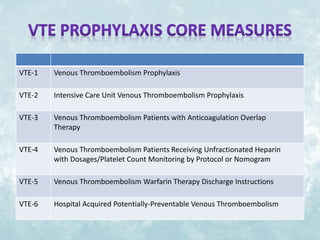
VTE-1 Venous Thromboembolism Prophylaxis 
VTE-2 Intensive Care Unit Venous Thromboembolism Prophylaxis 
VTE-3 Venous Thromboembolism Patients with Anticoagulation Overlap 
Therapy 
VTE-4 Venous Thromboembolism Patients Receiving Unfractionated Heparin 
with Dosages/Platelet Count Monitoring by Protocol or Nomogram 
VTE-5 Venous Thromboembolism Warfarin Therapy Discharge Instructions 
VTE-6 Hospital Acquired Potentially-Preventable Venous Thromboembolism
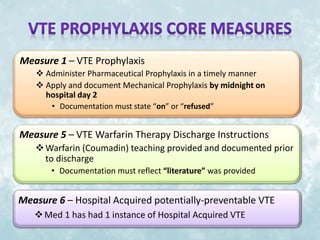
Measure 1 – VTE Prophylaxis 
 Administer Pharmaceutical Prophylaxis in a timely manner 
 Apply and document Mechanical Prophylaxis by midnight on 
hospital day 2 
• Documentation must state “on” or “refused” 
Measure 5 – VTE Warfarin Therapy Discharge Instructions 
Warfarin (Coumadin) teaching provided and documented prior 
to discharge 
• Documentation must reflect “literature” was provided 
Measure 6 – Hospital Acquired potentially-preventable VTE 
Med 1 has had 1 instance of Hospital Acquired VTE
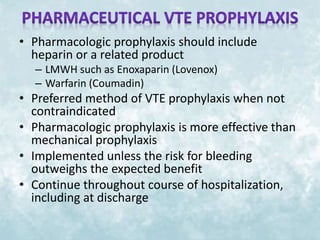
• Pharmacologic prophylaxis should include 
heparin or a related product 
– LMWH such as Enoxaparin (Lovenox) 
– Warfarin (Coumadin) 
• Preferred method of VTE prophylaxis when not 
contraindicated 
• Pharmacologic prophylaxis is more effective than 
mechanical prophylaxis 
• Implemented unless the risk for bleeding 
outweighs the expected benefit 
• Continue throughout course of hospitalization, 
including at discharge
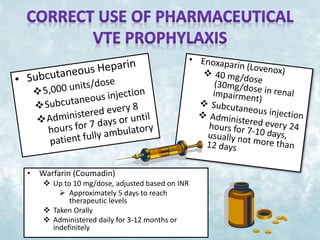
• Warfarin (Coumadin) 
 Up to 10 mg/dose, adjusted based on INR 
 Approximately 5 days to reach 
therapeutic levels 
 Taken Orally 
 Administered daily for 3-12 months or 
indefinitely
• Active Bleeding 
• High-risk uncontrolled hemorrhage 
• Bleeding disorders, Thrombocytopenia, and/or 
Conditions in which bleeding would be catastrophic 
• Renal dysfunction 
• Liver disease with Coagulopathy 
• Hypersensitivity to Heparin or LMWH 
• INR > 1.5 
• Spinal Tap or Epidural Anesthesia 
• Intracranial and/or Intraocular Surgery within 6 weeks 
• Major Trauma/Closed Head Injury/Intracranial Bleed 
• Uncontrolled Hypertension (SBP>200 mmHg, DBP> 110 
mmHg)
• Mechanical VTE prophylaxis includes: 
– Thromboembolism-Deterrent Hose (TEDs)/ACE Wraps 
– Intermittent Pneumatic Compression Devices (IPCDs) 
– Foot Impulse Devices (FIDs) 
• For patients unable to receive pharmacological VTE prophylaxis, or in 
conjunction with pharmacologic VTE prophylaxis 
• Use as IPCDs and FIDs as much of the time as is possible and practical, both 
when in bed and when sitting in a chair 
• TEDs should be worn day and night until the patient no longer has 
significantly reduced mobility (TEDs generally last about 3 months) 
• Continue to use mechanical VTE throughout the hospital stay, frequent 
ambulation is not a substitute 
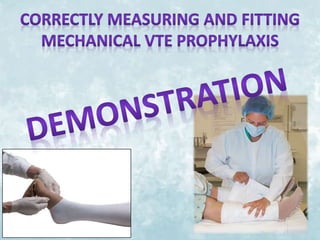
• Ensure patients have their legs measured and the correct size is provided 
• Re-measure legs in patients who develop edema or postoperative swelling 
• Remove TEDs twice daily for 30 minutes for hygiene and to skin inspection
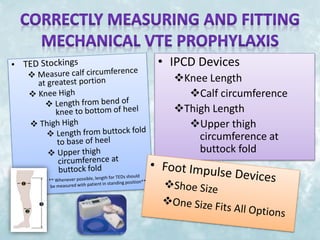
• IPCD Devices 
Knee Length 
Calf circumference 
Thigh Length 
Upper thigh 
circumference at 
buttock fold
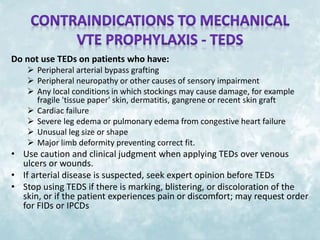
Do not use TEDs on patients who have: 
 Peripheral arterial bypass grafting 
 Peripheral neuropathy or other causes of sensory impairment 
 Any local conditions in which stockings may cause damage, for example 
fragile 'tissue paper' skin, dermatitis, gangrene or recent skin graft 
 Cardiac failure 
 Severe leg edema or pulmonary edema from congestive heart failure 
 Unusual leg size or shape 
 Major limb deformity preventing correct fit. 
• Use caution and clinical judgment when applying TEDs over venous 
ulcers or wounds. 
• If arterial disease is suspected, seek expert opinion before TEDs 
• Stop using TEDS if there is marking, blistering, or discoloration of the 
skin, or if the patient experiences pain or discomfort; may request order 
for FIDs or IPCDs
Do not use IPCDS on patients who have: 
 Any local leg condition in which the sleeves may interfere, such as: 
 dermatitis, 
 vein ligation [immediate postoperative] 
 gangrene, 
 recent skin graft. 
 Severe arteriosclerosis or other ischemic vascular disease. 
 Massive edema of the legs or pulmonary edema from congestive heart 
failure 
 Extreme deformity of the leg 
 Suspected pre-existing deep venous thrombosis 
Do not use FIDs on patients who have: 
 Conditions where an increase of fluid to the heart may be detrimental 
 Congestive Heart Failure 
 Pre-existing deep vein thrombosis, thrombophlebitis or pulmonary 
embolism
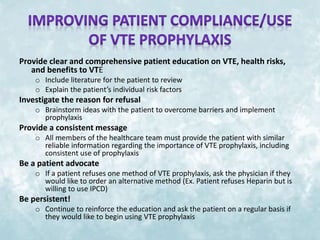
Provide clear and comprehensive patient education on VTE, health risks, 
and benefits to VTE 
o Include literature for the patient to review 
o Explain the patient’s individual risk factors 
Investigate the reason for refusal 
o Brainstorm ideas with the patient to overcome barriers and implement 
prophylaxis 
Provide a consistent message 
o All members of the healthcare team must provide the patient with similar 
reliable information regarding the importance of VTE prophylaxis, including 
consistent use of prophylaxis 
Be a patient advocate 
o If a patient refuses one method of VTE prophylaxis, ask the physician if they 
would like to order an alternative method (Ex. Patient refuses Heparin but is 
willing to use IPCD) 
Be persistent! 
o Continue to reinforce the education and ask the patient on a regular basis if 
they would like to begin using VTE prophylaxis
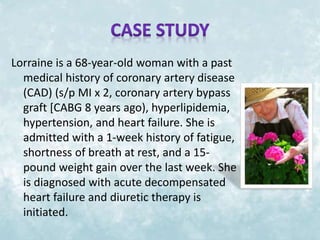
Lorraine is a 68-year-old woman with a past 
medical history of coronary artery disease 
(CAD) (s/p MI x 2, coronary artery bypass 
graft [CABG 8 years ago), hyperlipidemia, 
hypertension, and heart failure. She is 
admitted with a 1-week history of fatigue, 
shortness of breath at rest, and a 15- 
pound weight gain over the last week. She 
is diagnosed with acute decompensated 
heart failure and diuretic therapy is 
initiated.
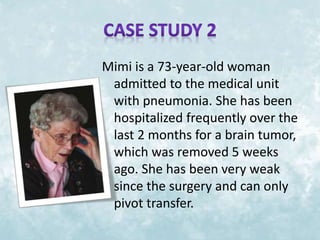
Mimi is a 73-year-old woman 
admitted to the medical unit 
with pneumonia. She has been 
hospitalized frequently over the 
last 2 months for a brain tumor, 
which was removed 5 weeks 
ago. She has been very weak 
since the surgery and can only 
pivot transfer.
Anderson, F. & Audet, A. M. (2010). Preventing deep vein thrombosis and pulmonary embolism. Retrieved from 
https://www.outcomes-umassmed.org/DVT/best_practice/index.htm#Section1 
Bozarth, A. L., Bajaj, N., & Abdeljalil, A. (2013). A Review of venous thromboembolism prophylaxis for hospitalized 
medical patients. Hospital Practice, 41(3), 60-69. doi: 10.3810/hp.2013.08.1069 
Camden, R. & Ludwig, S. (2014). Prophylaxis against venous thromboembolism in hospitalized medically ill patients: 
Update and practical approach. American Journal of Health-System Pharmacy, 71(11), 909-917. doi: 
10.2146/ajhp130475 
Covidien. (2010). A-V impulse foot compression system. Retrieved from 
http://www.covidien.com/imageServer.aspx/doc233675.pdf?contentID=28688&contenttype=application/pdf 
Covidien. (2013). Kendall SCD 700 series controller. Retrieved from 
http://www.covidien.com/imageServer.aspx/doc233674.pdf?contentID=42968&contenttype=application/pdf 
Dentali, F., Douketis, J. D., Gianni, M., Lim, W., & Crowther, M. A. (2007). Meta-analysis: Anticoagulant prophylaxis to 
prevent symptomatic venous thromboembolism in hospitalized medical patients. Anals of Internal Medicine, 
146(4), 278-288. 
Elpern, E., Killeen, K., Patel, G., & Senecal, P. A. (2013). The application of intermittent pneumatic compression devices 
for thromboprophylaxis. American Journal of Nursing, 113(4), 30-36. 
Haut, E. R., & Lau, B. D. (2013). Prevention of venous thromboembolism: Brief update review. Retrieved from 
http://www.ncbi.nlm.nih.gov/books/NBK133363/pdf/TOC.pdf 
King, C. S., Holley, A. B., Jackson, J. L., Shorr, A. F., & Moores, L. K. (2007).Twice versus three times daily heparin dosing 
for thromboembolism prophylaxis in the general medical population: A metaanalysis. Chest, 131(2), 507-516. 
doi:10.1378/chest.06-1861 
Laryea, J. & Champagne, B. (2013). Venous thromboembolism prophylaxis. Clinics in Colon and Rectal Surgery, 26(03), 
153–159. doi: 10.1055/s-0033-1351130 
National Institute for Health and Care Excellence. (2010). Venous thromboembolism: Reducing the risk of venous 
thromboembolism (deep vein thrombosis and pulmonary embolism) in patients admitted to hospital. NICE Clinical 
Guideline. Retrieved from http://www.nice.org.uk/guidance/cg92/resources/guidance-venous-thromboembolism-reducing- 
the-risk-pdf 
Piazza, G., Nguyen, T., Morrison, R., Cios, D., Hohlfelder, B., Fanikos J., Paterno, M., . . . Goldhaber, S. (2012). Patient 
education program for venous thromboembolism prevention in hospitalized patients. American Journal of 
Medicine, 125(3), 258-264. doi: 10.1016/j.amjmed.2011.09.012. 
The Joint Commission. (2014). Core measure sets: Venous thromboembolism. Retrieved from 
http://www.jointcommission.org/core_measure_sets.aspx

Vte prophylaxis

  • 1.
    Cyrena De Ramos St. Cloud State University November 12, 2014
  • 2.
    • Understand datasupporting the significance of VTE prophylaxis for medical patients • Recognize 3 core measures related to VTE prophylaxis • Understand correct use and contraindications for pharmaceutical VTE prophylaxis • Understand correct use, fit, and contraindications for mechanical VTE prophylaxis • Identify various ways to improve patient compliance/use of VTE prophylaxis
  • 3.
    • VTE comprisingpulmonary embolism(PE) and deep vein thrombosis (DVT), accounts for 5% - 10% of all deaths among hospitalized patients • DVTs affect as many as 600,000 patients annually • PEs are recognized as the most common cause of preventable hospital deaths and account for up to 200,000 deaths annually. • 10% to 20% of medical patients acquire DVTs • Only 40% of at-risk medical patients receive guideline recommended VTE prophylaxis
  • 4.
    • 60% ofDVTs and 50% of PEs could be avoided with proper use of VTE prophylaxis • 100,000 lives could be saved annually with proper use of VTE prophylaxis • 360,000 individuals would avoid the negative consequences of DVTs
  • 5.
    VTE-1 Venous ThromboembolismProphylaxis VTE-2 Intensive Care Unit Venous Thromboembolism Prophylaxis VTE-3 Venous Thromboembolism Patients with Anticoagulation Overlap Therapy VTE-4 Venous Thromboembolism Patients Receiving Unfractionated Heparin with Dosages/Platelet Count Monitoring by Protocol or Nomogram VTE-5 Venous Thromboembolism Warfarin Therapy Discharge Instructions VTE-6 Hospital Acquired Potentially-Preventable Venous Thromboembolism
  • 6.
    Measure 1 –VTE Prophylaxis  Administer Pharmaceutical Prophylaxis in a timely manner  Apply and document Mechanical Prophylaxis by midnight on hospital day 2 • Documentation must state “on” or “refused” Measure 5 – VTE Warfarin Therapy Discharge Instructions Warfarin (Coumadin) teaching provided and documented prior to discharge • Documentation must reflect “literature” was provided Measure 6 – Hospital Acquired potentially-preventable VTE Med 1 has had 1 instance of Hospital Acquired VTE
  • 7.
    • Pharmacologic prophylaxisshould include heparin or a related product – LMWH such as Enoxaparin (Lovenox) – Warfarin (Coumadin) • Preferred method of VTE prophylaxis when not contraindicated • Pharmacologic prophylaxis is more effective than mechanical prophylaxis • Implemented unless the risk for bleeding outweighs the expected benefit • Continue throughout course of hospitalization, including at discharge
  • 8.
    • Warfarin (Coumadin)  Up to 10 mg/dose, adjusted based on INR  Approximately 5 days to reach therapeutic levels  Taken Orally  Administered daily for 3-12 months or indefinitely
  • 9.
    • Active Bleeding • High-risk uncontrolled hemorrhage • Bleeding disorders, Thrombocytopenia, and/or Conditions in which bleeding would be catastrophic • Renal dysfunction • Liver disease with Coagulopathy • Hypersensitivity to Heparin or LMWH • INR > 1.5 • Spinal Tap or Epidural Anesthesia • Intracranial and/or Intraocular Surgery within 6 weeks • Major Trauma/Closed Head Injury/Intracranial Bleed • Uncontrolled Hypertension (SBP>200 mmHg, DBP> 110 mmHg)
  • 10.
    • Mechanical VTEprophylaxis includes: – Thromboembolism-Deterrent Hose (TEDs)/ACE Wraps – Intermittent Pneumatic Compression Devices (IPCDs) – Foot Impulse Devices (FIDs) • For patients unable to receive pharmacological VTE prophylaxis, or in conjunction with pharmacologic VTE prophylaxis • Use as IPCDs and FIDs as much of the time as is possible and practical, both when in bed and when sitting in a chair • TEDs should be worn day and night until the patient no longer has significantly reduced mobility (TEDs generally last about 3 months) • Continue to use mechanical VTE throughout the hospital stay, frequent ambulation is not a substitute • Ensure patients have their legs measured and the correct size is provided • Re-measure legs in patients who develop edema or postoperative swelling • Remove TEDs twice daily for 30 minutes for hygiene and to skin inspection
  • 11.
    • IPCD Devices Knee Length Calf circumference Thigh Length Upper thigh circumference at buttock fold
  • 13.
    Do not useTEDs on patients who have:  Peripheral arterial bypass grafting  Peripheral neuropathy or other causes of sensory impairment  Any local conditions in which stockings may cause damage, for example fragile 'tissue paper' skin, dermatitis, gangrene or recent skin graft  Cardiac failure  Severe leg edema or pulmonary edema from congestive heart failure  Unusual leg size or shape  Major limb deformity preventing correct fit. • Use caution and clinical judgment when applying TEDs over venous ulcers or wounds. • If arterial disease is suspected, seek expert opinion before TEDs • Stop using TEDS if there is marking, blistering, or discoloration of the skin, or if the patient experiences pain or discomfort; may request order for FIDs or IPCDs
  • 14.
    Do not useIPCDS on patients who have:  Any local leg condition in which the sleeves may interfere, such as:  dermatitis,  vein ligation [immediate postoperative]  gangrene,  recent skin graft.  Severe arteriosclerosis or other ischemic vascular disease.  Massive edema of the legs or pulmonary edema from congestive heart failure  Extreme deformity of the leg  Suspected pre-existing deep venous thrombosis Do not use FIDs on patients who have:  Conditions where an increase of fluid to the heart may be detrimental  Congestive Heart Failure  Pre-existing deep vein thrombosis, thrombophlebitis or pulmonary embolism
  • 15.
    Provide clear andcomprehensive patient education on VTE, health risks, and benefits to VTE o Include literature for the patient to review o Explain the patient’s individual risk factors Investigate the reason for refusal o Brainstorm ideas with the patient to overcome barriers and implement prophylaxis Provide a consistent message o All members of the healthcare team must provide the patient with similar reliable information regarding the importance of VTE prophylaxis, including consistent use of prophylaxis Be a patient advocate o If a patient refuses one method of VTE prophylaxis, ask the physician if they would like to order an alternative method (Ex. Patient refuses Heparin but is willing to use IPCD) Be persistent! o Continue to reinforce the education and ask the patient on a regular basis if they would like to begin using VTE prophylaxis
  • 16.
    Lorraine is a68-year-old woman with a past medical history of coronary artery disease (CAD) (s/p MI x 2, coronary artery bypass graft [CABG 8 years ago), hyperlipidemia, hypertension, and heart failure. She is admitted with a 1-week history of fatigue, shortness of breath at rest, and a 15- pound weight gain over the last week. She is diagnosed with acute decompensated heart failure and diuretic therapy is initiated.
  • 17.
    Mimi is a73-year-old woman admitted to the medical unit with pneumonia. She has been hospitalized frequently over the last 2 months for a brain tumor, which was removed 5 weeks ago. She has been very weak since the surgery and can only pivot transfer.
  • 19.
    Anderson, F. &Audet, A. M. (2010). Preventing deep vein thrombosis and pulmonary embolism. Retrieved from https://www.outcomes-umassmed.org/DVT/best_practice/index.htm#Section1 Bozarth, A. L., Bajaj, N., & Abdeljalil, A. (2013). A Review of venous thromboembolism prophylaxis for hospitalized medical patients. Hospital Practice, 41(3), 60-69. doi: 10.3810/hp.2013.08.1069 Camden, R. & Ludwig, S. (2014). Prophylaxis against venous thromboembolism in hospitalized medically ill patients: Update and practical approach. American Journal of Health-System Pharmacy, 71(11), 909-917. doi: 10.2146/ajhp130475 Covidien. (2010). A-V impulse foot compression system. Retrieved from http://www.covidien.com/imageServer.aspx/doc233675.pdf?contentID=28688&contenttype=application/pdf Covidien. (2013). Kendall SCD 700 series controller. Retrieved from http://www.covidien.com/imageServer.aspx/doc233674.pdf?contentID=42968&contenttype=application/pdf Dentali, F., Douketis, J. D., Gianni, M., Lim, W., & Crowther, M. A. (2007). Meta-analysis: Anticoagulant prophylaxis to prevent symptomatic venous thromboembolism in hospitalized medical patients. Anals of Internal Medicine, 146(4), 278-288. Elpern, E., Killeen, K., Patel, G., & Senecal, P. A. (2013). The application of intermittent pneumatic compression devices for thromboprophylaxis. American Journal of Nursing, 113(4), 30-36. Haut, E. R., & Lau, B. D. (2013). Prevention of venous thromboembolism: Brief update review. Retrieved from http://www.ncbi.nlm.nih.gov/books/NBK133363/pdf/TOC.pdf King, C. S., Holley, A. B., Jackson, J. L., Shorr, A. F., & Moores, L. K. (2007).Twice versus three times daily heparin dosing for thromboembolism prophylaxis in the general medical population: A metaanalysis. Chest, 131(2), 507-516. doi:10.1378/chest.06-1861 Laryea, J. & Champagne, B. (2013). Venous thromboembolism prophylaxis. Clinics in Colon and Rectal Surgery, 26(03), 153–159. doi: 10.1055/s-0033-1351130 National Institute for Health and Care Excellence. (2010). Venous thromboembolism: Reducing the risk of venous thromboembolism (deep vein thrombosis and pulmonary embolism) in patients admitted to hospital. NICE Clinical Guideline. Retrieved from http://www.nice.org.uk/guidance/cg92/resources/guidance-venous-thromboembolism-reducing- the-risk-pdf Piazza, G., Nguyen, T., Morrison, R., Cios, D., Hohlfelder, B., Fanikos J., Paterno, M., . . . Goldhaber, S. (2012). Patient education program for venous thromboembolism prevention in hospitalized patients. American Journal of Medicine, 125(3), 258-264. doi: 10.1016/j.amjmed.2011.09.012. The Joint Commission. (2014). Core measure sets: Venous thromboembolism. Retrieved from http://www.jointcommission.org/core_measure_sets.aspx

Editor's Notes

  • #4 CMS considers VTE in hospitalized patients a “never event,” which is pegged to the “pay for performance” initiative VTE prophylaxis is an essential patient safety practice and one that can prevent in hospital death 200,00 deaths annually refers to the US only Virchow’s classic description of factors basic to VTE included stasis or reduction in blood flow, vessel injury, and hypercoagulability. IPC devices are thought to reduce DVT risk by increasing the velocity of venous blood flow and by stimulating regional fibrinolytic activity.7
  • #5 Negative consequences – Pain Swelling of extremity Lost time from work/wages Venous stasis – leads to ulcers, chronic skin and bone infections (Results from irreversible damage to valves in veins) Vericose veins
  • #6 This is a table depicting the Joint Commission's Core Measures related to VTE prophylaxis. As nursing staff, we must focus on Measures 1, 5, and 6
  • #7 We’ve had 30 misses care center wide since January (mostly on Onc and Med 1).  Our goal percentage is 97%, we are currently at 91.4% so there’s lots of room for growth. VTE-1: physician must order appropriate prophylaxis (SCDs or heparin/lovenox or contraindications for both).  Nurses must administer heparin/lovenox or apply sequentials by end of midnight on hospital day 2.  Must document the sequentials as “applied” or “refused” to meet the core measure on the AID flowsheet.  PCAs can be vital to this measure, Biggest miss is not documenting sequential application or refusal.   VTE-5: Coumadin teaching must be provided and documented on the Teaching Record in Epic as “literature”.  If the nurse documents “explanation” – it does not meet the measure.   VTE-6: This measure assesses the number of patients diagnosed with confirmed VTE during hospitalization (not present at admission) who did not receive VTE prophylaxis between hospital admission and the day before the VTE diagnostic testing order date.   VTE is considered a ‘never event’ Medicare will no longer pay the extra cost of treating VTE that occur while the patient is in the hospital.
  • #8 Patients are still at risk for VTE when they are discharged, it is best practice to administer a final dose of Heparin or lovenox if it is due at the time of discharge to extend the patient’s protection. A patient may go home and rest and suffer a DVT or PE
  • #9 SCH administers sub-q heparin for VTE prophylaxis q8h (tid), however q12h (bid) is also an acceptable administration schedule. Bid dosing reduces the risk of bleeding complications, however tid dosing is more effective in reducing the instance of VTE. Additional research is needed to examine the effectiveness of this dosing in obese and morbidly obese patients. The risk of obese patients (body mass index [BMI] of ≥30 kg/m2) suffering VTE is twice that of their nonobese counterparts. Furthermore, there is a five-fold increased risk of VTE in the morbidly obese (BMI of ≥40 kg/m2). Renal impairment for lovenox dosing is CrCl less than 30mL/min Heparin: 7 days or until fully ambulatory/no longer at risk – whichever is longer
  • #10  The evidence supporting its recommendations comes from a recent multinational observational study of hospitalized medical patients for whom independent risk factors of major and nonmajor bleeding events were identified. Over 10,000 patients were evaluated, and 11 distinct risk factors were identified as being independently associated with in hospital bleeding. The 3 major risk factors were an active gastroduodenal ulcer, bleeding within the three months before hospital admission, and a platelet count of <50,000 platelets/mm3. Minor risk factors included advanced age, liver failure, renal failure, admission to an intensive care unit, placement of a central venous catheter, rheumatic disease, current cancer, and male sex. The authors of the ACCP guidelines concluded that patients with multiple risk factors or those with 1 of the 3 major risk factors have an excessive risk of bleeding and may not be eligible for chemical prophylaxis
  • #11 IPCD – intermittent pneumatic compression device Both graduated compression stockings and IPC devices increase venous blood flow and decrease venous stasis. In addition, IPC devices stimulate endogenous fibrinolytic activity4,5 by causing gentle trauma to the vascular endothelial cells of the lower leg and by altering rheological characteristics and perfusion pressure. Walking: With every step, the plantar arch is flattened, causing the venous plexus to empty. This action sends a column of blood up to the heart, allowing plexus to refill. Foot impulse device: The Impad features a hard rigid sole designed to contain and direct the impulse directly to the bottom of the foot. This action mimics the hemodynamic effect of ambulation by flattening the plantar plexus and completely evacuating blood from the bottom of the foot.
  • #12 **Whenever possible, length for TEDs should be measured with patient in standing position.
  • #17 What order for VTE prophylaxis would you question for this patient? Heparin sub-q q8h or IPCDs? – IPCDs, because mechanical prophylaxis should not be used in patients with heart failure, patients who have pulmonary edema or severe leg edema The patient asks how frequently she will need to receive the Heparin injections and how many doses she will need, how do you respond? SCH policy is to administer heparin sub-q q8h. She will receive 3 injections a day until she is discharged, it is unlikely she would need to continue this intervention after discharge. The patient is scared of receiving the injections in her abdomen, and doesn’t understand why she would receive a medication for something she doesn’t have, how do you respond? Provide the patient with verbal education and literature on VTEs and the importance of VTE prophylaxis. Explain to the patient her unique risk factors, and complications she might experience by refusing the prophylaxis.
  • #18 What order for VTE prophylaxis would you question for this patient? Heparin sub-q q8h or IPCDs? – Heparin Sub-Q, because the patient had intracranial surgery less than 6 weeks ago. The physician changes the order to knee-high IPCDs and TEDs, how will the nurse measure the patient’s legs to ensure the correct fit? Calf circumference at the greatest portion is necessary for both the IPCD and the TEDs, but leg length from the bend of the knee to the bottom of the heel is also needed for the TEDs In order to meet the core measures related to VTE, how soon after admission must VTE prophylaxis be documented? By midnight the 2nd hospital day.
  • #19 Don’t forget to click for reference slide