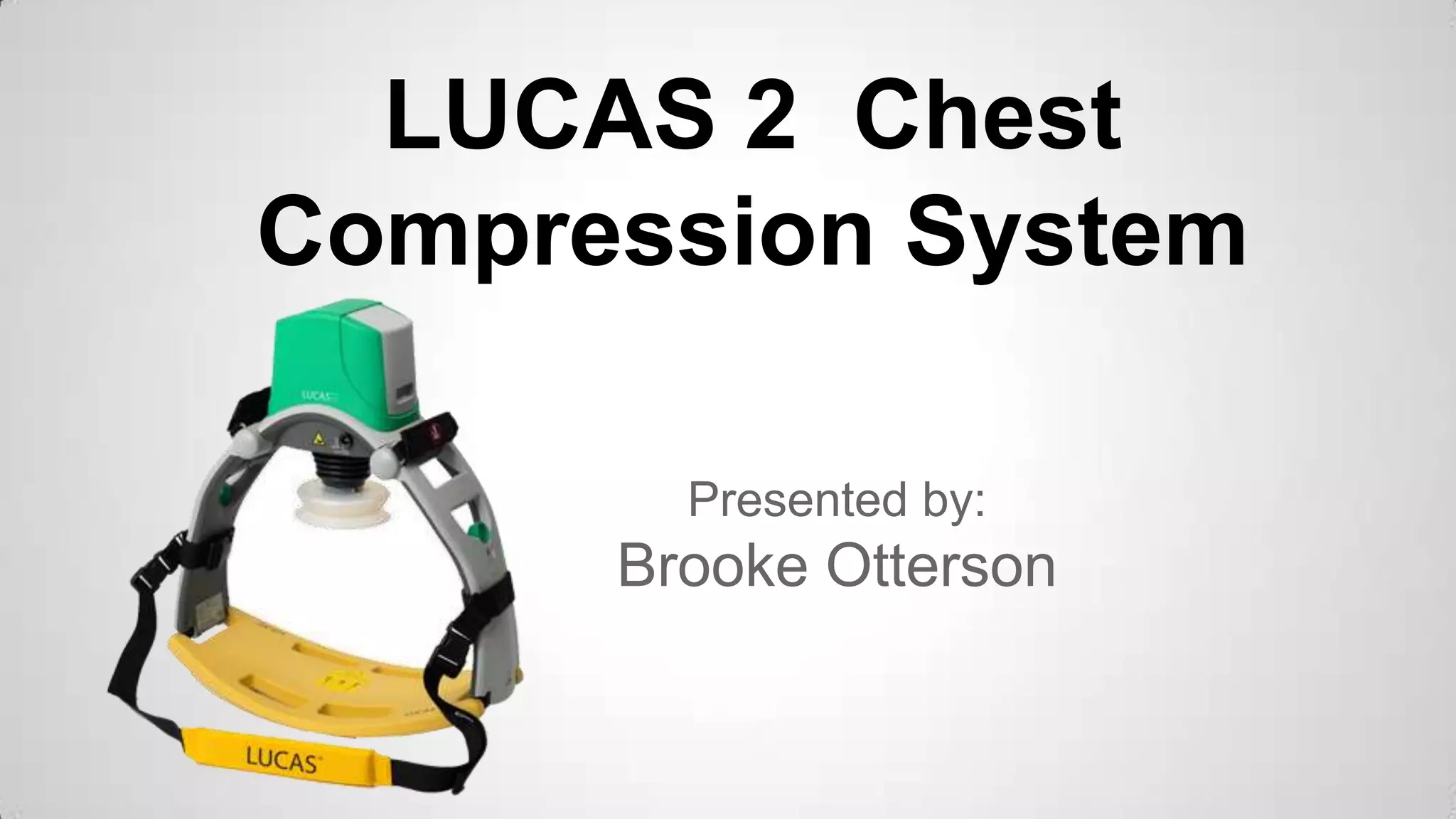
LUCAS 2 Chest
Compression System
Presented by:
Brooke Otterson
About the LUCAS 2
What it does & how to use it:
• Delivers mechanical chest compressions based on the 2010 AHA CPR
guidelines
• Video on how to use LUCAS 2:
https://www.youtube.com/watch?v=HvNkWpZmdHA
Who can it be used on?
Adult Patients who fit into the device:
• Sternum height of 6.7–11.9 inches (17 – 30.3 cm)
• Maximum chest width: 17.7 inches (45 cm)
The use of LUCAS is not restricted by patient weight.
*Patients with sternum height between 6.7 inches-7.3 inches will receive
linearly increasing depth from 1.5 inches to 2.1 inches.
Who Operates
• First responders
• Ambulance personnel
• Nurses
• Physicians
• Other medical staff who have undertaken a
CPR course and received training in how to
use LUCAS 2
Implications for Use
Sudden Cardiac Arrest Victims
Pre-hospital
At scene
During transfer- ambulance, helicopter
In-hospital
Emergency Department/Trauma Center/ICU
On Units- code teams
Cath Labs
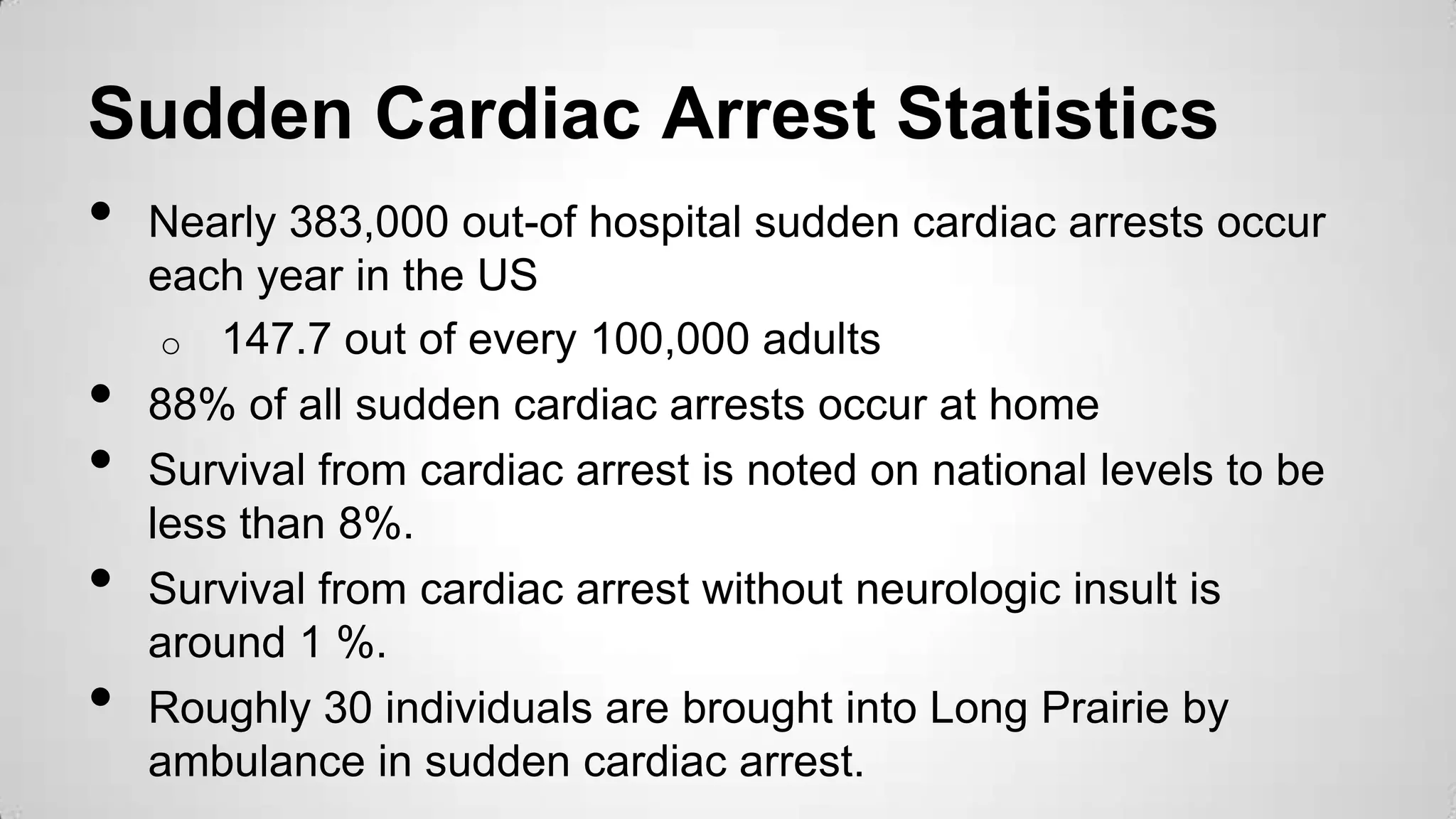
Sudden Cardiac Arrest Statistics
• Nearly 383,000 out-of hospital sudden cardiac arrests occur
each year in the US
o 147.7 out of every 100,000 adults
• 88% of all sudden cardiac arrests occur at home
• Survival from cardiac arrest is noted on national levels to be
less than 8%.
• Survival from cardiac arrest without neurologic insult is
around 1 %.
• Roughly 30 individuals are brought into Long Prairie by
ambulance in sudden cardiac arrest.
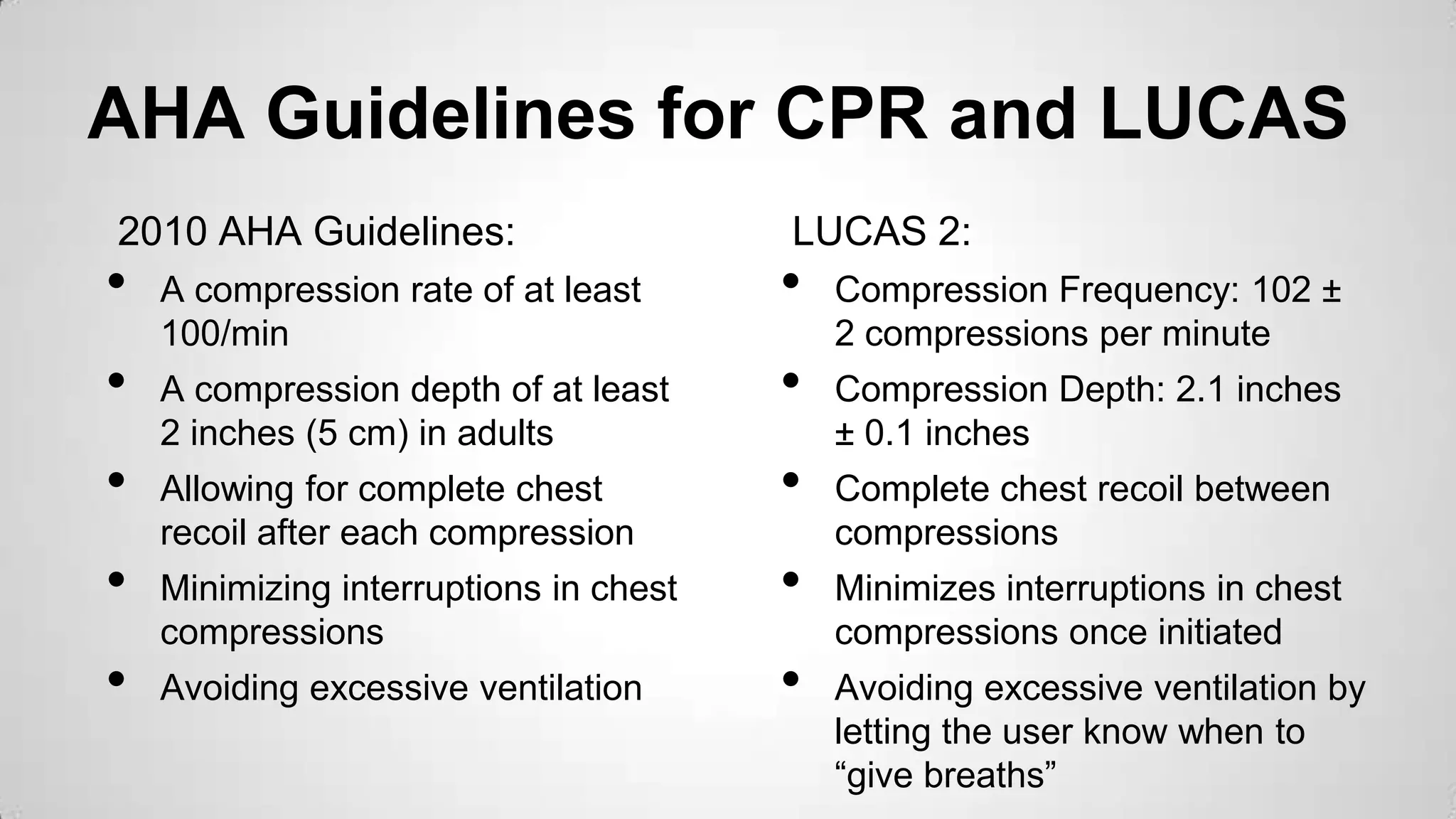
AHA Guidelines for CPR and LUCAS
2010 AHA Guidelines:
• A compression rate of at least
100/min
• A compression depth of at least
2 inches (5 cm) in adults
• Allowing for complete chest
recoil after each compression
• Minimizing interruptions in chest
compressions
• Avoiding excessive ventilation
LUCAS 2:
• Compression Frequency: 102 ±
2 compressions per minute
• Compression Depth: 2.1 inches
± 0.1 inches
• Complete chest recoil between
compressions
• Minimizes interruptions in chest
compressions once initiated
• Avoiding excessive ventilation by
letting the user know when to
―give breaths‖
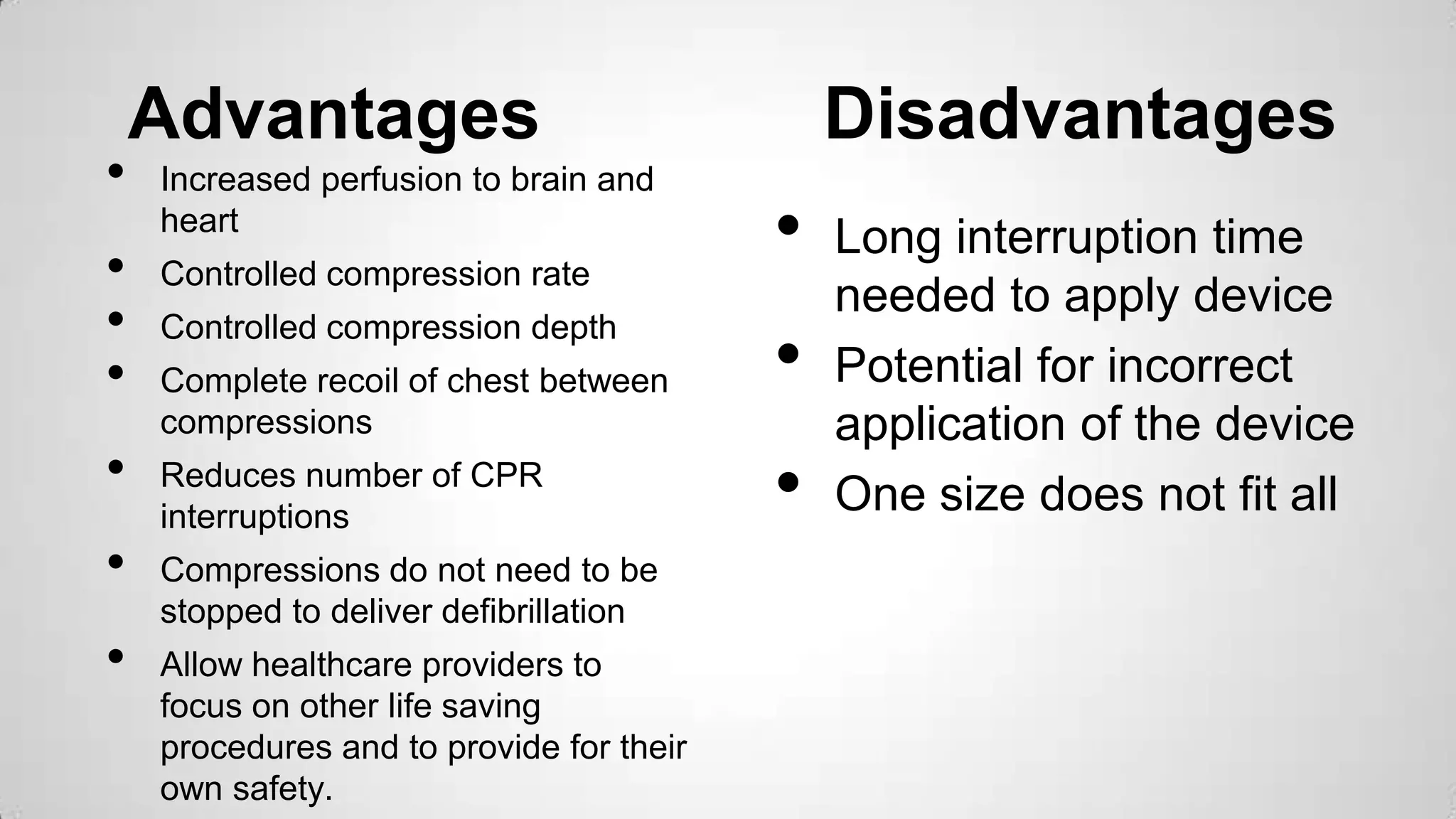
Advantages Disadvantages
• Increased perfusion to brain and
heart
• Controlled compression rate
• Controlled compression depth
• Complete recoil of chest between
compressions
• Reduces number of CPR
interruptions
• Compressions do not need to be
stopped to deliver defibrillation
• Allow healthcare providers to
focus on other life saving
procedures and to provide for their
own safety.
• Long interruption time
needed to apply device
• Potential for incorrect
application of the device
• One size does not fit all
References
American Heart Association, Inc. (2013). Heart disease and stroke statistics—2013 update. Retrieved from
http://circ.ahajournals.org/content/early/2012/12/12/CIR.0b013e31828124ad.full.pdf
American Heart Association, Inc. (2010). Highlights of the 2010 American Heart Association guidelines for CPR and
ECC.Retrieved from http://www.heart.org/idc/groups/heart-public/@wcm/@ecc/documents/downloadable/ucm_317350.pdf
Park, C., Roffi, M., Bendjelid, K., & Bonvini, R. (2013). Percutaneous noncoronary interventions during continuous mechanical
chest compression with the LUCAS-2 device. American Journal Of Emergency Medicine, 31(2), 456.e1-3.
doi:10.1016/j.ajem.2012.07.022
Physio-Control, Inc. (2011). Lucas chest compression system: Your partner in in life support. Retrieved from http://www.lucas-
cpr.com/
Physio-Control, Inc. (2013). LUCAS 2 chest compression system. Retrieved from http://www.physio-control.com/LUCAS/
Putzer, G., Braun, P., Zimmermann, A., Pedross, F., Strapazzon, G., Brugger, H., & Paal, P. (2013). LUCAS compared to
manual cardiopulmonary resuscitation is more effective during helicopter rescue-a prospective, randomized, cross-over
manikin study. The American Journal Of Emergency Medicine, 31(2), 384-389. doi:10.1016/j.ajem.2012.07.018
Trivedi, K., Borovnik-Lesjak, V., & Gazmuri, R. (2013). LUCAS 2(TM) device, compression depth, and the 2010
cardiopulmonary resuscitation guidelines. American Journal Of Emergency Medicine, 31(7), 1154.e1-2.
doi:10.1016/j.ajem.2013.03.007
Yost, D., Phillips, R., Gonzales, L., Lick, C., Satterlee, P., Levy, M., & ... Niskanen, R. (2012). Assessment of CPR interruptions
from transthoracic impedance during use of the LUCAS™ mechanical chest compression system. Resuscitation, 83(8), 961-
965. doi:10.1016/j.resuscitation.2012.01.019

Lucas 2 chest compression system (2)

  • 1.
    LUCAS 2 Chest CompressionSystem Presented by: Brooke Otterson
  • 2.
    About the LUCAS2 What it does & how to use it: • Delivers mechanical chest compressions based on the 2010 AHA CPR guidelines • Video on how to use LUCAS 2: https://www.youtube.com/watch?v=HvNkWpZmdHA Who can it be used on? Adult Patients who fit into the device: • Sternum height of 6.7–11.9 inches (17 – 30.3 cm) • Maximum chest width: 17.7 inches (45 cm) The use of LUCAS is not restricted by patient weight. *Patients with sternum height between 6.7 inches-7.3 inches will receive linearly increasing depth from 1.5 inches to 2.1 inches.
  • 3.
    Who Operates • Firstresponders • Ambulance personnel • Nurses • Physicians • Other medical staff who have undertaken a CPR course and received training in how to use LUCAS 2
  • 4.
    Implications for Use SuddenCardiac Arrest Victims Pre-hospital At scene During transfer- ambulance, helicopter In-hospital Emergency Department/Trauma Center/ICU On Units- code teams Cath Labs
  • 5.
    Sudden Cardiac ArrestStatistics • Nearly 383,000 out-of hospital sudden cardiac arrests occur each year in the US o 147.7 out of every 100,000 adults • 88% of all sudden cardiac arrests occur at home • Survival from cardiac arrest is noted on national levels to be less than 8%. • Survival from cardiac arrest without neurologic insult is around 1 %. • Roughly 30 individuals are brought into Long Prairie by ambulance in sudden cardiac arrest.
  • 6.
    AHA Guidelines forCPR and LUCAS 2010 AHA Guidelines: • A compression rate of at least 100/min • A compression depth of at least 2 inches (5 cm) in adults • Allowing for complete chest recoil after each compression • Minimizing interruptions in chest compressions • Avoiding excessive ventilation LUCAS 2: • Compression Frequency: 102 ± 2 compressions per minute • Compression Depth: 2.1 inches ± 0.1 inches • Complete chest recoil between compressions • Minimizes interruptions in chest compressions once initiated • Avoiding excessive ventilation by letting the user know when to ―give breaths‖
  • 7.
    Advantages Disadvantages • Increasedperfusion to brain and heart • Controlled compression rate • Controlled compression depth • Complete recoil of chest between compressions • Reduces number of CPR interruptions • Compressions do not need to be stopped to deliver defibrillation • Allow healthcare providers to focus on other life saving procedures and to provide for their own safety. • Long interruption time needed to apply device • Potential for incorrect application of the device • One size does not fit all
  • 8.
    References American Heart Association,Inc. (2013). Heart disease and stroke statistics—2013 update. Retrieved from http://circ.ahajournals.org/content/early/2012/12/12/CIR.0b013e31828124ad.full.pdf American Heart Association, Inc. (2010). Highlights of the 2010 American Heart Association guidelines for CPR and ECC.Retrieved from http://www.heart.org/idc/groups/heart-public/@wcm/@ecc/documents/downloadable/ucm_317350.pdf Park, C., Roffi, M., Bendjelid, K., & Bonvini, R. (2013). Percutaneous noncoronary interventions during continuous mechanical chest compression with the LUCAS-2 device. American Journal Of Emergency Medicine, 31(2), 456.e1-3. doi:10.1016/j.ajem.2012.07.022 Physio-Control, Inc. (2011). Lucas chest compression system: Your partner in in life support. Retrieved from http://www.lucas- cpr.com/ Physio-Control, Inc. (2013). LUCAS 2 chest compression system. Retrieved from http://www.physio-control.com/LUCAS/ Putzer, G., Braun, P., Zimmermann, A., Pedross, F., Strapazzon, G., Brugger, H., & Paal, P. (2013). LUCAS compared to manual cardiopulmonary resuscitation is more effective during helicopter rescue-a prospective, randomized, cross-over manikin study. The American Journal Of Emergency Medicine, 31(2), 384-389. doi:10.1016/j.ajem.2012.07.018 Trivedi, K., Borovnik-Lesjak, V., & Gazmuri, R. (2013). LUCAS 2(TM) device, compression depth, and the 2010 cardiopulmonary resuscitation guidelines. American Journal Of Emergency Medicine, 31(7), 1154.e1-2. doi:10.1016/j.ajem.2013.03.007 Yost, D., Phillips, R., Gonzales, L., Lick, C., Satterlee, P., Levy, M., & ... Niskanen, R. (2012). Assessment of CPR interruptions from transthoracic impedance during use of the LUCAS™ mechanical chest compression system. Resuscitation, 83(8), 961- 965. doi:10.1016/j.resuscitation.2012.01.019