 Review the entire
PowerPoint presentation.
 If you have any questions on
the material presented, the
Hepatitis BVaccine, or
Infection Control
Procedures, please contact
your Instructor immediately.
Instructors are available 24/7
to answer questions in real
time.
LEAD INSTRUCTOR:
 Captain Jim Turner – Registered Nurse & Paramedic
▪ 20 years experience in Fire & EMS fields
▪ MBVFD EMS Training Officer
▪ (321) 258-4679
ADDITIONAL INSTRUCTORS:
 Gavin Brown – Fire Chief & Certified EMT
▪ 16 years in experience in Fire & EMS fields
▪ BLS/Stop the Bleed/Tactical EMS Instructor
▪ (321) 288-0452
 Dave Micka – Health & Safety Officer
▪ 36 years in the fire service
▪ Retired safety program coordinator for ULA
▪ (321) 288-5473
 Discuss standards relating to Bloodborne
Pathogen (BBP) training.
 Learn about common BBP related diseases such
as HIV, AIDS, Hepatitis-B, and Hepatitis-C.
 Learn about BBP Safety, Controls, & Personal
Protective Equipment (PPE)
 Review Site Specific Information
 Review MBVFD Exposure Control Plan
The more you know, the better you will perform in real
situations!
 OSHA 29 CFR 1910.1030
 (Standard on Bloodborne Pathogens)
 Adopted by State of Florida Administrative
Code in 1993.
 Anyone whose job requires potential exposure
to bloodborne pathogens is required to
complete annual training.
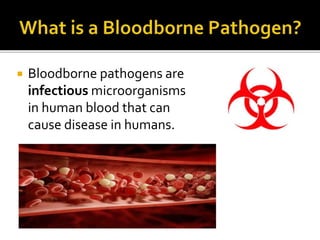
 Bloodborne pathogens are
infectious microorganisms
in human blood that can
cause disease in humans.
Part 2
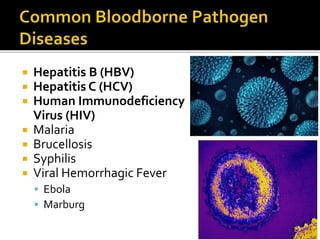
 Hepatitis B (HBV)
 Hepatitis C (HCV)
 Human Immunodeficiency
Virus (HIV)
 Malaria
 Brucellosis
 Syphilis
 Viral Hemorrhagic Fever
 Ebola
 Marburg
 Hepatitis B is a viral
infection that attacks
the liver.
 The virus is transmitted
through contact with the
blood or other body
fluids of an infected
person.
 HBV can survive for at
least 1 week in dried blood.
 May lead to chronic liver
disease, liver cancer, and
death
 Symptoms include:
jaundice, fatigue,
abdominal pain, loss of
appetite, intermittent
nausea , vomiting
 Symptoms can occur 1-9
months after exposure
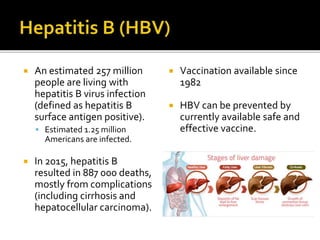
 An estimated 257 million
people are living with
hepatitis B virus infection
(defined as hepatitis B
surface antigen positive).
 Estimated 1.25 million
Americans are infected.
 In 2015, hepatitis B
resulted in 887 000 deaths,
mostly from complications
(including cirrhosis and
hepatocellular carcinoma).
 Vaccination available since
1982
 HBV can be prevented by
currently available safe and
effective vaccine.
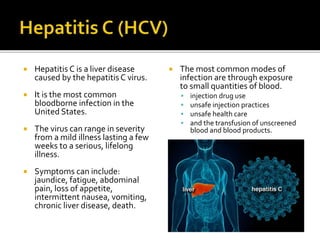
 Hepatitis C is a liver disease
caused by the hepatitis C virus.
 It is the most common
bloodborne infection in the
United States.
 The virus can range in severity
from a mild illness lasting a few
weeks to a serious, lifelong
illness.
 Symptoms can include:
jaundice, fatigue, abdominal
pain, loss of appetite,
intermittent nausea, vomiting,
chronic liver disease, death.
 The most common modes of
infection are through exposure
to small quantities of blood.
 injection drug use
 unsafe injection practices
 unsafe health care
 and the transfusion of unscreened
blood and blood products.
 Globally, an estimated 71
million people have
chronic hepatitis C
infection.
 A significant number of
those who are chronically
infected will develop
cirrhosis or liver cancer.
 Approximately 399,000
people die each year from
hepatitis C,
 mostly from cirrhosis and
hepatocellular carcinoma.
 Antiviral medicines can
cure more than 95% of
persons with hepatitis C
infection, thereby reducing
the risk of death from liver
cancer and cirrhosis, but
access to diagnosis and
treatment is low.
 There is currently no
vaccine for hepatitis C;
however research in this
area is ongoing.
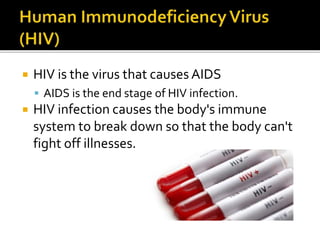
 HIV is the virus that causes AIDS
 AIDS is the end stage of HIV infection.
 HIV infection causes the body's immune
system to break down so that the body can't
fight off illnesses.
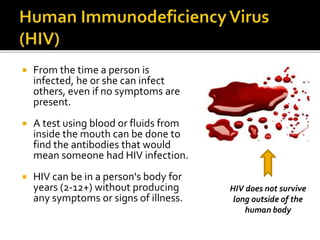
 From the time a person is
infected, he or she can infect
others, even if no symptoms are
present.
 A test using blood or fluids from
inside the mouth can be done to
find the antibodies that would
mean someone had HIV infection.
 HIV can be in a person's body for
years (2-12+) without producing
any symptoms or signs of illness.
HIV does not survive
long outside of the
human body
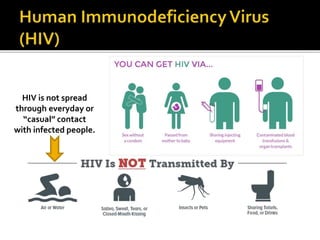
HIV is not spread
through everyday or
“casual” contact
with infected people.
 In recent years, about half the
people with HIV have
developed AIDS within 12
years, but the time between
infection with HIV and the
onset of AIDS can vary
greatly.
 Today there are promising
new medical treatments that
can postpone many of the
illnesses associated with
AIDS.
 AIDS is the most severe phase of HIV infection.
 People with AIDS have such badly damaged immune systems that
they get an increasing number of severe illnesses, called
opportunistic illnesses.
 Without treatment, people with AIDS typically survive about 3
years.
 People are diagnosed with AIDS when their CD4 cell count drops
below 200 cells/mm or if they develop certain opportunistic
illnesses. People with AIDS can have a high viral load and be very
infectious.
 In Florida, approximately 100,000 persons are infected
with HIV.
 About one quarter of those (25,000), are aware of their
HIV infection and are not receiving medical care to
prolong their lives, improve the quality of their lives, and
lower the risk that they will spread the infection to others.
 In the most recent statistic from the CDC (December,
2002), occupational exposure to HIV has resulted in 57
documented and 139 possible cases of HIV seroconversion
among healthcare personnel (HCP) in the United States.
Part 3
I will always wear all of my PPE
 Blood
 Semen &Vaginal secretions
 Cerebrospinal fluid: Fluid pertaining to or affecting the brain and the
spinal cord.
 Synovial fluid: A clear, viscid lubricating fluid secreted by membranes
in joint cavities and sheaths of tendons.
 Pleural fluid: Fluid in the lungs or in the thin serous membrane that
envelops each lung and folds back to make a lining for the chest
cavity.
 Pericardial fluid: Fluid in the membranous sac filled with serous fluid
that encloses the heart and the roots of the aorta and other large
blood vessels.
 Peritoneal fluid: Fluid from the serous membrane that lines the
walls of the abdominal cavity.
 Amniotic fluid:The fluid surrounding the fetus in the womb.
 Saliva in dental procedures
 Any body fluid that is visibly contaminated with blood
 Unfixed human tissue or organs (other than intact skin)
 HIV-containing cell, tissue or organ cultures
 HIV-containing culture media or other solutions
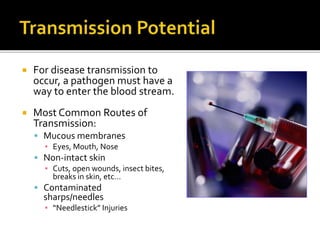
 For disease transmission to
occur, a pathogen must have a
way to enter the blood stream.
 Most Common Routes of
Transmission:
 Mucous membranes
▪ Eyes, Mouth, Nose
 Non-intact skin
▪ Cuts, open wounds, insect bites,
breaks in skin, etc…
 Contaminated
sharps/needles
▪ “Needlestick” Injuries
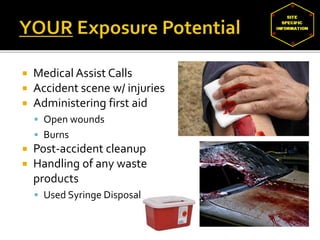
 Medical Assist Calls
 Accident scene w/ injuries
 Administering first aid
 Open wounds
 Burns
 Post-accident cleanup
 Handling of any waste
products
 Used Syringe Disposal
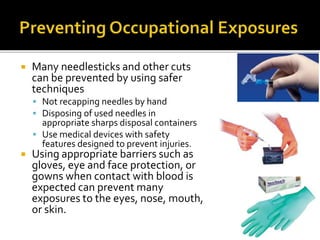
 Many needlesticks and other cuts
can be prevented by using safer
techniques
 Not recapping needles by hand
 Disposing of used needles in
appropriate sharps disposal containers
 Use medical devices with safety
features designed to prevent injuries.
 Using appropriate barriers such as
gloves, eye and face protection, or
gowns when contact with blood is
expected can prevent many
exposures to the eyes, nose, mouth,
or skin.
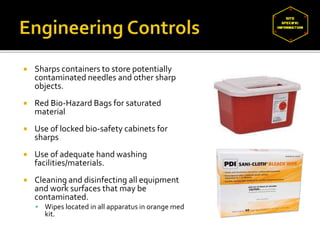
 Sharps containers to store potentially
contaminated needles and other sharp
objects.
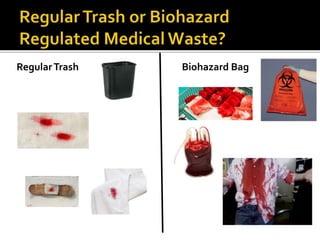
 Red Bio-Hazard Bags for saturated
material
 Use of locked bio-safety cabinets for
sharps
 Use of adequate hand washing
facilities/materials.
 Cleaning and disinfecting all equipment
and work surfaces that may be
contaminated.
 Wipes located in all apparatus in orange med
kit.
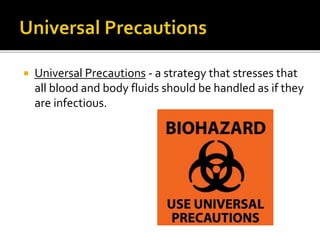
 Universal Precautions - a strategy that stresses that
all blood and body fluids should be handled as if they
are infectious.
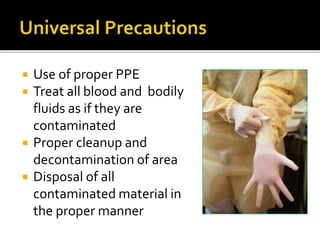
 Use of proper PPE
 Treat all blood and bodily
fluids as if they are
contaminated
 Proper cleanup and
decontamination of area
 Disposal of all
contaminated material in
the proper manner
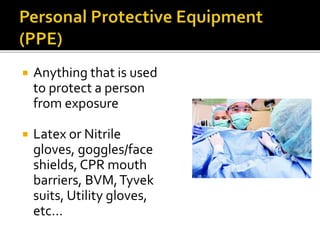
 Anything that is used
to protect a person
from exposure
 Latex or Nitrile
gloves, goggles/face
shields, CPR mouth
barriers, BVM,Tyvek
suits, Utility gloves,
etc…
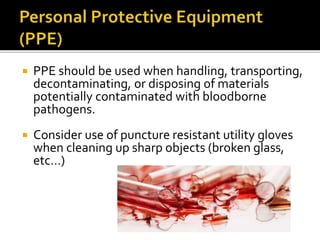
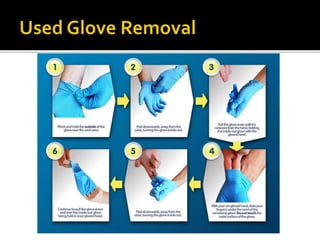
 PPE should be used when handling, transporting,
decontaminating, or disposing of materials
potentially contaminated with bloodborne
pathogens.
 Consider use of puncture resistant utility gloves
when cleaning up sharp objects (broken glass,
etc…)
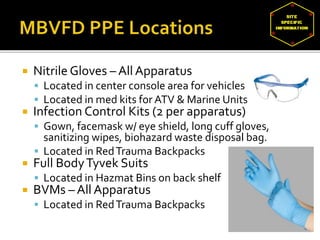
 Nitrile Gloves – All Apparatus
 Located in center console area for vehicles
 Located in med kits for ATV & Marine Units
 Infection Control Kits (2 per apparatus)
 Gown, facemask w/ eye shield, long cuff gloves,
sanitizing wipes, biohazard waste disposal bag.
 Located in RedTrauma Backpacks
 Full BodyTyvek Suits
 Located in Hazmat Bins on back shelf
 BVMs – All Apparatus
 Located in RedTrauma Backpacks
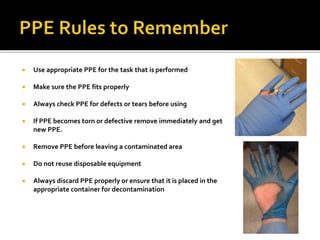
 Use appropriate PPE for the task that is performed
 Make sure the PPE fits properly
 Always check PPE for defects or tears before using
 If PPE becomes torn or defective remove immediately and get
new PPE.
 Remove PPE before leaving a contaminated area
 Do not reuse disposable equipment
 Always discard PPE properly or ensure that it is placed in the
appropriate container for decontamination
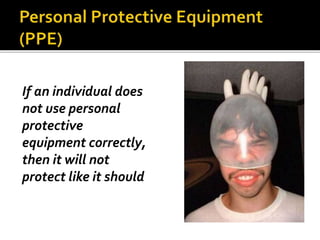
If an individual does
not use personal
protective
equipment correctly,
then it will not
protect like it should
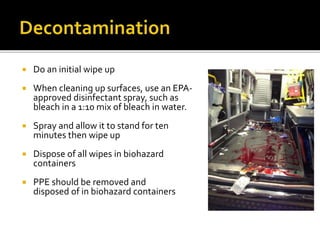
 Do an initial wipe up
 When cleaning up surfaces, use an EPA-
approved disinfectant spray, such as
bleach in a 1:10 mix of bleach in water.
 Spray and allow it to stand for ten
minutes then wipe up
 Dispose of all wipes in biohazard
containers
 PPE should be removed and
disposed of in biohazard containers
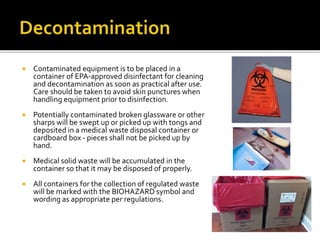
 Contaminated equipment is to be placed in a
container of EPA-approved disinfectant for cleaning
and decontamination as soon as practical after use.
Care should be taken to avoid skin punctures when
handling equipment prior to disinfection.
 Potentially contaminated broken glassware or other
sharps will be swept up or picked up with tongs and
deposited in a medical waste disposal container or
cardboard box - pieces shall not be picked up by
hand.
 Medical solid waste will be accumulated in the
container so that it may be disposed of properly.
 All containers for the collection of regulated waste
will be marked with the BIOHAZARD symbol and
wording as appropriate per regulations.
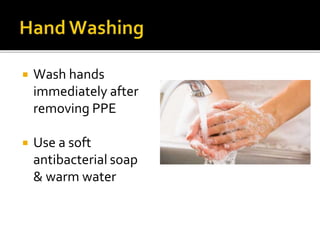
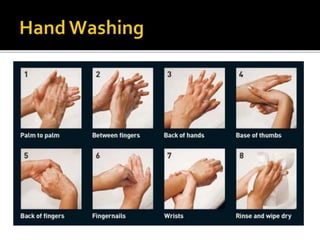
 Wash hands
immediately after
removing PPE
 Use a soft
antibacterial soap
& warm water
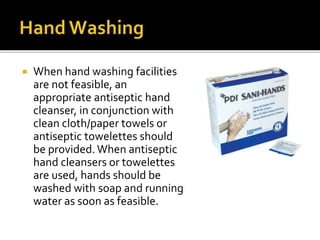
 When hand washing facilities
are not feasible, an
appropriate antiseptic hand
cleanser, in conjunction with
clean cloth/paper towels or
antiseptic towelettes should
be provided.When antiseptic
hand cleansers or towelettes
are used, hands should be
washed with soap and running
water as soon as feasible.
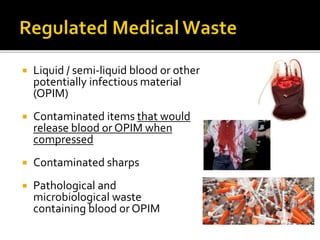
 Liquid / semi-liquid blood or other
potentially infectious material
(OPIM)
 Contaminated items that would
release blood or OPIM when
compressed
 Contaminated sharps
 Pathological and
microbiological waste
containing blood or OPIM
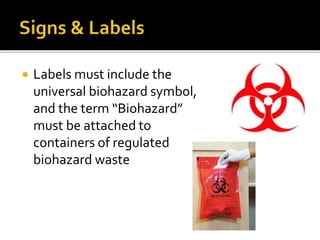
 Labels must include the
universal biohazard symbol,
and the term “Biohazard”
must be attached to
containers of regulated
biohazard waste
RegularTrash Biohazard Bag
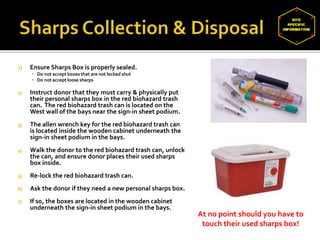
1) Ensure Sharps Box is properly sealed.
▪ Do not accept boxes that are not locked shut
▪ Do not accept loose sharps
2) Instruct donor that they must carry & physically put
their personal sharps box in the red biohazard trash
can. The red biohazard trash can is located on the
West wall of the bays near the sign-in sheet podium.
3) The allen wrench key for the red biohazard trash can
is located inside the wooden cabinet underneath the
sign-in sheet podium in the bays.
4) Walk the donor to the red biohazard trash can, unlock
the can, and ensure donor places their used sharps
box inside.
5) Re-lock the red biohazard trash can.
6) Ask the donor if they need a new personal sharps box.
7) If so, the boxes are located in the wooden cabinet
underneath the sign-in sheet podium in the bays.
At no point should you have to
touch their used sharps box!
 Although the most
important strategy for
reducing the risk of
occupational HIV
transmission is to prevent
occupational exposures,
plans for post-exposure
management of health
care personnel should be in
place.
 Exposure Incident - A specific incident of contact
with potentially infectious bodily fluid
 If there are no infiltrations of mucous membranes or
open skin surfaces, it is not considered an
occupational exposure
 Report all accidents involving blood or bodily
fluids immediately to the officer in charge
 Post-exposure medical evaluations are offered
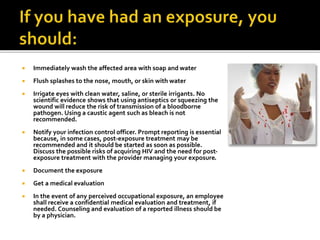
 Immediately wash the affected area with soap and water
 Flush splashes to the nose, mouth, or skin with water
 Irrigate eyes with clean water, saline, or sterile irrigants. No
scientific evidence shows that using antiseptics or squeezing the
wound will reduce the risk of transmission of a bloodborne
pathogen. Using a caustic agent such as bleach is not
recommended.
 Notify your infection control officer. Prompt reporting is essential
because, in some cases, post-exposure treatment may be
recommended and it should be started as soon as possible.
Discuss the possible risks of acquiring HIV and the need for post-
exposure treatment with the provider managing your exposure.
 Document the exposure
 Get a medical evaluation
 In the event of any perceived occupational exposure, an employee
shall receive a confidential medical evaluation and treatment, if
needed. Counseling and evaluation of a reported illness should be
by a physician.
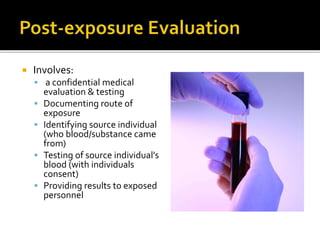
 Involves:
 a confidential medical
evaluation & testing
 Documenting route of
exposure
 Identifying source individual
(who blood/substance came
from)
 Testing of source individual’s
blood (with individuals
consent)
 Providing results to exposed
personnel
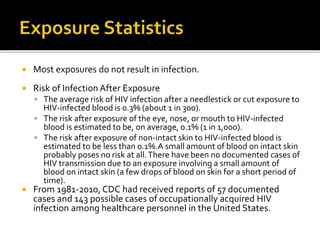
 Most exposures do not result in infection.
 Risk of Infection After Exposure
 The average risk of HIV infection after a needlestick or cut exposure to
HIV-infected blood is 0.3% (about 1 in 300).
 The risk after exposure of the eye, nose, or mouth to HIV-infected
blood is estimated to be, on average, 0.1% (1 in 1,000).
 The risk after exposure of non-intact skin to HIV-infected blood is
estimated to be less than 0.1%.A small amount of blood on intact skin
probably poses no risk at all.There have been no documented cases of
HIV transmission due to an exposure involving a small amount of
blood on intact skin (a few drops of blood on skin for a short period of
time).
 From 1981-2010, CDC had received reports of 57 documented
cases and 143 possible cases of occupationally acquired HIV
infection among healthcare personnel in the United States.
 Strongly endorsed by
medical communities
 Offered to all
department
personnel, free of
charge, before being
assigned to duties
with a potential for
exposure
 All Personnel must receive the
vaccine, or sign a Declination
Form.
 Declining of initial vaccination
can be rescinded at any time.
 Vaccination provided at no
cost to department personnel
 WHEN?
 At the time of initial
assignment to tasks where
occupational exposure may
take place
 At least annually there after
▪ Annual training must be
provided within one year of
their previous training
 Copy of the Department’s Exposure Control
Plan kept in the Chief’s office
 Copy of OSHA BBP Regulation 29 CFR
1910.1030 kept in the Chief’s office
 Exposure Control Plan reviewed and updated
as necessary annually
 Declination form on file for all personnel
 Medical records include:
 Hepatitis B vaccination status
 Post-exposure evaluation and follow-
up results
 Medical records must be
controlled, access limited and
stored separate
 Medical records must be retained
for duration of membership plus
30 years
 Training records include:
 Training dates
 Contents of the training
 Signature of trainer and
trainee
 Name and rank/position
 Records must be retained
for 3 years
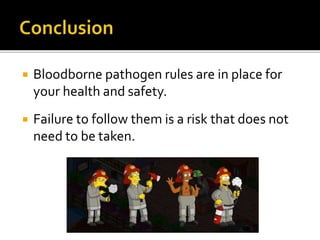
 Bloodborne pathogen rules are in place for
your health and safety.
 Failure to follow them is a risk that does not
need to be taken.
Dave Micka
(321) 288-5473
Gavin Brown
(321) 288-0452
JimTurner
(321) 258-4679
 https://www.cdc.gov/hiv/basics/whatishiv.html
 http://www.who.int/mediacentre/factsheets/fs164/en/
 http://www.who.int/mediacentre/factsheets/fs204/en/
 http://www.targetsolutions.com
 MBVFD BBP PowerPoint by Dave Micka (old version)

BBP 2023.pptx

  • 2.
     Review theentire PowerPoint presentation.  If you have any questions on the material presented, the Hepatitis BVaccine, or Infection Control Procedures, please contact your Instructor immediately. Instructors are available 24/7 to answer questions in real time.
  • 3.
    LEAD INSTRUCTOR:  CaptainJim Turner – Registered Nurse & Paramedic ▪ 20 years experience in Fire & EMS fields ▪ MBVFD EMS Training Officer ▪ (321) 258-4679 ADDITIONAL INSTRUCTORS:  Gavin Brown – Fire Chief & Certified EMT ▪ 16 years in experience in Fire & EMS fields ▪ BLS/Stop the Bleed/Tactical EMS Instructor ▪ (321) 288-0452  Dave Micka – Health & Safety Officer ▪ 36 years in the fire service ▪ Retired safety program coordinator for ULA ▪ (321) 288-5473
  • 4.
     Discuss standardsrelating to Bloodborne Pathogen (BBP) training.  Learn about common BBP related diseases such as HIV, AIDS, Hepatitis-B, and Hepatitis-C.  Learn about BBP Safety, Controls, & Personal Protective Equipment (PPE)  Review Site Specific Information  Review MBVFD Exposure Control Plan The more you know, the better you will perform in real situations!
  • 5.
     OSHA 29CFR 1910.1030  (Standard on Bloodborne Pathogens)  Adopted by State of Florida Administrative Code in 1993.  Anyone whose job requires potential exposure to bloodborne pathogens is required to complete annual training.
  • 6.
     Bloodborne pathogensare infectious microorganisms in human blood that can cause disease in humans.
  • 7.
  • 8.
     Hepatitis B(HBV)  Hepatitis C (HCV)  Human Immunodeficiency Virus (HIV)  Malaria  Brucellosis  Syphilis  Viral Hemorrhagic Fever  Ebola  Marburg
  • 9.
     Hepatitis Bis a viral infection that attacks the liver.  The virus is transmitted through contact with the blood or other body fluids of an infected person.  HBV can survive for at least 1 week in dried blood.  May lead to chronic liver disease, liver cancer, and death  Symptoms include: jaundice, fatigue, abdominal pain, loss of appetite, intermittent nausea , vomiting  Symptoms can occur 1-9 months after exposure
  • 10.
     An estimated257 million people are living with hepatitis B virus infection (defined as hepatitis B surface antigen positive).  Estimated 1.25 million Americans are infected.  In 2015, hepatitis B resulted in 887 000 deaths, mostly from complications (including cirrhosis and hepatocellular carcinoma).  Vaccination available since 1982  HBV can be prevented by currently available safe and effective vaccine.
  • 11.
     Hepatitis Cis a liver disease caused by the hepatitis C virus.  It is the most common bloodborne infection in the United States.  The virus can range in severity from a mild illness lasting a few weeks to a serious, lifelong illness.  Symptoms can include: jaundice, fatigue, abdominal pain, loss of appetite, intermittent nausea, vomiting, chronic liver disease, death.  The most common modes of infection are through exposure to small quantities of blood.  injection drug use  unsafe injection practices  unsafe health care  and the transfusion of unscreened blood and blood products.
  • 12.
     Globally, anestimated 71 million people have chronic hepatitis C infection.  A significant number of those who are chronically infected will develop cirrhosis or liver cancer.  Approximately 399,000 people die each year from hepatitis C,  mostly from cirrhosis and hepatocellular carcinoma.  Antiviral medicines can cure more than 95% of persons with hepatitis C infection, thereby reducing the risk of death from liver cancer and cirrhosis, but access to diagnosis and treatment is low.  There is currently no vaccine for hepatitis C; however research in this area is ongoing.
  • 13.
     HIV isthe virus that causes AIDS  AIDS is the end stage of HIV infection.  HIV infection causes the body's immune system to break down so that the body can't fight off illnesses.
  • 14.
     From thetime a person is infected, he or she can infect others, even if no symptoms are present.  A test using blood or fluids from inside the mouth can be done to find the antibodies that would mean someone had HIV infection.  HIV can be in a person's body for years (2-12+) without producing any symptoms or signs of illness. HIV does not survive long outside of the human body
  • 15.
    HIV is notspread through everyday or “casual” contact with infected people.
  • 16.
     In recentyears, about half the people with HIV have developed AIDS within 12 years, but the time between infection with HIV and the onset of AIDS can vary greatly.  Today there are promising new medical treatments that can postpone many of the illnesses associated with AIDS.
  • 17.
     AIDS isthe most severe phase of HIV infection.  People with AIDS have such badly damaged immune systems that they get an increasing number of severe illnesses, called opportunistic illnesses.  Without treatment, people with AIDS typically survive about 3 years.  People are diagnosed with AIDS when their CD4 cell count drops below 200 cells/mm or if they develop certain opportunistic illnesses. People with AIDS can have a high viral load and be very infectious.
  • 18.
     In Florida,approximately 100,000 persons are infected with HIV.  About one quarter of those (25,000), are aware of their HIV infection and are not receiving medical care to prolong their lives, improve the quality of their lives, and lower the risk that they will spread the infection to others.  In the most recent statistic from the CDC (December, 2002), occupational exposure to HIV has resulted in 57 documented and 139 possible cases of HIV seroconversion among healthcare personnel (HCP) in the United States.
  • 19.
    Part 3 I willalways wear all of my PPE I will always wear all of my PPE I will always wear all of my PPE I will always wear all of my PPE I will always wear all of my PPE I will always wear all of my PPE
  • 20.
     Blood  Semen&Vaginal secretions  Cerebrospinal fluid: Fluid pertaining to or affecting the brain and the spinal cord.  Synovial fluid: A clear, viscid lubricating fluid secreted by membranes in joint cavities and sheaths of tendons.  Pleural fluid: Fluid in the lungs or in the thin serous membrane that envelops each lung and folds back to make a lining for the chest cavity.  Pericardial fluid: Fluid in the membranous sac filled with serous fluid that encloses the heart and the roots of the aorta and other large blood vessels.
  • 21.
     Peritoneal fluid:Fluid from the serous membrane that lines the walls of the abdominal cavity.  Amniotic fluid:The fluid surrounding the fetus in the womb.  Saliva in dental procedures  Any body fluid that is visibly contaminated with blood  Unfixed human tissue or organs (other than intact skin)  HIV-containing cell, tissue or organ cultures  HIV-containing culture media or other solutions
  • 22.
     For diseasetransmission to occur, a pathogen must have a way to enter the blood stream.  Most Common Routes of Transmission:  Mucous membranes ▪ Eyes, Mouth, Nose  Non-intact skin ▪ Cuts, open wounds, insect bites, breaks in skin, etc…  Contaminated sharps/needles ▪ “Needlestick” Injuries
  • 23.
     Medical AssistCalls  Accident scene w/ injuries  Administering first aid  Open wounds  Burns  Post-accident cleanup  Handling of any waste products  Used Syringe Disposal
  • 24.
     Many needlesticksand other cuts can be prevented by using safer techniques  Not recapping needles by hand  Disposing of used needles in appropriate sharps disposal containers  Use medical devices with safety features designed to prevent injuries.  Using appropriate barriers such as gloves, eye and face protection, or gowns when contact with blood is expected can prevent many exposures to the eyes, nose, mouth, or skin.
  • 25.
     Sharps containersto store potentially contaminated needles and other sharp objects.  Red Bio-Hazard Bags for saturated material  Use of locked bio-safety cabinets for sharps  Use of adequate hand washing facilities/materials.  Cleaning and disinfecting all equipment and work surfaces that may be contaminated.  Wipes located in all apparatus in orange med kit.
  • 26.
     Universal Precautions- a strategy that stresses that all blood and body fluids should be handled as if they are infectious.
  • 27.
     Use ofproper PPE  Treat all blood and bodily fluids as if they are contaminated  Proper cleanup and decontamination of area  Disposal of all contaminated material in the proper manner
  • 28.
     Anything thatis used to protect a person from exposure  Latex or Nitrile gloves, goggles/face shields, CPR mouth barriers, BVM,Tyvek suits, Utility gloves, etc…
  • 29.
     PPE shouldbe used when handling, transporting, decontaminating, or disposing of materials potentially contaminated with bloodborne pathogens.  Consider use of puncture resistant utility gloves when cleaning up sharp objects (broken glass, etc…)
  • 30.
     Nitrile Gloves– All Apparatus  Located in center console area for vehicles  Located in med kits for ATV & Marine Units  Infection Control Kits (2 per apparatus)  Gown, facemask w/ eye shield, long cuff gloves, sanitizing wipes, biohazard waste disposal bag.  Located in RedTrauma Backpacks  Full BodyTyvek Suits  Located in Hazmat Bins on back shelf  BVMs – All Apparatus  Located in RedTrauma Backpacks
  • 31.
     Use appropriatePPE for the task that is performed  Make sure the PPE fits properly  Always check PPE for defects or tears before using  If PPE becomes torn or defective remove immediately and get new PPE.  Remove PPE before leaving a contaminated area  Do not reuse disposable equipment  Always discard PPE properly or ensure that it is placed in the appropriate container for decontamination
  • 33.
    If an individualdoes not use personal protective equipment correctly, then it will not protect like it should
  • 34.
     Do aninitial wipe up  When cleaning up surfaces, use an EPA- approved disinfectant spray, such as bleach in a 1:10 mix of bleach in water.  Spray and allow it to stand for ten minutes then wipe up  Dispose of all wipes in biohazard containers  PPE should be removed and disposed of in biohazard containers
  • 35.
     Contaminated equipmentis to be placed in a container of EPA-approved disinfectant for cleaning and decontamination as soon as practical after use. Care should be taken to avoid skin punctures when handling equipment prior to disinfection.  Potentially contaminated broken glassware or other sharps will be swept up or picked up with tongs and deposited in a medical waste disposal container or cardboard box - pieces shall not be picked up by hand.  Medical solid waste will be accumulated in the container so that it may be disposed of properly.  All containers for the collection of regulated waste will be marked with the BIOHAZARD symbol and wording as appropriate per regulations.
  • 36.
     Wash hands immediatelyafter removing PPE  Use a soft antibacterial soap & warm water
  • 38.
     When handwashing facilities are not feasible, an appropriate antiseptic hand cleanser, in conjunction with clean cloth/paper towels or antiseptic towelettes should be provided.When antiseptic hand cleansers or towelettes are used, hands should be washed with soap and running water as soon as feasible.
  • 39.
     Liquid /semi-liquid blood or other potentially infectious material (OPIM)  Contaminated items that would release blood or OPIM when compressed  Contaminated sharps  Pathological and microbiological waste containing blood or OPIM
  • 40.
     Labels mustinclude the universal biohazard symbol, and the term “Biohazard” must be attached to containers of regulated biohazard waste
  • 41.
  • 42.
    1) Ensure SharpsBox is properly sealed. ▪ Do not accept boxes that are not locked shut ▪ Do not accept loose sharps 2) Instruct donor that they must carry & physically put their personal sharps box in the red biohazard trash can. The red biohazard trash can is located on the West wall of the bays near the sign-in sheet podium. 3) The allen wrench key for the red biohazard trash can is located inside the wooden cabinet underneath the sign-in sheet podium in the bays. 4) Walk the donor to the red biohazard trash can, unlock the can, and ensure donor places their used sharps box inside. 5) Re-lock the red biohazard trash can. 6) Ask the donor if they need a new personal sharps box. 7) If so, the boxes are located in the wooden cabinet underneath the sign-in sheet podium in the bays. At no point should you have to touch their used sharps box!
  • 43.
     Although themost important strategy for reducing the risk of occupational HIV transmission is to prevent occupational exposures, plans for post-exposure management of health care personnel should be in place.
  • 44.
     Exposure Incident- A specific incident of contact with potentially infectious bodily fluid  If there are no infiltrations of mucous membranes or open skin surfaces, it is not considered an occupational exposure  Report all accidents involving blood or bodily fluids immediately to the officer in charge  Post-exposure medical evaluations are offered
  • 45.
     Immediately washthe affected area with soap and water  Flush splashes to the nose, mouth, or skin with water  Irrigate eyes with clean water, saline, or sterile irrigants. No scientific evidence shows that using antiseptics or squeezing the wound will reduce the risk of transmission of a bloodborne pathogen. Using a caustic agent such as bleach is not recommended.  Notify your infection control officer. Prompt reporting is essential because, in some cases, post-exposure treatment may be recommended and it should be started as soon as possible. Discuss the possible risks of acquiring HIV and the need for post- exposure treatment with the provider managing your exposure.  Document the exposure  Get a medical evaluation  In the event of any perceived occupational exposure, an employee shall receive a confidential medical evaluation and treatment, if needed. Counseling and evaluation of a reported illness should be by a physician.
  • 46.
     Involves:  aconfidential medical evaluation & testing  Documenting route of exposure  Identifying source individual (who blood/substance came from)  Testing of source individual’s blood (with individuals consent)  Providing results to exposed personnel
  • 47.
     Most exposuresdo not result in infection.  Risk of Infection After Exposure  The average risk of HIV infection after a needlestick or cut exposure to HIV-infected blood is 0.3% (about 1 in 300).  The risk after exposure of the eye, nose, or mouth to HIV-infected blood is estimated to be, on average, 0.1% (1 in 1,000).  The risk after exposure of non-intact skin to HIV-infected blood is estimated to be less than 0.1%.A small amount of blood on intact skin probably poses no risk at all.There have been no documented cases of HIV transmission due to an exposure involving a small amount of blood on intact skin (a few drops of blood on skin for a short period of time).  From 1981-2010, CDC had received reports of 57 documented cases and 143 possible cases of occupationally acquired HIV infection among healthcare personnel in the United States.
  • 48.
     Strongly endorsedby medical communities  Offered to all department personnel, free of charge, before being assigned to duties with a potential for exposure
  • 49.
     All Personnelmust receive the vaccine, or sign a Declination Form.  Declining of initial vaccination can be rescinded at any time.  Vaccination provided at no cost to department personnel
  • 50.
     WHEN?  Atthe time of initial assignment to tasks where occupational exposure may take place  At least annually there after ▪ Annual training must be provided within one year of their previous training
  • 51.
     Copy ofthe Department’s Exposure Control Plan kept in the Chief’s office  Copy of OSHA BBP Regulation 29 CFR 1910.1030 kept in the Chief’s office  Exposure Control Plan reviewed and updated as necessary annually  Declination form on file for all personnel
  • 52.
     Medical recordsinclude:  Hepatitis B vaccination status  Post-exposure evaluation and follow- up results  Medical records must be controlled, access limited and stored separate  Medical records must be retained for duration of membership plus 30 years
  • 53.
     Training recordsinclude:  Training dates  Contents of the training  Signature of trainer and trainee  Name and rank/position  Records must be retained for 3 years
  • 54.
     Bloodborne pathogenrules are in place for your health and safety.  Failure to follow them is a risk that does not need to be taken.
  • 55.
    Dave Micka (321) 288-5473 GavinBrown (321) 288-0452 JimTurner (321) 258-4679
  • 56.
     https://www.cdc.gov/hiv/basics/whatishiv.html  http://www.who.int/mediacentre/factsheets/fs164/en/ http://www.who.int/mediacentre/factsheets/fs204/en/  http://www.targetsolutions.com  MBVFD BBP PowerPoint by Dave Micka (old version)