COGNITIVE BEHAVIORAL
THERAPY and MINDFULNESS
Alla Swenson
“If you can change your mind, you can change your life.”
William James
The staff will identify the main concept of Cognitive
Behavioral Therapy at the end of the presentation on
04/25/14.
The staff will identify the role of mindfulness and
positive thinking in CBT at the end of the presentation
on 04/25/14.
The staff will practice new skills of using CBT at the
end of the presentation on 04/25/14.
Objectives
Psychosocial theoretic basis of psychiatric therapy
Concepts of CBT and Mindfulness
ABCDE model
Role of mindfulness and positive thinking
CBT model and Personality Disorder
Recovery plan
CBT case study
Content
Buddhist psychology
Mindfulness
Sigmund Freud (1856-1939)
Founder of psychoanalysis
Abraham Maslow (1921-1970)
Maslow’s hierarchy of needs
Ivan Pavlov (1849-1936)
Classical conditioning phenomenon
Psychosocial Theoretic Basis of
Psychiatric Nursing
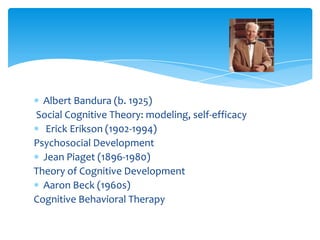
Albert Bandura (b. 1925)
Social Cognitive Theory: modeling, self-efficacy
Erick Erikson (1902-1994)
Psychosocial Development
Jean Piaget (1896-1980)
Theory of Cognitive Development
Aaron Beck (1960s)
Cognitive Behavioral Therapy
The term mindfulness is an English translation of the
Pali word sati. Pali was the language of Buddhist
psychology 2,500 years ago, and mindfulness is the
core teaching of this tradition. Sati connotes
awareness, attention, and remembering.
Mindfulness in Psychotherapy is (1) awareness, (2) of
present experience, (3) with acceptance.
Acceptance = nonjudgmental, kindness, friendliness
Mindfulness
What would you, as a new awareness or visitor to this new
body, notice about the sensations of breathing, as you breathe
in, then out? Notice the sensations in the abdomen, the chest, the
throat, the mouth and nose. You can notice how your attention
wanders, as thoughts come in, sometimes crowding in, and your
attention can follow those thoughts. Just notice as your attention
wanders, then gently bring your focus back to your breath. Minds
do wander, thoughts will come and thoughts will go, that is the
nature of the human mind. As a visitor, you can stand back, notice
those thoughts, feelings, sounds and sensations, and keep bringing
your attention back to your breath.
The Breath
Co-occurring disorders – presence of comorbid mental
illness and a substance use disorder in the same person
Goal of treatment – comprehensive recovery plan for the
complex problem
“We are all here for some special reason. Stop being a prisoner
of your past. Become the architect of your future.”
Robin Sharma
Co-occurring disorders
The Stages of Change Model has five phases:
Pre-contemplation: Avoidance. That is, not seeing a
problem behavior or not considering change.
Contemplation: Acknowledging that there is a problem but
struggling with ambivalence. Weighing pros and cons and
the benefits and barriers to change.
Preparation/Determination: Taking steps and getting ready
to change.
Action/Willpower: Making the change and living the new
behaviors, which is an all-consuming activity.
Maintenance: Maintaining the behavior change that is now
integrated into the person's life.
Relapse: Returning to the previous stage.
Motivational Interviewing
High expectations
Express empathy
Develop discrepancy
Roll with resistance
Support self –efficacy
“If you want light to come into your life, you need to
stand where it is shining.” Guy Finley
PRINCIPLES OF MOTIVATIONAL
INTERVIEWING
CBT – is a highly structured psychotherapeutic method used to alter
distorted beliefs and problem behaviors by identifying and replacing
negative inaccurate thoughts and changing rewards for behaviors
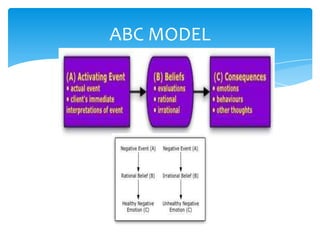
ABCDE MODEL
Activating Event – the actual event and the client’s immediate
interpretations of the event
Beliefs about the event – this evaluation can be rational or irrational
Consequences – how you feel and what you do or other thoughts
Dispute or challenge unreasonable expectations
Effective outlook developed by disputing or challenging negative
belief systems
What is CBT?
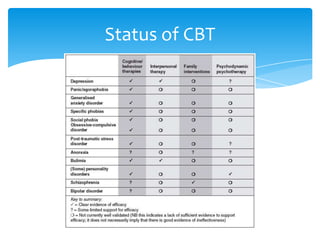
Status of CBT
ABC MODEL
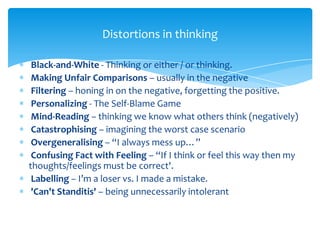
Black-and-White - Thinking or either / or thinking.
Making Unfair Comparisons – usually in the negative
Filtering – honing in on the negative, forgetting the positive.
Personalizing - The Self-Blame Game
Mind-Reading – thinking we know what others think (negatively)
Catastrophising – imagining the worst case scenario
Overgeneralising – “I always mess up…”
Confusing Fact with Feeling – “If I think or feel this way then my
thoughts/feelings must be correct'.
Labelling – I’m a loser vs. I made a mistake.
'Can't Standitis' – being unnecessarily intolerant
Distortions in thinking
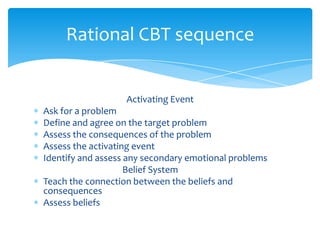
Activating Event
Ask for a problem
Define and agree on the target problem
Assess the consequences of the problem
Assess the activating event
Identify and assess any secondary emotional problems
Belief System
Teach the connection between the beliefs and
consequences
Assess beliefs
Rational CBT sequence
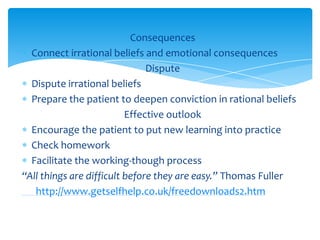
Consequences
Connect irrational beliefs and emotional consequences
Dispute
Dispute irrational beliefs
Prepare the patient to deepen conviction in rational beliefs
Effective outlook
Encourage the patient to put new learning into practice
Check homework
Facilitate the working-though process
“All things are difficult before they are easy.” Thomas Fuller
http://www.getselfhelp.co.uk/freedownloads2.htm
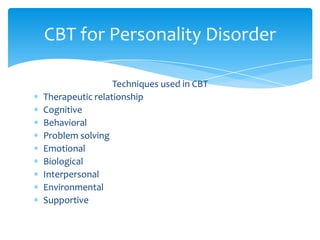
Techniques used in CBT
Therapeutic relationship
Cognitive
Behavioral
Problem solving
Emotional
Biological
Interpersonal
Environmental
Supportive
CBT for Personality Disorder
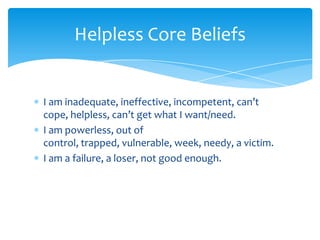
I am inadequate, ineffective, incompetent, can’t
cope, helpless, can’t get what I want/need.
I am powerless, out of
control, trapped, vulnerable, week, needy, a victim.
I am a failure, a loser, not good enough.
Helpless Core Beliefs
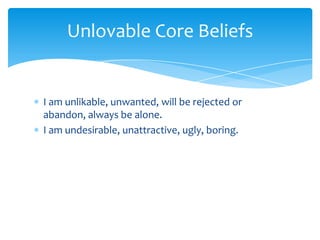
I am unlikable, unwanted, will be rejected or
abandon, always be alone.
I am undesirable, unattractive, ugly, boring.
Unlovable Core Beliefs
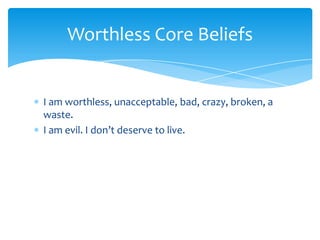
I am worthless, unacceptable, bad, crazy, broken, a
waste.
I am evil. I don’t deserve to live.
Worthless Core Beliefs
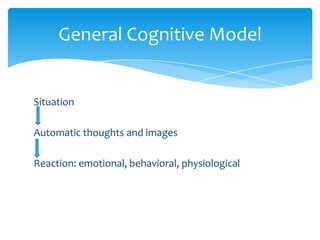
Situation
Automatic thoughts and images
Reaction: emotional, behavioral, physiological
General Cognitive Model
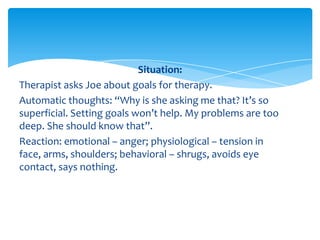
Situation:
Therapist asks Joe about goals for therapy.
Automatic thoughts: “Why is she asking me that? It’s so
superficial. Setting goals won’t help. My problems are too
deep. She should know that”.
Reaction: emotional – anger; physiological – tension in
face, arms, shoulders; behavioral – shrugs, avoids eye
contact, says nothing.
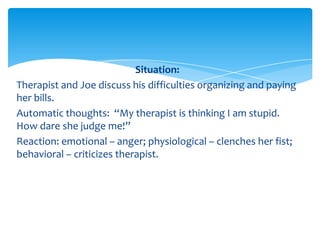
Situation:
Therapist and Joe discuss his difficulties organizing and paying
her bills.
Automatic thoughts: “My therapist is thinking I am stupid.
How dare she judge me!”
Reaction: emotional – anger; physiological – clenches her fist;
behavioral – criticizes therapist.
New idea
High expectations
Positive reinforcement: praise, reassurance,
encouragement
Empathy
Professionalism vs hostility
Non-verbal/verbal
Inspiration
“The purpose of our lives is to be happy”.
Dalai Lama
Communication and personal
attitude
Assessment
Nursing diagnoses
Plan development
Intervention
Evaluation
Nursing Process
Avoid polar opposite beliefs; guide patient toward
adopting something in the middle.
“I am bad”, to “I am okay”.
“I am incompetent”, to “I have strengths and
weakness like everyone else”.
“I am defective”, to “I am normal”.
Develop a New Core Beliefs
Physical, emotional, and spiritual healing
Learn stress reduction therapy
Radically change diet or marriage
Take control over your health: willingness to change, do
research, be proactive
Follow your intuition: body knows what it needs to
heal, change your body-mind-spirit
Use herbs and boost your immune system
Be active physically
The key factors that can make a
real difference
Increase positive emotions: love yourself, life, and others
Embrace social support: "In poverty and other misfortunes
true friends are sure refuge”. Aristotle
Discover your spiritual beliefs
Have strong reason for living
Create your love and happiness and spread to others
“Happiness is an attitude. We either make ourselves
miserable, or happy and strong. The amount of work is the
same.”
Francesca Reigler
Boyd, M. (2008). Psychiatric Nursing. Wolter Kluwer
Health/Lippincott Williams & Wilkins. Philadelphia,
Baltimore, New York, London.
German, C., Siegel, R., Fulton, P. (2005). Mindfulness and
Psychotherapy. The Guilford Press, New York, London.
Winston, A., Rosenthal, R., Pinsker, H. (2012). Learning
Supportive Psychotherapy. American Psychiatric
Publishing. Washington DC, London.
References

Cognitive behavioral therapy

  • 1.
    COGNITIVE BEHAVIORAL THERAPY andMINDFULNESS Alla Swenson “If you can change your mind, you can change your life.” William James
  • 2.
    The staff willidentify the main concept of Cognitive Behavioral Therapy at the end of the presentation on 04/25/14. The staff will identify the role of mindfulness and positive thinking in CBT at the end of the presentation on 04/25/14. The staff will practice new skills of using CBT at the end of the presentation on 04/25/14. Objectives
  • 3.
    Psychosocial theoretic basisof psychiatric therapy Concepts of CBT and Mindfulness ABCDE model Role of mindfulness and positive thinking CBT model and Personality Disorder Recovery plan CBT case study Content
  • 4.
    Buddhist psychology Mindfulness Sigmund Freud(1856-1939) Founder of psychoanalysis Abraham Maslow (1921-1970) Maslow’s hierarchy of needs Ivan Pavlov (1849-1936) Classical conditioning phenomenon Psychosocial Theoretic Basis of Psychiatric Nursing
  • 5.
    Albert Bandura (b.1925) Social Cognitive Theory: modeling, self-efficacy Erick Erikson (1902-1994) Psychosocial Development Jean Piaget (1896-1980) Theory of Cognitive Development Aaron Beck (1960s) Cognitive Behavioral Therapy
  • 6.
    The term mindfulnessis an English translation of the Pali word sati. Pali was the language of Buddhist psychology 2,500 years ago, and mindfulness is the core teaching of this tradition. Sati connotes awareness, attention, and remembering. Mindfulness in Psychotherapy is (1) awareness, (2) of present experience, (3) with acceptance. Acceptance = nonjudgmental, kindness, friendliness Mindfulness
  • 7.
    What would you,as a new awareness or visitor to this new body, notice about the sensations of breathing, as you breathe in, then out? Notice the sensations in the abdomen, the chest, the throat, the mouth and nose. You can notice how your attention wanders, as thoughts come in, sometimes crowding in, and your attention can follow those thoughts. Just notice as your attention wanders, then gently bring your focus back to your breath. Minds do wander, thoughts will come and thoughts will go, that is the nature of the human mind. As a visitor, you can stand back, notice those thoughts, feelings, sounds and sensations, and keep bringing your attention back to your breath. The Breath
  • 8.
    Co-occurring disorders –presence of comorbid mental illness and a substance use disorder in the same person Goal of treatment – comprehensive recovery plan for the complex problem “We are all here for some special reason. Stop being a prisoner of your past. Become the architect of your future.” Robin Sharma Co-occurring disorders
  • 9.
    The Stages ofChange Model has five phases: Pre-contemplation: Avoidance. That is, not seeing a problem behavior or not considering change. Contemplation: Acknowledging that there is a problem but struggling with ambivalence. Weighing pros and cons and the benefits and barriers to change. Preparation/Determination: Taking steps and getting ready to change. Action/Willpower: Making the change and living the new behaviors, which is an all-consuming activity. Maintenance: Maintaining the behavior change that is now integrated into the person's life. Relapse: Returning to the previous stage. Motivational Interviewing
  • 10.
    High expectations Express empathy Developdiscrepancy Roll with resistance Support self –efficacy “If you want light to come into your life, you need to stand where it is shining.” Guy Finley PRINCIPLES OF MOTIVATIONAL INTERVIEWING
  • 11.
    CBT – isa highly structured psychotherapeutic method used to alter distorted beliefs and problem behaviors by identifying and replacing negative inaccurate thoughts and changing rewards for behaviors ABCDE MODEL Activating Event – the actual event and the client’s immediate interpretations of the event Beliefs about the event – this evaluation can be rational or irrational Consequences – how you feel and what you do or other thoughts Dispute or challenge unreasonable expectations Effective outlook developed by disputing or challenging negative belief systems What is CBT?
  • 12.
  • 13.
  • 14.
    Black-and-White - Thinkingor either / or thinking. Making Unfair Comparisons – usually in the negative Filtering – honing in on the negative, forgetting the positive. Personalizing - The Self-Blame Game Mind-Reading – thinking we know what others think (negatively) Catastrophising – imagining the worst case scenario Overgeneralising – “I always mess up…” Confusing Fact with Feeling – “If I think or feel this way then my thoughts/feelings must be correct'. Labelling – I’m a loser vs. I made a mistake. 'Can't Standitis' – being unnecessarily intolerant Distortions in thinking
  • 15.
    Activating Event Ask fora problem Define and agree on the target problem Assess the consequences of the problem Assess the activating event Identify and assess any secondary emotional problems Belief System Teach the connection between the beliefs and consequences Assess beliefs Rational CBT sequence
  • 16.
    Consequences Connect irrational beliefsand emotional consequences Dispute Dispute irrational beliefs Prepare the patient to deepen conviction in rational beliefs Effective outlook Encourage the patient to put new learning into practice Check homework Facilitate the working-though process “All things are difficult before they are easy.” Thomas Fuller http://www.getselfhelp.co.uk/freedownloads2.htm
  • 17.
    Techniques used inCBT Therapeutic relationship Cognitive Behavioral Problem solving Emotional Biological Interpersonal Environmental Supportive CBT for Personality Disorder
  • 18.
    I am inadequate,ineffective, incompetent, can’t cope, helpless, can’t get what I want/need. I am powerless, out of control, trapped, vulnerable, week, needy, a victim. I am a failure, a loser, not good enough. Helpless Core Beliefs
  • 19.
    I am unlikable,unwanted, will be rejected or abandon, always be alone. I am undesirable, unattractive, ugly, boring. Unlovable Core Beliefs
  • 20.
    I am worthless,unacceptable, bad, crazy, broken, a waste. I am evil. I don’t deserve to live. Worthless Core Beliefs
  • 21.
    Situation Automatic thoughts andimages Reaction: emotional, behavioral, physiological General Cognitive Model
  • 22.
    Situation: Therapist asks Joeabout goals for therapy. Automatic thoughts: “Why is she asking me that? It’s so superficial. Setting goals won’t help. My problems are too deep. She should know that”. Reaction: emotional – anger; physiological – tension in face, arms, shoulders; behavioral – shrugs, avoids eye contact, says nothing.
  • 23.
    Situation: Therapist and Joediscuss his difficulties organizing and paying her bills. Automatic thoughts: “My therapist is thinking I am stupid. How dare she judge me!” Reaction: emotional – anger; physiological – clenches her fist; behavioral – criticizes therapist.
  • 24.
    New idea High expectations Positivereinforcement: praise, reassurance, encouragement Empathy Professionalism vs hostility Non-verbal/verbal Inspiration “The purpose of our lives is to be happy”. Dalai Lama Communication and personal attitude
  • 25.
  • 26.
    Avoid polar oppositebeliefs; guide patient toward adopting something in the middle. “I am bad”, to “I am okay”. “I am incompetent”, to “I have strengths and weakness like everyone else”. “I am defective”, to “I am normal”. Develop a New Core Beliefs
  • 27.
    Physical, emotional, andspiritual healing Learn stress reduction therapy Radically change diet or marriage Take control over your health: willingness to change, do research, be proactive Follow your intuition: body knows what it needs to heal, change your body-mind-spirit Use herbs and boost your immune system Be active physically The key factors that can make a real difference
  • 28.
    Increase positive emotions:love yourself, life, and others Embrace social support: "In poverty and other misfortunes true friends are sure refuge”. Aristotle Discover your spiritual beliefs Have strong reason for living Create your love and happiness and spread to others “Happiness is an attitude. We either make ourselves miserable, or happy and strong. The amount of work is the same.” Francesca Reigler
  • 29.
    Boyd, M. (2008).Psychiatric Nursing. Wolter Kluwer Health/Lippincott Williams & Wilkins. Philadelphia, Baltimore, New York, London. German, C., Siegel, R., Fulton, P. (2005). Mindfulness and Psychotherapy. The Guilford Press, New York, London. Winston, A., Rosenthal, R., Pinsker, H. (2012). Learning Supportive Psychotherapy. American Psychiatric Publishing. Washington DC, London. References