Presented by-
Jasleen Kaur Brar
Infection
• Infection is the entry &
multiplication of an
infectious agent in the
tissues of the host
• Bacteria, virues, fungus
etc…
2
Infection
• One of the leading causes of preventable
death in hospital
• CDC estimates approx. 2 million
preventable infections in hospital
• Importance of keeping hospitals clean
and infection free is greater now than
ever.
3
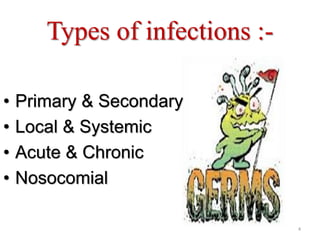
Types of infections :-
• Primary & Secondary
• Local & Systemic
• Acute & Chronic
• Nosocomial
4
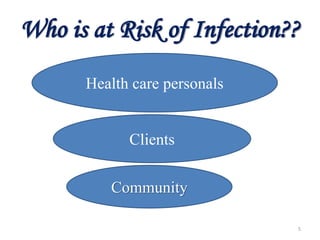
Who is at Risk of Infection??
Health care personals
Clients
Community
5
Chain of Infection
In order for infection to
spread, several steps (chain
of infection) must occur. An
infection will develop only if
this chain remains intact.
6
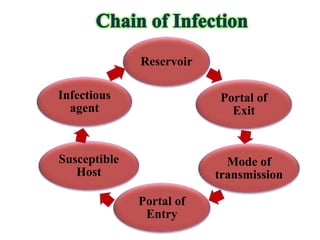
Reservoir
Portal of
Exit
Mode of
transmission
Portal of
Entry
Susceptible
Host
Infectious
agent
BREAKING THE
CHAIN OF
INFECTION
prevent the transmission of
infection
8
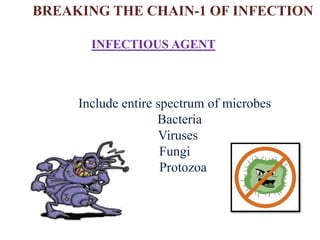
Include entire spectrum of microbes
Bacteria
Viruses
Fungi
Protozoa
INFECTIOUS AGENT
BREAKING THE CHAIN-1 OF INFECTION
 Routinely send Blood cultures, urine culture , skin
swabs, throat swabs, tracheal aspirate cultures.
 Send Endotracheal Tube tip, Urinary catheter tip and
central line tip for culture after removal.
BREAKING THE CHAIN 1 Cont…..
• Proper cleaning by water and mechanical
action with or without detergents.
• Disinfection
• Sterilization of contaminated objects.
Sterilization and disinfection are physical
processes, involving the use of heat, radiation,
chemical processes, etc., which use various
solutions or gases.
BREAKING THE CHAIN 1 Cont…..
DISINFECTANTS
HIGH LEVEL DISINFECTANTS
• Activated Glutaraldehyde (cidex2%)
• Sodium hypochlorite 1%.
• Carbolic Solution 5%
• Bleaching Powder 1%
LOW LEVEL DISINFECTANTS
• Methylated spirit 70%
• Betadine solution 10%
• Savlon 1%
DISINFECTANTS
BREAKING THE CHAIN 1 Cont…..
Regular Cleaning and Disinfection of
• Bed Trolleys
• I.V stands
• Table & Chairs
• Resuscitation equipments
• Suction Apparatus
• Ventilator tubings
• Leads
•Infusion Pumps
•Floor
•Windows
•Walls
•Ceiling
•Wash Basins
•Drums for Biomedical Waste
BREAKING THE CHAIN 1 Cont…..
For Sterilized Items:
 Store at dry & clean place.
Put date of sterilization.
Use within 72 hrs of sterilization.
Check date before use.
 Put indicator tape.
Follow manufacturer’s advice for particular piece of
equipment & their preferable method of sterilization.
BREAKING THE CHAIN 2 Cont…..
BREAKING THE CHAIN-2 OF INFECTION
RESERVOIRS
It includes:
Humans
Animals
The inanimate environment
(water, food, soil and soiled medical equipment)
EMPLOYEE HEALTH
Immunization of health personnel’s e.g. Hepatitis B
vaccination.
Regular check up for early detection of any
communicable disease
Restriction from work of patient contact when infected
with communicable disease.
BREAKING THE CHAIN 2 Cont…..
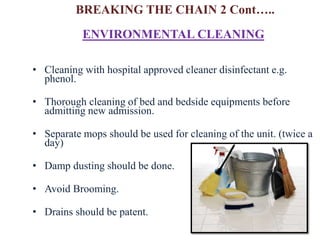
• Cleaning with hospital approved cleaner disinfectant e.g.
phenol.
• Thorough cleaning of bed and bedside equipments before
admitting new admission.
• Separate mops should be used for cleaning of the unit. (twice a
day)
• Damp dusting should be done.
• Avoid Brooming.
• Drains should be patent.
ENVIRONMENTAL CLEANING
BREAKING THE CHAIN 2 Cont…..
• Keep the bed sheets dry and clean.
• Change sheets every day.
• Do not shake blankets and linen in ICU area.
• Do not throw them on floor.
• Soiled linen counting should be done in separate
place.
HANDLING OF LINEN
BREAKING THE CHAIN 2 Cont…..
• Traffic should be restricted except for doctors, nurses
& supportive staff.
• Allow only one attendant.(3-4hrs).
• Keep the doors and windows closed.
• Instruct the attendants about hand washing, disposal
of waste , hygienic preparation of baby’s feed etc.
TRAFFIC CONTROL
BREAKING THE CHAIN 2 Cont…..
• No personal clothing, flowers and eatables
should be allowed.
• Mobile phones should not be allowed inside
the area.
• Machines(X-Rays ,echo machines ,ultrasound
machines) from outside should be cleaned with
spirit before their use.
BREAKING THE CHAIN 2 Cont…..
• Measures to be taken to avoid their entry into the unit
i.e. by proper cleaning, sealing & draining.
• Patient diet should be kept in covered containers.
• Keep fly flappers on each bedside of patient.
• Fly trapper should be in working order.
• Pesticides sprays should be used weekly.
PEST CONTROL
BREAKING THE CHAIN 2 Cont…..
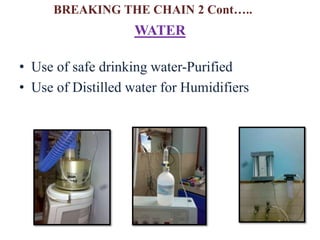
• Use of safe drinking water-Purified
• Use of Distilled water for Humidifiers
WATER
BREAKING THE CHAIN 2 Cont…..
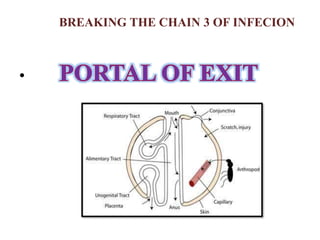
BREAKING THE CHAIN 3 OF INFECION
•
BREAKING THE CHAIN 3 Contd..
• Practise aseptic precautions.
• Avoid talking directly into the client’s face to
prevent droplet infections.
• Wearing of masks is important once the nurse
herself has infection or deals with clients
suffering from infections.
• Careful handling of wastes like urine, faeces,
emesis and blood is important.
• Disposable gloves should be worn to prevent
direct contact with wastes or infected materials.
BREAKING THE CHAIN 4 Cont…..
• Airborne precautions
• Well ventilated, private room with door closed,
should be there for patient with respiratory bacterial or
viral infection.
• Place client in a private room that has negative air
pressure 6-12 air changes per hour.
• Wear masks when entering the room of a client who
is known or suspected of having primary tuberculosis.
• Susceptible people should not enter the room of a
client who has measles or chickenpox. If they must
enter they should wear a respirator.
• Limit movement of client outside the room to
essential purposes.
• To be followed in case of Meningitis,
Diphtheria, pertusis, and influenza etc., mumps
• Place client in private room.
• If a private room is not available, place client
with another client who is infected with same
organism.
• Wear a mask if working within 3 feet of the
client.
• Limit movement of client outside the room to
essential purposes. Place surgical mask during
transport.
To be followed in case of cellulitis, acute diarrhea, bronchiolitis
etc.
• Place client in private room.
• Wear gloves, Remove gloves before leaving client
room.
• Clean hands immediately after removing gloves. Use
antimicrobial agent.
• Wear gown when entering room if there is a
possibility of contact with infected surfaces or items
or if the client is incontinent or has diarrhoea,
colostomy or wound drainage not covered by a
dressing.
• Remove gown in the client’s room.
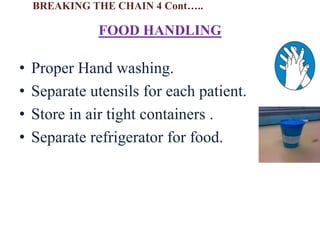
• Proper Hand washing.
• Separate utensils for each patient.
• Store in air tight containers .
• Separate refrigerator for food.
FOOD HANDLING
BREAKING THE CHAIN 4 Cont…..
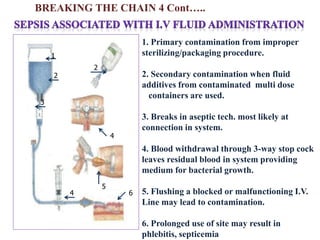
1. Primary contamination from improper
sterilizing/packaging procedure.
2. Secondary contamination when fluid
additives from contaminated multi dose
containers are used.
3. Breaks in aseptic tech. most likely at
connection in system.
4. Blood withdrawal through 3-way stop cock
leaves residual blood in system providing
medium for bacterial growth.
5. Flushing a blocked or malfunctioning I.V.
Line may lead to contamination.
6. Prolonged use of site may result in
phlebitis, septicemia
1
2
2
3
4
4
5
6
BREAKING THE CHAIN 4 Cont…..
DRUGS AND I.V.FLUID THERAPY
• Aseptic Technique while catheter insertion.
• Use of disposable syringes.
• Meticulous cleaning of I.V puncture with
spirit.(3swab method)
• Secure I.V. lines, well cover them with sterile pad.
• Change I.V. site q48hrly or on indication.
• Change of Administration sets-72 hrs
Lipid based solutions-24 hrs
Blood products-discard after use
• Keep them labeled with date and drug name.
BREAKING THE CHAIN 4 Cont…..
BREAKING THE CHAIN 5 Cont…..
•Maintain integrity of skin and mucous membranes.
•Proper positioning of tubings, etc. may prevent injuries
and skin breakdown.
•Turning and positioning of debilitated clients
•Ensure personal hygiene of clients regularly.
•Dispose of contaminated syringes and needles properly
to prevent accidental injuries to hospital personnel as
well as clients.
•Proper handling of catheters, drainage sets etc. is
essential.
•Care should be taken while collecting and handling
specimens.
•Regular wound care is to be instituted properly to
prevent infection.
BREAKING THE CHAIN 5 Cont…..
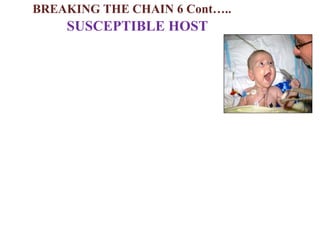
SUSCEPTIBLE HOST
BREAKING THE CHAIN 6 Cont…..
Protecting normal defence mechanisms by:
• The appropriate use of prophylactic antibiotics
• Maintaining an adequate intake.
• Care of invasive devices that breach the natural
defences. ( e.g. urinary catheter, intravenous
lines)
• Encouraging deep breathing and coughing
exercises.
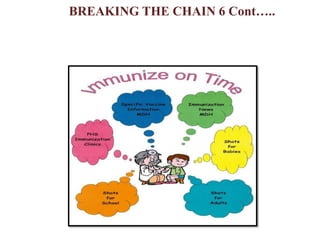
• Encouraging proper immunization of children
and adult clients.
BREAKING THE CHAIN 6 Cont…..
• Promotion of intake of a well balanced diet
containing essential proteins, vitamins, fats and
carbohydrates.
• Institution of measures to improve appetite of
the patient.
• Promotion of the client’s comfort and sleep.
• Helping the client to identify method to relieve
stress
BREAKING THE CHAIN 6 Cont…..
CDC devised
Guidelines to
reduce the
transmission of
Infection
(1996)
39
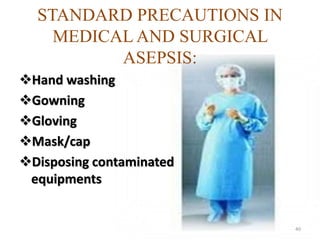
STANDARD PRECAUTIONS IN
MEDICAL AND SURGICAL
ASEPSIS:
Hand washing
Gowning
Gloving
Mask/cap
Disposing contaminated
equipments
40
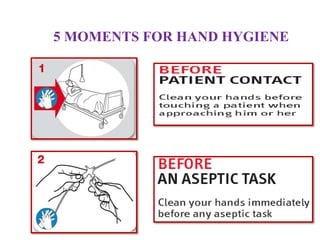
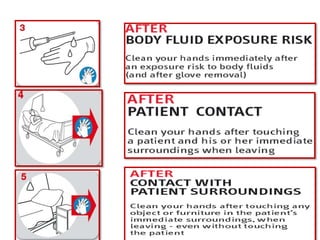
5 MOMENTS FOR HAND HYGIENE
• There are three kinds of handwashing used in
the clinical setting, each of which is appropriate
in different situations:
1.Handwashing with plain soap and running
water
2. Handwashing with antiseptic soap and
running water
3.Alcohol handrub
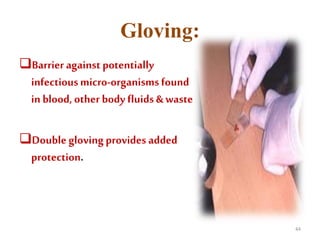
Gloving:
Barrier against potentially
infectiousmicro-organismsfound
in blood, other body fluids & waste
Double gloving provides added
protection.
44
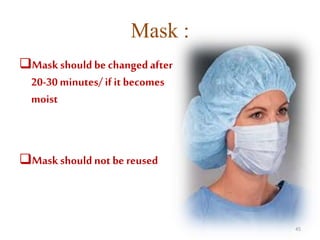
Mask :
Maskshould be changedafter
20-30 minutes/ if it becomes
moist
Maskshould not be reused
45
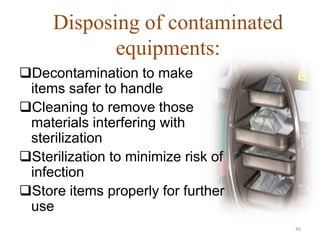
Disposing of contaminated
equipments:
Decontamination to make
items safer to handle
Cleaning to remove those
materials interfering with
sterilization
Sterilization to minimize risk of
infection
Store items properly for further
use
46
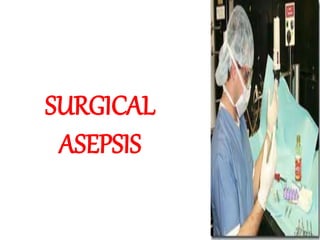
SURGICAL
ASEPSIS
47
Aseptic technique
Practices that help reduce the risk of post
procedure infections in clients by
decreasing the likelihood that
microorganisms will enter the body during
clinical procedures
48
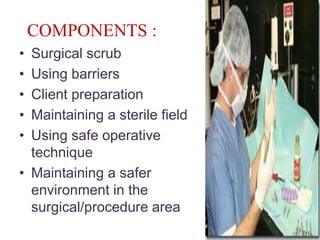
COMPONENTS :
• Surgical scrub
• Using barriers
• Client preparation
• Maintaining a sterile field
• Using safe operative
technique
• Maintaining a safer
environment in the
surgical/procedure area
49
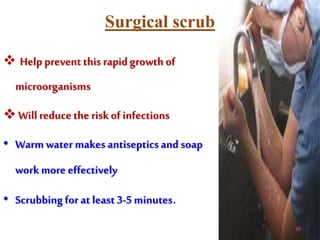
Surgical scrub
 Helpprevent this rapid growth of
microorganisms
 Willreduce the riskof infections
• Warm water makes antiseptics and soap
workmore effectively
• Scrubbing for at least 3-5 minutes.
50
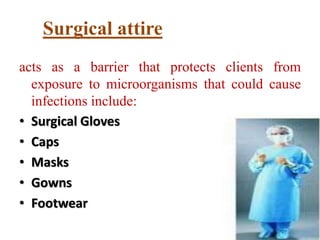
Surgical attire
acts as a barrier that protects clients from
exposure to microorganisms that could cause
infections include:
• Surgical Gloves
• Caps
• Masks
• Gowns
• Footwear
51
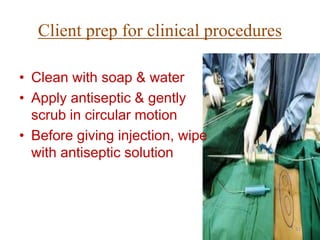
Client prep for clinical procedures
• Clean with soap & water
• Apply antiseptic & gently
scrub in circular motion
• Before giving injection, wipe
with antiseptic solution
52
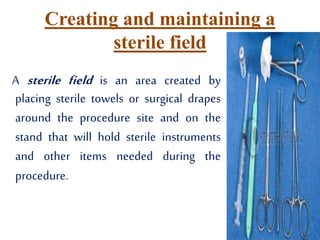
Creating and maintaining a
sterile field
A sterile field is an area created by
placing sterile towels or surgical drapes
around the procedure site and on the
stand that will hold sterile instruments
and other items needed during the
procedure.
53
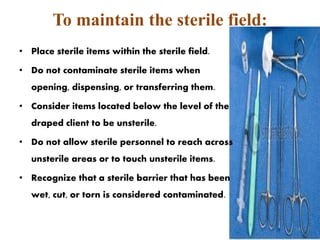
To maintain the sterile field:
• Place sterile items within the sterile field.
• Do not contaminate sterile items when
opening, dispensing, or transferring them.
• Consider items located below the level of the
draped client to be unsterile.
• Do not allow sterile personnel to reach across
unsterile areas or to touch unsterile items.
• Recognize that a sterile barrier that has been
wet, cut, or torn is considered contaminated.
54
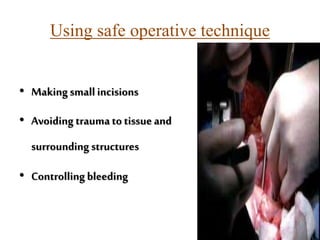
Using safe operative technique
• Makingsmallincisions
• Avoiding traumato tissue and
surrounding structures
• Controllingbleeding
55
Maintaining a safer environment in the
surgical/procedure area
• Limitthe number of people who enter surgicalareas.
• wear cleanclothes, a mask, a cap, and sturdy footwear.
• Enclosethe areas to minimizedust and eliminateinsects.
• Air-conditionthe room, if possible.
• Beforea new clientis brought into theroom, clean and
disinfectall surfaces
56
Control of Hospital Associated
infections
The hospital-Associated infection Control Committee
should be responsible for:
• monitoring of HAI
• implementation of
control measures
57
ISOLATION SYSTEM
Isolation or barrier nursing is technique which is
intended to confine the micro- organisms within a given
and recognizedarea.
58
Universal precautions by
Occupational Safety & Health
Administration
• Disease Specific isolation method: certain
practices are followed for each infectious
disease.
• Client specific isolation: grouped into
following categories
59
A. STRICT ISOLATION:
 Prevents transmission of highly contagious
infections by air & contact like rabies
 Gowns, plastic aprons, masks, and gloves
should be worn.
 Crockery & cutlery should be disposable.
 All other clinical equipment should be
sterilized.
 Hospital staff and visitors should be made
aware of the risks when attending such
patients.
60
B. CONTACT ISOLATION
• Prevents transmission of infections spread
by close/ direct contact
• Private room
• Hand washing
• Wearing gown & Gloves while caring etc
61
C. Respiratory isolation
• Prevents transmission of highlytransmissible infections
spread by close contacts incase of respiratory diseases or
infectionspread by droplet infectione.g. Swineflu,
influenza,T.B. etc.
• Wear gowns, gloves & masks before touching in caseof
drooling.
• Restrict numbers of visitors
• Patients advised to cover nose andmouth during
coughing, talking, sneezingetc.
• Keepreasonable distancefrom the patients
62
D. Enteric isolation
• Prevents infectiontransmission by direct orindirect
contact with faeces.
• Gloves andgown worn when handling soiled articles.
• Thorough hand washingby patients and nurses with
antiseptic soaps.
• Scrubnailbeds.
• Disinfectionof soiled linen.
• Ensuredaily cleaningand disinfectionof articles
63
E. Wound and skin isolation
• Prevents infectiontransmitted by direct or indirect
contact with purulent materialor drainage from an
infected body site.
• Use gown andgloves.
• Strict isolationfor patients with infected burns, rabies,
tetanus, scabies
• Frequent and thorough hand washing.
64
ROLE OF THE NURSE
In controlling Infections
• Washinghands
• Adhering to aseptic techniques
• Segregate contaminated articles
• Isolationof infected material
• Periodical screening &immunization
• Surveillanceof nosocomial infections
65
BIO MEDICAL WASTE MANAGEMENT
POLICY
• Biomedical waste (management and handling) rules,
1998 are promoted by the ministry of environment and
forest’s, govt. of India, under environment protection act,
1986.
• These rules apply to all persons who generate, collect,
receive, store, transport, treat dispose or handle
biomedicalwaste inany form.
66
1.Infectiouswaste : Waste suspected to contain
pathogens e.g. laboratory cultures; waste from
isolation wards; swabs, or equipments that
have been in contact with infected patients;
excreta.
2.Pathologicalwaste: Human tissues or fluids e.g.
body parts; blood and other body fluids; fetuses
67
3.Sharps: Sharp waste e.g. needles; infusion
sets; scalpels; knives; blades; broken glass
4. Pharmaceutical waste: Waste containing
pharmaceuticals e.g. pharmaceuticals that
are expired or no longer needed; items
contaminated by or containing
pharmaceuticals ( bottles, boxes)
68
5. Genotoxicwaste Waste containing substances with
genotoxic properties e.g. waste containing cytostatic
drugs (often used in cancer therapy);
6. Chemicalwaste: Waste containing chemical substances
e.g. laboratory reagents; film developer; disinfectants
that are expired or no longer needed; solvents
69
7. Wastes with high content ofheavy metals:
Batteries; broken thermometers; blood-
pressure gauges; etc.
8. Pressurized containers:Gas cylinders; gas
cartridges; aerosol canes
70
9. Radioactive waste: Waste containing radioactive
substances e.g. unused liquids from
radiotherapy or laboratory research;
contaminated glassware, packages, or
absorbent paper; urine and excreta from
patients treated or tested with radionucleides
71
COLOR CODING &
TREATMENT OF BIOMEDICAL
WASTE
72
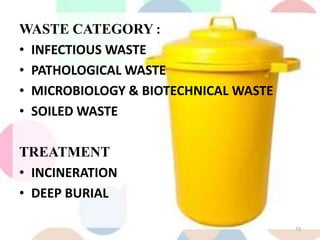
WASTE CATEGORY :
• INFECTIOUS WASTE
• PATHOLOGICAL WASTE
• MICROBIOLOGY & BIOTECHNICAL WASTE
• SOILED WASTE
TREATMENT
• INCINERATION
• DEEP BURIAL
73
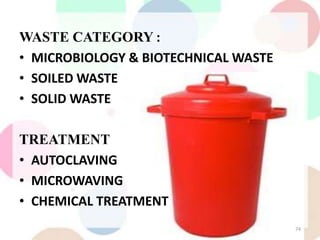
WASTE CATEGORY :
• MICROBIOLOGY & BIOTECHNICAL WASTE
• SOILED WASTE
• SOLID WASTE
TREATMENT
• AUTOCLAVING
• MICROWAVING
• CHEMICAL TREATMENT
74
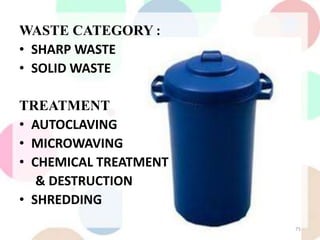
WASTE CATEGORY :
• SHARP WASTE
• SOLID WASTE
TREATMENT
• AUTOCLAVING
• MICROWAVING
• CHEMICAL TREATMENT
& DESTRUCTION
• SHREDDING
75
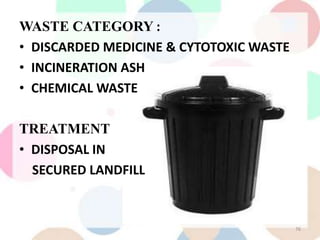
WASTE CATEGORY :
• DISCARDED MEDICINE & CYTOTOXIC WASTE
• INCINERATION ASH
• CHEMICAL WASTE
TREATMENT
• DISPOSAL IN
SECURED LANDFILL
76
77

Infection control

  • 1.
  • 2.
    Infection • Infection isthe entry & multiplication of an infectious agent in the tissues of the host • Bacteria, virues, fungus etc… 2
  • 3.
    Infection • One ofthe leading causes of preventable death in hospital • CDC estimates approx. 2 million preventable infections in hospital • Importance of keeping hospitals clean and infection free is greater now than ever. 3
  • 4.
    Types of infections:- • Primary & Secondary • Local & Systemic • Acute & Chronic • Nosocomial 4
  • 5.
    Who is atRisk of Infection?? Health care personals Clients Community 5
  • 6.
    Chain of Infection Inorder for infection to spread, several steps (chain of infection) must occur. An infection will develop only if this chain remains intact. 6
  • 7.
    Reservoir Portal of Exit Mode of transmission Portalof Entry Susceptible Host Infectious agent
  • 8.
    BREAKING THE CHAIN OF INFECTION preventthe transmission of infection 8
  • 9.
    Include entire spectrumof microbes Bacteria Viruses Fungi Protozoa INFECTIOUS AGENT BREAKING THE CHAIN-1 OF INFECTION
  • 10.
     Routinely sendBlood cultures, urine culture , skin swabs, throat swabs, tracheal aspirate cultures.  Send Endotracheal Tube tip, Urinary catheter tip and central line tip for culture after removal. BREAKING THE CHAIN 1 Cont…..
  • 11.
    • Proper cleaningby water and mechanical action with or without detergents. • Disinfection • Sterilization of contaminated objects. Sterilization and disinfection are physical processes, involving the use of heat, radiation, chemical processes, etc., which use various solutions or gases. BREAKING THE CHAIN 1 Cont…..
  • 12.
    DISINFECTANTS HIGH LEVEL DISINFECTANTS •Activated Glutaraldehyde (cidex2%) • Sodium hypochlorite 1%. • Carbolic Solution 5% • Bleaching Powder 1% LOW LEVEL DISINFECTANTS • Methylated spirit 70% • Betadine solution 10% • Savlon 1% DISINFECTANTS BREAKING THE CHAIN 1 Cont…..
  • 13.
    Regular Cleaning andDisinfection of • Bed Trolleys • I.V stands • Table & Chairs • Resuscitation equipments • Suction Apparatus • Ventilator tubings • Leads •Infusion Pumps •Floor •Windows •Walls •Ceiling •Wash Basins •Drums for Biomedical Waste BREAKING THE CHAIN 1 Cont…..
  • 14.
    For Sterilized Items: Store at dry & clean place. Put date of sterilization. Use within 72 hrs of sterilization. Check date before use.  Put indicator tape. Follow manufacturer’s advice for particular piece of equipment & their preferable method of sterilization. BREAKING THE CHAIN 2 Cont…..
  • 15.
    BREAKING THE CHAIN-2OF INFECTION RESERVOIRS It includes: Humans Animals The inanimate environment (water, food, soil and soiled medical equipment)
  • 16.
    EMPLOYEE HEALTH Immunization ofhealth personnel’s e.g. Hepatitis B vaccination. Regular check up for early detection of any communicable disease Restriction from work of patient contact when infected with communicable disease. BREAKING THE CHAIN 2 Cont…..
  • 17.
    • Cleaning withhospital approved cleaner disinfectant e.g. phenol. • Thorough cleaning of bed and bedside equipments before admitting new admission. • Separate mops should be used for cleaning of the unit. (twice a day) • Damp dusting should be done. • Avoid Brooming. • Drains should be patent. ENVIRONMENTAL CLEANING BREAKING THE CHAIN 2 Cont…..
  • 18.
    • Keep thebed sheets dry and clean. • Change sheets every day. • Do not shake blankets and linen in ICU area. • Do not throw them on floor. • Soiled linen counting should be done in separate place. HANDLING OF LINEN BREAKING THE CHAIN 2 Cont…..
  • 19.
    • Traffic shouldbe restricted except for doctors, nurses & supportive staff. • Allow only one attendant.(3-4hrs). • Keep the doors and windows closed. • Instruct the attendants about hand washing, disposal of waste , hygienic preparation of baby’s feed etc. TRAFFIC CONTROL BREAKING THE CHAIN 2 Cont…..
  • 20.
    • No personalclothing, flowers and eatables should be allowed. • Mobile phones should not be allowed inside the area. • Machines(X-Rays ,echo machines ,ultrasound machines) from outside should be cleaned with spirit before their use. BREAKING THE CHAIN 2 Cont…..
  • 21.
    • Measures tobe taken to avoid their entry into the unit i.e. by proper cleaning, sealing & draining. • Patient diet should be kept in covered containers. • Keep fly flappers on each bedside of patient. • Fly trapper should be in working order. • Pesticides sprays should be used weekly. PEST CONTROL BREAKING THE CHAIN 2 Cont…..
  • 22.
    • Use ofsafe drinking water-Purified • Use of Distilled water for Humidifiers WATER BREAKING THE CHAIN 2 Cont…..
  • 23.
    BREAKING THE CHAIN3 OF INFECION •
  • 24.
    BREAKING THE CHAIN3 Contd.. • Practise aseptic precautions. • Avoid talking directly into the client’s face to prevent droplet infections. • Wearing of masks is important once the nurse herself has infection or deals with clients suffering from infections. • Careful handling of wastes like urine, faeces, emesis and blood is important. • Disposable gloves should be worn to prevent direct contact with wastes or infected materials.
  • 25.
    BREAKING THE CHAIN4 Cont…..
  • 26.
    BREAKING THE CHAIN4 Cont…..
  • 27.
    • Airborne precautions •Well ventilated, private room with door closed, should be there for patient with respiratory bacterial or viral infection. • Place client in a private room that has negative air pressure 6-12 air changes per hour. • Wear masks when entering the room of a client who is known or suspected of having primary tuberculosis. • Susceptible people should not enter the room of a client who has measles or chickenpox. If they must enter they should wear a respirator. • Limit movement of client outside the room to essential purposes.
  • 28.
    • To befollowed in case of Meningitis, Diphtheria, pertusis, and influenza etc., mumps • Place client in private room. • If a private room is not available, place client with another client who is infected with same organism. • Wear a mask if working within 3 feet of the client. • Limit movement of client outside the room to essential purposes. Place surgical mask during transport.
  • 29.
    To be followedin case of cellulitis, acute diarrhea, bronchiolitis etc. • Place client in private room. • Wear gloves, Remove gloves before leaving client room. • Clean hands immediately after removing gloves. Use antimicrobial agent. • Wear gown when entering room if there is a possibility of contact with infected surfaces or items or if the client is incontinent or has diarrhoea, colostomy or wound drainage not covered by a dressing. • Remove gown in the client’s room.
  • 30.
    • Proper Handwashing. • Separate utensils for each patient. • Store in air tight containers . • Separate refrigerator for food. FOOD HANDLING BREAKING THE CHAIN 4 Cont…..
  • 31.
    1. Primary contaminationfrom improper sterilizing/packaging procedure. 2. Secondary contamination when fluid additives from contaminated multi dose containers are used. 3. Breaks in aseptic tech. most likely at connection in system. 4. Blood withdrawal through 3-way stop cock leaves residual blood in system providing medium for bacterial growth. 5. Flushing a blocked or malfunctioning I.V. Line may lead to contamination. 6. Prolonged use of site may result in phlebitis, septicemia 1 2 2 3 4 4 5 6 BREAKING THE CHAIN 4 Cont…..
  • 32.
    DRUGS AND I.V.FLUIDTHERAPY • Aseptic Technique while catheter insertion. • Use of disposable syringes. • Meticulous cleaning of I.V puncture with spirit.(3swab method) • Secure I.V. lines, well cover them with sterile pad. • Change I.V. site q48hrly or on indication. • Change of Administration sets-72 hrs Lipid based solutions-24 hrs Blood products-discard after use • Keep them labeled with date and drug name. BREAKING THE CHAIN 4 Cont…..
  • 33.
    BREAKING THE CHAIN5 Cont…..
  • 34.
    •Maintain integrity ofskin and mucous membranes. •Proper positioning of tubings, etc. may prevent injuries and skin breakdown. •Turning and positioning of debilitated clients •Ensure personal hygiene of clients regularly. •Dispose of contaminated syringes and needles properly to prevent accidental injuries to hospital personnel as well as clients. •Proper handling of catheters, drainage sets etc. is essential. •Care should be taken while collecting and handling specimens. •Regular wound care is to be instituted properly to prevent infection. BREAKING THE CHAIN 5 Cont…..
  • 35.
  • 36.
    BREAKING THE CHAIN6 Cont…..
  • 37.
    Protecting normal defencemechanisms by: • The appropriate use of prophylactic antibiotics • Maintaining an adequate intake. • Care of invasive devices that breach the natural defences. ( e.g. urinary catheter, intravenous lines) • Encouraging deep breathing and coughing exercises. • Encouraging proper immunization of children and adult clients. BREAKING THE CHAIN 6 Cont…..
  • 38.
    • Promotion ofintake of a well balanced diet containing essential proteins, vitamins, fats and carbohydrates. • Institution of measures to improve appetite of the patient. • Promotion of the client’s comfort and sleep. • Helping the client to identify method to relieve stress BREAKING THE CHAIN 6 Cont…..
  • 39.
    CDC devised Guidelines to reducethe transmission of Infection (1996) 39
  • 40.
    STANDARD PRECAUTIONS IN MEDICALAND SURGICAL ASEPSIS: Hand washing Gowning Gloving Mask/cap Disposing contaminated equipments 40
  • 41.
    5 MOMENTS FORHAND HYGIENE
  • 43.
    • There arethree kinds of handwashing used in the clinical setting, each of which is appropriate in different situations: 1.Handwashing with plain soap and running water 2. Handwashing with antiseptic soap and running water 3.Alcohol handrub
  • 44.
    Gloving: Barrier against potentially infectiousmicro-organismsfound inblood, other body fluids & waste Double gloving provides added protection. 44
  • 45.
    Mask : Maskshould bechangedafter 20-30 minutes/ if it becomes moist Maskshould not be reused 45
  • 46.
    Disposing of contaminated equipments: Decontaminationto make items safer to handle Cleaning to remove those materials interfering with sterilization Sterilization to minimize risk of infection Store items properly for further use 46
  • 47.
  • 48.
    Aseptic technique Practices thathelp reduce the risk of post procedure infections in clients by decreasing the likelihood that microorganisms will enter the body during clinical procedures 48
  • 49.
    COMPONENTS : • Surgicalscrub • Using barriers • Client preparation • Maintaining a sterile field • Using safe operative technique • Maintaining a safer environment in the surgical/procedure area 49
  • 50.
    Surgical scrub  Helppreventthis rapid growth of microorganisms  Willreduce the riskof infections • Warm water makes antiseptics and soap workmore effectively • Scrubbing for at least 3-5 minutes. 50
  • 51.
    Surgical attire acts asa barrier that protects clients from exposure to microorganisms that could cause infections include: • Surgical Gloves • Caps • Masks • Gowns • Footwear 51
  • 52.
    Client prep forclinical procedures • Clean with soap & water • Apply antiseptic & gently scrub in circular motion • Before giving injection, wipe with antiseptic solution 52
  • 53.
    Creating and maintaininga sterile field A sterile field is an area created by placing sterile towels or surgical drapes around the procedure site and on the stand that will hold sterile instruments and other items needed during the procedure. 53
  • 54.
    To maintain thesterile field: • Place sterile items within the sterile field. • Do not contaminate sterile items when opening, dispensing, or transferring them. • Consider items located below the level of the draped client to be unsterile. • Do not allow sterile personnel to reach across unsterile areas or to touch unsterile items. • Recognize that a sterile barrier that has been wet, cut, or torn is considered contaminated. 54
  • 55.
    Using safe operativetechnique • Makingsmallincisions • Avoiding traumato tissue and surrounding structures • Controllingbleeding 55
  • 56.
    Maintaining a saferenvironment in the surgical/procedure area • Limitthe number of people who enter surgicalareas. • wear cleanclothes, a mask, a cap, and sturdy footwear. • Enclosethe areas to minimizedust and eliminateinsects. • Air-conditionthe room, if possible. • Beforea new clientis brought into theroom, clean and disinfectall surfaces 56
  • 57.
    Control of HospitalAssociated infections The hospital-Associated infection Control Committee should be responsible for: • monitoring of HAI • implementation of control measures 57
  • 58.
    ISOLATION SYSTEM Isolation orbarrier nursing is technique which is intended to confine the micro- organisms within a given and recognizedarea. 58
  • 59.
    Universal precautions by OccupationalSafety & Health Administration • Disease Specific isolation method: certain practices are followed for each infectious disease. • Client specific isolation: grouped into following categories 59
  • 60.
    A. STRICT ISOLATION: Prevents transmission of highly contagious infections by air & contact like rabies  Gowns, plastic aprons, masks, and gloves should be worn.  Crockery & cutlery should be disposable.  All other clinical equipment should be sterilized.  Hospital staff and visitors should be made aware of the risks when attending such patients. 60
  • 61.
    B. CONTACT ISOLATION •Prevents transmission of infections spread by close/ direct contact • Private room • Hand washing • Wearing gown & Gloves while caring etc 61
  • 62.
    C. Respiratory isolation •Prevents transmission of highlytransmissible infections spread by close contacts incase of respiratory diseases or infectionspread by droplet infectione.g. Swineflu, influenza,T.B. etc. • Wear gowns, gloves & masks before touching in caseof drooling. • Restrict numbers of visitors • Patients advised to cover nose andmouth during coughing, talking, sneezingetc. • Keepreasonable distancefrom the patients 62
  • 63.
    D. Enteric isolation •Prevents infectiontransmission by direct orindirect contact with faeces. • Gloves andgown worn when handling soiled articles. • Thorough hand washingby patients and nurses with antiseptic soaps. • Scrubnailbeds. • Disinfectionof soiled linen. • Ensuredaily cleaningand disinfectionof articles 63
  • 64.
    E. Wound andskin isolation • Prevents infectiontransmitted by direct or indirect contact with purulent materialor drainage from an infected body site. • Use gown andgloves. • Strict isolationfor patients with infected burns, rabies, tetanus, scabies • Frequent and thorough hand washing. 64
  • 65.
    ROLE OF THENURSE In controlling Infections • Washinghands • Adhering to aseptic techniques • Segregate contaminated articles • Isolationof infected material • Periodical screening &immunization • Surveillanceof nosocomial infections 65
  • 66.
    BIO MEDICAL WASTEMANAGEMENT POLICY • Biomedical waste (management and handling) rules, 1998 are promoted by the ministry of environment and forest’s, govt. of India, under environment protection act, 1986. • These rules apply to all persons who generate, collect, receive, store, transport, treat dispose or handle biomedicalwaste inany form. 66
  • 67.
    1.Infectiouswaste : Wastesuspected to contain pathogens e.g. laboratory cultures; waste from isolation wards; swabs, or equipments that have been in contact with infected patients; excreta. 2.Pathologicalwaste: Human tissues or fluids e.g. body parts; blood and other body fluids; fetuses 67
  • 68.
    3.Sharps: Sharp wastee.g. needles; infusion sets; scalpels; knives; blades; broken glass 4. Pharmaceutical waste: Waste containing pharmaceuticals e.g. pharmaceuticals that are expired or no longer needed; items contaminated by or containing pharmaceuticals ( bottles, boxes) 68
  • 69.
    5. Genotoxicwaste Wastecontaining substances with genotoxic properties e.g. waste containing cytostatic drugs (often used in cancer therapy); 6. Chemicalwaste: Waste containing chemical substances e.g. laboratory reagents; film developer; disinfectants that are expired or no longer needed; solvents 69
  • 70.
    7. Wastes withhigh content ofheavy metals: Batteries; broken thermometers; blood- pressure gauges; etc. 8. Pressurized containers:Gas cylinders; gas cartridges; aerosol canes 70
  • 71.
    9. Radioactive waste:Waste containing radioactive substances e.g. unused liquids from radiotherapy or laboratory research; contaminated glassware, packages, or absorbent paper; urine and excreta from patients treated or tested with radionucleides 71
  • 72.
    COLOR CODING & TREATMENTOF BIOMEDICAL WASTE 72
  • 73.
    WASTE CATEGORY : •INFECTIOUS WASTE • PATHOLOGICAL WASTE • MICROBIOLOGY & BIOTECHNICAL WASTE • SOILED WASTE TREATMENT • INCINERATION • DEEP BURIAL 73
  • 74.
    WASTE CATEGORY : •MICROBIOLOGY & BIOTECHNICAL WASTE • SOILED WASTE • SOLID WASTE TREATMENT • AUTOCLAVING • MICROWAVING • CHEMICAL TREATMENT 74
  • 75.
    WASTE CATEGORY : •SHARP WASTE • SOLID WASTE TREATMENT • AUTOCLAVING • MICROWAVING • CHEMICAL TREATMENT & DESTRUCTION • SHREDDING 75
  • 76.
    WASTE CATEGORY : •DISCARDED MEDICINE & CYTOTOXIC WASTE • INCINERATION ASH • CHEMICAL WASTE TREATMENT • DISPOSAL IN SECURED LANDFILL 76
  • 77.