Hamilton County Health Department
Health Education Division
The Learner Will Be Able To…
• Recall three bloodborne pathogens.
• Describe three ways bloodborne
pathogens can be transmitted.
• List three ways a bloodborne pathogen
exposure occurs.
• Review the procedure for reporting a
bloodborne pathogen exposure.
Scope and Application…
• Bloodborne Pathogens
Standards apply to ALL
employees with
occupation exposure to
blood and other
potentially infectious
materials and waste.
Who Is At Risk…
• Health Care Providers
• Buildings & Grounds Workers
• Teachers
• Coroners
• Law Enforcement Personnel
• EMS & Firefighters
• Childcare Workers
• Anyone providing first‐response medical care
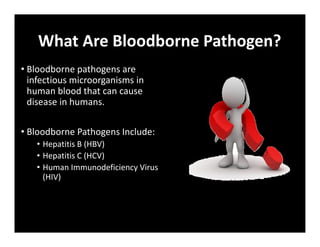
What Are Bloodborne Pathogen?
• Bloodborne pathogens are
infectious microorganisms in
human blood that can cause
disease in humans.
• Bloodborne Pathogens Include:
• Hepatitis B (HBV)
• Hepatitis C (HCV)
• Human Immunodeficiency Virus
(HIV)
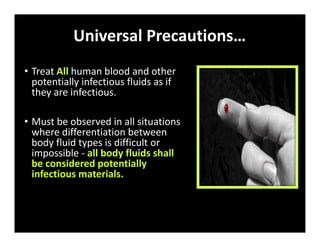
Universal Precautions…
• Treat All human blood and other
potentially infectious fluids as if
they are infectious.
• Must be observed in all situations
where differentiation between
body fluid types is difficult or
impossible ‐ all body fluids shall
be considered potentially
infectious materials.
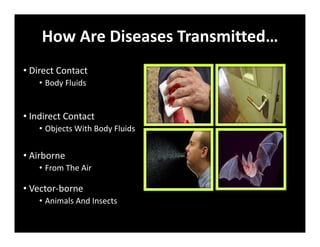
How Are Diseases Transmitted…
• Direct Contact
• Body Fluids
• Indirect Contact
• Objects With Body Fluids
• Airborne
• From The Air
• Vector‐borne
• Animals And Insects
Occupational Exposure…
• Reasonable anticipated
contact with blood or OPIM.
• May result from performance
of an employee’s duties.
• Occurs by:
• Skin
• Eyes
• Mucous membranes
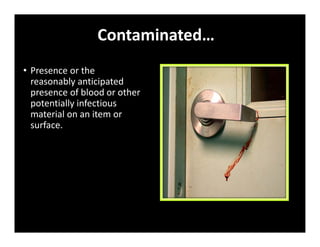
Contaminated…
• Presence or the
reasonably anticipated
presence of blood or other
potentially infectious
material on an item or
surface.
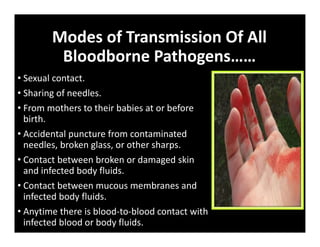
Modes of Transmission Of All
Bloodborne Pathogens……
• Sexual contact.
• Sharing of needles.
• From mothers to their babies at or before
birth.
• Accidental puncture from contaminated
needles, broken glass, or other sharps.
• Contact between broken or damaged skin
and infected body fluids.
• Contact between mucous membranes and
infected body fluids.
• Anytime there is blood‐to‐blood contact with
infected blood or body fluids.
Other Potentially Infectious Materials
(OPIM)…
• Blood products
• Semen
• Vaginal secretions
• Cerebrospinal fluid
• Pleural fluid (lung fluid)
• Synovial fluid (fluid from your joints)
• Amniotic fluid (uterine fluid)
• Peritoneal fluid (fluid that fills your body cavity)
• Saliva in dental settings
• Any body fluid that is visibly contaminated with blood
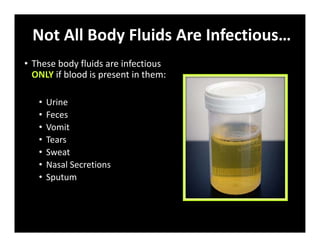
Not All Body Fluids Are Infectious…
• These body fluids are infectious
ONLY if blood is present in them:
• Urine
• Feces
• Vomit
• Tears
• Sweat
• Nasal Secretions
• Sputum
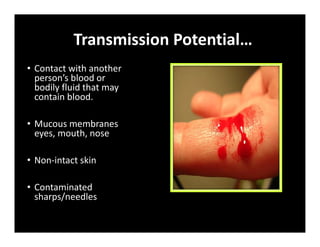
Transmission Potential…
• Contact with another
person’s blood or
bodily fluid that may
contain blood.
• Mucous membranes
eyes, mouth, nose
• Non‐intact skin
• Contaminated
sharps/needles
Transmission Potential…
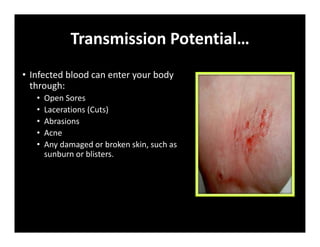
• Infected blood can enter your body
through:
• Open Sores
• Lacerations (Cuts)
• Abrasions
• Acne
• Any damaged or broken skin, such as
sunburn or blisters.
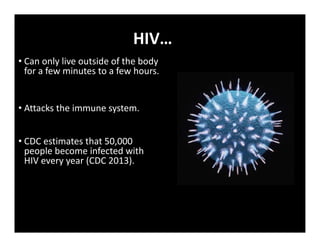
HIV…
• Can only live outside of the body
for a few minutes to a few hours.
• Attacks the immune system.
• CDC estimates that 50,000
people become infected with
HIV every year (CDC 2013).
HIV…
• Approximately 1 in 5 who are
HIV + do not know they are
infected with the disease.
• HIV will develop into AIDS
within approximately 10 years.
• 6,171 people are living with
AIDS in 2014 (ISDH,
12/31/2014).
• No cure or vaccine to prevent
HIV‐only prevention.
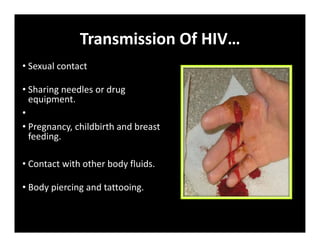
Transmission Of HIV…
• Sexual contact
• Sharing needles or drug
equipment.
•
• Pregnancy, childbirth and breast
feeding.
• Contact with other body fluids.
• Body piercing and tattooing.
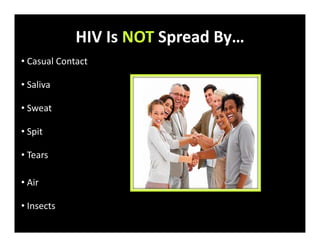
HIV Is NOT Spread By…
• Casual Contact
• Saliva
• Sweat
• Spit
• Tears
• Air
• Insects
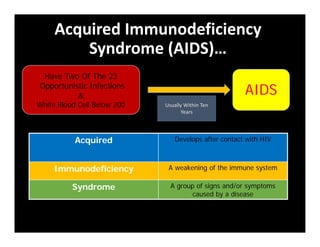
Acquired Immunodeficiency
Syndrome (AIDS)…
AIDS
Have Two Of The 23
Opportunistic Infections
&
White Blood Cell Below 200
Acquired Develops after contact with HIV
Immunodeficiency A weakening of the immune system
Syndrome A group of signs and/or symptoms
caused by a disease
Usually Within Ten
Years
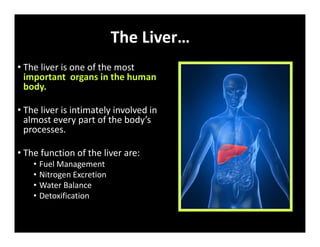
The Liver…
• The liver is one of the most
important organs in the human
body.
• The liver is intimately involved in
almost every part of the body’s
processes.
• The function of the liver are:
• Fuel Management
• Nitrogen Excretion
• Water Balance
• Detoxification
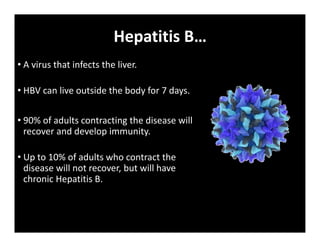
Hepatitis B…
• A virus that infects the liver.
• HBV can live outside the body for 7 days.
• 90% of adults contracting the disease will
recover and develop immunity.
• Up to 10% of adults who contract the
disease will not recover, but will have
chronic Hepatitis B.
Symptoms of Hepatitis B…
• Fever
• Fatigue
• Loss of appetite
• Nausea/Vomiting
• Abdominal Pain
• Dark Urine
• Clay‐Colored Stools
• Joint Pain
• Jaundice
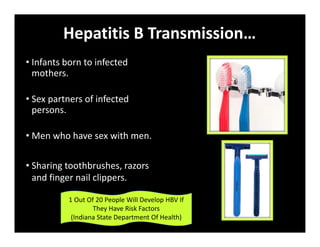
Hepatitis B Transmission…
• Infants born to infected
mothers.
• Sex partners of infected
persons.
• Men who have sex with men.
• Sharing toothbrushes, razors
and finger nail clippers.
1 Out Of 20 People Will Develop HBV If
They Have Risk Factors
(Indiana State Department Of Health)
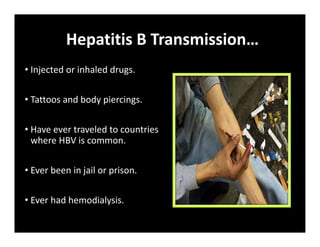
Hepatitis B Transmission…
• Injected or inhaled drugs.
• Tattoos and body piercings.
• Have ever traveled to countries
where HBV is common.
• Ever been in jail or prison.
• Ever had hemodialysis.
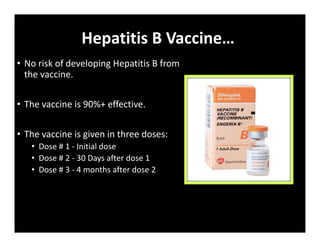
Hepatitis B Vaccine…
• No risk of developing Hepatitis B from
the vaccine.
• The vaccine is 90%+ effective.
• The vaccine is given in three doses:
• Dose # 1 ‐ Initial dose
• Dose # 2 ‐ 30 Days after dose 1
• Dose # 3 ‐ 4 months after dose 2
Hepatitis C…
• The most chronic bloodborne
disease in the United States!
• Approximately 3.2 million people are
chronically infected.
• 80% of people have no signs or
symptoms.
• May remain undetected in the body for
years.
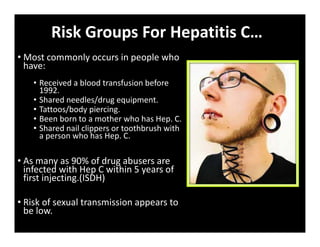
Risk Groups For Hepatitis C…
• Most commonly occurs in people who
have:
• Received a blood transfusion before
1992.
• Shared needles/drug equipment.
• Tattoos/body piercing.
• Been born to a mother who has Hep. C.
• Shared nail clippers or toothbrush with
a person who has Hep. C.
• As many as 90% of drug abusers are
infected with Hep C within 5 years of
first injecting.(ISDH)
• Risk of sexual transmission appears to
be low.
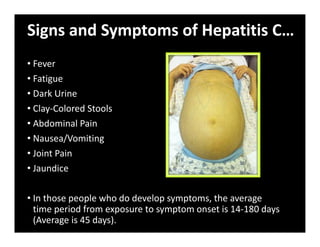
Signs and Symptoms of Hepatitis C…
• Fever
• Fatigue
• Dark Urine
• Clay‐Colored Stools
• Abdominal Pain
• Nausea/Vomiting
• Joint Pain
• Jaundice
• In those people who do develop symptoms, the average
time period from exposure to symptom onset is 14‐180 days
(Average is 45 days).
Co‐Infection…
• Some people are infected with both HIV
and Hepatitis C.
• CDC estimates that 3,000,000 people are
co‐infected in the United States.
• 50%‐90% of injection drug abusers are
infected with both HIV and Hepatitis C
(CDC).
• A person who has a co‐infection will usually
develop liver damage faster.
Your Exposure Potential…
• Post‐Accident Cleanup.
• Administering First‐Aid.
• Janitorial or Maintenance Work.
• Handling of any Waste Products.
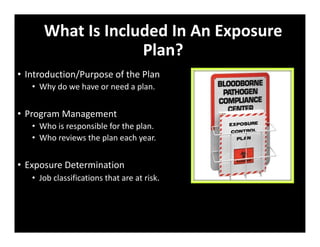
What Is Included In An Exposure
Plan?
• Introduction/Purpose of the Plan
• Why do we have or need a plan.
• Program Management
• Who is responsible for the plan.
• Who reviews the plan each year.
• Exposure Determination
• Job classifications that are at risk.
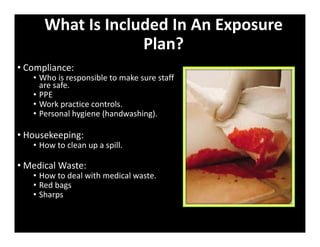
What Is Included In An Exposure
Plan?
• Compliance:
• Who is responsible to make sure staff
are safe.
• PPE
• Work practice controls.
• Personal hygiene (handwashing).
• Housekeeping:
• How to clean up a spill.
• Medical Waste:
• How to deal with medical waste.
• Red bags
• Sharps
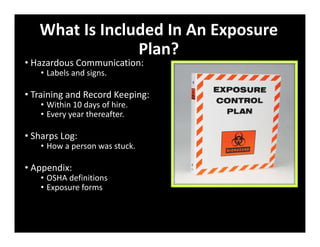
What Is Included In An Exposure
Plan?
• Hazardous Communication:
• Labels and signs.
• Training and Record Keeping:
• Within 10 days of hire.
• Every year thereafter.
• Sharps Log:
• How a person was stuck.
• Appendix:
• OSHA definitions
• Exposure forms
What Is Included In An Exposure
Plan?
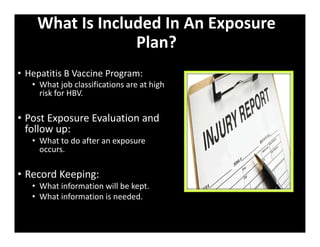
• Hepatitis B Vaccine Program:
• What job classifications are at high
risk for HBV.
• Post Exposure Evaluation and
follow up:
• What to do after an exposure
occurs.
• Record Keeping:
• What information will be kept.
• What information is needed.
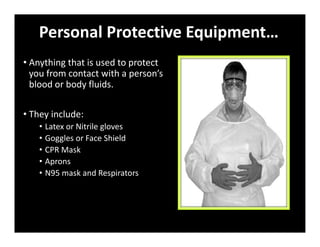
Personal Protective Equipment…
• Anything that is used to protect
you from contact with a person’s
blood or body fluids.
• They include:
• Latex or Nitrile gloves
• Goggles or Face Shield
• CPR Mask
• Aprons
• N95 mask and Respirators
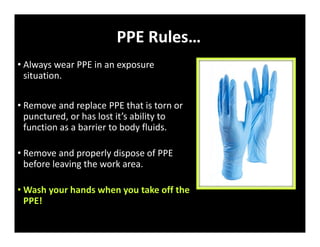
PPE Rules…
• Always wear PPE in an exposure
situation.
• Remove and replace PPE that is torn or
punctured, or has lost it’s ability to
function as a barrier to body fluids.
• Remove and properly dispose of PPE
before leaving the work area.
• Wash your hands when you take off the
PPE!
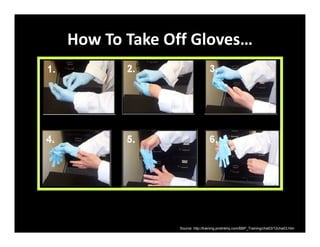
How To Take Off Gloves…
Source: http://training.prolinkhq.com/BBP_Training/cha03/12cha03.htm
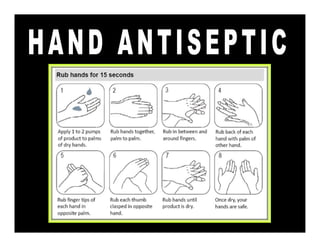
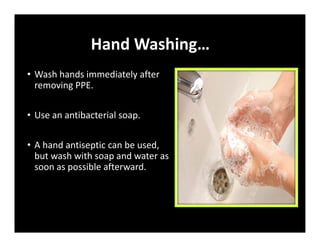
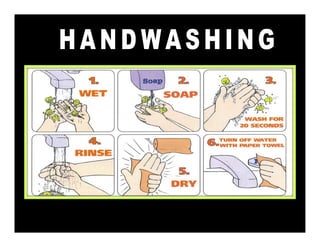
Hand Washing…
• Wash hands immediately after
removing PPE.
• Use an antibacterial soap.
• A hand antiseptic can be used,
but wash with soap and water as
soon as possible afterward.
Regulated Medical Waste…
• Liquid or semi‐liquid blood or
other potentially infectious
materials and sharps.
• Must be placed in closeable
leak‐proof container built to
contain all content during
handling, storage, transport or
shipping and be appropriately
labeled or color‐coded.
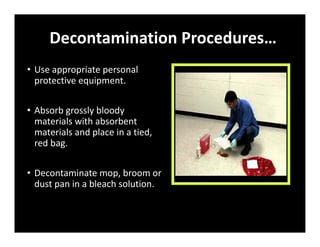
Decontamination Procedures…
• Use appropriate personal
protective equipment.
• Absorb grossly bloody
materials with absorbent
materials and place in a tied,
red bag.
• Decontaminate mop, broom or
dust pan in a bleach solution.
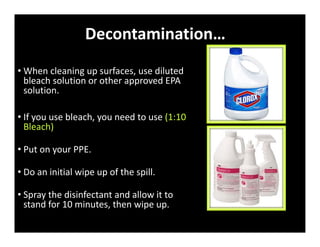
Decontamination…
• When cleaning up surfaces, use diluted
bleach solution or other approved EPA
solution.
• If you use bleach, you need to use (1:10
Bleach)
• Put on your PPE.
• Do an initial wipe up of the spill.
• Spray the disinfectant and allow it to
stand for 10 minutes, then wipe up.
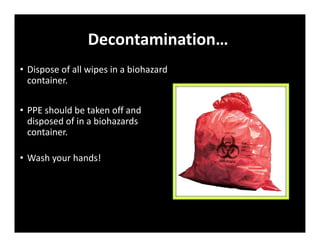
Decontamination…
• Dispose of all wipes in a biohazard
container.
• PPE should be taken off and
disposed of in a biohazards
container.
• Wash your hands!
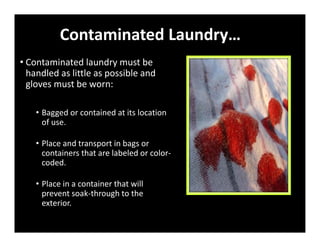
Contaminated Laundry…
• Contaminated laundry must be
handled as little as possible and
gloves must be worn:
• Bagged or contained at its location
of use.
• Place and transport in bags or
containers that are labeled or color‐
coded.
• Place in a container that will
prevent soak‐through to the
exterior.
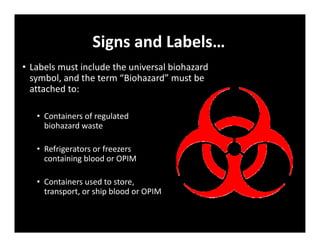
Signs and Labels…
• Labels must include the universal biohazard
symbol, and the term “Biohazard” must be
attached to:
• Containers of regulated
biohazard waste
• Refrigerators or freezers
containing blood or OPIM
• Containers used to store,
transport, or ship blood or OPIM
Exposure Determination…
• Employer required to identify job
classifications where occupation
exposures can occur:
• Job classification in which ALL have
occupational exposure
• Job classification in which SOME
have occupational exposure
• List of all tasks and procedures in
which occupational exposures
occur
Exposure Incident…
 Keep Calm
 Tell a supervisor ASAP
 If body fluid enters eyes or mouth, wash with
water for 20 minutes.
 If body fluid comes in contact with broken or
chapped skin or needle stick, wash with soap
and water for 20 minutes!
 Call Riverview Workmed ASAP at 317‐502‐
7577 (24 hours a day).
 If You Do Have A True Exposure, You Have
TWO Hrs. To Start Treatment!
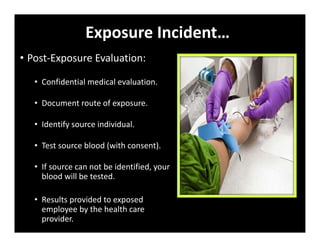
Exposure Incident…
• Post‐Exposure Evaluation:
• Confidential medical evaluation.
• Document route of exposure.
• Identify source individual.
• Test source blood (with consent).
• If source can not be identified, your
blood will be tested.
• Results provided to exposed
employee by the health care
provider.
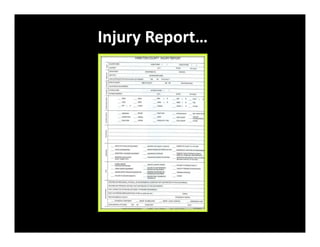
Injury Report…
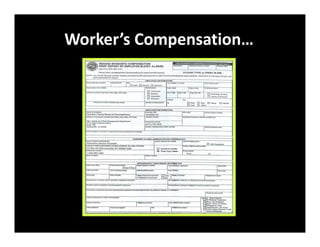
Worker’s Compensation…
Known Source…
Know Source
Know Source
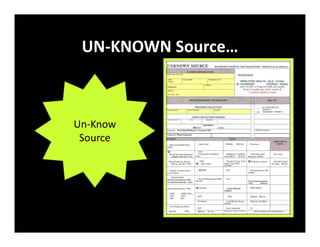
UN‐KNOWN Source…
Un‐Know
Source
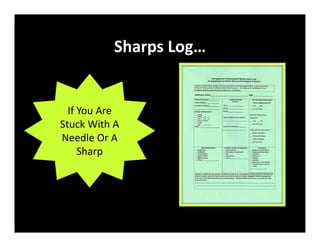
Sharps Log…
If You Are
Stuck With A
Needle Or A
Sharp
Ryan White Law…
• The Ryan White Law mandates that
the source patient test results be
provided to the designated
infection control officer of the
employee involved in an exposure
incident
IF IT IS WET AND NOT YOURS, DO
NOT TOUCH IT WITHOUT GLOVES!
Sources…
• Centers For Disease Control and Prevention
• IOSHA
• Indiana State Department Of Health
• OSHA
• Medical Reserve Corps
• University of Arkansas

Blood-borne-Pathogen-Presentation-PDF.pdf

  • 1.
    Hamilton County HealthDepartment Health Education Division
  • 2.
    The Learner WillBe Able To… • Recall three bloodborne pathogens. • Describe three ways bloodborne pathogens can be transmitted. • List three ways a bloodborne pathogen exposure occurs. • Review the procedure for reporting a bloodborne pathogen exposure.
  • 3.
    Scope and Application… •Bloodborne Pathogens Standards apply to ALL employees with occupation exposure to blood and other potentially infectious materials and waste.
  • 4.
    Who Is AtRisk… • Health Care Providers • Buildings & Grounds Workers • Teachers • Coroners • Law Enforcement Personnel • EMS & Firefighters • Childcare Workers • Anyone providing first‐response medical care
  • 5.
    What Are BloodbornePathogen? • Bloodborne pathogens are infectious microorganisms in human blood that can cause disease in humans. • Bloodborne Pathogens Include: • Hepatitis B (HBV) • Hepatitis C (HCV) • Human Immunodeficiency Virus (HIV)
  • 6.
    Universal Precautions… • TreatAll human blood and other potentially infectious fluids as if they are infectious. • Must be observed in all situations where differentiation between body fluid types is difficult or impossible ‐ all body fluids shall be considered potentially infectious materials.
  • 7.
    How Are DiseasesTransmitted… • Direct Contact • Body Fluids • Indirect Contact • Objects With Body Fluids • Airborne • From The Air • Vector‐borne • Animals And Insects
  • 8.
    Occupational Exposure… • Reasonableanticipated contact with blood or OPIM. • May result from performance of an employee’s duties. • Occurs by: • Skin • Eyes • Mucous membranes
  • 9.
    Contaminated… • Presence orthe reasonably anticipated presence of blood or other potentially infectious material on an item or surface.
  • 10.
    Modes of TransmissionOf All Bloodborne Pathogens…… • Sexual contact. • Sharing of needles. • From mothers to their babies at or before birth. • Accidental puncture from contaminated needles, broken glass, or other sharps. • Contact between broken or damaged skin and infected body fluids. • Contact between mucous membranes and infected body fluids. • Anytime there is blood‐to‐blood contact with infected blood or body fluids.
  • 11.
    Other Potentially InfectiousMaterials (OPIM)… • Blood products • Semen • Vaginal secretions • Cerebrospinal fluid • Pleural fluid (lung fluid) • Synovial fluid (fluid from your joints) • Amniotic fluid (uterine fluid) • Peritoneal fluid (fluid that fills your body cavity) • Saliva in dental settings • Any body fluid that is visibly contaminated with blood
  • 12.
    Not All BodyFluids Are Infectious… • These body fluids are infectious ONLY if blood is present in them: • Urine • Feces • Vomit • Tears • Sweat • Nasal Secretions • Sputum
  • 13.
    Transmission Potential… • Contactwith another person’s blood or bodily fluid that may contain blood. • Mucous membranes eyes, mouth, nose • Non‐intact skin • Contaminated sharps/needles
  • 14.
    Transmission Potential… • Infectedblood can enter your body through: • Open Sores • Lacerations (Cuts) • Abrasions • Acne • Any damaged or broken skin, such as sunburn or blisters.
  • 15.
    HIV… • Can onlylive outside of the body for a few minutes to a few hours. • Attacks the immune system. • CDC estimates that 50,000 people become infected with HIV every year (CDC 2013).
  • 16.
    HIV… • Approximately 1in 5 who are HIV + do not know they are infected with the disease. • HIV will develop into AIDS within approximately 10 years. • 6,171 people are living with AIDS in 2014 (ISDH, 12/31/2014). • No cure or vaccine to prevent HIV‐only prevention.
  • 17.
    Transmission Of HIV… •Sexual contact • Sharing needles or drug equipment. • • Pregnancy, childbirth and breast feeding. • Contact with other body fluids. • Body piercing and tattooing.
  • 18.
    HIV Is NOTSpread By… • Casual Contact • Saliva • Sweat • Spit • Tears • Air • Insects
  • 19.
    Acquired Immunodeficiency Syndrome (AIDS)… AIDS HaveTwo Of The 23 Opportunistic Infections & White Blood Cell Below 200 Acquired Develops after contact with HIV Immunodeficiency A weakening of the immune system Syndrome A group of signs and/or symptoms caused by a disease Usually Within Ten Years
  • 20.
    The Liver… • Theliver is one of the most important organs in the human body. • The liver is intimately involved in almost every part of the body’s processes. • The function of the liver are: • Fuel Management • Nitrogen Excretion • Water Balance • Detoxification
  • 21.
    Hepatitis B… • Avirus that infects the liver. • HBV can live outside the body for 7 days. • 90% of adults contracting the disease will recover and develop immunity. • Up to 10% of adults who contract the disease will not recover, but will have chronic Hepatitis B.
  • 22.
    Symptoms of HepatitisB… • Fever • Fatigue • Loss of appetite • Nausea/Vomiting • Abdominal Pain • Dark Urine • Clay‐Colored Stools • Joint Pain • Jaundice
  • 23.
    Hepatitis B Transmission… •Infants born to infected mothers. • Sex partners of infected persons. • Men who have sex with men. • Sharing toothbrushes, razors and finger nail clippers. 1 Out Of 20 People Will Develop HBV If They Have Risk Factors (Indiana State Department Of Health)
  • 24.
    Hepatitis B Transmission… •Injected or inhaled drugs. • Tattoos and body piercings. • Have ever traveled to countries where HBV is common. • Ever been in jail or prison. • Ever had hemodialysis.
  • 25.
    Hepatitis B Vaccine… •No risk of developing Hepatitis B from the vaccine. • The vaccine is 90%+ effective. • The vaccine is given in three doses: • Dose # 1 ‐ Initial dose • Dose # 2 ‐ 30 Days after dose 1 • Dose # 3 ‐ 4 months after dose 2
  • 26.
    Hepatitis C… • Themost chronic bloodborne disease in the United States! • Approximately 3.2 million people are chronically infected. • 80% of people have no signs or symptoms. • May remain undetected in the body for years.
  • 27.
    Risk Groups ForHepatitis C… • Most commonly occurs in people who have: • Received a blood transfusion before 1992. • Shared needles/drug equipment. • Tattoos/body piercing. • Been born to a mother who has Hep. C. • Shared nail clippers or toothbrush with a person who has Hep. C. • As many as 90% of drug abusers are infected with Hep C within 5 years of first injecting.(ISDH) • Risk of sexual transmission appears to be low.
  • 28.
    Signs and Symptomsof Hepatitis C… • Fever • Fatigue • Dark Urine • Clay‐Colored Stools • Abdominal Pain • Nausea/Vomiting • Joint Pain • Jaundice • In those people who do develop symptoms, the average time period from exposure to symptom onset is 14‐180 days (Average is 45 days).
  • 29.
    Co‐Infection… • Some peopleare infected with both HIV and Hepatitis C. • CDC estimates that 3,000,000 people are co‐infected in the United States. • 50%‐90% of injection drug abusers are infected with both HIV and Hepatitis C (CDC). • A person who has a co‐infection will usually develop liver damage faster.
  • 30.
    Your Exposure Potential… •Post‐Accident Cleanup. • Administering First‐Aid. • Janitorial or Maintenance Work. • Handling of any Waste Products.
  • 31.
    What Is IncludedIn An Exposure Plan? • Introduction/Purpose of the Plan • Why do we have or need a plan. • Program Management • Who is responsible for the plan. • Who reviews the plan each year. • Exposure Determination • Job classifications that are at risk.
  • 32.
    What Is IncludedIn An Exposure Plan? • Compliance: • Who is responsible to make sure staff are safe. • PPE • Work practice controls. • Personal hygiene (handwashing). • Housekeeping: • How to clean up a spill. • Medical Waste: • How to deal with medical waste. • Red bags • Sharps
  • 33.
    What Is IncludedIn An Exposure Plan? • Hazardous Communication: • Labels and signs. • Training and Record Keeping: • Within 10 days of hire. • Every year thereafter. • Sharps Log: • How a person was stuck. • Appendix: • OSHA definitions • Exposure forms
  • 34.
    What Is IncludedIn An Exposure Plan? • Hepatitis B Vaccine Program: • What job classifications are at high risk for HBV. • Post Exposure Evaluation and follow up: • What to do after an exposure occurs. • Record Keeping: • What information will be kept. • What information is needed.
  • 35.
    Personal Protective Equipment… •Anything that is used to protect you from contact with a person’s blood or body fluids. • They include: • Latex or Nitrile gloves • Goggles or Face Shield • CPR Mask • Aprons • N95 mask and Respirators
  • 36.
    PPE Rules… • Alwayswear PPE in an exposure situation. • Remove and replace PPE that is torn or punctured, or has lost it’s ability to function as a barrier to body fluids. • Remove and properly dispose of PPE before leaving the work area. • Wash your hands when you take off the PPE!
  • 37.
    How To TakeOff Gloves… Source: http://training.prolinkhq.com/BBP_Training/cha03/12cha03.htm
  • 38.
    Hand Washing… • Washhands immediately after removing PPE. • Use an antibacterial soap. • A hand antiseptic can be used, but wash with soap and water as soon as possible afterward.
  • 41.
    Regulated Medical Waste… •Liquid or semi‐liquid blood or other potentially infectious materials and sharps. • Must be placed in closeable leak‐proof container built to contain all content during handling, storage, transport or shipping and be appropriately labeled or color‐coded.
  • 42.
    Decontamination Procedures… • Useappropriate personal protective equipment. • Absorb grossly bloody materials with absorbent materials and place in a tied, red bag. • Decontaminate mop, broom or dust pan in a bleach solution.
  • 43.
    Decontamination… • When cleaningup surfaces, use diluted bleach solution or other approved EPA solution. • If you use bleach, you need to use (1:10 Bleach) • Put on your PPE. • Do an initial wipe up of the spill. • Spray the disinfectant and allow it to stand for 10 minutes, then wipe up.
  • 44.
    Decontamination… • Dispose ofall wipes in a biohazard container. • PPE should be taken off and disposed of in a biohazards container. • Wash your hands!
  • 45.
    Contaminated Laundry… • Contaminatedlaundry must be handled as little as possible and gloves must be worn: • Bagged or contained at its location of use. • Place and transport in bags or containers that are labeled or color‐ coded. • Place in a container that will prevent soak‐through to the exterior.
  • 46.
    Signs and Labels… •Labels must include the universal biohazard symbol, and the term “Biohazard” must be attached to: • Containers of regulated biohazard waste • Refrigerators or freezers containing blood or OPIM • Containers used to store, transport, or ship blood or OPIM
  • 47.
    Exposure Determination… • Employerrequired to identify job classifications where occupation exposures can occur: • Job classification in which ALL have occupational exposure • Job classification in which SOME have occupational exposure • List of all tasks and procedures in which occupational exposures occur
  • 48.
    Exposure Incident…  KeepCalm  Tell a supervisor ASAP  If body fluid enters eyes or mouth, wash with water for 20 minutes.  If body fluid comes in contact with broken or chapped skin or needle stick, wash with soap and water for 20 minutes!  Call Riverview Workmed ASAP at 317‐502‐ 7577 (24 hours a day).  If You Do Have A True Exposure, You Have TWO Hrs. To Start Treatment!
  • 49.
    Exposure Incident… • Post‐ExposureEvaluation: • Confidential medical evaluation. • Document route of exposure. • Identify source individual. • Test source blood (with consent). • If source can not be identified, your blood will be tested. • Results provided to exposed employee by the health care provider.
  • 50.
  • 51.
  • 52.
  • 53.
  • 54.
    Sharps Log… If YouAre Stuck With A Needle Or A Sharp
  • 55.
    Ryan White Law… •The Ryan White Law mandates that the source patient test results be provided to the designated infection control officer of the employee involved in an exposure incident
  • 56.
    IF IT ISWET AND NOT YOURS, DO NOT TOUCH IT WITHOUT GLOVES!
  • 57.
    Sources… • Centers ForDisease Control and Prevention • IOSHA • Indiana State Department Of Health • OSHA • Medical Reserve Corps • University of Arkansas