Body Fluids
Dr. Sangeetha Balakrishnan
23 February, 2017
Presumptive/Preliminary/Screening/
Field/Indicative Tests for Blood
1. Luminol Test
2. Fluorescein Test
3. Phenolpthalein Test
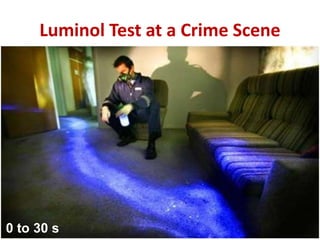
Luminol Test at a Crime Scene
0 to 30 s
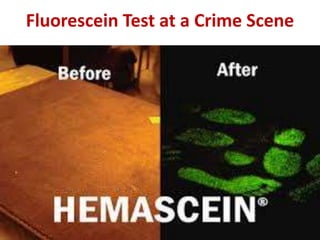
Fluorescein Test at a Crime Scene
Phenolpthalein Test
• Can detect blood diluted to 1 part in 10
million.
• Gives false positives for certain vegetable
extracts.
• How is it done?:
(i) Suspected blood stain (on a cotton swab) +
water + Phenolpthalein colourless
(ii) Add hydrogen peroxide immediate
PINK colour!
Confirmatory Tests for Blood
1. Teichmann Test
2. Takayama Test (Hemochromogen Test)
• Both are called Microcrystal Tests.
Blood + Crystallising Reagent
Characteristic Shaped
Crystals.
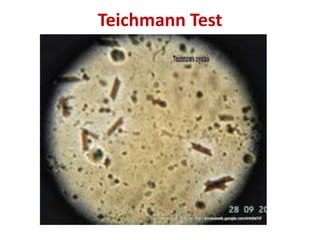
Teichmann Test
• Blood + Teichmann’s Reagent (heat) Hb
hemin react with halides brownish-
yellow rhomboid crystals
• Microscopic Observation
• Teichmann’s Reagent: Potassium bromide +
Potassium chloride + Potassium iodide in
Acetic acid.
Teichmann Test
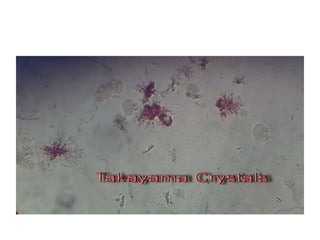
Takayama Test
(Hemochromogen Test)
• Suspected blood stain on a glass slide + heat +
add pyridine in Sodium hydroxide + reducing
sugar red feathery crystals of pyridine
ferroprotoporphyrin
• Very sensitive test.
• Even very old blood stains give +’ve results!
Saliva
• Saliva is produced in the mouth.
• Function: preliminary digestion of food.
• Contains: water, proteins, enzymes, salts.
• Alpha amylase: enzyme in saliva.
• Alpha amylase breaks down starch in food.
• It is also present in other body fluids, but in
low concentrations.
Preliminary Test - Saliva
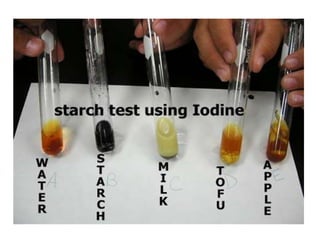
• Principle: Starch + Iodine Deep blue colour
• Suspected saliva sample + water/saline
incubate at body temperature.
• If the suspected sample is indeed saliva, it will
contain alpha amylase!
• Alpha amylase will break down starch into
simpler components. (digestion)
• Add Iodine solution.
• Absence of starch (it has been broken down)
No Deep Blue colour!
Drawbacks of the Saliva
Preliminary Test
• Not particularly sensitive.
• Not specific to saliva.
• Use saliva sample for DNA testing.
• Detection of saliva at scene of crime:
Shine UV light fluorescence!
Saliva – Confirmatory test
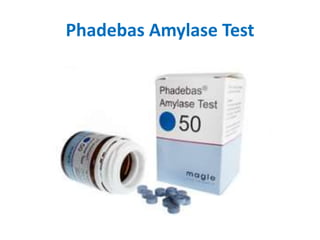
• Phadebas Amylase Test
Developed by Pharmacia Diagnostics.
Qualitative and quantitative test.
Phadebas: a synthetic biochemical substrate.
• The substrate has starch microspheres.
• The microspheres are chemically bonded to a blue
coloured dye.
Phadebas substrate + suspected saliva (in water)
salivary amylase digests starch starch microspheres
break down blue dye is released!
Phadebas Amylase Test
Urine
• Main components:
(i) Creatinine
(ii) Urea
Presumptive Test – Urine
1. Jaffe Test
• Based on the detection of creatinine
• Suspected urine sample + picric acid + 5% NaOH
immediate orange colour
Presumptive Test – Urine … cont’d
2) Assay for Urea
• Bromothymol Blue is a pH-indicator dye.
• Colour: Yellow-green at pH 6
Aqua blue at pH > 7.6
(i) Whatman Filter Paper + Bromothymol Blue (1
drop) allow to dry
(ii) Add a drop from the suspected urine sample.
(iii) Add a drop of Urease.
(iv) If urea is present (meaning: urine is present),
urease will degrade urea to ammonia gas.
(v) This will cause the pH to increase.
(vi) Aqua blue colour!
Semen
• Produced by the male sex organ.
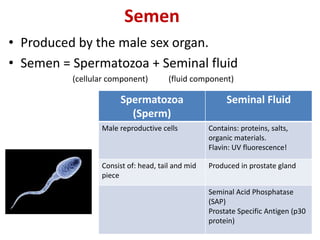
• Semen = Spermatozoa + Seminal fluid
(cellular component) (fluid component)
Spermatozoa
(Sperm)
Seminal Fluid
Male reproductive cells Contains: proteins, salts,
organic materials.
Flavin: UV fluorescence!
Consist of: head, tail and mid
piece
Produced in prostate gland
Seminal Acid Phosphatase
(SAP)
Prostate Specific Antigen (p30
protein)
Presumptive Test - Semen
• Based on Seminal Acid Phosphatase (SAP).
• There are other acid phosphatases in the
body!
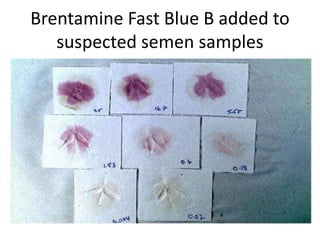
• Brentamine Spot Test or Walker Test
• Suspected Semen Sample + Brentamine Fast
Blue B Intense purple colour within 2
minutes
Brentamine Fast Blue B added to
suspected semen samples
Confirmatory Test - Semen
1. Christmas Tree Stain Test
• Basis: Sperms analysed in lab are NOT motile.
• Hence identification should be in the presence of other
cellular material!
• A pair of dyes is used:
(i) Picroindigocarmine (PIC)
(ii) Nuclear Fast Red
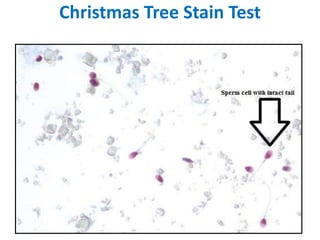
• PIC: stains the tails green-blue-grey
• Nuclear Fast Red: stains the heads (with DNA) bright
crimson.
Christmas Tree Stain Test
Confirmatory Test – Semen … cont’d
2. Detection of Prostate Specific Antigen or p30
protein:
Oligospermia (low sperm count)
Aspemia (no sperms)
Suspected semen sample + Reagent Intense
purple.
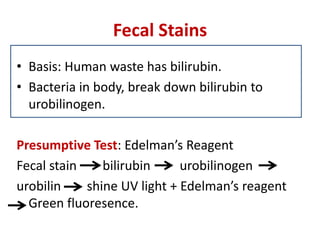
Fecal Stains
• Basis: Human waste has bilirubin.
• Bacteria in body, break down bilirubin to
urobilinogen.
Presumptive Test: Edelman’s Reagent
Fecal stain bilirubin urobilinogen
urobilin shine UV light + Edelman’s reagent
Green fluoresence.
Confirmatory Test – Fecal Stains
• Microscopy:
• To look for animal and plant cells present due
to digestion.
Sweat
• Suspected sweat sample + Crystal Violet -
deep purple
• Fatty acids in sweat react with the dye.

Body fluids

  • 1.
    Body Fluids Dr. SangeethaBalakrishnan 23 February, 2017
  • 2.
    Presumptive/Preliminary/Screening/ Field/Indicative Tests forBlood 1. Luminol Test 2. Fluorescein Test 3. Phenolpthalein Test
  • 3.
    Luminol Test ata Crime Scene 0 to 30 s
  • 4.
    Fluorescein Test ata Crime Scene
  • 5.
    Phenolpthalein Test • Candetect blood diluted to 1 part in 10 million. • Gives false positives for certain vegetable extracts. • How is it done?: (i) Suspected blood stain (on a cotton swab) + water + Phenolpthalein colourless (ii) Add hydrogen peroxide immediate PINK colour!
  • 6.
    Confirmatory Tests forBlood 1. Teichmann Test 2. Takayama Test (Hemochromogen Test) • Both are called Microcrystal Tests. Blood + Crystallising Reagent Characteristic Shaped Crystals.
  • 7.
    Teichmann Test • Blood+ Teichmann’s Reagent (heat) Hb hemin react with halides brownish- yellow rhomboid crystals • Microscopic Observation • Teichmann’s Reagent: Potassium bromide + Potassium chloride + Potassium iodide in Acetic acid.
  • 8.
  • 9.
    Takayama Test (Hemochromogen Test) •Suspected blood stain on a glass slide + heat + add pyridine in Sodium hydroxide + reducing sugar red feathery crystals of pyridine ferroprotoporphyrin • Very sensitive test. • Even very old blood stains give +’ve results!
  • 11.
    Saliva • Saliva isproduced in the mouth. • Function: preliminary digestion of food. • Contains: water, proteins, enzymes, salts. • Alpha amylase: enzyme in saliva. • Alpha amylase breaks down starch in food. • It is also present in other body fluids, but in low concentrations.
  • 12.
    Preliminary Test -Saliva • Principle: Starch + Iodine Deep blue colour • Suspected saliva sample + water/saline incubate at body temperature. • If the suspected sample is indeed saliva, it will contain alpha amylase! • Alpha amylase will break down starch into simpler components. (digestion) • Add Iodine solution. • Absence of starch (it has been broken down) No Deep Blue colour!
  • 14.
    Drawbacks of theSaliva Preliminary Test • Not particularly sensitive. • Not specific to saliva. • Use saliva sample for DNA testing. • Detection of saliva at scene of crime: Shine UV light fluorescence!
  • 15.
    Saliva – Confirmatorytest • Phadebas Amylase Test Developed by Pharmacia Diagnostics. Qualitative and quantitative test. Phadebas: a synthetic biochemical substrate. • The substrate has starch microspheres. • The microspheres are chemically bonded to a blue coloured dye. Phadebas substrate + suspected saliva (in water) salivary amylase digests starch starch microspheres break down blue dye is released!
  • 16.
  • 17.
    Urine • Main components: (i)Creatinine (ii) Urea Presumptive Test – Urine 1. Jaffe Test • Based on the detection of creatinine • Suspected urine sample + picric acid + 5% NaOH immediate orange colour
  • 18.
    Presumptive Test –Urine … cont’d 2) Assay for Urea • Bromothymol Blue is a pH-indicator dye. • Colour: Yellow-green at pH 6 Aqua blue at pH > 7.6 (i) Whatman Filter Paper + Bromothymol Blue (1 drop) allow to dry (ii) Add a drop from the suspected urine sample. (iii) Add a drop of Urease. (iv) If urea is present (meaning: urine is present), urease will degrade urea to ammonia gas. (v) This will cause the pH to increase. (vi) Aqua blue colour!
  • 19.
    Semen • Produced bythe male sex organ. • Semen = Spermatozoa + Seminal fluid (cellular component) (fluid component) Spermatozoa (Sperm) Seminal Fluid Male reproductive cells Contains: proteins, salts, organic materials. Flavin: UV fluorescence! Consist of: head, tail and mid piece Produced in prostate gland Seminal Acid Phosphatase (SAP) Prostate Specific Antigen (p30 protein)
  • 20.
    Presumptive Test -Semen • Based on Seminal Acid Phosphatase (SAP). • There are other acid phosphatases in the body! • Brentamine Spot Test or Walker Test • Suspected Semen Sample + Brentamine Fast Blue B Intense purple colour within 2 minutes
  • 21.
    Brentamine Fast BlueB added to suspected semen samples
  • 22.
    Confirmatory Test -Semen 1. Christmas Tree Stain Test • Basis: Sperms analysed in lab are NOT motile. • Hence identification should be in the presence of other cellular material! • A pair of dyes is used: (i) Picroindigocarmine (PIC) (ii) Nuclear Fast Red • PIC: stains the tails green-blue-grey • Nuclear Fast Red: stains the heads (with DNA) bright crimson.
  • 23.
  • 24.
    Confirmatory Test –Semen … cont’d 2. Detection of Prostate Specific Antigen or p30 protein: Oligospermia (low sperm count) Aspemia (no sperms) Suspected semen sample + Reagent Intense purple.
  • 25.
    Fecal Stains • Basis:Human waste has bilirubin. • Bacteria in body, break down bilirubin to urobilinogen. Presumptive Test: Edelman’s Reagent Fecal stain bilirubin urobilinogen urobilin shine UV light + Edelman’s reagent Green fluoresence.
  • 26.
    Confirmatory Test –Fecal Stains • Microscopy: • To look for animal and plant cells present due to digestion.
  • 27.
    Sweat • Suspected sweatsample + Crystal Violet - deep purple • Fatty acids in sweat react with the dye.