Disputed Paternity
Round 2
Who is father ??
2
Definitions
3
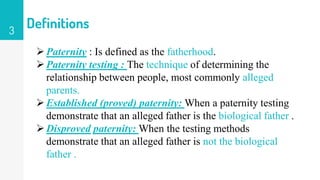
Paternity : Is defined as the fatherhood.
Paternity testing : The technique of determining the
relationship between people, most commonly alleged
parents.
Established (proved) paternity: When a paternity testing
demonstrate that an alleged father is the biological father .
Disproved paternity: When the testing methods
demonstrate that an alleged father is not the biological
father .
Clinical case
4
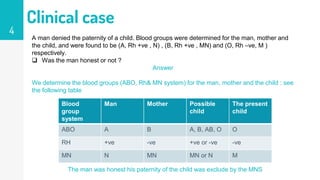
A man denied the paternity of a child. Blood groups were determined for the man, mother and
the child, and were found to be (A, Rh +ve , N) , (B, Rh +ve , MN) and (O, Rh –ve, M )
respectively.
 Was the man honest or not ?
Answer
We determine the blood groups (ABO, Rh& MN system) for the man, mother and the child : see
the following table
Blood
group
system
Man Mother Possible
child
The present
child
ABO A B A, B, AB, O O
RH +ve -ve +ve or -ve -ve
MN N MN MN or N M
The man was honest his paternity of the child was exclude by the MNS
”
The questions of disputed paternity
arises in the following cases
5
1. In case of sorting baby claimed
by two sets of parents
6 👧 👩
👶
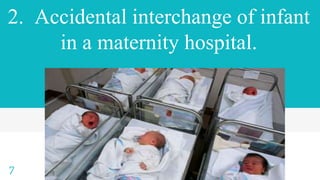
2. Accidental interchange of infant
in a maternity hospital.
7
3. Am I the father ?!!!!
8
💃
A father may deny paternity of a child in
case of :
▹ The wife living apart from her husband
▹ Raped
▹ Adultery
9
4. When lost child is recovered after years,
it is required to determine whether he
belongs to a given set of parents.
10
5. Mass disasters
11
”
How to manage a case of disputed
paternity ?
12
Human Genetically Controlled Markers System
(HGCMS)
13
Blood
Groups
HLA
DNA
prints
Enzyme
Groups
Protein
Groups
Blood Groups
Medico-legal importance of blood groups
15
Personal identification
Disputed paternity
Blood transfusion
Organ transplantation
pregnancy
5
2
3
4
1
Blood Groups
16
Blood
Groups
Major
ABO
Rh
(85% +ve & 15% -ve)
Minor
Blood Groups
17
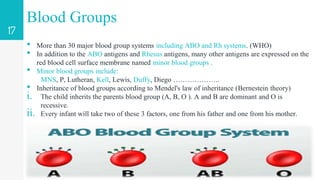
• More than 30 major blood group systems including ABO and Rh systems. (WHO)
• In addition to the ABO antigens and Rhesus antigens, many other antigens are expressed on the
red blood cell surface membrane named minor blood groups .
• Minor blood groups include:
MNS, P, Lutheran, Kell, Lewis, Duffy, Diego ………………..
• Inheritance of blood groups according to Mendel's law of inheritance (Bernestein theory)
i. The child inherits the parents blood group (A, B, O ). A and B are dominant and O is
recessive.
ii. Every infant will take two of these 3 factors, one from his father and one from his mother.
Blood Groups
18
▹ If the infant inherits the two different dominant factors so his blood group is
AB .
▹ If both inherited factors are recessive this indicates blood group O .
▹ If the two inherited factors are one dominant (A or B) and other recessive (O)
this indicates the blood group (A or B) .
▹ If the two inherited factors are dominant and similar (AA) or (BB) This
indicates the blood group (A or B)
19
Blood Groups
20
Blood Groups
Parents Possible child Impossible child
O & O O A, B, & AB
O & A O or A B & AB
O & B O or B A & AB
O & AB A or B O & AB
A & A O or A B & AB
A & B O, A, B, or AB None
A & AB A, B, or AB O
B & B O or B A & AB
B & AB A, B or AB O
AB & AB A, B or AB O
Rh Blood Group System
22
Rh Blood Group System
▹ System for classifying blood groups according to the
presence or absence of the Rh antigen on the cell
membranes of the red blood cells.
23
Rh +ve : if he has D antigen on RBCs. His genotype may be DD or
Dd
Rh –ve : if he has not D antigen on RBCs . His genotype is dd
Parents Possible child Impossible child
(Rh +ve) & (Rh +ve) (Rh +ve) or (Rh –ve) ----------------
(Rh +ve) & (Rh –ve) (Rh +ve) or (Rh –ve) ----------------
(Rh –ve) & (Rh –ve) (Rh –ve) (Rh +ve)
MNS
25
MNS
Inheritance of MN blood groups: by two codominant genes : M &N .
 The genotype of blood group M is MM
 The genotype of blood group N is NN
 The genotype of blood group MN is MN
Parents Possible child Impossible child
M & M M MN & N
M &N MN M & N
M &MN M or MN N
N & N N M & MN
N &MN N or MN M
MN & MN M, N, MN None
Enzyme Groups & Protein Groups
27
Enzyme Groups
Examples of polymorphic enzymes (in RBCs) :
▹ Lactate dehydrogenase enzymes
▹ Phosphatase enzymes
These enzymes are detected by :
Electrophoresis
28
Protein Groups
Examples of blood proteins (in the plasma) :
▹ Haptoglobins
▹ Gc and Gm
▹ Immunoglobulins
These proteins are detected by :
Electrophoresis
HLA
HLA : Human leukocytosis Antigen Loci
▹ Protein substance on the surface of a wide variety of tissues
▹ Detected by major histocompatibility complex (MHC),
situated on the short arm of chromosome 6.
30
Medico-legal importance of HLA
31
Organ transplantation
Disease association
Disputed paternity
2
3
1
Aid much in
the field of
DNA
▹ DNA fingerprints (old name)
▹ DNA prints (recent name)
▹ DNA is determined by PCR
32
Protocol for investigating disputed
paternity cases
33
Protocol for investigation
1. Determination of blood groups:
▸ Easy and rapid technique .
▸ Cheap .
▸ It gives 100% exclusion results .
▸ It gives 75% probability results .
34
75% probability results
Blood groups
Easy
Cheap
Rabid
100 % exclusion result
Protocol for investigation
2. Determination of enzymes or proteins patterns:
▸ Rapid technique .
▸ Non expensive .
▸ Disadvantage: alone it is non-conclusive .
35
Protocol for investigation
3. Determination of HLA typing:
▸ Difficult technique .
▸ Expensive .
▸ Alone it gives 98% probability of paternity.
36
Protocol for investigation
4. Determination of enzymes or proteins patterns:
▸ Difficult technique .
▸ Expensive .
▸ Alone it gives 100% probability of paternity .
It is the only test which can by itself solve the problem of
the disputed paternity
37
38
THANKS!
Any questions?
TEAM PRESENTATION
39
Hesham Shaban Mohamed Mustafa Alaa Hassan Khaled Shawky
Mohamed Ghozal Moamen Fayed Hadeer Mohamed Hadeer Nabhan
Ahmed Ragab
Hager Salah
Hager Sobhy
Reem Abdelhakeem

Disputed Paternity.pptx

  • 1.
  • 2.
  • 3.
    Definitions 3 Paternity : Isdefined as the fatherhood. Paternity testing : The technique of determining the relationship between people, most commonly alleged parents. Established (proved) paternity: When a paternity testing demonstrate that an alleged father is the biological father . Disproved paternity: When the testing methods demonstrate that an alleged father is not the biological father .
  • 4.
    Clinical case 4 A mandenied the paternity of a child. Blood groups were determined for the man, mother and the child, and were found to be (A, Rh +ve , N) , (B, Rh +ve , MN) and (O, Rh –ve, M ) respectively.  Was the man honest or not ? Answer We determine the blood groups (ABO, Rh& MN system) for the man, mother and the child : see the following table Blood group system Man Mother Possible child The present child ABO A B A, B, AB, O O RH +ve -ve +ve or -ve -ve MN N MN MN or N M The man was honest his paternity of the child was exclude by the MNS
  • 5.
    ” The questions ofdisputed paternity arises in the following cases 5
  • 6.
    1. In caseof sorting baby claimed by two sets of parents 6 👧 👩 👶
  • 7.
    2. Accidental interchangeof infant in a maternity hospital. 7
  • 8.
    3. Am Ithe father ?!!!! 8 💃
  • 9.
    A father maydeny paternity of a child in case of : ▹ The wife living apart from her husband ▹ Raped ▹ Adultery 9
  • 10.
    4. When lostchild is recovered after years, it is required to determine whether he belongs to a given set of parents. 10
  • 11.
  • 12.
    ” How to managea case of disputed paternity ? 12
  • 13.
    Human Genetically ControlledMarkers System (HGCMS) 13 Blood Groups HLA DNA prints Enzyme Groups Protein Groups
  • 14.
  • 15.
    Medico-legal importance ofblood groups 15 Personal identification Disputed paternity Blood transfusion Organ transplantation pregnancy 5 2 3 4 1
  • 16.
  • 17.
    Blood Groups 17 • Morethan 30 major blood group systems including ABO and Rh systems. (WHO) • In addition to the ABO antigens and Rhesus antigens, many other antigens are expressed on the red blood cell surface membrane named minor blood groups . • Minor blood groups include: MNS, P, Lutheran, Kell, Lewis, Duffy, Diego ……………….. • Inheritance of blood groups according to Mendel's law of inheritance (Bernestein theory) i. The child inherits the parents blood group (A, B, O ). A and B are dominant and O is recessive. ii. Every infant will take two of these 3 factors, one from his father and one from his mother.
  • 18.
  • 19.
    ▹ If theinfant inherits the two different dominant factors so his blood group is AB . ▹ If both inherited factors are recessive this indicates blood group O . ▹ If the two inherited factors are one dominant (A or B) and other recessive (O) this indicates the blood group (A or B) . ▹ If the two inherited factors are dominant and similar (AA) or (BB) This indicates the blood group (A or B) 19 Blood Groups
  • 20.
    20 Blood Groups Parents Possiblechild Impossible child O & O O A, B, & AB O & A O or A B & AB O & B O or B A & AB O & AB A or B O & AB A & A O or A B & AB A & B O, A, B, or AB None A & AB A, B, or AB O B & B O or B A & AB B & AB A, B or AB O AB & AB A, B or AB O
  • 21.
  • 22.
    22 Rh Blood GroupSystem ▹ System for classifying blood groups according to the presence or absence of the Rh antigen on the cell membranes of the red blood cells.
  • 23.
    23 Rh +ve :if he has D antigen on RBCs. His genotype may be DD or Dd Rh –ve : if he has not D antigen on RBCs . His genotype is dd Parents Possible child Impossible child (Rh +ve) & (Rh +ve) (Rh +ve) or (Rh –ve) ---------------- (Rh +ve) & (Rh –ve) (Rh +ve) or (Rh –ve) ---------------- (Rh –ve) & (Rh –ve) (Rh –ve) (Rh +ve)
  • 24.
  • 25.
    25 MNS Inheritance of MNblood groups: by two codominant genes : M &N .  The genotype of blood group M is MM  The genotype of blood group N is NN  The genotype of blood group MN is MN Parents Possible child Impossible child M & M M MN & N M &N MN M & N M &MN M or MN N N & N N M & MN N &MN N or MN M MN & MN M, N, MN None
  • 26.
    Enzyme Groups &Protein Groups
  • 27.
    27 Enzyme Groups Examples ofpolymorphic enzymes (in RBCs) : ▹ Lactate dehydrogenase enzymes ▹ Phosphatase enzymes These enzymes are detected by : Electrophoresis
  • 28.
    28 Protein Groups Examples ofblood proteins (in the plasma) : ▹ Haptoglobins ▹ Gc and Gm ▹ Immunoglobulins These proteins are detected by : Electrophoresis
  • 29.
  • 30.
    HLA : Humanleukocytosis Antigen Loci ▹ Protein substance on the surface of a wide variety of tissues ▹ Detected by major histocompatibility complex (MHC), situated on the short arm of chromosome 6. 30
  • 31.
    Medico-legal importance ofHLA 31 Organ transplantation Disease association Disputed paternity 2 3 1 Aid much in the field of
  • 32.
    DNA ▹ DNA fingerprints(old name) ▹ DNA prints (recent name) ▹ DNA is determined by PCR 32
  • 33.
    Protocol for investigatingdisputed paternity cases 33
  • 34.
    Protocol for investigation 1.Determination of blood groups: ▸ Easy and rapid technique . ▸ Cheap . ▸ It gives 100% exclusion results . ▸ It gives 75% probability results . 34 75% probability results Blood groups Easy Cheap Rabid 100 % exclusion result
  • 35.
    Protocol for investigation 2.Determination of enzymes or proteins patterns: ▸ Rapid technique . ▸ Non expensive . ▸ Disadvantage: alone it is non-conclusive . 35
  • 36.
    Protocol for investigation 3.Determination of HLA typing: ▸ Difficult technique . ▸ Expensive . ▸ Alone it gives 98% probability of paternity. 36
  • 37.
    Protocol for investigation 4.Determination of enzymes or proteins patterns: ▸ Difficult technique . ▸ Expensive . ▸ Alone it gives 100% probability of paternity . It is the only test which can by itself solve the problem of the disputed paternity 37
  • 38.
  • 39.
    TEAM PRESENTATION 39 Hesham ShabanMohamed Mustafa Alaa Hassan Khaled Shawky Mohamed Ghozal Moamen Fayed Hadeer Mohamed Hadeer Nabhan Ahmed Ragab Hager Salah Hager Sobhy Reem Abdelhakeem