

قَالُواْ سُبْحَانَكَ لاَ عِلْمَ لَنَا إِلاَّ مَا عَلَّمْتَنَا  إِنَّكَ أَنتَ الْعَلِيمُ الْحَكِيمُ  البقرة  32
By BY  Ashraf Mahmoud Emara Professor of Clinical Toxicology Forensic Medicine and Clinical Toxicology Department Faculty of medicine Tanta university
Introduction Medico-legal importance of blood examination: How would you prove that a stain is blood? How to prove that the stain is human? Does the blood belong to a certain person?
PH of about 7.4.  It is mainly composed of: Cells (about 45%) Plasma (about 55%).  Introduction
Introduction Volume of blood is about 8 to 8.5 % (80-85 ml per kg) of body weight. Types of cells: Red blood cells (RBCs)  White blood cells (WBCs). Platelets.
Blood of a victim or assailant may be found on: Weapon Clothes Scene of the crime. In criminal cases
In mass disasters. In criminal cases
In cases of rape, a blood stains may be found on the clothes or the body of the victim. In criminal cases
Disputed paternity. Cases of mixed up children in maternity hospitals. In Hereditary problems
Incompatible blood transfusion  In Clinical problems
The physical properties of blood: Fresh blood (oxy Hb and reduced Hb):  Red  Soluble in water . Old blood (Methaemoglobin): Brown  Soluble in diluted acids and alkalies. Very old blood (Haematoporphyrin): Black  Soluble in conc. acids and alkalies.
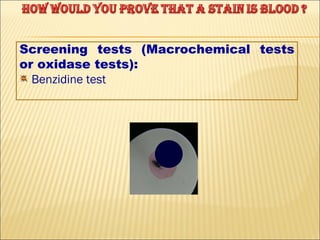
Screening tests (Macrochemical tests or oxidase tests): Good negative tests. Done on a filter paper or in a test tube. Depend on presence of peroxidase enzyme  Peroxidase present in other body secretions and many vegetables. Name:  Benzidine test Phenol-phthalein test  (Kastle Meyer’s test) Guaiacum test
Screening tests (Macrochemical tests or oxidase tests): Benzidine test
Screening tests (Macrochemical tests or oxidase tests): Phenol-phthalein test  (Kastle Meyer’s test)
Screening tests (Macrochemical tests or oxidase tests): Guaiacum test
Confirmatory tests: Microchemical tests: Depends upon the formation of special crystals of haemoglobin derivatives after addition of specific chemicals to the blood. Teichmann test  (Haemin crystal test) Takayama test  (Haemochromogen crystal test)
Microchemical tests: Teichmann test  (Haemin crystal test) Small brown regular crystals with rhombic termination of acid hematin.
Microchemical tests: Takayama test  (Haemochromogen crystal test) Needle salmon pink, feathery shaped crystals of alkaline hematin arranged in clusters or rosettes.
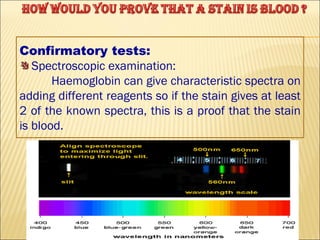
Confirmatory tests: Spectroscopic examination: Haemoglobin can give characteristic spectra on adding different reagents so if the stain gives at least 2 of the known spectra, this is a proof that the stain is blood.
Confirmatory tests: Microscopical test: Human RBCs: Rounded Biconcave side view Non nucleated.
Confirmatory tests: Microscopical test: Non Mammalian:  Oval  Biconvex  Nucleated Camel RBCs:  Oval Biconvex  Non nucleated.
Precipitin test: antigen antibody reaction Stain extract  +  antisera  ring of white precipitate  Antiserum is prepared by injection a rabbit with human blood, antibodies will be formed in its serum against human antigen.
Gel diffusion electrophoresis Latex particle agglutination test
Sexing (intact cell to give accurate results): Female: Davidson body “thin stalked drumstick projection of chromatin” in polymorph nuclear cells.
Male: Y chromosome can be seen in cells soaked in solution of Mg Cl 2  and stained with chemical quinacrine hydrochloride.
Individuality of blood: ABO system. Wet sample. Dried sample: Absorption inhibition test: Mixed agglutination test: NM (S) system. Rh antigen.
Individuality of blood: Other genetic markers: Red cell isoenzymes: Types of Hemoglobin: HbA (adult Hb) HbF (Fetal Hb in fetus and very young infant) HbS (in sickle cell anaemia, present in 8-11% of blacks). HbC (normally present in black people Hb variants are detected by electrophoresis.
Individuality of blood: The human leukocyte antigen system : It is used in doubtful paternity and before organ transplantation.  DNA printing
Thank you

Blood examination

  • 2.
    قَالُواْ سُبْحَانَكَ لاَعِلْمَ لَنَا إِلاَّ مَا عَلَّمْتَنَا إِنَّكَ أَنتَ الْعَلِيمُ الْحَكِيمُ البقرة 32
  • 3.
    By BY Ashraf Mahmoud Emara Professor of Clinical Toxicology Forensic Medicine and Clinical Toxicology Department Faculty of medicine Tanta university
  • 5.
    Introduction Medico-legal importanceof blood examination: How would you prove that a stain is blood? How to prove that the stain is human? Does the blood belong to a certain person?
  • 7.
    PH of about7.4. It is mainly composed of: Cells (about 45%) Plasma (about 55%). Introduction
  • 8.
    Introduction Volume ofblood is about 8 to 8.5 % (80-85 ml per kg) of body weight. Types of cells: Red blood cells (RBCs) White blood cells (WBCs). Platelets.
  • 10.
    Blood of avictim or assailant may be found on: Weapon Clothes Scene of the crime. In criminal cases
  • 11.
    In mass disasters.In criminal cases
  • 12.
    In cases ofrape, a blood stains may be found on the clothes or the body of the victim. In criminal cases
  • 13.
    Disputed paternity. Casesof mixed up children in maternity hospitals. In Hereditary problems
  • 14.
    Incompatible blood transfusion In Clinical problems
  • 16.
    The physical propertiesof blood: Fresh blood (oxy Hb and reduced Hb): Red Soluble in water . Old blood (Methaemoglobin): Brown Soluble in diluted acids and alkalies. Very old blood (Haematoporphyrin): Black Soluble in conc. acids and alkalies.
  • 17.
    Screening tests (Macrochemicaltests or oxidase tests): Good negative tests. Done on a filter paper or in a test tube. Depend on presence of peroxidase enzyme Peroxidase present in other body secretions and many vegetables. Name: Benzidine test Phenol-phthalein test (Kastle Meyer’s test) Guaiacum test
  • 18.
    Screening tests (Macrochemicaltests or oxidase tests): Benzidine test
  • 19.
    Screening tests (Macrochemicaltests or oxidase tests): Phenol-phthalein test (Kastle Meyer’s test)
  • 20.
    Screening tests (Macrochemicaltests or oxidase tests): Guaiacum test
  • 21.
    Confirmatory tests: Microchemicaltests: Depends upon the formation of special crystals of haemoglobin derivatives after addition of specific chemicals to the blood. Teichmann test (Haemin crystal test) Takayama test (Haemochromogen crystal test)
  • 22.
    Microchemical tests: Teichmanntest (Haemin crystal test) Small brown regular crystals with rhombic termination of acid hematin.
  • 23.
    Microchemical tests: Takayamatest (Haemochromogen crystal test) Needle salmon pink, feathery shaped crystals of alkaline hematin arranged in clusters or rosettes.
  • 24.
    Confirmatory tests: Spectroscopicexamination: Haemoglobin can give characteristic spectra on adding different reagents so if the stain gives at least 2 of the known spectra, this is a proof that the stain is blood.
  • 25.
    Confirmatory tests: Microscopicaltest: Human RBCs: Rounded Biconcave side view Non nucleated.
  • 26.
    Confirmatory tests: Microscopicaltest: Non Mammalian: Oval Biconvex Nucleated Camel RBCs: Oval Biconvex Non nucleated.
  • 28.
    Precipitin test: antigenantibody reaction Stain extract + antisera ring of white precipitate Antiserum is prepared by injection a rabbit with human blood, antibodies will be formed in its serum against human antigen.
  • 29.
    Gel diffusion electrophoresisLatex particle agglutination test
  • 31.
    Sexing (intact cellto give accurate results): Female: Davidson body “thin stalked drumstick projection of chromatin” in polymorph nuclear cells.
  • 32.
    Male: Y chromosomecan be seen in cells soaked in solution of Mg Cl 2 and stained with chemical quinacrine hydrochloride.
  • 33.
    Individuality of blood:ABO system. Wet sample. Dried sample: Absorption inhibition test: Mixed agglutination test: NM (S) system. Rh antigen.
  • 34.
    Individuality of blood:Other genetic markers: Red cell isoenzymes: Types of Hemoglobin: HbA (adult Hb) HbF (Fetal Hb in fetus and very young infant) HbS (in sickle cell anaemia, present in 8-11% of blacks). HbC (normally present in black people Hb variants are detected by electrophoresis.
  • 35.
    Individuality of blood:The human leukocyte antigen system : It is used in doubtful paternity and before organ transplantation. DNA printing
  • 36.