ANALYSIS OF BLOOD
SBP4502 BASIC FORENSIC
Raj Cheema, PhD
Department of Biomedical Sciences, FMHS, UPM
manraj@upm.edu.my
ISLAM
&
FORENSIC
SCIENCE
Clear and defined guidance and framework with aims or goals
intended by Islamic law for the realization of benefit to mankind
Collection of proof that support each other till it form
a solid and defined conclusion/evidence
TABLE OF CONTENTS
The basics of blood
(pre-class activity)
Importance of blood
analysis in forensic
Blood spatter analysis Recap, case study and
reflection
(post-class activity)
01
03
02
04
BASICS
SPATTER
SEROLOGY
SUMMARY
At the end of the lecture, students would be able to;
I. Identify the fundamentals of basic serology and forensic serology.
II. Recognize the significance of blood analysis in forensic investigations.
III. Demonstrate an understanding of blood pattern analysis principles.
LEARNING OUTCOMES
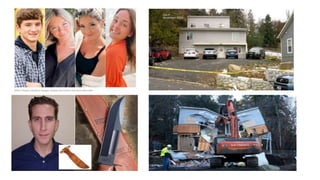
https://www.newsweek.com/bryan-kohbergers-lawyer-fishing-info-about-potential-jurors-1884588
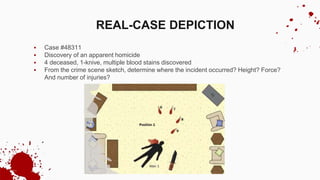
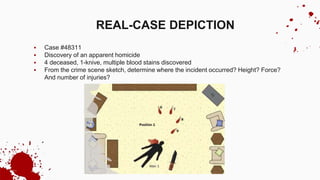
 Case #48311
 Discovery of an apparent homicide
 4 deceased, 1-knive, multiple blood stains discovered
 From the crime scene sketch, determine where the incident occurred? Height? Force?
And number of injuries?
REAL-CASE DEPICTION
01
Comprehend the basics of forensic serology (Anatomy and Physiology)
BASICS (LO 1)
Serology (Blood Basics)
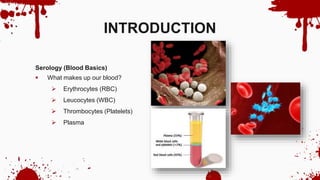
 What makes up our blood?
 Erythrocytes (RBC)
 Leucocytes (WBC)
 Thrombocytes (Platelets)
 Plasma
INTRODUCTION
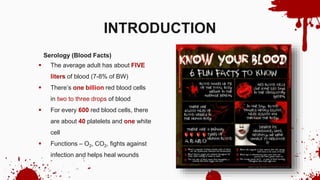
Serology (Blood Facts)
 The average adult has about FIVE
liters of blood (7-8% of BW)
 There’s one billion red blood cells
in two to three drops of blood
 For every 600 red blood cells, there
are about 40 platelets and one white
cell
 Functions – O2, CO2, fights against
infection and helps heal wounds
INTRODUCTION
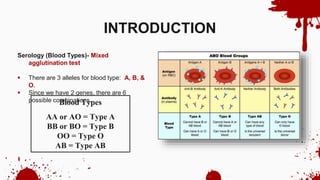
Serology (Blood Types)- Mixed
agglutination test
 There are 3 alleles for blood type: A, B, &
O.
 Since we have 2 genes, there are 6
possible combinations.
INTRODUCTION
Blood Types
AA or AO = Type A
BB or BO = Type B
OO = Type O
AB = Type AB
PRE-CLASS DATA
PutraBlast pre-class viewing quiz
PRE-CLASS DATA
Question
3
Question
6
02
Understand the importance of blood analysis in
forensic
SEROLOGY (LO 1 & 2)
Importance of blood analysis in forensic science
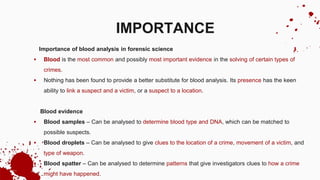
 Blood is the most common and possibly most important evidence in the solving of certain types of
crimes.
 Nothing has been found to provide a better substitute for blood analysis. Its presence has the keen
ability to link a suspect and a victim, or a suspect to a location.
Blood evidence
 Blood samples – Can be analysed to determine blood type and DNA, which can be matched to
possible suspects.
 Blood droplets – Can be analysed to give clues to the location of a crime, movement of a victim, and
type of weapon.
 Blood spatter – Can be analysed to determine patterns that give investigators clues to how a crime
might have happened.
IMPORTANCE
History
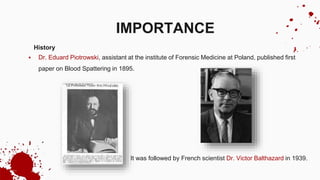
 Dr. Eduard Piotrowski, assistant at the institute of Forensic Medicine at Poland, published first
paper on Blood Spattering in 1895.
 It was followed by French scientist Dr. Victor Balthazard in 1939.
IMPORTANCE
History
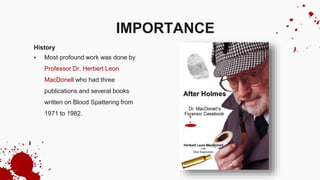
 Most profound work was done by
Professor Dr. Herbert Leon
MacDonell who had three
publications and several books
written on Blood Spattering from
1971 to 1982.
IMPORTANCE
The serology section of a forensic laboratory may deal with any or all the following:
 Blood typing/grouping
 Characterization of unknown blood
 Stain patterns for crime reconstruction
 DNA techniques used for identification
 Etc.
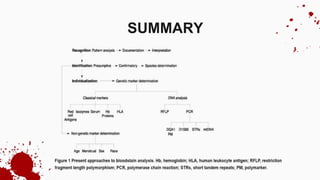
Bloodstain identification is commonly achieved by one of five methods of analysis:
i. Microscopic examination
ii. Chemical methods
iii. Spectrophoto-metric analysis
iv. Immunological methods
v. DNA analysis
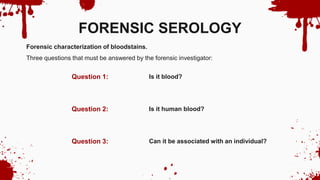
FORENSIC SEROLOGY
Is it blood?
Is it human blood?
Can it be associated with an individual?
Question 1:
Question 3:
Question 2:
FORENSIC SEROLOGY
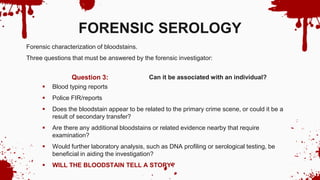
Forensic characterization of bloodstains.
Three questions that must be answered by the forensic investigator:
Is it blood?
Question 1:
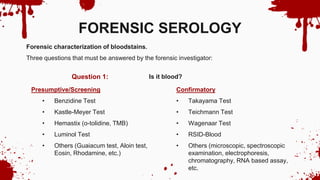
FORENSIC SEROLOGY
Forensic characterization of bloodstains.
Three questions that must be answered by the forensic investigator:
Presumptive/Screening
• Benzidine Test
• Kastle-Meyer Test
• Hemastix (o-tolidine, TMB)
• Luminol Test
• Others (Guaiacum test, Aloin test,
Eosin, Rhodamine, etc.)
Confirmatory
• Takayama Test
• Teichmann Test
• Wagenaar Test
• RSID-Blood
• Others (microscopic, spectroscopic
examination, electrophoresis,
chromatography, RNA based assay,
etc.
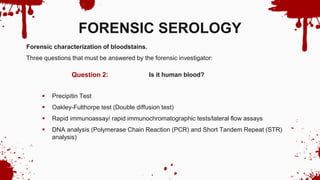
Is it human blood?
Question 2:
FORENSIC SEROLOGY
Forensic characterization of bloodstains.
Three questions that must be answered by the forensic investigator:
 Precipitin Test
 Oakley-Fulthorpe test (Double diffusion test)
 Rapid immunoassay/ rapid immunochromatographic tests/lateral flow assays
 DNA analysis (Polymerase Chain Reaction (PCR) and Short Tandem Repeat (STR)
analysis)
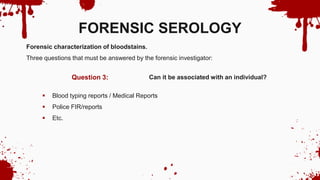
Can it be associated with an individual?
Question 3:
FORENSIC SEROLOGY
Forensic characterization of bloodstains.
Three questions that must be answered by the forensic investigator:
 Blood typing reports / Medical Reports
 Police FIR/reports
 Etc.
Is it blood?
Question 1:
FORENSIC SEROLOGY
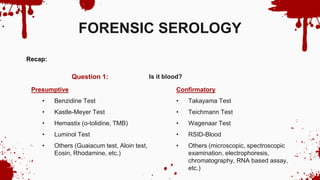
Recap:
Presumptive
• Benzidine Test
• Kastle-Meyer Test
• Hemastix (o-tolidine, TMB)
• Luminol Test
• Others (Guaiacum test, Aloin test,
Eosin, Rhodamine, etc.)
Confirmatory
• Takayama Test
• Teichmann Test
• Wagenaar Test
• RSID-Blood
• Others (microscopic, spectroscopic
examination, electrophoresis,
chromatography, RNA based assay,
etc.)
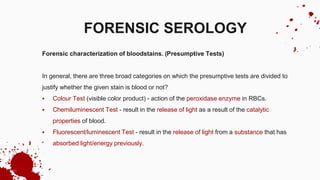
Forensic characterization of bloodstains. (Presumptive Tests)
In general, there are three broad categories on which the presumptive tests are divided to
justify whether the given stain is blood or not?
 Colour Test (visible color product) - action of the peroxidase enzyme in RBCs.
 Chemiluminescent Test - result in the release of light as a result of the catalytic
properties of blood.
 Fluorescent/luminescent Test - result in the release of light from a substance that has
absorbed light/energy previously.
FORENSIC SEROLOGY
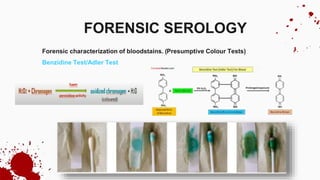
Forensic characterization of bloodstains. (Presumptive Colour Tests)
Benzidine Test/Adler Test
FORENSIC SEROLOGY
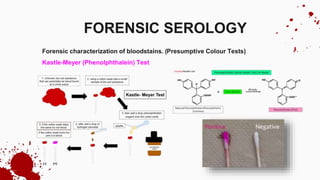
Forensic characterization of bloodstains. (Presumptive Colour Tests)
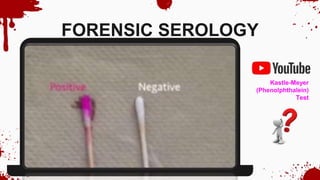
Kastle-Meyer (Phenolphthalein) Test
FORENSIC SEROLOGY
FORENSIC SEROLOGY
Kastle-Meyer
(Phenolphthalein)
Test
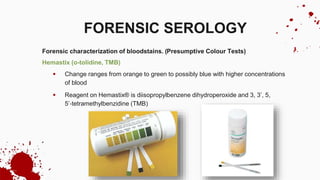
Forensic characterization of bloodstains. (Presumptive Colour Tests)
Hemastix (o-tolidine, TMB)
 Change ranges from orange to green to possibly blue with higher concentrations
of blood
 Reagent on Hemastix® is diisopropylbenzene dihydroperoxide and 3, 3’, 5,
5’‐tetramethylbenzidine (TMB)
FORENSIC SEROLOGY
Forensic characterization of bloodstains. (Presumptive Colour Tests)
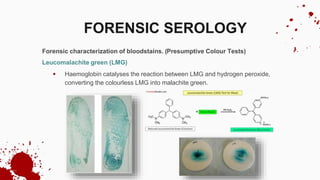
Leucomalachite green (LMG)
 Haemoglobin catalyses the reaction between LMG and hydrogen peroxide,
converting the colourless LMG into malachite green.
FORENSIC SEROLOGY
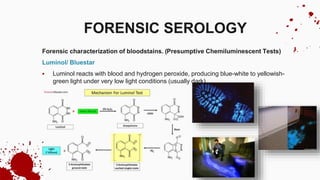
Forensic characterization of bloodstains. (Presumptive Chemiluminescent Tests)
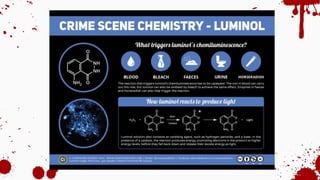
Luminol/ Bluestar
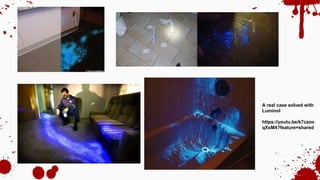
 Luminol reacts with blood and hydrogen peroxide, producing blue-white to yellowish-
green light under very low light conditions (usually dark).
FORENSIC SEROLOGY
Forensic characterization of bloodstains. (Presumptive Chemiluminescent Tests)
Luminol/ Bluestar
 The possibility exists, however, that blood may be present in amounts too little to see
with the unaided eye, or that the blood at the scene had been “cleaned up” prior to
arrival of the crime scene team.
 The light, or luminescence, emitted in the luminol reaction results when an oxidising
agent, such as blood, catalyses the oxidation of luminol by hydrogen peroxide in a
basic solution.
 The reaction is not specific to blood.
 A follow up presumptive test, such as phenolphthalein, is typically run on potential
samples prior to collection.
FORENSIC SEROLOGY
A real case solved with
Luminol
https://youtu.be/k7czoo
qXsM4?feature=shared
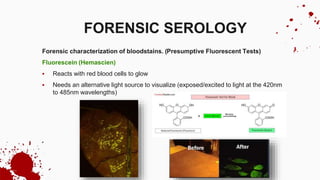
Forensic characterization of bloodstains. (Presumptive Fluorescent Tests)
Fluorescein (Hemascien)
 Reacts with red blood cells to glow
 Needs an alternative light source to visualize (exposed/excited to light at the 420nm
to 485nm wavelengths)
FORENSIC SEROLOGY
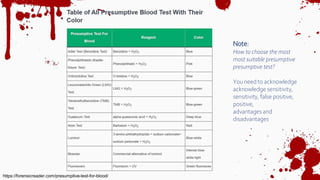
Note:
How to choose the most
most suitable presumptive
presumptive test?
You need to acknowledge
acknowledge sensitivity,
sensitivity, false positive,
positive,
advantages and
disadvantages
https://forensicreader.com/presumptive-test-for-blood/
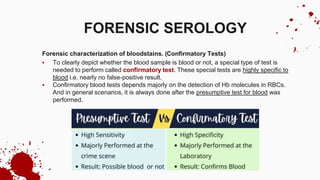
Forensic characterization of bloodstains. (Confirmatory Tests)
 To clearly depict whether the blood sample is blood or not, a special type of test is
needed to perform called confirmatory test. These special tests are highly specific to
blood i.e. nearly no false-positive result.
 Confirmatory blood tests depends majorly on the detection of Hb molecules in RBCs.
And in general scenarios, it is always done after the presumptive test for blood was
performed.
FORENSIC SEROLOGY
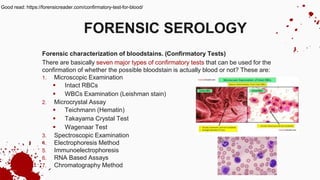
Forensic characterization of bloodstains. (Confirmatory Tests)
There are basically seven major types of confirmatory tests that can be used for the
confirmation of whether the possible bloodstain is actually blood or not? These are:
1. Microscopic Examination
 Intact RBCs
 WBCs Examination (Leishman stain)
2. Microcrystal Assay
 Teichmann (Hematin)
 Takayama Crystal Test
 Wagenaar Test
3. Spectroscopic Examination
4. Electrophoresis Method
5. Immunoelectrophoresis
6. RNA Based Assays
7. Chromatography Method
FORENSIC SEROLOGY
Good read: https://forensicreader.com/confirmatory-test-for-blood/
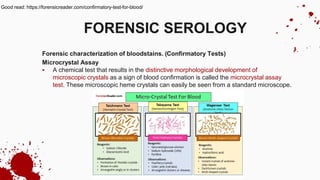
Forensic characterization of bloodstains. (Confirmatory Tests)
Microcrystal Assay
 A chemical test that results in the distinctive morphological development of
microscopic crystals as a sign of blood confirmation is called the microcrystal assay
test. These microscopic heme crystals can easily be seen from a standard microscope.
FORENSIC SEROLOGY
Good read: https://forensicreader.com/confirmatory-test-for-blood/
Forensic characterization of bloodstains. (Confirmatory Tests)
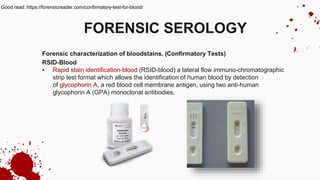
RSID-Blood
 Rapid stain identification-blood (RSID-blood) a lateral flow immuno-chromatographic
strip test format which allows the identification of human blood by detection
of glycophorin A, a red blood cell membrane antigen, using two anti-human
glycophorin A (GPA) monoclonal antibodies.
FORENSIC SEROLOGY
Good read: https://forensicreader.com/confirmatory-test-for-blood/
Is it human blood?
Question 2:
FORENSIC SEROLOGY
Forensic characterization of bloodstains.
Three questions that must be answered by the forensic investigator:
 Precipitin Test
 Oakley-Fulthorpe test (double diffusion test)
 Rapid immunoassay/ rapid immunochromatographic tests/lateral flow assays
 DNA analysis (Polymerase Chain Reaction (PCR) and Short Tandem Repeat (STR)
analysis)
FORENSIC SEROLOGY
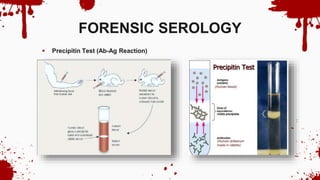
 Precipitin Test (Ab-Ag Reaction)
FORENSIC SEROLOGY
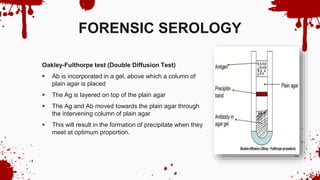
Oakley-Fulthorpe test (Double Diffusion Test)
 Ab is incorporated in a gel, above which a column of
plain agar is placed
 The Ag is layered on top of the plain agar
 The Ag and Ab moved towards the plain agar through
the intervening column of plain agar
 This will result in the formation of precipitate when they
meet at optimum proportion.
Can it be associated with an individual?
Question 3:
FORENSIC SEROLOGY
Forensic characterization of bloodstains.
Three questions that must be answered by the forensic investigator:
 Blood typing reports
 Police FIR/reports
 Does the bloodstain appear to be related to the primary crime scene, or could it be a
result of secondary transfer?
 Are there any additional bloodstains or related evidence nearby that require
examination?
 Would further laboratory analysis, such as DNA profiling or serological testing, be
beneficial in aiding the investigation?
 WILL THE BLOODSTAIN TELL A STORY?
Take 5
LET’S PLAY
03
Grasp the blood spatter analysis concept
SPATTER (LO 3)
BLOOD PATTERN ANALYSIS
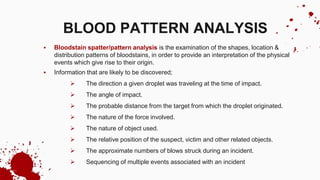
 Bloodstain spatter/pattern analysis is the examination of the shapes, location &
distribution patterns of bloodstains, in order to provide an interpretation of the physical
events which give rise to their origin.
 Information that are likely to be discovered;
 The direction a given droplet was traveling at the time of impact.
 The angle of impact.
 The probable distance from the target from which the droplet originated.
 The nature of the force involved.
 The nature of object used.
 The relative position of the suspect, victim and other related objects.
 The approximate numbers of blows struck during an incident.
 Sequencing of multiple events associated with an incident
BLOOD PATTERN ANALYSIS
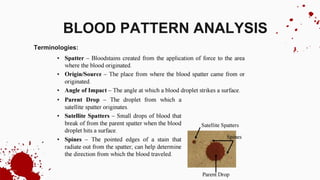
Terminologies:
BLOOD PATTERN ANALYSIS
Blood Spatter/Pattern Analysis will delve into;
I. Categories of Bloodstain Patterns
II. Directionality of Bloodstain
III. Impact Angle Determination
IV. Target Surface and Stain Shape
V. Point of Convergence
VI. Point of Origin
BLOOD PATTERN ANALYSIS
I. Categories of Bloodstain Patterns
a) Passive Bloodstains b) Transfer Bloodstains
BLOOD PATTERN ANALYSIS
c) Projected Bloodstains
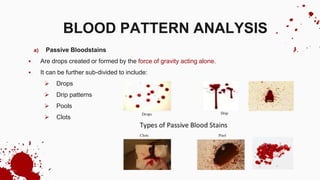
a) Passive Bloodstains
 Are drops created or formed by the force of gravity acting alone.
 It can be further sub-divided to include:
 Drops
 Drip patterns
 Pools
 Clots
BLOOD PATTERN ANALYSIS
b) Transfer Bloodstains
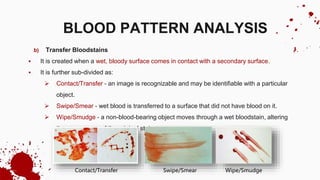
 It is created when a wet, bloody surface comes in contact with a secondary surface.
 It is further sub-divided as:
 Contact/Transfer - an image is recognizable and may be identifiable with a particular
object.
 Swipe/Smear - wet blood is transferred to a surface that did not have blood on it.
 Wipe/Smudge - a non-blood-bearing object moves through a wet bloodstain, altering
the appearance of the original stain.
BLOOD PATTERN ANALYSIS
Contact/Transfer Swipe/Smear Wipe/Smudge
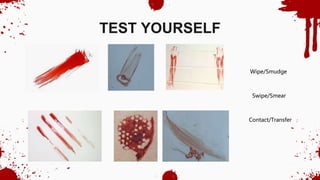
TEST YOURSELF
Contact/Transfer
Swipe/Smear
Wipe/Smudge
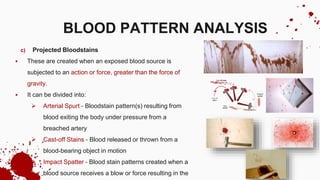
c) Projected Bloodstains
 These are created when an exposed blood source is
subjected to an action or force, greater than the force of
gravity.
 It can be divided into:
 Arterial Spurt - Bloodstain pattern(s) resulting from
blood exiting the body under pressure from a
breached artery
 Cast-off Stains - Blood released or thrown from a
blood-bearing object in motion
 Impact Spatter - Blood stain patterns created when a
blood source receives a blow or force resulting in the
BLOOD PATTERN ANALYSIS
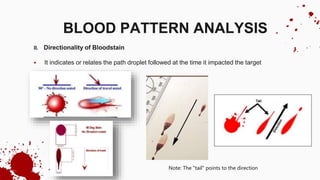
II. Directionality of Bloodstain
 It indicates or relates the path droplet followed at the time it impacted the target
BLOOD PATTERN ANALYSIS
Note: The "tail" points to the direction
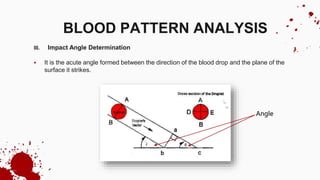
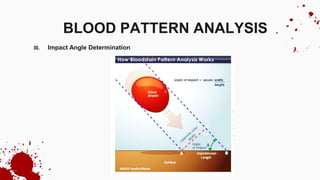
III. Impact Angle Determination
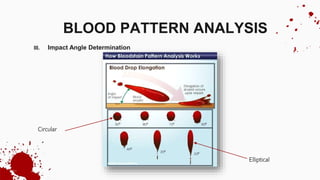
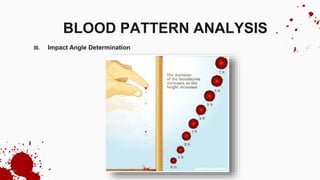
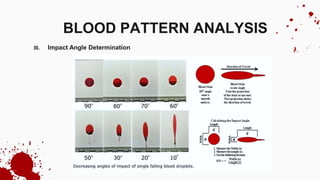
 It is the acute angle formed between the direction of the blood drop and the plane of the
surface it strikes.
BLOOD PATTERN ANALYSIS
Angle
III. Impact Angle Determination
BLOOD PATTERN ANALYSIS
Circular
Elliptical
III. Impact Angle Determination
BLOOD PATTERN ANALYSIS
III. Impact Angle Determination
BLOOD PATTERN ANALYSIS
Take 5
III. Impact Angle Determination
BLOOD PATTERN ANALYSIS
III. Impact Angle Determination
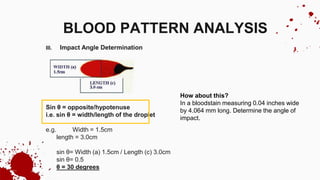
Sin θ = opposite/hypotenuse
i.e. sin θ = width/length of the droplet
e.g. Width = 1.5cm
length = 3.0cm
sin θ= Width (a) 1.5cm / Length (c) 3.0cm
sin θ= 0.5
θ = 30 degrees
BLOOD PATTERN ANALYSIS
How about this?
In a bloodstain measuring 0.04 inches wide
by 4.064 mm long. Determine the angle of
impact.
 Breakout room group activity (max 5 in a
group)
 You are required to calculate and determine
the impact angle of blood stains
 You will be provided with the worksheet
 You are given 10 minutes to complete the
worksheet and
 You will present your data to the class
GROUP ACTIVITY
IV. Target Surface and Stain Shape
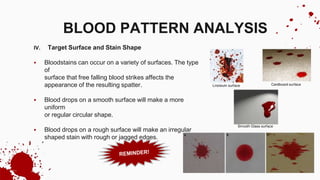
 Bloodstains can occur on a variety of surfaces. The type
of
surface that free falling blood strikes affects the
appearance of the resulting spatter.
 Blood drops on a smooth surface will make a more
uniform
or regular circular shape.
 Blood drops on a rough surface will make an irregular
shaped stain with rough or jagged edges.
BLOOD PATTERN ANALYSIS
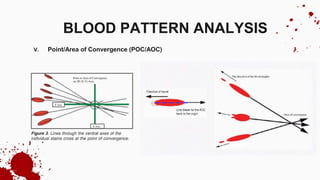
V. Point/Area of Convergence (POC/AOC)
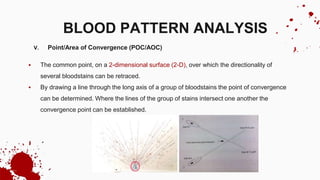
 The common point, on a 2-dimensional surface (2-D), over which the directionality of
several bloodstains can be retraced.
 By drawing a line through the long axis of a group of bloodstains the point of convergence
can be determined. Where the lines of the group of stains intersect one another the
convergence point can be established.
BLOOD PATTERN ANALYSIS
V. Point/Area of Convergence (POC/AOC)
BLOOD PATTERN ANALYSIS
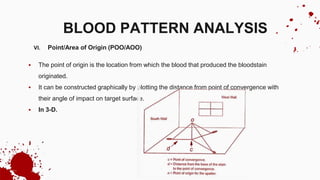
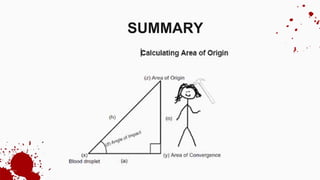
VI. Point/Area of Origin (POO/AOO)
 The point of origin is the location from which the blood that produced the bloodstain
originated.
 It can be constructed graphically by plotting the distance from point of convergence with
their angle of impact on target surface.
 In 3-D.
BLOOD PATTERN ANALYSIS
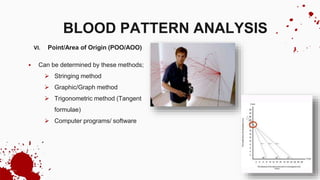
VI. Point/Area of Origin (POO/AOO)
 Can be determined by these methods;
 Stringing method
 Graphic/Graph method
 Trigonometric method (Tangent
formulae)
 Computer programs/ software
BLOOD PATTERN ANALYSIS
VI. Point/Area of Origin (POO/AOO)
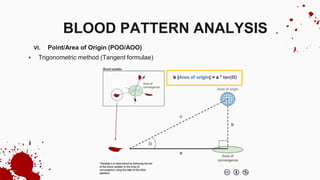
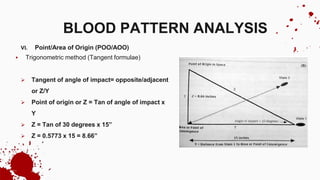
 Trigonometric method (Tangent formulae)
BLOOD PATTERN ANALYSIS
VI. Point/Area of Origin (POO/AOO)
 Trigonometric method (Tangent formulae)
 Tangent of angle of impact= opposite/adjacent
or Z/Y
 Point of origin or Z = Tan of angle of impact x
Y
 Z = Tan of 30 degrees x 15”
 Z = 0.5773 x 15 = 8.66”
BLOOD PATTERN ANALYSIS
 Blood is the most common and possibly most important evidence in the solving of certain
types of crimes.
 A drop of blood tells a thousand stories.
 Its COMPLEX!
 Its never simple……creativity is required to solve a crime. We have to look at every
ANGLE!
SUMMARY
SUMMARY
SUMMARY
Check it out! (Blood Spatter)
 https://youtu.be/qFR6JvVJk6o
 https://youtu.be/sCXfosxgyrI
 https://youtu.be/AHH8VItHQvk?si=X
n201zkIPbTLdvTN
 http://www.forensicsciencesimplified
.org/blood/BloodstainPatterns.pdf
REVISION LINKS/RESOURCES
 Case #48311
 Discovery of an apparent homicide
 4 deceased, 1-knive, multiple blood stains discovered
 From the crime scene sketch, determine where the incident occurred? Height? Force?
And number of injuries?
REAL-CASE DEPICTION
POST-CLASS
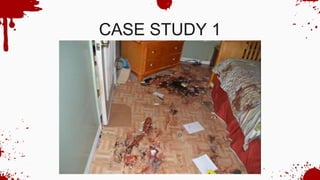
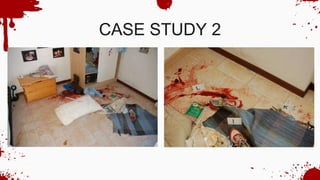
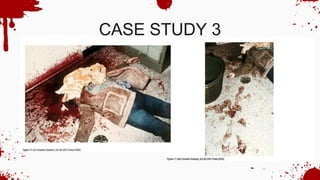
In this activity, you will delve into the intricacies of blood analysis at a crime
scene. Your task is to provide an analysis of blood overview of these 3 case
studies. Place your answer in the discussion forum in PB. Do take the time to
discuss other responses too. Thank you!
CASE STUDY 1
CASE STUDY 2
CASE STUDY 3
REFERENCES
General information
 Saferstein, Criminalistics: An Introduction to Forensic Science
 Siegel, Forensic Science: The Basics
 Nordby, Forensic Science: An Introduction to Scientific and Investigative Techniques
Presumptive Test
 https://forensicreader.com/presumptive-test-for-blood/
Confirmatory Test
 https://forensicreader.com/confirmatory-test-for-blood/
Blood Pattern Analysis
 https://www.crimescene-forensics.com/Crime_Scene_Forensics/Bloodstains.html
CREDITS: This presentation template was created by Slidesgo, and
includes icons by Flaticon, and infographics & images by Freepik
THANKS!
DO YOU HAVE ANY QUESTIONS?
manraj@upm.edu.my
012-5717395
Reminder
Student
evaluation

Forensic Blood Analysis --- 2-4-2024.pptx

  • 1.
    ANALYSIS OF BLOOD SBP4502BASIC FORENSIC Raj Cheema, PhD Department of Biomedical Sciences, FMHS, UPM manraj@upm.edu.my
  • 2.
    ISLAM & FORENSIC SCIENCE Clear and definedguidance and framework with aims or goals intended by Islamic law for the realization of benefit to mankind Collection of proof that support each other till it form a solid and defined conclusion/evidence
  • 3.
    TABLE OF CONTENTS Thebasics of blood (pre-class activity) Importance of blood analysis in forensic Blood spatter analysis Recap, case study and reflection (post-class activity) 01 03 02 04 BASICS SPATTER SEROLOGY SUMMARY
  • 4.
    At the endof the lecture, students would be able to; I. Identify the fundamentals of basic serology and forensic serology. II. Recognize the significance of blood analysis in forensic investigations. III. Demonstrate an understanding of blood pattern analysis principles. LEARNING OUTCOMES
  • 5.
  • 7.
     Case #48311 Discovery of an apparent homicide  4 deceased, 1-knive, multiple blood stains discovered  From the crime scene sketch, determine where the incident occurred? Height? Force? And number of injuries? REAL-CASE DEPICTION
  • 8.
    01 Comprehend the basicsof forensic serology (Anatomy and Physiology) BASICS (LO 1)
  • 9.
    Serology (Blood Basics) What makes up our blood?  Erythrocytes (RBC)  Leucocytes (WBC)  Thrombocytes (Platelets)  Plasma INTRODUCTION
  • 10.
    Serology (Blood Facts) The average adult has about FIVE liters of blood (7-8% of BW)  There’s one billion red blood cells in two to three drops of blood  For every 600 red blood cells, there are about 40 platelets and one white cell  Functions – O2, CO2, fights against infection and helps heal wounds INTRODUCTION
  • 11.
    Serology (Blood Types)-Mixed agglutination test  There are 3 alleles for blood type: A, B, & O.  Since we have 2 genes, there are 6 possible combinations. INTRODUCTION Blood Types AA or AO = Type A BB or BO = Type B OO = Type O AB = Type AB
  • 12.
  • 13.
  • 14.
    02 Understand the importanceof blood analysis in forensic SEROLOGY (LO 1 & 2)
  • 15.
    Importance of bloodanalysis in forensic science  Blood is the most common and possibly most important evidence in the solving of certain types of crimes.  Nothing has been found to provide a better substitute for blood analysis. Its presence has the keen ability to link a suspect and a victim, or a suspect to a location. Blood evidence  Blood samples – Can be analysed to determine blood type and DNA, which can be matched to possible suspects.  Blood droplets – Can be analysed to give clues to the location of a crime, movement of a victim, and type of weapon.  Blood spatter – Can be analysed to determine patterns that give investigators clues to how a crime might have happened. IMPORTANCE
  • 16.
    History  Dr. EduardPiotrowski, assistant at the institute of Forensic Medicine at Poland, published first paper on Blood Spattering in 1895.  It was followed by French scientist Dr. Victor Balthazard in 1939. IMPORTANCE
  • 17.
    History  Most profoundwork was done by Professor Dr. Herbert Leon MacDonell who had three publications and several books written on Blood Spattering from 1971 to 1982. IMPORTANCE
  • 18.
    The serology sectionof a forensic laboratory may deal with any or all the following:  Blood typing/grouping  Characterization of unknown blood  Stain patterns for crime reconstruction  DNA techniques used for identification  Etc. Bloodstain identification is commonly achieved by one of five methods of analysis: i. Microscopic examination ii. Chemical methods iii. Spectrophoto-metric analysis iv. Immunological methods v. DNA analysis FORENSIC SEROLOGY
  • 19.
    Is it blood? Isit human blood? Can it be associated with an individual? Question 1: Question 3: Question 2: FORENSIC SEROLOGY Forensic characterization of bloodstains. Three questions that must be answered by the forensic investigator:
  • 20.
    Is it blood? Question1: FORENSIC SEROLOGY Forensic characterization of bloodstains. Three questions that must be answered by the forensic investigator: Presumptive/Screening • Benzidine Test • Kastle-Meyer Test • Hemastix (o-tolidine, TMB) • Luminol Test • Others (Guaiacum test, Aloin test, Eosin, Rhodamine, etc.) Confirmatory • Takayama Test • Teichmann Test • Wagenaar Test • RSID-Blood • Others (microscopic, spectroscopic examination, electrophoresis, chromatography, RNA based assay, etc.
  • 21.
    Is it humanblood? Question 2: FORENSIC SEROLOGY Forensic characterization of bloodstains. Three questions that must be answered by the forensic investigator:  Precipitin Test  Oakley-Fulthorpe test (Double diffusion test)  Rapid immunoassay/ rapid immunochromatographic tests/lateral flow assays  DNA analysis (Polymerase Chain Reaction (PCR) and Short Tandem Repeat (STR) analysis)
  • 22.
    Can it beassociated with an individual? Question 3: FORENSIC SEROLOGY Forensic characterization of bloodstains. Three questions that must be answered by the forensic investigator:  Blood typing reports / Medical Reports  Police FIR/reports  Etc.
  • 23.
    Is it blood? Question1: FORENSIC SEROLOGY Recap: Presumptive • Benzidine Test • Kastle-Meyer Test • Hemastix (o-tolidine, TMB) • Luminol Test • Others (Guaiacum test, Aloin test, Eosin, Rhodamine, etc.) Confirmatory • Takayama Test • Teichmann Test • Wagenaar Test • RSID-Blood • Others (microscopic, spectroscopic examination, electrophoresis, chromatography, RNA based assay, etc.)
  • 24.
    Forensic characterization ofbloodstains. (Presumptive Tests) In general, there are three broad categories on which the presumptive tests are divided to justify whether the given stain is blood or not?  Colour Test (visible color product) - action of the peroxidase enzyme in RBCs.  Chemiluminescent Test - result in the release of light as a result of the catalytic properties of blood.  Fluorescent/luminescent Test - result in the release of light from a substance that has absorbed light/energy previously. FORENSIC SEROLOGY
  • 25.
    Forensic characterization ofbloodstains. (Presumptive Colour Tests) Benzidine Test/Adler Test FORENSIC SEROLOGY
  • 26.
    Forensic characterization ofbloodstains. (Presumptive Colour Tests) Kastle-Meyer (Phenolphthalein) Test FORENSIC SEROLOGY
  • 27.
  • 28.
    Forensic characterization ofbloodstains. (Presumptive Colour Tests) Hemastix (o-tolidine, TMB)  Change ranges from orange to green to possibly blue with higher concentrations of blood  Reagent on Hemastix® is diisopropylbenzene dihydroperoxide and 3, 3’, 5, 5’‐tetramethylbenzidine (TMB) FORENSIC SEROLOGY
  • 29.
    Forensic characterization ofbloodstains. (Presumptive Colour Tests) Leucomalachite green (LMG)  Haemoglobin catalyses the reaction between LMG and hydrogen peroxide, converting the colourless LMG into malachite green. FORENSIC SEROLOGY
  • 30.
    Forensic characterization ofbloodstains. (Presumptive Chemiluminescent Tests) Luminol/ Bluestar  Luminol reacts with blood and hydrogen peroxide, producing blue-white to yellowish- green light under very low light conditions (usually dark). FORENSIC SEROLOGY
  • 31.
    Forensic characterization ofbloodstains. (Presumptive Chemiluminescent Tests) Luminol/ Bluestar  The possibility exists, however, that blood may be present in amounts too little to see with the unaided eye, or that the blood at the scene had been “cleaned up” prior to arrival of the crime scene team.  The light, or luminescence, emitted in the luminol reaction results when an oxidising agent, such as blood, catalyses the oxidation of luminol by hydrogen peroxide in a basic solution.  The reaction is not specific to blood.  A follow up presumptive test, such as phenolphthalein, is typically run on potential samples prior to collection. FORENSIC SEROLOGY
  • 33.
    A real casesolved with Luminol https://youtu.be/k7czoo qXsM4?feature=shared
  • 34.
    Forensic characterization ofbloodstains. (Presumptive Fluorescent Tests) Fluorescein (Hemascien)  Reacts with red blood cells to glow  Needs an alternative light source to visualize (exposed/excited to light at the 420nm to 485nm wavelengths) FORENSIC SEROLOGY
  • 35.
    Note: How to choosethe most most suitable presumptive presumptive test? You need to acknowledge acknowledge sensitivity, sensitivity, false positive, positive, advantages and disadvantages https://forensicreader.com/presumptive-test-for-blood/
  • 36.
    Forensic characterization ofbloodstains. (Confirmatory Tests)  To clearly depict whether the blood sample is blood or not, a special type of test is needed to perform called confirmatory test. These special tests are highly specific to blood i.e. nearly no false-positive result.  Confirmatory blood tests depends majorly on the detection of Hb molecules in RBCs. And in general scenarios, it is always done after the presumptive test for blood was performed. FORENSIC SEROLOGY
  • 37.
    Forensic characterization ofbloodstains. (Confirmatory Tests) There are basically seven major types of confirmatory tests that can be used for the confirmation of whether the possible bloodstain is actually blood or not? These are: 1. Microscopic Examination  Intact RBCs  WBCs Examination (Leishman stain) 2. Microcrystal Assay  Teichmann (Hematin)  Takayama Crystal Test  Wagenaar Test 3. Spectroscopic Examination 4. Electrophoresis Method 5. Immunoelectrophoresis 6. RNA Based Assays 7. Chromatography Method FORENSIC SEROLOGY Good read: https://forensicreader.com/confirmatory-test-for-blood/
  • 38.
    Forensic characterization ofbloodstains. (Confirmatory Tests) Microcrystal Assay  A chemical test that results in the distinctive morphological development of microscopic crystals as a sign of blood confirmation is called the microcrystal assay test. These microscopic heme crystals can easily be seen from a standard microscope. FORENSIC SEROLOGY Good read: https://forensicreader.com/confirmatory-test-for-blood/
  • 39.
    Forensic characterization ofbloodstains. (Confirmatory Tests) RSID-Blood  Rapid stain identification-blood (RSID-blood) a lateral flow immuno-chromatographic strip test format which allows the identification of human blood by detection of glycophorin A, a red blood cell membrane antigen, using two anti-human glycophorin A (GPA) monoclonal antibodies. FORENSIC SEROLOGY Good read: https://forensicreader.com/confirmatory-test-for-blood/
  • 40.
    Is it humanblood? Question 2: FORENSIC SEROLOGY Forensic characterization of bloodstains. Three questions that must be answered by the forensic investigator:  Precipitin Test  Oakley-Fulthorpe test (double diffusion test)  Rapid immunoassay/ rapid immunochromatographic tests/lateral flow assays  DNA analysis (Polymerase Chain Reaction (PCR) and Short Tandem Repeat (STR) analysis)
  • 41.
    FORENSIC SEROLOGY  PrecipitinTest (Ab-Ag Reaction)
  • 42.
    FORENSIC SEROLOGY Oakley-Fulthorpe test(Double Diffusion Test)  Ab is incorporated in a gel, above which a column of plain agar is placed  The Ag is layered on top of the plain agar  The Ag and Ab moved towards the plain agar through the intervening column of plain agar  This will result in the formation of precipitate when they meet at optimum proportion.
  • 43.
    Can it beassociated with an individual? Question 3: FORENSIC SEROLOGY Forensic characterization of bloodstains. Three questions that must be answered by the forensic investigator:  Blood typing reports  Police FIR/reports  Does the bloodstain appear to be related to the primary crime scene, or could it be a result of secondary transfer?  Are there any additional bloodstains or related evidence nearby that require examination?  Would further laboratory analysis, such as DNA profiling or serological testing, be beneficial in aiding the investigation?  WILL THE BLOODSTAIN TELL A STORY?
  • 44.
  • 45.
  • 46.
    03 Grasp the bloodspatter analysis concept SPATTER (LO 3)
  • 48.
  • 49.
     Bloodstain spatter/patternanalysis is the examination of the shapes, location & distribution patterns of bloodstains, in order to provide an interpretation of the physical events which give rise to their origin.  Information that are likely to be discovered;  The direction a given droplet was traveling at the time of impact.  The angle of impact.  The probable distance from the target from which the droplet originated.  The nature of the force involved.  The nature of object used.  The relative position of the suspect, victim and other related objects.  The approximate numbers of blows struck during an incident.  Sequencing of multiple events associated with an incident BLOOD PATTERN ANALYSIS
  • 50.
  • 51.
    Blood Spatter/Pattern Analysiswill delve into; I. Categories of Bloodstain Patterns II. Directionality of Bloodstain III. Impact Angle Determination IV. Target Surface and Stain Shape V. Point of Convergence VI. Point of Origin BLOOD PATTERN ANALYSIS
  • 52.
    I. Categories ofBloodstain Patterns a) Passive Bloodstains b) Transfer Bloodstains BLOOD PATTERN ANALYSIS c) Projected Bloodstains
  • 53.
    a) Passive Bloodstains Are drops created or formed by the force of gravity acting alone.  It can be further sub-divided to include:  Drops  Drip patterns  Pools  Clots BLOOD PATTERN ANALYSIS
  • 54.
    b) Transfer Bloodstains It is created when a wet, bloody surface comes in contact with a secondary surface.  It is further sub-divided as:  Contact/Transfer - an image is recognizable and may be identifiable with a particular object.  Swipe/Smear - wet blood is transferred to a surface that did not have blood on it.  Wipe/Smudge - a non-blood-bearing object moves through a wet bloodstain, altering the appearance of the original stain. BLOOD PATTERN ANALYSIS Contact/Transfer Swipe/Smear Wipe/Smudge
  • 55.
  • 56.
    c) Projected Bloodstains These are created when an exposed blood source is subjected to an action or force, greater than the force of gravity.  It can be divided into:  Arterial Spurt - Bloodstain pattern(s) resulting from blood exiting the body under pressure from a breached artery  Cast-off Stains - Blood released or thrown from a blood-bearing object in motion  Impact Spatter - Blood stain patterns created when a blood source receives a blow or force resulting in the BLOOD PATTERN ANALYSIS
  • 57.
    II. Directionality ofBloodstain  It indicates or relates the path droplet followed at the time it impacted the target BLOOD PATTERN ANALYSIS Note: The "tail" points to the direction
  • 58.
    III. Impact AngleDetermination  It is the acute angle formed between the direction of the blood drop and the plane of the surface it strikes. BLOOD PATTERN ANALYSIS Angle
  • 59.
    III. Impact AngleDetermination BLOOD PATTERN ANALYSIS Circular Elliptical
  • 60.
    III. Impact AngleDetermination BLOOD PATTERN ANALYSIS
  • 61.
    III. Impact AngleDetermination BLOOD PATTERN ANALYSIS
  • 62.
  • 63.
    III. Impact AngleDetermination BLOOD PATTERN ANALYSIS
  • 64.
    III. Impact AngleDetermination Sin θ = opposite/hypotenuse i.e. sin θ = width/length of the droplet e.g. Width = 1.5cm length = 3.0cm sin θ= Width (a) 1.5cm / Length (c) 3.0cm sin θ= 0.5 θ = 30 degrees BLOOD PATTERN ANALYSIS How about this? In a bloodstain measuring 0.04 inches wide by 4.064 mm long. Determine the angle of impact.
  • 65.
     Breakout roomgroup activity (max 5 in a group)  You are required to calculate and determine the impact angle of blood stains  You will be provided with the worksheet  You are given 10 minutes to complete the worksheet and  You will present your data to the class GROUP ACTIVITY
  • 66.
    IV. Target Surfaceand Stain Shape  Bloodstains can occur on a variety of surfaces. The type of surface that free falling blood strikes affects the appearance of the resulting spatter.  Blood drops on a smooth surface will make a more uniform or regular circular shape.  Blood drops on a rough surface will make an irregular shaped stain with rough or jagged edges. BLOOD PATTERN ANALYSIS
  • 67.
    V. Point/Area ofConvergence (POC/AOC)  The common point, on a 2-dimensional surface (2-D), over which the directionality of several bloodstains can be retraced.  By drawing a line through the long axis of a group of bloodstains the point of convergence can be determined. Where the lines of the group of stains intersect one another the convergence point can be established. BLOOD PATTERN ANALYSIS
  • 68.
    V. Point/Area ofConvergence (POC/AOC) BLOOD PATTERN ANALYSIS
  • 69.
    VI. Point/Area ofOrigin (POO/AOO)  The point of origin is the location from which the blood that produced the bloodstain originated.  It can be constructed graphically by plotting the distance from point of convergence with their angle of impact on target surface.  In 3-D. BLOOD PATTERN ANALYSIS
  • 70.
    VI. Point/Area ofOrigin (POO/AOO)  Can be determined by these methods;  Stringing method  Graphic/Graph method  Trigonometric method (Tangent formulae)  Computer programs/ software BLOOD PATTERN ANALYSIS
  • 71.
    VI. Point/Area ofOrigin (POO/AOO)  Trigonometric method (Tangent formulae) BLOOD PATTERN ANALYSIS
  • 72.
    VI. Point/Area ofOrigin (POO/AOO)  Trigonometric method (Tangent formulae)  Tangent of angle of impact= opposite/adjacent or Z/Y  Point of origin or Z = Tan of angle of impact x Y  Z = Tan of 30 degrees x 15”  Z = 0.5773 x 15 = 8.66” BLOOD PATTERN ANALYSIS
  • 73.
     Blood isthe most common and possibly most important evidence in the solving of certain types of crimes.  A drop of blood tells a thousand stories.  Its COMPLEX!  Its never simple……creativity is required to solve a crime. We have to look at every ANGLE! SUMMARY
  • 74.
  • 75.
  • 76.
    Check it out!(Blood Spatter)  https://youtu.be/qFR6JvVJk6o  https://youtu.be/sCXfosxgyrI  https://youtu.be/AHH8VItHQvk?si=X n201zkIPbTLdvTN  http://www.forensicsciencesimplified .org/blood/BloodstainPatterns.pdf REVISION LINKS/RESOURCES
  • 77.
     Case #48311 Discovery of an apparent homicide  4 deceased, 1-knive, multiple blood stains discovered  From the crime scene sketch, determine where the incident occurred? Height? Force? And number of injuries? REAL-CASE DEPICTION
  • 78.
    POST-CLASS In this activity,you will delve into the intricacies of blood analysis at a crime scene. Your task is to provide an analysis of blood overview of these 3 case studies. Place your answer in the discussion forum in PB. Do take the time to discuss other responses too. Thank you!
  • 79.
  • 80.
  • 81.
  • 82.
    REFERENCES General information  Saferstein,Criminalistics: An Introduction to Forensic Science  Siegel, Forensic Science: The Basics  Nordby, Forensic Science: An Introduction to Scientific and Investigative Techniques Presumptive Test  https://forensicreader.com/presumptive-test-for-blood/ Confirmatory Test  https://forensicreader.com/confirmatory-test-for-blood/ Blood Pattern Analysis  https://www.crimescene-forensics.com/Crime_Scene_Forensics/Bloodstains.html
  • 83.
    CREDITS: This presentationtemplate was created by Slidesgo, and includes icons by Flaticon, and infographics & images by Freepik THANKS! DO YOU HAVE ANY QUESTIONS? manraj@upm.edu.my 012-5717395 Reminder Student evaluation

Editor's Notes

  • #3 Surah Al-Alaq 96:2 He who created man from blood clot
  • #8 https://youtu.be/AHH8VItHQvk?si=JPGjScGzX79P3G6q
  • #21 Presumptive test – high sensitivity but low specificity. Can be detected even at 1:100,000 dilution
  • #65 14.5 Degrees
  • #78 https://youtu.be/AHH8VItHQvk?si=JPGjScGzX79P3G6q
  • #80 Crime scene photo from the murders of Mary Jo and Blake Hadley at the hands of their son Tyler Hadley
  • #81 Amanda Knox murder