Blood stain
Dr. GURJEET SINGH
PGT
AMCH
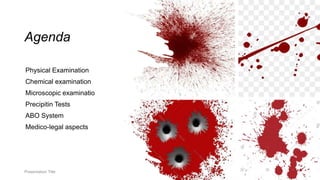
Agenda
Physical Examination
Chemical examination
Microscopic examinatio
Precipitin Tests
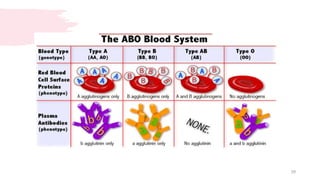
ABO System
Medico-legal aspects
Presentation Title
Introduction
Forensic serology involves the
examination and analysis of a variety of
body fluids which includes blood, saliva,
semen and urine.
9/3/20XX Presentation Title 3
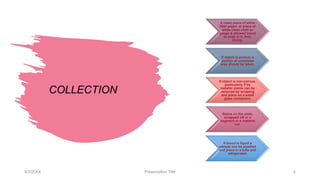
COLLECTION
9/3/20XX Presentation Title 4
A clean piece of white
filter paper, or piece of
white clean cloth or
gauge & allowed blood
to soak in it, then
drying.
If object is porous, a
portion of unstained
area should be taken.
If object is non-porous,
particularly if its
metallic stains can be
removed by scraping
and place on a small
glass containers.
Stains on the cloth,
scrapped off or a
fragment or a material
cut.
If blood is liquid a
sample can be pipetted
and place in a tube and
refrigerated.
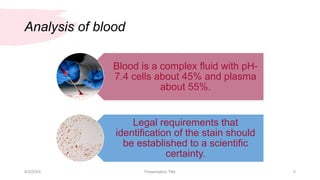
Analysis of blood
Blood is a complex fluid with pH-
7.4 cells about 45% and plasma
about 55%.
Legal requirements that
identification of the stain should
be established to a scientific
certainty.
9/3/20XX Presentation Title 5
9/3/20XX Presentation Title 6
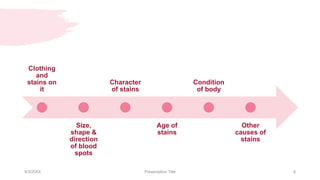
Physical examination
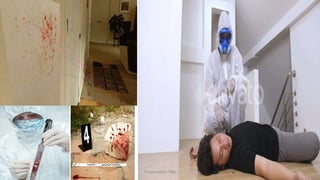
The valuable clues can be achieved
by visiting crime scene.
9/3/20XX Presentation Title 7
Clothing
and
stains on
it
Size,
shape &
direction
of blood
spots
Character
of stains
Age of
stains
Condition
of body
Other
causes of
stains
9/3/20XX Presentation Title 8
9/3/20XX
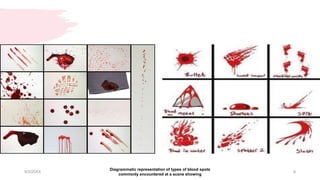
Diagrammatic representation of types of blood spots
commonly encountered at a scene showing
9
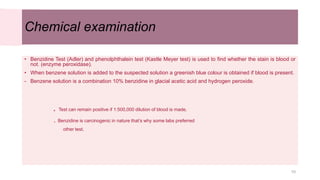
Chemical examination
• Benzidine Test (Adler) and phenolphthalein test (Kastle Meyer test) is used to find whether the stain is blood or
not. (enzyme peroxidase).
• When benzene solution is added to the suspected solution a greenish blue colour is obtained if blood is present.
- Benzene solution is a combination 10% benzidine in glacial acetic acid and hydrogen peroxide.
. Test can remain positive if 1:500,000 dilution of blood is made.
. Benzidine is carcinogenic in nature that’s why some labs preferred
other test.
10
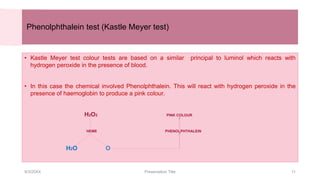
Phenolphthalein test (Kastle Meyer test)
• Kastle Meyer test colour tests are based on a similar principal to luminol which reacts with
hydrogen peroxide in the presence of blood.
• In this case the chemical involved Phenolphthalein. This will react with hydrogen peroxide in the
presence of haemoglobin to produce a pink colour.
H2O2 PINK COLOUR
HEME PHENOLPHTHALEIN
H2O O
9/3/20XX Presentation Title 11
OTHER TESTS
O- Tolidine ( Kohn or
O’Kelly) test
Tetramethylbenzidine.
Leucomalachite
green.
9/3/20XX Presentation Title 12
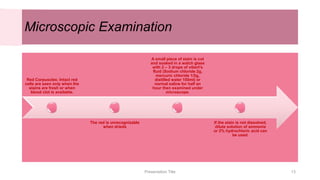
Microscopic Examination
Red Corpuscles: Intact red
cells are seen only when the
stains are fresh or when
blood clot is available.
The red is unrecognizable
when drieds
A small piece of stain is cut
and soaked in a watch glass
with 2 – 3 drops of vibert's
fluid (Sodium chloride 2g,
mercuric chloride 1/2g,
distilled water 100ml) or
normal saline for half an
hour then examined under
microscope.
If the stain is not dissolved,
dilute solution of ammonia
or 2% hydrochloric acid can
be used.
Presentation Title 13
14
Hen Human
frog
Bird
Cat
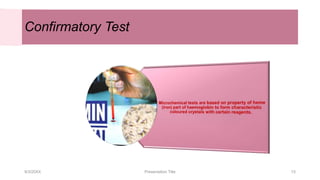
Confirmatory Test
9/3/20XX Presentation Title 15
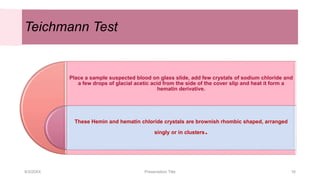
Teichmann Test
Place a sample suspected blood on glass slide, add few crystals of sodium chloride and
a few drops of glacial acetic acid from the side of the cover slip and heat it form a
hematin derivative.
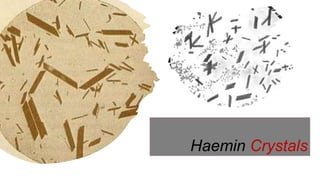
These Hemin and hematin chloride crystals are brownish rhombic shaped, arranged
singly or in clusters.
9/3/20XX Presentation Title 16
Haemin Crystals
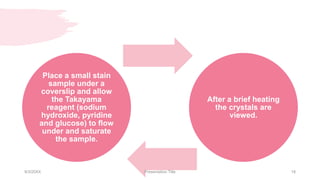
Place a small stain
sample under a
coverslip and allow
the Takayama
reagent (sodium
hydroxide, pyridine
and glucose) to flow
under and saturate
the sample.
After a brief heating
the crystals are
viewed.
9/3/20XX Presentation Title 18
9/3/20XX Presentation Title 19
Pink Feathery Crystals
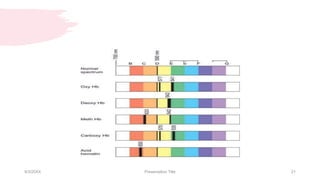
Spectroscopic Examination
It is the most delicate and
reliable test for detecting
the presence of blood in
both recent and old stains.
Less than 0.1 mg of blood
is sufficient.
Blood stain is dissolved in
water, normal saline or
dilute ammonia.
9/3/20XX Presentation Title 20
9/3/20XX Presentation Title 21
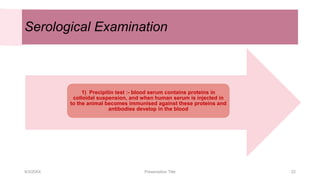
Serological Examination
9/3/20XX Presentation Title 22
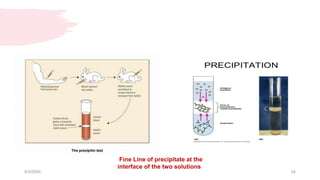
1) Precipitin test :- blood serum contains proteins in
colloidal suspension, and when human serum is injected in
to the animal becomes immunised against these proteins and
antibodies develop in the blood
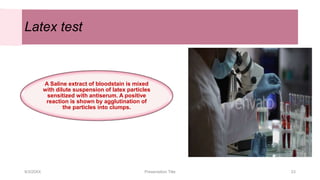
Latex test
9/3/20XX Presentation Title 23
A Saline extract of bloodstain is mixed
with dilute suspension of latex particles
sensitized with antiserum. A positive
reaction is shown by agglutination of
the particles into clumps.
9/3/20XX 24
Fine Line of precipitate at the
interface of the two solutions
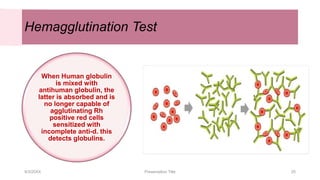
Hemagglutination Test
9/3/20XX Presentation Title 25
When Human globulin
is mixed with
antihuman globulin, the
latter is absorbed and is
no longer capable of
agglutinating Rh
positive red cells
sensitized with
incomplete anti-d. this
detects globulins.
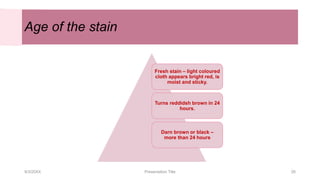
Age of the stain
9/3/20XX Presentation Title 26
Fresh stain – light coloured
cloth appears bright red, is
moist and sticky.
Turns reddidsh brown in 24
hours.
Darn brown or black –
more than 24 hours
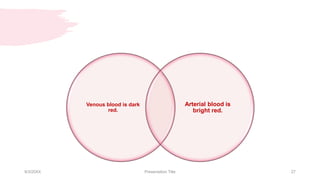
Venous blood is dark
red.
Arterial blood is
bright red.
9/3/20XX Presentation Title 27
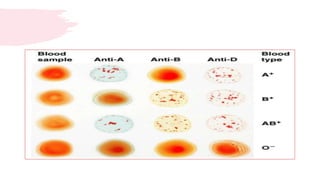
Grouping of blood stains
9/3/20XX Presentation Title 28
29
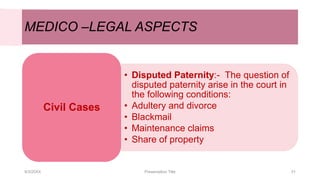
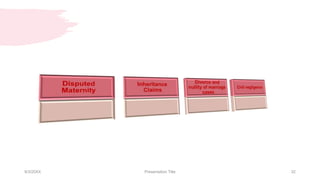
MEDICO –LEGAL ASPECTS
• Disputed Paternity:- The question of
disputed paternity arise in the court in
the following conditions:
• Adultery and divorce
• Blackmail
• Maintenance claims
• Share of property
Civil Cases
9/3/20XX Presentation Title 31
9/3/20XX Presentation Title 32
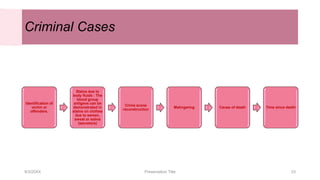
Criminal Cases
Identification of
victim or
offenders.
Stains due to
body fluids : The
blood group
antigens can be
demonstrated in
stains on clothes
due to semen,
sweat or saliva
(secretors)
Crime scene
reconstruction
Malingering Cause of death Time since death
9/3/20XX Presentation Title 33
Reference
1)Saukko P, Knight B. Knight’s forensic pathology.4th Ed. CRC
Press; 2015
2)DiMaio VJM, Kimberley Molina D. DiMaio’s Forensic
Pathology. Boca Raton: CRC Press; 2021.
3)Subrahmanyam BV. Parikh’s textbook of medical
jurisprudence, forensic medicine and toxicology for
classrooms and courtrooms. 8th ed. New Delhi, India: CBS
Publishers & Distributors; 2019.
4)Reddy KSN, Reddy M. The synopsis of forensic medicine &
toxicology the synopsis of forensic medicine & toxicology. New
Delhi, India: Jaypee Brothers Medical; 2022.
9/3/20XX Presentation Title 34
Thank you

Blood stain 1.pptx

  • 1.
  • 2.
    Agenda Physical Examination Chemical examination Microscopicexaminatio Precipitin Tests ABO System Medico-legal aspects Presentation Title
  • 3.
    Introduction Forensic serology involvesthe examination and analysis of a variety of body fluids which includes blood, saliva, semen and urine. 9/3/20XX Presentation Title 3
  • 4.
    COLLECTION 9/3/20XX Presentation Title4 A clean piece of white filter paper, or piece of white clean cloth or gauge & allowed blood to soak in it, then drying. If object is porous, a portion of unstained area should be taken. If object is non-porous, particularly if its metallic stains can be removed by scraping and place on a small glass containers. Stains on the cloth, scrapped off or a fragment or a material cut. If blood is liquid a sample can be pipetted and place in a tube and refrigerated.
  • 5.
    Analysis of blood Bloodis a complex fluid with pH- 7.4 cells about 45% and plasma about 55%. Legal requirements that identification of the stain should be established to a scientific certainty. 9/3/20XX Presentation Title 5
  • 6.
  • 7.
    Physical examination The valuableclues can be achieved by visiting crime scene. 9/3/20XX Presentation Title 7
  • 8.
    Clothing and stains on it Size, shape & direction ofblood spots Character of stains Age of stains Condition of body Other causes of stains 9/3/20XX Presentation Title 8
  • 9.
    9/3/20XX Diagrammatic representation oftypes of blood spots commonly encountered at a scene showing 9
  • 10.
    Chemical examination • BenzidineTest (Adler) and phenolphthalein test (Kastle Meyer test) is used to find whether the stain is blood or not. (enzyme peroxidase). • When benzene solution is added to the suspected solution a greenish blue colour is obtained if blood is present. - Benzene solution is a combination 10% benzidine in glacial acetic acid and hydrogen peroxide. . Test can remain positive if 1:500,000 dilution of blood is made. . Benzidine is carcinogenic in nature that’s why some labs preferred other test. 10
  • 11.
    Phenolphthalein test (KastleMeyer test) • Kastle Meyer test colour tests are based on a similar principal to luminol which reacts with hydrogen peroxide in the presence of blood. • In this case the chemical involved Phenolphthalein. This will react with hydrogen peroxide in the presence of haemoglobin to produce a pink colour. H2O2 PINK COLOUR HEME PHENOLPHTHALEIN H2O O 9/3/20XX Presentation Title 11
  • 12.
    OTHER TESTS O- Tolidine( Kohn or O’Kelly) test Tetramethylbenzidine. Leucomalachite green. 9/3/20XX Presentation Title 12
  • 13.
    Microscopic Examination Red Corpuscles:Intact red cells are seen only when the stains are fresh or when blood clot is available. The red is unrecognizable when drieds A small piece of stain is cut and soaked in a watch glass with 2 – 3 drops of vibert's fluid (Sodium chloride 2g, mercuric chloride 1/2g, distilled water 100ml) or normal saline for half an hour then examined under microscope. If the stain is not dissolved, dilute solution of ammonia or 2% hydrochloric acid can be used. Presentation Title 13
  • 14.
  • 15.
  • 16.
    Teichmann Test Place asample suspected blood on glass slide, add few crystals of sodium chloride and a few drops of glacial acetic acid from the side of the cover slip and heat it form a hematin derivative. These Hemin and hematin chloride crystals are brownish rhombic shaped, arranged singly or in clusters. 9/3/20XX Presentation Title 16
  • 17.
  • 18.
    Place a smallstain sample under a coverslip and allow the Takayama reagent (sodium hydroxide, pyridine and glucose) to flow under and saturate the sample. After a brief heating the crystals are viewed. 9/3/20XX Presentation Title 18
  • 19.
    9/3/20XX Presentation Title19 Pink Feathery Crystals
  • 20.
    Spectroscopic Examination It isthe most delicate and reliable test for detecting the presence of blood in both recent and old stains. Less than 0.1 mg of blood is sufficient. Blood stain is dissolved in water, normal saline or dilute ammonia. 9/3/20XX Presentation Title 20
  • 21.
  • 22.
    Serological Examination 9/3/20XX PresentationTitle 22 1) Precipitin test :- blood serum contains proteins in colloidal suspension, and when human serum is injected in to the animal becomes immunised against these proteins and antibodies develop in the blood
  • 23.
    Latex test 9/3/20XX PresentationTitle 23 A Saline extract of bloodstain is mixed with dilute suspension of latex particles sensitized with antiserum. A positive reaction is shown by agglutination of the particles into clumps.
  • 24.
    9/3/20XX 24 Fine Lineof precipitate at the interface of the two solutions
  • 25.
    Hemagglutination Test 9/3/20XX PresentationTitle 25 When Human globulin is mixed with antihuman globulin, the latter is absorbed and is no longer capable of agglutinating Rh positive red cells sensitized with incomplete anti-d. this detects globulins.
  • 26.
    Age of thestain 9/3/20XX Presentation Title 26 Fresh stain – light coloured cloth appears bright red, is moist and sticky. Turns reddidsh brown in 24 hours. Darn brown or black – more than 24 hours
  • 27.
    Venous blood isdark red. Arterial blood is bright red. 9/3/20XX Presentation Title 27
  • 28.
    Grouping of bloodstains 9/3/20XX Presentation Title 28
  • 29.
  • 31.
    MEDICO –LEGAL ASPECTS •Disputed Paternity:- The question of disputed paternity arise in the court in the following conditions: • Adultery and divorce • Blackmail • Maintenance claims • Share of property Civil Cases 9/3/20XX Presentation Title 31
  • 32.
  • 33.
    Criminal Cases Identification of victimor offenders. Stains due to body fluids : The blood group antigens can be demonstrated in stains on clothes due to semen, sweat or saliva (secretors) Crime scene reconstruction Malingering Cause of death Time since death 9/3/20XX Presentation Title 33
  • 34.
    Reference 1)Saukko P, KnightB. Knight’s forensic pathology.4th Ed. CRC Press; 2015 2)DiMaio VJM, Kimberley Molina D. DiMaio’s Forensic Pathology. Boca Raton: CRC Press; 2021. 3)Subrahmanyam BV. Parikh’s textbook of medical jurisprudence, forensic medicine and toxicology for classrooms and courtrooms. 8th ed. New Delhi, India: CBS Publishers & Distributors; 2019. 4)Reddy KSN, Reddy M. The synopsis of forensic medicine & toxicology the synopsis of forensic medicine & toxicology. New Delhi, India: Jaypee Brothers Medical; 2022. 9/3/20XX Presentation Title 34
  • 35.