Forensic Serology
Forensic Serology
Forensic serology is the application of the study of blood, semen,
saliva and other body fluids, to legal matters. The field generally is
comprised of the detection of enzymes and antigens, as in the
identification of seminal stains or blood typing (ABO and secretor
status) and DNA typing.
The serology section of a forensic laboratory may deal with any
or all of the following:
•
•
•
•
•
•
blood typing
characterization of unknown stains
blood spatter analysis for crime reconstruction
paternity testing
semen identification in sexual assault cases
DNA typing for identification of victims and suspects
The Composition of Blood
Blood is a mixture of many components:
inorganic substances (salts)
water
cells
enzymes
proteins
55 % of blood content is plasma – mostly water
and substances dissolved in it
Most of the solid materials (by weight) are cells
red blood cells, RBCs (erythrocytes)
white blood cells (leukocytes)
Forensic Characterization of Bloodstains
Three questions that must be answered by the
forensic investigator:
1) Is it blood? Use presumptive tests:
Kastle-Meyer
Leucomalachite Green
Luminol
2) If yes, is it human blood? (Precipitin Test)
3)If yes, can it be associated with an
individual? (DNA)
Presumptive tests rely on hemoglobin’s ability to catalyze
the oxidation of certain reagents, usually resulting in a color
change. Oxidizing agent is usually hydrogen peroxide
(H2O2).
Visible Stains
Kastle Meyer: solution of phenolphthalein is applied to
suspected blood stain, followed by hydrogen peroxide. A bright
pink color indicates the presence of blood.
Leucho-Malachite Green: same procedure as K-M; produces
blue-green color in the presence of blood.
Invisible Stains
Luminol: used for large areas where blood is suspected but not
visible. If blood is present, it will glow. Must be viewed in
darkness and photographed quickly.
Is It Blood? Presumptive Tests for Blood
Luminol
•Red blood cells contain hemoglobin
(Hb) – the protein responsible for
transporting oxygen
•Each Hb contains four iron (Fe)
containing hemes
•Luminol reacts with iron
Heme structure
Blood is not the only material that will cause presumptive
test reagents to change color.
Horse radish & potatoes can also give positive results
(these are unlikely to be at a crime scene, though).
Luminol can give false positive results when exposed to
household bleach, some metals, and some vegetables.
Blood is the only body fluid that will give a positive reaction.
Positive results must be confirmed with Precipitin Test.
False Positives
Once a presumptive test indicates that a stain may be blood,
the serologist must confirm that it is human blood.
Precipitin test identifies the presence of proteins that
are found only in human blood.
Precipitin Test Procedure
• animal (usually a rat or rabbit) is injected with human blood
• animal’s blood forms antibodies
• antibodies are harvested from animal’s blood serum (“antiserum”)
• in a test tube, an extract from the suspected bloodstain is added
to the antiserum
• if a precipitate forms where the two meet, it is human blood
Confirmatory Tests
Blood Typing: Antigens
On the surface of red blood cells are molecules
(proteins) called antigens.
Antigens allow a living system to recognize foreign
biological substances, such as infectious agents and
allergens.
Antigens also impart specific characteristics to the
RBCs. These characteristics can be partly used to
identify individuals.
Human RBCs have many antigens, but the ones most
commonly used for blood typing are Rh & ABO.
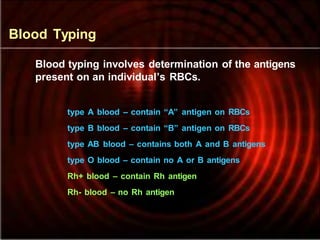
Blood Typing
Blood typing involves determination of the antigens
present on an individual’s RBCs.
type A blood – contain “A” antigen on RBCs
type B blood – contain “B” antigen on RBCs
type AB blood – contains both A and B antigens
type O blood – contain no A or B antigens
Rh+ blood – contain Rh antigen
Rh- blood – no Rh antigen
A blood type (40-42%) is most common among
Caucasians and those of European descent.
B blood type (10-12%) is most common among African
Americans and Thai Asians.
AB blood type (3-5%) is most common among
Japanese & Chinese populations.
O blood type (43-45%) is most common among
indigenous peoples and Latin Americans.
Distribution of Blood Types in the US
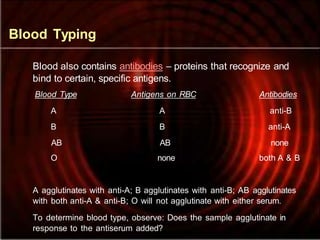
Blood Typing
Blood also contains antibodies – proteins that recognize and
bind to certain, specific antigens.
Blood Type Antigens on RBC Antibodies
A A anti-B
B B anti-A
AB AB none
O none both A & B
A agglutinates with anti-A; B agglutinates with anti-B; AB agglutinates
with both anti-A & anti-B; O will not agglutinate with either serum.
To determine blood type, observe: Does the sample agglutinate in
response to the antiserum added?
Blood Typing
Human serum containing specific
antibodies can be purchased.
Separately mix a drop of
unknown blood sample with
drop of each anti-serum.
Reaction between blood
and anti-serum
No reaction between
blood and anti-serum
Blood Typing Example
A sample of unknown blood is mixed with three anti-
sera samples:
Tube 1 (Anti-A): No reaction
Tube 2 (Anti B): No reaction
Tube 3 (Anti Rh): Cloudy reaction
In terms of the A-B-O and Rh systems, what type blood
is the sample?
The ABO antigens are not confined to RBC; 80% of
Americans are “secretors”, which means that they
secrete their ABO antigens into other body fluids.
O positive
Characteristics of Blood
CLASS
Species
Type
Disease
Rh factor
Antigens
INDIVIDUAL
DNA
Is color a class or individual characteristic of blood?
THINK ABOUT IT.
Bloodstain Analysis
Categories of Bloodstains:
Passive (dripping)
Transfer (smearing)
Projected
Projected bloodstains occur in shootings, trauma
from blunt weapons, hacking, beating or slashing
attacks.
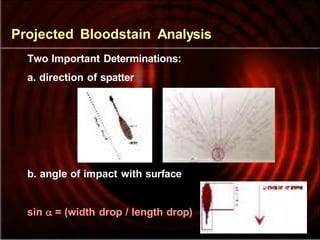
Projected Bloodstain Analysis
Two Important Determinations:
a. direction of spatter
b. angle of impact with surface
sin  = (width drop / length drop)
Forensic Characterization of Semen
Many crimes involve sexual assault. Forensic Investigators may
need to search for semen stains at a crime scene.
Bedding, clothing, towels, carpets, cushions, vehicle seats, etc.
Seminal Fluid contains:
• water, spermatozoa, enzymes, inorganic salts
Presumptive Tests
•UV light (semen fluoresces under UV light)
•Acid Phosphatase (a presumptive test reagent that rapidly
turns purple if AP is present)
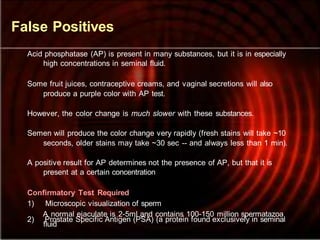
Acid phosphatase (AP) is present in many substances, but it is in especially
high concentrations in seminal fluid.
Some fruit juices, contraceptive creams, and vaginal secretions will also
produce a purple color with AP test.
However, the color change is much slower with these substances.
Semen will produce the color change very rapidly (fresh stains will take ~10
seconds, older stains may take ~30 sec -- and always less than 1 min).
A positive result for AP determines not the presence of AP, but that it is
present at a certain concentration
Confirmatory Test Required
1) Microscopic visualization of sperm
A normal ejaculate is 2-5ml and contains 100-150 million spermatazoa
2) Prostate Specific Antigen (PSA) (a protein found exclusively in seminal
fluid
False Positives
Forensic Characterization of Saliva
Saliva is a mixture of many components:
99% water
Mucin (protein helps in swallowing)
Amylase (enzyme to help digest carbohydrates)
Buccal cells (good source for DNA)
Adults produce 1.0-1.5 liters of saliva/day. Saliva is not
uncommon at crime scenes, especially those involving sexual
assault and bite marks.
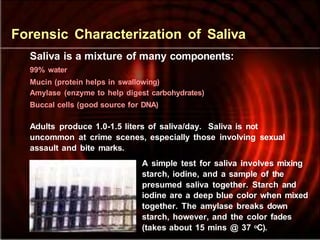
A simple test for saliva involves mixing
starch, iodine, and a sample of the
presumed saliva together. Starch and
iodine are a deep blue color when mixed
together. The amylase breaks down
starch, however, and the color fades
(takes about 15 mins @ 37 oC).
Conclusions

Forensic Serology.pptx

  • 1.
  • 2.
    Forensic Serology Forensic serologyis the application of the study of blood, semen, saliva and other body fluids, to legal matters. The field generally is comprised of the detection of enzymes and antigens, as in the identification of seminal stains or blood typing (ABO and secretor status) and DNA typing. The serology section of a forensic laboratory may deal with any or all of the following: • • • • • • blood typing characterization of unknown stains blood spatter analysis for crime reconstruction paternity testing semen identification in sexual assault cases DNA typing for identification of victims and suspects
  • 3.
    The Composition ofBlood Blood is a mixture of many components: inorganic substances (salts) water cells enzymes proteins 55 % of blood content is plasma – mostly water and substances dissolved in it Most of the solid materials (by weight) are cells red blood cells, RBCs (erythrocytes) white blood cells (leukocytes)
  • 4.
    Forensic Characterization ofBloodstains Three questions that must be answered by the forensic investigator: 1) Is it blood? Use presumptive tests: Kastle-Meyer Leucomalachite Green Luminol 2) If yes, is it human blood? (Precipitin Test) 3)If yes, can it be associated with an individual? (DNA)
  • 5.
    Presumptive tests relyon hemoglobin’s ability to catalyze the oxidation of certain reagents, usually resulting in a color change. Oxidizing agent is usually hydrogen peroxide (H2O2). Visible Stains Kastle Meyer: solution of phenolphthalein is applied to suspected blood stain, followed by hydrogen peroxide. A bright pink color indicates the presence of blood. Leucho-Malachite Green: same procedure as K-M; produces blue-green color in the presence of blood. Invisible Stains Luminol: used for large areas where blood is suspected but not visible. If blood is present, it will glow. Must be viewed in darkness and photographed quickly. Is It Blood? Presumptive Tests for Blood
  • 6.
    Luminol •Red blood cellscontain hemoglobin (Hb) – the protein responsible for transporting oxygen •Each Hb contains four iron (Fe) containing hemes •Luminol reacts with iron Heme structure
  • 7.
    Blood is notthe only material that will cause presumptive test reagents to change color. Horse radish & potatoes can also give positive results (these are unlikely to be at a crime scene, though). Luminol can give false positive results when exposed to household bleach, some metals, and some vegetables. Blood is the only body fluid that will give a positive reaction. Positive results must be confirmed with Precipitin Test. False Positives
  • 8.
    Once a presumptivetest indicates that a stain may be blood, the serologist must confirm that it is human blood. Precipitin test identifies the presence of proteins that are found only in human blood. Precipitin Test Procedure • animal (usually a rat or rabbit) is injected with human blood • animal’s blood forms antibodies • antibodies are harvested from animal’s blood serum (“antiserum”) • in a test tube, an extract from the suspected bloodstain is added to the antiserum • if a precipitate forms where the two meet, it is human blood Confirmatory Tests
  • 9.
    Blood Typing: Antigens Onthe surface of red blood cells are molecules (proteins) called antigens. Antigens allow a living system to recognize foreign biological substances, such as infectious agents and allergens. Antigens also impart specific characteristics to the RBCs. These characteristics can be partly used to identify individuals. Human RBCs have many antigens, but the ones most commonly used for blood typing are Rh & ABO.
  • 10.
    Blood Typing Blood typinginvolves determination of the antigens present on an individual’s RBCs. type A blood – contain “A” antigen on RBCs type B blood – contain “B” antigen on RBCs type AB blood – contains both A and B antigens type O blood – contain no A or B antigens Rh+ blood – contain Rh antigen Rh- blood – no Rh antigen
  • 11.
    A blood type(40-42%) is most common among Caucasians and those of European descent. B blood type (10-12%) is most common among African Americans and Thai Asians. AB blood type (3-5%) is most common among Japanese & Chinese populations. O blood type (43-45%) is most common among indigenous peoples and Latin Americans. Distribution of Blood Types in the US
  • 12.
    Blood Typing Blood alsocontains antibodies – proteins that recognize and bind to certain, specific antigens. Blood Type Antigens on RBC Antibodies A A anti-B B B anti-A AB AB none O none both A & B A agglutinates with anti-A; B agglutinates with anti-B; AB agglutinates with both anti-A & anti-B; O will not agglutinate with either serum. To determine blood type, observe: Does the sample agglutinate in response to the antiserum added?
  • 13.
    Blood Typing Human serumcontaining specific antibodies can be purchased. Separately mix a drop of unknown blood sample with drop of each anti-serum. Reaction between blood and anti-serum No reaction between blood and anti-serum
  • 14.
    Blood Typing Example Asample of unknown blood is mixed with three anti- sera samples: Tube 1 (Anti-A): No reaction Tube 2 (Anti B): No reaction Tube 3 (Anti Rh): Cloudy reaction In terms of the A-B-O and Rh systems, what type blood is the sample? The ABO antigens are not confined to RBC; 80% of Americans are “secretors”, which means that they secrete their ABO antigens into other body fluids. O positive
  • 15.
    Characteristics of Blood CLASS Species Type Disease Rhfactor Antigens INDIVIDUAL DNA Is color a class or individual characteristic of blood? THINK ABOUT IT.
  • 16.
    Bloodstain Analysis Categories ofBloodstains: Passive (dripping) Transfer (smearing) Projected Projected bloodstains occur in shootings, trauma from blunt weapons, hacking, beating or slashing attacks.
  • 17.
    Projected Bloodstain Analysis TwoImportant Determinations: a. direction of spatter b. angle of impact with surface sin  = (width drop / length drop)
  • 18.
    Forensic Characterization ofSemen Many crimes involve sexual assault. Forensic Investigators may need to search for semen stains at a crime scene. Bedding, clothing, towels, carpets, cushions, vehicle seats, etc. Seminal Fluid contains: • water, spermatozoa, enzymes, inorganic salts Presumptive Tests •UV light (semen fluoresces under UV light) •Acid Phosphatase (a presumptive test reagent that rapidly turns purple if AP is present)
  • 19.
    Acid phosphatase (AP)is present in many substances, but it is in especially high concentrations in seminal fluid. Some fruit juices, contraceptive creams, and vaginal secretions will also produce a purple color with AP test. However, the color change is much slower with these substances. Semen will produce the color change very rapidly (fresh stains will take ~10 seconds, older stains may take ~30 sec -- and always less than 1 min). A positive result for AP determines not the presence of AP, but that it is present at a certain concentration Confirmatory Test Required 1) Microscopic visualization of sperm A normal ejaculate is 2-5ml and contains 100-150 million spermatazoa 2) Prostate Specific Antigen (PSA) (a protein found exclusively in seminal fluid False Positives
  • 20.
    Forensic Characterization ofSaliva Saliva is a mixture of many components: 99% water Mucin (protein helps in swallowing) Amylase (enzyme to help digest carbohydrates) Buccal cells (good source for DNA) Adults produce 1.0-1.5 liters of saliva/day. Saliva is not uncommon at crime scenes, especially those involving sexual assault and bite marks. A simple test for saliva involves mixing starch, iodine, and a sample of the presumed saliva together. Starch and iodine are a deep blue color when mixed together. The amylase breaks down starch, however, and the color fades (takes about 15 mins @ 37 oC).
  • 21.