WELCOME TO 
A SEMINAR PRESENTATION 
ON 
“BLACK BOX INSIDE 
AIRCRAFT”
Black boxes - which are actually orange 
- are a group of data collection devices 
mounted in the tail of an aircraft. 
Dr David Warren, an Australian aviation 
scientist, proposed a flight recording 
device and by 1958 he had produced 
the prototype "ARL Flight Memory Unit".
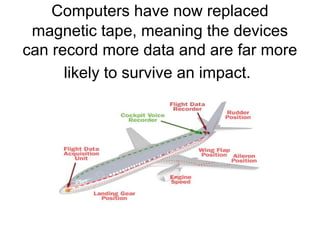
Computers have now replaced 
magnetic tape, meaning the devices 
can record more data and are far more 
likely to survive an impact.
World’s first flight memory recorder 
(Black Box)
Generations of Data Recorders 
First Generation Foil Recorders 
Second Generation Tape Recorders 
Third Generation Solid State 
Recorders 
Components of the Black Box 
CVR - Cockpit Voice Recorder 
FDR - Flight Data Recorder
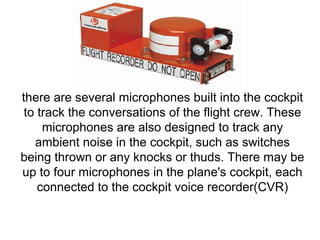
there are several microphones built into the cockpit 
to track the conversations of the flight crew. These 
microphones are also designed to track any 
ambient noise in the cockpit, such as switches 
being thrown or any knocks or thuds. There may be 
up to four microphones in the plane's cockpit, each 
connected to the cockpit voice recorder(CVR)
Any sounds in the cockpit are picked up by these 
microphones and sent to the CVR, where the 
recordings are digitized and stored. There is also 
another device in the cockpit, called the 
associated control unit, that provides pre-amplification 
for audio going to the CVR. Here 
are the positions of the four microphones: 
- Pilot's headset 
- Co-pilot's headset 
- Headset of a third crew member (if there is a 
third crew member) 
- Near the center of the cockpit, where it can 
pick up audio alerts and other sounds
• Flight Data Recorders 
The flight data recorder (FDR) is designed to 
record the operating data from the plane's 
systems. There are sensors that are wired from 
various areas on the plane to the flight-data 
acquisition unit, which is wired to the FDR. 
When a switch is turned on or off, that operation 
is recorded by the FDR.
few of the parameters recorded by most FDRs: 
Time 
Pressure altitude 
Airspeed 
Vertical acceleration Magnetic heading 
Control-column position 
Rudder-pedal position 
Control-wheel position 
Horizontal stabilizer 
Fuel flow 
Solid-state recorders can track more parameters 
than magnetic tape because they allow for a 
faster data flow. Solid-state FDRs can store up to 
25 hours of flight data.
Built to Survive 
• The only devices that survive are the crash-survivable 
memory units (CSMUs) of the flight 
data recorders and cockpit voice recorders. 
Typically, the rest of the recorders' chassis and 
inner components are mangled. The CSMU is a 
large cylinder that bolts onto the flat portion of the 
recorder. This device is engineered to withstand 
extreme heat, violent crashes and tons of 
pressure. In older magnetic-tape recorders, the 
CSMU is inside a rectangular box.
Using three layers of materials, the CSMU in a 
solid-state black box insulates and protects the 
stack of memory boards that store the digitized 
information.
Aluminum housing - There is a thin layer of 
aluminum around the stack of memory cards. 
High-temperature insulation - This dry-silica 
material is 1 inch (2.54 cm) thick and provides high-temperature 
thermal protection. This is what keeps 
the memory boards safe during post-accident fires. 
Stainless-steel shell- The high-temperature 
insulation material is contained within a stainless-steel 
cast shell that is about 0.25 inches (0.64 cm) 
thick. Titanium can be used to create this outer 
armor as well.
There are several tests that make up the crash-survival 
sequence • Crash impact 
• Pin drop 
• Static crush 
• Fire test 
• Deep-sea submersion 
• Salt-water submersion 
• Fluid immersion 
• After finding the black boxes, investigators take 
the recorders to a lab where they can download 
the data from the recorders and attempt to 
recreate the events of the accident.
This process can take weeks or months to 
complete. In the United States, black-box 
manufacturers supply the NTSB with the readout 
systems and software needed to do a full analysis 
of the recorders' stored data. 
• Modern flight data recorder 
• The recorders made of strong materials, such as 
titanium, and insulated to withstand a crash 
impact many times the force of gravity, 
temperatures of more than 1,000 degC for up to 
30 minutes and the immense pressure of lying 
on the seabed.
Modern black boxes record up to 300 factors 
of flight including: 
-Airspeed and altitude 
-Heading and vertical acceleration 
-Aircraft pitch 
-Cockpit conversations 
-Radio communications
Black box

Black box

  • 1.
    WELCOME TO ASEMINAR PRESENTATION ON “BLACK BOX INSIDE AIRCRAFT”
  • 2.
    Black boxes -which are actually orange - are a group of data collection devices mounted in the tail of an aircraft. Dr David Warren, an Australian aviation scientist, proposed a flight recording device and by 1958 he had produced the prototype "ARL Flight Memory Unit".
  • 3.
    Computers have nowreplaced magnetic tape, meaning the devices can record more data and are far more likely to survive an impact.
  • 4.
    World’s first flightmemory recorder (Black Box)
  • 5.
    Generations of DataRecorders First Generation Foil Recorders Second Generation Tape Recorders Third Generation Solid State Recorders Components of the Black Box CVR - Cockpit Voice Recorder FDR - Flight Data Recorder
  • 6.
    there are severalmicrophones built into the cockpit to track the conversations of the flight crew. These microphones are also designed to track any ambient noise in the cockpit, such as switches being thrown or any knocks or thuds. There may be up to four microphones in the plane's cockpit, each connected to the cockpit voice recorder(CVR)
  • 7.
    Any sounds inthe cockpit are picked up by these microphones and sent to the CVR, where the recordings are digitized and stored. There is also another device in the cockpit, called the associated control unit, that provides pre-amplification for audio going to the CVR. Here are the positions of the four microphones: - Pilot's headset - Co-pilot's headset - Headset of a third crew member (if there is a third crew member) - Near the center of the cockpit, where it can pick up audio alerts and other sounds
  • 8.
    • Flight DataRecorders The flight data recorder (FDR) is designed to record the operating data from the plane's systems. There are sensors that are wired from various areas on the plane to the flight-data acquisition unit, which is wired to the FDR. When a switch is turned on or off, that operation is recorded by the FDR.
  • 9.
    few of theparameters recorded by most FDRs: Time Pressure altitude Airspeed Vertical acceleration Magnetic heading Control-column position Rudder-pedal position Control-wheel position Horizontal stabilizer Fuel flow Solid-state recorders can track more parameters than magnetic tape because they allow for a faster data flow. Solid-state FDRs can store up to 25 hours of flight data.
  • 10.
    Built to Survive • The only devices that survive are the crash-survivable memory units (CSMUs) of the flight data recorders and cockpit voice recorders. Typically, the rest of the recorders' chassis and inner components are mangled. The CSMU is a large cylinder that bolts onto the flat portion of the recorder. This device is engineered to withstand extreme heat, violent crashes and tons of pressure. In older magnetic-tape recorders, the CSMU is inside a rectangular box.
  • 11.
    Using three layersof materials, the CSMU in a solid-state black box insulates and protects the stack of memory boards that store the digitized information.
  • 12.
    Aluminum housing -There is a thin layer of aluminum around the stack of memory cards. High-temperature insulation - This dry-silica material is 1 inch (2.54 cm) thick and provides high-temperature thermal protection. This is what keeps the memory boards safe during post-accident fires. Stainless-steel shell- The high-temperature insulation material is contained within a stainless-steel cast shell that is about 0.25 inches (0.64 cm) thick. Titanium can be used to create this outer armor as well.
  • 13.
    There are severaltests that make up the crash-survival sequence • Crash impact • Pin drop • Static crush • Fire test • Deep-sea submersion • Salt-water submersion • Fluid immersion • After finding the black boxes, investigators take the recorders to a lab where they can download the data from the recorders and attempt to recreate the events of the accident.
  • 14.
    This process cantake weeks or months to complete. In the United States, black-box manufacturers supply the NTSB with the readout systems and software needed to do a full analysis of the recorders' stored data. • Modern flight data recorder • The recorders made of strong materials, such as titanium, and insulated to withstand a crash impact many times the force of gravity, temperatures of more than 1,000 degC for up to 30 minutes and the immense pressure of lying on the seabed.
  • 15.
    Modern black boxesrecord up to 300 factors of flight including: -Airspeed and altitude -Heading and vertical acceleration -Aircraft pitch -Cockpit conversations -Radio communications