BLACK BOX
REPRESENTED BY:
ARKA MUKHERJEE
CONTENT
 INTRODUCTION
 HISTORY
 CONSTRUCTION
 INSIDE THE BLACK BOX
 TECHNOLOGY USED
 WORKING OF BLACK BOX
 ADVANTAGES
 REFERNCE
 CONCLUSION
 BIBLIOGRAPHY
INTRODUCTION
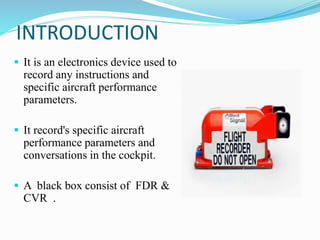
 It is an electronics device used to
record any instructions and
specific aircraft performance
parameters.
 It record's specific aircraft
performance parameters and
conversations in the cockpit.
 A black box consist of FDR &
CVR .
HISTORY
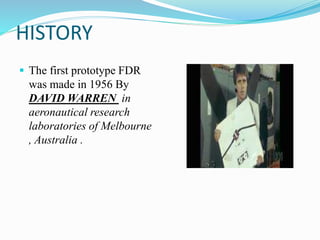
 The first prototype FDR
was made in 1956 By
DAVID WARREN in
aeronautical research
laboratories of Melbourne
, Australia .
CONSTRUCTION
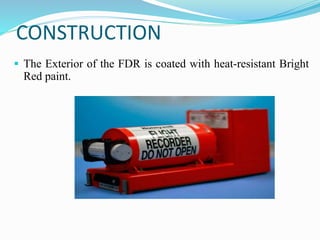
 The Exterior of the FDR is coated with heat-resistant Bright
Red paint.
CONSTRUCTION [POSITION]
 The unit is usually mounted in the aircraft‘s empennage (tail
section).
BUILT TO SURVIVE [ CONSTRUCTION]
 In airline accidents, the
only devices that survive
are the Crash-survivable
memory units (CSMUs) of
the flight data recorders
and cockpit voice recorders.
Typically, the rest of the
recorders' chassis and inner
components are mangled
 Three layers of materials in
CSMU:
 Aluminum housing
 High-temperature insulation
 Stainless-steel shell
INSIDE THE BLACK BOX
 Flight Data Recorder (FDR)
 Cockpit Voice Recorder (CVR)
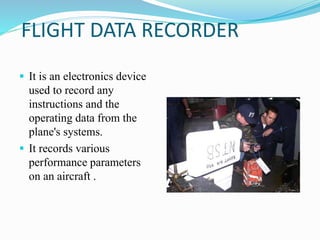
FLIGHT DATA RECORDER
 It is an electronics device
used to record any
instructions and the
operating data from the
plane's systems.
 It records various
performance parameters
on an aircraft .
PARAMETERS RECORDED BY MOST FDR’S
 Time
 Pressure attitude
 Air speed
 Vertical acceleration
 Magnetic heading
 Fuel flow
 Horizontal stabilizer
 Control column position
 Control wheel position
 Rudder –pedal position
 A FDR is shown below which is recovered after a crash
COCKPIT VOICE RECORDER
 It records the audio environment in the flight deck of an
aircraft for the purpose of accident & incidents .
 This is typically achieved by recording the signals of the
microphones & earphones of the pilots headsets & of an
area microphone in the roof of the cockpit .
 According to FAA after 2005 the recording duration is
minimum of 30 minutes .
 But according to NTSB it should be of 2 hours.
THE POSITIONS OF THE FOUR MICROPHONES
 Pilot's headset
 Co-pilot's headset
 Headset of a third crew member (if there is a third crew
member)
 Near the center of the cockpit, where it can pick up audio
alerts and other sounds
COCKPIT VOICE RECORDER
TECHNOLOGY USED
 MAGNETIC TAPES
 SOLID STATE
TECHNOLOGY
MAGNETIC TAPES
 This technology was introduced in late
`1960’s & made magnetic tapes a
recording medium up to the introduction
of solid state technology .
 CVR & FDR records over the oldest
data with the newest data in an endless
loop recording pattern .
 Then DFDR’S were introduced which
can record at 64 12-bit data per seconds.
But it was limited to flights having
digital avionics like Boeing 767 & airbus
a320 .
 In this technology it can record up to 30
min of data.
SOLID STATE TECHNOLOGY
 The introduction of this technology expanded recording capacity , enhanced
crashfire survivability ,& improved recording reliability .
 It can record up to 64 12 bit data words per seconds or four times the capacity of
magnetic tapes in DFDR’s
 It can records up to 25 hours of flight data .
 These recording devices cost between $10,000 to $15,000
each.
 Both Black Boxes are powered by one of two power
generators that draw their power from the plane's engines.
 The Memory boards have enough digital storage space to
accommodate 2 hours of Audio data for CVRs and 25
hours of Flight data for FDRs.
WORKING OF BLACK BOX
Underwater Locator
Beacon (ULB)
 Submergence sensor on
the side of the beacon.
 Pulses at 37.5 kilohertz
(kHz).
 sound as deep as 14,000
feet (4,267 m).
 Once the beacon begins
"pinging," it pings once per
second for 30 days.
WORKING OF BLACK BOX
Retrieving Information
 This portable interface can
allow investigators quick
access to the data on a black
box..
 Retrieval of FDR
 Retrieval of CVR
 Once the beacon begins
"pinging," it pings once per
second for 30 days.
ADVANTAGES
 Retrieval comes first.
 It is very useful for accident investigations .
 The mistakes or error can be avoided in other aircrafts .
This black box alone was left to tell the story
of the crash of Egypt Air Flight 990.
The cockpit voice recorder from the downed
Alaska Airlines Flight 261
CONCLUSION
From the study of Black Box we derived a information
that how the information about aircraft mishap is analyzed
& unanswered question is answered.
In this study we discuss about various technology various
aspects involved in black box.
BIBLIOGRAPHY
 WIKIPEDIA
 GOOGLE
 NATIONAL GEOGRAPHIC
THANK YOU
ANY QUERIES

Black Box

  • 1.
  • 2.
    CONTENT  INTRODUCTION  HISTORY CONSTRUCTION  INSIDE THE BLACK BOX  TECHNOLOGY USED  WORKING OF BLACK BOX  ADVANTAGES  REFERNCE  CONCLUSION  BIBLIOGRAPHY
  • 3.
    INTRODUCTION  It isan electronics device used to record any instructions and specific aircraft performance parameters.  It record's specific aircraft performance parameters and conversations in the cockpit.  A black box consist of FDR & CVR .
  • 4.
    HISTORY  The firstprototype FDR was made in 1956 By DAVID WARREN in aeronautical research laboratories of Melbourne , Australia .
  • 5.
    CONSTRUCTION  The Exteriorof the FDR is coated with heat-resistant Bright Red paint.
  • 6.
    CONSTRUCTION [POSITION]  Theunit is usually mounted in the aircraft‘s empennage (tail section).
  • 7.
    BUILT TO SURVIVE[ CONSTRUCTION]  In airline accidents, the only devices that survive are the Crash-survivable memory units (CSMUs) of the flight data recorders and cockpit voice recorders. Typically, the rest of the recorders' chassis and inner components are mangled  Three layers of materials in CSMU:  Aluminum housing  High-temperature insulation  Stainless-steel shell
  • 8.
    INSIDE THE BLACKBOX  Flight Data Recorder (FDR)  Cockpit Voice Recorder (CVR)
  • 9.
    FLIGHT DATA RECORDER It is an electronics device used to record any instructions and the operating data from the plane's systems.  It records various performance parameters on an aircraft .
  • 10.
    PARAMETERS RECORDED BYMOST FDR’S  Time  Pressure attitude  Air speed  Vertical acceleration  Magnetic heading  Fuel flow  Horizontal stabilizer  Control column position  Control wheel position  Rudder –pedal position
  • 11.
     A FDRis shown below which is recovered after a crash
  • 12.
    COCKPIT VOICE RECORDER It records the audio environment in the flight deck of an aircraft for the purpose of accident & incidents .  This is typically achieved by recording the signals of the microphones & earphones of the pilots headsets & of an area microphone in the roof of the cockpit .  According to FAA after 2005 the recording duration is minimum of 30 minutes .  But according to NTSB it should be of 2 hours.
  • 13.
    THE POSITIONS OFTHE FOUR MICROPHONES  Pilot's headset  Co-pilot's headset  Headset of a third crew member (if there is a third crew member)  Near the center of the cockpit, where it can pick up audio alerts and other sounds
  • 14.
  • 15.
    TECHNOLOGY USED  MAGNETICTAPES  SOLID STATE TECHNOLOGY
  • 16.
    MAGNETIC TAPES  Thistechnology was introduced in late `1960’s & made magnetic tapes a recording medium up to the introduction of solid state technology .  CVR & FDR records over the oldest data with the newest data in an endless loop recording pattern .  Then DFDR’S were introduced which can record at 64 12-bit data per seconds. But it was limited to flights having digital avionics like Boeing 767 & airbus a320 .  In this technology it can record up to 30 min of data.
  • 17.
    SOLID STATE TECHNOLOGY The introduction of this technology expanded recording capacity , enhanced crashfire survivability ,& improved recording reliability .  It can record up to 64 12 bit data words per seconds or four times the capacity of magnetic tapes in DFDR’s  It can records up to 25 hours of flight data .
  • 18.
     These recordingdevices cost between $10,000 to $15,000 each.  Both Black Boxes are powered by one of two power generators that draw their power from the plane's engines.  The Memory boards have enough digital storage space to accommodate 2 hours of Audio data for CVRs and 25 hours of Flight data for FDRs.
  • 19.
    WORKING OF BLACKBOX Underwater Locator Beacon (ULB)  Submergence sensor on the side of the beacon.  Pulses at 37.5 kilohertz (kHz).  sound as deep as 14,000 feet (4,267 m).  Once the beacon begins "pinging," it pings once per second for 30 days.
  • 20.
    WORKING OF BLACKBOX Retrieving Information  This portable interface can allow investigators quick access to the data on a black box..  Retrieval of FDR  Retrieval of CVR  Once the beacon begins "pinging," it pings once per second for 30 days.
  • 21.
    ADVANTAGES  Retrieval comesfirst.  It is very useful for accident investigations .  The mistakes or error can be avoided in other aircrafts .
  • 22.
    This black boxalone was left to tell the story of the crash of Egypt Air Flight 990.
  • 23.
    The cockpit voicerecorder from the downed Alaska Airlines Flight 261
  • 24.
    CONCLUSION From the studyof Black Box we derived a information that how the information about aircraft mishap is analyzed & unanswered question is answered. In this study we discuss about various technology various aspects involved in black box.
  • 25.
  • 26.
  • 27.