SOFTWARE QUALITY
ASSURANCE
WHITE BOX


      Seminar: Oana FEIDI
      Quality Manager – Continental Automotive
BLACK-BOX VS. WHITE-BOX

                      Test cases derived from specifications


   The focus is not the design, nor the implementation
                                   The focus is on the logic of implementation
WHITE BOX (STRUCTURAL
TESTING)
 Structural - test case selection is based on an
 analysis of the internal structure of
 component

     Control flow
       Statement testing

       Branch/Decision Testing

       Branch Condition Testing

       Modified Condition Combination Testing


     Data flow testing
WHITE BOX
   Using the white-box testing techniques outlined
    in this seminar, a software engineer can design
    test cases that
        exercise independent paths within a module or unit;
        exercise logical decisions on both their true and false side;

        execute loops at their boundaries and within their

         operational bounds
        exercise internal data structures to ensure their validity
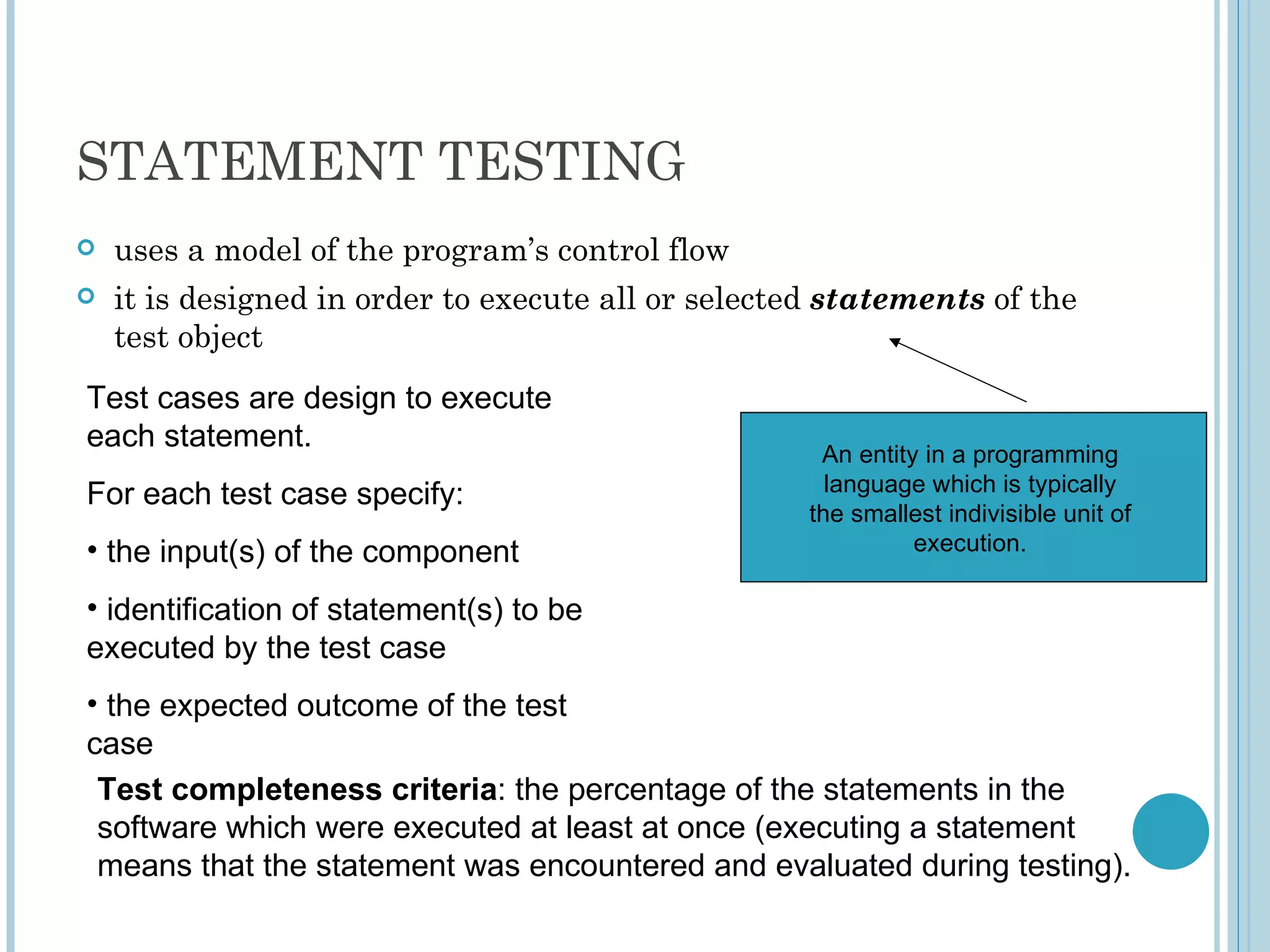
STATEMENT TESTING
   uses a model of the program’s control flow
   it is designed in order to execute all or selected statements of the
    test object
Test cases are design to execute
each statement.
                                                      An entity in a programming
For each test case specify:                            language which is typically
                                                     the smallest indivisible unit of
• the input(s) of the component                                execution.

• identification of statement(s) to be
executed by the test case
• the expected outcome of the test
case
 Test completeness criteria: the percentage of the statements in the
 software which were executed at least at once (executing a statement
 means that the statement was encountered and evaluated during testing).
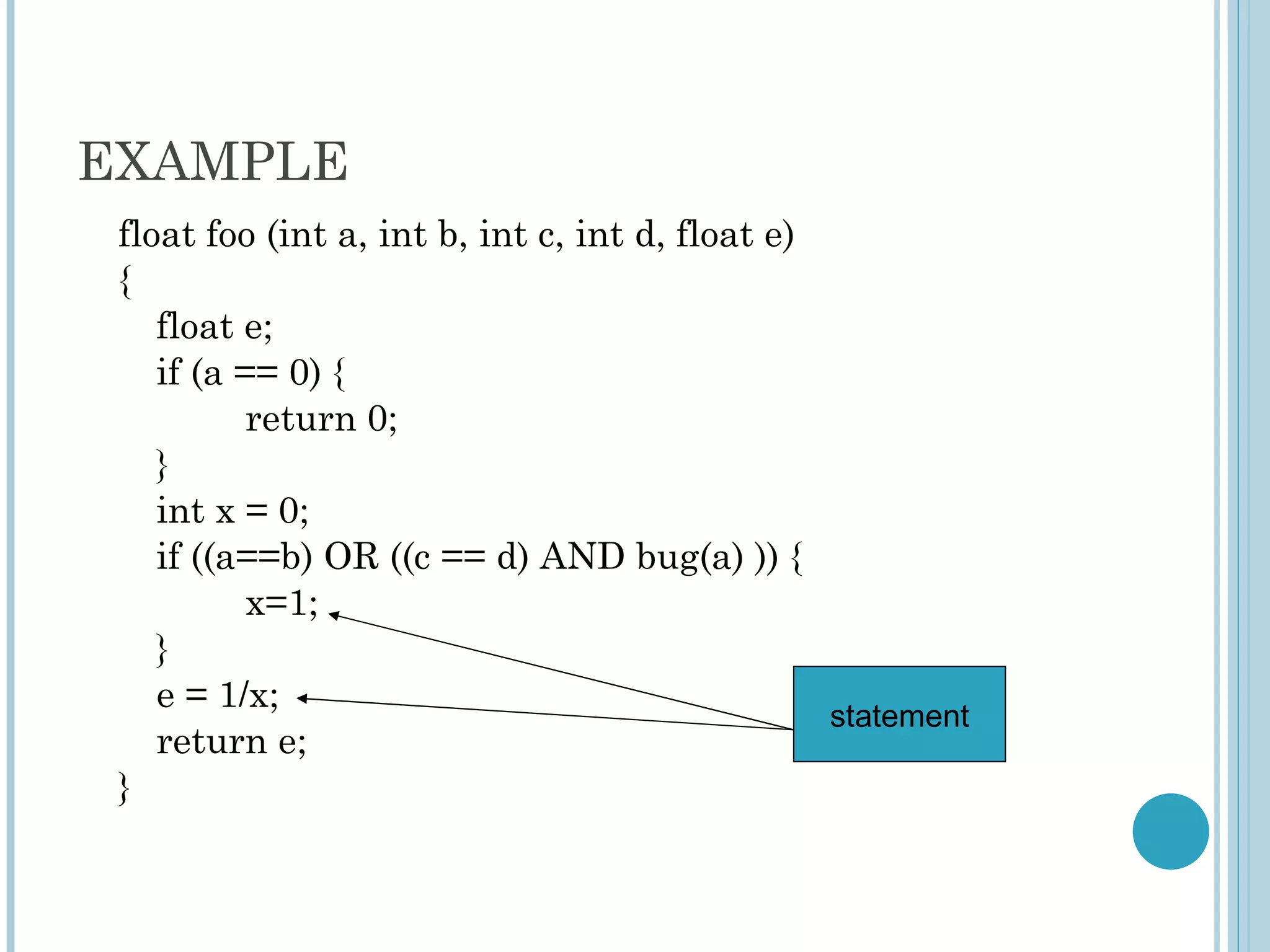
EXAMPLE
 float foo (int a, int b, int c, int d, float e)
 {
    float e;
    if (a == 0) {
           return 0;
    }
    int x = 0;
    if ((a==b) OR ((c == d) AND bug(a) )) {
           x=1;
    }
    e = 1/x;
                                                 statement
    return e;
 }
BRANCH/DECISION TESTING
 uses a model of the program’s flow
 it is designed in order to execute (each) outcome
  of all or selected decision points in a test object
                                            an executable statement
    For each test specify:
                                           which may transfer control
    • the input(s) of the component          to another statement,
                                            depending upon the logic
    • Identification of decision
                                            of the decision statement
    outcome(s) to be executed by
    the test case
    • the expected outcome of the
    test case

 Test completeness criteria: achievement of the test coverage – 100%
 of the branches (one true and one false for each part of condition)
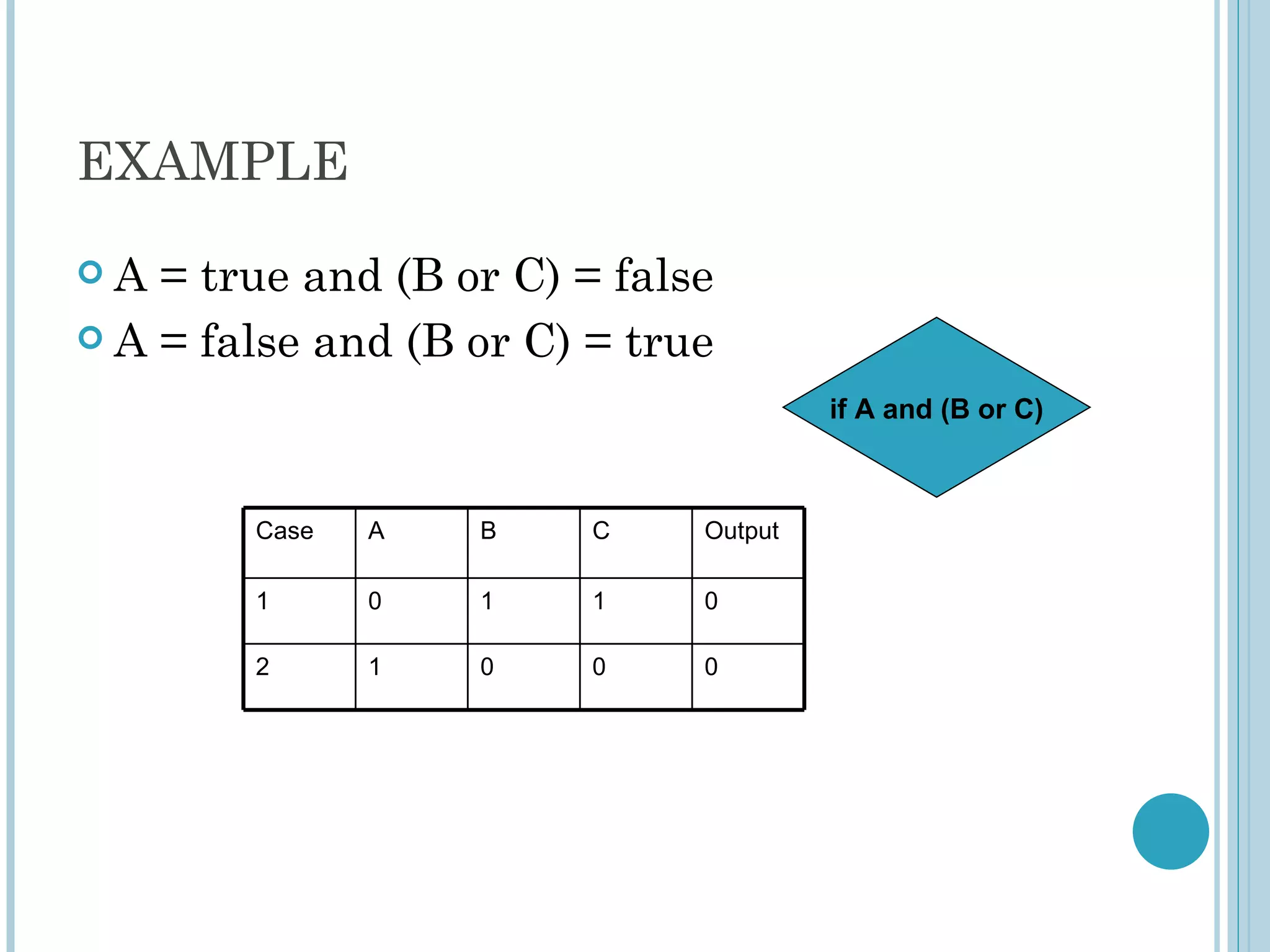
EXAMPLE
A  = true and (B or C) = false
 A = false and (B or C) = true

                                       if A and (B or C)


        Case   A   B     C    Output

        1      0   1     1    0

        2      1   0     0    0
BRANCH CONDITION COMBINATION
   uses a model of the program flow where each
    combination of the inputs for a decision/condition must
    be tested, in order to check if each branch is covered
   For each test case specify:
        the input(s) of the component
        the expected outcome of the test case which can show which

         branch is covered


Test completeness criteria: for a condition containing n
  boolean operands → 2n test cases are required to achieve
  100% coverage
Note: this coverage rapidly becomes unachievable for more
 complex conditions.
WHITE BOX - SUMMARY
 Statement     testing
     uses a model of the program’s control flow
     it is designed in order to execute all or selected statements of

      the test object
 Branch/Decision       Testing
     uses a model of the program’s flow
     it is designed in order to execute (each) outcome of all or

      selected decision points in a test object
 Branch    Condition Combination
       uses a model of the program flow where each combination
        of the inputs for a decision/condition must be tested, in
        order to check if each branch is covered
MODIFIED CONDITION COMBINATION
TESTING
 usesa model of the program’s flow where each
 atomic condition is independently tested, in order
 to show how the decision outcome is affected

 test
     case are designed to show that each condition
 independently affects the decision outcome

 For    each test case specify:
      the input(s) of the component
      The expected outcome of the test case
MODIFIED CONDITION COMBINATION
TESTING
   Test completeness criteria
       for a condition containing n boolean operands, to achieve
        100% coverage are necessary:
         minimum: n + 1 test cases
         maximum: 2n test cases


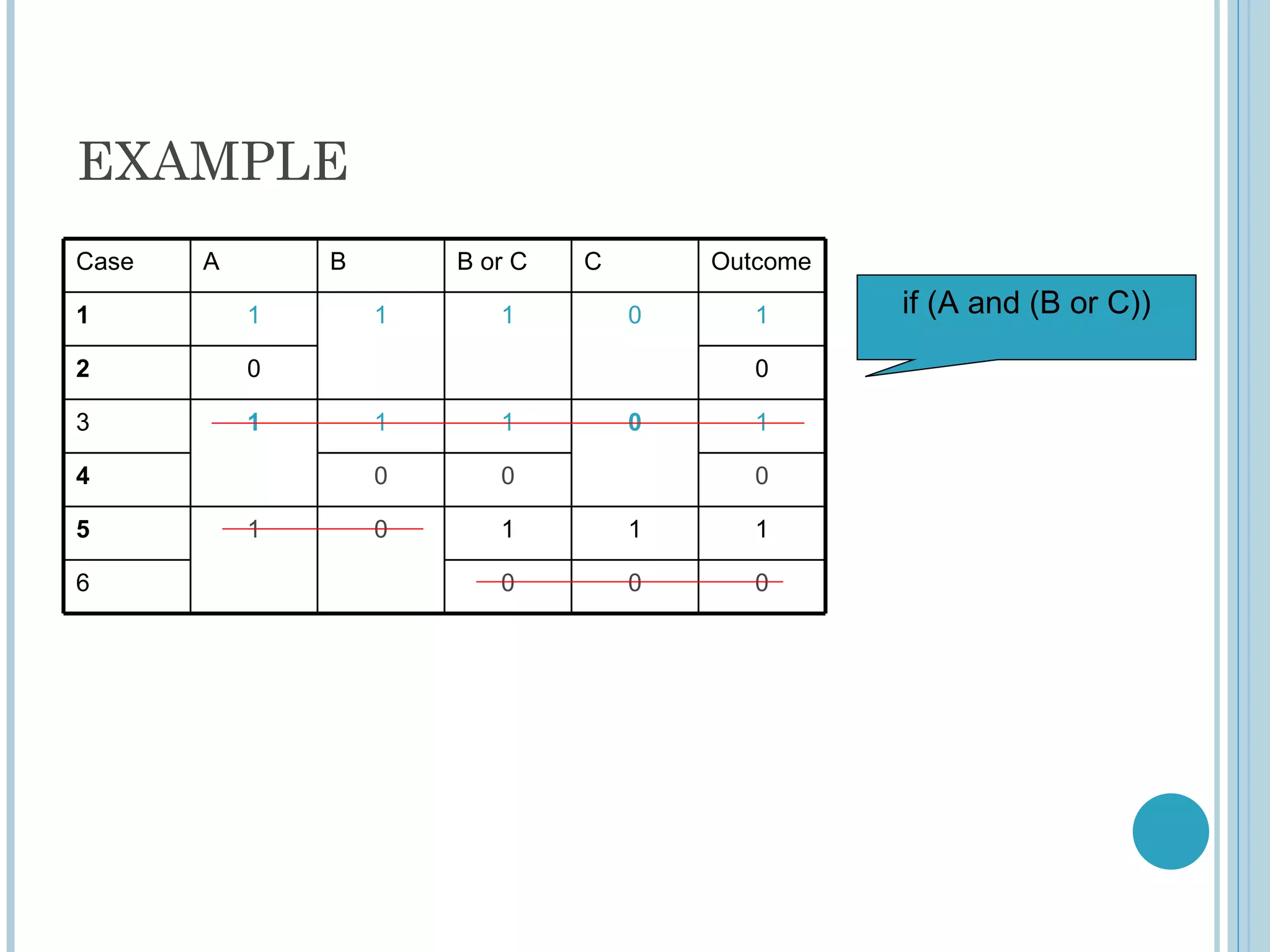
   Example: for 3 boolean operands, to achieve 100%
    coverage are necessary:
         Minimum 4 test cases
         Maximum 6 test cases
EXAMPLE
Case   A       B       B or C   C       Outcome

1          1       1      1         0      1      if (A and (B or C))

2          0                               0

3          1       1      1         0      1

4                  0      0                0

5          1       0      1         1      1

6                         0         0      0
LOOP TESTING
   Simple Loops:- 'n' is the maximum number of allowable
    passes
        skip the loop entirely.
        only one pass thru the loop.

        two passes thru the loop.

        m passes thru the loop where m< n.

        n-1,n,n+1 passes thru the loop


   Nested loops
        start with the innermost loop. Set all other loop to min. values.
        conduct simple loop tests for the innermost loop while holding the
         outer loops at their min. iteration values.
        work outward, conducting tests for the next loop, but keeping all
         the outer loops at their min. iteration count.
        continue until all loops have been tested.
EXERCISE
   1) Identify what scenarios have to be run to achieve
    100% statement coverage and 100% branch coverage
    on the following code


   2) Test the same examples on the following link.
       Does white-box covers 100% the black-box?

Whitebox testing

  • 1.
    SOFTWARE QUALITY ASSURANCE WHITE BOX Seminar: Oana FEIDI Quality Manager – Continental Automotive
  • 2.
    BLACK-BOX VS. WHITE-BOX  Test cases derived from specifications  The focus is not the design, nor the implementation  The focus is on the logic of implementation
  • 3.
    WHITE BOX (STRUCTURAL TESTING) Structural - test case selection is based on an analysis of the internal structure of component  Control flow  Statement testing  Branch/Decision Testing  Branch Condition Testing  Modified Condition Combination Testing  Data flow testing
  • 4.
    WHITE BOX  Using the white-box testing techniques outlined in this seminar, a software engineer can design test cases that  exercise independent paths within a module or unit;  exercise logical decisions on both their true and false side;  execute loops at their boundaries and within their operational bounds  exercise internal data structures to ensure their validity
  • 5.
    STATEMENT TESTING  uses a model of the program’s control flow  it is designed in order to execute all or selected statements of the test object Test cases are design to execute each statement. An entity in a programming For each test case specify: language which is typically the smallest indivisible unit of • the input(s) of the component execution. • identification of statement(s) to be executed by the test case • the expected outcome of the test case Test completeness criteria: the percentage of the statements in the software which were executed at least at once (executing a statement means that the statement was encountered and evaluated during testing).
  • 6.
    EXAMPLE float foo(int a, int b, int c, int d, float e) { float e; if (a == 0) { return 0; } int x = 0; if ((a==b) OR ((c == d) AND bug(a) )) { x=1; } e = 1/x; statement return e; }
  • 7.
    BRANCH/DECISION TESTING  usesa model of the program’s flow  it is designed in order to execute (each) outcome of all or selected decision points in a test object an executable statement For each test specify: which may transfer control • the input(s) of the component to another statement, depending upon the logic • Identification of decision of the decision statement outcome(s) to be executed by the test case • the expected outcome of the test case Test completeness criteria: achievement of the test coverage – 100% of the branches (one true and one false for each part of condition)
  • 8.
    EXAMPLE A =true and (B or C) = false  A = false and (B or C) = true if A and (B or C) Case A B C Output 1 0 1 1 0 2 1 0 0 0
  • 9.
    BRANCH CONDITION COMBINATION  uses a model of the program flow where each combination of the inputs for a decision/condition must be tested, in order to check if each branch is covered  For each test case specify:  the input(s) of the component  the expected outcome of the test case which can show which branch is covered Test completeness criteria: for a condition containing n boolean operands → 2n test cases are required to achieve 100% coverage Note: this coverage rapidly becomes unachievable for more complex conditions.
  • 10.
    WHITE BOX -SUMMARY  Statement testing  uses a model of the program’s control flow  it is designed in order to execute all or selected statements of the test object  Branch/Decision Testing  uses a model of the program’s flow  it is designed in order to execute (each) outcome of all or selected decision points in a test object  Branch Condition Combination  uses a model of the program flow where each combination of the inputs for a decision/condition must be tested, in order to check if each branch is covered
  • 11.
    MODIFIED CONDITION COMBINATION TESTING usesa model of the program’s flow where each atomic condition is independently tested, in order to show how the decision outcome is affected  test case are designed to show that each condition independently affects the decision outcome  For each test case specify:  the input(s) of the component  The expected outcome of the test case
  • 12.
    MODIFIED CONDITION COMBINATION TESTING  Test completeness criteria  for a condition containing n boolean operands, to achieve 100% coverage are necessary:  minimum: n + 1 test cases  maximum: 2n test cases  Example: for 3 boolean operands, to achieve 100% coverage are necessary:  Minimum 4 test cases  Maximum 6 test cases
  • 13.
    EXAMPLE Case A B B or C C Outcome 1 1 1 1 0 1 if (A and (B or C)) 2 0 0 3 1 1 1 0 1 4 0 0 0 5 1 0 1 1 1 6 0 0 0
  • 14.
    LOOP TESTING  Simple Loops:- 'n' is the maximum number of allowable passes  skip the loop entirely.  only one pass thru the loop.  two passes thru the loop.  m passes thru the loop where m< n.  n-1,n,n+1 passes thru the loop  Nested loops  start with the innermost loop. Set all other loop to min. values.  conduct simple loop tests for the innermost loop while holding the outer loops at their min. iteration values.  work outward, conducting tests for the next loop, but keeping all the outer loops at their min. iteration count.  continue until all loops have been tested.
  • 15.
    EXERCISE  1) Identify what scenarios have to be run to achieve 100% statement coverage and 100% branch coverage on the following code  2) Test the same examples on the following link. Does white-box covers 100% the black-box?