PRESENTATION ON
BLACK BOX
Represented by
MOHD AARISH
ECE 2
CONTENT
INTRODUCTION
HISTORY
INSIDE THE BLACK BOX
TECHNOLOGY USED
TESTING A CSMU
PARAMETERS RECORDED BY FDR
ADVANTAGES
BIBLIOGRAPHY
INTRODUCTION
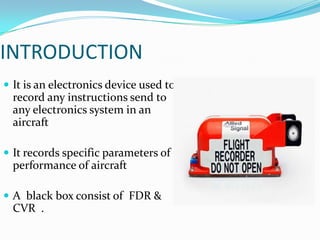
 It is an electronics device used to
record any instructions send to
any electronics system in an
aircraft
 It records specific parameters of
performance of aircraft
 A black box consist of FDR &
CVR .
HISTORY
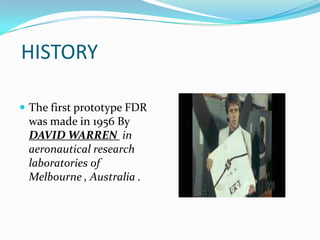
 The first prototype FDR
was made in 1956 By
DAVID WARREN in
aeronautical research
laboratories of
Melbourne , Australia .
flight data recorder
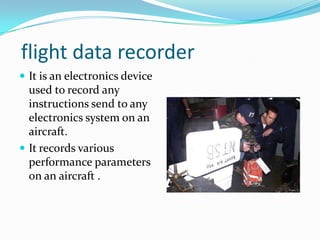
 It is an electronics device
used to record any
instructions send to any
electronics system on an
aircraft.
 It records various
performance parameters
on an aircraft .
INSIDE THE BLACK BOX
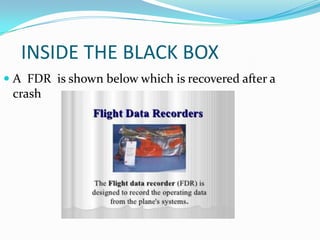
 A FDR is shown below which is recovered after a
crash
Cockpit voice recorder
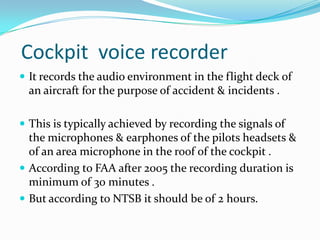
 It records the audio environment in the flight deck of
an aircraft for the purpose of accident & incidents .
 This is typically achieved by recording the signals of
the microphones & earphones of the pilots headsets &
of an area microphone in the roof of the cockpit .
 According to FAA after 2005 the recording duration is
minimum of 30 minutes .
 But according to NTSB it should be of 2 hours.
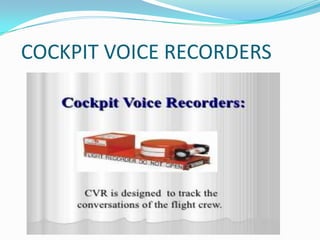
COCKPIT VOICE RECORDERS
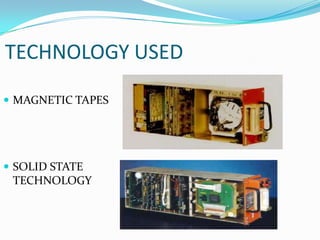
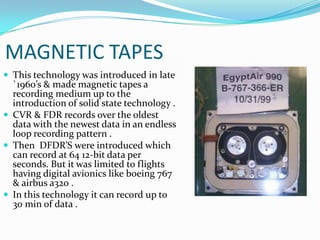
TECHNOLOGY USED
 MAGNETIC TAPES
 SOLID STATE
TECHNOLOGY
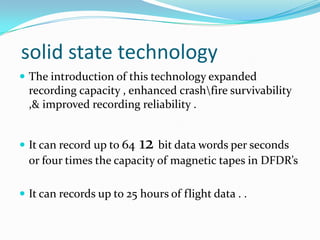
MAGNETIC TAPES
 This technology was introduced in late
`1960’s & made magnetic tapes a
recording medium up to the
introduction of solid state technology .
 CVR & FDR records over the oldest
data with the newest data in an endless
loop recording pattern .
 Then DFDR’S were introduced which
can record at 64 12-bit data per
seconds. But it was limited to flights
having digital avionics like boeing 767
& airbus a320 .
 In this technology it can record up to
30 min of data .
solid state technology
 The introduction of this technology expanded
recording capacity , enhanced crashfire survivability
,& improved recording reliability .
 It can record up to 64 12 bit data words per seconds
or four times the capacity of magnetic tapes in DFDR’s
 It can records up to 25 hours of flight data . .
TESTING A CSMU
(CRASH SURVIVABLE MEMORY UNIT)
 CRASH IMPACT (researchers shoot the CSMU down
in an air cannon to create an impact of3400Gs)
 PIN DROP (researchers apply 500 pound weight with
a 0.25 steel pin)
STATIC CRUSH(for five minute researchers apply5000
pound per square inch to each six axis points)
 FIRE TEST (researches apply 1100 c for 1 hour)
 DEEP SEA SUBMERSION (researchers place the
CSMU in a tank of salt water up to 24 hours)
 SALT WATER SUBMERSION (it must survive in a salt
water up to 30 days)
 FLUID IMMERSION(various components are placed
in variety of aviation fluids like jet fuels , lubricants etc
.)
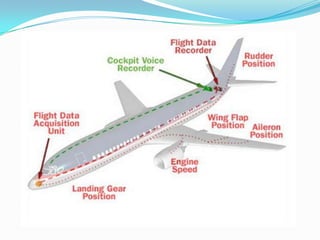
Parameters recorded by most FDR’S
 Time
 Pressure attitude
 Air speed
 Vertical acceleration
 Magnetic heading
 Fuel flow
 Horizontal stabilizer
 Control column position
 Control wheel position
 Rudder –pedal position
ADVANTAGES
It is very useful for accident
investigations .
The mistakes or error can be
avoided in other aircrafts .
Bibliography -
 WIKIPEDIA
 GOOGLE
 (science.howstuffworks.com)
THANK YOU
ANY QUERIES ?

Black box

  • 1.
  • 2.
    CONTENT INTRODUCTION HISTORY INSIDE THE BLACKBOX TECHNOLOGY USED TESTING A CSMU PARAMETERS RECORDED BY FDR ADVANTAGES BIBLIOGRAPHY
  • 3.
    INTRODUCTION  It isan electronics device used to record any instructions send to any electronics system in an aircraft  It records specific parameters of performance of aircraft  A black box consist of FDR & CVR .
  • 4.
    HISTORY  The firstprototype FDR was made in 1956 By DAVID WARREN in aeronautical research laboratories of Melbourne , Australia .
  • 5.
    flight data recorder It is an electronics device used to record any instructions send to any electronics system on an aircraft.  It records various performance parameters on an aircraft .
  • 6.
    INSIDE THE BLACKBOX  A FDR is shown below which is recovered after a crash
  • 7.
    Cockpit voice recorder It records the audio environment in the flight deck of an aircraft for the purpose of accident & incidents .  This is typically achieved by recording the signals of the microphones & earphones of the pilots headsets & of an area microphone in the roof of the cockpit .  According to FAA after 2005 the recording duration is minimum of 30 minutes .  But according to NTSB it should be of 2 hours.
  • 8.
  • 10.
    TECHNOLOGY USED  MAGNETICTAPES  SOLID STATE TECHNOLOGY
  • 11.
    MAGNETIC TAPES  Thistechnology was introduced in late `1960’s & made magnetic tapes a recording medium up to the introduction of solid state technology .  CVR & FDR records over the oldest data with the newest data in an endless loop recording pattern .  Then DFDR’S were introduced which can record at 64 12-bit data per seconds. But it was limited to flights having digital avionics like boeing 767 & airbus a320 .  In this technology it can record up to 30 min of data .
  • 12.
    solid state technology The introduction of this technology expanded recording capacity , enhanced crashfire survivability ,& improved recording reliability .  It can record up to 64 12 bit data words per seconds or four times the capacity of magnetic tapes in DFDR’s  It can records up to 25 hours of flight data . .
  • 13.
    TESTING A CSMU (CRASHSURVIVABLE MEMORY UNIT)  CRASH IMPACT (researchers shoot the CSMU down in an air cannon to create an impact of3400Gs)  PIN DROP (researchers apply 500 pound weight with a 0.25 steel pin) STATIC CRUSH(for five minute researchers apply5000 pound per square inch to each six axis points)
  • 14.
     FIRE TEST(researches apply 1100 c for 1 hour)  DEEP SEA SUBMERSION (researchers place the CSMU in a tank of salt water up to 24 hours)  SALT WATER SUBMERSION (it must survive in a salt water up to 30 days)  FLUID IMMERSION(various components are placed in variety of aviation fluids like jet fuels , lubricants etc .)
  • 15.
    Parameters recorded bymost FDR’S  Time  Pressure attitude  Air speed  Vertical acceleration  Magnetic heading  Fuel flow  Horizontal stabilizer  Control column position  Control wheel position  Rudder –pedal position
  • 16.
    ADVANTAGES It is veryuseful for accident investigations . The mistakes or error can be avoided in other aircrafts .
  • 17.
    Bibliography -  WIKIPEDIA GOOGLE  (science.howstuffworks.com)
  • 18.
  • 19.