Bipolar Disorder
Andrea DeWitte
What is Bipolar Disorder?
 Bipolar disorder, also known as manic-depressive illness, is a brain disorder
that causes unusual shifts in mood, energy, activity levels, and the ability to
carry out day-to-day tasks
 People with bipolar disorder go through unusual mood changes, ranging from
periods of extremely “up” or happy to periods of “down” or very sad
 “Up” refers to a manic episode while “down” refers to a depressive episode
 These mood swings are more extreme than just being happy or sad, they can
affect a person’s sleep, energy level, and ability to think clearly
 Bipolar symptoms are so strong that they can damage relationships and make
it hard to go to school or keep a job
Symptoms
 People with bipolar disorder experience periods of unusually intense emotion,
changes in sleep patterns and activity levels, and unusual behaviors
Depressive (“Down”) episode symptoms:
• Feel very sad or hopeless
• Have very little energy
• Have decreased activity levels
• Have trouble sleeping
• Feel worried and empty
• Have trouble concentrating
• Eat too much or too little
• Feel tired or exhausted
Manic (“Up”) episode symptoms:
• Feel very “high” or happy
• Have a lot of energy
• Have increased activity levels
• Have trouble sleeping
• Talk really fast
• Be agitated or irritable
• Do risky things
• Think they can do a lot of things at once
Prevalence
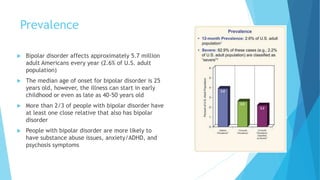
 Bipolar disorder affects approximately 5.7 million
adult Americans every year (2.6% of U.S. adult
population)
 The median age of onset for bipolar disorder is 25
years old, however, the illness can start in early
childhood or even as late as 40-50 years old
 More than 2/3 of people with bipolar disorder have
at least one close relative that also has bipolar
disorder
 People with bipolar disorder are more likely to
have substance abuse issues, anxiety/ADHD, and
psychosis symptoms
Causes
 Doctors do not know what causes bipolar disorder, but several things may
contribute to the illness
 Bipolar disorder sometimes runs in the family, therefore heredity is linked to
causing the illness
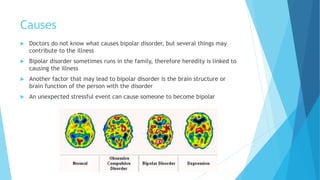
 Another factor that may lead to bipolar disorder is the brain structure or
brain function of the person with the disorder
 An unexpected stressful event can cause someone to become bipolar
Treatment
 Medication: mood stabilizers, atypical antipsychotics, and
antidepressants
 Psychotherapy: “talk therapy” provides support,
education and guidance to people with bipolar disorder
and their families
 Electroconvulsive Therapy: “shock therapy” provides a
quick electric current that can sometimes correct
problems in the brain
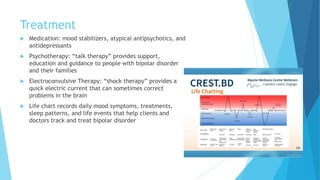
 Life chart records daily mood symptoms, treatments,
sleep patterns, and life events that help clients and
doctors track and treat bipolar disorder
Work Cited
 https://www.nimh.nih.gov/health/publications/bipolar-disorder/index.shtml
 http://www.dbsalliance.org/site/PageServer?pagename=education_statistics_
bipolar_disorder
 https://www.youtube.com/watch?v=IJtXLXQ326A
Bipolar Disorder
Bipolar Disorder
Bipolar Disorder
Bipolar Disorder
Bipolar Disorder

Bipolar Disorder

  • 1.
  • 2.
    What is BipolarDisorder?  Bipolar disorder, also known as manic-depressive illness, is a brain disorder that causes unusual shifts in mood, energy, activity levels, and the ability to carry out day-to-day tasks  People with bipolar disorder go through unusual mood changes, ranging from periods of extremely “up” or happy to periods of “down” or very sad  “Up” refers to a manic episode while “down” refers to a depressive episode  These mood swings are more extreme than just being happy or sad, they can affect a person’s sleep, energy level, and ability to think clearly  Bipolar symptoms are so strong that they can damage relationships and make it hard to go to school or keep a job
  • 3.
    Symptoms  People withbipolar disorder experience periods of unusually intense emotion, changes in sleep patterns and activity levels, and unusual behaviors Depressive (“Down”) episode symptoms: • Feel very sad or hopeless • Have very little energy • Have decreased activity levels • Have trouble sleeping • Feel worried and empty • Have trouble concentrating • Eat too much or too little • Feel tired or exhausted Manic (“Up”) episode symptoms: • Feel very “high” or happy • Have a lot of energy • Have increased activity levels • Have trouble sleeping • Talk really fast • Be agitated or irritable • Do risky things • Think they can do a lot of things at once
  • 4.
    Prevalence  Bipolar disorderaffects approximately 5.7 million adult Americans every year (2.6% of U.S. adult population)  The median age of onset for bipolar disorder is 25 years old, however, the illness can start in early childhood or even as late as 40-50 years old  More than 2/3 of people with bipolar disorder have at least one close relative that also has bipolar disorder  People with bipolar disorder are more likely to have substance abuse issues, anxiety/ADHD, and psychosis symptoms
  • 5.
    Causes  Doctors donot know what causes bipolar disorder, but several things may contribute to the illness  Bipolar disorder sometimes runs in the family, therefore heredity is linked to causing the illness  Another factor that may lead to bipolar disorder is the brain structure or brain function of the person with the disorder  An unexpected stressful event can cause someone to become bipolar
  • 6.
    Treatment  Medication: moodstabilizers, atypical antipsychotics, and antidepressants  Psychotherapy: “talk therapy” provides support, education and guidance to people with bipolar disorder and their families  Electroconvulsive Therapy: “shock therapy” provides a quick electric current that can sometimes correct problems in the brain  Life chart records daily mood symptoms, treatments, sleep patterns, and life events that help clients and doctors track and treat bipolar disorder
  • 7.
    Work Cited  https://www.nimh.nih.gov/health/publications/bipolar-disorder/index.shtml http://www.dbsalliance.org/site/PageServer?pagename=education_statistics_ bipolar_disorder  https://www.youtube.com/watch?v=IJtXLXQ326A