BIPOLAR
DISORDE
RW. P. Rivindu H. Wickramanayake
Group no. 04a
5th Year 2nd Semester – 2019 December
Tbilisi State Medical University, Georgia
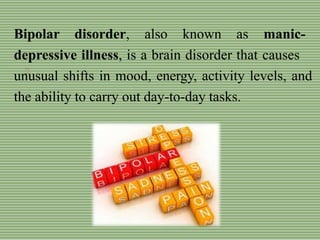
Bipolar disorder, also known as manic-
depressive illness, is a brain disorder that causes
unusual shifts in mood, energy, activity levels, and
the ability to carry out day-to-day tasks.
Symptoms
 Unusually intense emotional states that occur in
distinct periods called "mood episodes"
 An overly joyful or overexcited state is called
a manic episode, and
 An extremely sad or hopeless state is called a
depressive episode
 Sometimes, a mood episode includes
symptoms of both mania and depression. This is
called a mixed state.
 In addition to mania and depression, bipolar
disorder can cause a range of moods.
 A person having a hypomanic episode
may feel very good, be highly productive,
function well, and may not feel that
anything is wrong even as family and
friends recognize the mood swings.
 Without proper treatment, however,
people with hypomania may develop
severe mania or depression.
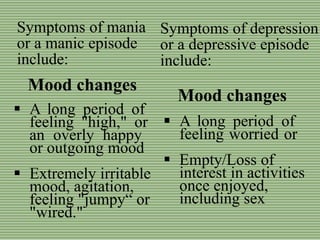
Symptoms of depression
or a depressive episode
include:
Mood changes
Mood changes
 A long period of
feeling "high," or
an overly happy
or outgoing mood
 Extremely irritable
mood, agitation,
feeling "jumpy“ or
"wired."
Symptoms of mania
or a manic episode
include:
 A long period of
feeling worried or
 Empty/Loss of
interest in activities
once enjoyed,
including sex
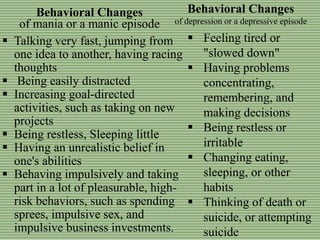
 Talking very fast, jumping from
one idea to another, having racing
thoughts
 Being easily distracted
 Increasing goal-directed
activities, such as taking on new
projects
 Being restless, Sleeping little
 Having an unrealistic belief in
one's abilities
 Behaving impulsively and taking
part in a lot of pleasurable, high-
risk behaviors, such as spending
sprees, impulsive sex, and
impulsive business investments.
Behavioral Changes
of mania or a manic episode
Behavioral Changes
of depression or a depressive episode
 Feeling tired or
"slowed down"
 Having problems
concentrating,
remembering, and
making decisions
 Being restless or
irritable
 Changing eating,
sleeping, or other
habits
 Thinking of death or
suicide, or attempting
suicide
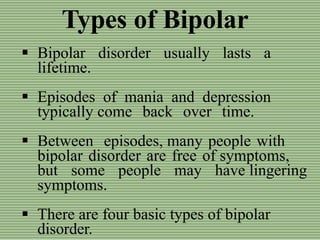
Types of Bipolar
 Bipolar disorder usually lasts a
lifetime.
 Episodes of mania and depression
typically come back over time.
 Between episodes, many people with
bipolar disorder are free of symptoms,
but some people may have lingering
symptoms.
 There are four basic types of bipolar
disorder.
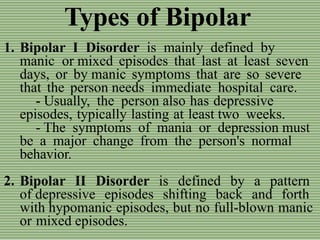
Types of Bipolar
1. Bipolar I Disorder is mainly defined by
manic or mixed episodes that last at least seven
days, or by manic symptoms that are so severe
that the person needs immediate hospital care.
- Usually, the person also has depressive
episodes, typically lasting at least two weeks.
- The symptoms of mania or depression must
be a major change from the person's normal
behavior.
2. Bipolar II Disorder is defined by a pattern
of depressive episodes shifting back and forth
with hypomanic episodes, but no full-blown manic
or mixed episodes.
3. Bipolar Disorder Not Otherwise Specified (BP-
NOS) is diagnosed when a person has symptoms
of the illness that do not meet diagnostic criteria
for either bipolar I or II.
- The symptoms may not last long enough, or
the person may have too few symptoms, to be
diagnosed with bipolar I or II.
- However, the symptoms are clearly out of
the person's normal range of behavior.
4. Cyclothymic Disorder, or Cyclothymia, is a
mild form of bipolar disorder.
- People who have cyclothymia have episodes
of hypomania that shift back and forth with mild
depression for at least two years.
Etiology for Bipolar Disorder
 The Brain and Bipolar Disorder
- Experts believe bipolar disorder is partly caused by an
underlying problem with the balance of brain chemicals called
neurotransmitters.
 Genetics
- Bipolar disorder tends to run in families. Children with a
parent or sibling who has bipolar disorder are four to six times
more likely to develop the illness, compared with children who do
not have a family history of bipolar disorder.
- Studies of identical twins have shown that the twin of a
person with bipolar illness does not always develop the disorder.
The study results suggest factors besides genes are also at work.
- It is likely that many different genes and a person's
environment are involved.
Who Is At Risk?
 Bipolar disorder often develops in a
person's late teens or early adult years.
 At least half of all cases start before age 25.
 Some people have their first symptoms
during childhood, while others may
develop symptoms late in life.
SeasonalAffective Disorder
(SAD)
 Vulnerable to changes in sunlight,
especially Fall and Spring
- Prevalence rates of 4-6%, found more
often in northern latitudes.
- Many SAD symptoms opposite of
those found in major depression
- increase in appetite,
- weight gain,
- more sleep
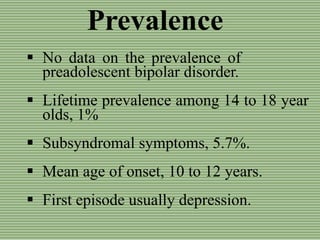
Prevalence
 No data on the prevalence of
preadolescent bipolar disorder.
 Lifetime prevalence among 14 to 18 year
olds, 1%
 Subsyndromal symptoms, 5.7%.
 Mean age of onset, 10 to 12 years.
 First episode usually depression.
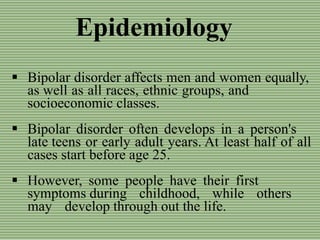
Epidemiology
 Bipolar disorder affects men and women equally,
as well as all races, ethnic groups, and
socioeconomic classes.
 Bipolar disorder often develops in a person's
late teens or early adult years. At least half of all
cases start before age 25.
 However, some people have their first
symptoms during childhood, while others
may develop through out the life.
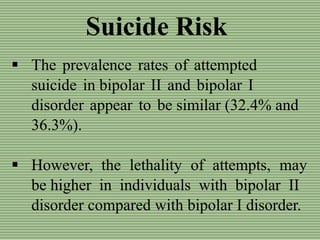
Suicide Risk
 The prevalence rates of attempted
suicide in bipolar II and bipolar I
disorder appear to be similar (32.4% and
36.3%).
 However, the lethality of attempts, may
be higher in individuals with bipolar II
disorder compared with bipolar I disorder.
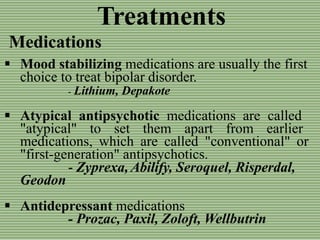
Treatments
Medications
 Mood stabilizing medications are usually the first
choice to treat bipolar disorder.
- Lithium, Depakote
 Atypical antipsychotic medications are called
"atypical" to set them apart from earlier
medications, which are called "conventional" or
"first-generation" antipsychotics.
- Zyprexa, Abilify, Seroquel, Risperdal,
Geodon
 Antidepressant medications
- Prozac, Paxil, Zoloft, Wellbutrin
Psychotherapy
 Cognitive behavioral therapy (CBT)
 Family-focused therapy
 Psychoeducation
 In addition to medication, psychotherapy, or
"talk“ therapy, can be an effective treatment
for bipolar disorder.
 It can provide support, education, and
guidance to people with bipolar disorder and
their families.
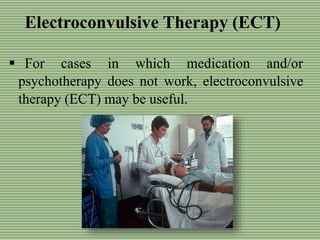
Electroconvulsive Therapy (ECT)
 For cases in which medication and/or
psychotherapy does not work, electroconvulsive
therapy (ECT) may be useful.
Bipolar Disorder - Rivin

Bipolar Disorder - Rivin

  • 1.
    BIPOLAR DISORDE RW. P. RivinduH. Wickramanayake Group no. 04a 5th Year 2nd Semester – 2019 December Tbilisi State Medical University, Georgia
  • 2.
    Bipolar disorder, alsoknown as manic- depressive illness, is a brain disorder that causes unusual shifts in mood, energy, activity levels, and the ability to carry out day-to-day tasks.
  • 3.
    Symptoms  Unusually intenseemotional states that occur in distinct periods called "mood episodes"  An overly joyful or overexcited state is called a manic episode, and  An extremely sad or hopeless state is called a depressive episode  Sometimes, a mood episode includes symptoms of both mania and depression. This is called a mixed state.  In addition to mania and depression, bipolar disorder can cause a range of moods.
  • 4.
     A personhaving a hypomanic episode may feel very good, be highly productive, function well, and may not feel that anything is wrong even as family and friends recognize the mood swings.  Without proper treatment, however, people with hypomania may develop severe mania or depression.
  • 5.
    Symptoms of depression ora depressive episode include: Mood changes Mood changes  A long period of feeling "high," or an overly happy or outgoing mood  Extremely irritable mood, agitation, feeling "jumpy“ or "wired." Symptoms of mania or a manic episode include:  A long period of feeling worried or  Empty/Loss of interest in activities once enjoyed, including sex
  • 6.
     Talking veryfast, jumping from one idea to another, having racing thoughts  Being easily distracted  Increasing goal-directed activities, such as taking on new projects  Being restless, Sleeping little  Having an unrealistic belief in one's abilities  Behaving impulsively and taking part in a lot of pleasurable, high- risk behaviors, such as spending sprees, impulsive sex, and impulsive business investments. Behavioral Changes of mania or a manic episode Behavioral Changes of depression or a depressive episode  Feeling tired or "slowed down"  Having problems concentrating, remembering, and making decisions  Being restless or irritable  Changing eating, sleeping, or other habits  Thinking of death or suicide, or attempting suicide
  • 7.
    Types of Bipolar Bipolar disorder usually lasts a lifetime.  Episodes of mania and depression typically come back over time.  Between episodes, many people with bipolar disorder are free of symptoms, but some people may have lingering symptoms.  There are four basic types of bipolar disorder.
  • 8.
    Types of Bipolar 1.Bipolar I Disorder is mainly defined by manic or mixed episodes that last at least seven days, or by manic symptoms that are so severe that the person needs immediate hospital care. - Usually, the person also has depressive episodes, typically lasting at least two weeks. - The symptoms of mania or depression must be a major change from the person's normal behavior. 2. Bipolar II Disorder is defined by a pattern of depressive episodes shifting back and forth with hypomanic episodes, but no full-blown manic or mixed episodes.
  • 9.
    3. Bipolar DisorderNot Otherwise Specified (BP- NOS) is diagnosed when a person has symptoms of the illness that do not meet diagnostic criteria for either bipolar I or II. - The symptoms may not last long enough, or the person may have too few symptoms, to be diagnosed with bipolar I or II. - However, the symptoms are clearly out of the person's normal range of behavior. 4. Cyclothymic Disorder, or Cyclothymia, is a mild form of bipolar disorder. - People who have cyclothymia have episodes of hypomania that shift back and forth with mild depression for at least two years.
  • 10.
    Etiology for BipolarDisorder  The Brain and Bipolar Disorder - Experts believe bipolar disorder is partly caused by an underlying problem with the balance of brain chemicals called neurotransmitters.  Genetics - Bipolar disorder tends to run in families. Children with a parent or sibling who has bipolar disorder are four to six times more likely to develop the illness, compared with children who do not have a family history of bipolar disorder. - Studies of identical twins have shown that the twin of a person with bipolar illness does not always develop the disorder. The study results suggest factors besides genes are also at work. - It is likely that many different genes and a person's environment are involved.
  • 11.
    Who Is AtRisk?  Bipolar disorder often develops in a person's late teens or early adult years.  At least half of all cases start before age 25.  Some people have their first symptoms during childhood, while others may develop symptoms late in life.
  • 12.
    SeasonalAffective Disorder (SAD)  Vulnerableto changes in sunlight, especially Fall and Spring - Prevalence rates of 4-6%, found more often in northern latitudes. - Many SAD symptoms opposite of those found in major depression - increase in appetite, - weight gain, - more sleep
  • 13.
    Prevalence  No dataon the prevalence of preadolescent bipolar disorder.  Lifetime prevalence among 14 to 18 year olds, 1%  Subsyndromal symptoms, 5.7%.  Mean age of onset, 10 to 12 years.  First episode usually depression.
  • 14.
    Epidemiology  Bipolar disorderaffects men and women equally, as well as all races, ethnic groups, and socioeconomic classes.  Bipolar disorder often develops in a person's late teens or early adult years. At least half of all cases start before age 25.  However, some people have their first symptoms during childhood, while others may develop through out the life.
  • 15.
    Suicide Risk  Theprevalence rates of attempted suicide in bipolar II and bipolar I disorder appear to be similar (32.4% and 36.3%).  However, the lethality of attempts, may be higher in individuals with bipolar II disorder compared with bipolar I disorder.
  • 16.
    Treatments Medications  Mood stabilizingmedications are usually the first choice to treat bipolar disorder. - Lithium, Depakote  Atypical antipsychotic medications are called "atypical" to set them apart from earlier medications, which are called "conventional" or "first-generation" antipsychotics. - Zyprexa, Abilify, Seroquel, Risperdal, Geodon  Antidepressant medications - Prozac, Paxil, Zoloft, Wellbutrin
  • 17.
    Psychotherapy  Cognitive behavioraltherapy (CBT)  Family-focused therapy  Psychoeducation  In addition to medication, psychotherapy, or "talk“ therapy, can be an effective treatment for bipolar disorder.  It can provide support, education, and guidance to people with bipolar disorder and their families.
  • 18.
    Electroconvulsive Therapy (ECT) For cases in which medication and/or psychotherapy does not work, electroconvulsive therapy (ECT) may be useful.