Eileen Prince
BIPOLAR DISORDER
Disclaimer
• This a project for a high school AP Psychology course. This is a
fictionalized account of having a psychological ailment. For
questions about this blog project or its content please email the
teacher, Laura Astorian: laura.astorian@cobbk12.org
What is Bipolar Disorder?
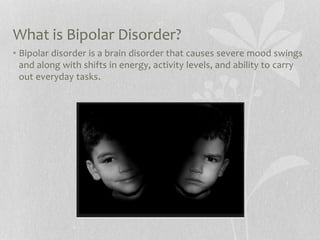
• Bipolar disorder is a brain disorder that causes severe mood swings
and along with shifts in energy, activity levels, and ability to carry
out everyday tasks.
Criteria for Bipolar Disorder
• Bipolar Disorder I
• Patient has had at least one manic episode followed by or preceded by
hypomanic or depressive episodes. Manic episodes can impair certain areas
of life.
• Bipolar Disorder II
• Patient has had at least one major depressive episode lasting at least two
weeks and at least one hypomanic episode lasting at least four days, but
has never had a manic episode. Depressive episodes can cause impair
functioning in certain areas of life.
Symptoms of a Manic Episode
•Increasing activities
•Being restless and may not feel tired
•Has unrealistic beliefs in one’s own abilities
•Behaving impulsively
Symptoms of a Manic Episode
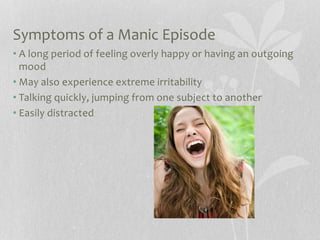
• A long period of feeling overly happy or having an outgoing
mood
• May also experience extreme irritability
• Talking quickly, jumping from one subject to another
• Easily distracted
Symptoms of Depressive Episode
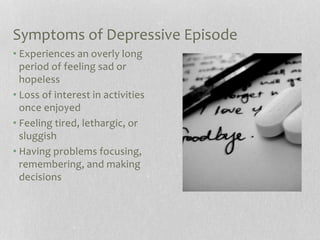
• Experiences an overly long
period of feeling sad or
hopeless
• Loss of interest in activities
once enjoyed
• Feeling tired, lethargic, or
sluggish
• Having problems focusing,
remembering, and making
decisions
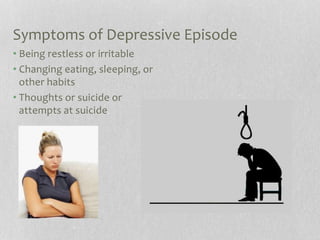
Symptoms of Depressive Episode
• Being restless or irritable
• Changing eating, sleeping, or
other habits
• Thoughts or suicide or
attempts at suicide
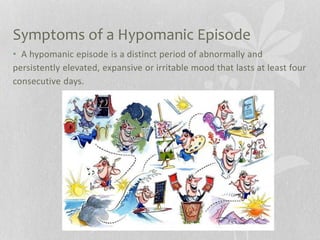
Symptoms of a Hypomanic Episode
• A hypomanic episode is a distinct period of abnormally and
persistently elevated, expansive or irritable mood that lasts at least four
consecutive days.
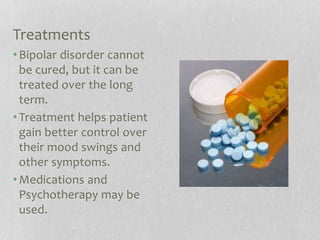
Treatments
•Bipolar disorder cannot
be cured, but it can be
treated over the long
term.
•Treatment helps patient
gain better control over
their mood swings and
other symptoms.
•Medications and
Psychotherapy may be
used.
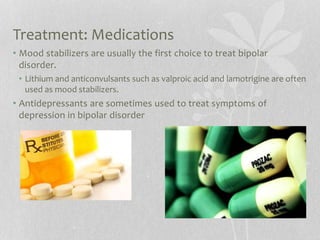
Treatment: Medications
• Mood stabilizers are usually the first choice to treat bipolar
disorder.
• Lithium and anticonvulsants such as valproic acid and lamotrigine are often
used as mood stabilizers.
• Antidepressants are sometimes used to treat symptoms of
depression in bipolar disorder
Treatment: Psychotherapy
• Cognitive behavioral therapy
helps people with the
disorder learn to change
harmful or negative thought
patterns and behaviors.
• Family-focused therapy helps
enhance family coping
strategies and by improving
communication and problem-
solving among family
members.
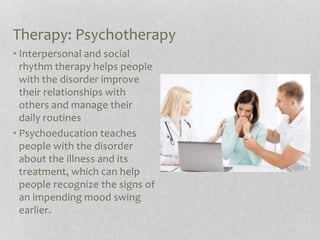
Therapy: Psychotherapy
• Interpersonal and social
rhythm therapy helps people
with the disorder improve
their relationships with
others and manage their
daily routines
• Psychoeducation teaches
people with the disorder
about the illness and its
treatment, which can help
people recognize the signs of
an impending mood swing
earlier.
Therapy: Other Treatments
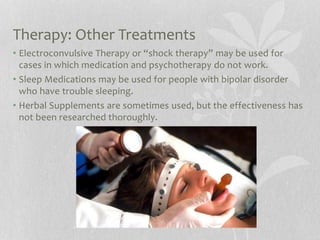
• Electroconvulsive Therapy or “shock therapy” may be used for
cases in which medication and psychotherapy do not work.
• Sleep Medications may be used for people with bipolar disorder
who have trouble sleeping.
• Herbal Supplements are sometimes used, but the effectiveness has
not been researched thoroughly.
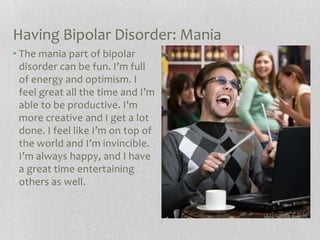
Having Bipolar Disorder: Mania
• The mania part of bipolar
disorder can be fun. I’m full
of energy and optimism. I
feel great all the time and I’m
able to be productive. I’m
more creative and I get a lot
done. I feel like I’m on top of
the world and I’m invincible.
I’m always happy, and I have
a great time entertaining
others as well.
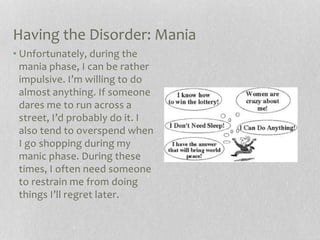
Having the Disorder: Mania
• Unfortunately, during the
mania phase, I can be rather
impulsive. I’m willing to do
almost anything. If someone
dares me to run across a
street, I’d probably do it. I
also tend to overspend when
I go shopping during my
manic phase. During these
times, I often need someone
to restrain me from doing
things I’ll regret later.
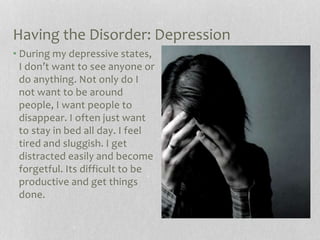
Having the Disorder: Depression
• During my depressive states,
I don’t want to see anyone or
do anything. Not only do I
not want to be around
people, I want people to
disappear. I often just want
to stay in bed all day. I feel
tired and sluggish. I get
distracted easily and become
forgetful. Its difficult to be
productive and get things
done.
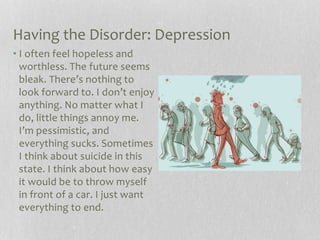
Having the Disorder: Depression
• I often feel hopeless and
worthless. The future seems
bleak. There’s nothing to
look forward to. I don’t enjoy
anything. No matter what I
do, little things annoy me.
I’m pessimistic, and
everything sucks. Sometimes
I think about suicide in this
state. I think about how easy
it would be to throw myself
in front of a car. I just want
everything to end.
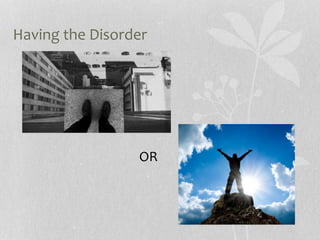
Having the Disorder
OR
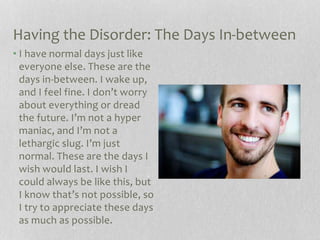
Having the Disorder: The Days In-between
• I have normal days just like
everyone else. These are the
days in-between. I wake up,
and I feel fine. I don’t worry
about everything or dread
the future. I’m not a hyper
maniac, and I’m not a
lethargic slug. I’m just
normal. These are the days I
wish would last. I wish I
could always be like this, but
I know that’s not possible, so
I try to appreciate these days
as much as possible.
Having the Disorder: Therapy
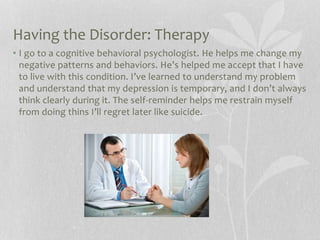
• I go to a cognitive behavioral psychologist. He helps me change my
negative patterns and behaviors. He’s helped me accept that I have
to live with this condition. I’ve learned to understand my problem
and understand that my depression is temporary, and I don’t always
think clearly during it. The self-reminder helps me restrain myself
from doing thins I’ll regret later like suicide.
Having the Disorder: Therapy
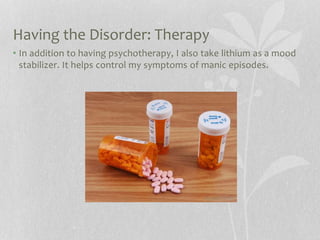
• In addition to having psychotherapy, I also take lithium as a mood
stabilizer. It helps control my symptoms of manic episodes.
Sources
• http://www.nimh.nih.gov/health/topics/bipolar-disorder/index.shtml
• http://www.healthline.com/health/bipolar-disorder/what-bipolar-
feels-like#2
• http://www.mayoclinic.org/diseases-conditions/bipolar-
disorder/basics/risk-factors/con-20027544

Bipolar Disorder

  • 1.
  • 2.
    Disclaimer • This aproject for a high school AP Psychology course. This is a fictionalized account of having a psychological ailment. For questions about this blog project or its content please email the teacher, Laura Astorian: laura.astorian@cobbk12.org
  • 3.
    What is BipolarDisorder? • Bipolar disorder is a brain disorder that causes severe mood swings and along with shifts in energy, activity levels, and ability to carry out everyday tasks.
  • 4.
    Criteria for BipolarDisorder • Bipolar Disorder I • Patient has had at least one manic episode followed by or preceded by hypomanic or depressive episodes. Manic episodes can impair certain areas of life. • Bipolar Disorder II • Patient has had at least one major depressive episode lasting at least two weeks and at least one hypomanic episode lasting at least four days, but has never had a manic episode. Depressive episodes can cause impair functioning in certain areas of life.
  • 5.
    Symptoms of aManic Episode •Increasing activities •Being restless and may not feel tired •Has unrealistic beliefs in one’s own abilities •Behaving impulsively
  • 6.
    Symptoms of aManic Episode • A long period of feeling overly happy or having an outgoing mood • May also experience extreme irritability • Talking quickly, jumping from one subject to another • Easily distracted
  • 7.
    Symptoms of DepressiveEpisode • Experiences an overly long period of feeling sad or hopeless • Loss of interest in activities once enjoyed • Feeling tired, lethargic, or sluggish • Having problems focusing, remembering, and making decisions
  • 8.
    Symptoms of DepressiveEpisode • Being restless or irritable • Changing eating, sleeping, or other habits • Thoughts or suicide or attempts at suicide
  • 9.
    Symptoms of aHypomanic Episode • A hypomanic episode is a distinct period of abnormally and persistently elevated, expansive or irritable mood that lasts at least four consecutive days.
  • 10.
    Treatments •Bipolar disorder cannot becured, but it can be treated over the long term. •Treatment helps patient gain better control over their mood swings and other symptoms. •Medications and Psychotherapy may be used.
  • 11.
    Treatment: Medications • Moodstabilizers are usually the first choice to treat bipolar disorder. • Lithium and anticonvulsants such as valproic acid and lamotrigine are often used as mood stabilizers. • Antidepressants are sometimes used to treat symptoms of depression in bipolar disorder
  • 12.
    Treatment: Psychotherapy • Cognitivebehavioral therapy helps people with the disorder learn to change harmful or negative thought patterns and behaviors. • Family-focused therapy helps enhance family coping strategies and by improving communication and problem- solving among family members.
  • 13.
    Therapy: Psychotherapy • Interpersonaland social rhythm therapy helps people with the disorder improve their relationships with others and manage their daily routines • Psychoeducation teaches people with the disorder about the illness and its treatment, which can help people recognize the signs of an impending mood swing earlier.
  • 14.
    Therapy: Other Treatments •Electroconvulsive Therapy or “shock therapy” may be used for cases in which medication and psychotherapy do not work. • Sleep Medications may be used for people with bipolar disorder who have trouble sleeping. • Herbal Supplements are sometimes used, but the effectiveness has not been researched thoroughly.
  • 15.
    Having Bipolar Disorder:Mania • The mania part of bipolar disorder can be fun. I’m full of energy and optimism. I feel great all the time and I’m able to be productive. I’m more creative and I get a lot done. I feel like I’m on top of the world and I’m invincible. I’m always happy, and I have a great time entertaining others as well.
  • 16.
    Having the Disorder:Mania • Unfortunately, during the mania phase, I can be rather impulsive. I’m willing to do almost anything. If someone dares me to run across a street, I’d probably do it. I also tend to overspend when I go shopping during my manic phase. During these times, I often need someone to restrain me from doing things I’ll regret later.
  • 17.
    Having the Disorder:Depression • During my depressive states, I don’t want to see anyone or do anything. Not only do I not want to be around people, I want people to disappear. I often just want to stay in bed all day. I feel tired and sluggish. I get distracted easily and become forgetful. Its difficult to be productive and get things done.
  • 18.
    Having the Disorder:Depression • I often feel hopeless and worthless. The future seems bleak. There’s nothing to look forward to. I don’t enjoy anything. No matter what I do, little things annoy me. I’m pessimistic, and everything sucks. Sometimes I think about suicide in this state. I think about how easy it would be to throw myself in front of a car. I just want everything to end.
  • 19.
  • 20.
    Having the Disorder:The Days In-between • I have normal days just like everyone else. These are the days in-between. I wake up, and I feel fine. I don’t worry about everything or dread the future. I’m not a hyper maniac, and I’m not a lethargic slug. I’m just normal. These are the days I wish would last. I wish I could always be like this, but I know that’s not possible, so I try to appreciate these days as much as possible.
  • 21.
    Having the Disorder:Therapy • I go to a cognitive behavioral psychologist. He helps me change my negative patterns and behaviors. He’s helped me accept that I have to live with this condition. I’ve learned to understand my problem and understand that my depression is temporary, and I don’t always think clearly during it. The self-reminder helps me restrain myself from doing thins I’ll regret later like suicide.
  • 22.
    Having the Disorder:Therapy • In addition to having psychotherapy, I also take lithium as a mood stabilizer. It helps control my symptoms of manic episodes.
  • 23.