There is no nationally accepted
definition but most agree on the
following elements:
A group of three or more people.
These people share a common identifying sign, symbol, or name.
Gang members individually or collectively engage in an ongoing pattern
of criminal or delinquent activity.
They are often between 12 and 24 years old.
Most gangs, then but not all, are involved in violence, drug sales,
carrying guns, and other criminal acts.
Gangs are more likely to be present in schools that are located within central cities with populations
between 100,000 and 1 million, but juvenile gang problems affect communities of all sizes and in all
regions of the United States.
Gang member tend to be those for whom family and school environments have not worked.
One half to two thirds of the youth join gangs are members for 1 year or less.
The race or ethnicity of gang members is reflected by the composition of the community.
•Gang members are white in primarily white communities and are African
American in predominantly African American communities.
Students who join gangs tend to be already delinquent, but dramatically increase their criminal activity during
their gang membership. Frequent association with delinquent peers is one of the strongest pridictors (or risk
factors) of gang membership.
Los Angeles and Chicago have the highest rates of gang homicides in the nation.
The schools that contain gangs are characterized by high levels of student victimization,
numerous security measures, and large number or readily available drugs.
The high level victimization in schools are not strongly reflected in the community,
suggesting “that the school environment makes a unique contribution to the criminal
victimization of adolescents.
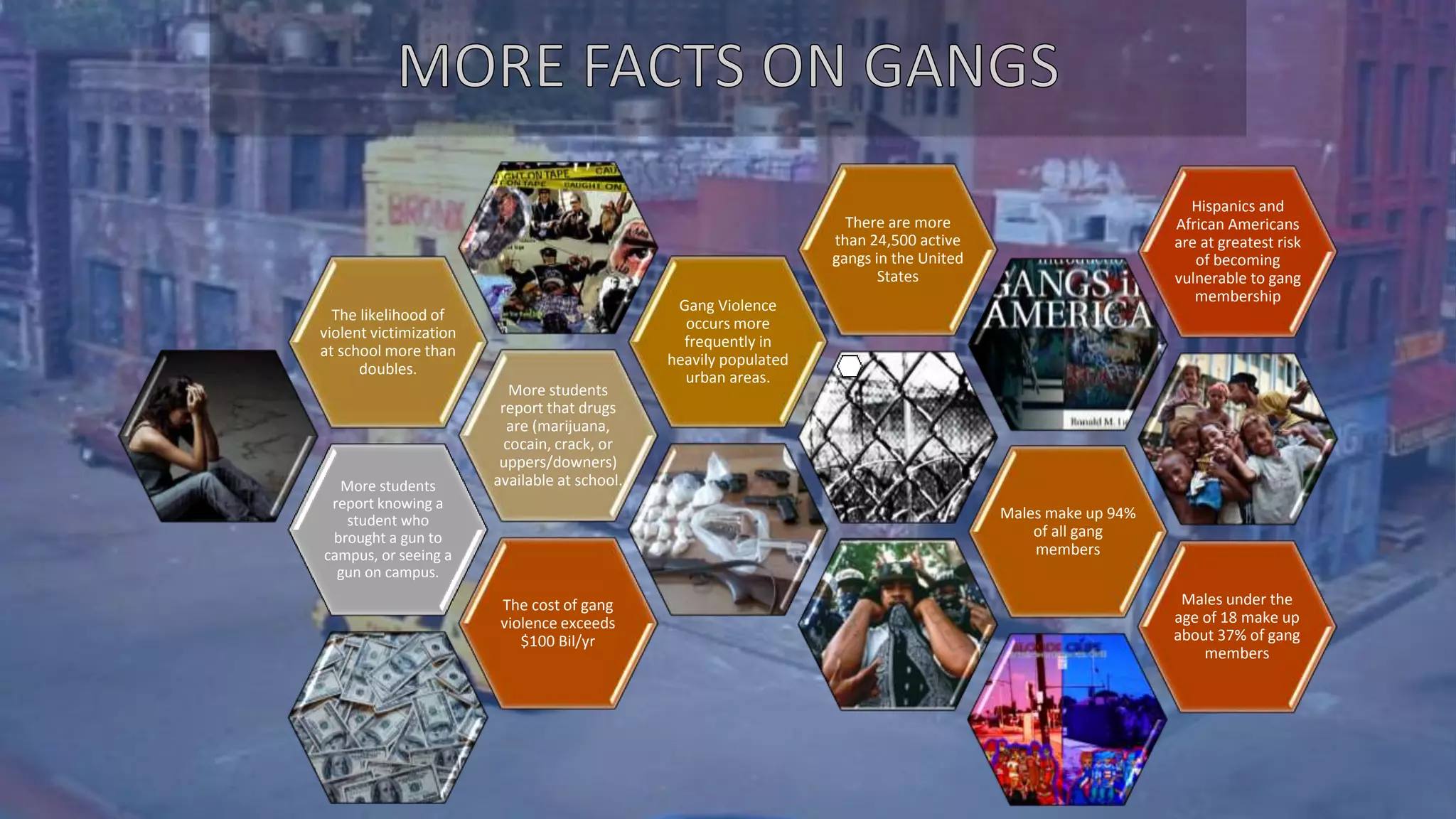
More students
report knowing a
student who
brought a gun to
campus, or seeing a
gun on campus.
More students
report that drugs
are (marijuana,
cocain, crack, or
uppers/downers)
available at school.
The likelihood of
violent victimization
at school more than
doubles.
Gang Violence
occurs more
frequently in
heavily populated
urban areas.
There are more
than 24,500 active
gangs in the United
States
Males make up 94%
of all gang
members
The cost of gang
violence exceeds
$100 Bil/yr
Males under the
age of 18 make up
about 37% of gang
members
Hispanics and
African Americans
are at greatest risk
of becoming
vulnerable to gang
membership
Experiencing a
sudden drop in
grades and a lack
of interest in
school.
Acquiring new
friends who are
“questionable”
character in the
eyes of the
parents.
Being secretive/
defensive about
activities with
friends.
Disengaging
from family.
Encountering
delinquency
issues with the
police.
Engaging in out
of control
behavior such as
ignoring curfews,
running away,
and defiant.
Flashing hand
signs (hand
gestures) to
friends or even
when alone.
Changing
manner or dress,
and adopting
gang-style
clothing, jewelry,
and/or tattoos.
Having gang
graffiti or
symbols on
personal
property
Changing a
nickname to
something more
acceptable to a
gang.
Having an
unexplained
increase in
personal
monetary
income.
Possessing drugs
or other
controlled
substances
Experiences
changes in
health that may
be due to
drug/alcohol
abuse.
Receiving
unexplained
threats/message
s from caller who
refuse to identify
themselves.
Refusing to
account for time
spent away from
how.
Individual
factors
•Problem behaviors in schools
•Impulsiveness
•Negative life events
•Abouse
•Victimization
Family
factors
•Divorce
•Family transition
•Disengaged parenting
•Inconsistant rules
•Poor parental supervision
School
factors
•Poor school performance
•Low school attachment
•Constant supervision/expulsions
•Being labled as slow learners
Community
factors
•Poverty
•Neighborhood disorganization
•Segregation
•High crime
•marginalization
• Early aggressive behaviors (2nd – 3rd graders)
• Stealing
• Lying
• Fighting
• Blaming others
Living in an area with a high level of gang activity, drug/alcohol use, available firearms.
Lack of a positive support system at home.
Violence against family members.
Exposure to tv shows, movies, and/or music that glorifies music.
Lack of alternative activities, such as community youth
programs.
Lack of positive role models.
Low self-esteem and/or a sense of hopelessness.
Poor decision making and communication skills.
Too much unsupervised free time.
Poor school achievement.
Problematic child-parent relationship.
Lack or respect for authority (parents, teachers, law enforcement officers)
Family members who are or were gang members.
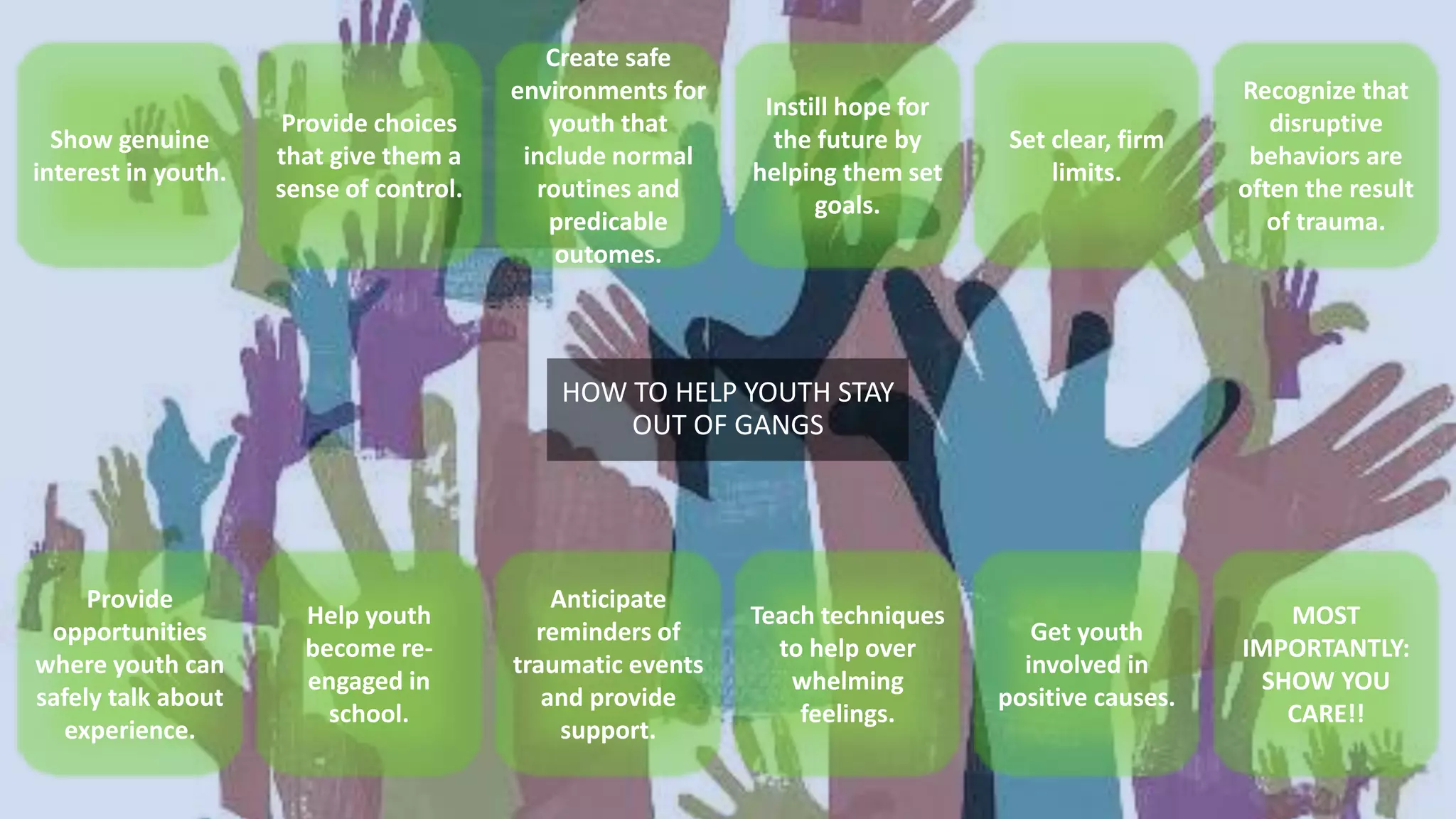
HOW TO HELP YOUTH STAY
OUT OF GANGS
Provide
opportunities
where youth can
safely talk about
experience.
Help youth
become re-
engaged in
school.
Anticipate
reminders of
traumatic events
and provide
support.
Teach techniques
to help over
whelming
feelings.
Get youth
involved in
positive causes.
MOST
IMPORTANTLY:
SHOW YOU
CARE!!
Recognize that
disruptive
behaviors are
often the result
of trauma.
Set clear, firm
limits.
Instill hope for
the future by
helping them set
goals.
Create safe
environments for
youth that
include normal
routines and
predicable
outomes.
Provide choices
that give them a
sense of control.
Show genuine
interest in youth.
GANG PREVENTION
PROGRAMS & RESOURCES
AN INTERVIEW WITH A FRIEND
I asked a really good friend of mine about his
experiences when he went to school in East Los
Angeles. This is the conversation that we had.
https://www.aacap.org/AACA
P/Families_and_Youth/Facts_
for_Families/FFF-
Guide/Children-and-Gangs-
098.aspx https://www.slideshare.net/d
slrogers/gangs-in-schools-
presentation
https://www.socialworkers.or
g/assets/secured/documents/
practice/ssw/Gangs%20in%20
Schools.pdf
http://www.pent.ca.gov/pos/
sd/gangs_HM.pdf
http://forhighschoolcounselor
s.blogspot.com/2015/01/gang
-college-for-high-school-
counselors.html
http://www.sampsonsheriff.c
om/otherforms/Gang%20Pres
entation.pdf
https://www.ericdigests.org/
1995-1/gangs.htm

Gangs

  • 2.
    There is nonationally accepted definition but most agree on the following elements: A group of three or more people. These people share a common identifying sign, symbol, or name. Gang members individually or collectively engage in an ongoing pattern of criminal or delinquent activity. They are often between 12 and 24 years old.
  • 3.
    Most gangs, thenbut not all, are involved in violence, drug sales, carrying guns, and other criminal acts. Gangs are more likely to be present in schools that are located within central cities with populations between 100,000 and 1 million, but juvenile gang problems affect communities of all sizes and in all regions of the United States. Gang member tend to be those for whom family and school environments have not worked. One half to two thirds of the youth join gangs are members for 1 year or less. The race or ethnicity of gang members is reflected by the composition of the community. •Gang members are white in primarily white communities and are African American in predominantly African American communities. Students who join gangs tend to be already delinquent, but dramatically increase their criminal activity during their gang membership. Frequent association with delinquent peers is one of the strongest pridictors (or risk factors) of gang membership. Los Angeles and Chicago have the highest rates of gang homicides in the nation. The schools that contain gangs are characterized by high levels of student victimization, numerous security measures, and large number or readily available drugs. The high level victimization in schools are not strongly reflected in the community, suggesting “that the school environment makes a unique contribution to the criminal victimization of adolescents.
  • 4.
    More students report knowinga student who brought a gun to campus, or seeing a gun on campus. More students report that drugs are (marijuana, cocain, crack, or uppers/downers) available at school. The likelihood of violent victimization at school more than doubles. Gang Violence occurs more frequently in heavily populated urban areas. There are more than 24,500 active gangs in the United States Males make up 94% of all gang members The cost of gang violence exceeds $100 Bil/yr Males under the age of 18 make up about 37% of gang members Hispanics and African Americans are at greatest risk of becoming vulnerable to gang membership
  • 5.
    Experiencing a sudden dropin grades and a lack of interest in school. Acquiring new friends who are “questionable” character in the eyes of the parents. Being secretive/ defensive about activities with friends. Disengaging from family. Encountering delinquency issues with the police. Engaging in out of control behavior such as ignoring curfews, running away, and defiant. Flashing hand signs (hand gestures) to friends or even when alone. Changing manner or dress, and adopting gang-style clothing, jewelry, and/or tattoos. Having gang graffiti or symbols on personal property Changing a nickname to something more acceptable to a gang. Having an unexplained increase in personal monetary income. Possessing drugs or other controlled substances Experiences changes in health that may be due to drug/alcohol abuse. Receiving unexplained threats/message s from caller who refuse to identify themselves. Refusing to account for time spent away from how.
  • 6.
    Individual factors •Problem behaviors inschools •Impulsiveness •Negative life events •Abouse •Victimization Family factors •Divorce •Family transition •Disengaged parenting •Inconsistant rules •Poor parental supervision School factors •Poor school performance •Low school attachment •Constant supervision/expulsions •Being labled as slow learners Community factors •Poverty •Neighborhood disorganization •Segregation •High crime •marginalization • Early aggressive behaviors (2nd – 3rd graders) • Stealing • Lying • Fighting • Blaming others
  • 7.
    Living in anarea with a high level of gang activity, drug/alcohol use, available firearms. Lack of a positive support system at home. Violence against family members. Exposure to tv shows, movies, and/or music that glorifies music. Lack of alternative activities, such as community youth programs. Lack of positive role models. Low self-esteem and/or a sense of hopelessness. Poor decision making and communication skills. Too much unsupervised free time. Poor school achievement. Problematic child-parent relationship. Lack or respect for authority (parents, teachers, law enforcement officers) Family members who are or were gang members.
  • 8.
    HOW TO HELPYOUTH STAY OUT OF GANGS Provide opportunities where youth can safely talk about experience. Help youth become re- engaged in school. Anticipate reminders of traumatic events and provide support. Teach techniques to help over whelming feelings. Get youth involved in positive causes. MOST IMPORTANTLY: SHOW YOU CARE!! Recognize that disruptive behaviors are often the result of trauma. Set clear, firm limits. Instill hope for the future by helping them set goals. Create safe environments for youth that include normal routines and predicable outomes. Provide choices that give them a sense of control. Show genuine interest in youth.
  • 10.
  • 11.
    AN INTERVIEW WITHA FRIEND I asked a really good friend of mine about his experiences when he went to school in East Los Angeles. This is the conversation that we had.
  • 13.