By
Ekam Emefiele
Med. Student
BIPOLAR DISORDER
 It is also known as manic-depressive disorder
 Bipolar disorder is a serious mental illness that is
characterized by extreme mood swings from mania to
depression.
 It affects about 0.6-0.9% of the general population,
and it occurs in males and females equally.
 It can result in damaged relationships, poor job or
school performance and even suicide. But it can be
treated and people with the illness can lead full and
productive lives
 People with BD are also at higher risk for thyroid
disease, migraine, heart diseases, diabetes, obesity
and other physical illnesses.
History
 Bipolar Disorder
•200 CE First reports
•1913 Emil Kraepelin
•Manic -Depressive
•1930’s ECT first used
•1949 Lithium first used
•1950 Chlorpromazine first used
•1952 Genetic link recognized
•1980 Bipolar Disorder term adopted
•1995 Depakote approved for BP
•2003 First atypical approved for BP
 Main Distinction: unipolar or bipolar
 Unipolar: only one end of the emotion spectrum
 Major Depressive Episode
 Manic Episode
 Dysthymia: mild, chronic form of depression
Epidemiology
 Peak age of onset is adolescence through early
20s.
• Onset of first manic episode after age 40 years is
a “red flag” to consider substance use or general
medical condition
 Lifetime suicide rates range from 10-15%
 Seasonal variation
• Depression is more common in fall, winter and
spring
• Mania is more common in summer
Causes
The exact cause of bipolar disorder is unknown.
Experts believe there are a number of factors that
work together to make a person more likely to
develop the condition.
 Chemical imbalance in the brain e.g.
noradrenaline, serotonin and dopamine
 Genetics: BD is frequently inherited, with genetic
factors accounting for about 80% of the cause of
this condition
 Environmental factors e.g. stress, seasonal
changes, substance abuse, sleep deprivation,
medications (like antidepressants) etc.
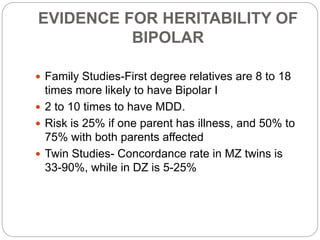
EVIDENCE FOR HERITABILITY OF
BIPOLAR
 Family Studies-First degree relatives are 8 to 18
times more likely to have Bipolar I
 2 to 10 times to have MDD.
 Risk is 25% if one parent has illness, and 50% to
75% with both parents affected
 Twin Studies- Concordance rate in MZ twins is
33-90%, while in DZ is 5-25%
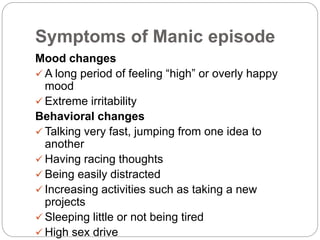
Symptoms of Manic episode
Mood changes
 A long period of feeling “high” or overly happy
mood
 Extreme irritability
Behavioral changes
 Talking very fast, jumping from one idea to
another
 Having racing thoughts
 Being easily distracted
 Increasing activities such as taking a new
projects
 Sleeping little or not being tired
 High sex drive
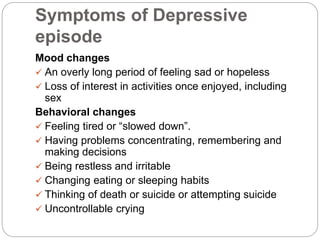
Symptoms of Depressive
episode
Mood changes
 An overly long period of feeling sad or hopeless
 Loss of interest in activities once enjoyed, including
sex
Behavioral changes
 Feeling tired or “slowed down”.
 Having problems concentrating, remembering and
making decisions
 Being restless and irritable
 Changing eating or sleeping habits
 Thinking of death or suicide or attempting suicide
 Uncontrollable crying
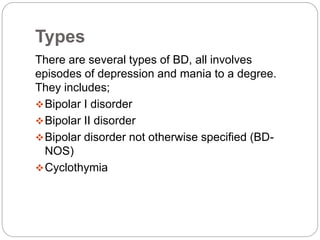
Types
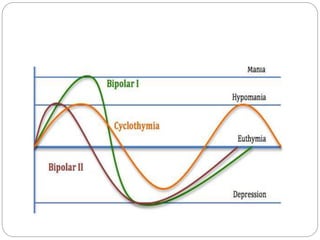
There are several types of BD, all involves
episodes of depression and mania to a degree.
They includes;
Bipolar I disorder
Bipolar II disorder
Bipolar disorder not otherwise specified (BD-
NOS)
Cyclothymia
Bipolar I disorder
This is defined by manic episode or mixed episode
that last at least 7 days or by mania symptoms that
are so severe that the person needs immediate
hospitalization.
Usually depressive episodes occurs as well,
typically lasting at least 2 weeks but not required for
diagnosis.
Bipolar II disorder
• It is considered to be the milder form of BD
• According to American Psychiatric Association (APA),
the diagnosis for Bipolar II disorder involves a
minimum of one hypomanic episode lasting at
least 4days and one or more episode of major
depression.
• They usually suffer lower grade of hypomania, if not
treated, it can lead to full mania
• The DSM lists school failure, occupational failure, and
divorce as social problems associated with Bipolar II
Disorder.
• Bipolar II symptoms tend to occur more frequently in
women than men. When it does occur in males, the
number of hypomanic episodes typically equals that
of depressive episodes whereas depression tends to
dominate in women.
Cyclothymic Disorder
 It is a milder form of BD
 It is characterized by episodes of hypomania as
well as mild depression for at least 2 years.
 However, the symptoms do not meet the diagnostic
requirements for any other type of BD
 Individuals with Cyclothymia do not remain symptom-
free for more than two months at a time
 Substance abuse may be associated with
Cyclothymia, as well as sleep disorders.
 The condition typically has a slow, gradual, and
progressive onset and a chronic course once
established.
 There is a 15-50% chance that cyclothymic
individuals will go on to develop bipolar I or II
disorders in later life.
Bipolar Disorder NOS
 It is a bipolar condition that does not neatly fit into the
symptomology of BD I, BD II or cyclothymia
 If you are diagnosed with this disorder, you are likely to be
re-evaluated for one of the other types of BD when you
have another episode
 Examples given by DSM to give diagnosis includes;
I. Having symptoms of mania and depression but the
episodes are too short to qualify as an actual episode
II. Having many episodes of hypomania, but not had a
depressive episode
III. Having a manic or mixed episode, but you were
previously diagnosed with a psychotic disorder or
schizophrenia
IV. Having symptoms of hypomania and depression, but
they don’t last long enough to qualify as cyclothymia
V. It looks like you have a BD, but your doctor thinks your
symptoms might be caused by drugs, alcohol or a
general medical condition
Rapid-cycling BD
 This is a severe form of BD
 It occurs when a person has 4 or more episodes
of major depression, mania, hypomania or mixed
states all within a year
 RC-BD seems to be more common in people who
had their first bipolar episode at a younger age
 It affects more women than men
• BD may also be present in a mixed state in
which you might experience both mania and
depression at the same time.
• During a mixed state, you might feel very
agitated, have trouble sleeping, experience major
changes in appetite and have suicidal thoughts
• People in the mixed state may feel very sad or
hopeless while at the same time feel energized.
 Sometimes a person with severe episodes of mania
and depression has psychotic symptoms too such as
hallucinations and delusions.
 The psychotic symptoms tends to reflect the person’s
extreme mood.
 For example;
a) If you are having psychotic symptoms during manic
episode, you may believe you are a famous person,
have a lot of money or have special powers
b) If you are having psychotic symptoms during
depression, you might believe you are ruined and
penniless or have committed a crime
• As a result, people with BD who are having psychotic
symptoms are sometimes misdiagnosed with
schizophrenia
Patients with bipolar II disorder are more frequently
misdiagnosed with unipolar disorder for the
following reasons;
 Often the patient feels remarkably well when
hypomanic and he/she is therefore unlikely to
spontaneously report these episodes and may
even deny them when directly questioned.
 Patients with hypomania do not present with
psychotic symptoms and they are not
hospitalized, so there may be no indication or
records of a previous hypomanic episode
BD and Substance Abuse
• Substance abuse is very common with people with BD, but
the reasons for this link is unclear.
• Some people with BD may try to treat their symptoms with
alcohol or drugs.
• However, substance abuse may trigger or prolong bipolar
symptoms and their behavioral control problems
associated with mania can result in a person drinking too
much.
• According to the most recent literature on substance abuse
and bipolar disorder, these two problems occur together so
frequently that all young people with a bipolar diagnosis
should also be assessed for drug and alcohol problems.
• Those who experience mixed states or rapid cycling have
the highest rate of danger from substance abuse — the
discomfort a person feels in these moods is so great that
he/she may be willing to do or take almost anything to
make it stop.
Management
Bipolar disorder cannot be cured, but it can be
treated effectively over the long-term. Proper
treatment helps many people with BD—even those
with the most severe forms of the illness—gain
better control of their mood swings and related
symptoms. But because it is a lifelong illness, long-
term, continuous treatment is needed to control
symptoms. However, even with proper treatment,
mood changes can occur
Treatment is more effective if you work closely with
a doctor and talk openly about your concerns and
choices. An effective maintenance treatment plan
usually includes a combination of medication and
Medications
 This is the key in stabilizing BD
 Initial treatment of mania consist of Lithium or Valproic
acid (Depacote)
 If the patient is psychotic, a neuroleptic medication
(antipsychotics) is also given
 Long-acting benzodiazepines may be used for
treating agitation. However, it should be used with
caution in patients with a history of substance abuse
because of the addictive potential of these agents.
 When the patient with BD becomes depressed, an
SSRI or bupropion is recommended. The use of
tricyclic antidepressants should be avoided because
of the possibilities of inducing rapid-cycling of the
symptoms.
Note that taking only an antidepressant can
increase your risk of switching to mania or
hypomania, or of developing rapid-cycling
symptoms. To prevent this switch, it is usually
required that the patient takes a mood-stabilizing
medication at the same time as an antidepressant.
Psychotherapy
When done in combination with medication,
psychotherapy can be an effective treatment for BD. It
can provide support, education, and guidance to people
with BD and their families. Some psychotherapy
treatments used to treat BD include:
 Cognitive behavioral therapy (CBT), which helps
people with BD learn to change harmful or negative
thought patterns and behaviors.
 Family-focused therapy, which involves family
members. It helps enhance family coping strategies,
such as recognizing new episodes early and helping
their loved one. This therapy also improves
communication among family members, as well as
problem-solving.
 Interpersonal and social rhythm therapy, which
helps people with BD improve their relationships
with others and manage their daily routines.
Regular daily routines and sleep schedules may
help protect against manic episodes.
 Psychoeducation, which teaches people with
BD about the illness and its treatment.
Psychoeducation can help you recognize signs of
an impending mood swing so you can seek
treatment early, before a full-blown episode
occurs. Usually done in a group, psychoeducation
may also be helpful for family members and
caregivers.
Electroconvulsive Therapy
(ECT)
• For cases in which medication and psychotherapy do not work,
electroconvulsive therapy (ECT) may be useful. ECT, formerly known as
"shock therapy," once had a bad reputation. But in recent years, it has
greatly improved and can provide relief for people with severe bipolar
disorder who have not been able to recover with other treatments.
• Before ECT is administered, a patient takes a muscle relaxant and is put
under brief anesthesia. He or she does not consciously feel the
electrical impulse administered in ECT. On average, ECT treatments
last from 30–90 seconds. People who have ECT usually recover after
5–15 minutes and are able to go home the same day.
• Sometimes ECT is used for bipolar symptoms when other medical
conditions, including pregnancy, make the use of medications too risky.
ECT is a highly effective treatment for severely depressive, manic, or
mixed episodes. But it is generally not used as a first-line treatment.
• ECT may cause some short-term side effects, including confusion,
disorientation, and memory loss. People with bipolar disorder should
discuss possible benefits and risks of ECT with an experienced doctor.
Thank you!

Bipolar disorder

  • 1.
  • 2.
     It isalso known as manic-depressive disorder  Bipolar disorder is a serious mental illness that is characterized by extreme mood swings from mania to depression.  It affects about 0.6-0.9% of the general population, and it occurs in males and females equally.  It can result in damaged relationships, poor job or school performance and even suicide. But it can be treated and people with the illness can lead full and productive lives  People with BD are also at higher risk for thyroid disease, migraine, heart diseases, diabetes, obesity and other physical illnesses.
  • 3.
    History  Bipolar Disorder •200CE First reports •1913 Emil Kraepelin •Manic -Depressive •1930’s ECT first used •1949 Lithium first used •1950 Chlorpromazine first used •1952 Genetic link recognized •1980 Bipolar Disorder term adopted •1995 Depakote approved for BP •2003 First atypical approved for BP
  • 4.
     Main Distinction:unipolar or bipolar  Unipolar: only one end of the emotion spectrum  Major Depressive Episode  Manic Episode  Dysthymia: mild, chronic form of depression
  • 5.
    Epidemiology  Peak ageof onset is adolescence through early 20s. • Onset of first manic episode after age 40 years is a “red flag” to consider substance use or general medical condition  Lifetime suicide rates range from 10-15%  Seasonal variation • Depression is more common in fall, winter and spring • Mania is more common in summer
  • 6.
    Causes The exact causeof bipolar disorder is unknown. Experts believe there are a number of factors that work together to make a person more likely to develop the condition.  Chemical imbalance in the brain e.g. noradrenaline, serotonin and dopamine  Genetics: BD is frequently inherited, with genetic factors accounting for about 80% of the cause of this condition  Environmental factors e.g. stress, seasonal changes, substance abuse, sleep deprivation, medications (like antidepressants) etc.
  • 7.
    EVIDENCE FOR HERITABILITYOF BIPOLAR  Family Studies-First degree relatives are 8 to 18 times more likely to have Bipolar I  2 to 10 times to have MDD.  Risk is 25% if one parent has illness, and 50% to 75% with both parents affected  Twin Studies- Concordance rate in MZ twins is 33-90%, while in DZ is 5-25%
  • 8.
    Symptoms of Manicepisode Mood changes  A long period of feeling “high” or overly happy mood  Extreme irritability Behavioral changes  Talking very fast, jumping from one idea to another  Having racing thoughts  Being easily distracted  Increasing activities such as taking a new projects  Sleeping little or not being tired  High sex drive
  • 9.
    Symptoms of Depressive episode Moodchanges  An overly long period of feeling sad or hopeless  Loss of interest in activities once enjoyed, including sex Behavioral changes  Feeling tired or “slowed down”.  Having problems concentrating, remembering and making decisions  Being restless and irritable  Changing eating or sleeping habits  Thinking of death or suicide or attempting suicide  Uncontrollable crying
  • 10.
    Types There are severaltypes of BD, all involves episodes of depression and mania to a degree. They includes; Bipolar I disorder Bipolar II disorder Bipolar disorder not otherwise specified (BD- NOS) Cyclothymia
  • 11.
    Bipolar I disorder Thisis defined by manic episode or mixed episode that last at least 7 days or by mania symptoms that are so severe that the person needs immediate hospitalization. Usually depressive episodes occurs as well, typically lasting at least 2 weeks but not required for diagnosis.
  • 12.
    Bipolar II disorder •It is considered to be the milder form of BD • According to American Psychiatric Association (APA), the diagnosis for Bipolar II disorder involves a minimum of one hypomanic episode lasting at least 4days and one or more episode of major depression. • They usually suffer lower grade of hypomania, if not treated, it can lead to full mania • The DSM lists school failure, occupational failure, and divorce as social problems associated with Bipolar II Disorder. • Bipolar II symptoms tend to occur more frequently in women than men. When it does occur in males, the number of hypomanic episodes typically equals that of depressive episodes whereas depression tends to dominate in women.
  • 13.
    Cyclothymic Disorder  Itis a milder form of BD  It is characterized by episodes of hypomania as well as mild depression for at least 2 years.  However, the symptoms do not meet the diagnostic requirements for any other type of BD  Individuals with Cyclothymia do not remain symptom- free for more than two months at a time  Substance abuse may be associated with Cyclothymia, as well as sleep disorders.  The condition typically has a slow, gradual, and progressive onset and a chronic course once established.  There is a 15-50% chance that cyclothymic individuals will go on to develop bipolar I or II disorders in later life.
  • 14.
    Bipolar Disorder NOS It is a bipolar condition that does not neatly fit into the symptomology of BD I, BD II or cyclothymia  If you are diagnosed with this disorder, you are likely to be re-evaluated for one of the other types of BD when you have another episode  Examples given by DSM to give diagnosis includes; I. Having symptoms of mania and depression but the episodes are too short to qualify as an actual episode II. Having many episodes of hypomania, but not had a depressive episode III. Having a manic or mixed episode, but you were previously diagnosed with a psychotic disorder or schizophrenia IV. Having symptoms of hypomania and depression, but they don’t last long enough to qualify as cyclothymia V. It looks like you have a BD, but your doctor thinks your symptoms might be caused by drugs, alcohol or a general medical condition
  • 16.
    Rapid-cycling BD  Thisis a severe form of BD  It occurs when a person has 4 or more episodes of major depression, mania, hypomania or mixed states all within a year  RC-BD seems to be more common in people who had their first bipolar episode at a younger age  It affects more women than men
  • 17.
    • BD mayalso be present in a mixed state in which you might experience both mania and depression at the same time. • During a mixed state, you might feel very agitated, have trouble sleeping, experience major changes in appetite and have suicidal thoughts • People in the mixed state may feel very sad or hopeless while at the same time feel energized.
  • 18.
     Sometimes aperson with severe episodes of mania and depression has psychotic symptoms too such as hallucinations and delusions.  The psychotic symptoms tends to reflect the person’s extreme mood.  For example; a) If you are having psychotic symptoms during manic episode, you may believe you are a famous person, have a lot of money or have special powers b) If you are having psychotic symptoms during depression, you might believe you are ruined and penniless or have committed a crime • As a result, people with BD who are having psychotic symptoms are sometimes misdiagnosed with schizophrenia
  • 19.
    Patients with bipolarII disorder are more frequently misdiagnosed with unipolar disorder for the following reasons;  Often the patient feels remarkably well when hypomanic and he/she is therefore unlikely to spontaneously report these episodes and may even deny them when directly questioned.  Patients with hypomania do not present with psychotic symptoms and they are not hospitalized, so there may be no indication or records of a previous hypomanic episode
  • 20.
    BD and SubstanceAbuse • Substance abuse is very common with people with BD, but the reasons for this link is unclear. • Some people with BD may try to treat their symptoms with alcohol or drugs. • However, substance abuse may trigger or prolong bipolar symptoms and their behavioral control problems associated with mania can result in a person drinking too much. • According to the most recent literature on substance abuse and bipolar disorder, these two problems occur together so frequently that all young people with a bipolar diagnosis should also be assessed for drug and alcohol problems. • Those who experience mixed states or rapid cycling have the highest rate of danger from substance abuse — the discomfort a person feels in these moods is so great that he/she may be willing to do or take almost anything to make it stop.
  • 21.
  • 22.
    Bipolar disorder cannotbe cured, but it can be treated effectively over the long-term. Proper treatment helps many people with BD—even those with the most severe forms of the illness—gain better control of their mood swings and related symptoms. But because it is a lifelong illness, long- term, continuous treatment is needed to control symptoms. However, even with proper treatment, mood changes can occur Treatment is more effective if you work closely with a doctor and talk openly about your concerns and choices. An effective maintenance treatment plan usually includes a combination of medication and
  • 23.
    Medications  This isthe key in stabilizing BD  Initial treatment of mania consist of Lithium or Valproic acid (Depacote)  If the patient is psychotic, a neuroleptic medication (antipsychotics) is also given  Long-acting benzodiazepines may be used for treating agitation. However, it should be used with caution in patients with a history of substance abuse because of the addictive potential of these agents.  When the patient with BD becomes depressed, an SSRI or bupropion is recommended. The use of tricyclic antidepressants should be avoided because of the possibilities of inducing rapid-cycling of the symptoms.
  • 24.
    Note that takingonly an antidepressant can increase your risk of switching to mania or hypomania, or of developing rapid-cycling symptoms. To prevent this switch, it is usually required that the patient takes a mood-stabilizing medication at the same time as an antidepressant.
  • 25.
    Psychotherapy When done incombination with medication, psychotherapy can be an effective treatment for BD. It can provide support, education, and guidance to people with BD and their families. Some psychotherapy treatments used to treat BD include:  Cognitive behavioral therapy (CBT), which helps people with BD learn to change harmful or negative thought patterns and behaviors.  Family-focused therapy, which involves family members. It helps enhance family coping strategies, such as recognizing new episodes early and helping their loved one. This therapy also improves communication among family members, as well as problem-solving.
  • 26.
     Interpersonal andsocial rhythm therapy, which helps people with BD improve their relationships with others and manage their daily routines. Regular daily routines and sleep schedules may help protect against manic episodes.  Psychoeducation, which teaches people with BD about the illness and its treatment. Psychoeducation can help you recognize signs of an impending mood swing so you can seek treatment early, before a full-blown episode occurs. Usually done in a group, psychoeducation may also be helpful for family members and caregivers.
  • 27.
    Electroconvulsive Therapy (ECT) • Forcases in which medication and psychotherapy do not work, electroconvulsive therapy (ECT) may be useful. ECT, formerly known as "shock therapy," once had a bad reputation. But in recent years, it has greatly improved and can provide relief for people with severe bipolar disorder who have not been able to recover with other treatments. • Before ECT is administered, a patient takes a muscle relaxant and is put under brief anesthesia. He or she does not consciously feel the electrical impulse administered in ECT. On average, ECT treatments last from 30–90 seconds. People who have ECT usually recover after 5–15 minutes and are able to go home the same day. • Sometimes ECT is used for bipolar symptoms when other medical conditions, including pregnancy, make the use of medications too risky. ECT is a highly effective treatment for severely depressive, manic, or mixed episodes. But it is generally not used as a first-line treatment. • ECT may cause some short-term side effects, including confusion, disorientation, and memory loss. People with bipolar disorder should discuss possible benefits and risks of ECT with an experienced doctor.
  • 28.