C
BULLYING
BY
TRISHA JORSTAD
Description
Aggressive behavior among school aged children that involves a real or perceived power
imbalance.
Types of bullying
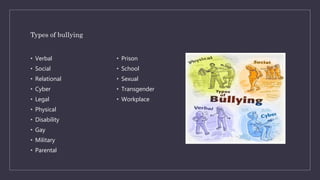
• Verbal
• Social
• Relational
• Cyber
• Legal
• Physical
• Disability
• Gay
• Military
• Parental
• Prison
• School
• Sexual
• Transgender
• Workplace
Bullying Statistics
• More than one out of every 5 (20.8%) students report being bullied
• The federal government began collecting data on school bullying in 2005, when the prevalence
of bullying was around 28%
• Rates of bullying vary across studies form 9%-98%. A met analysis of 80 studies analyzing
bullying involvement rates for 12-18 year olds reported a mean prevalence rate of 35% for
traditional bullying involvement and 15% for cyber bullying involvement
• 64% of children who were bullied did not report it; only 36% reported bullying
• School based bullying prevention programs decrease bullying by up 25%
• Reasons for bullying was most by students were looks (55%), body shape (37%), and race (16%)
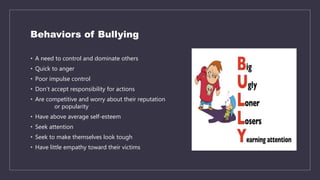
Behaviors of Bullying
• A need to control and dominate others
• Quick to anger
• Poor impulse control
• Don’t accept responsibility for actions
• Are competitive and worry about their reputation
or popularity
• Have above average self-esteem
• Seek attention
• Seek to make themselves look tough
• Have little empathy toward their victims
Strategies to deal with bullying
• Talk to the children about bullying an dhow wrong it is
• Set policies and rules
• Build a safe environment
• Keep lines of communication open
• Educate students and staff
https://en.Wikipedia.org
www.stopbullying.gov
More about bullying
Bullying can occur during or after school hours. While most reported bullying happens in
the school building, on the play ground, on the bus, traveling to or from school, in neighborhoods
or on internet.
Effects of bullying
• Suicide estimated between 15 and 25 children commit suicide
• Violence bullied children can lead up to violent adults
• Positive development can teach life lessons and instill strength
Certain types of bullying
Verbal bullying – saying or writing mean things.
Verbal bullying includes: teasing, name calling, inappropriate sexual comments, taunting,
and threatening to cause harm.
Social bullying – sometimes referred to as relational bullying, involves hurting someone's
reputation or relationships.
Social bullying includes: leaving someone out on purpose, telling other children not to
be friends with someone, spreading rumors about someone, and embarrassing someone in
public.
Physical bullying – involves hurting a person’s body or possessions.
Physical bullying includes: hitting/kicking/pinching, spitting, tripping/pushing, taking or
breaking someone’s things, and making mean or rude hand gestures.
Continue from previous page
Relational bullying includes: common amongst youth but particularly upon girls, can be used as a
tool by bullies to both improve their social standing and control others, and not overt and can
continue for long time without being noticed.
Cyber bullying includes: use of technology to harass, threaten, embarrass, or target another
person, can be done through email, instant messaging, social networking sites, text messages and
cell phones.

Bullying

  • 1.
  • 2.
    Description Aggressive behavior amongschool aged children that involves a real or perceived power imbalance.
  • 3.
    Types of bullying •Verbal • Social • Relational • Cyber • Legal • Physical • Disability • Gay • Military • Parental • Prison • School • Sexual • Transgender • Workplace
  • 4.
    Bullying Statistics • Morethan one out of every 5 (20.8%) students report being bullied • The federal government began collecting data on school bullying in 2005, when the prevalence of bullying was around 28% • Rates of bullying vary across studies form 9%-98%. A met analysis of 80 studies analyzing bullying involvement rates for 12-18 year olds reported a mean prevalence rate of 35% for traditional bullying involvement and 15% for cyber bullying involvement • 64% of children who were bullied did not report it; only 36% reported bullying • School based bullying prevention programs decrease bullying by up 25% • Reasons for bullying was most by students were looks (55%), body shape (37%), and race (16%)
  • 5.
    Behaviors of Bullying •A need to control and dominate others • Quick to anger • Poor impulse control • Don’t accept responsibility for actions • Are competitive and worry about their reputation or popularity • Have above average self-esteem • Seek attention • Seek to make themselves look tough • Have little empathy toward their victims
  • 6.
    Strategies to dealwith bullying • Talk to the children about bullying an dhow wrong it is • Set policies and rules • Build a safe environment • Keep lines of communication open • Educate students and staff https://en.Wikipedia.org www.stopbullying.gov
  • 7.
    More about bullying Bullyingcan occur during or after school hours. While most reported bullying happens in the school building, on the play ground, on the bus, traveling to or from school, in neighborhoods or on internet. Effects of bullying • Suicide estimated between 15 and 25 children commit suicide • Violence bullied children can lead up to violent adults • Positive development can teach life lessons and instill strength
  • 8.
    Certain types ofbullying Verbal bullying – saying or writing mean things. Verbal bullying includes: teasing, name calling, inappropriate sexual comments, taunting, and threatening to cause harm. Social bullying – sometimes referred to as relational bullying, involves hurting someone's reputation or relationships. Social bullying includes: leaving someone out on purpose, telling other children not to be friends with someone, spreading rumors about someone, and embarrassing someone in public. Physical bullying – involves hurting a person’s body or possessions. Physical bullying includes: hitting/kicking/pinching, spitting, tripping/pushing, taking or breaking someone’s things, and making mean or rude hand gestures.
  • 9.
    Continue from previouspage Relational bullying includes: common amongst youth but particularly upon girls, can be used as a tool by bullies to both improve their social standing and control others, and not overt and can continue for long time without being noticed. Cyber bullying includes: use of technology to harass, threaten, embarrass, or target another person, can be done through email, instant messaging, social networking sites, text messages and cell phones.