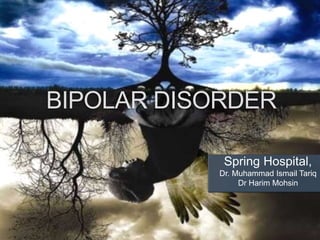


BIPOLAR DISORDER
Spring Hospital,
Dr. Muhammad Ismail Tariq
Dr Harim Mohsin
Bipolar disorder awareness
• Objectives:
• Increase awareness of bipolar disorder (including both
mania and depression)
• Promote early detection and accurate diagnosis
• Reduce Stigma
• Minimize the Impact on those who live with this medical
illness.
Bipolar Disorder-
Major Public Health Issue
• Costs of treatment for an individual exceed $17,000 per
year.
• 1 in 3 people with bipolar disorder fail to comply with
medications.
• Non-adherence to treatment often results in
hospitalization and suicide
Prevalence Rates and Course
• Bipolar I
• Lifetime: .4-1.6%
• = in men and women
• Men>manic episodes
• Women>dep episodes
• Women>rapid cycling
• Ave. age onset = 20
• Recurrent
• 60-70% of manic episodes occur before or after a
depressive episode
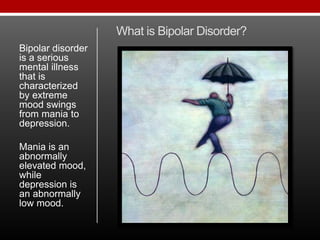
What is Bipolar Disorder?
Bipolar disorder
is a serious
mental illness
that is
characterized
by extreme
mood swings
from mania to
depression.
Mania is an
abnormally
elevated mood,
while
depression is
an abnormally
low mood.
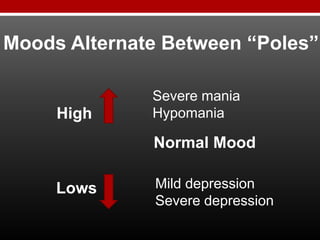
Severe mania
Hypomania
Mild depression
Severe depression
Moods Alternate Between “Poles”
High
Lows
Normal Mood
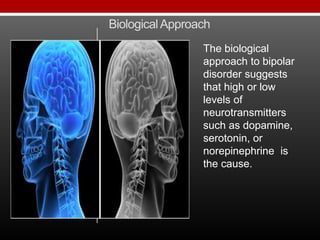
BiologicalApproach
The biological
approach to bipolar
disorder suggests
that high or low
levels of
neurotransmitters
such as dopamine,
serotonin, or
norepinephrine is
the cause.
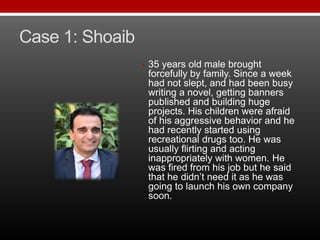
Case 1: Shoaib
• 35 years old male brought
forcefully by family. Since a week
had not slept, and had been busy
writing a novel, getting banners
published and building huge
projects. His children were afraid
of his aggressive behavior and he
had recently started using
recreational drugs too. He was
usually flirting and acting
inappropriately with women. He
was fired from his job but he said
that he didn’t need it as he was
going to launch his own company
soon.
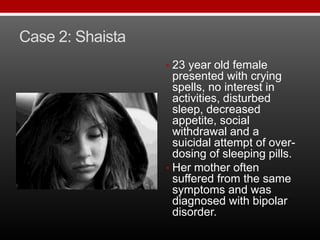
Case 2: Shaista
• 23 year old female
presented with crying
spells, no interest in
activities, disturbed
sleep, decreased
appetite, social
withdrawal and a
suicidal attempt of over-
dosing of sleeping pills.
• Her mother often
suffered from the same
symptoms and was
diagnosed with bipolar
disorder.
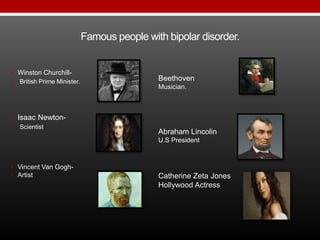
Famous people with bipolar disorder.
Beethoven
Musician.
Abraham Lincolin
U.S President
Catherine Zeta Jones
Hollywood Actress
• Winston Churchill-
• British Prime Minister.
• Isaac Newton-
• Scientist
• Vincent Van Gogh-
• Artist
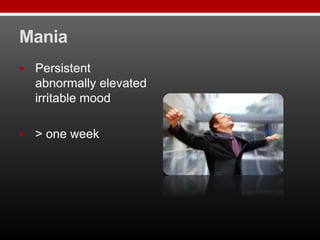
Mania
 Persistent
abnormally elevated
irritable mood
 > one week
Symptoms of Mania
 Inflated self-esteem/grandiosity
 Decreased need for sleep
 Racing thoughts or "flight of ideas"
 Spending sprees
 Increased physical/mental energy
 Irritability/aggressive behavior
 Impulsive/risk taking
 Increased sexual drive
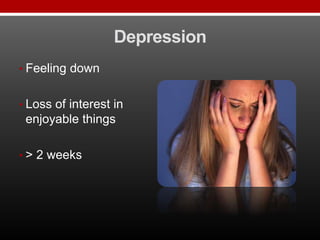
Depression
• Feeling down
• Loss of interest in
enjoyable things
• > 2 weeks
Symptoms of Depression (Cont.)
 Weight loss/gain
 Insomnia/hypersomnia
 Psychomotor agitation/slow down
 Fatigue/loss of energy
 Decreased ability to concentrate/make decisions
 Recurrent thoughts of death/suicide
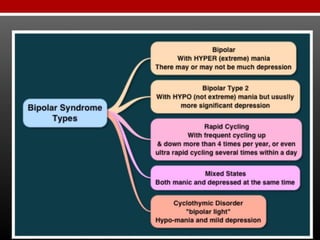
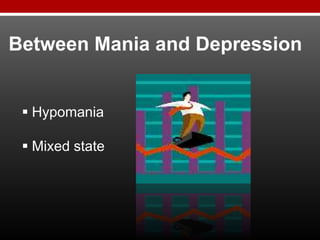
 Hypomania
 Mixed state
Between Mania and Depression
What is it Like to be Bipolar?
Etiological Factors
• Hereditary Factors
• Biochemical Hypothesis
• Stressful Life Events
• Family environment HEE
• Cognitive Styles as Vulnerabilities
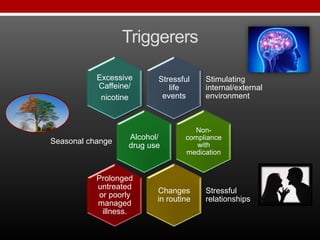
Triggerers
Stressful
life
events
Stimulating
internal/external
environment
Excessive
Caffeine/
nicotine
Alcohol/
drug use
Seasonal change
Non-
compliance
with
medication
Changes
in routine
Stressful
relationships
Prolonged
untreated
or poorly
managed
illness.
B.D. comorbidities & Differential Diagnosis
• Bipolar vs. unipolar
• ADHD
• Schizophrenia
• Substance abuse
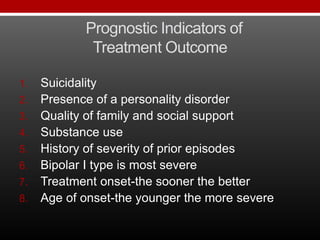
Prognostic Indicators of
Treatment Outcome
1. Suicidality
2. Presence of a personality disorder
3. Quality of family and social support
4. Substance use
5. History of severity of prior episodes
6. Bipolar I type is most severe
7. Treatment onset-the sooner the better
8. Age of onset-the younger the more severe
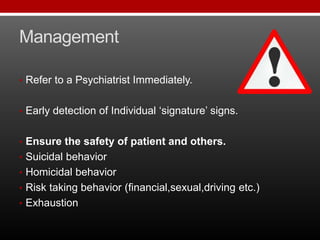
Management
• Refer to a Psychiatrist Immediately.
• Early detection of Individual ‘signature’ signs.
• Ensure the safety of patient and others.
• Suicidal behavior
• Homicidal behavior
• Risk taking behavior (financial,sexual,driving etc.)
• Exhaustion
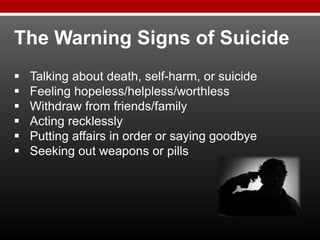
The Warning Signs of Suicide
 Talking about death, self-harm, or suicide
 Feeling hopeless/helpless/worthless
 Withdraw from friends/family
 Acting recklessly
 Putting affairs in order or saying goodbye
 Seeking out weapons or pills
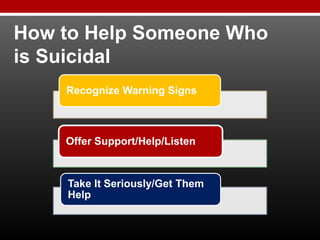
Recognize Warning Signs
Offer Support/Help/Listen
Take It Seriously/Get Them
Help
How to Help Someone Who
is Suicidal
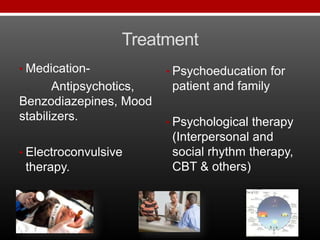
Treatment
• Medication-
Antipsychotics,
Benzodiazepines, Mood
stabilizers.
• Electroconvulsive
therapy.
• Psychoeducation for
patient and family
• Psychological therapy
(Interpersonal and
social rhythm therapy,
CBT & others)
Monitoring and prevention
• Continually monitor psychiatric status
• Identify individual’s triggerers
• Identify early warnings and seek help
• Prevent relapse and encourage adherence to treatment.
Help for care givers
• Medication-refer to
psychiatrist
• Take care of own health-
seek professional help for
own psychiatric issues
(e.g depression).
• Family, couples therapy,
Group therapy
• Join a Support group.
Self-Help For Bipolar Disorder
 Monitor your moods
 Make healthy choices
 Seek support
 Keep stress in check
 Get educated
Bipolar disorder

Bipolar disorder

  • 1.
    BIPOLAR DISORDER Spring Hospital, Dr.Muhammad Ismail Tariq Dr Harim Mohsin
  • 2.
    Bipolar disorder awareness •Objectives: • Increase awareness of bipolar disorder (including both mania and depression) • Promote early detection and accurate diagnosis • Reduce Stigma • Minimize the Impact on those who live with this medical illness.
  • 3.
    Bipolar Disorder- Major PublicHealth Issue • Costs of treatment for an individual exceed $17,000 per year. • 1 in 3 people with bipolar disorder fail to comply with medications. • Non-adherence to treatment often results in hospitalization and suicide
  • 4.
    Prevalence Rates andCourse • Bipolar I • Lifetime: .4-1.6% • = in men and women • Men>manic episodes • Women>dep episodes • Women>rapid cycling • Ave. age onset = 20 • Recurrent • 60-70% of manic episodes occur before or after a depressive episode
  • 5.
    What is BipolarDisorder? Bipolar disorder is a serious mental illness that is characterized by extreme mood swings from mania to depression. Mania is an abnormally elevated mood, while depression is an abnormally low mood.
  • 6.
    Severe mania Hypomania Mild depression Severedepression Moods Alternate Between “Poles” High Lows Normal Mood
  • 7.
    BiologicalApproach The biological approach tobipolar disorder suggests that high or low levels of neurotransmitters such as dopamine, serotonin, or norepinephrine is the cause.
  • 9.
    Case 1: Shoaib •35 years old male brought forcefully by family. Since a week had not slept, and had been busy writing a novel, getting banners published and building huge projects. His children were afraid of his aggressive behavior and he had recently started using recreational drugs too. He was usually flirting and acting inappropriately with women. He was fired from his job but he said that he didn’t need it as he was going to launch his own company soon.
  • 10.
    Case 2: Shaista •23 year old female presented with crying spells, no interest in activities, disturbed sleep, decreased appetite, social withdrawal and a suicidal attempt of over- dosing of sleeping pills. • Her mother often suffered from the same symptoms and was diagnosed with bipolar disorder.
  • 11.
    Famous people withbipolar disorder. Beethoven Musician. Abraham Lincolin U.S President Catherine Zeta Jones Hollywood Actress • Winston Churchill- • British Prime Minister. • Isaac Newton- • Scientist • Vincent Van Gogh- • Artist
  • 12.
  • 13.
    Symptoms of Mania Inflated self-esteem/grandiosity  Decreased need for sleep  Racing thoughts or "flight of ideas"  Spending sprees  Increased physical/mental energy  Irritability/aggressive behavior  Impulsive/risk taking  Increased sexual drive
  • 14.
    Depression • Feeling down •Loss of interest in enjoyable things • > 2 weeks
  • 15.
    Symptoms of Depression(Cont.)  Weight loss/gain  Insomnia/hypersomnia  Psychomotor agitation/slow down  Fatigue/loss of energy  Decreased ability to concentrate/make decisions  Recurrent thoughts of death/suicide
  • 16.
     Hypomania  Mixedstate Between Mania and Depression
  • 17.
    What is itLike to be Bipolar?
  • 18.
    Etiological Factors • HereditaryFactors • Biochemical Hypothesis • Stressful Life Events • Family environment HEE • Cognitive Styles as Vulnerabilities
  • 19.
  • 20.
    B.D. comorbidities &Differential Diagnosis • Bipolar vs. unipolar • ADHD • Schizophrenia • Substance abuse
  • 21.
    Prognostic Indicators of TreatmentOutcome 1. Suicidality 2. Presence of a personality disorder 3. Quality of family and social support 4. Substance use 5. History of severity of prior episodes 6. Bipolar I type is most severe 7. Treatment onset-the sooner the better 8. Age of onset-the younger the more severe
  • 22.
    Management • Refer toa Psychiatrist Immediately. • Early detection of Individual ‘signature’ signs. • Ensure the safety of patient and others. • Suicidal behavior • Homicidal behavior • Risk taking behavior (financial,sexual,driving etc.) • Exhaustion
  • 23.
    The Warning Signsof Suicide  Talking about death, self-harm, or suicide  Feeling hopeless/helpless/worthless  Withdraw from friends/family  Acting recklessly  Putting affairs in order or saying goodbye  Seeking out weapons or pills
  • 24.
    Recognize Warning Signs OfferSupport/Help/Listen Take It Seriously/Get Them Help How to Help Someone Who is Suicidal
  • 25.
    Treatment • Medication- Antipsychotics, Benzodiazepines, Mood stabilizers. •Electroconvulsive therapy. • Psychoeducation for patient and family • Psychological therapy (Interpersonal and social rhythm therapy, CBT & others)
  • 26.
    Monitoring and prevention •Continually monitor psychiatric status • Identify individual’s triggerers • Identify early warnings and seek help • Prevent relapse and encourage adherence to treatment.
  • 27.
    Help for caregivers • Medication-refer to psychiatrist • Take care of own health- seek professional help for own psychiatric issues (e.g depression). • Family, couples therapy, Group therapy • Join a Support group.
  • 28.
    Self-Help For BipolarDisorder  Monitor your moods  Make healthy choices  Seek support  Keep stress in check  Get educated

Editor's Notes

  • #7 Lets talk about how the moods alternate. Along a continuum there is a high end, middle, and low end that reflects a person with bipolar disorder and their mood. There are two opposite polls at each end reflecting very different moods, this is why it is called “bipolar disorder.” A person with this disorder can swing from one end to the other. Mania is at the extreme of one poll, with severe depression at the other poll, with normal mood being in the middle.
  • #13 Mania is defined as an episode that lasts more than a week and consists of an abnormally high mood. Sometimes these are the people who are the loudest in a crowd, the most daring, and confident people. At first they can appear happy, energetic, and animated but they continue with this behavior longer than what is considered the norm. This level of high energy physically and mentally takes a toll on their body depleting them of energy when they eventually come crashing down.
  • #14 Mania can be displayed in a variety of symptoms. A manic person will not necessarily have all of these symptoms but most likely a few in a variety of combinations. They can feel they are unstoppable, take risks they usually would not take while finding it difficult to sleep due to racing thoughts. Many times they find it is difficult to relax in one place due to the increased physical and mental energy. They can become overly aggressive or irritable and feel a increase in their sexual drive. Due to their impulsiveness some people feel the need to go on spending sprees buying things they want in the moment. These symptoms can lead to dangerous acts and intervention from family and friends is needed to keep the person safe and get them help. People are less likely to seek treatment when they are in the manic phase because they usually do not realize that anything is wrong and most describe it as a good feeling (NAMI, 2011).
  • #15 Depression is the other end of the pole. Major depression is defined as a serious medical illness that affects 15 million American adults in a year (NAMI, 2011). It is more then the “blues” lasting much longer affecting the daily life of those experiencing it. People with depression lose interest in things they once loved to do and isolate themselves from others.
  • #16 Like mania there are many symptoms of depression and one does not have to exhibit all of them to be diagnosed as depressed. They may eat too much or not feel like eating at all. Some people have difficulty sleeping and others sleep hours and hours through the night and day rarely leaving their beds. They may feel emotionally and physical tired, sometimes unable to get out of bed at all. Decision making is affected because they cannot concentrate well. Feelings of worthlessness and being a burden to others can bring thought of death and suicide. It is in this mood that people with bipolar disorder are more likely to seek help (NAMI, 2011).
  • #17 Hypomania is a shorter duration of manic symptoms that are less severe lasting at least four days as is considered a mild functional impairment (Stovall, 2012). People may experience this if they are usually more on the “low” or depressed side and do not have elated manic symptoms. A mixed state is often referred to as rapid cycling because a person they have both depressive and mania simultaneously. Depressed people are more likely to seek treatment and lays the groundwork for diagnosing bipolar disorder.
  • #18 People with bipolar disorder are not seeking sympathy, but empathy. In order to understand what it can be like here is a short video than can help explain it. Play video. Now what do you think? What are your thoughts and feelings? What are some ways you could help a friend or loved one with bipolar disorder?
  • #25 Depression can lead to suicide. Steps should be taken to assure a depressed person gets the help they need. These are some of the ways that you can help someone. Make time for a depressed person or it may be too late.
  • #29 People affected by bipolar disorder can help themselves through keeping track of their moods, making choices that support wellness and managing stress levels. A plan should be in place for support if the need should arise. Seeking education on their own or through support groups about the disorder can help them understand and manage the disorder, realizing that they are not alone.