Incarcerated Parents
By: Shelby Pendleton-Weathers
Course: Positive Classroom Management
What does it mean?
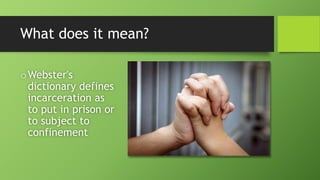
oWebster's
dictionary defines
incarceration as
to put in prison or
to subject to
confinement
Prevalence
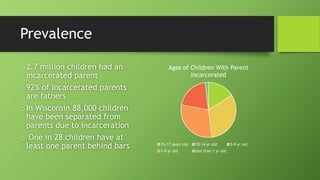
o2.7 million children had an
incarcerated parent
o92% of incarcerated parents
are fathers
oIn Wisconsin 88,000 children
have been separated from
parents due to incarceration
o One in 28 children have at
least one parent behind bars
Ages of Children With Parent
Incarcerated
15-17 years old 10-14 yr old 5-9 yr old
1-4 yr old less than 1 yr old
Impact on Child
• Twice as likely to have learning disabilities
• Higher rates of depression
• Bullies themselves (or be bullied)
• Antisocial
• Regression
• Academic skills
• Behaviors
• Developmental milestones
Support
http://youth.gov/youth-topics/children-of-incarcerated-parents
http://www.sesamestreet.org/toolkits/incarceration#
Useful Strategies
• Be aware of stereotyping
• Tendencies to assume thoughts about behavior, motivation, and academic abilities
• Be sensitive to triggers
• Children may be more sensitive to current events or the police
• Be aware of asking for “parent’s permission” on activities
• Talk to the children about their feelings
• Communicate with the caregiver
• Books in the classroom on the topic
• A non-threatening way to let children know they are not along
Sources
o https://www.merriam-webster.com/dictionary/incarcerate
o http://www.fatherhood.org/fatherhood/fathers-behind-bars-the-problem-and-solution-for-americas-children-
infographichttp://www.wccf.org/pressroom/5328-2/
o http://host.madison.com/ct/report-nearly-wisconsin-kids-have-had-a-parent-behind-bars/article_cf059ac2-f7a4-596f-9853-9e67e5f60cd6.html
o https://www.usatoday.com/story/news/2015/10/27/report-one-14-children-have-had-incarcerated-parent/74663774/
o http://youth.gov/sites/default/files/COIPInfographic_508.pdf
o http://youth.gov/sites/default/files/COIP_TipSheet-Teachers_508.pdf
o https://www.purdue.edu/hhs/hdfs/fii/wp-content/uploads/2015/07/s_mifis05c03.pdf
o http://www.spac.k12.pa.us/2010conference/2010%20spac%20conference%20workshop%20handouts/6%20Mona%20Fleeger%20STARS/5%20what%20
educators%20and%20schools%20need%20to%20know%20when.pdf
o http://www.projectavary.org/top-ten/
o http://www.sesamestreetincommunities.org/topics/incarceration/?utm_source=google&utm_medium=cpc&utm_term=incarceratedparentsstatist
ics&utm_content=IncarcerationStatistics&utm_campaign=SSIC2017
o http://youth.gov/youth-topics/children-of-incarcerated-parents
o http://www.pewresearch.org/fact-tank/2013/06/21/sesame-street-reaches-out-to-2-7-million-american-children-with-an-incarcerated-parent/

Incarcerated Parents

  • 1.
    Incarcerated Parents By: ShelbyPendleton-Weathers Course: Positive Classroom Management
  • 2.
    What does itmean? oWebster's dictionary defines incarceration as to put in prison or to subject to confinement
  • 3.
    Prevalence o2.7 million childrenhad an incarcerated parent o92% of incarcerated parents are fathers oIn Wisconsin 88,000 children have been separated from parents due to incarceration o One in 28 children have at least one parent behind bars Ages of Children With Parent Incarcerated 15-17 years old 10-14 yr old 5-9 yr old 1-4 yr old less than 1 yr old
  • 4.
    Impact on Child •Twice as likely to have learning disabilities • Higher rates of depression • Bullies themselves (or be bullied) • Antisocial • Regression • Academic skills • Behaviors • Developmental milestones
  • 5.
  • 6.
    Useful Strategies • Beaware of stereotyping • Tendencies to assume thoughts about behavior, motivation, and academic abilities • Be sensitive to triggers • Children may be more sensitive to current events or the police • Be aware of asking for “parent’s permission” on activities • Talk to the children about their feelings • Communicate with the caregiver • Books in the classroom on the topic • A non-threatening way to let children know they are not along
  • 7.
    Sources o https://www.merriam-webster.com/dictionary/incarcerate o http://www.fatherhood.org/fatherhood/fathers-behind-bars-the-problem-and-solution-for-americas-children- infographichttp://www.wccf.org/pressroom/5328-2/ ohttp://host.madison.com/ct/report-nearly-wisconsin-kids-have-had-a-parent-behind-bars/article_cf059ac2-f7a4-596f-9853-9e67e5f60cd6.html o https://www.usatoday.com/story/news/2015/10/27/report-one-14-children-have-had-incarcerated-parent/74663774/ o http://youth.gov/sites/default/files/COIPInfographic_508.pdf o http://youth.gov/sites/default/files/COIP_TipSheet-Teachers_508.pdf o https://www.purdue.edu/hhs/hdfs/fii/wp-content/uploads/2015/07/s_mifis05c03.pdf o http://www.spac.k12.pa.us/2010conference/2010%20spac%20conference%20workshop%20handouts/6%20Mona%20Fleeger%20STARS/5%20what%20 educators%20and%20schools%20need%20to%20know%20when.pdf o http://www.projectavary.org/top-ten/ o http://www.sesamestreetincommunities.org/topics/incarceration/?utm_source=google&utm_medium=cpc&utm_term=incarceratedparentsstatist ics&utm_content=IncarcerationStatistics&utm_campaign=SSIC2017 o http://youth.gov/youth-topics/children-of-incarcerated-parents o http://www.pewresearch.org/fact-tank/2013/06/21/sesame-street-reaches-out-to-2-7-million-american-children-with-an-incarcerated-parent/