GAIT PHASES
K.SOUNDARARAJAN
OBJECTIVES
• Introduction
• Gait cycle
• Phases of Gait
• Stance Phase
• Swing Phase
• Gait Terminology
• Conclusion
K. Soundararajan, SRIHER 2
GAIT AND PHASES OF GAIT CYCLE
INTRODUCTION
 Human locomotion or gait may be described as a whole
produced by co-ordinated rotatory movements of body
segments
Normal gait is rhythmic and characterised by alternative
propulsive and retropulsive motions of the lower extremities
The alternative movements of the lower extremities
essentially support and carry along head, arm and trunk
(HAT)
HAT constitutes about 75% of the total body weight
Head & arms – 25%
Trunk _ 50%
 In standing posture the HAT is supported by the lower
extremities, in gait the HAT is not only supported but also
transferred from one extremity to other.
 These activities require co-ordination, balance intact
kinesthetic and proprioceptive senses, and integrity of the
joints and the muscles.
 Gait patterns reflects the persons occupation, body structure
health status and personality as well as many other physical
and psychological attributes.
 Knowledge of the proper gait pattern is useful for analysing,
identifying and correcting abnormalities in the gait.
GAIT CYCLE :
Gait is forward propulsion of the body by the lower
extremity with the co ordinated rotated movements of
body segments.
Gait cycle includes the activities that occur from the point
of initial contact of one lower extremity to the point at
which the same extremity contacts the ground again.
During one gait cycle each extremity passes through two
phases
1. Stance phase
2. Swing phase
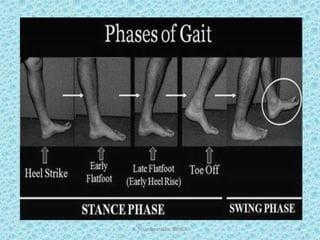
STANCE PHASE :
The activity which occurs during the
foot having the contact with the ground
The stance phase begins at the instant
that one extremity contacts the ground,
during the stance phase some portion of the
foot is always in contact with the ground.
SWING PHASE :
The activity which occurs during the foot
when is not having the contact with the ground
K. Soundararajan, SRIHER 9
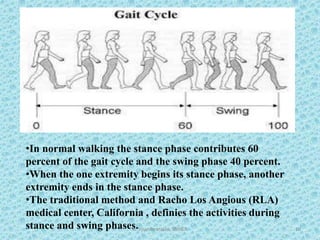
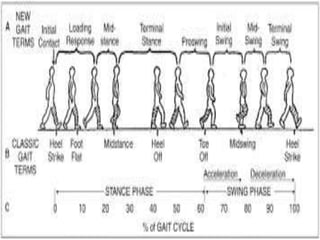
•In normal walking the stance phase contributes 60
percent of the gait cycle and the swing phase 40 percent.
•When the one extremity begins its stance phase, another
extremity ends in the stance phase.
•The traditional method and Racho Los Angious (RLA)
medical center, California , definies the activities during
stance and swing phases.K. Soundararajan, SRIHER 10
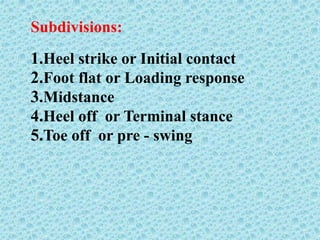
Subdivisions:
1.Heel strike or Initial contact
2.Foot flat or Loading response
3.Midstance
4.Heel off or Terminal stance
5.Toe off or pre - swing
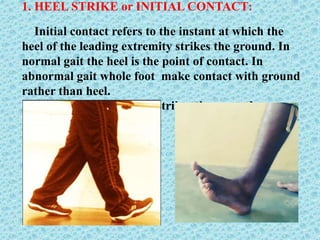
1. HEEL STRIKE or INITIAL CONTACT:
Initial contact refers to the instant at which the
heel of the leading extremity strikes the ground. In
normal gait the heel is the point of contact. In
abnormal gait whole foot make contact with ground
rather than heel.
EX: Here Right side heel strikes the ground
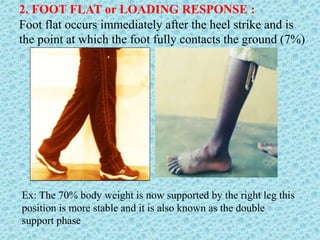
2. FOOT FLAT or LOADING RESPONSE :
Foot flat occurs immediately after the heel strike and is
the point at which the foot fully contacts the ground (7%)
Ex: The 70% body weight is now supported by the right leg this
position is more stable and it is also known as the double
support phase
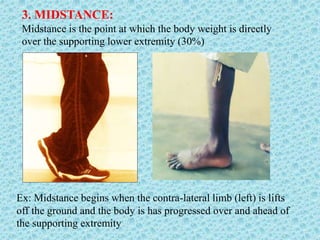
3. MIDSTANCE:
Midstance is the point at which the body weight is directly
over the supporting lower extremity (30%)
Ex: Midstance begins when the contra-lateral limb (left) is lifts
off the ground and the body is has progressed over and ahead of
the supporting extremity
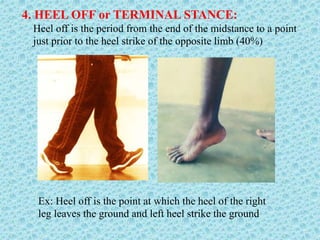
4. HEEL OFF or TERMINAL STANCE:
Heel off is the period from the end of the midstance to a point
just prior to the heel strike of the opposite limb (40%)
Ex: Heel off is the point at which the heel of the right
leg leaves the ground and left heel strike the ground
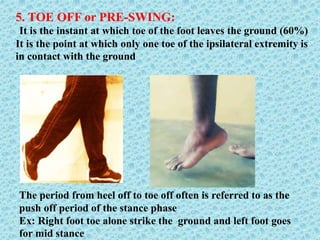
5. TOE OFF or PRE-SWING:
It is the instant at which toe of the foot leaves the ground (60%)
It is the point at which only one toe of the ipsilateral extremity is
in contact with the ground
The period from heel off to toe off often is referred to as the
push off period of the stance phase
Ex: Right foot toe alone strike the ground and left foot goes
for mid stance
SWING PHASE :
1.Acceleration or Initial swing
2.Midswing
3.Deceleration or Terminal swing
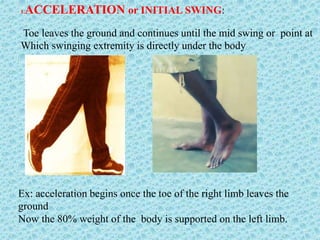
1.ACCELERATION or INITIAL SWING:
Toe leaves the ground and continues until the mid swing or point at
Which swinging extremity is directly under the body
Ex: acceleration begins once the toe of the right limb leaves the
ground
Now the 80% weight of the body is supported on the left limb.
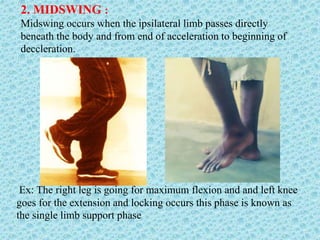
2. MIDSWING :
Midswing occurs when the ipsilateral limb passes directly
beneath the body and from end of acceleration to beginning of
deccleration.
Ex: The right leg is going for maximum flexion and and left knee
goes for the extension and locking occurs this phase is known as
the single limb support phase
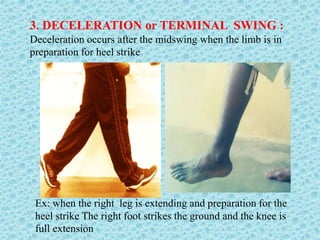
3. DECELERATION or TERMINAL SWING :
Deceleration occurs after the midswing when the limb is in
preparation for heel strike
Ex: when the right leg is extending and preparation for the
heel strike The right foot strikes the ground and the knee is
full extension
STANCE TIME :
It is the amount of time that elapses during the stance phase of
one extremity in a gait cycle
SINGLE SUPPORT TIME :
It is the amount of time that elapses during the period when only
one extremity is on the supporting surface in a gait cycle.
DOUBLE SUPPORT TIME :
It is the amount of time that a person spends with both feet on the
ground during one cycle.
% increases in elderly people ( balance disorder)
% decreases as speed of walking increases
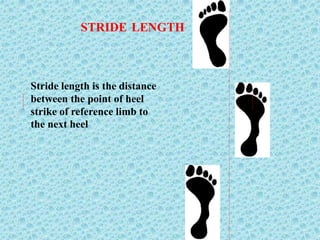
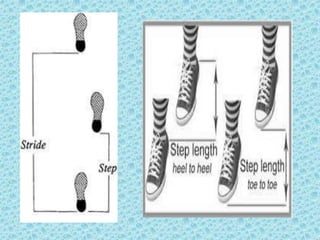
STRIDE LENGTH
Stride length is the distance
between the point of heel
strike of reference limb to
the next heel
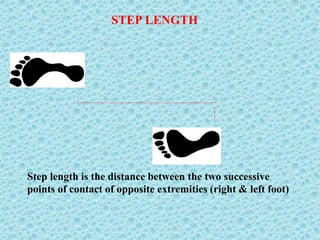
STEP LENGTH
Step length is the distance between the two successive
points of contact of opposite extremities (right & left foot)
CADENCE :
Cadence is the number of steps taken by a person per unit of
time
Cadence = number of steps/min
180 steps/ min = Running
110 steps/ min = Normal adult
WALKING VELOCITY :
It is rate of linear forward motion of the body.
Which can be measured in km or in miles
Walking velocity = distance walked/time
DISCUSSION …..
REFERENCE
Thank you

Biomechanics gait

  • 1.
  • 2.
    OBJECTIVES • Introduction • Gaitcycle • Phases of Gait • Stance Phase • Swing Phase • Gait Terminology • Conclusion K. Soundararajan, SRIHER 2
  • 3.
    GAIT AND PHASESOF GAIT CYCLE
  • 4.
    INTRODUCTION  Human locomotionor gait may be described as a whole produced by co-ordinated rotatory movements of body segments Normal gait is rhythmic and characterised by alternative propulsive and retropulsive motions of the lower extremities The alternative movements of the lower extremities essentially support and carry along head, arm and trunk (HAT) HAT constitutes about 75% of the total body weight Head & arms – 25% Trunk _ 50%
  • 5.
     In standingposture the HAT is supported by the lower extremities, in gait the HAT is not only supported but also transferred from one extremity to other.  These activities require co-ordination, balance intact kinesthetic and proprioceptive senses, and integrity of the joints and the muscles.  Gait patterns reflects the persons occupation, body structure health status and personality as well as many other physical and psychological attributes.  Knowledge of the proper gait pattern is useful for analysing, identifying and correcting abnormalities in the gait.
  • 6.
    GAIT CYCLE : Gaitis forward propulsion of the body by the lower extremity with the co ordinated rotated movements of body segments. Gait cycle includes the activities that occur from the point of initial contact of one lower extremity to the point at which the same extremity contacts the ground again. During one gait cycle each extremity passes through two phases 1. Stance phase 2. Swing phase
  • 7.
    STANCE PHASE : Theactivity which occurs during the foot having the contact with the ground The stance phase begins at the instant that one extremity contacts the ground, during the stance phase some portion of the foot is always in contact with the ground.
  • 8.
    SWING PHASE : Theactivity which occurs during the foot when is not having the contact with the ground
  • 9.
  • 10.
    •In normal walkingthe stance phase contributes 60 percent of the gait cycle and the swing phase 40 percent. •When the one extremity begins its stance phase, another extremity ends in the stance phase. •The traditional method and Racho Los Angious (RLA) medical center, California , definies the activities during stance and swing phases.K. Soundararajan, SRIHER 10
  • 11.
    Subdivisions: 1.Heel strike orInitial contact 2.Foot flat or Loading response 3.Midstance 4.Heel off or Terminal stance 5.Toe off or pre - swing
  • 12.
    1. HEEL STRIKEor INITIAL CONTACT: Initial contact refers to the instant at which the heel of the leading extremity strikes the ground. In normal gait the heel is the point of contact. In abnormal gait whole foot make contact with ground rather than heel. EX: Here Right side heel strikes the ground
  • 13.
    2. FOOT FLATor LOADING RESPONSE : Foot flat occurs immediately after the heel strike and is the point at which the foot fully contacts the ground (7%) Ex: The 70% body weight is now supported by the right leg this position is more stable and it is also known as the double support phase
  • 14.
    3. MIDSTANCE: Midstance isthe point at which the body weight is directly over the supporting lower extremity (30%) Ex: Midstance begins when the contra-lateral limb (left) is lifts off the ground and the body is has progressed over and ahead of the supporting extremity
  • 15.
    4. HEEL OFFor TERMINAL STANCE: Heel off is the period from the end of the midstance to a point just prior to the heel strike of the opposite limb (40%) Ex: Heel off is the point at which the heel of the right leg leaves the ground and left heel strike the ground
  • 16.
    5. TOE OFFor PRE-SWING: It is the instant at which toe of the foot leaves the ground (60%) It is the point at which only one toe of the ipsilateral extremity is in contact with the ground The period from heel off to toe off often is referred to as the push off period of the stance phase Ex: Right foot toe alone strike the ground and left foot goes for mid stance
  • 17.
    SWING PHASE : 1.Accelerationor Initial swing 2.Midswing 3.Deceleration or Terminal swing
  • 18.
    1.ACCELERATION or INITIALSWING: Toe leaves the ground and continues until the mid swing or point at Which swinging extremity is directly under the body Ex: acceleration begins once the toe of the right limb leaves the ground Now the 80% weight of the body is supported on the left limb.
  • 19.
    2. MIDSWING : Midswingoccurs when the ipsilateral limb passes directly beneath the body and from end of acceleration to beginning of deccleration. Ex: The right leg is going for maximum flexion and and left knee goes for the extension and locking occurs this phase is known as the single limb support phase
  • 20.
    3. DECELERATION orTERMINAL SWING : Deceleration occurs after the midswing when the limb is in preparation for heel strike Ex: when the right leg is extending and preparation for the heel strike The right foot strikes the ground and the knee is full extension
  • 22.
    STANCE TIME : Itis the amount of time that elapses during the stance phase of one extremity in a gait cycle SINGLE SUPPORT TIME : It is the amount of time that elapses during the period when only one extremity is on the supporting surface in a gait cycle. DOUBLE SUPPORT TIME : It is the amount of time that a person spends with both feet on the ground during one cycle. % increases in elderly people ( balance disorder) % decreases as speed of walking increases
  • 23.
    STRIDE LENGTH Stride lengthis the distance between the point of heel strike of reference limb to the next heel
  • 24.
    STEP LENGTH Step lengthis the distance between the two successive points of contact of opposite extremities (right & left foot)
  • 26.
    CADENCE : Cadence isthe number of steps taken by a person per unit of time Cadence = number of steps/min 180 steps/ min = Running 110 steps/ min = Normal adult WALKING VELOCITY : It is rate of linear forward motion of the body. Which can be measured in km or in miles Walking velocity = distance walked/time
  • 27.
  • 28.
  • 29.