BY : NAVNEET KAUR
 The kinetic chain (sometimes called the kinematic chain) is an
engineering concept used to describe human movement. It is used in
a wide variety of clinical conditions, including musculoskeletal,
sports medicine, neuro-rehabilitation etc.
 The concept was introduced by Franz Reuleaux, a mechanical
engineer, in 1875. He proposed that rigid, overlapping segments
were connected via joints and this created a system whereby
movement at one joint produced or affected movement at another
joint in the kinetic link.
 This series or chains can be closed or open
Steindler defined an open kinetic chain as “a
combination of successively arranged joints in which
the terminal segments can move freely”. Thus the
distal segment of the extremity is free to move in
space, for example: waving a hand, moving the foot
during the swing phase of gait, or doing a seated knee
extension.
• Open kinetic chain exercises are typically characterized by a rotary
stress pattern at the joint. For example, when doing a seated knee-
extension the primary stress to the joint is the rotation of the distal tibia
on the proximal femur even though other accessory movements like
rolling and translation occur.
• Open kinetic chain movements occur in one primary axis. During the
seated knee extension exercise, the motion primarily occurs in the
sagittal plane.
The number of simultaneously moving segments is
typically limited to one. "One segment of the joint
(i.e. femur) remains stationary during the knee-
extension exercise, while the other segment that
forms the joint (i.e. tibia) is mobile." This adds
control to the exercise because of the stability of
the stationary segment (i.e. femur).
These types of exercises allow for more isolated
muscle activation because less muscle co-
contraction is used to perform the movement.
oIt is a system where neither the proximal nor
the distal segments can move.
o Movement at one segment in the closed chain
moves all the other joints predictably.
o For example, during a squat, the movement at
the knee joint accompanies movement at the hip
and ankle joints.
 Using the standing squat as an example
-
 Linear stress pattern is produced at the
tibiofemoral joint due to axial joint
loading
 Movement occurs at multiple joints and
multiple-joint axes at the hip, knee,
ankle (talocrural), and subtalar joints
 Simultaneous movement occurs at both
segments
 Because of the simultaneous segmental
movement, an increase in muscular co-
contraction is required to stabilize and
control the movements across the joints
in the chain
CLOSED CHAIN KINETICS
Open kinetic chain execises focus a great
concentration of work on a targeted joint or
muscle.
In most cases, open kinetic chain exercises are
single joint movement.
For eg, when performing leg extension
exercise, the only movement occurs at
knee joint which targets the quadriceps.
In this exercise lower leg is the most
distal segment moving.
The lower leg freely moving in space
during exercise makes it an open kinetic
chain exercise.
OPEN
CHAIN
KINETIC
EXECISE
S
LOWER BODY
 Knee extension
 Knee flexion [leg curl]
 Seated leg raise
UPPER BODY
 Bench press
 Shoulder press
 Elbow flexion
 Elbow extension
USES OF
CLOSED
KINETIC
CHAIN
EXERCISES
Closed kinetic chain exercises focus more
on moving body against the ground.
For eg, in squat exercise the feet plant
firmly on ground and do not move. Rather
the body moves against the ground.
As you descend in squat, the knees and
hips flex, but the feet do not move.
The feet are distal segment of this exercise
and they stay stationary. Therefore,the
squat is a closed kinetic chain exercise.
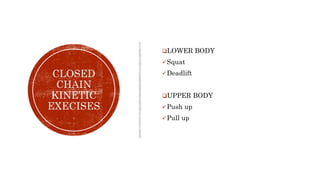
CLOSED
CHAIN
KINETIC
EXECISES
LOWER BODY
Squat
Deadlift
UPPER BODY
Push up
Pull up
THANK YOU

Kinetic chain {kinematic chain}

  • 1.
  • 2.
     The kineticchain (sometimes called the kinematic chain) is an engineering concept used to describe human movement. It is used in a wide variety of clinical conditions, including musculoskeletal, sports medicine, neuro-rehabilitation etc.  The concept was introduced by Franz Reuleaux, a mechanical engineer, in 1875. He proposed that rigid, overlapping segments were connected via joints and this created a system whereby movement at one joint produced or affected movement at another joint in the kinetic link.  This series or chains can be closed or open
  • 3.
    Steindler defined anopen kinetic chain as “a combination of successively arranged joints in which the terminal segments can move freely”. Thus the distal segment of the extremity is free to move in space, for example: waving a hand, moving the foot during the swing phase of gait, or doing a seated knee extension.
  • 4.
    • Open kineticchain exercises are typically characterized by a rotary stress pattern at the joint. For example, when doing a seated knee- extension the primary stress to the joint is the rotation of the distal tibia on the proximal femur even though other accessory movements like rolling and translation occur. • Open kinetic chain movements occur in one primary axis. During the seated knee extension exercise, the motion primarily occurs in the sagittal plane.
  • 5.
    The number ofsimultaneously moving segments is typically limited to one. "One segment of the joint (i.e. femur) remains stationary during the knee- extension exercise, while the other segment that forms the joint (i.e. tibia) is mobile." This adds control to the exercise because of the stability of the stationary segment (i.e. femur). These types of exercises allow for more isolated muscle activation because less muscle co- contraction is used to perform the movement.
  • 7.
    oIt is asystem where neither the proximal nor the distal segments can move. o Movement at one segment in the closed chain moves all the other joints predictably. o For example, during a squat, the movement at the knee joint accompanies movement at the hip and ankle joints.
  • 8.
     Using thestanding squat as an example -  Linear stress pattern is produced at the tibiofemoral joint due to axial joint loading  Movement occurs at multiple joints and multiple-joint axes at the hip, knee, ankle (talocrural), and subtalar joints  Simultaneous movement occurs at both segments  Because of the simultaneous segmental movement, an increase in muscular co- contraction is required to stabilize and control the movements across the joints in the chain
  • 9.
  • 10.
    Open kinetic chainexecises focus a great concentration of work on a targeted joint or muscle. In most cases, open kinetic chain exercises are single joint movement.
  • 11.
    For eg, whenperforming leg extension exercise, the only movement occurs at knee joint which targets the quadriceps. In this exercise lower leg is the most distal segment moving. The lower leg freely moving in space during exercise makes it an open kinetic chain exercise.
  • 12.
    OPEN CHAIN KINETIC EXECISE S LOWER BODY  Kneeextension  Knee flexion [leg curl]  Seated leg raise UPPER BODY  Bench press  Shoulder press  Elbow flexion  Elbow extension
  • 13.
    USES OF CLOSED KINETIC CHAIN EXERCISES Closed kineticchain exercises focus more on moving body against the ground. For eg, in squat exercise the feet plant firmly on ground and do not move. Rather the body moves against the ground. As you descend in squat, the knees and hips flex, but the feet do not move. The feet are distal segment of this exercise and they stay stationary. Therefore,the squat is a closed kinetic chain exercise.
  • 14.
  • 15.