Musculoskeletal Examination
Advances and Related Evidence
Soundararajan K
11/14/2019 K. Soundararajan, MPT, SRIHER 1
Contents of Topic
1. Screening
2. Mobility testing
3. Muscle performance
4. Concepts based evaluation
11/14/2019 K. Soundararajan, MPT, SRIHER 2
Introduction
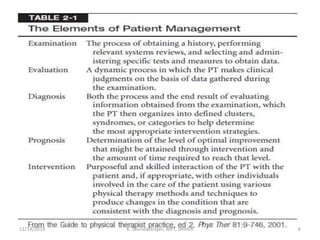
• Examination is systematic process by which a
therapist obtains information about a patient’s
problem(s) ultimately to formulate a Somatic
diagnosis and determine whether these problems
can be appropriately treated by PT interventions.
• If treatment of identified problems does not fall
within the scope of PT practice then referral
11/14/2019 K. Soundararajan, MPT, SRIHER 3
Evaluations must be sufficiently
comprehensive to provide information
necessary to make or verify a treating
diagnosis, identify patient/client goals,
develop a plan of care, and guide treatment
and re-evaluations as needed. (APTA,2014)
11/14/2019 K. Soundararajan, MPT, SRIHER 4
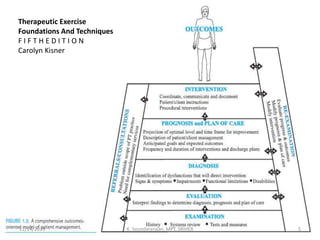
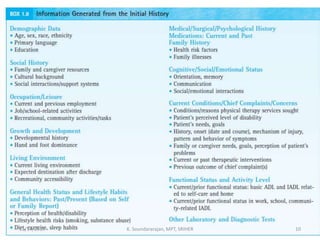
Therapeutic Exercise
Foundations And Techniques
F I F T H E D I T I O N
Carolyn Kisner
11/14/2019 K. Soundararajan, MPT, SRIHER 5
11/14/2019 K. Soundararajan, MPT, SRIHER 6
11/14/2019 K. Soundararajan, MPT, SRIHER 7
11/14/2019 K. Soundararajan, MPT, SRIHER 8
11/14/2019 K. Soundararajan, MPT, SRIHER 9
11/14/2019 K. Soundararajan, MPT, SRIHER 10
11/14/2019 K. Soundararajan, MPT, SRIHER 11
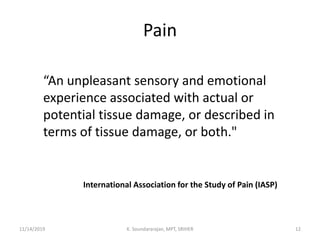
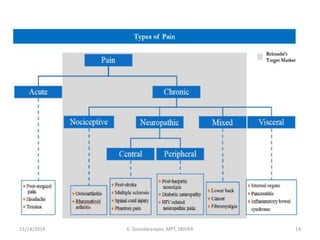
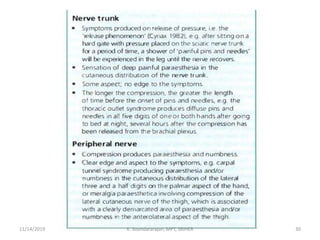
Pain
“An unpleasant sensory and emotional
experience associated with actual or
potential tissue damage, or described in
terms of tissue damage, or both."
International Association for the Study of Pain (IASP)
11/14/2019 K. Soundararajan, MPT, SRIHER 12
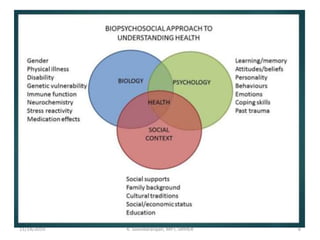
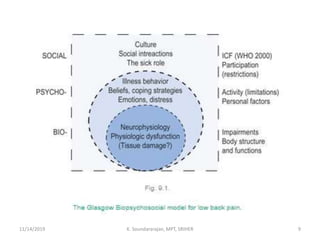
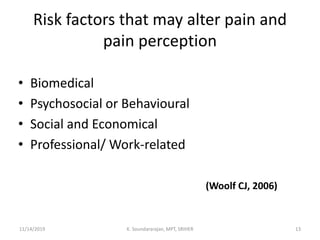
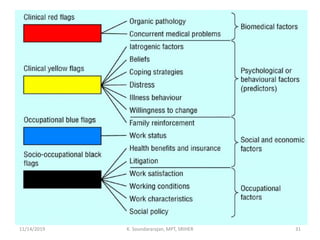
Risk factors that may alter pain and
pain perception
• Biomedical
• Psychosocial or Behavioural
• Social and Economical
• Professional/ Work-related
(Woolf CJ, 2006)
11/14/2019 K. Soundararajan, MPT, SRIHER 13
11/14/2019 K. Soundararajan, MPT, SRIHER 14
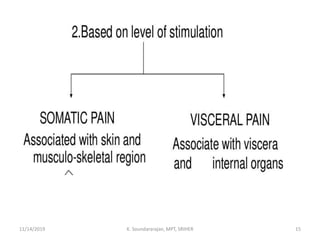
11/14/2019 K. Soundararajan, MPT, SRIHER 15
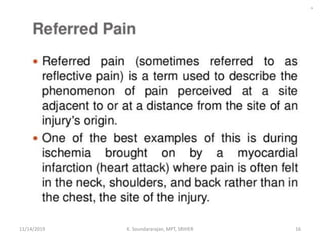
11/14/2019 K. Soundararajan, MPT, SRIHER 16
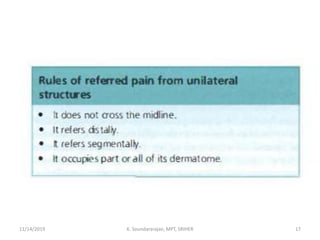
11/14/2019 K. Soundararajan, MPT, SRIHER 17
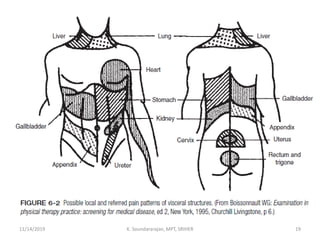
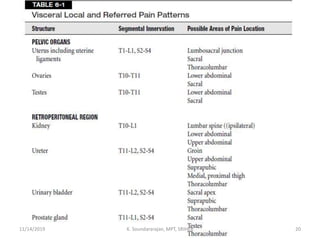
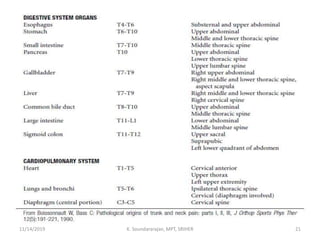
VISERAL PAIN
Noxious stimulation within an organ
Inflammatory in origin
Viscera is insensitive to mechanical stimuli
E.g.- Pathology in heart
Stomach lesion
Renal calculi
11/14/2019 K. Soundararajan, MPT, SRIHER 18
11/14/2019 K. Soundararajan, MPT, SRIHER 19
11/14/2019 K. Soundararajan, MPT, SRIHER 20
11/14/2019 K. Soundararajan, MPT, SRIHER 21
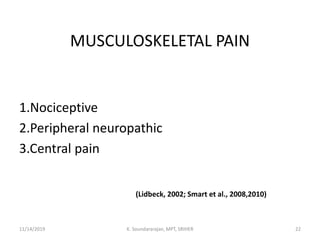
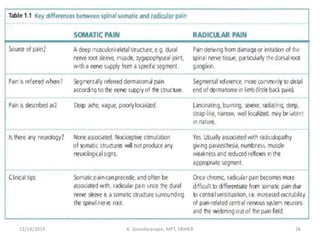
MUSCULOSKELETAL PAIN
1.Nociceptive
2.Peripheral neuropathic
3.Central pain
(Lidbeck, 2002; Smart et al., 2008,2010)
11/14/2019 K. Soundararajan, MPT, SRIHER 22
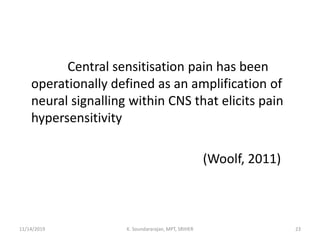
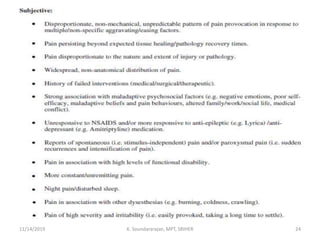
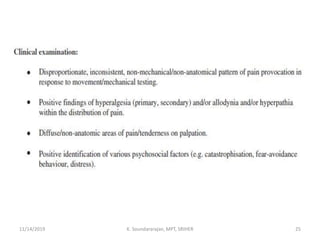
Central sensitisation pain has been
operationally defined as an amplification of
neural signalling within CNS that elicits pain
hypersensitivity
(Woolf, 2011)
11/14/2019 K. Soundararajan, MPT, SRIHER 23
11/14/2019 K. Soundararajan, MPT, SRIHER 24
11/14/2019 K. Soundararajan, MPT, SRIHER 25
11/14/2019 K. Soundararajan, MPT, SRIHER 26
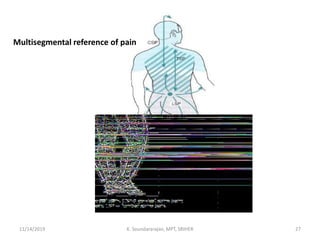
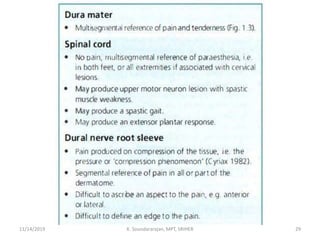
Multisegmental reference of pain
11/14/2019 K. Soundararajan, MPT, SRIHER 27
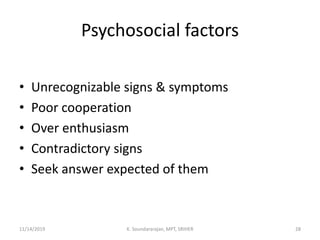
Psychosocial factors
• Unrecognizable signs & symptoms
• Poor cooperation
• Over enthusiasm
• Contradictory signs
• Seek answer expected of them
11/14/2019 K. Soundararajan, MPT, SRIHER 28
11/14/2019 K. Soundararajan, MPT, SRIHER 29
11/14/2019 K. Soundararajan, MPT, SRIHER 30
11/14/2019 K. Soundararajan, MPT, SRIHER 31
11/14/2019 K. Soundararajan, MPT, SRIHER 32
11/14/2019 K. Soundararajan, MPT, SRIHER 33
11/14/2019 K. Soundararajan, MPT, SRIHER 34
11/14/2019 K. Soundararajan, MPT, SRIHER 35
11/14/2019 K. Soundararajan, MPT, SRIHER 36
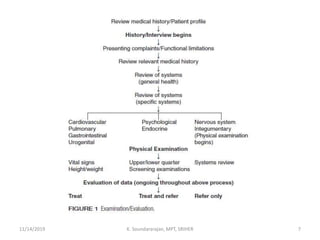
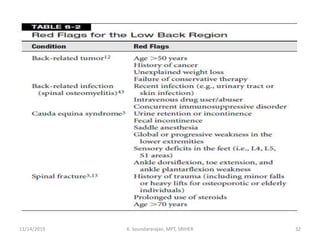
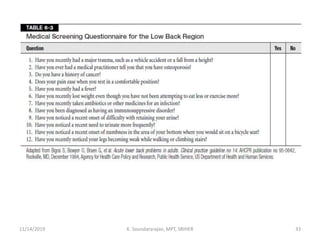
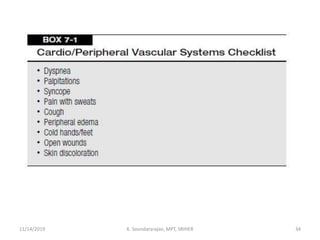
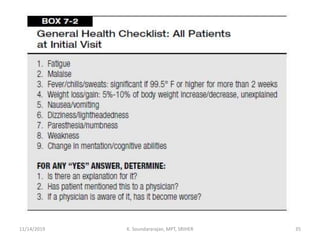
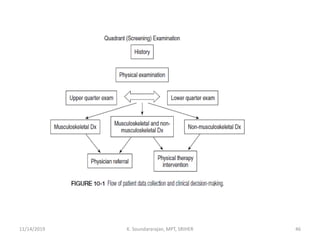
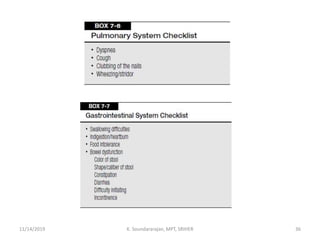
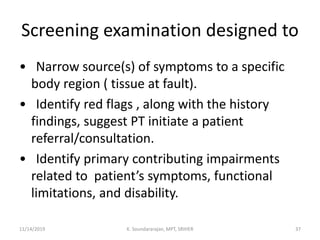
Screening examination designed to
• Narrow source(s) of symptoms to a specific
body region ( tissue at fault).
• Identify red flags , along with the history
findings, suggest PT initiate a patient
referral/consultation.
• Identify primary contributing impairments
related to patient’s symptoms, functional
limitations, and disability.
11/14/2019 K. Soundararajan, MPT, SRIHER 37
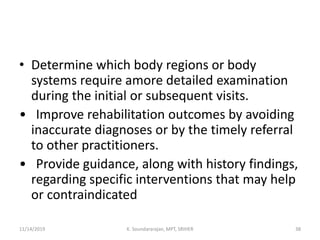
• Determine which body regions or body
systems require amore detailed examination
during the initial or subsequent visits.
• Improve rehabilitation outcomes by avoiding
inaccurate diagnoses or by the timely referral
to other practitioners.
• Provide guidance, along with history findings,
regarding specific interventions that may help
or contraindicated
11/14/2019 K. Soundararajan, MPT, SRIHER 38
PRE MANIPULATIVE
SCREENING
11/14/2019 K. Soundararajan, MPT, SRIHER 39
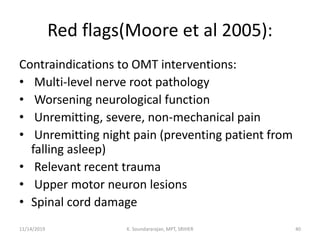
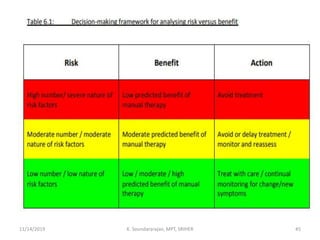
Red flags(Moore et al 2005):
Contraindications to OMT interventions:
• Multi-level nerve root pathology
• Worsening neurological function
• Unremitting, severe, non-mechanical pain
• Unremitting night pain (preventing patient from
falling asleep)
• Relevant recent trauma
• Upper motor neuron lesions
• Spinal cord damage
11/14/2019 K. Soundararajan, MPT, SRIHER 40
Precautions to OMT interventions
• Local infection , Inflammatory disease
• Active cancer /History of cancer
• Long-term steroid use / Osteoporosis
• Systemically unwell ,Hypermobility syndromes
• Connective tissue disease
• A first sudden episode before age 18 or after age 55
• Cervical anomalies
• Throat infections in children
• Recent manipulation by another health professional
11/14/2019 K. Soundararajan, MPT, SRIHER 41
Serious conditions which may mimic
musculoskeletal dysfunction in the
early stages
• CAD (e.g. vertebrobasilar insufficiency due to
dissection) (Kerry et al, 2008)
• Upper cervical instability (Niere and Torney,
2004), that could compromise the vascular
and neurological structures.
11/14/2019 K. Soundararajan, MPT, SRIHER 42
Physical examination
• Blood pressure
• Cranio vertebral ligament testing
• Neurological examination
• Positional testing (Provocative positional
testing )
• Palpation of the carotid artery
CHECK FOR : VASCULAR OR NEUROLOGICAL
11/14/2019 K. Soundararajan, MPT, SRIHER 43
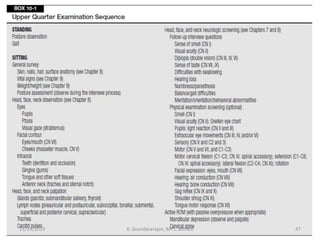
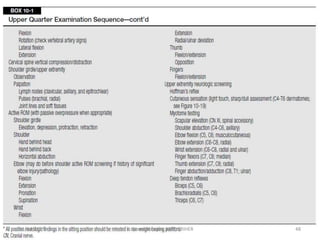
NEUROLOGICAL TESTING
•Reflexes
•Dermatomes
•Myotomes
•Cranial / peripheral nerve assessment
•Pathological reflexes
11/14/2019 K. Soundararajan, MPT, SRIHER 44
11/14/2019 K. Soundararajan, MPT, SRIHER 45
11/14/2019 K. Soundararajan, MPT, SRIHER 46
11/14/2019 K. Soundararajan, MPT, SRIHER 47
11/14/2019 K. Soundararajan, MPT, SRIHER 48
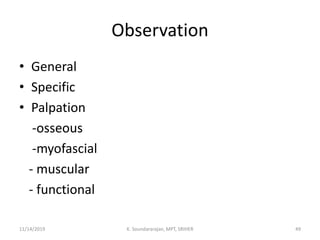
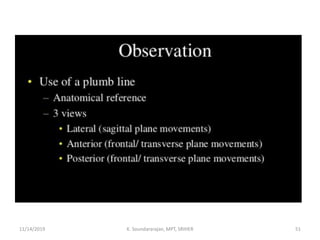
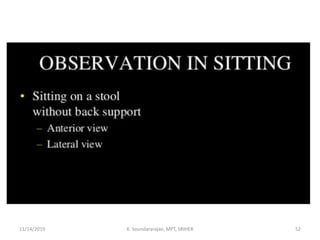
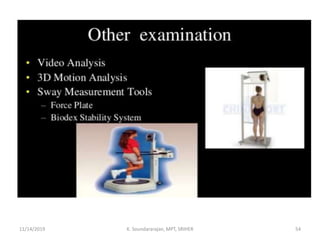
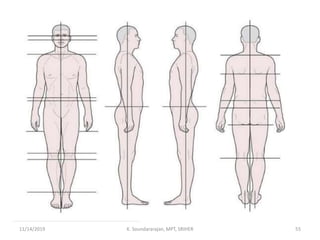
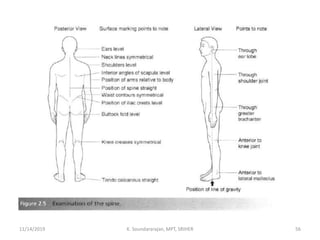
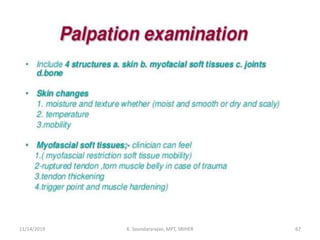
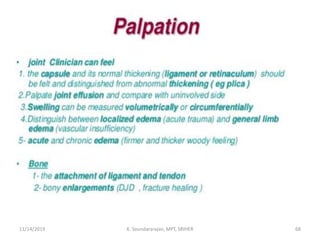
Observation
• General
• Specific
• Palpation
-osseous
-myofascial
- muscular
- functional
11/14/2019 K. Soundararajan, MPT, SRIHER 49
11/14/2019 K. Soundararajan, MPT, SRIHER 50
11/14/2019 K. Soundararajan, MPT, SRIHER 51
11/14/2019 K. Soundararajan, MPT, SRIHER 52
11/14/2019 K. Soundararajan, MPT, SRIHER 53
11/14/2019 K. Soundararajan, MPT, SRIHER 54
11/14/2019 K. Soundararajan, MPT, SRIHER 55
11/14/2019 K. Soundararajan, MPT, SRIHER 56
11/14/2019 K. Soundararajan, MPT, SRIHER 57
Gait Analysis
11/14/2019 K. Soundararajan, MPT, SRIHER 58
• Subjective
Our observation of gait is a subjective
measure that we can use. We might ask the
individual to walk normally, on insides and
outsides of feet, in a straight line, running. All
the time looking to compare sides and
understanding of "normal".
11/14/2019 K. Soundararajan, MPT, SRIHER 59
Objective
Quantitative method
• Video Analysis and Treadmill
• Electronic and Computerized Apparatus
• Electronic Pedometers
• Satellite Positioning System
11/14/2019 K. Soundararajan, MPT, SRIHER 60
Qualitative methods
• Rancho Los Amigos Hospital Rating List
• Ten Meter Walking Test
• 6 Minute Walk Test
• 2 Minute Walk Test
• Dynamic Gait Index
• Emory Functional Ambulation Profile
• Timed Up and Go Test This test is statistically
associated with falling in men, but not in women.
• Functional Ambulation Categories
• Tinetti-Test
11/14/2019 K. Soundararajan, MPT, SRIHER 61
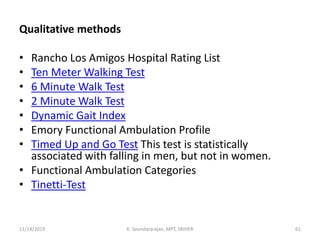
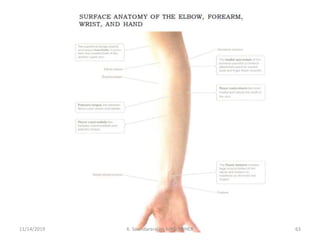
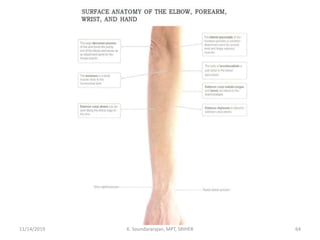
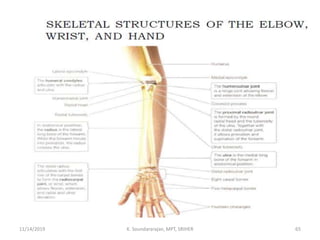
Specific observation
11/14/2019 K. Soundararajan, MPT, SRIHER 62
11/14/2019 K. Soundararajan, MPT, SRIHER 63
11/14/2019 K. Soundararajan, MPT, SRIHER 64
11/14/2019 K. Soundararajan, MPT, SRIHER 65
11/14/2019 K. Soundararajan, MPT, SRIHER 66
11/14/2019 K. Soundararajan, MPT, SRIHER 67
11/14/2019 K. Soundararajan, MPT, SRIHER 68
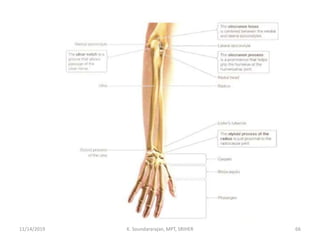
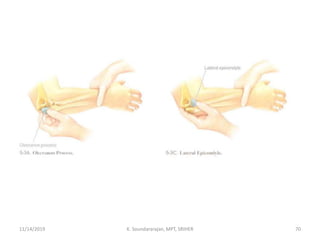
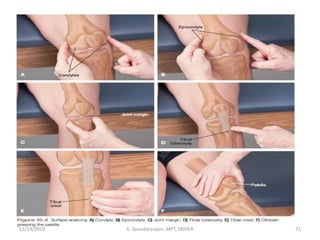
Osseous palpation
11/14/2019 K. Soundararajan, MPT, SRIHER 69
11/14/2019 K. Soundararajan, MPT, SRIHER 70
11/14/2019 K. Soundararajan, MPT, SRIHER 71
11/14/2019 K. Soundararajan, MPT, SRIHER 72
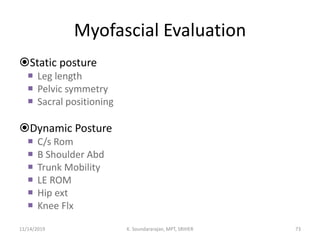
Myofascial Evaluation
Static posture
 Leg length
 Pelvic symmetry
 Sacral positioning
Dynamic Posture
 C/s Rom
 B Shoulder Abd
 Trunk Mobility
 LE ROM
 Hip ext
 Knee Flx
11/14/2019 K. Soundararajan, MPT, SRIHER 73
Myofascial Evaluation
• Palpation
– Superior – inferior glides
– Medial – lateral glides
– Clockwise –Counter-clockwise glides
– Joints: Compression - distraction
11/14/2019 K. Soundararajan, MPT, SRIHER 74
11/14/2019 K. Soundararajan, MPT, SRIHER 75
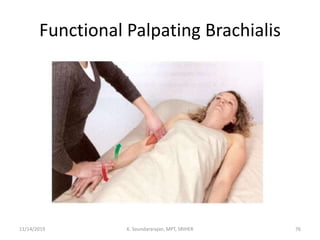
Functional Palpating Brachialis
11/14/2019 K. Soundararajan, MPT, SRIHER 76
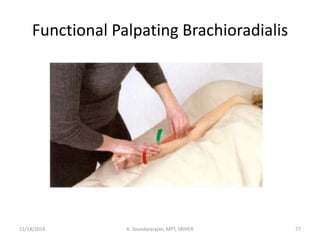
Functional Palpating Brachioradialis
11/14/2019 K. Soundararajan, MPT, SRIHER 77
11/14/2019 K. Soundararajan, MPT, SRIHER 78
11/14/2019 K. Soundararajan, MPT, SRIHER 79
11/14/2019 K. Soundararajan, MPT, SRIHER 80
11/14/2019 K. Soundararajan, MPT, SRIHER 81
11/14/2019 K. Soundararajan, MPT, SRIHER 82
11/14/2019 K. Soundararajan, MPT, SRIHER 83
11/14/2019 K. Soundararajan, MPT, SRIHER 84
11/14/2019 K. Soundararajan, MPT, SRIHER 85
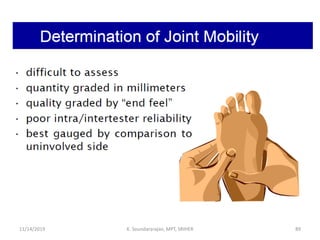
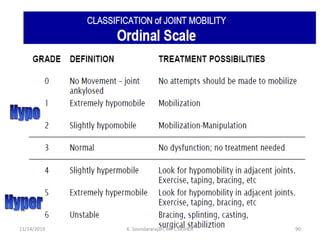
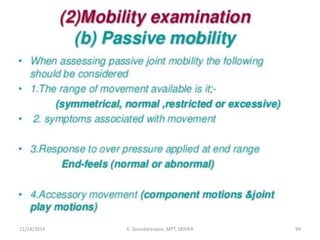
Joint mobility Testing
• Joint integrity and mobility represent the
structure and function of the joint and are
classified in biomechanical terms as
arthrokinematic motion.
• Joint mobility is the capacity of the joint to be
moved passively, evaluating the structure and
integrity of the joint surface in addition to
periarticular soft tissue characteristics.
11/14/2019 K. Soundararajan, MPT, SRIHER 86
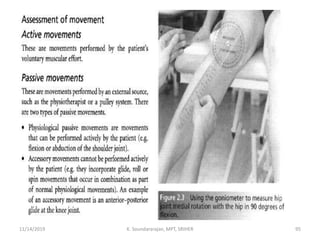
• The physical therapist uses tests and measures to
assess accessory joint movements (movements
not under voluntary control), including the
existence of either excessive motion
(hypermobility) or limited motion (hypomobility).
• Responses monitored at rest, during activity, and
after activity may indicate the presence or
severity of an impairment, activity limitation, or
participation restriction.
11/14/2019 K. Soundararajan, MPT, SRIHER 87
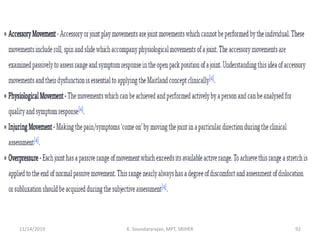
Joint Play
- movement not under voluntary control (passive)
- can not be achieved by active muscular
contraction
versus
Component Movement
- involuntary obligatory joint motion occurring
outside the joint accompanies active motion
– i.e. - scapulohumeral rhythm
11/14/2019 K. Soundararajan, MPT, SRIHER 88
11/14/2019 K. Soundararajan, MPT, SRIHER 89
11/14/2019 K. Soundararajan, MPT, SRIHER 90
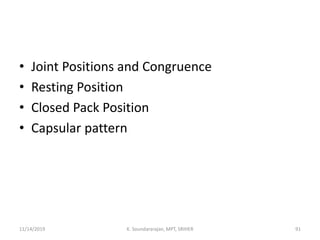
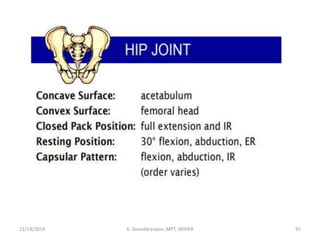
• Joint Positions and Congruence
• Resting Position
• Closed Pack Position
• Capsular pattern
11/14/2019 K. Soundararajan, MPT, SRIHER 91
11/14/2019 K. Soundararajan, MPT, SRIHER 92
11/14/2019 K. Soundararajan, MPT, SRIHER 93
11/14/2019 K. Soundararajan, MPT, SRIHER 94
11/14/2019 K. Soundararajan, MPT, SRIHER 95
11/14/2019 K. Soundararajan, MPT, SRIHER 96
11/14/2019 K. Soundararajan, MPT, SRIHER 97
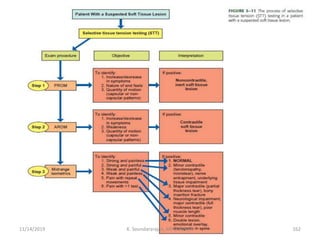
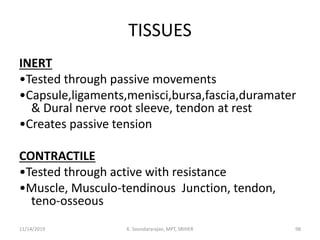
TISSUES
INERT
•Tested through passive movements
•Capsule,ligaments,menisci,bursa,fascia,duramater
& Dural nerve root sleeve, tendon at rest
•Creates passive tension
CONTRACTILE
•Tested through active with resistance
•Muscle, Musculo-tendinous Junction, tendon,
teno-osseous
11/14/2019 K. Soundararajan, MPT, SRIHER 98
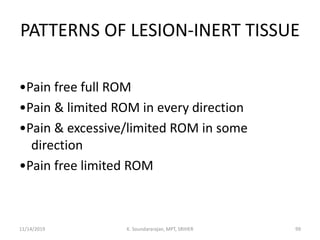
PATTERNS OF LESION-INERT TISSUE
•Pain free full ROM
•Pain & limited ROM in every direction
•Pain & excessive/limited ROM in some
direction
•Pain free limited ROM
11/14/2019 K. Soundararajan, MPT, SRIHER 99
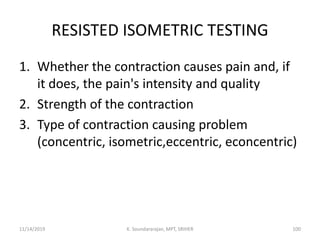
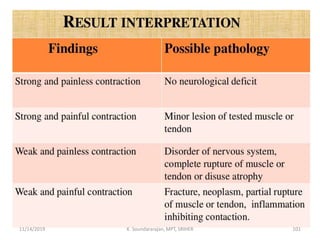
RESISTED ISOMETRIC TESTING
1. Whether the contraction causes pain and, if
it does, the pain's intensity and quality
2. Strength of the contraction
3. Type of contraction causing problem
(concentric, isometric,eccentric, econcentric)
11/14/2019 K. Soundararajan, MPT, SRIHER 100
11/14/2019 K. Soundararajan, MPT, SRIHER 101
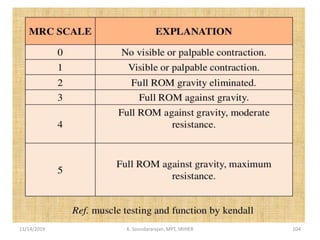
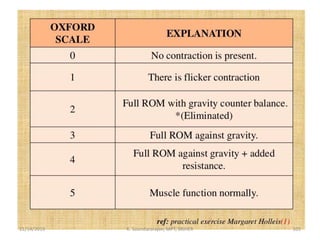
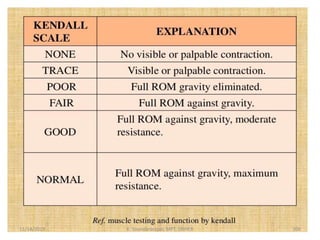
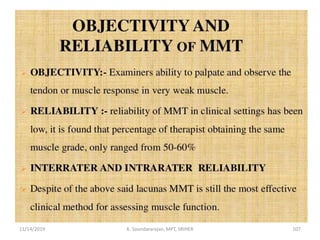
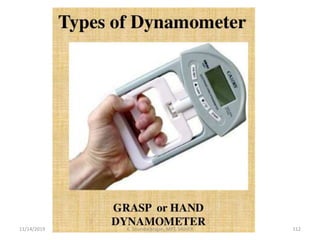
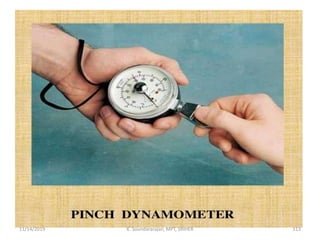
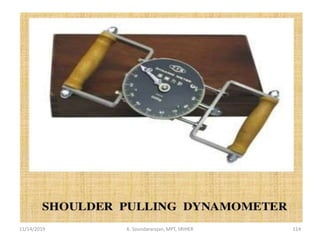
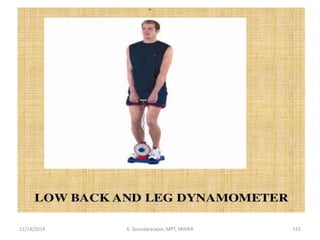
MUSCLE STRENGTH / POWER TESTING
11/14/2019 K. Soundararajan, MPT, SRIHER 102
11/14/2019 K. Soundararajan, MPT, SRIHER 103
11/14/2019 K. Soundararajan, MPT, SRIHER 104
11/14/2019 K. Soundararajan, MPT, SRIHER 105
11/14/2019 K. Soundararajan, MPT, SRIHER 106
11/14/2019 K. Soundararajan, MPT, SRIHER 107
11/14/2019 K. Soundararajan, MPT, SRIHER 108
11/14/2019 K. Soundararajan, MPT, SRIHER 109
11/14/2019 K. Soundararajan, MPT, SRIHER 110
11/14/2019 K. Soundararajan, MPT, SRIHER 111
11/14/2019 K. Soundararajan, MPT, SRIHER 112
11/14/2019 K. Soundararajan, MPT, SRIHER 113
11/14/2019 K. Soundararajan, MPT, SRIHER 114
11/14/2019 K. Soundararajan, MPT, SRIHER 115
MUSCLE ENDURANCE TESTING
11/14/2019 K. Soundararajan, MPT, SRIHER 116
• McGill core endurance test
• Plank hold test
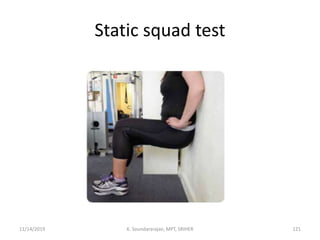
• Static squad test
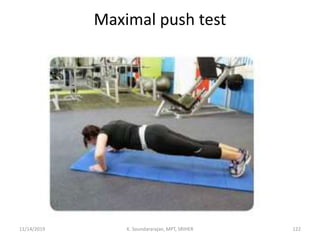
• Maximal push test
11/14/2019 K. Soundararajan, MPT, SRIHER 117
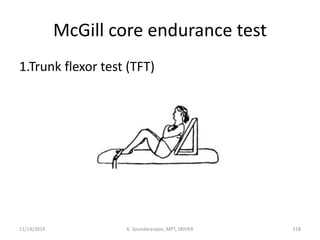
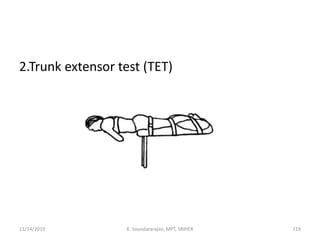
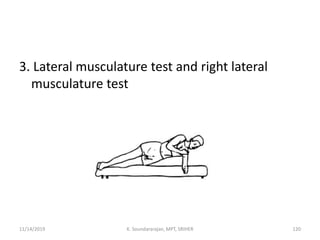
McGill core endurance test
1.Trunk flexor test (TFT)
11/14/2019 K. Soundararajan, MPT, SRIHER 118
2.Trunk extensor test (TET)
11/14/2019 K. Soundararajan, MPT, SRIHER 119
3. Lateral musculature test and right lateral
musculature test
11/14/2019 K. Soundararajan, MPT, SRIHER 120
Static squad test
11/14/2019 K. Soundararajan, MPT, SRIHER 121
Maximal push test
11/14/2019 K. Soundararajan, MPT, SRIHER 122
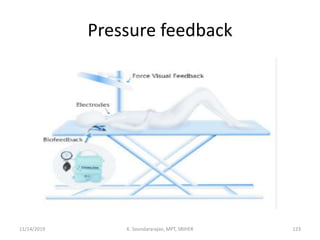
Pressure feedback
11/14/2019 K. Soundararajan, MPT, SRIHER 123
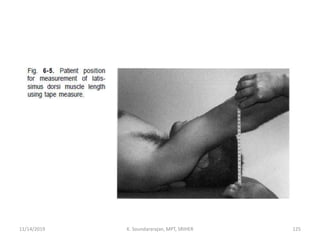
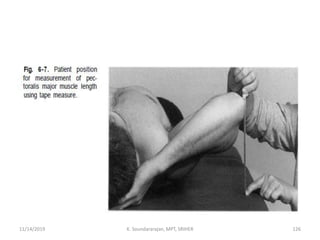
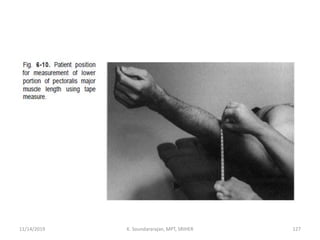
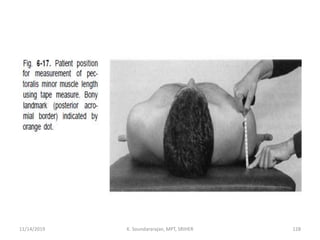
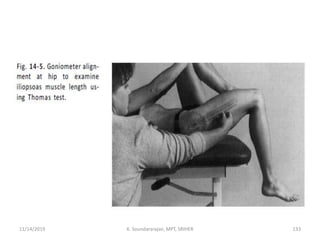
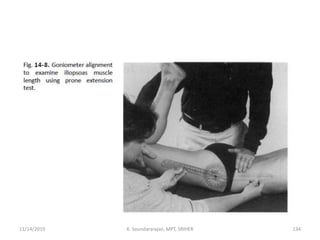
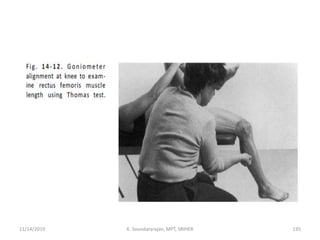
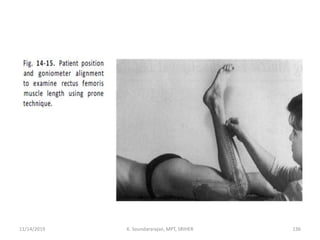
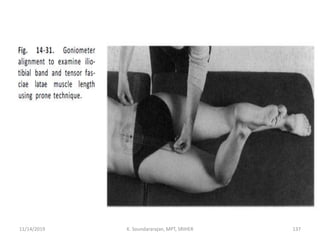
TESTS FOR MUSCLE LENGTH
11/14/2019 K. Soundararajan, MPT, SRIHER 124
11/14/2019 K. Soundararajan, MPT, SRIHER 125
11/14/2019 K. Soundararajan, MPT, SRIHER 126
11/14/2019 K. Soundararajan, MPT, SRIHER 127
11/14/2019 K. Soundararajan, MPT, SRIHER 128
RELIABILITY OF MUSCLE LENGTH
TESTING
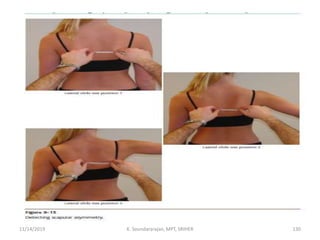
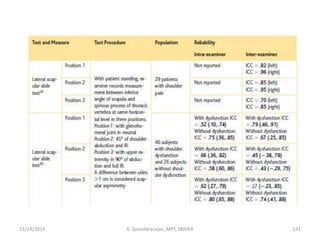
• No research exists as to the reliability of
measurements of muscle length of upper
extremity.
• Such research would be quite valuable for the
clinician attempting to provide an upper
extremity flexibility examination.
11/14/2019 K. Soundararajan, MPT, SRIHER 129
11/14/2019 K. Soundararajan, MPT, SRIHER 130
11/14/2019 K. Soundararajan, MPT, SRIHER 131
TESTS FOR MUSCLE LENGTH:
HAMSTRINGS
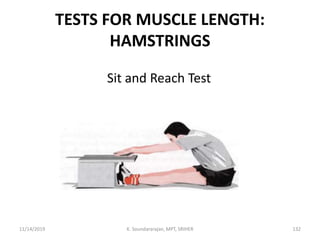
Sit and Reach Test
11/14/2019 K. Soundararajan, MPT, SRIHER 132
11/14/2019 K. Soundararajan, MPT, SRIHER 133
11/14/2019 K. Soundararajan, MPT, SRIHER 134
11/14/2019 K. Soundararajan, MPT, SRIHER 135
11/14/2019 K. Soundararajan, MPT, SRIHER 136
11/14/2019 K. Soundararajan, MPT, SRIHER 137
11/14/2019 K. Soundararajan, MPT, SRIHER 138
11/14/2019 K. Soundararajan, MPT, SRIHER 139
11/14/2019 K. Soundararajan, MPT, SRIHER 140
11/14/2019 K. Soundararajan, MPT, SRIHER 141
11/14/2019 K. Soundararajan, MPT, SRIHER 142
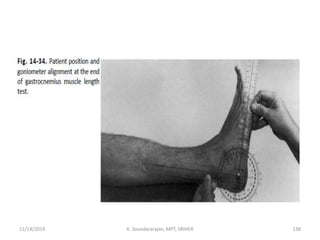
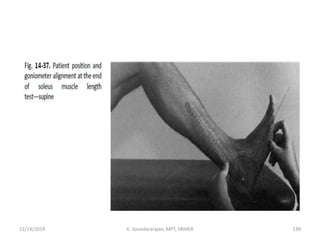
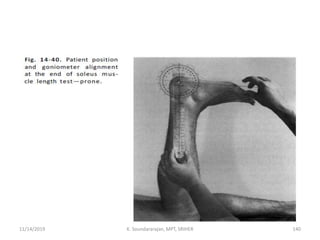
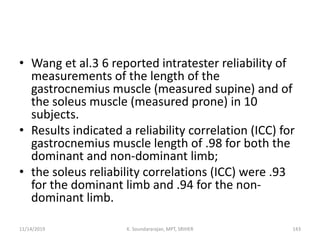
• Wang et al.3 6 reported intratester reliability of
measurements of the length of the
gastrocnemius muscle (measured supine) and of
the soleus muscle (measured prone) in 10
subjects.
• Results indicated a reliability correlation (ICC) for
gastrocnemius muscle length of .98 for both the
dominant and non-dominant limb;
• the soleus reliability correlations (ICC) were .93
for the dominant limb and .94 for the non-
dominant limb.
11/14/2019 K. Soundararajan, MPT, SRIHER 143
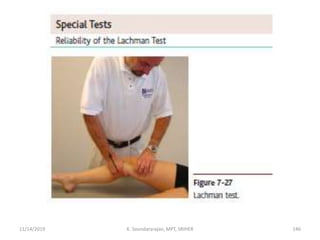
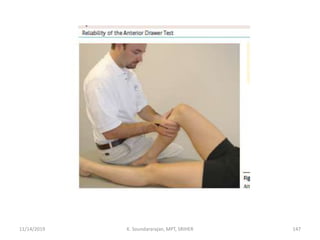
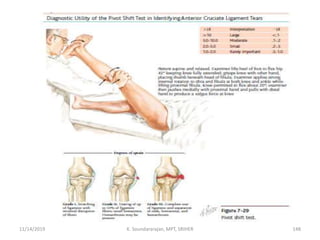
Special test
11/14/2019 K. Soundararajan, MPT, SRIHER 144
11/14/2019 K. Soundararajan, MPT, SRIHER 145
11/14/2019 K. Soundararajan, MPT, SRIHER 146
11/14/2019 K. Soundararajan, MPT, SRIHER 147
11/14/2019 K. Soundararajan, MPT, SRIHER 148
11/14/2019 K. Soundararajan, MPT, SRIHER 149
11/14/2019 K. Soundararajan, MPT, SRIHER 150
11/14/2019 K. Soundararajan, MPT, SRIHER 151
11/14/2019 K. Soundararajan, MPT, SRIHER 152
11/14/2019 K. Soundararajan, MPT, SRIHER 153
11/14/2019 K. Soundararajan, MPT, SRIHER 154
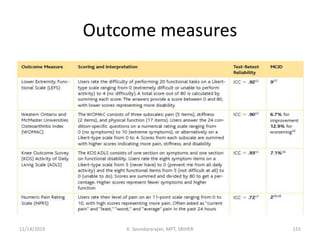
Outcome measures
11/14/2019 K. Soundararajan, MPT, SRIHER 155
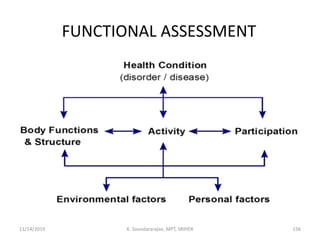
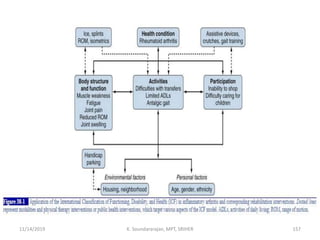
FUNCTIONAL ASSESSMENT
11/14/2019 K. Soundararajan, MPT, SRIHER 156
11/14/2019 K. Soundararajan, MPT, SRIHER 157
PHYSICAL DIAGNOSIS
• Clinical grouping-SIN,Momentary or End range
• Source of problem-joint,inert,contractile &
nervous tissue
11/14/2019 K. Soundararajan, MPT, SRIHER 158
Various Concept
Based Examination
Introduction
11/14/2019 K. Soundararajan, MPT, SRIHER 159
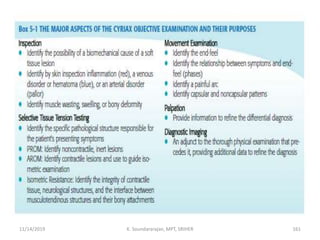
The Cyriax Approach
11/14/2019 K. Soundararajan, MPT, SRIHER 160
11/14/2019 K. Soundararajan, MPT, SRIHER 161
11/14/2019 K. Soundararajan, MPT, SRIHER 162
11/14/2019 K. Soundararajan, MPT, SRIHER 163
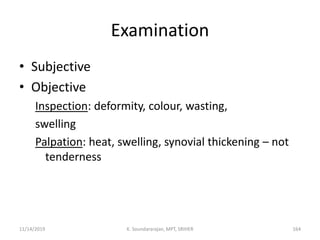
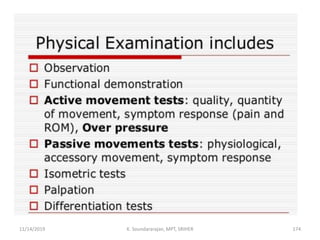
Examination
• Subjective
• Objective
Inspection: deformity, colour, wasting,
swelling
Palpation: heat, swelling, synovial thickening – not
tenderness
11/14/2019 K. Soundararajan, MPT, SRIHER 164
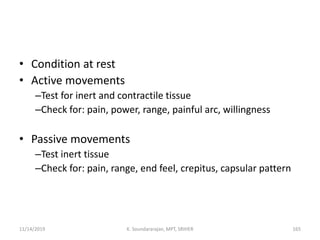
• Condition at rest
• Active movements
–Test for inert and contractile tissue
–Check for: pain, power, range, painful arc, willingness
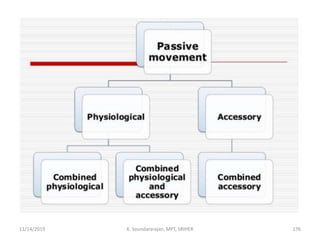
• Passive movements
–Test inert tissue
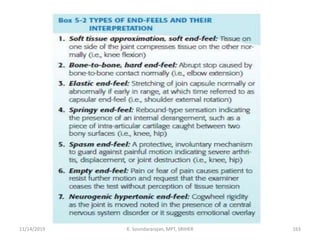
–Check for: pain, range, end feel, crepitus, capsular pattern
11/14/2019 K. Soundararajan, MPT, SRIHER 165
• Resisted Movements
– Test contractile tissue
– Check for: pain and power
• Neurological tests
• Palpation
– To localise exact site of lesion
• Objective tests
– Blood, X-ray, EMG, scan
11/14/2019 K. Soundararajan, MPT, SRIHER 166
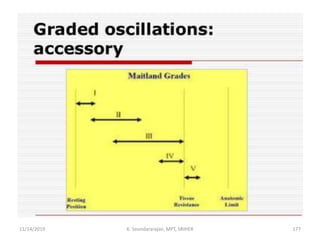
Mobilisations
• Grade A – passive movements within painfree
range
• Grade B - passive movements to end of joint
range
• Grade C - passive movements to end of joint
range & overpressure of minimal amplitude
11/14/2019 K. Soundararajan, MPT, SRIHER 167
11/14/2019 K. Soundararajan, MPT, SRIHER 168
11/14/2019 K. Soundararajan, MPT, SRIHER 169
11/14/2019 K. Soundararajan, MPT, SRIHER 170
11/14/2019 K. Soundararajan, MPT, SRIHER 171
11/14/2019 K. Soundararajan, MPT, SRIHER 172
11/14/2019 K. Soundararajan, MPT, SRIHER 173
11/14/2019 K. Soundararajan, MPT, SRIHER 174
11/14/2019 K. Soundararajan, MPT, SRIHER 175
11/14/2019 K. Soundararajan, MPT, SRIHER 176
11/14/2019 K. Soundararajan, MPT, SRIHER 177
11/14/2019 K. Soundararajan, MPT, SRIHER 178
11/14/2019 K. Soundararajan, MPT, SRIHER 179
11/14/2019 K. Soundararajan, MPT, SRIHER 180
11/14/2019 K. Soundararajan, MPT, SRIHER 181
11/14/2019 K. Soundararajan, MPT, SRIHER 182
11/14/2019 K. Soundararajan, MPT, SRIHER 183
11/14/2019 K. Soundararajan, MPT, SRIHER 184
11/14/2019 K. Soundararajan, MPT, SRIHER 185
11/14/2019 K. Soundararajan, MPT, SRIHER 186
11/14/2019 K. Soundararajan, MPT, SRIHER 187
11/14/2019 K. Soundararajan, MPT, SRIHER 188
11/14/2019 K. Soundararajan, MPT, SRIHER 189
11/14/2019 K. Soundararajan, MPT, SRIHER 190
11/14/2019 K. Soundararajan, MPT, SRIHER 191
11/14/2019 K. Soundararajan, MPT, SRIHER 192
11/14/2019 K. Soundararajan, MPT, SRIHER 193
11/14/2019 K. Soundararajan, MPT, SRIHER 194
11/14/2019 K. Soundararajan, MPT, SRIHER 195
11/14/2019 K. Soundararajan, MPT, SRIHER 196
11/14/2019 K. Soundararajan, MPT, SRIHER 197
11/14/2019 K. Soundararajan, MPT, SRIHER 198
11/14/2019 K. Soundararajan, MPT, SRIHER 199
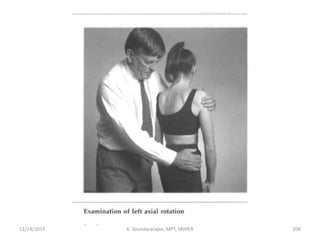
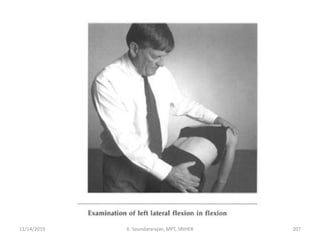
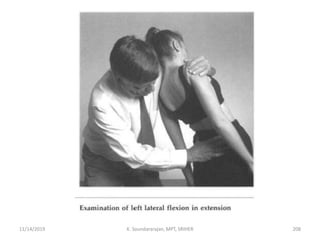
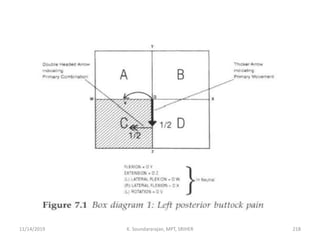
COMBINED MOVEMENTS
11/14/2019 K. Soundararajan, MPT, SRIHER 200
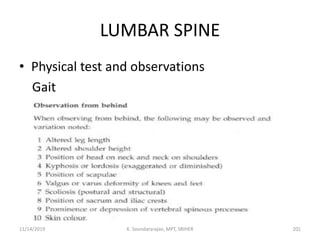
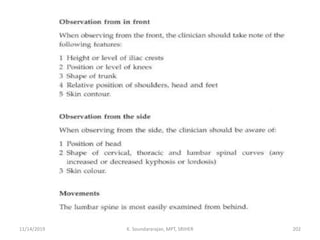
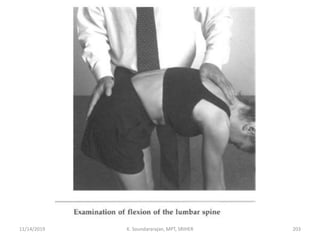
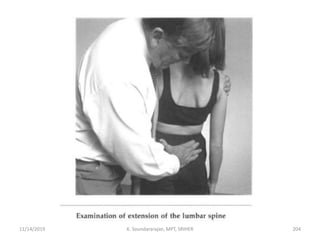
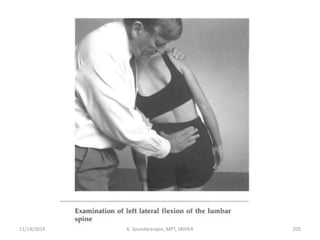
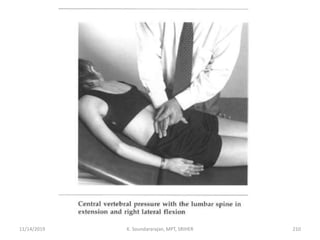
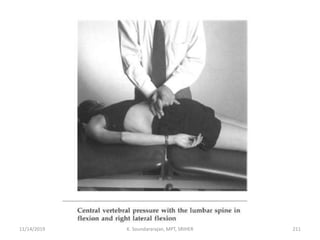
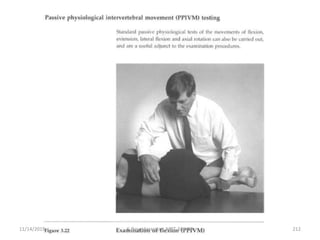
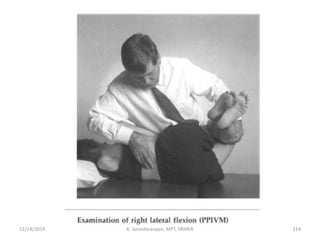
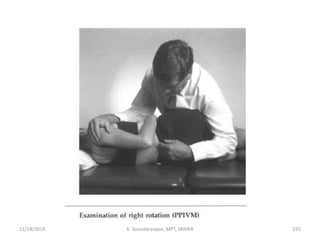
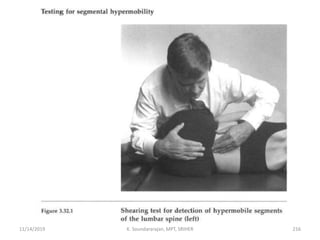
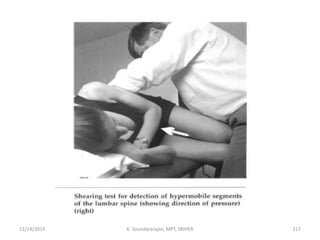
LUMBAR SPINE
• Physical test and observations
Gait
11/14/2019 K. Soundararajan, MPT, SRIHER 201
11/14/2019 K. Soundararajan, MPT, SRIHER 202
11/14/2019 K. Soundararajan, MPT, SRIHER 203
11/14/2019 K. Soundararajan, MPT, SRIHER 204
11/14/2019 K. Soundararajan, MPT, SRIHER 205
11/14/2019 K. Soundararajan, MPT, SRIHER 206
11/14/2019 K. Soundararajan, MPT, SRIHER 207
11/14/2019 K. Soundararajan, MPT, SRIHER 208
11/14/2019 K. Soundararajan, MPT, SRIHER 209
11/14/2019 K. Soundararajan, MPT, SRIHER 210
11/14/2019 K. Soundararajan, MPT, SRIHER 211
11/14/2019 K. Soundararajan, MPT, SRIHER 212
11/14/2019 K. Soundararajan, MPT, SRIHER 213
11/14/2019 K. Soundararajan, MPT, SRIHER 214
11/14/2019 K. Soundararajan, MPT, SRIHER 215
11/14/2019 K. Soundararajan, MPT, SRIHER 216
11/14/2019 K. Soundararajan, MPT, SRIHER 217
11/14/2019 K. Soundararajan, MPT, SRIHER 218
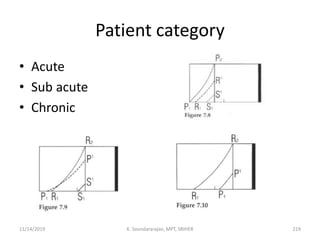
Patient category
• Acute
• Sub acute
• Chronic
11/14/2019 K. Soundararajan, MPT, SRIHER 219
References
11/14/2019 K. Soundararajan, MPT, SRIHER 220
11/14/2019 K. Soundararajan, MPT, SRIHER 221
11/14/2019 K. Soundararajan, MPT, SRIHER 222
Thank you
11/14/2019 K. Soundararajan, MPT, SRIHER 223

Musculoskeletal examination