AEROBIC AND ANAEROBIC
CONDITIONING
K.SOUNDARARAJAN
11/14/2019 K. Soundararajan, MPT, SRIHER 1
Objectives
End of this seminar everyone may understand
what is
โ€ข Aerobic VS Anaerobic Conditioning
โ€ข Principles
โ€ข Adaptation of body
โ€ข Training
11/14/2019 K. Soundararajan, MPT, SRIHER 2
Introduction
โ€ข Conditioning is the process of getting the
cardiovascular and pulmonary systems
working efficiently for a sport by training the
different energy systems
โ€ข (immediate, short-term and long-term).
11/14/2019 K. Soundararajan, MPT, SRIHER 3
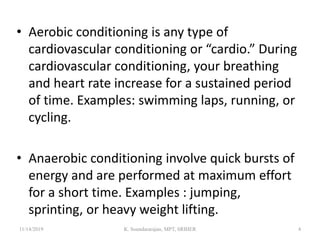
โ€ข Aerobic conditioning is any type of
cardiovascular conditioning or โ€œcardio.โ€ During
cardiovascular conditioning, your breathing
and heart rate increase for a sustained period
of time. Examples: swimming laps, running, or
cycling.
โ€ข Anaerobic conditioning involve quick bursts of
energy and are performed at maximum effort
for a short time. Examples : jumping,
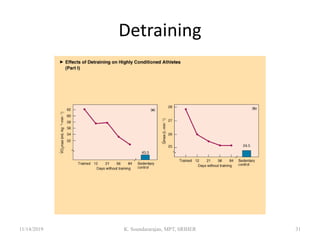
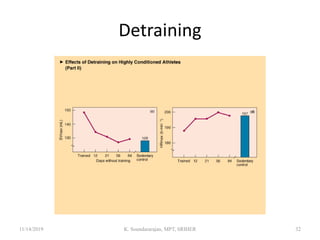
sprinting, or heavy weight lifting.
11/14/2019 K. Soundararajan, MPT, SRIHER 4
โ€ข Respiration rate and Heart rate differ in
aerobic activities versus anaerobic ones.
โ€ข Oxygen is your main energy source during
aerobic workouts.
11/14/2019 K. Soundararajan, MPT, SRIHER 5
โ€ข During aerobic exercise, you breathe faster
and deeper than when your heart rate is at
rest.
โ€ข Youโ€™re maximizing the amount of oxygen in
the blood.
โ€ข Your heart rate goes up, increasing blood flow
to the muscles and back to the lungs.
11/14/2019 K. Soundararajan, MPT, SRIHER 6
โ€ข During anaerobic exercise, your body requires
immediate energy.
โ€ข Your body relies on stored energy sources,
rather than oxygen, to fuel itself.
โ€ข That includes breaking down glucose.
11/14/2019 K. Soundararajan, MPT, SRIHER 7
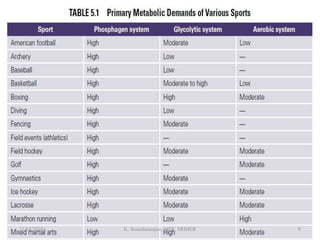
11/14/2019 K. Soundararajan, MPT, SRIHER 8
11/14/2019 K. Soundararajan, MPT, SRIHER 9
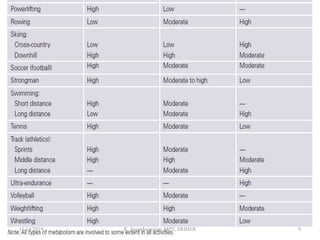
I. ENERGY REQUIREMENTS
๏Training and conditioning for a particular
sport or performance goal must be based
on its energy components.
โ€ข The amount of time spent in practice in
order to meet the energy requirements
varies according to sport demands.
11/14/2019 K. Soundararajan, MPT, SRIHER 10
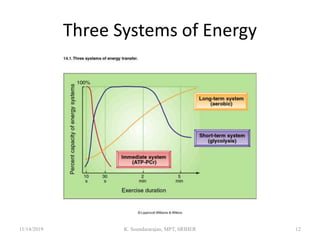
Energy Requirements
B The three energy systems often operate
simultaneously during physical activity.
C Relative contribution of each system to total energy
requirement differs markedly depending on exercise
intensity & duration.
D Magnitude of energy from anaerobic sources
depends on personโ€™s capacity and tolerance for lactic
acid accumulation.
E As exercise intensity diminishes and duration extends
beyond 4 minutes, energy more dependent on
aerobic metabolism.
11/14/2019 K. Soundararajan, MPT, SRIHER 11
Three Systems of Energy
11/14/2019 K. Soundararajan, MPT, SRIHER 12
II. TRAINING PRINCIPLES
Major objective in exercise training is to
cause biological adaptations.
S pecificity
P rogression
O verload
R eversibility
T rait
11/14/2019 K. Soundararajan, MPT, SRIHER 13
1. Specificity of Training
In order for a training program to be
beneficial, it must develop the specific
physiological capabilities required to
perform a given sport or activity.
SAID: specific adaptation to imposed
demand.
11/14/2019 K. Soundararajan, MPT, SRIHER 14
โ€ข It means that when the body is placed under
some form of stress, it starts to make
adaptations that will allow the body to get
better at withstanding that specific form of
stress in the future
โ€ข The SAID principle is one of the most
important basic concepts in sports science
11/14/2019 K. Soundararajan, MPT, SRIHER 15
โ€ข The adaptation process does not occur by any
one mechanism โ€“ it is a tendency of the body
which is played out in innumerable separate
mechanisms
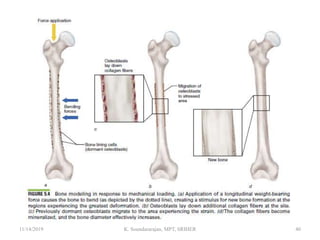
โ€ข If you place mechanical stress on the bones of
the body by shock or impact, this will set in
motion simple physiological processes that
will thicken & harden the bones in the exact
area of stress
โ€ข The dominant arm of a tennis player will have
larger bones than the opposite arm.
11/14/2019 K. Soundararajan, MPT, SRIHER 16
Limitation
โ€ข 1st First is that the training stress must be of
right amount
โ€ข 2nd The stress must be sufficiently specific to
ensure transfer or carryover to your sport or
activity
11/14/2019 K. Soundararajan, MPT, SRIHER 17
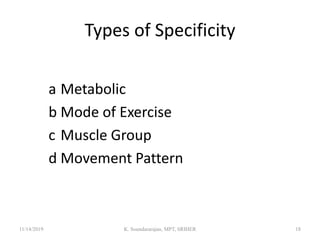
Types of Specificity
a Metabolic
b Mode of Exercise
c Muscle Group
d Movement Pattern
11/14/2019 K. Soundararajan, MPT, SRIHER 18
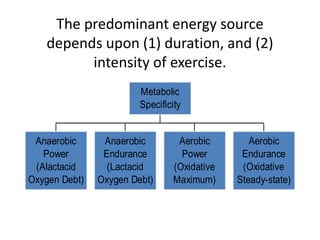
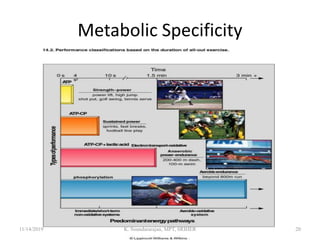
The predominant energy source
depends upon (1) duration, and (2)
intensity of exercise.
Anaerobic
Power
(Alactacid
Oxygen Debt)
Anaerobic
Endurance
(Lactacid
Oxygen Debt)
Aerobic
Power
(Oxidative
Maximum)
Aerobic
Endurance
(Oxidative
Steady-state)
Metabolic
Specificity
Metabolic Specificity
11/14/2019 K. Soundararajan, MPT, SRIHER 20
2. Progressive Overload
Overload must be progressive to
continue to prompt training
adaptations.
11/14/2019 K. Soundararajan, MPT, SRIHER 21
โ€ข In order for a muscle to grow, strength to be
gained, performance to increase, or for any
similar improvement to occur, the human
body must be forced to adapt to a tension
that is above and beyond what it has
previously experienced
11/14/2019 K. Soundararajan, MPT, SRIHER 22
โ€ข Lets pretend that right now a person can lift
50lbs on some exercise for 3sets of 8 reps.
โ€ข Now if you continue this for next 20 yrs, you
will not gain any new muscle or strength
because there is no progressive overload.
โ€ข However,if you were to lift 50lbs for 3 sets of 9
reps on that same exercise,then a reason
would finally exist.why? becโ€™ you increased
the demands,increased the work to your
body& tension.
โ€ข This is progressive overload
11/14/2019 K. Soundararajan, MPT, SRIHER 23
3. Overload
โ€ข Exercising at a level above normal
brings biological adaptations that
improve functional efficiency.
โ€ข In order to overload aerobic or
anaerobic systems, training must be
quantified.
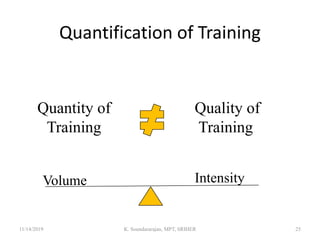
โ€ข Quantity of Training: intensity &
volume (frequency and duration).
11/14/2019 K. Soundararajan, MPT, SRIHER 24
Quantification of Training
Quantity of
Training
Quality of
Training
Volume Intensity
11/14/2019 K. Soundararajan, MPT, SRIHER 25
Intensity of Training
โ€ข Training intensity relates to how hard one
exercises.
โ€ข Exercise intensity represents the most
critical factor for successful training.
11/14/2019 K. Soundararajan, MPT, SRIHER 26
Volume of Training
โ€ข Training adaptations are best achieved when
optimal amount of work in training sessions
โ€ข Optimal amount of work varies individually
โ€ข Training volume can be increased by either
duration or frequency
โ€ข Improvement depends in part on kcals per
session and work/week
11/14/2019 K. Soundararajan, MPT, SRIHER 27
4. Reversibility
โ€ข Most metabolic and cardiorespiratory benefits
gained through exercise training are lost
within relatively short period of time after
training is stopped.
โ€ข In one experiment, VO2 max, maximal stroke
volume and cardiac output decreased roughly
1% per day during 20 days bed rest.
11/14/2019 K. Soundararajan, MPT, SRIHER 28
โ€ข Its The LOSS of training ADAPTATION due
to REDUCTION of training LOAD
โ€ข Any Adaptation occurred as a result of
training will be REVERSED when training is
stopped
โ€ข Eg. Organic or functional Changes occurred as
a result of training will be reversed to original
level in absence of training
11/14/2019 K. Soundararajan, MPT, SRIHER 29
โ€ข Reversibility occurs during recovery period .
โ€ข Recovery Period โ€“ Period Of rest for physical
and mental regeneration
โ€ข Fitness and Adaptation is decreased in this
period
โ€ข Ensure that the gains from training are not
lost .
11/14/2019 K. Soundararajan, MPT, SRIHER 30
Detraining
11/14/2019 K. Soundararajan, MPT, SRIHER 31
Detraining
11/14/2019 K. Soundararajan, MPT, SRIHER 32
5. Individual Traits
โ€ข Relative fitness level at beginning of
training.
โ€ข Trainees respond differently to given
exercise stimulus.
11/14/2019 K. Soundararajan, MPT, SRIHER 33
III. Adaptations to Anaerobic and
Aerobic Training
Training Effect: the chronic anatomic,
morphologic, physiologic, and psychologic
changes that result from repeated exposure
to exercise.
11/14/2019 K. Soundararajan, MPT, SRIHER 34
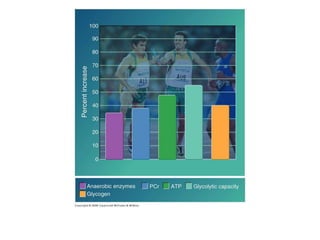
A. Anaerobic Training Effect
1. Increased intramuscular levels of anaerobic
substrates: ATP, CP, and Glycogen
2. Increased quantity and activity of key enzymes
that control anaerobic phase of glycolysis
3. Increased capacity to generate high levels of
blood lactate (and pain tolerance)
o No research for improved buffering capacity.
11/14/2019 K. Soundararajan, MPT, SRIHER 35
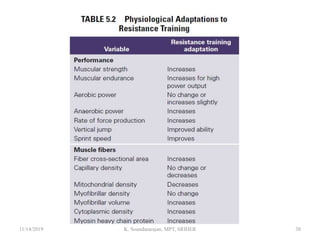
Anaerobic Training Effect
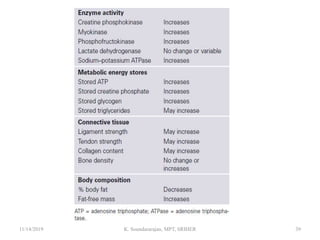
Heart Changes due to pressure overload.
1. Thickened septum
2. Thickening of posterior wall
3. Increased left ventricular mass with no
change in left ventricular end diastolic
volume (concentric hypertrophy)
11/14/2019 K. Soundararajan, MPT, SRIHER 37
11/14/2019 K. Soundararajan, MPT, SRIHER 38
11/14/2019 K. Soundararajan, MPT, SRIHER 39
11/14/2019 K. Soundararajan, MPT, SRIHER 40
11/14/2019 K. Soundararajan, MPT, SRIHER 41
11/14/2019 K. Soundararajan, MPT, SRIHER 42
11/14/2019 K. Soundararajan, MPT, SRIHER 43
11/14/2019 K. Soundararajan, MPT, SRIHER 44
11/14/2019 K. Soundararajan, MPT, SRIHER 45
11/14/2019 K. Soundararajan, MPT, SRIHER 46
11/14/2019 K. Soundararajan, MPT, SRIHER 47
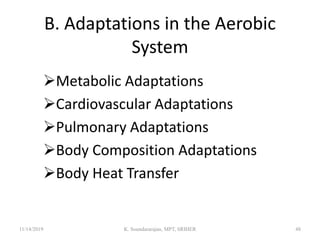
B. Adaptations in the Aerobic
System
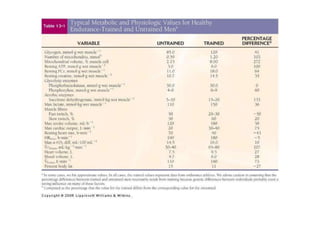
๏ƒ˜Metabolic Adaptations
๏ƒ˜Cardiovascular Adaptations
๏ƒ˜Pulmonary Adaptations
๏ƒ˜Body Composition Adaptations
๏ƒ˜Body Heat Transfer
11/14/2019 K. Soundararajan, MPT, SRIHER 48
11/14/2019 K. Soundararajan, MPT, SRIHER 49
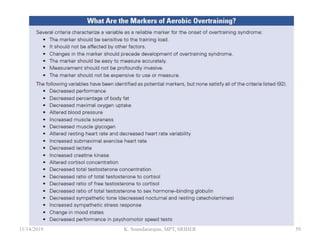
11/14/2019 K. Soundararajan, MPT, SRIHER 50
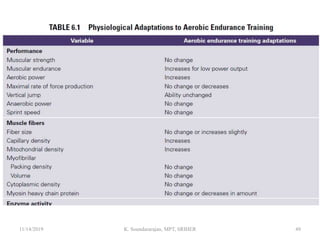
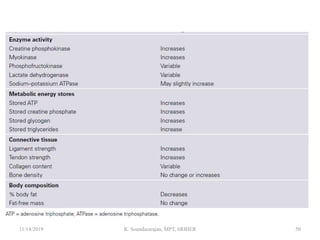
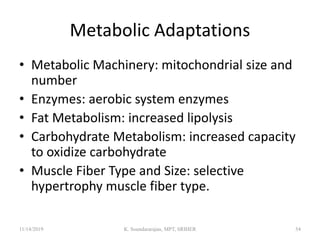
Metabolic Adaptations
โ€ข Metabolic Machinery: mitochondrial size and
number
โ€ข Enzymes: aerobic system enzymes
โ€ข Fat Metabolism: increased lipolysis
โ€ข Carbohydrate Metabolism: increased capacity
to oxidize carbohydrate
โ€ข Muscle Fiber Type and Size: selective
hypertrophy muscle fiber type.
11/14/2019 K. Soundararajan, MPT, SRIHER 54
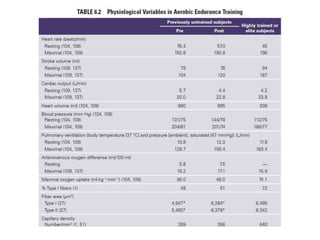
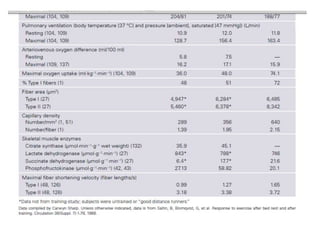
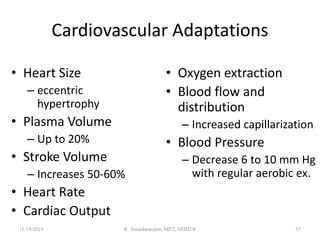
Cardiovascular Adaptations
โ€ข Heart Size
โ€“ eccentric
hypertrophy
โ€ข Plasma Volume
โ€“ Up to 20%
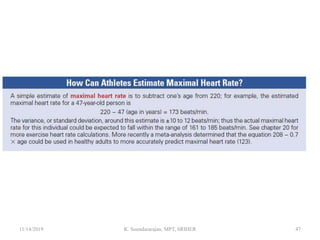
โ€ข Stroke Volume
โ€“ Increases 50-60%
โ€ข Heart Rate
โ€ข Cardiac Output
โ€ข Oxygen extraction
โ€ข Blood flow and
distribution
โ€“ Increased capillarization
โ€ข Blood Pressure
โ€“ Decrease 6 to 10 mm Hg
with regular aerobic ex.
11/14/2019 K. Soundararajan, MPT, SRIHER 55
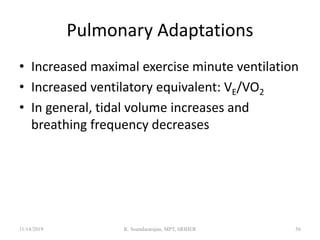
Pulmonary Adaptations
โ€ข Increased maximal exercise minute ventilation
โ€ข Increased ventilatory equivalent: VE/VO2
โ€ข In general, tidal volume increases and
breathing frequency decreases
11/14/2019 K. Soundararajan, MPT, SRIHER 56
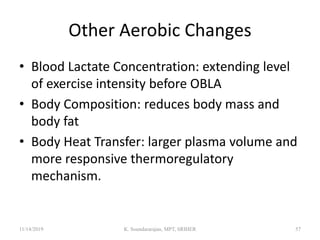
Other Aerobic Changes
โ€ข Blood Lactate Concentration: extending level
of exercise intensity before OBLA
โ€ข Body Composition: reduces body mass and
body fat
โ€ข Body Heat Transfer: larger plasma volume and
more responsive thermoregulatory
mechanism.
11/14/2019 K. Soundararajan, MPT, SRIHER 57
11/14/2019 K. Soundararajan, MPT, SRIHER 58
11/14/2019 K. Soundararajan, MPT, SRIHER 59
VI. ANAEROBIC TRAINING
๏ Goals of Anaerobic Training
B Training Methods
C Prescription Content
D Frequency and Duration
11/14/2019 K. Soundararajan, MPT, SRIHER 60
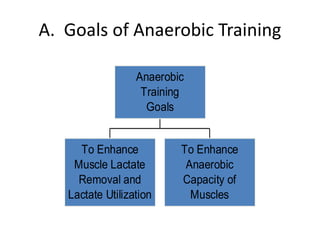
A. Goals of Anaerobic Training
To Enhance
Muscle Lactate
Removal and
Lactate Utilization
To Enhance
Anaerobic
Capacity of
Muscles
Anaerobic
Training
Goals
Anaerobic Training
โ€ข ATP-PCr System: All-out bursts for 5 to 10 sec.
Recovery progresses rapidly (30 to 60 sec).
โ€ข Glycolytic System: Bouts of up to 1 min of
intense, rhythmic repeated several times
interspersed with 3-5 min recovery (โ€œlactate
stackingโ€).
11/14/2019 K. Soundararajan, MPT, SRIHER 62
B. Training Methods
โ€ข Acceleration Sprints: gradual increases
from slow to moderate to full sprinting in
50-100 m segments followed by 50 m light
activity.
โ€ข Sprint Training: Repeated sprints at
maximal speed with complete recovery (5
minutes or more) between repeats. Only 3
to 6 bouts in a session.
โ€ข Interval Training: Repeated periods of work
alternated with periods of relief.11/14/2019 K. Soundararajan, MPT, SRIHER 63
C. Prescription Content
โ€ข Training Time: rate of work during the work
interval (e.g. 200-m in 28 seconds)
โ€ข Repetitions: number of work intervals per
set (e.g. six 200-m runs)
โ€ข Sets: a grouping of work and relief intervals
(e.g. a set is six 200-m runs @ 28 sec, 1:24
rest interval)
โ€ข Work-relief Ratio: time ratio of work and
relief (e.g., 1:2 means relief is twice work)
โ€ข Type of Relief: rest or light to mild exercise11/14/2019 K. Soundararajan, MPT, SRIHER 64
Interval Training Relief Interval
โ€ข 1:3 (work: relief) for training
immediate energy systems
โ€ข 1:2 for training glycolytic energy
systems
โ€ข 1:1 or 1:1ยฝ for training aerobic
energy systems
11/14/2019 K. Soundararajan, MPT, SRIHER 65
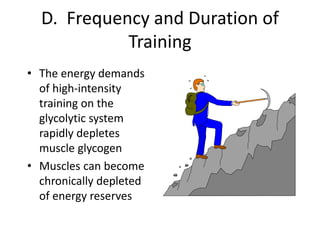
D. Frequency and Duration of
Training
โ€ข The energy demands
of high-intensity
training on the
glycolytic system
rapidly depletes
muscle glycogen
โ€ข Muscles can become
chronically depleted
of energy reserves
V. AEROBIC TRAINING
A. Goals of Aerobic Training
B. Factors Influencing Aerobic Response
C. Guidelines
D. Training Methods
E. Determining Intensity
F. Exercise During Pregnancy
11/14/2019 K. Soundararajan, MPT, SRIHER 67
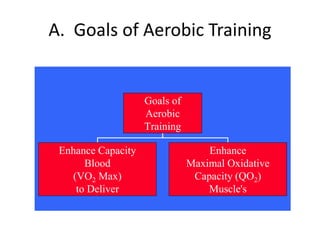
A. Goals of Aerobic Training
Goals of
Aerobic
Training
Enhance Capacity
Blood
(VO2 Max)
to Deliver
Enhance
Maximal Oxidative
Capacity (QO2)
Muscle's
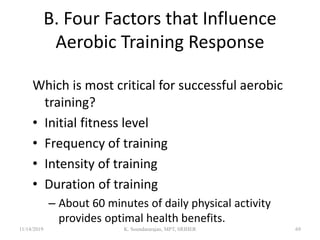
B. Four Factors that Influence
Aerobic Training Response
Which is most critical for successful aerobic
training?
โ€ข Initial fitness level
โ€ข Frequency of training
โ€ข Intensity of training
โ€ข Duration of training
โ€“ About 60 minutes of daily physical activity
provides optimal health benefits.
11/14/2019 K. Soundararajan, MPT, SRIHER 69
C. Guidelines
โ€ข Start slowly: severe muscle discomfort &
excessive cardiovascular strain offer no
benefit
โ€ข Warm up: adjusts coronary blood flow &
hemoglobin unloading
โ€ข Cool-down period: allow metabolism to
regress to resting
11/14/2019 K. Soundararajan, MPT, SRIHER 70
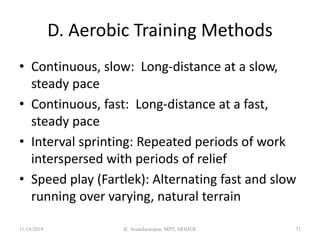
D. Aerobic Training Methods
โ€ข Continuous, slow: Long-distance at a slow,
steady pace
โ€ข Continuous, fast: Long-distance at a fast,
steady pace
โ€ข Interval sprinting: Repeated periods of work
interspersed with periods of relief
โ€ข Speed play (Fartlek): Alternating fast and slow
running over varying, natural terrain
11/14/2019 K. Soundararajan, MPT, SRIHER 71
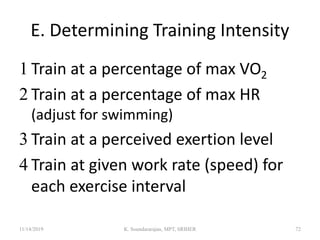
E. Determining Training Intensity
๏€ฑ Train at a percentage of max VO2
๏€ฒ Train at a percentage of max HR
(adjust for swimming)
๏€ณ Train at a perceived exertion level
๏€ด Train at given work rate (speed) for
each exercise interval
11/14/2019 K. Soundararajan, MPT, SRIHER 72
Maintaining Aerobic Fitness
โ€ข Studies reveal that if
exercise intensity is
maintained, the
frequency and
duration of training
can be reduced
considerably without
decrements in aerobic
performance
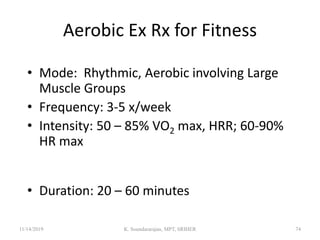
Aerobic Ex Rx for Fitness
โ€ข Mode: Rhythmic, Aerobic involving Large
Muscle Groups
โ€ข Frequency: 3-5 x/week
โ€ข Intensity: 50 โ€“ 85% VO2 max, HRR; 60-90%
HR max (college age 50-55 % HRR or 70%
HR max minimum and 85-90% HRR 90% HR
max upper limit)
โ€ข Duration: 20 โ€“ 60 minutes
11/14/2019 K. Soundararajan, MPT, SRIHER 74
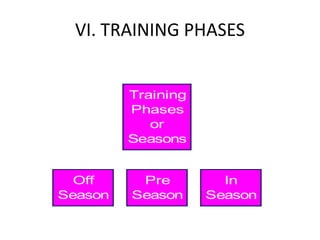
VI. TRAINING PHASES
Off
Season
Pre
Season
In
Season
Training
Phases
or
Seasons
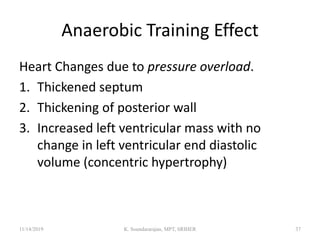
Reference
โ€ข McArdle, William D., Frank I. Katch, and Victor
L. Katch. 2000. Essentials of Exercise
Physiology 2nd ed. Image Collection.
Lippincott Williams & Wilkins.
โ€ข Plowman, Sharon A. and Denise L. Smith.
1998. Digital Image Archive for Exercise
Physiology. Allyn & Bacon.
11/14/2019 K. Soundararajan, MPT, SRIHER 76

Aerobic and Anaerobic Conditioning

  • 1.
  • 2.
    Objectives End of thisseminar everyone may understand what is โ€ข Aerobic VS Anaerobic Conditioning โ€ข Principles โ€ข Adaptation of body โ€ข Training 11/14/2019 K. Soundararajan, MPT, SRIHER 2
  • 3.
    Introduction โ€ข Conditioning isthe process of getting the cardiovascular and pulmonary systems working efficiently for a sport by training the different energy systems โ€ข (immediate, short-term and long-term). 11/14/2019 K. Soundararajan, MPT, SRIHER 3
  • 4.
    โ€ข Aerobic conditioningis any type of cardiovascular conditioning or โ€œcardio.โ€ During cardiovascular conditioning, your breathing and heart rate increase for a sustained period of time. Examples: swimming laps, running, or cycling. โ€ข Anaerobic conditioning involve quick bursts of energy and are performed at maximum effort for a short time. Examples : jumping, sprinting, or heavy weight lifting. 11/14/2019 K. Soundararajan, MPT, SRIHER 4
  • 5.
    โ€ข Respiration rateand Heart rate differ in aerobic activities versus anaerobic ones. โ€ข Oxygen is your main energy source during aerobic workouts. 11/14/2019 K. Soundararajan, MPT, SRIHER 5
  • 6.
    โ€ข During aerobicexercise, you breathe faster and deeper than when your heart rate is at rest. โ€ข Youโ€™re maximizing the amount of oxygen in the blood. โ€ข Your heart rate goes up, increasing blood flow to the muscles and back to the lungs. 11/14/2019 K. Soundararajan, MPT, SRIHER 6
  • 7.
    โ€ข During anaerobicexercise, your body requires immediate energy. โ€ข Your body relies on stored energy sources, rather than oxygen, to fuel itself. โ€ข That includes breaking down glucose. 11/14/2019 K. Soundararajan, MPT, SRIHER 7
  • 8.
  • 9.
  • 10.
    I. ENERGY REQUIREMENTS ๏Trainingand conditioning for a particular sport or performance goal must be based on its energy components. โ€ข The amount of time spent in practice in order to meet the energy requirements varies according to sport demands. 11/14/2019 K. Soundararajan, MPT, SRIHER 10
  • 11.
    Energy Requirements B Thethree energy systems often operate simultaneously during physical activity. C Relative contribution of each system to total energy requirement differs markedly depending on exercise intensity & duration. D Magnitude of energy from anaerobic sources depends on personโ€™s capacity and tolerance for lactic acid accumulation. E As exercise intensity diminishes and duration extends beyond 4 minutes, energy more dependent on aerobic metabolism. 11/14/2019 K. Soundararajan, MPT, SRIHER 11
  • 12.
    Three Systems ofEnergy 11/14/2019 K. Soundararajan, MPT, SRIHER 12
  • 13.
    II. TRAINING PRINCIPLES Majorobjective in exercise training is to cause biological adaptations. S pecificity P rogression O verload R eversibility T rait 11/14/2019 K. Soundararajan, MPT, SRIHER 13
  • 14.
    1. Specificity ofTraining In order for a training program to be beneficial, it must develop the specific physiological capabilities required to perform a given sport or activity. SAID: specific adaptation to imposed demand. 11/14/2019 K. Soundararajan, MPT, SRIHER 14
  • 15.
    โ€ข It meansthat when the body is placed under some form of stress, it starts to make adaptations that will allow the body to get better at withstanding that specific form of stress in the future โ€ข The SAID principle is one of the most important basic concepts in sports science 11/14/2019 K. Soundararajan, MPT, SRIHER 15
  • 16.
    โ€ข The adaptationprocess does not occur by any one mechanism โ€“ it is a tendency of the body which is played out in innumerable separate mechanisms โ€ข If you place mechanical stress on the bones of the body by shock or impact, this will set in motion simple physiological processes that will thicken & harden the bones in the exact area of stress โ€ข The dominant arm of a tennis player will have larger bones than the opposite arm. 11/14/2019 K. Soundararajan, MPT, SRIHER 16
  • 17.
    Limitation โ€ข 1st Firstis that the training stress must be of right amount โ€ข 2nd The stress must be sufficiently specific to ensure transfer or carryover to your sport or activity 11/14/2019 K. Soundararajan, MPT, SRIHER 17
  • 18.
    Types of Specificity aMetabolic b Mode of Exercise c Muscle Group d Movement Pattern 11/14/2019 K. Soundararajan, MPT, SRIHER 18
  • 19.
    The predominant energysource depends upon (1) duration, and (2) intensity of exercise. Anaerobic Power (Alactacid Oxygen Debt) Anaerobic Endurance (Lactacid Oxygen Debt) Aerobic Power (Oxidative Maximum) Aerobic Endurance (Oxidative Steady-state) Metabolic Specificity
  • 20.
    Metabolic Specificity 11/14/2019 K.Soundararajan, MPT, SRIHER 20
  • 21.
    2. Progressive Overload Overloadmust be progressive to continue to prompt training adaptations. 11/14/2019 K. Soundararajan, MPT, SRIHER 21
  • 22.
    โ€ข In orderfor a muscle to grow, strength to be gained, performance to increase, or for any similar improvement to occur, the human body must be forced to adapt to a tension that is above and beyond what it has previously experienced 11/14/2019 K. Soundararajan, MPT, SRIHER 22
  • 23.
    โ€ข Lets pretendthat right now a person can lift 50lbs on some exercise for 3sets of 8 reps. โ€ข Now if you continue this for next 20 yrs, you will not gain any new muscle or strength because there is no progressive overload. โ€ข However,if you were to lift 50lbs for 3 sets of 9 reps on that same exercise,then a reason would finally exist.why? becโ€™ you increased the demands,increased the work to your body& tension. โ€ข This is progressive overload 11/14/2019 K. Soundararajan, MPT, SRIHER 23
  • 24.
    3. Overload โ€ข Exercisingat a level above normal brings biological adaptations that improve functional efficiency. โ€ข In order to overload aerobic or anaerobic systems, training must be quantified. โ€ข Quantity of Training: intensity & volume (frequency and duration). 11/14/2019 K. Soundararajan, MPT, SRIHER 24
  • 25.
    Quantification of Training Quantityof Training Quality of Training Volume Intensity 11/14/2019 K. Soundararajan, MPT, SRIHER 25
  • 26.
    Intensity of Training โ€ขTraining intensity relates to how hard one exercises. โ€ข Exercise intensity represents the most critical factor for successful training. 11/14/2019 K. Soundararajan, MPT, SRIHER 26
  • 27.
    Volume of Training โ€ขTraining adaptations are best achieved when optimal amount of work in training sessions โ€ข Optimal amount of work varies individually โ€ข Training volume can be increased by either duration or frequency โ€ข Improvement depends in part on kcals per session and work/week 11/14/2019 K. Soundararajan, MPT, SRIHER 27
  • 28.
    4. Reversibility โ€ข Mostmetabolic and cardiorespiratory benefits gained through exercise training are lost within relatively short period of time after training is stopped. โ€ข In one experiment, VO2 max, maximal stroke volume and cardiac output decreased roughly 1% per day during 20 days bed rest. 11/14/2019 K. Soundararajan, MPT, SRIHER 28
  • 29.
    โ€ข Its TheLOSS of training ADAPTATION due to REDUCTION of training LOAD โ€ข Any Adaptation occurred as a result of training will be REVERSED when training is stopped โ€ข Eg. Organic or functional Changes occurred as a result of training will be reversed to original level in absence of training 11/14/2019 K. Soundararajan, MPT, SRIHER 29
  • 30.
    โ€ข Reversibility occursduring recovery period . โ€ข Recovery Period โ€“ Period Of rest for physical and mental regeneration โ€ข Fitness and Adaptation is decreased in this period โ€ข Ensure that the gains from training are not lost . 11/14/2019 K. Soundararajan, MPT, SRIHER 30
  • 31.
  • 32.
  • 33.
    5. Individual Traits โ€ขRelative fitness level at beginning of training. โ€ข Trainees respond differently to given exercise stimulus. 11/14/2019 K. Soundararajan, MPT, SRIHER 33
  • 34.
    III. Adaptations toAnaerobic and Aerobic Training Training Effect: the chronic anatomic, morphologic, physiologic, and psychologic changes that result from repeated exposure to exercise. 11/14/2019 K. Soundararajan, MPT, SRIHER 34
  • 35.
    A. Anaerobic TrainingEffect 1. Increased intramuscular levels of anaerobic substrates: ATP, CP, and Glycogen 2. Increased quantity and activity of key enzymes that control anaerobic phase of glycolysis 3. Increased capacity to generate high levels of blood lactate (and pain tolerance) o No research for improved buffering capacity. 11/14/2019 K. Soundararajan, MPT, SRIHER 35
  • 37.
    Anaerobic Training Effect HeartChanges due to pressure overload. 1. Thickened septum 2. Thickening of posterior wall 3. Increased left ventricular mass with no change in left ventricular end diastolic volume (concentric hypertrophy) 11/14/2019 K. Soundararajan, MPT, SRIHER 37
  • 38.
  • 39.
  • 40.
  • 41.
  • 42.
  • 43.
  • 44.
  • 45.
  • 46.
  • 47.
  • 48.
    B. Adaptations inthe Aerobic System ๏ƒ˜Metabolic Adaptations ๏ƒ˜Cardiovascular Adaptations ๏ƒ˜Pulmonary Adaptations ๏ƒ˜Body Composition Adaptations ๏ƒ˜Body Heat Transfer 11/14/2019 K. Soundararajan, MPT, SRIHER 48
  • 49.
  • 50.
  • 54.
    Metabolic Adaptations โ€ข MetabolicMachinery: mitochondrial size and number โ€ข Enzymes: aerobic system enzymes โ€ข Fat Metabolism: increased lipolysis โ€ข Carbohydrate Metabolism: increased capacity to oxidize carbohydrate โ€ข Muscle Fiber Type and Size: selective hypertrophy muscle fiber type. 11/14/2019 K. Soundararajan, MPT, SRIHER 54
  • 55.
    Cardiovascular Adaptations โ€ข HeartSize โ€“ eccentric hypertrophy โ€ข Plasma Volume โ€“ Up to 20% โ€ข Stroke Volume โ€“ Increases 50-60% โ€ข Heart Rate โ€ข Cardiac Output โ€ข Oxygen extraction โ€ข Blood flow and distribution โ€“ Increased capillarization โ€ข Blood Pressure โ€“ Decrease 6 to 10 mm Hg with regular aerobic ex. 11/14/2019 K. Soundararajan, MPT, SRIHER 55
  • 56.
    Pulmonary Adaptations โ€ข Increasedmaximal exercise minute ventilation โ€ข Increased ventilatory equivalent: VE/VO2 โ€ข In general, tidal volume increases and breathing frequency decreases 11/14/2019 K. Soundararajan, MPT, SRIHER 56
  • 57.
    Other Aerobic Changes โ€ขBlood Lactate Concentration: extending level of exercise intensity before OBLA โ€ข Body Composition: reduces body mass and body fat โ€ข Body Heat Transfer: larger plasma volume and more responsive thermoregulatory mechanism. 11/14/2019 K. Soundararajan, MPT, SRIHER 57
  • 58.
  • 59.
  • 60.
    VI. ANAEROBIC TRAINING ๏Goals of Anaerobic Training B Training Methods C Prescription Content D Frequency and Duration 11/14/2019 K. Soundararajan, MPT, SRIHER 60
  • 61.
    A. Goals ofAnaerobic Training To Enhance Muscle Lactate Removal and Lactate Utilization To Enhance Anaerobic Capacity of Muscles Anaerobic Training Goals
  • 62.
    Anaerobic Training โ€ข ATP-PCrSystem: All-out bursts for 5 to 10 sec. Recovery progresses rapidly (30 to 60 sec). โ€ข Glycolytic System: Bouts of up to 1 min of intense, rhythmic repeated several times interspersed with 3-5 min recovery (โ€œlactate stackingโ€). 11/14/2019 K. Soundararajan, MPT, SRIHER 62
  • 63.
    B. Training Methods โ€ขAcceleration Sprints: gradual increases from slow to moderate to full sprinting in 50-100 m segments followed by 50 m light activity. โ€ข Sprint Training: Repeated sprints at maximal speed with complete recovery (5 minutes or more) between repeats. Only 3 to 6 bouts in a session. โ€ข Interval Training: Repeated periods of work alternated with periods of relief.11/14/2019 K. Soundararajan, MPT, SRIHER 63
  • 64.
    C. Prescription Content โ€ขTraining Time: rate of work during the work interval (e.g. 200-m in 28 seconds) โ€ข Repetitions: number of work intervals per set (e.g. six 200-m runs) โ€ข Sets: a grouping of work and relief intervals (e.g. a set is six 200-m runs @ 28 sec, 1:24 rest interval) โ€ข Work-relief Ratio: time ratio of work and relief (e.g., 1:2 means relief is twice work) โ€ข Type of Relief: rest or light to mild exercise11/14/2019 K. Soundararajan, MPT, SRIHER 64
  • 65.
    Interval Training ReliefInterval โ€ข 1:3 (work: relief) for training immediate energy systems โ€ข 1:2 for training glycolytic energy systems โ€ข 1:1 or 1:1ยฝ for training aerobic energy systems 11/14/2019 K. Soundararajan, MPT, SRIHER 65
  • 66.
    D. Frequency andDuration of Training โ€ข The energy demands of high-intensity training on the glycolytic system rapidly depletes muscle glycogen โ€ข Muscles can become chronically depleted of energy reserves
  • 67.
    V. AEROBIC TRAINING A.Goals of Aerobic Training B. Factors Influencing Aerobic Response C. Guidelines D. Training Methods E. Determining Intensity F. Exercise During Pregnancy 11/14/2019 K. Soundararajan, MPT, SRIHER 67
  • 68.
    A. Goals ofAerobic Training Goals of Aerobic Training Enhance Capacity Blood (VO2 Max) to Deliver Enhance Maximal Oxidative Capacity (QO2) Muscle's
  • 69.
    B. Four Factorsthat Influence Aerobic Training Response Which is most critical for successful aerobic training? โ€ข Initial fitness level โ€ข Frequency of training โ€ข Intensity of training โ€ข Duration of training โ€“ About 60 minutes of daily physical activity provides optimal health benefits. 11/14/2019 K. Soundararajan, MPT, SRIHER 69
  • 70.
    C. Guidelines โ€ข Startslowly: severe muscle discomfort & excessive cardiovascular strain offer no benefit โ€ข Warm up: adjusts coronary blood flow & hemoglobin unloading โ€ข Cool-down period: allow metabolism to regress to resting 11/14/2019 K. Soundararajan, MPT, SRIHER 70
  • 71.
    D. Aerobic TrainingMethods โ€ข Continuous, slow: Long-distance at a slow, steady pace โ€ข Continuous, fast: Long-distance at a fast, steady pace โ€ข Interval sprinting: Repeated periods of work interspersed with periods of relief โ€ข Speed play (Fartlek): Alternating fast and slow running over varying, natural terrain 11/14/2019 K. Soundararajan, MPT, SRIHER 71
  • 72.
    E. Determining TrainingIntensity ๏€ฑ Train at a percentage of max VO2 ๏€ฒ Train at a percentage of max HR (adjust for swimming) ๏€ณ Train at a perceived exertion level ๏€ด Train at given work rate (speed) for each exercise interval 11/14/2019 K. Soundararajan, MPT, SRIHER 72
  • 73.
    Maintaining Aerobic Fitness โ€ขStudies reveal that if exercise intensity is maintained, the frequency and duration of training can be reduced considerably without decrements in aerobic performance
  • 74.
    Aerobic Ex Rxfor Fitness โ€ข Mode: Rhythmic, Aerobic involving Large Muscle Groups โ€ข Frequency: 3-5 x/week โ€ข Intensity: 50 โ€“ 85% VO2 max, HRR; 60-90% HR max (college age 50-55 % HRR or 70% HR max minimum and 85-90% HRR 90% HR max upper limit) โ€ข Duration: 20 โ€“ 60 minutes 11/14/2019 K. Soundararajan, MPT, SRIHER 74
  • 75.
  • 76.
    Reference โ€ข McArdle, WilliamD., Frank I. Katch, and Victor L. Katch. 2000. Essentials of Exercise Physiology 2nd ed. Image Collection. Lippincott Williams & Wilkins. โ€ข Plowman, Sharon A. and Denise L. Smith. 1998. Digital Image Archive for Exercise Physiology. Allyn & Bacon. 11/14/2019 K. Soundararajan, MPT, SRIHER 76