>> 0 >> 1 >> 2 >> 3 >> 4 >>
Posture Assessment
>> 0 >> 1 >> 2 >> 3 >> 4 >>
Assessment of posture
HIPS
•H istory
•I nspection(Observation)
•P alpation
•S pecial (Functional) Tests
>> 0 >> 1 >> 2 >> 3 >> 4 >>
History
• Was there any history of injury? if so what was
the mechanism of injury?
• If there is h/o had the patient experienced any
back injury previously? if so what caused the
pain?
• Is there any posture that relieves pain or
increase symptoms?
• Does the family have any h/o back or anr
special problems(congenital abnormalities)?
>> 0 >> 1 >> 2 >> 3 >> 4 >>
• Any Previous illness ,surgery, injury?
• Any h/o other conditions(connective tissue
disorder?
• Does the foot wear make any difference to
the patients posture or symptoms?
• Age of patient(degeneration changes)?
• In child ,if growth spurt-when it began?
>> 0 >> 1 >> 2 >> 3 >> 4 >>
• For females, when menarche begin? any back
pain during menses?
• If deformity present-progressive or stationary?
• Any neurological symptoms?
• Nature ,extent,type,duration of pain?
• In children is there any difficulty in fitting
clothes?(scoliosis)
>> 0 >> 1 >> 2 >> 3 >> 4 >>
• Any difficulty in breathing?
• Dominant hand?
• Any previous treatment? what ?was it
successful?
• Driving, sitting, and sleeping postures
• Level and intensity of exercise
>> 0 >> 1 >> 2 >> 3 >> 4 >>
OBSERVATION
• Considerations
– Area being used is private, comfortable
– Patient preparedness
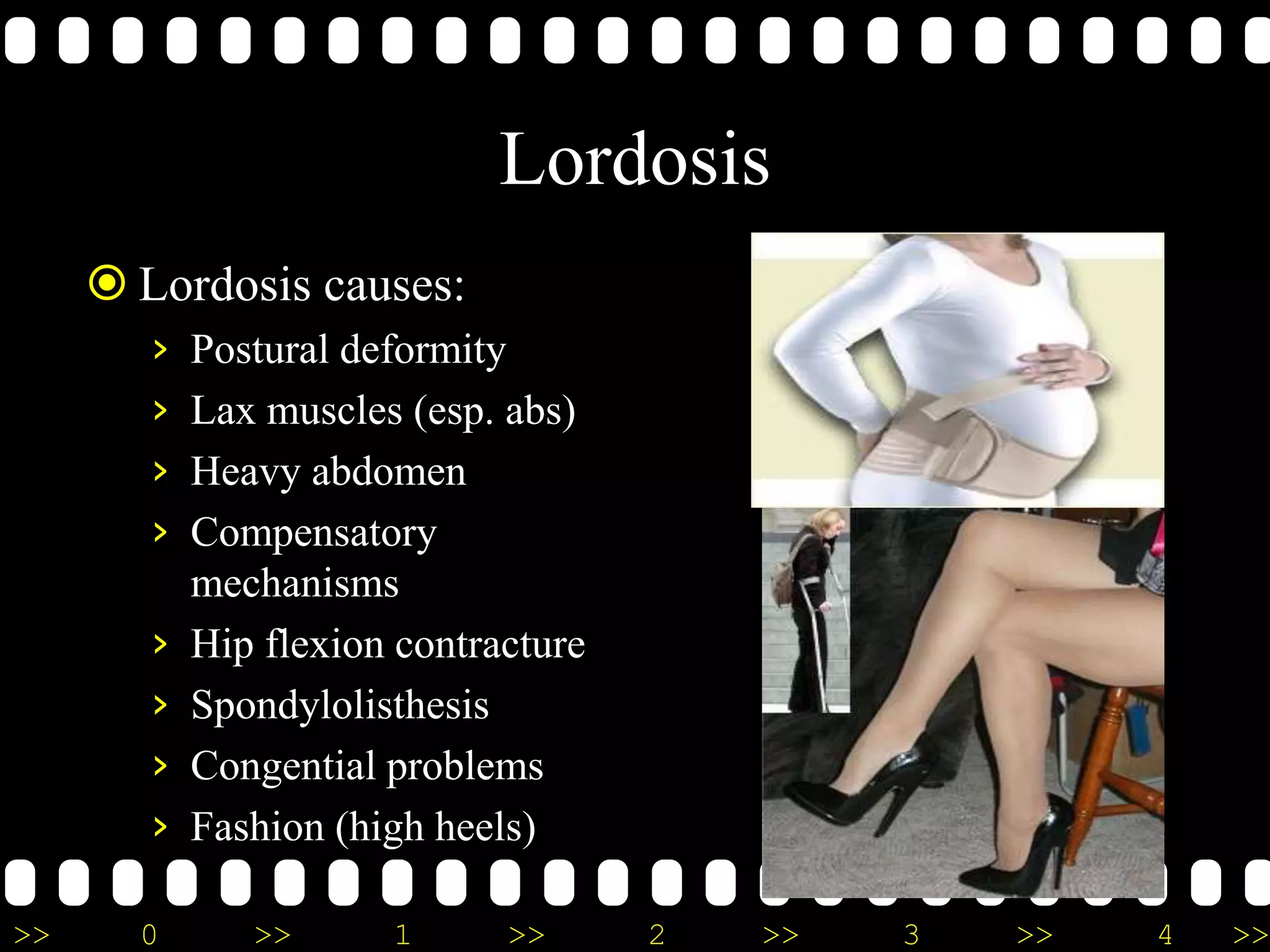
– Do not inform patient you are assessing posture
– Use systematic approach
• Start at feet and work superiorly or vice versa
– Compare bilaterally for symmetry
– Your eyes should be at level of region you are observing
• Note any use of assisstive device
• Habitual relaxed posture must be examined
>> 0 >> 1 >> 2 >> 3 >> 4 >>
• Asymmetry
1.standing
2.sitting
3.lying(supine,prone)
• Presence of muscle wastings
• Soft tissue/bony swelling /enlargement
• Scars and skin changes
>> 0 >> 1 >> 2 >> 3 >> 4 >>
Observation
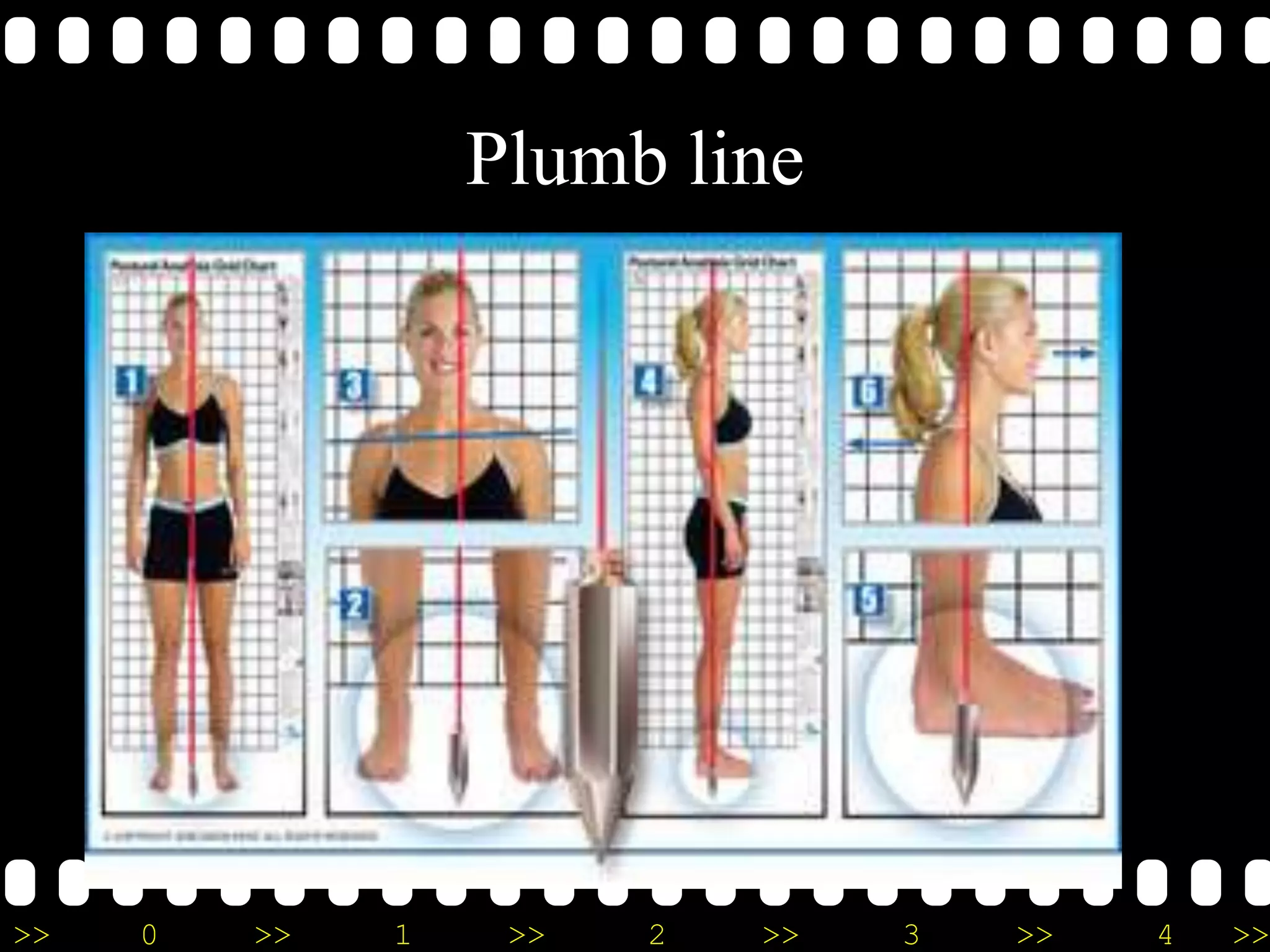
• Use of a plumb line
– Anatomical reference
– 3 views
• Lateral (sagittal plane movements)
• Anterior (frontal/ transverse plane movements)
• Posterior (frontal/ transverse plane movements)
>> 0 >> 1 >> 2 >> 3 >> 4 >>
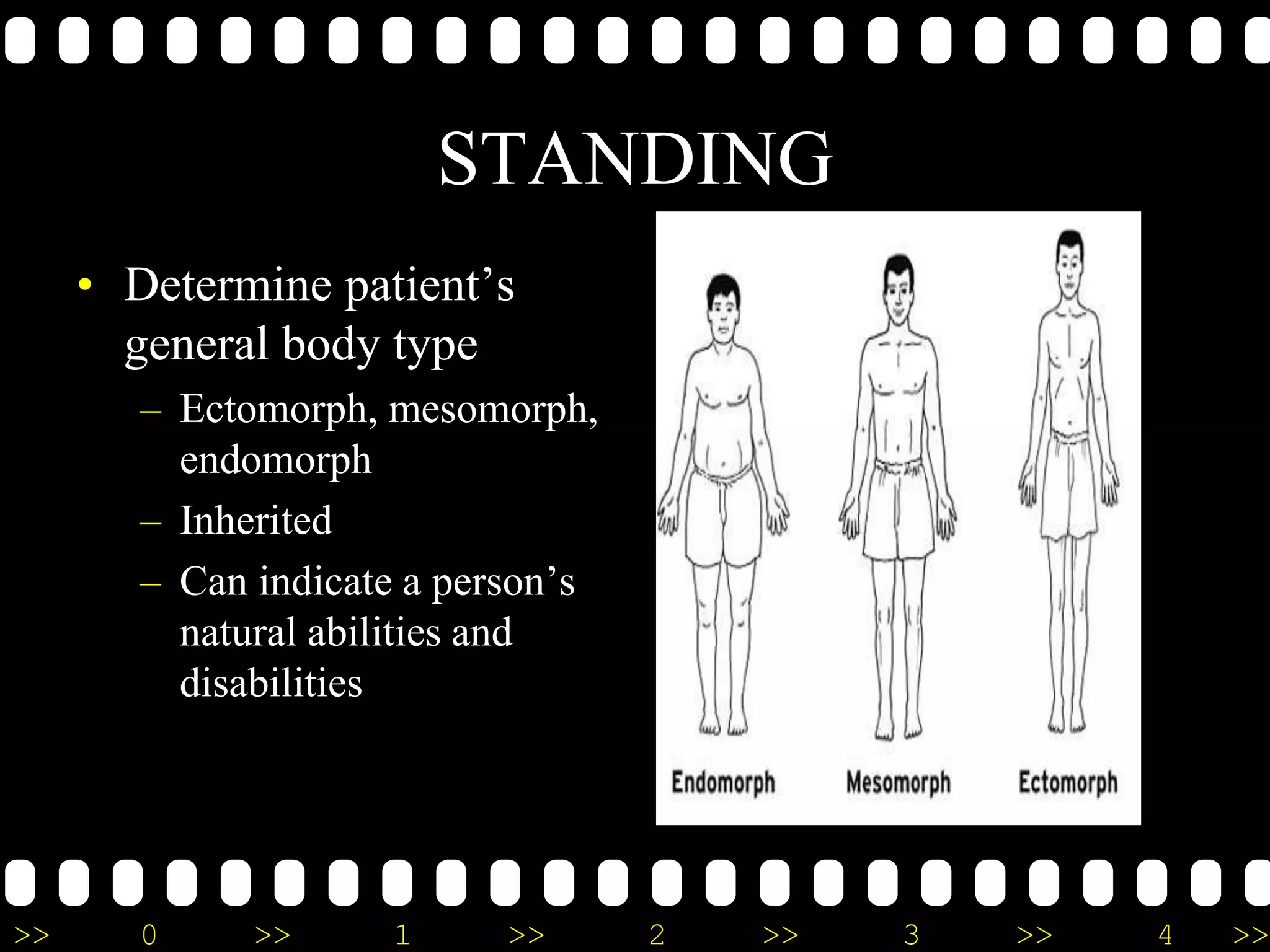
STANDING
• Determine patient’s
general body type
– Ectomorph, mesomorph,
endomorph
– Inherited
– Can indicate a person’s
natural abilities and
disabilities
>> 0 >> 1 >> 2 >> 3 >> 4 >>
Plumb line
>> 0 >> 1 >> 2 >> 3 >> 4 >>
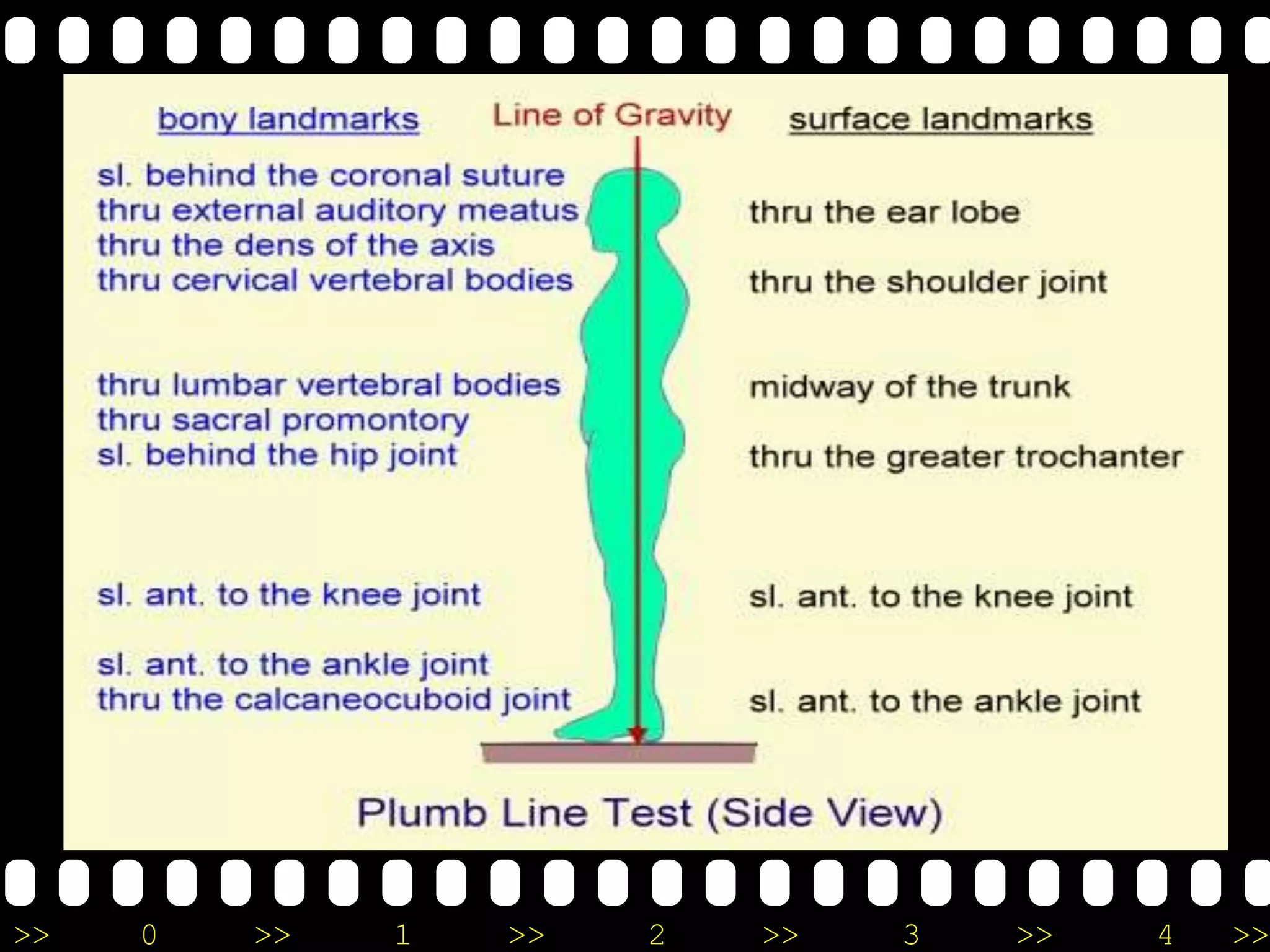
Plumb line test(lateral view)
The plumb line is placed just in front of lateral
malleolus or through greater trochanter.
The individual to be tested is asked to take a
few steps in place and then stand still with the
feet at approximately the width of the hip
joints, the arms relaxed at the side of the body,
and the eyes looking forward
>> 0 >> 1 >> 2 >> 3 >> 4 >>
>> 0 >> 1 >> 2 >> 3 >> 4 >>
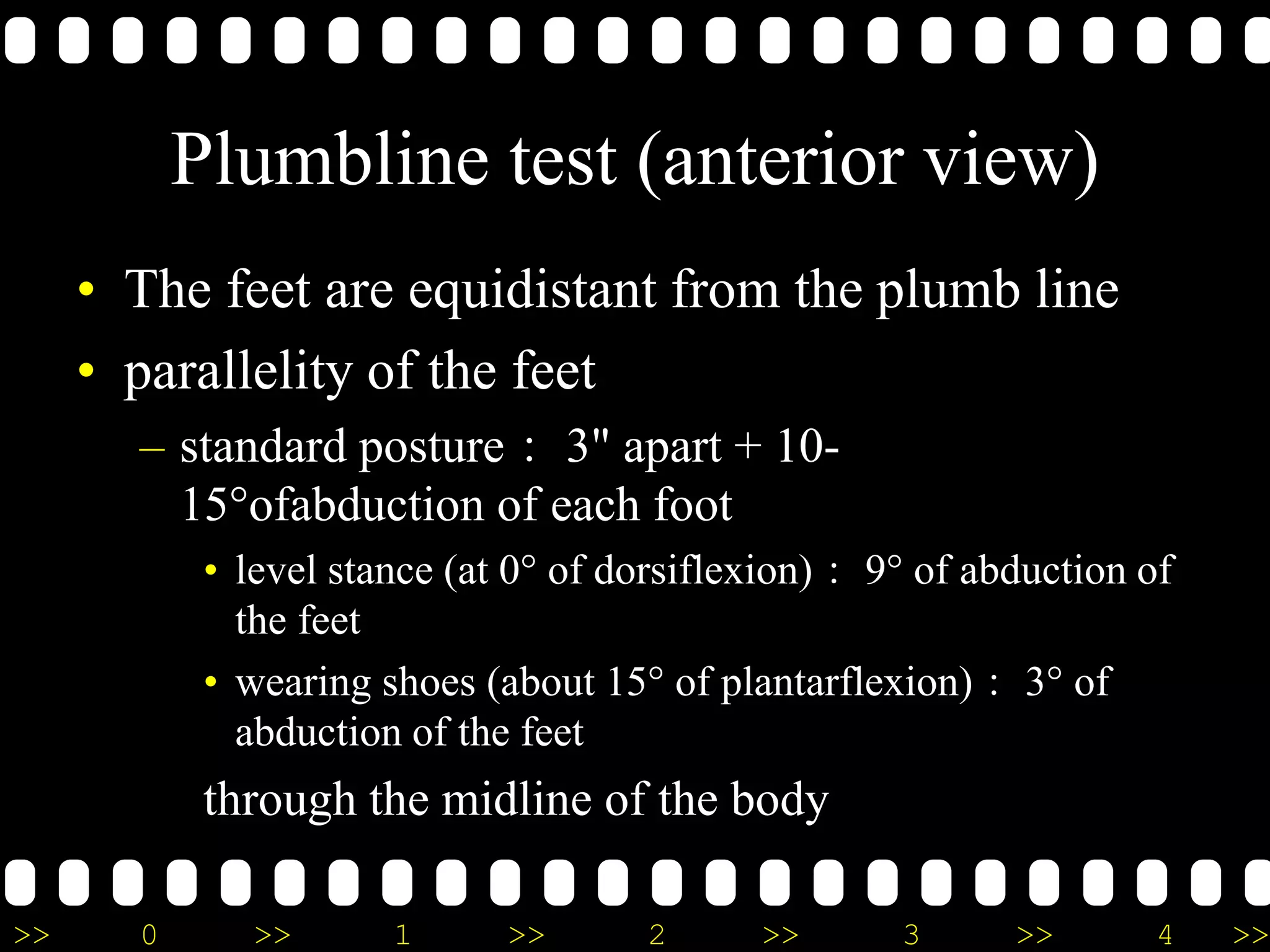
Plumbline test (anterior view)
• The feet are equidistant from the plumb line
• parallelity of the feet
– standard posture: 3" apart + 10-
15°ofabduction of each foot
• level stance (at 0° of dorsiflexion): 9° of abduction of
the feet
• wearing shoes (about 15° of plantarflexion): 3° of
abduction of the feet
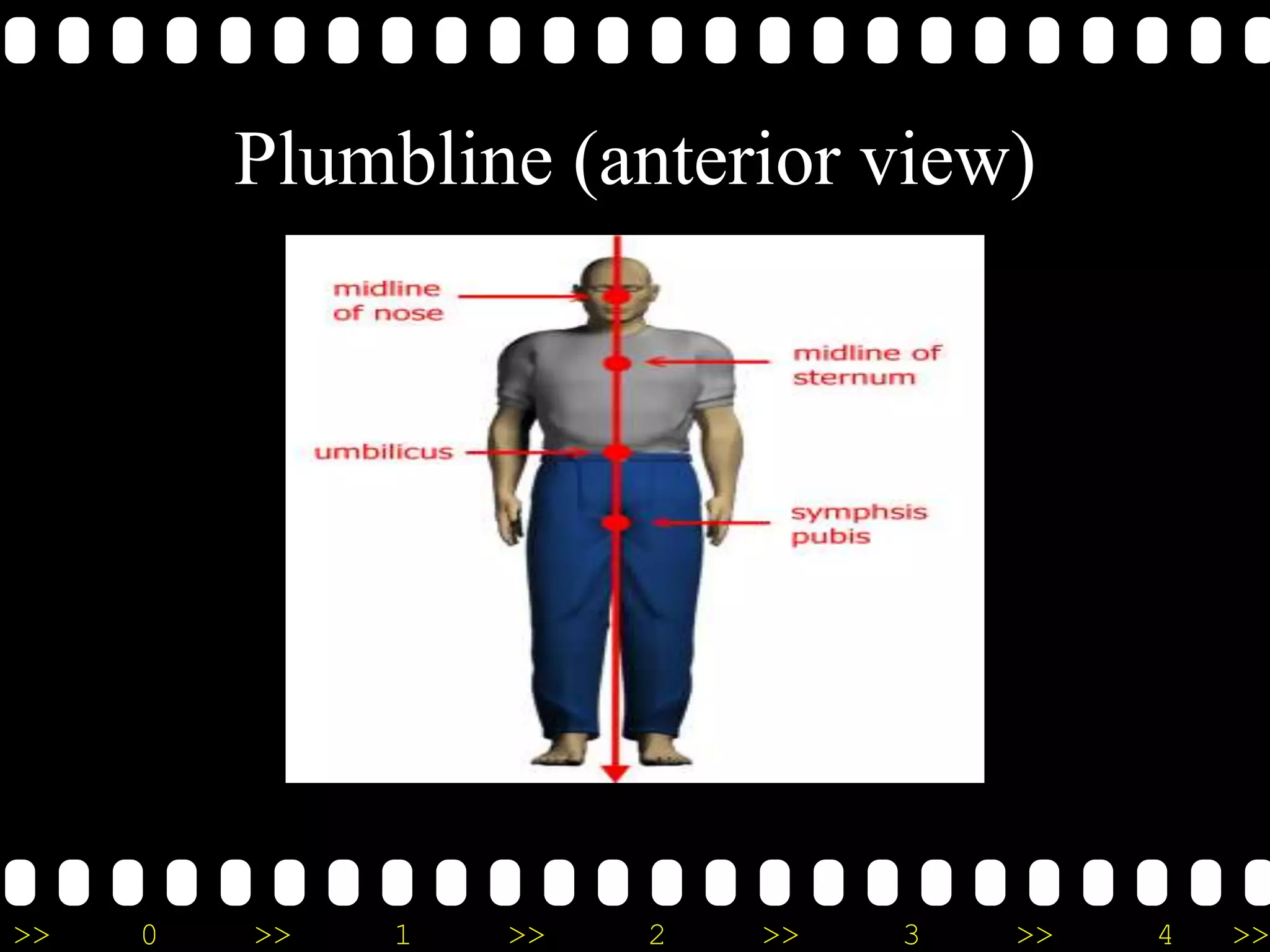
through the midline of the body
>> 0 >> 1 >> 2 >> 3 >> 4 >>
Plumbline (anterior view)
>> 0 >> 1 >> 2 >> 3 >> 4 >>
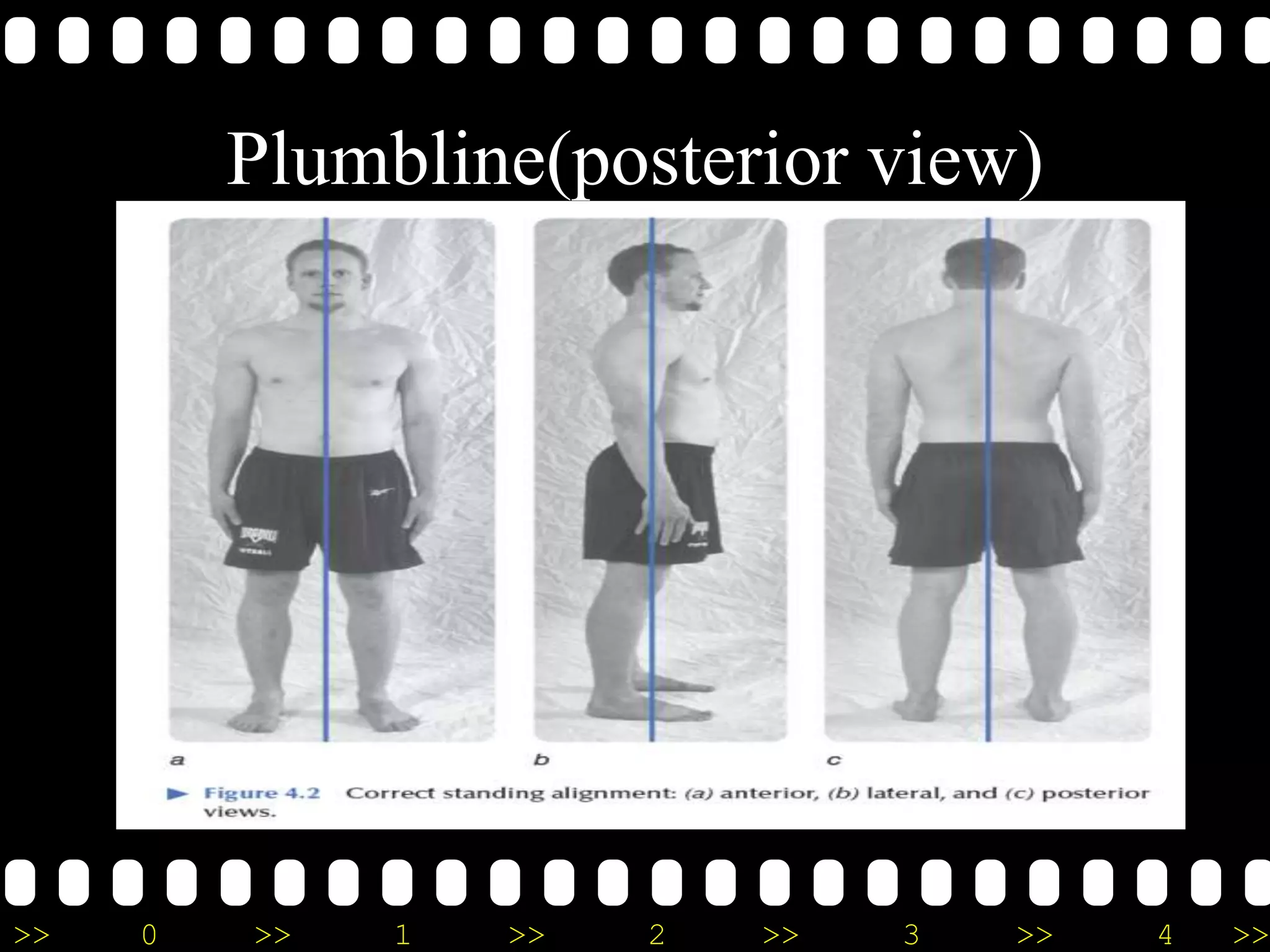
Plumbline(posterior view)
>> 0 >> 1 >> 2 >> 3 >> 4 >>
Observation and
documentation of
plumbline measurement
>> 0 >> 1 >> 2 >> 3 >> 4 >>
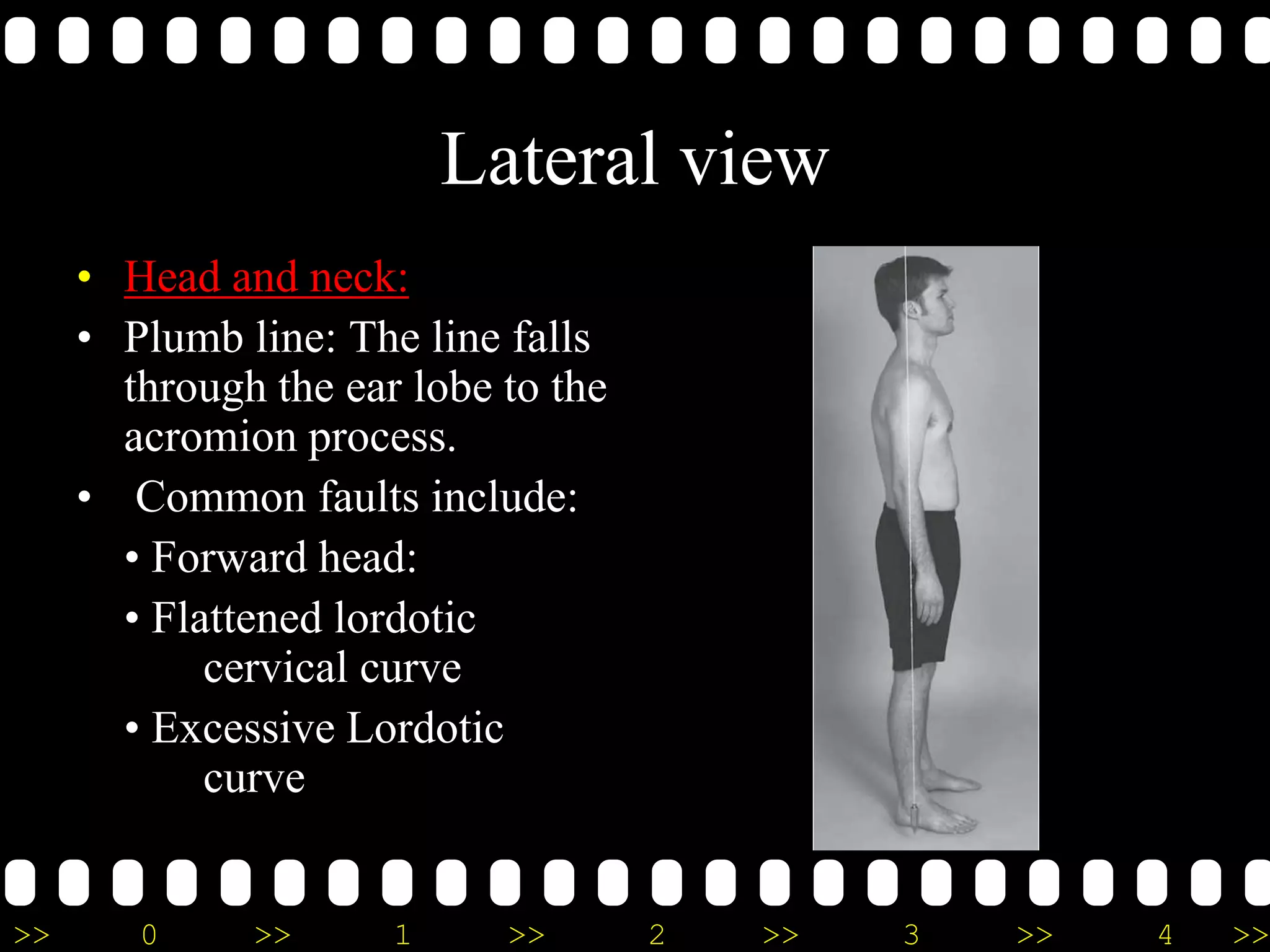
Lateral view
• Head and neck:
• Plumb line: The line falls
through the ear lobe to the
acromion process.
• Common faults include:
• Forward head:
• Flattened lordotic
cervical curve
• Excessive Lordotic
curve
>> 0 >> 1 >> 2 >> 3 >> 4 >>
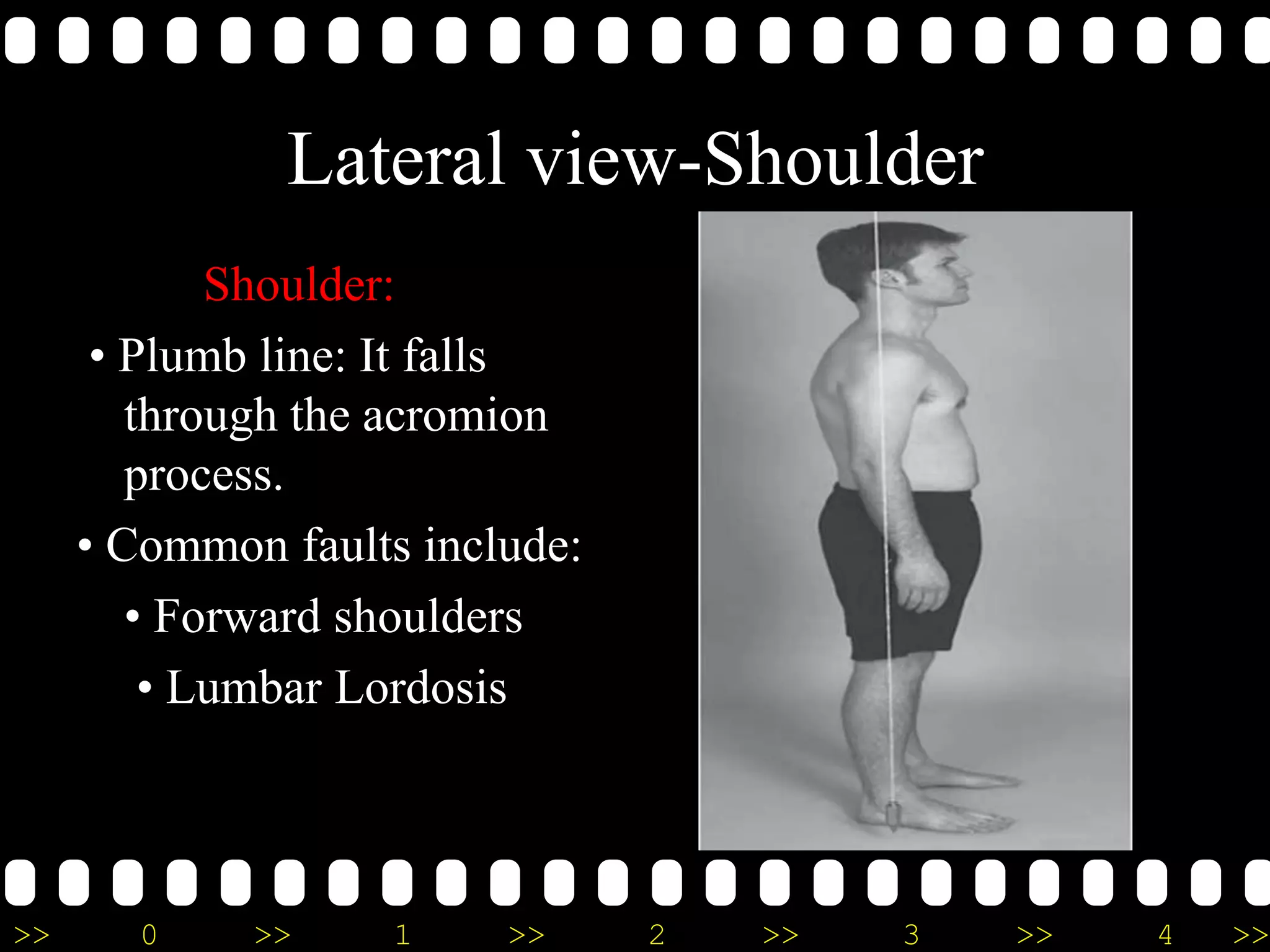
Lateral view-Shoulder
Shoulder:
• Plumb line: It falls
through the acromion
process.
• Common faults include:
• Forward shoulders
• Lumbar Lordosis
>> 0 >> 1 >> 2 >> 3 >> 4 >>
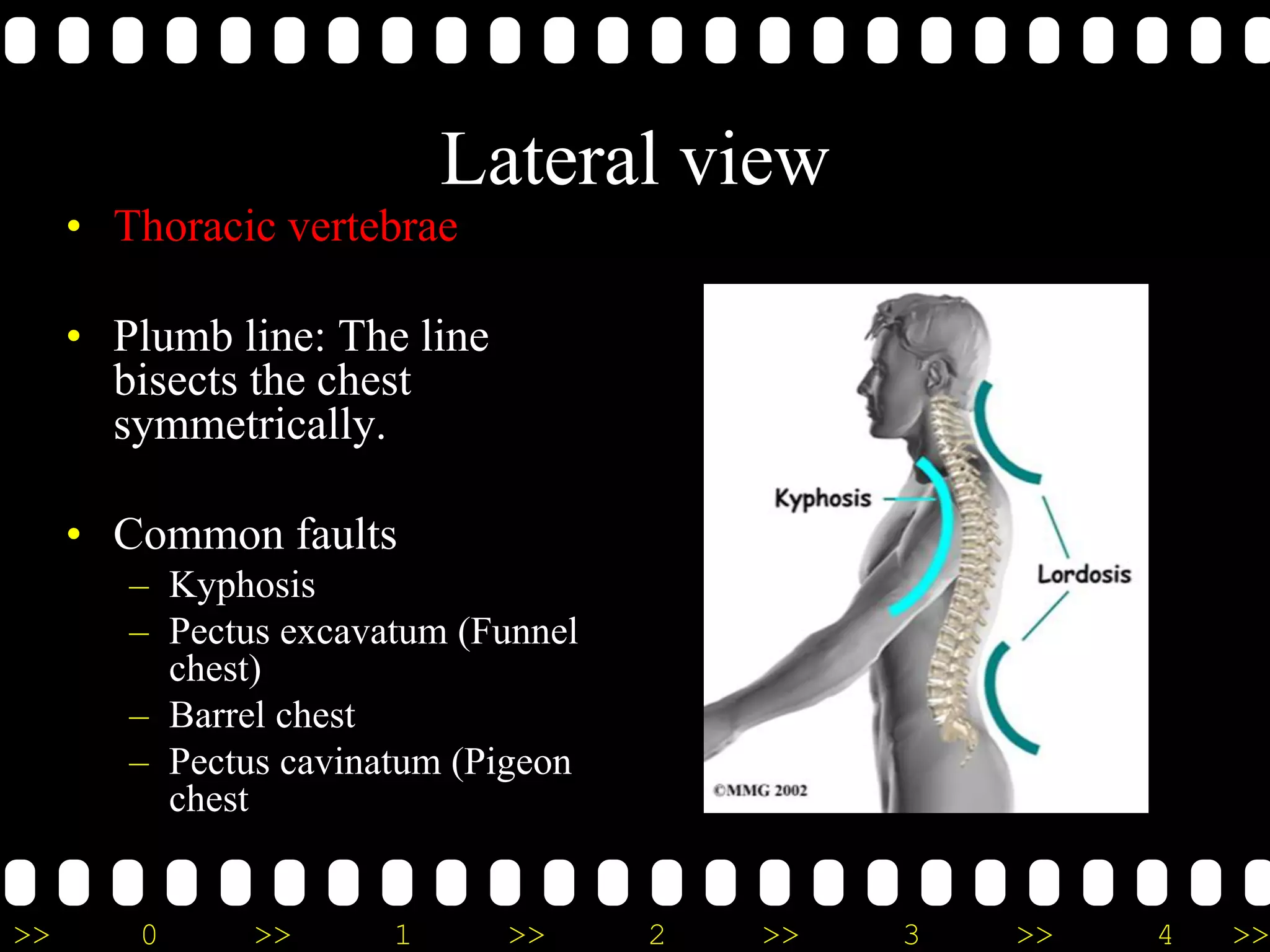
Lateral view
• Thoracic vertebrae
• Plumb line: The line
bisects the chest
symmetrically.
• Common faults
– Kyphosis
– Pectus excavatum (Funnel
chest)
– Barrel chest
– Pectus cavinatum (Pigeon
chest
>> 0 >> 1 >> 2 >> 3 >> 4 >>
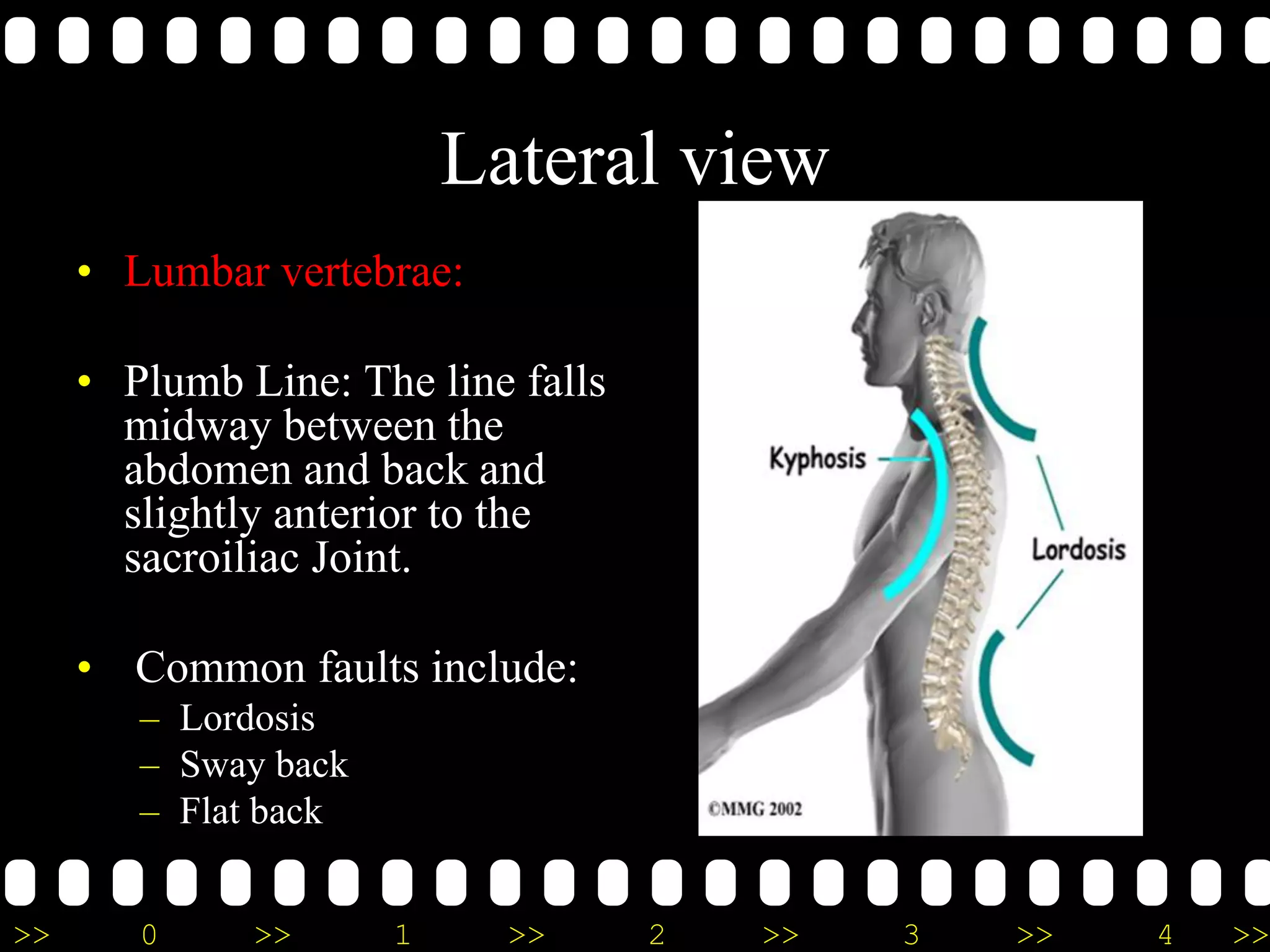
Lateral view
• Lumbar vertebrae:
• Plumb Line: The line falls
midway between the
abdomen and back and
slightly anterior to the
sacroiliac Joint.
• Common faults include:
– Lordosis
– Sway back
– Flat back
>> 0 >> 1 >> 2 >> 3 >> 4 >>
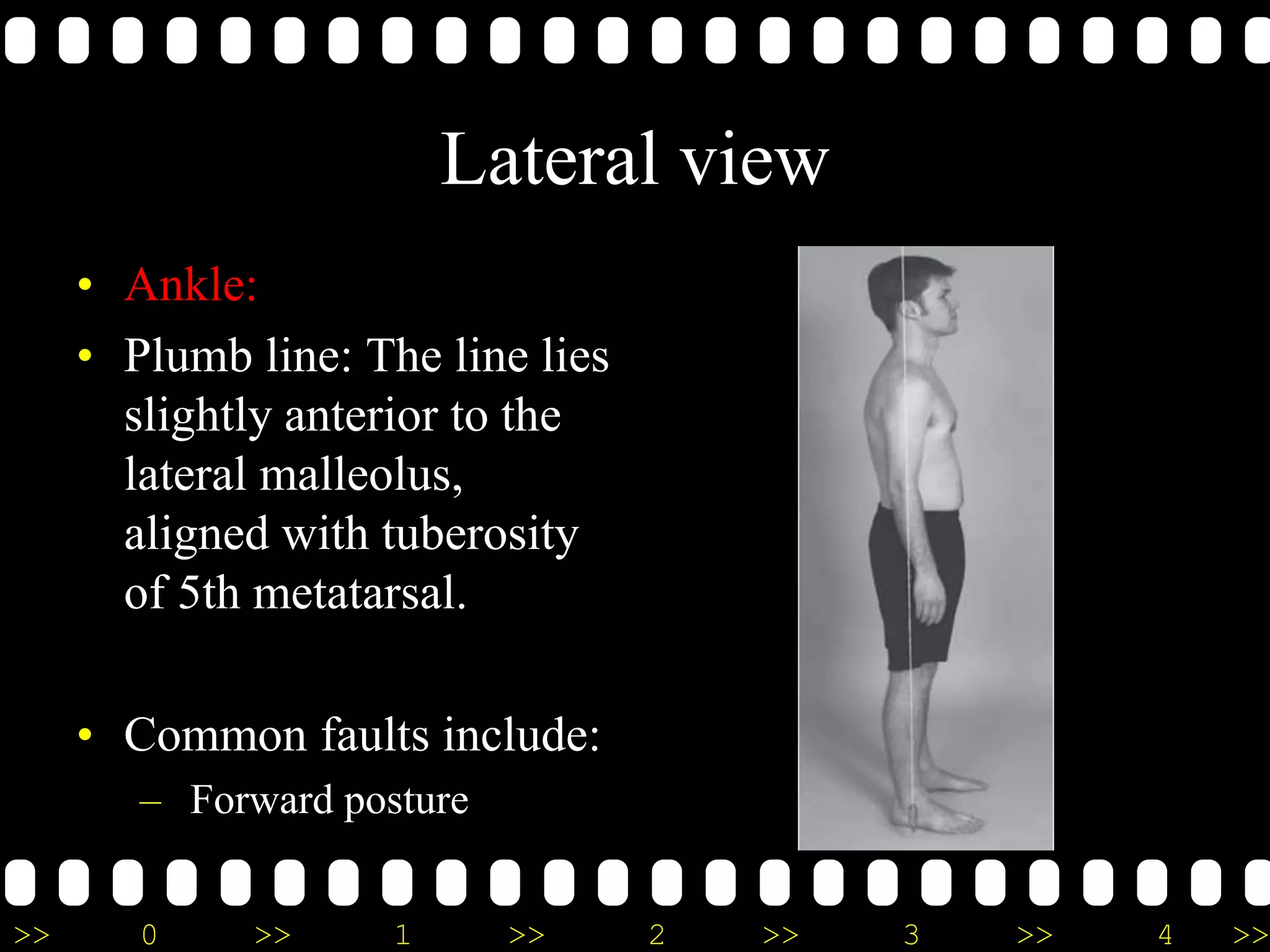
Lateral view
• Ankle:
• Plumb line: The line lies
slightly anterior to the
lateral malleolus,
aligned with tuberosity
of 5th metatarsal.
• Common faults include:
– Forward posture
>> 0 >> 1 >> 2 >> 3 >> 4 >>
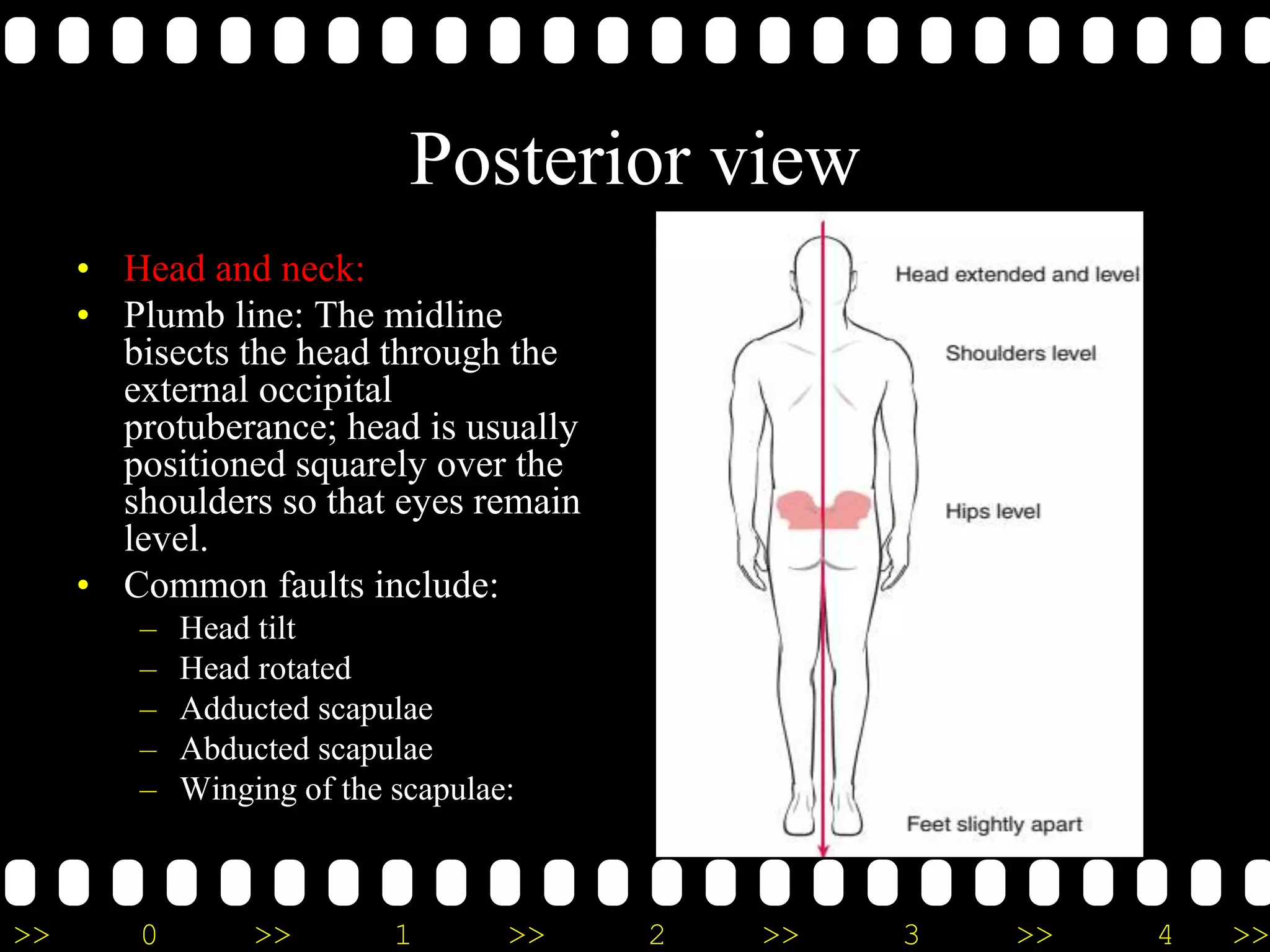
Posterior view
• Head and neck:
• Plumb line: The midline
bisects the head through the
external occipital
protuberance; head is usually
positioned squarely over the
shoulders so that eyes remain
level.
• Common faults include:
– Head tilt
– Head rotated
– Adducted scapulae
– Abducted scapulae
– Winging of the scapulae:
>> 0 >> 1 >> 2 >> 3 >> 4 >>
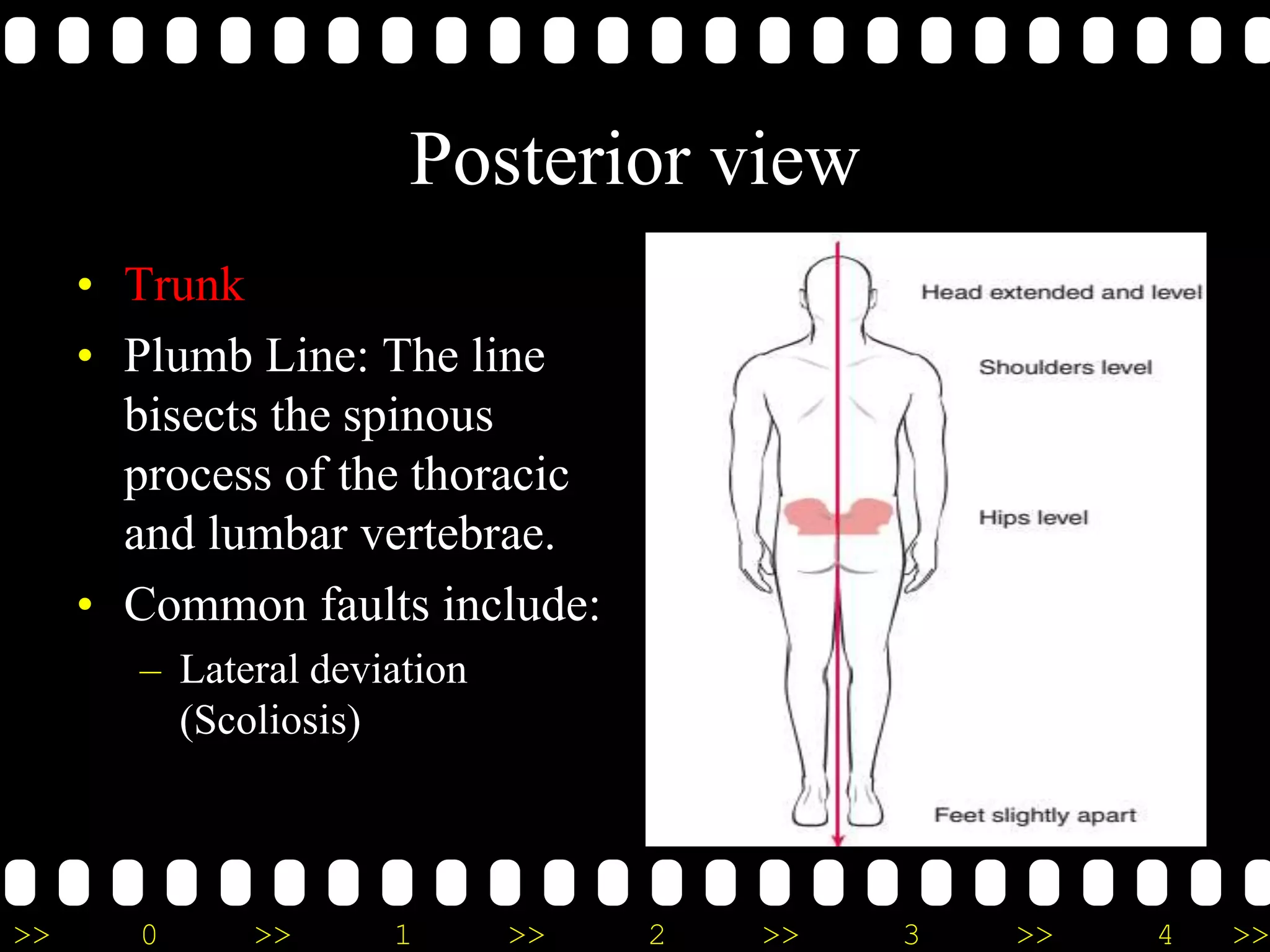
Posterior view
• Trunk
• Plumb Line: The line
bisects the spinous
process of the thoracic
and lumbar vertebrae.
• Common faults include:
– Lateral deviation
(Scoliosis)
>> 0 >> 1 >> 2 >> 3 >> 4 >>
Posterior view
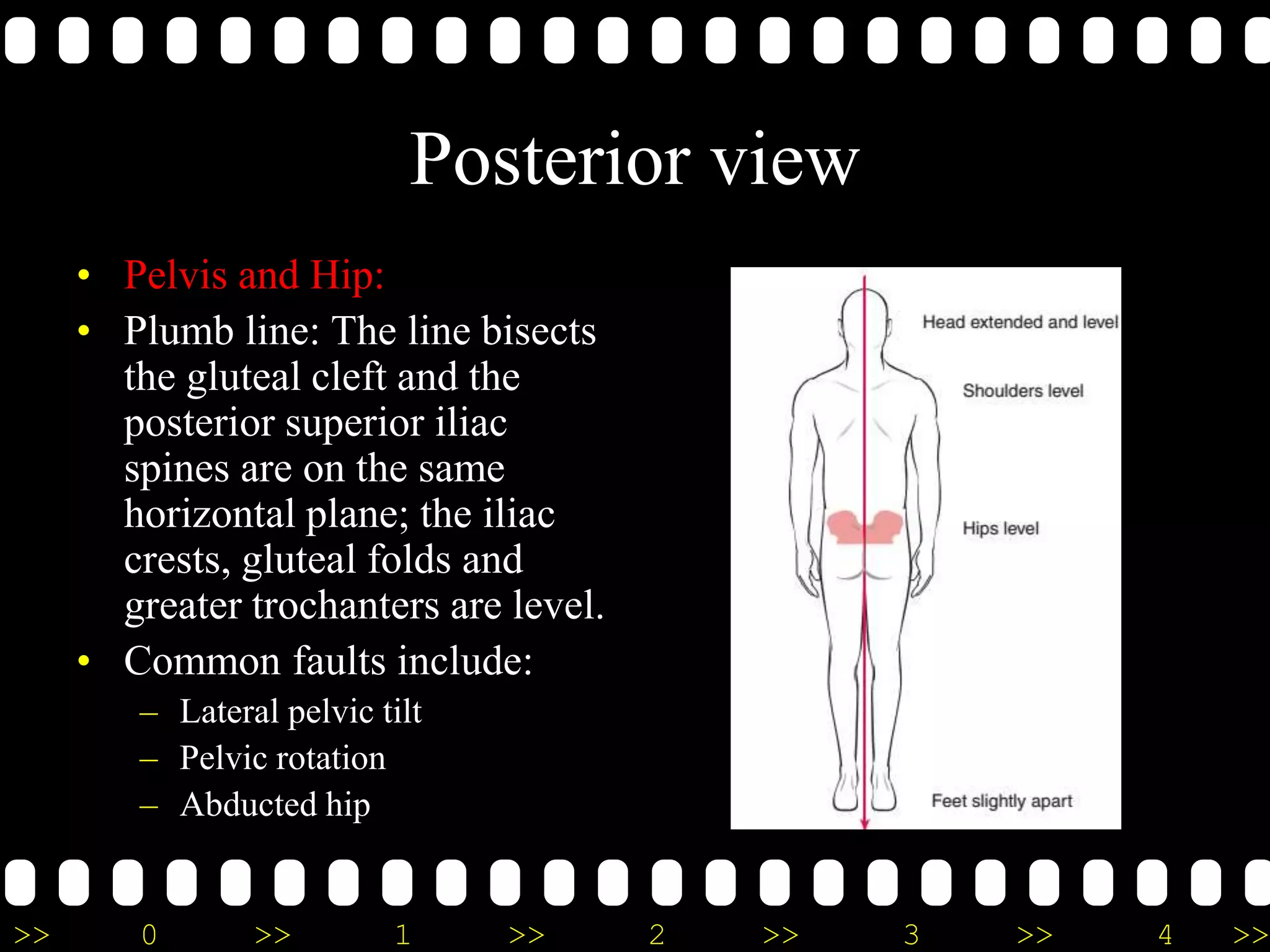
• Pelvis and Hip:
• Plumb line: The line bisects
the gluteal cleft and the
posterior superior iliac
spines are on the same
horizontal plane; the iliac
crests, gluteal folds and
greater trochanters are level.
• Common faults include:
– Lateral pelvic tilt
– Pelvic rotation
– Abducted hip
>> 0 >> 1 >> 2 >> 3 >> 4 >>
Posterior view
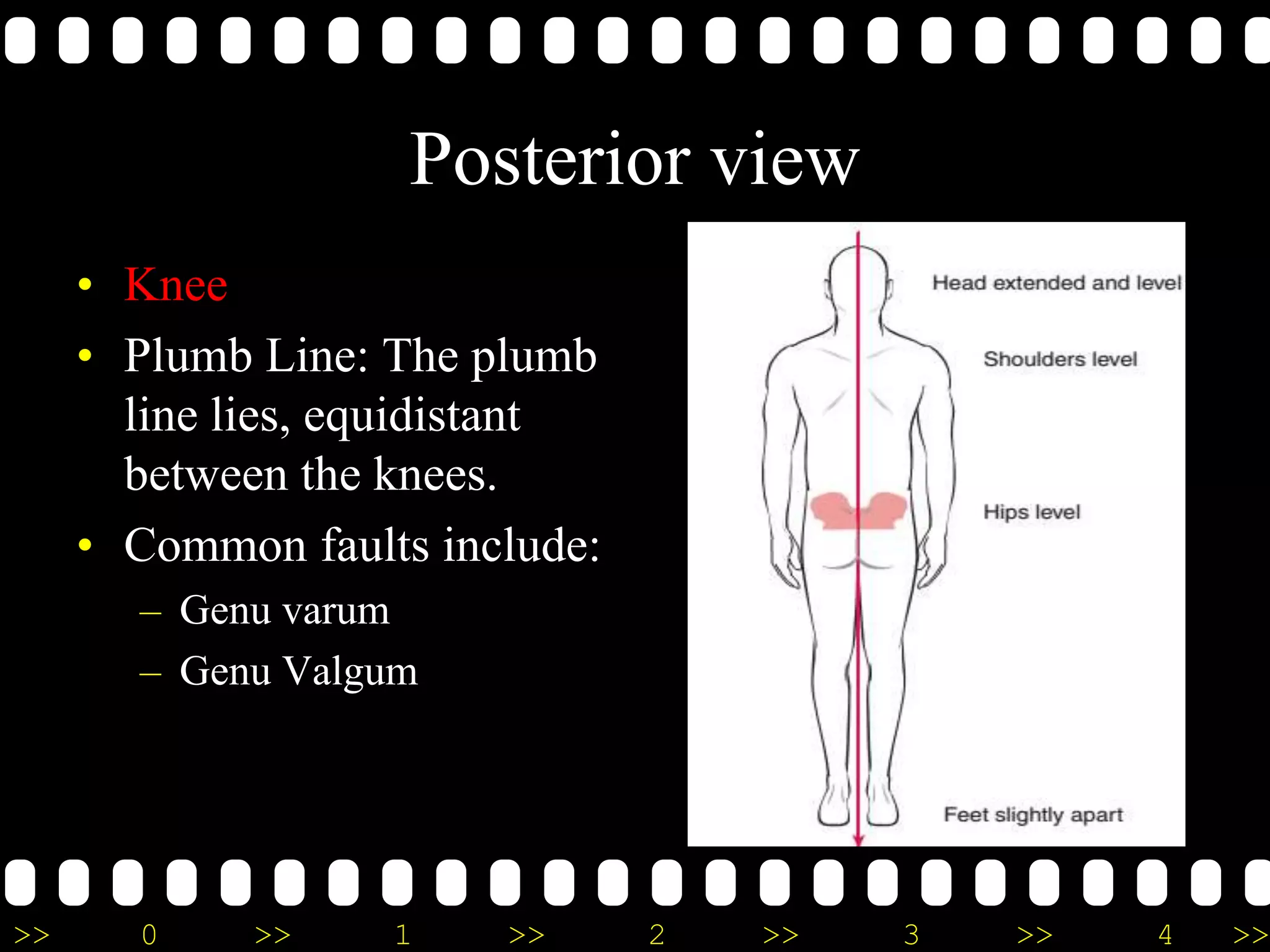
• Knee
• Plumb Line: The plumb
line lies, equidistant
between the knees.
• Common faults include:
– Genu varum
– Genu Valgum
>> 0 >> 1 >> 2 >> 3 >> 4 >>
Posterior view
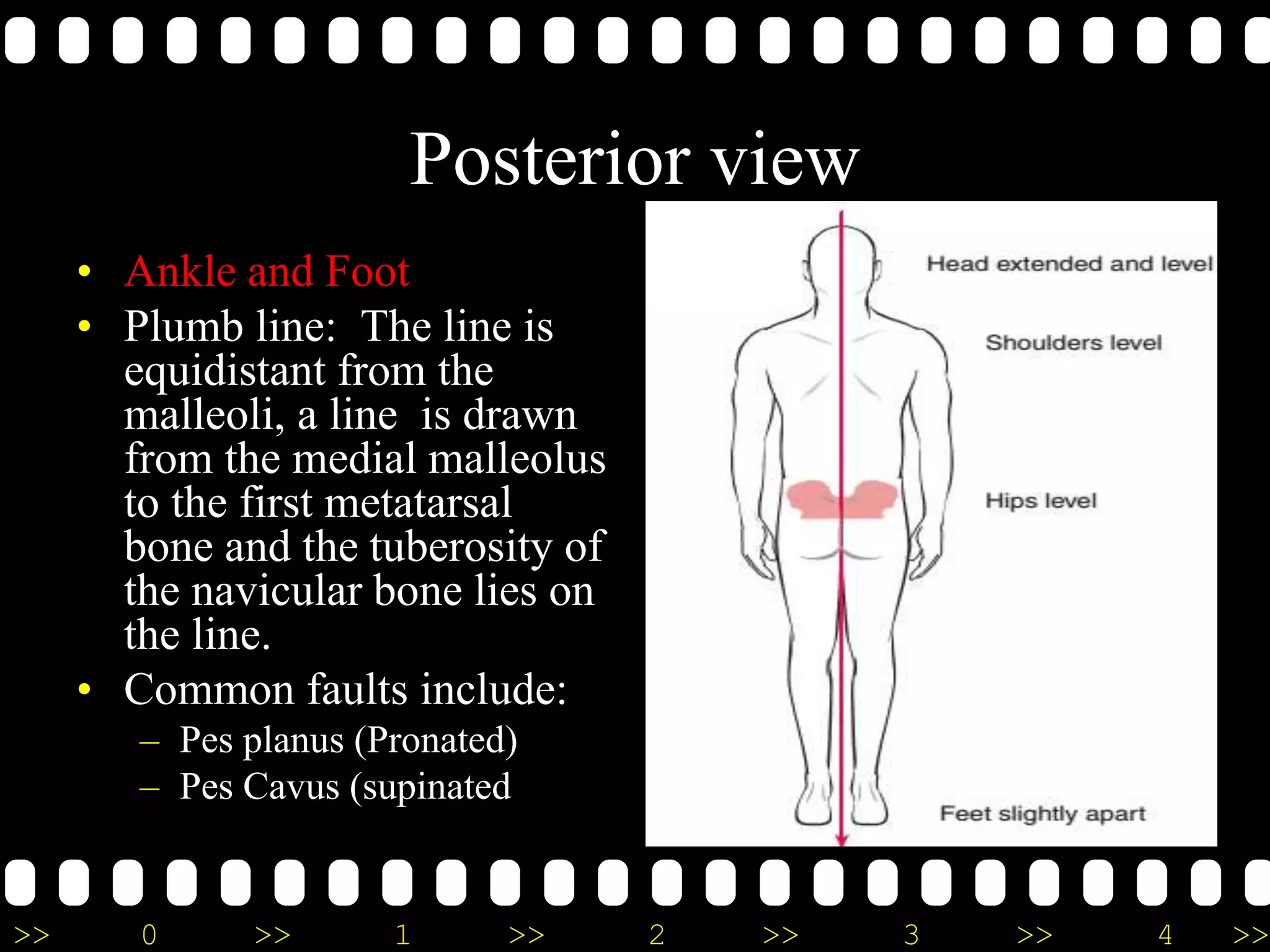
• Ankle and Foot
• Plumb line: The line is
equidistant from the
malleoli, a line is drawn
from the medial malleolus
to the first metatarsal
bone and the tuberosity of
the navicular bone lies on
the line.
• Common faults include:
– Pes planus (Pronated)
– Pes Cavus (supinated
>> 0 >> 1 >> 2 >> 3 >> 4 >>
Anterior view
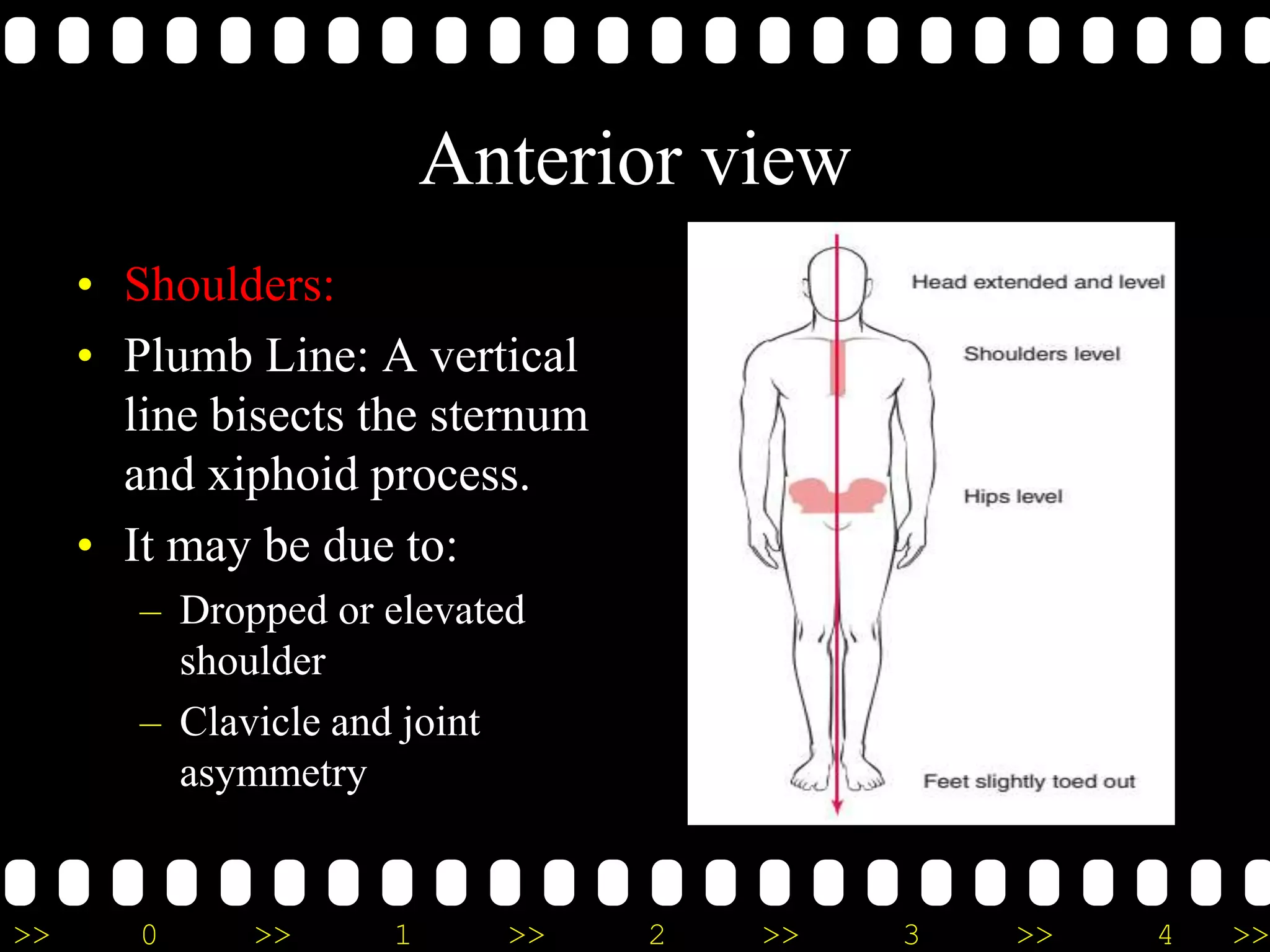
• Shoulders:
• Plumb Line: A vertical
line bisects the sternum
and xiphoid process.
• It may be due to:
– Dropped or elevated
shoulder
– Clavicle and joint
asymmetry
>> 0 >> 1 >> 2 >> 3 >> 4 >>
Anterior view
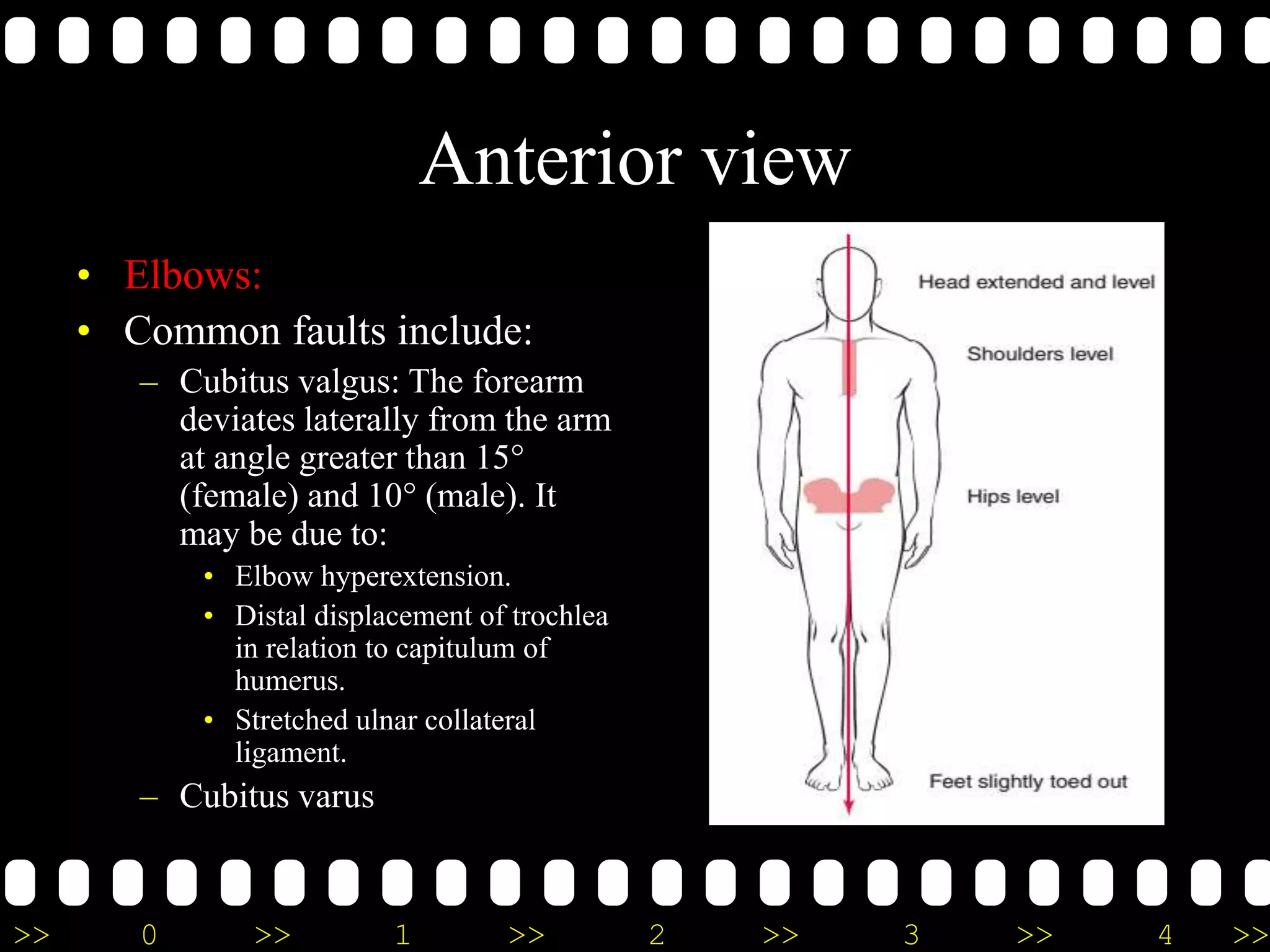
• Elbows:
• Common faults include:
– Cubitus valgus: The forearm
deviates laterally from the arm
at angle greater than 15°
(female) and 10° (male). It
may be due to:
• Elbow hyperextension.
• Distal displacement of trochlea
in relation to capitulum of
humerus.
• Stretched ulnar collateral
ligament.
– Cubitus varus
>> 0 >> 1 >> 2 >> 3 >> 4 >>
Anterior view
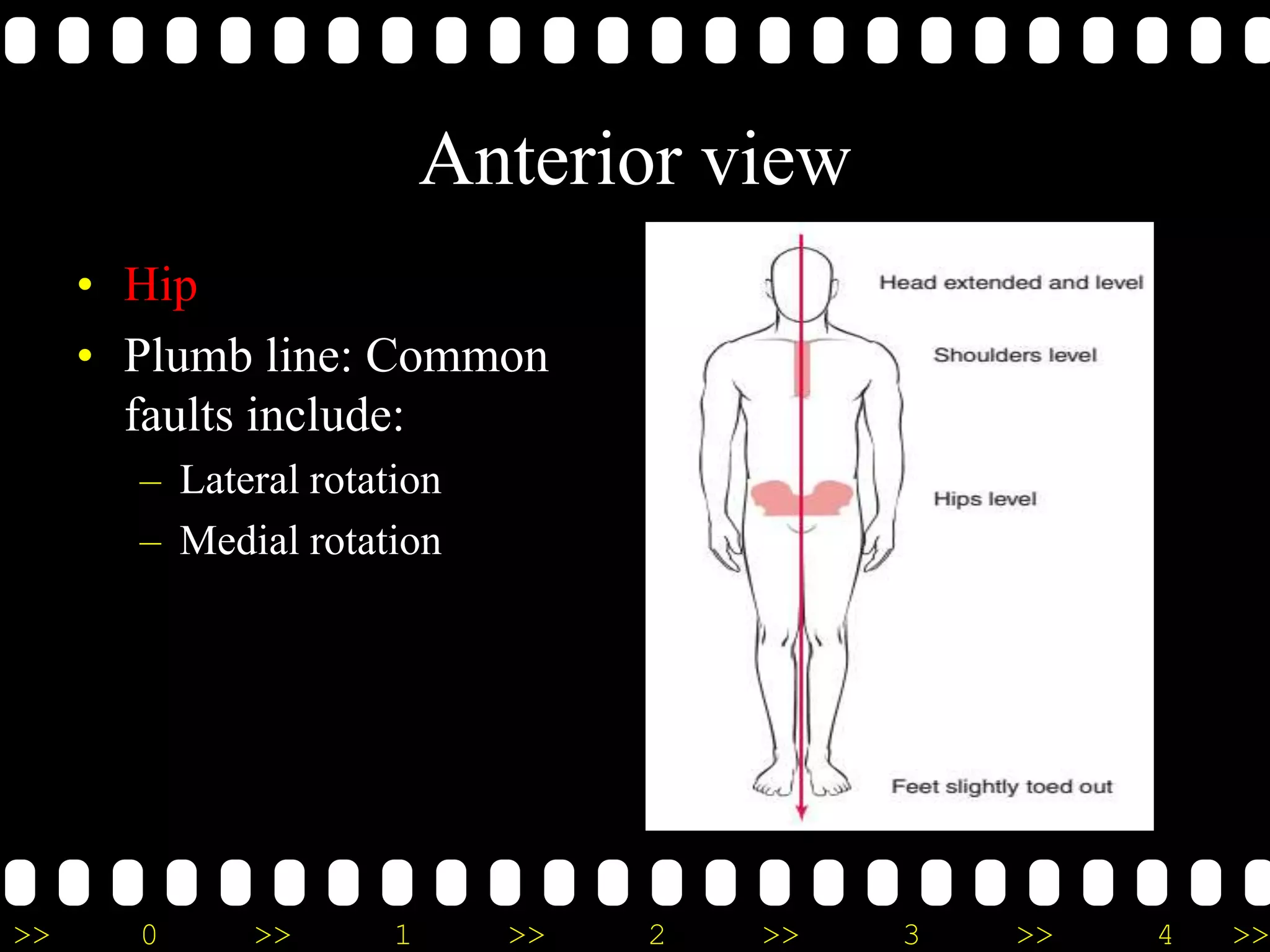
• Hip
• Plumb line: Common
faults include:
– Lateral rotation
– Medial rotation
>> 0 >> 1 >> 2 >> 3 >> 4 >>
Anterior view
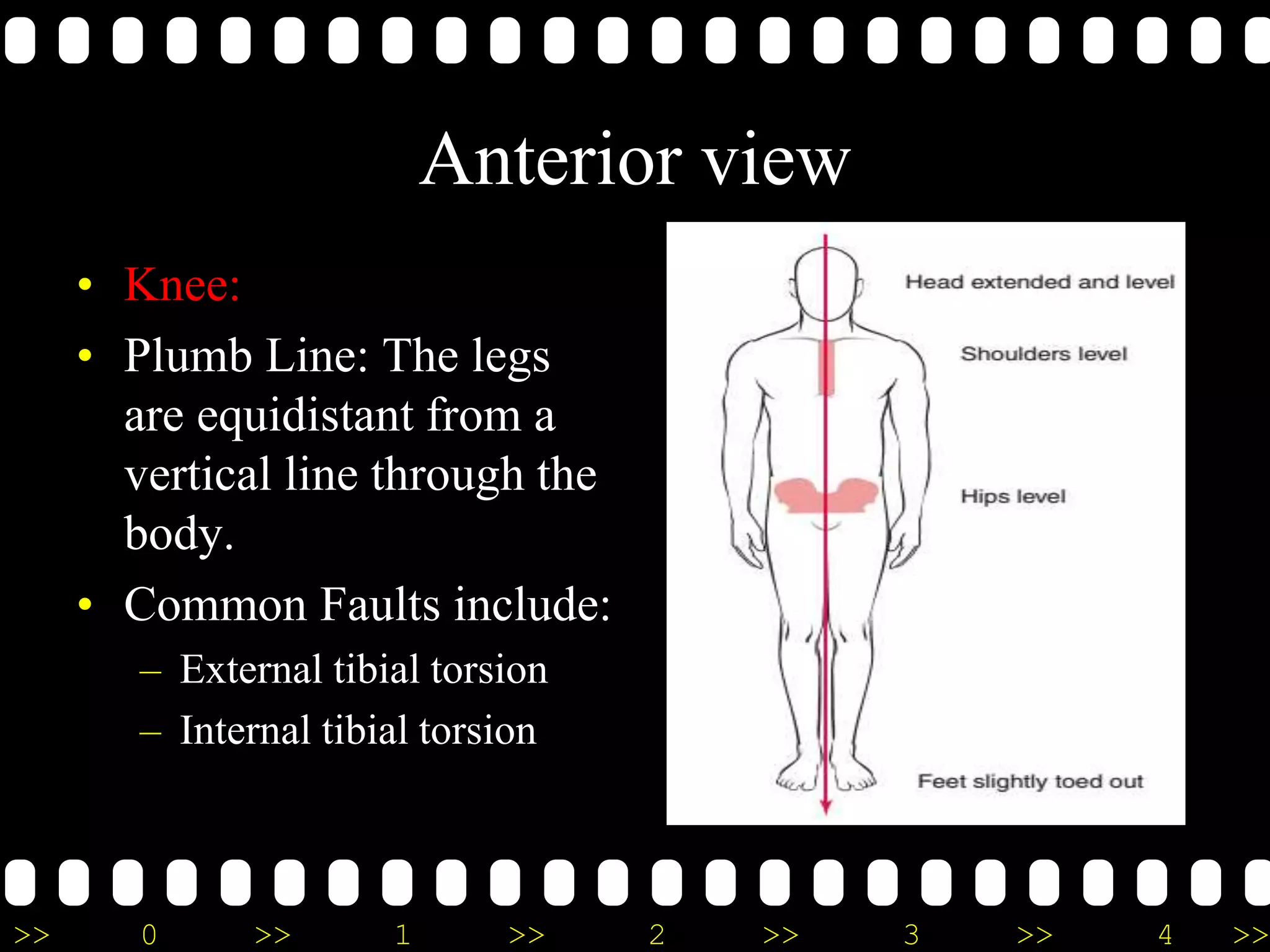
• Knee:
• Plumb Line: The legs
are equidistant from a
vertical line through the
body.
• Common Faults include:
– External tibial torsion
– Internal tibial torsion
>> 0 >> 1 >> 2 >> 3 >> 4 >>
Anterior view
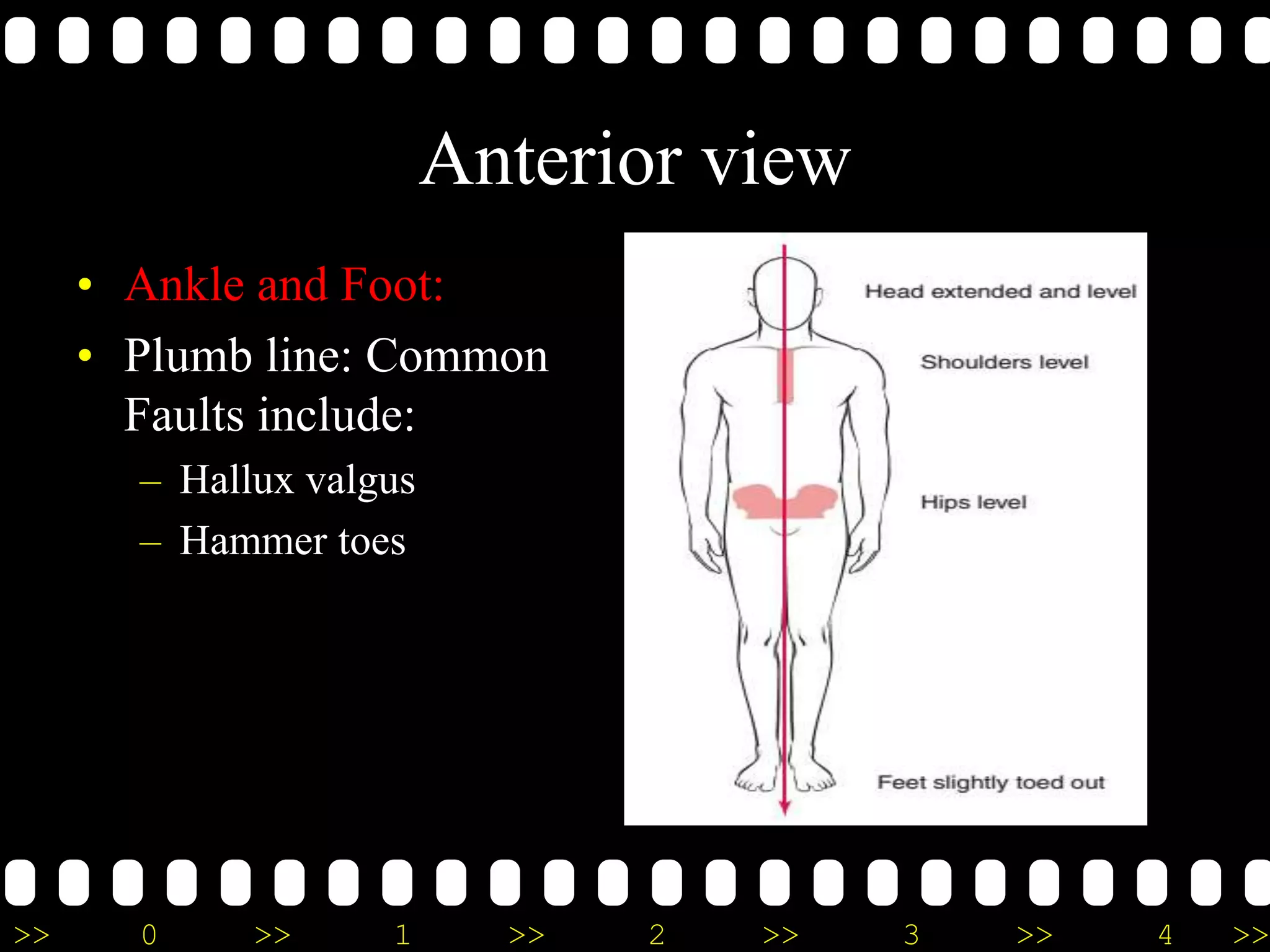
• Ankle and Foot:
• Plumb line: Common
Faults include:
– Hallux valgus
– Hammer toes
>> 0 >> 1 >> 2 >> 3 >> 4 >>
OBSERVATION IN SITTING
• Sitting on a stool
without back support
– Anterior view
– Lateral view
>> 0 >> 1 >> 2 >> 3 >> 4 >>
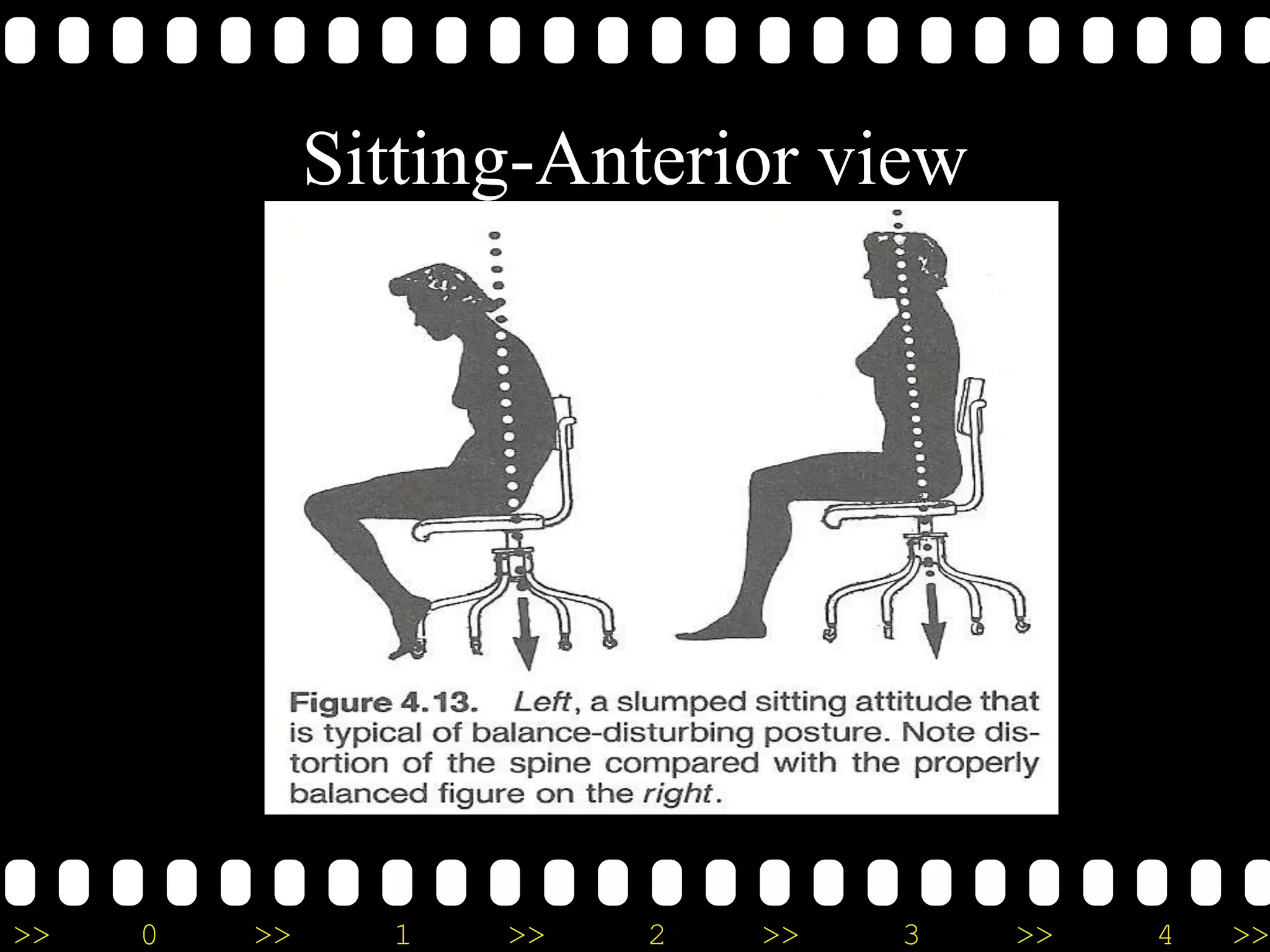
Sitting-Anterior view
>> 0 >> 1 >> 2 >> 3 >> 4 >>
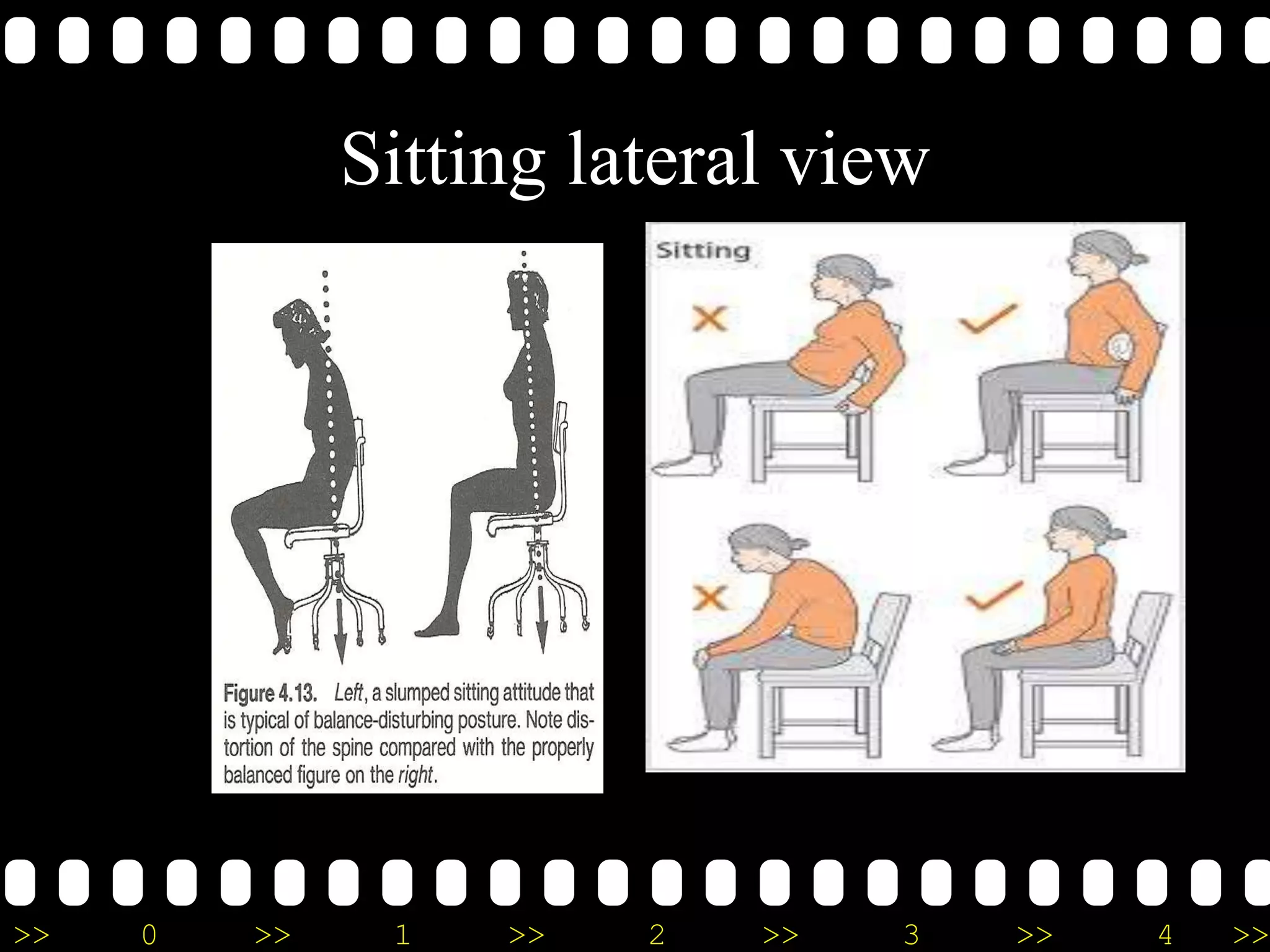
Sitting lateral view
>> 0 >> 1 >> 2 >> 3 >> 4 >>
Sitting-Anterior view
• Note for the knees
whether it it at same
distance from floor
>> 0 >> 1 >> 2 >> 3 >> 4 >>
Observation -Lying
• Supine lying
• Prone lying
>> 0 >> 1 >> 2 >> 3 >> 4 >>
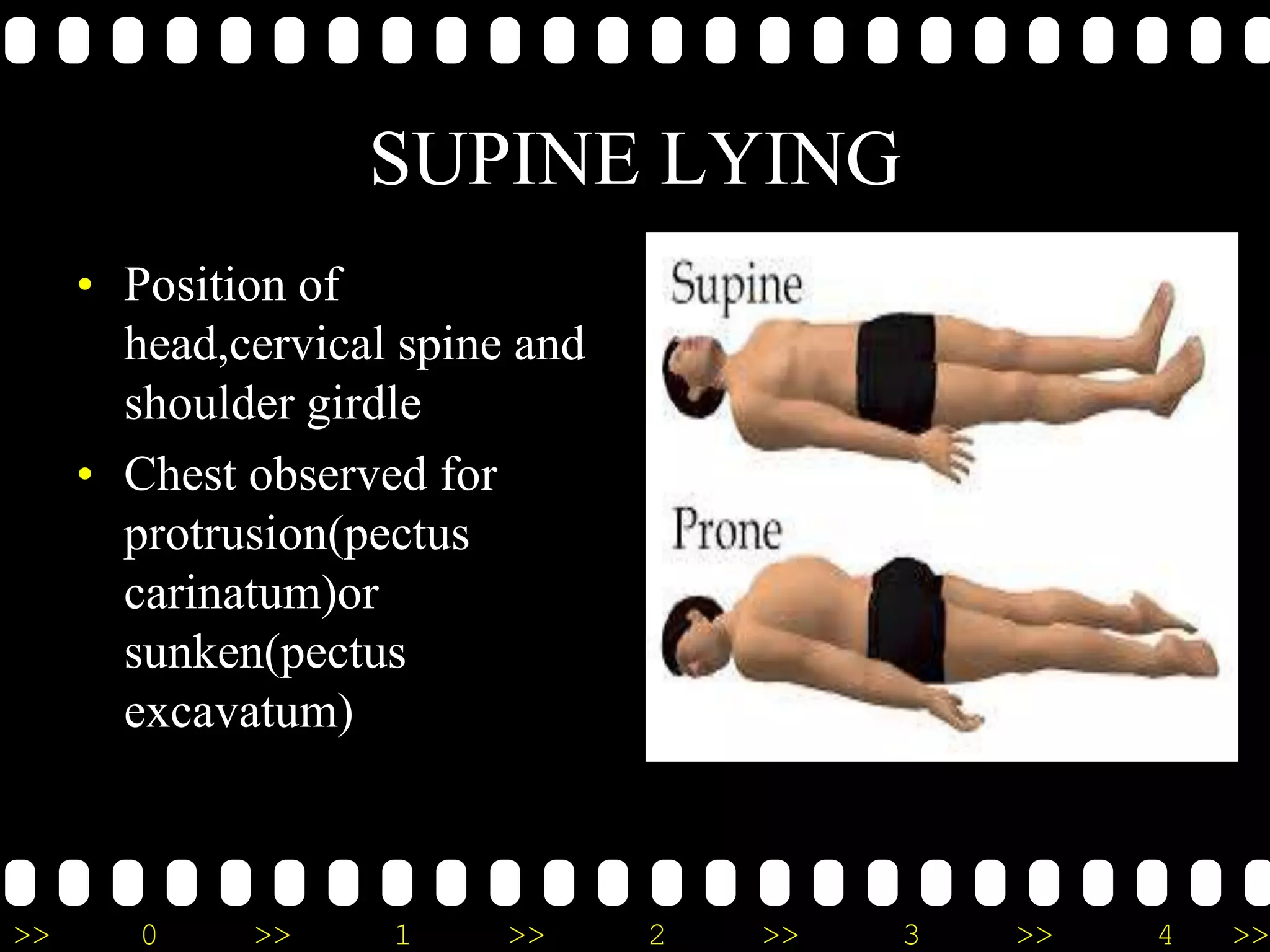
SUPINE LYING
• Position of
head,cervical spine and
shoulder girdle
• Chest observed for
protrusion(pectus
carinatum)or
sunken(pectus
excavatum)
>> 0 >> 1 >> 2 >> 3 >> 4 >>
Supine lying
• Abdomen muscles noted(flabby)
• Waist angle noted
• ASIS level
• Any extension in lumbar spine
>> 0 >> 1 >> 2 >> 3 >> 4 >>
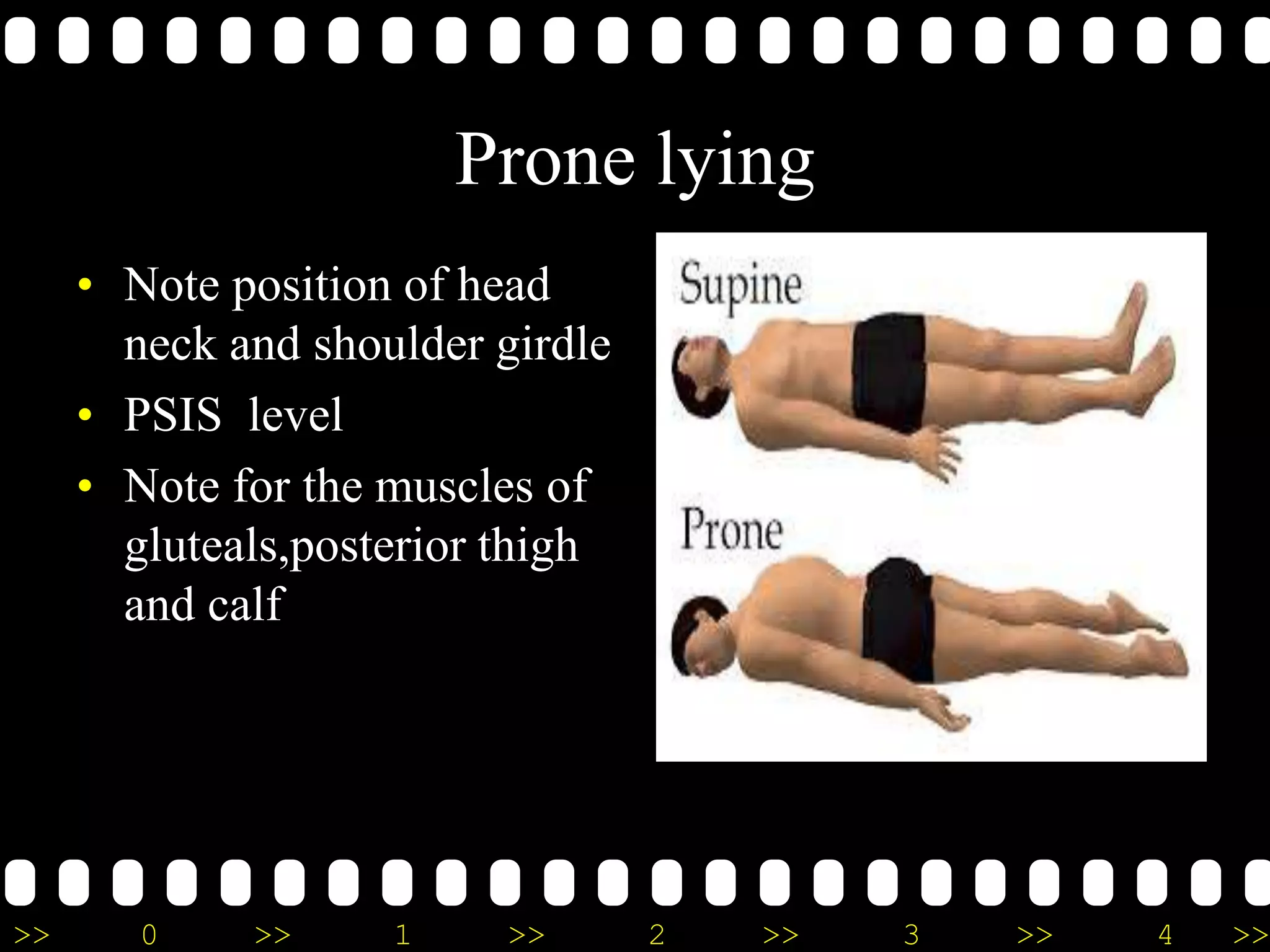
Prone lying
• Note position of head
neck and shoulder girdle
• PSIS level
• Note for the muscles of
gluteals,posterior thigh
and calf
>> 0 >> 1 >> 2 >> 3 >> 4 >>
PALPATION
• In assessment position
(i.e., standing), palpate:
– Laterally
• ASIS vs. PSIS
– Anteriorly
• Patellae
• Iliac Crests
• ASIS heights
• Lateral Malleolar heights
• Fibular Head heights
• Shoulder heights
- Posteriorly
 PSIS positions
 Spinal alignment
 Scapular positions
>> 0 >> 1 >> 2 >> 3 >> 4 >>
Functional testing
• Slump Test
• Leg length measurement
• Romberg
• Tandem walking
• Others designed to:
– Rule out bony restrictions
– Rule out soft tissue
restrictions
– Assess muscular length
• ROM
• Resting muscle length
>> 0 >> 1 >> 2 >> 3 >> 4 >>
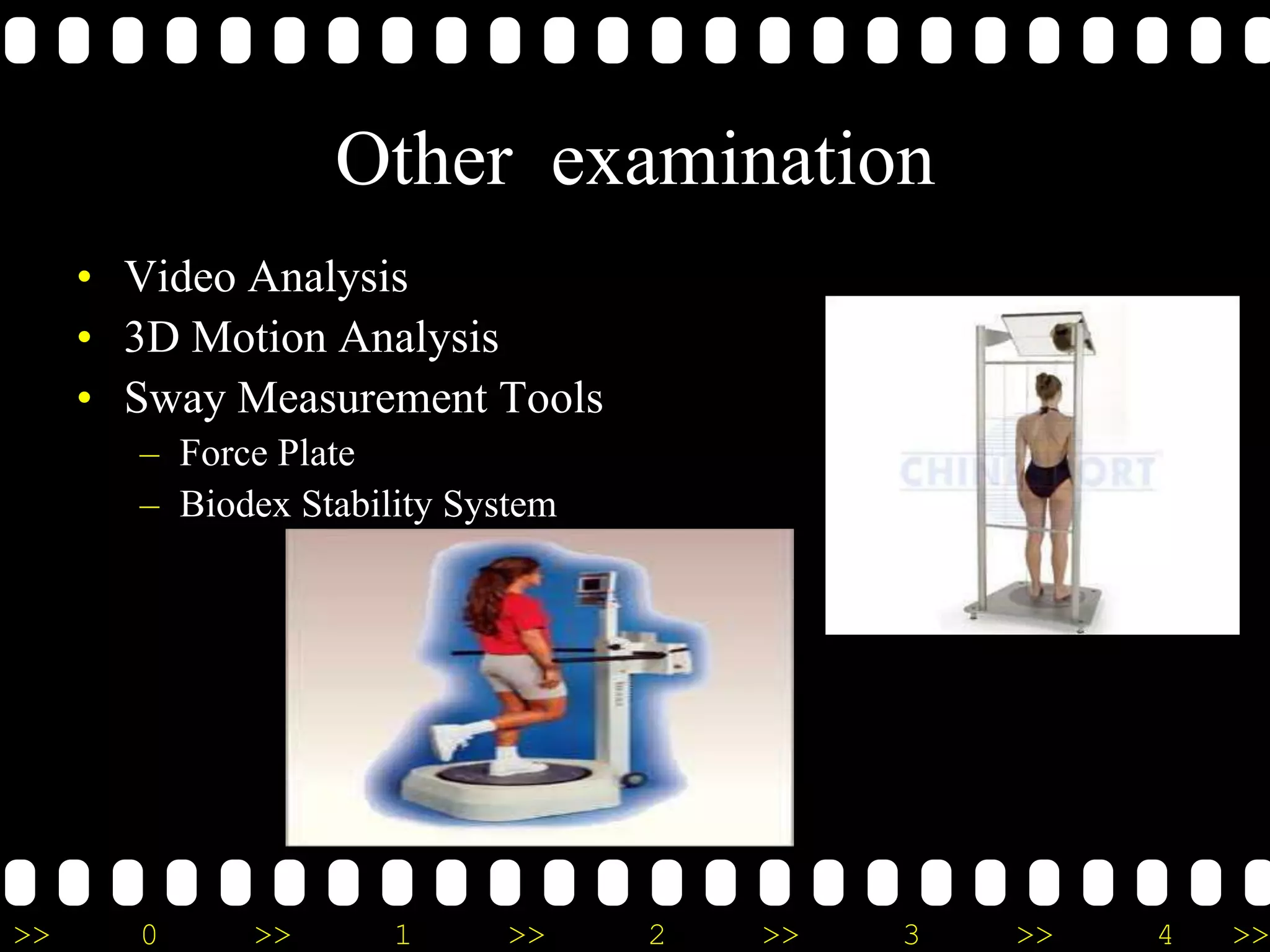
Other examination
• Video Analysis
• 3D Motion Analysis
• Sway Measurement Tools
– Force Plate
– Biodex Stability System
>> 0 >> 1 >> 2 >> 3 >> 4 >>
Postural deviations
>> 0 >> 1 >> 2 >> 3 >> 4 >>
Commonly seen postural deviations
• Foot & Ankle
– Hyperpronation
– Supination
• Knee
– Genu Recurvatum
– Genu Valgum
– Genu Varum
>> 0 >> 1 >> 2 >> 3 >> 4 >>
Commonly seen postural deviations
• Spine
• Lordosis
Sway back deformity
• Kyphosis
Round back
humpback/gibbus
Flat back
Dowagers hump
• Scoliosis
Non –structural scoliosis
Structural scoloisis
Idiopathic scoliosis
>> 0 >> 1 >> 2 >> 3 >> 4 >>
Lordosis
• Lordosis is an excessive anterior curvature of
spine
• Pathologically it is exaggeration of the normal
curves found in the cervical and lumbar spines
>> 0 >> 1 >> 2 >> 3 >> 4 >>
Lordosis
 Lordosis causes:
› Postural deformity
› Lax muscles (esp. abs)
› Heavy abdomen
› Compensatory
mechanisms
› Hip flexion contracture
› Spondylolisthesis
› Congential problems
› Fashion (high heels)
>> 0 >> 1 >> 2 >> 3 >> 4 >>
Lordosis
• Observe sagging
shoulder
• Medial rotation of leg
• Head poking forward
• The normal pelvic
angle(30degree) is
increased with lordosis
>> 0 >> 1 >> 2 >> 3 >> 4 >>
Postural correction exercises-Lordosis
• Lengthening the muscles that create anterior
pelvic tilt and making them more flexible
• Strengthening and shortening the muscles that
create posterior pelvic tilt
• Learning to control normal pelvic position
>> 0 >> 1 >> 2 >> 3 >> 4 >>
Swayback deformity
Increased pelvic inclination (40)
• Typically includes kyphosis
>> 0 >> 1 >> 2 >> 3 >> 4 >>
Kyphosis
• It is excessive posterior curvature of spine
• Pathologically it is exaggeration of the normal
curve found in the thoracic spine
>> 0 >> 1 >> 2 >> 3 >> 4 >>
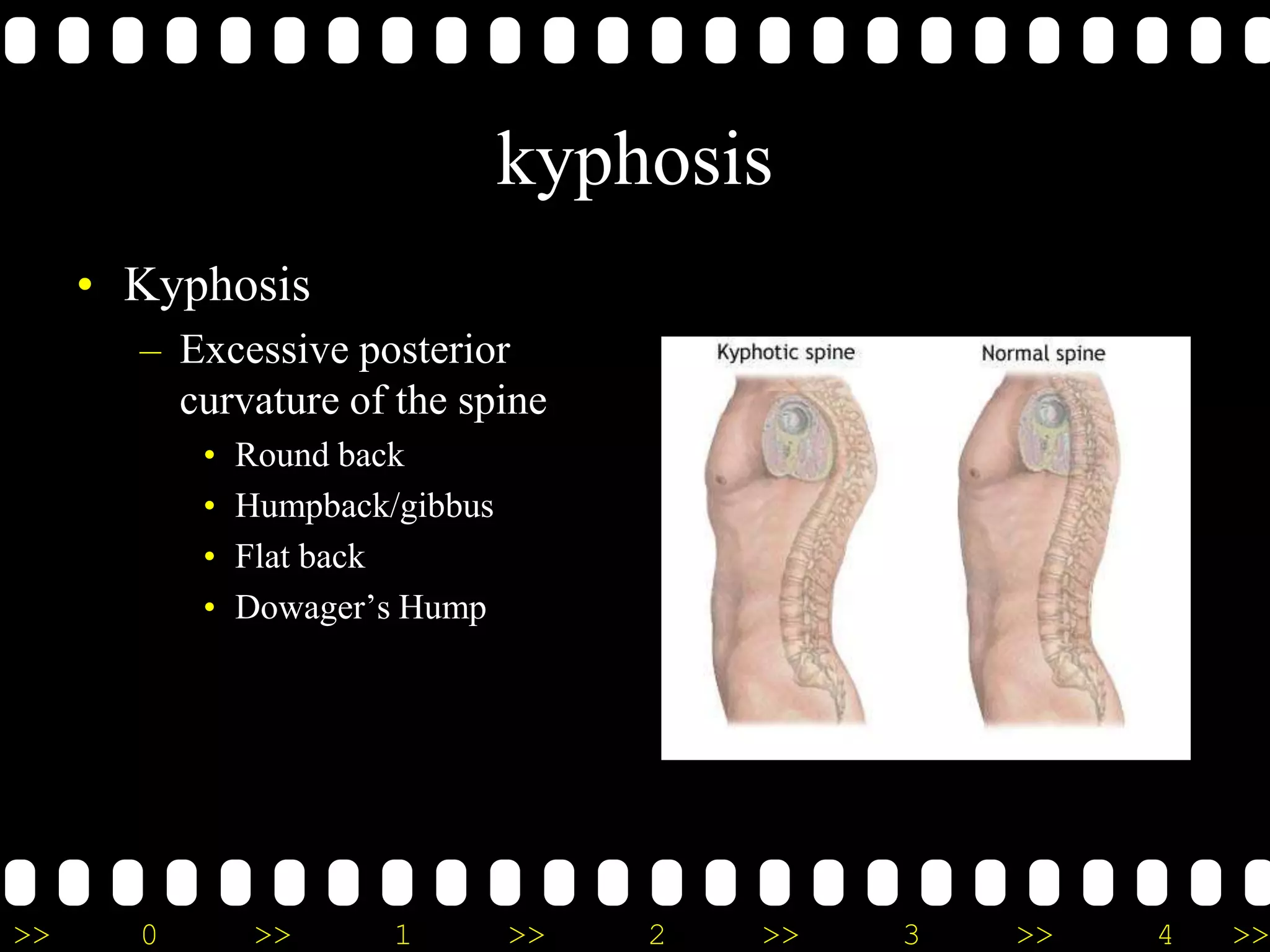
kyphosis
• Kyphosis
– Excessive posterior
curvature of the spine
• Round back
• Humpback/gibbus
• Flat back
• Dowager’s Hump
>> 0 >> 1 >> 2 >> 3 >> 4 >>
Kyphosis-Round back
• Long rounded curve
with ed pelvic
inclination and thoraco
lumbar kyphosis
• O/E
• Tight (hip ext & trunk
flexors)
• Weak(hip flexors
&lumbar extensors)
>> 0 >> 1 >> 2 >> 3 >> 4 >>
Kyphosis –Hump back/Gibbus
• Localised sharp
posterior angulation of
thoracic spine
>> 0 >> 1 >> 2 >> 3 >> 4 >>
Kyphosis –Flat back
• Decreased pelvic
inclination (20 degrees)
• Mobile lumbar spine
>> 0 >> 1 >> 2 >> 3 >> 4 >>
Kyphosis-Dowagers Hump
• Older patient
• Causes-osteoporosis
• Where thorocic
vertebral bodies
degenerates and wedge
in anterior direction
>> 0 >> 1 >> 2 >> 3 >> 4 >>
Corrective exercises for kyphosis
• Exercises to maintain normal pelvic position –
to create a basis for correct alignment of the
spine.
• Exercises to stretch and lengthen the chest
muscles (pectoralis major/pectoralis minor)
• Strengthening the upper back muscles, the
deep erector spinae and the shoulder extensors
>> 0 >> 1 >> 2 >> 3 >> 4 >>
Corrective exercises for kyphosis
• Breathing exercises for increasing range of
respiration (especially inhalation).
• In addition to the chest muscles mentioned
above, movement of the joints connecting
thorax and ribs (the sterno-costal joints) and
those linking ribs and vertebrae (the costo-
vertebral joints)is of great importance for
maintaining chest fl exibility and optimal
respiratory functioning
>> 0 >> 1 >> 2 >> 3 >> 4 >>
• Mobility exercises for the thoracic vertebrae
(T1–12) on all movement planes, from a
variety of starting positions
• Exercises to increase hamstring fl exibility and
thus improve functional pelvic mobility on the
sagittal plane (in anterior and posterior pelvic
tilt).
• Awareness and relaxation exercises.
>> 0 >> 1 >> 2 >> 3 >> 4 >>
Corrective exercises-Flat back
• Exercise to maintain normal pelvic position –
for optimal alignment of the spine and for
encouraging anterior pelvic tilt on the sagittal
plane
• Hamstring fl exibility and lengthening
exercises, to improve anterior pelvic tilt
• Strengthening hip flexors
• Exercise to improve general lower back
vertebral mobility
>> 0 >> 1 >> 2 >> 3 >> 4 >>
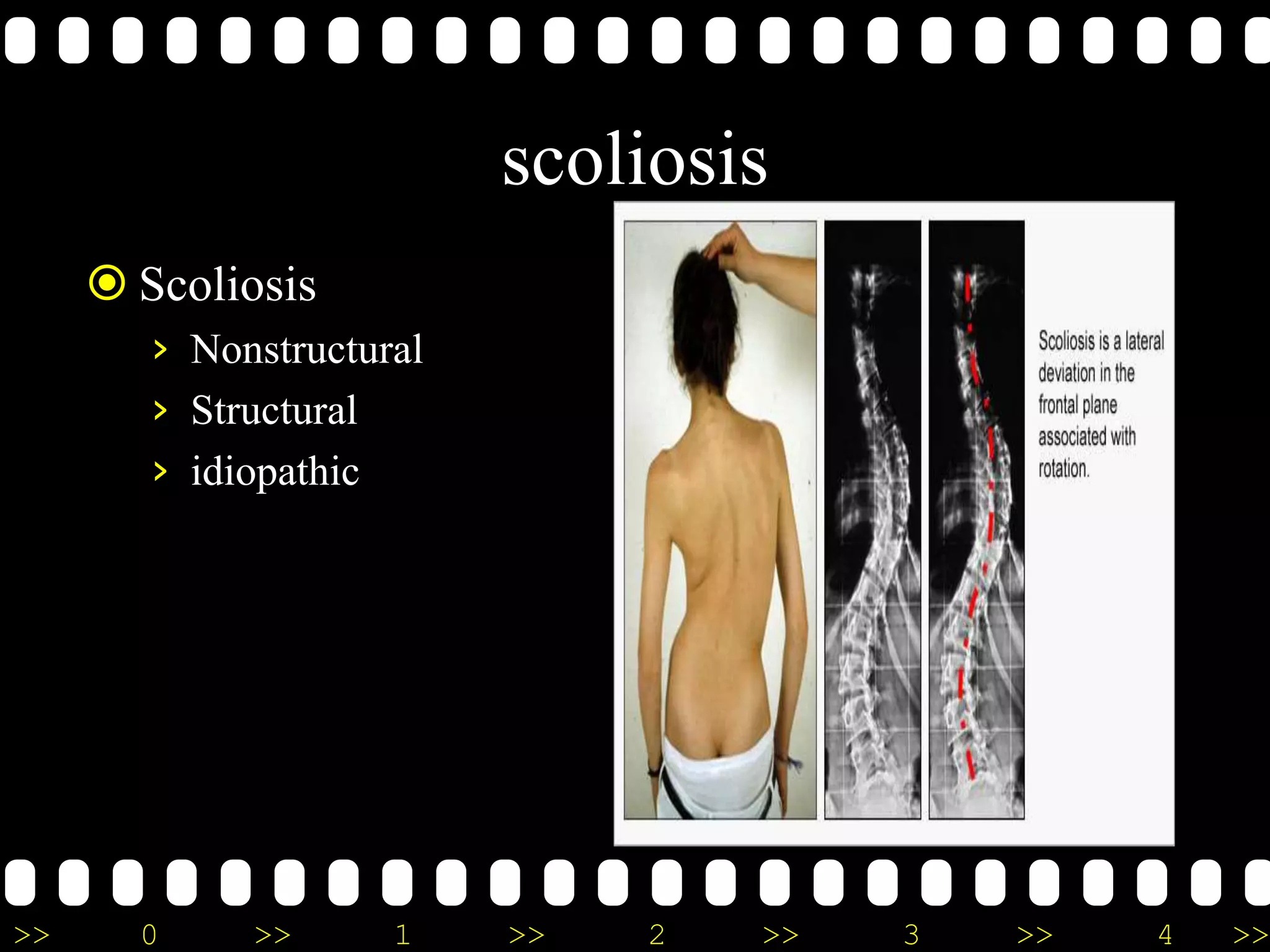
scoliosis
 Scoliosis
› Nonstructural
› Structural
› idiopathic
>> 0 >> 1 >> 2 >> 3 >> 4 >>
Non-Structural and structural scoliosis
Non structural
FUNCTIONAL
RELATED TO LIMB
LENGTH DISCREPANCY
NO BONY DEFORMITY
SIDEBENDIG IS USUALLY
SYMMETRIC
FORWARD FLEXION –
SCOLIOTIC CURVE
DISAPPEARS
NON PROGRESSIVE
Structural
• CONGENITAL/ACQUIRE
D
• MAY BE IDIOPATHIC
• BONY DEFORMITY
• SIDE BENDING –
ASYMMETRIC
• FORWARD FLEXION-
SCOLIOTIC CURVE
DOES NOT DISAPPEAR
• PROGRESSIVE
>> 0 >> 1 >> 2 >> 3 >> 4 >>
IDIOPATHIC SCOLIOSIS
• 70-85% of all structural scoliosis
• Fixed rotational prominence on convex side
• RAZOR BACK SPINE
>> 0 >> 1 >> 2 >> 3 >> 4 >>
Objective measurement
• Demographic data,
• Anthropometric tests
• Height of acromia
• Scapula–spine distance
• S1–acromia distance
• Biacromial diameter
• Height of the anterior superior iliac spine (ASIS)
• Lower limb length
>> 0 >> 1 >> 2 >> 3 >> 4 >>
• Functional tests
• LATERAL BENDING TEST
• FLEXIBILITY TEST OF SHOULDER
GIRDLE
• X-rays (COBB angle).
>> 0 >> 1 >> 2 >> 3 >> 4 >>
Corrective exercies for scoliosis
1.Symmetrical exercises aimed to strengthen back and abdominal
muscles and for functional improvement in ranges of joint motion.
2. Breathing exercises to increase lung volume and thorax mobility
and flexibility.
3. Asymmetrical exercises for lengthening muscles on the concave
(shortened) side, and for contracting muscles on the convex
(lengthened) side. Asymmetrical exercises are also designed to
encourage specific movement of spinal column vertebrae in desired
directions (mainly for moderating or balancing rotation in cases of
structural scoliosis).
4. Static exercises which also make use of body weight (various
“hanging” and traction exercises) for releasing tension along the
spine
>> 0 >> 1 >> 2 >> 3 >> 4 >>
POSTURAL DEVIATIONS-KNEE
• Knee
– Genu Recurvatum
– Genu Valgum
– Genu Varum
>> 0 >> 1 >> 2 >> 3 >> 4 >>
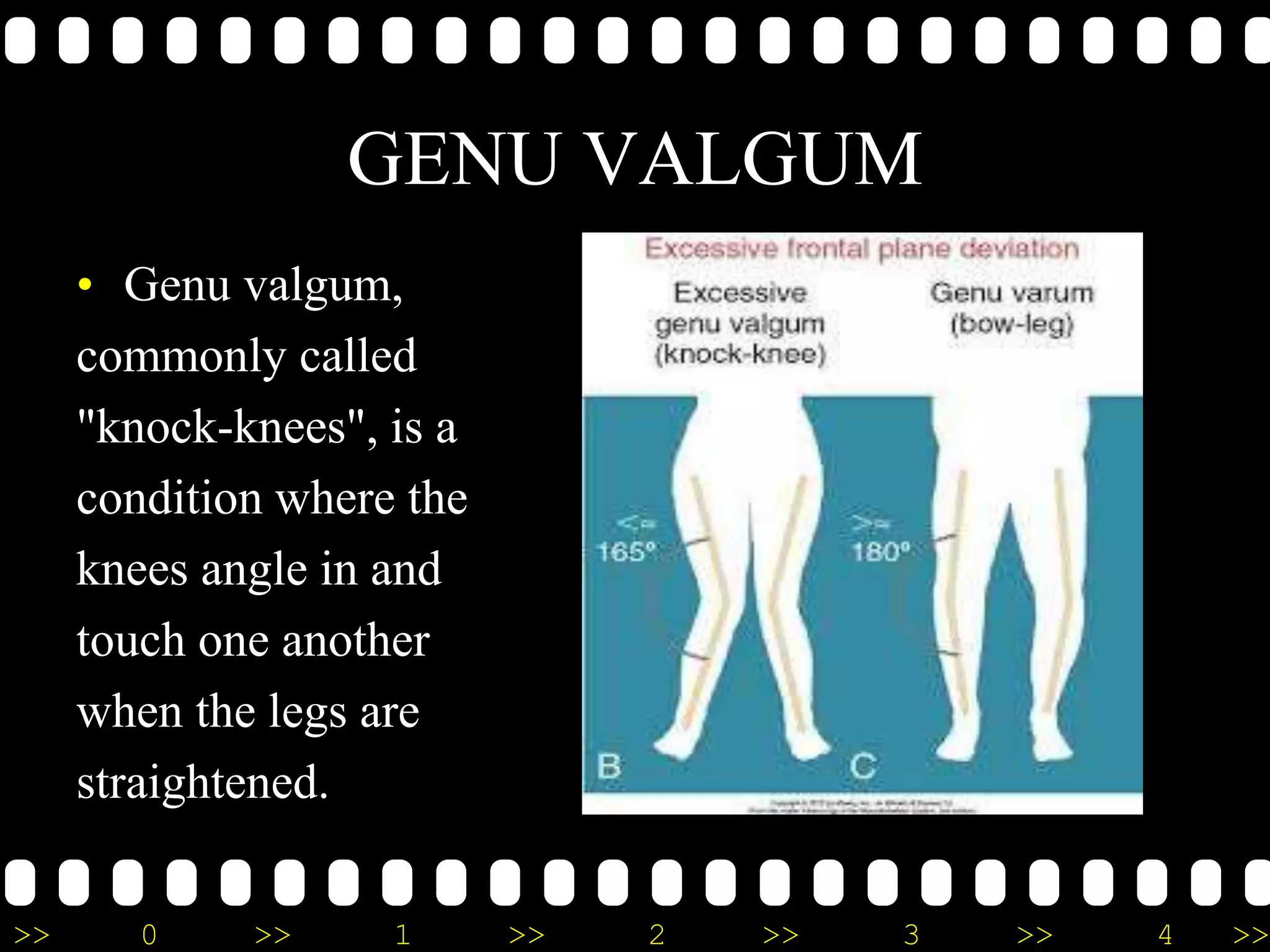
GENU VALGUM
• Genu valgum,
commonly called
"knock-knees", is a
condition where the
knees angle in and
touch one another
when the legs are
straightened.
>> 0 >> 1 >> 2 >> 3 >> 4 >>
CAUSES OF GENU
VALGUM(KNOCK KNEE)
• Rickets
• Osteomalacia
• Rheumatoid Arthritis
• Muscular paralysis of semimembranosus or
semitendinosus
• Fracture
• May be secondary to flat foot, osteoarthritis
>> 0 >> 1 >> 2 >> 3 >> 4 >>
MEASUREMENT OF GENU
VALGUM
• The degree of knock knee is measured by the
distance between the medial malleoli at the
ankle when the child lies down with the knees
touching each other
>> 0 >> 1 >> 2 >> 3 >> 4 >>
TREATMENT FOR GENU
VALGUM
• In mild cases of Genu Valgum in
young children, wearing of boots with the
inner side of heel raised by 3/8" inch and
elongated forward heel (Robert Jones heels)
corrects the deformity.
>> 0 >> 1 >> 2 >> 3 >> 4 >>
TREATMENT FOR GENU
VALGUM
In more complicated cases, the child requires a
supracondyles closed wedge osteotomy.
• Post operative Physiotherapy
• Gradual knee mobilization is the main part of the
treatment.
• heat modalities may be given for relief of pain.
• Strengthening exercises for quadriceps, hamstrings
and gluteus muscles are given.
• When the patient is able to walk, he is given correct
training for standing, balancing, weight transferring
and walking
>> 0 >> 1 >> 2 >> 3 >> 4 >>
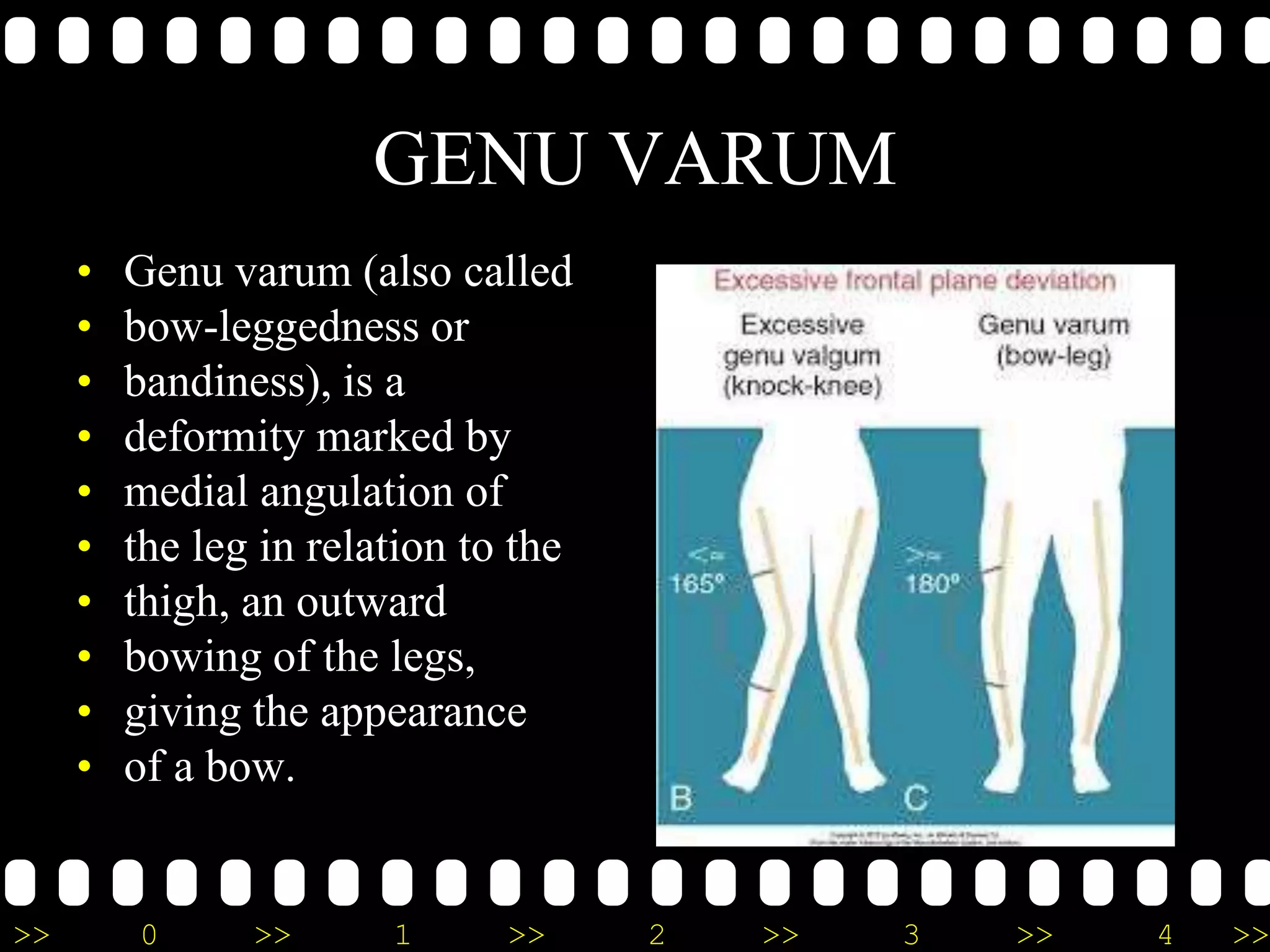
GENU VARUM
• Genu varum (also called
• bow-leggedness or
• bandiness), is a
• deformity marked by
• medial angulation of
• the leg in relation to the
• thigh, an outward
• bowing of the legs,
• giving the appearance
• of a bow.
>> 0 >> 1 >> 2 >> 3 >> 4 >>
• Due to defective growth of the medial side of
the epiphyseal plate.
• It is commonly seen unilaterally and
• Seen in conditions such as Rickets, Paget's
disease and severe degree osteoarthritis of the
knee
>> 0 >> 1 >> 2 >> 3 >> 4 >>
• The degree of deformity is measured by the
distance between the two medial femoral
condyles when the patient is lying.
>> 0 >> 1 >> 2 >> 3 >> 4 >>
TREATMENT OF BOW LEGS
• Generally, no treatment is required for
idiopathic presentation as it is a normal
anatomical variant in young children.
• Treatment is indicated when its persists
beyond 3 and half years old, Unilateral
presentation, or progressive worsening of the
curvature.
• During childhood, assure the proper intake of
vitamin D to prevent rickets.
>> 0 >> 1 >> 2 >> 3 >> 4 >>
TREATMENT OF BOW LEGS
• Mild degree of deformity can be treated by
wearing surgical shoes with 3/8" outer raised
and with a long inner rod extending to the
groin and leather straps across the tibia and the
knee.
• Corrective operations can also be performed,
if necessary. The person would need to wear
casts or braces following the operation
• Post op management same as genu valgum
>> 0 >> 1 >> 2 >> 3 >> 4 >>
GENU RECURVATUM
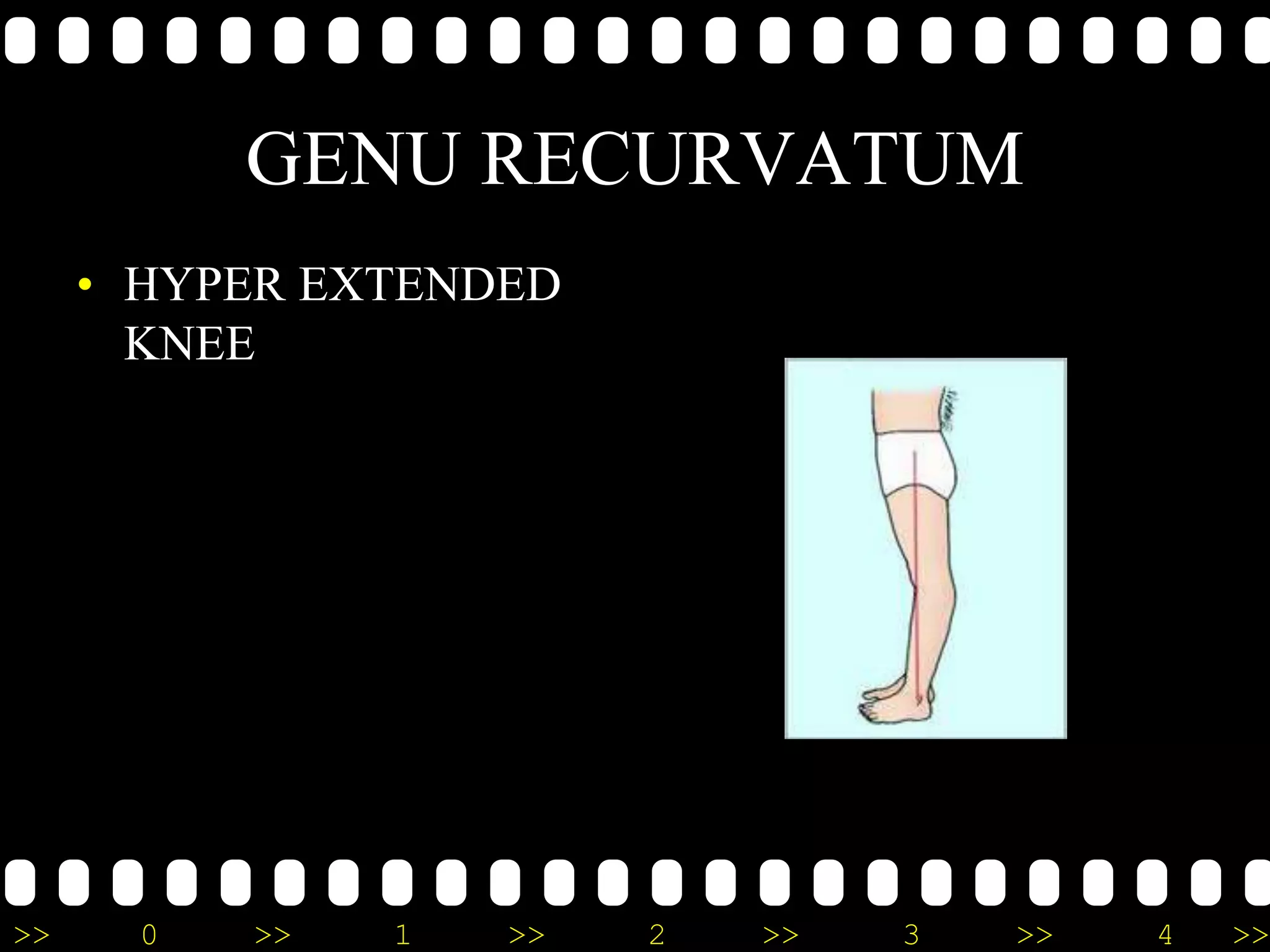
• HYPER EXTENDED
KNEE
>> 0 >> 1 >> 2 >> 3 >> 4 >>
GENU RECURVATUM
• A defined disorder of the connective tissue
• Laxity of the knee ligaments
• Instability of the knee joint due to ligaments and
joint capsule injuries
• Irregular alignment of the femur and tibia
• A deficit in the joints
• A discrepancy in lower limb length
• Certain diseases: Cerebral Palsy, Multiple
Sclerosis, Muscular Dystrophy
• Birth defect/congenital defect
>> 0 >> 1 >> 2 >> 3 >> 4 >>
• measure the patient's
heel heights.
• If there is a normal
contralateral (opposite)
knee to compare to, an
increase in heel height
can be diagnostic for
genu recurvatum.
>> 0 >> 1 >> 2 >> 3 >> 4 >>
TREATMENT FOR GENU
RECURVATUM
• QUADRICEPS STRENGTHENING
EXERCISES
• IF SEVERE TIBIAL OSTEOTOMY
• POST OP
BRACES LIMITING HYPEREXTENSION
>> 0 >> 1 >> 2 >> 3 >> 4 >>
POSTURAL DEVIATIONS OF
ANKLE
• Ankle
– Hyperpronation
– Supination
>> 0 >> 1 >> 2 >> 3 >> 4 >>
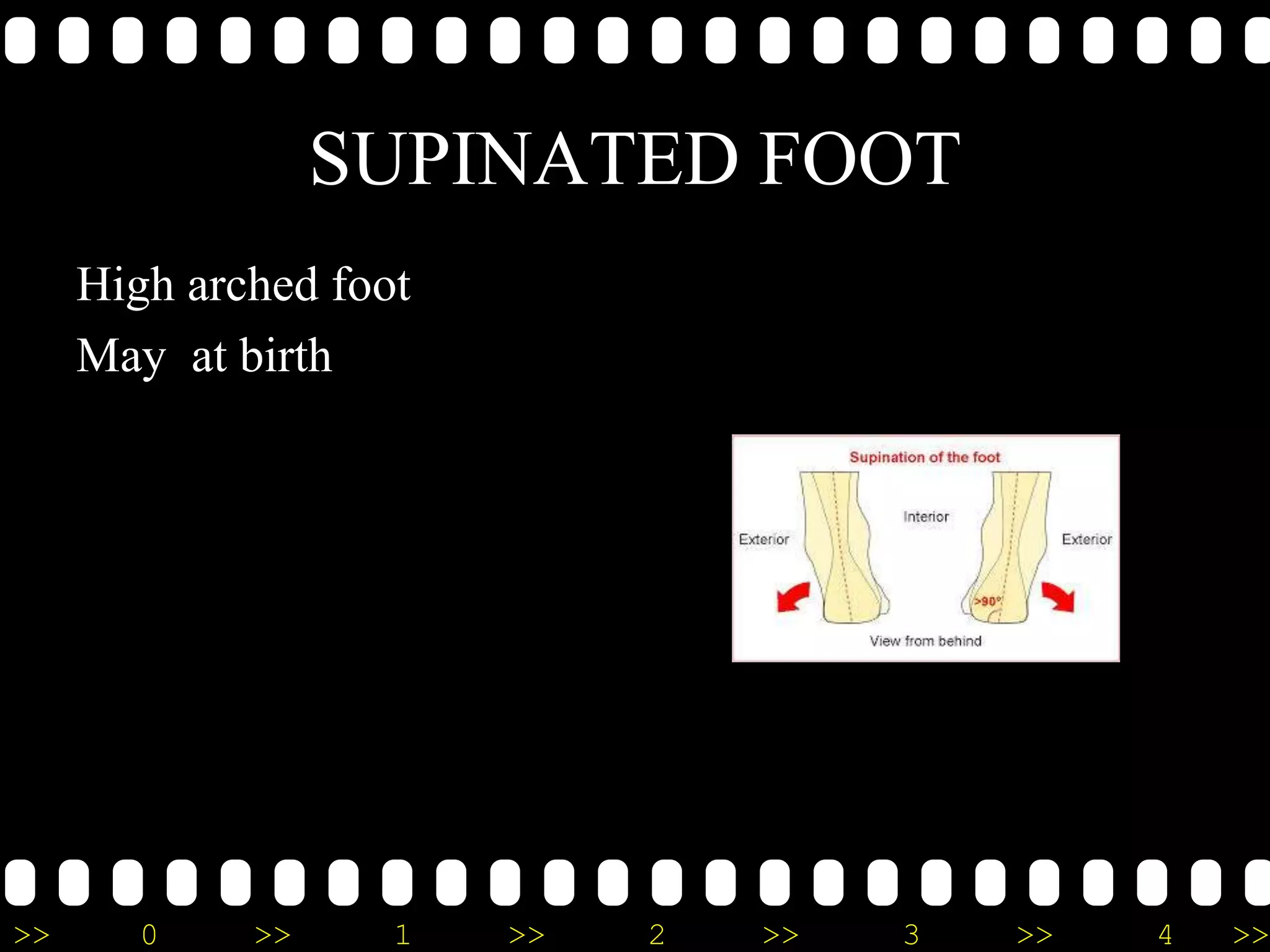
SUPINATED FOOT
High arched foot
May at birth
>> 0 >> 1 >> 2 >> 3 >> 4 >>
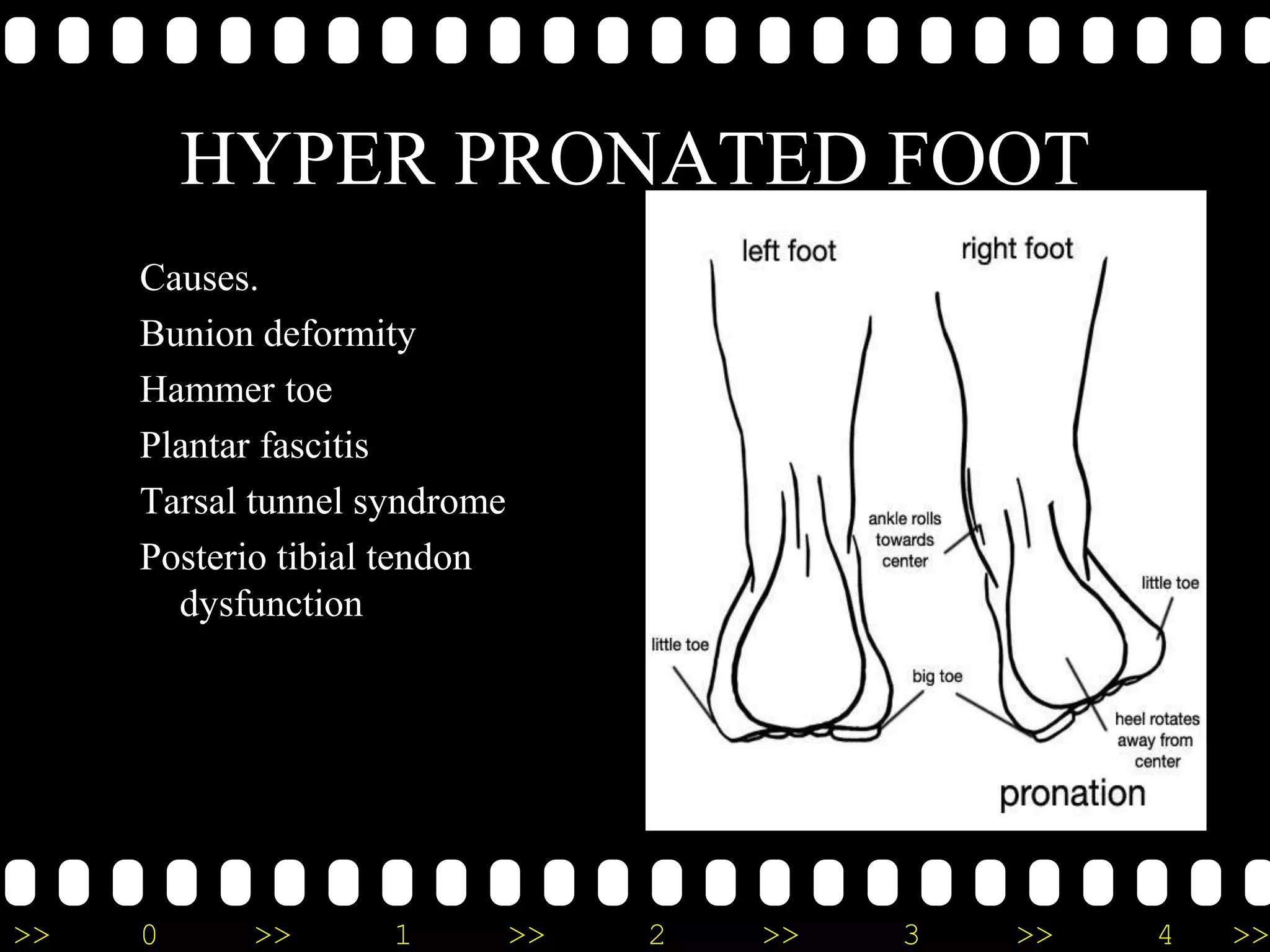
HYPER PRONATED FOOT
Causes.
Bunion deformity
Hammer toe
Plantar fascitis
Tarsal tunnel syndrome
Posterio tibial tendon
dysfunction
>> 0 >> 1 >> 2 >> 3 >> 4 >>

Posture assessment cpd

  • 1.
    >> 0 >>1 >> 2 >> 3 >> 4 >> Posture Assessment
  • 2.
    >> 0 >>1 >> 2 >> 3 >> 4 >> Assessment of posture HIPS •H istory •I nspection(Observation) •P alpation •S pecial (Functional) Tests
  • 3.
    >> 0 >>1 >> 2 >> 3 >> 4 >> History • Was there any history of injury? if so what was the mechanism of injury? • If there is h/o had the patient experienced any back injury previously? if so what caused the pain? • Is there any posture that relieves pain or increase symptoms? • Does the family have any h/o back or anr special problems(congenital abnormalities)?
  • 4.
    >> 0 >>1 >> 2 >> 3 >> 4 >> • Any Previous illness ,surgery, injury? • Any h/o other conditions(connective tissue disorder? • Does the foot wear make any difference to the patients posture or symptoms? • Age of patient(degeneration changes)? • In child ,if growth spurt-when it began?
  • 5.
    >> 0 >>1 >> 2 >> 3 >> 4 >> • For females, when menarche begin? any back pain during menses? • If deformity present-progressive or stationary? • Any neurological symptoms? • Nature ,extent,type,duration of pain? • In children is there any difficulty in fitting clothes?(scoliosis)
  • 6.
    >> 0 >>1 >> 2 >> 3 >> 4 >> • Any difficulty in breathing? • Dominant hand? • Any previous treatment? what ?was it successful? • Driving, sitting, and sleeping postures • Level and intensity of exercise
  • 7.
    >> 0 >>1 >> 2 >> 3 >> 4 >> OBSERVATION • Considerations – Area being used is private, comfortable – Patient preparedness – Do not inform patient you are assessing posture – Use systematic approach • Start at feet and work superiorly or vice versa – Compare bilaterally for symmetry – Your eyes should be at level of region you are observing • Note any use of assisstive device • Habitual relaxed posture must be examined
  • 8.
    >> 0 >>1 >> 2 >> 3 >> 4 >> • Asymmetry 1.standing 2.sitting 3.lying(supine,prone) • Presence of muscle wastings • Soft tissue/bony swelling /enlargement • Scars and skin changes
  • 9.
    >> 0 >>1 >> 2 >> 3 >> 4 >> Observation • Use of a plumb line – Anatomical reference – 3 views • Lateral (sagittal plane movements) • Anterior (frontal/ transverse plane movements) • Posterior (frontal/ transverse plane movements)
  • 10.
    >> 0 >>1 >> 2 >> 3 >> 4 >> STANDING • Determine patient’s general body type – Ectomorph, mesomorph, endomorph – Inherited – Can indicate a person’s natural abilities and disabilities
  • 11.
    >> 0 >>1 >> 2 >> 3 >> 4 >> Plumb line
  • 12.
    >> 0 >>1 >> 2 >> 3 >> 4 >> Plumb line test(lateral view) The plumb line is placed just in front of lateral malleolus or through greater trochanter. The individual to be tested is asked to take a few steps in place and then stand still with the feet at approximately the width of the hip joints, the arms relaxed at the side of the body, and the eyes looking forward
  • 13.
    >> 0 >>1 >> 2 >> 3 >> 4 >>
  • 14.
    >> 0 >>1 >> 2 >> 3 >> 4 >> Plumbline test (anterior view) • The feet are equidistant from the plumb line • parallelity of the feet – standard posture: 3" apart + 10- 15°ofabduction of each foot • level stance (at 0° of dorsiflexion): 9° of abduction of the feet • wearing shoes (about 15° of plantarflexion): 3° of abduction of the feet through the midline of the body
  • 15.
    >> 0 >>1 >> 2 >> 3 >> 4 >> Plumbline (anterior view)
  • 16.
    >> 0 >>1 >> 2 >> 3 >> 4 >> Plumbline(posterior view)
  • 17.
    >> 0 >>1 >> 2 >> 3 >> 4 >> Observation and documentation of plumbline measurement
  • 18.
    >> 0 >>1 >> 2 >> 3 >> 4 >> Lateral view • Head and neck: • Plumb line: The line falls through the ear lobe to the acromion process. • Common faults include: • Forward head: • Flattened lordotic cervical curve • Excessive Lordotic curve
  • 19.
    >> 0 >>1 >> 2 >> 3 >> 4 >> Lateral view-Shoulder Shoulder: • Plumb line: It falls through the acromion process. • Common faults include: • Forward shoulders • Lumbar Lordosis
  • 20.
    >> 0 >>1 >> 2 >> 3 >> 4 >> Lateral view • Thoracic vertebrae • Plumb line: The line bisects the chest symmetrically. • Common faults – Kyphosis – Pectus excavatum (Funnel chest) – Barrel chest – Pectus cavinatum (Pigeon chest
  • 21.
    >> 0 >>1 >> 2 >> 3 >> 4 >> Lateral view • Lumbar vertebrae: • Plumb Line: The line falls midway between the abdomen and back and slightly anterior to the sacroiliac Joint. • Common faults include: – Lordosis – Sway back – Flat back
  • 22.
    >> 0 >>1 >> 2 >> 3 >> 4 >> Lateral view • Ankle: • Plumb line: The line lies slightly anterior to the lateral malleolus, aligned with tuberosity of 5th metatarsal. • Common faults include: – Forward posture
  • 23.
    >> 0 >>1 >> 2 >> 3 >> 4 >> Posterior view • Head and neck: • Plumb line: The midline bisects the head through the external occipital protuberance; head is usually positioned squarely over the shoulders so that eyes remain level. • Common faults include: – Head tilt – Head rotated – Adducted scapulae – Abducted scapulae – Winging of the scapulae:
  • 24.
    >> 0 >>1 >> 2 >> 3 >> 4 >> Posterior view • Trunk • Plumb Line: The line bisects the spinous process of the thoracic and lumbar vertebrae. • Common faults include: – Lateral deviation (Scoliosis)
  • 25.
    >> 0 >>1 >> 2 >> 3 >> 4 >> Posterior view • Pelvis and Hip: • Plumb line: The line bisects the gluteal cleft and the posterior superior iliac spines are on the same horizontal plane; the iliac crests, gluteal folds and greater trochanters are level. • Common faults include: – Lateral pelvic tilt – Pelvic rotation – Abducted hip
  • 26.
    >> 0 >>1 >> 2 >> 3 >> 4 >> Posterior view • Knee • Plumb Line: The plumb line lies, equidistant between the knees. • Common faults include: – Genu varum – Genu Valgum
  • 27.
    >> 0 >>1 >> 2 >> 3 >> 4 >> Posterior view • Ankle and Foot • Plumb line: The line is equidistant from the malleoli, a line is drawn from the medial malleolus to the first metatarsal bone and the tuberosity of the navicular bone lies on the line. • Common faults include: – Pes planus (Pronated) – Pes Cavus (supinated
  • 28.
    >> 0 >>1 >> 2 >> 3 >> 4 >> Anterior view • Shoulders: • Plumb Line: A vertical line bisects the sternum and xiphoid process. • It may be due to: – Dropped or elevated shoulder – Clavicle and joint asymmetry
  • 29.
    >> 0 >>1 >> 2 >> 3 >> 4 >> Anterior view • Elbows: • Common faults include: – Cubitus valgus: The forearm deviates laterally from the arm at angle greater than 15° (female) and 10° (male). It may be due to: • Elbow hyperextension. • Distal displacement of trochlea in relation to capitulum of humerus. • Stretched ulnar collateral ligament. – Cubitus varus
  • 30.
    >> 0 >>1 >> 2 >> 3 >> 4 >> Anterior view • Hip • Plumb line: Common faults include: – Lateral rotation – Medial rotation
  • 31.
    >> 0 >>1 >> 2 >> 3 >> 4 >> Anterior view • Knee: • Plumb Line: The legs are equidistant from a vertical line through the body. • Common Faults include: – External tibial torsion – Internal tibial torsion
  • 32.
    >> 0 >>1 >> 2 >> 3 >> 4 >> Anterior view • Ankle and Foot: • Plumb line: Common Faults include: – Hallux valgus – Hammer toes
  • 33.
    >> 0 >>1 >> 2 >> 3 >> 4 >> OBSERVATION IN SITTING • Sitting on a stool without back support – Anterior view – Lateral view
  • 34.
    >> 0 >>1 >> 2 >> 3 >> 4 >> Sitting-Anterior view
  • 35.
    >> 0 >>1 >> 2 >> 3 >> 4 >> Sitting lateral view
  • 36.
    >> 0 >>1 >> 2 >> 3 >> 4 >> Sitting-Anterior view • Note for the knees whether it it at same distance from floor
  • 37.
    >> 0 >>1 >> 2 >> 3 >> 4 >> Observation -Lying • Supine lying • Prone lying
  • 38.
    >> 0 >>1 >> 2 >> 3 >> 4 >> SUPINE LYING • Position of head,cervical spine and shoulder girdle • Chest observed for protrusion(pectus carinatum)or sunken(pectus excavatum)
  • 39.
    >> 0 >>1 >> 2 >> 3 >> 4 >> Supine lying • Abdomen muscles noted(flabby) • Waist angle noted • ASIS level • Any extension in lumbar spine
  • 40.
    >> 0 >>1 >> 2 >> 3 >> 4 >> Prone lying • Note position of head neck and shoulder girdle • PSIS level • Note for the muscles of gluteals,posterior thigh and calf
  • 41.
    >> 0 >>1 >> 2 >> 3 >> 4 >> PALPATION • In assessment position (i.e., standing), palpate: – Laterally • ASIS vs. PSIS – Anteriorly • Patellae • Iliac Crests • ASIS heights • Lateral Malleolar heights • Fibular Head heights • Shoulder heights - Posteriorly  PSIS positions  Spinal alignment  Scapular positions
  • 42.
    >> 0 >>1 >> 2 >> 3 >> 4 >> Functional testing • Slump Test • Leg length measurement • Romberg • Tandem walking • Others designed to: – Rule out bony restrictions – Rule out soft tissue restrictions – Assess muscular length • ROM • Resting muscle length
  • 43.
    >> 0 >>1 >> 2 >> 3 >> 4 >> Other examination • Video Analysis • 3D Motion Analysis • Sway Measurement Tools – Force Plate – Biodex Stability System
  • 44.
    >> 0 >>1 >> 2 >> 3 >> 4 >> Postural deviations
  • 45.
    >> 0 >>1 >> 2 >> 3 >> 4 >> Commonly seen postural deviations • Foot & Ankle – Hyperpronation – Supination • Knee – Genu Recurvatum – Genu Valgum – Genu Varum
  • 46.
    >> 0 >>1 >> 2 >> 3 >> 4 >> Commonly seen postural deviations • Spine • Lordosis Sway back deformity • Kyphosis Round back humpback/gibbus Flat back Dowagers hump • Scoliosis Non –structural scoliosis Structural scoloisis Idiopathic scoliosis
  • 47.
    >> 0 >>1 >> 2 >> 3 >> 4 >> Lordosis • Lordosis is an excessive anterior curvature of spine • Pathologically it is exaggeration of the normal curves found in the cervical and lumbar spines
  • 48.
    >> 0 >>1 >> 2 >> 3 >> 4 >> Lordosis  Lordosis causes: › Postural deformity › Lax muscles (esp. abs) › Heavy abdomen › Compensatory mechanisms › Hip flexion contracture › Spondylolisthesis › Congential problems › Fashion (high heels)
  • 49.
    >> 0 >>1 >> 2 >> 3 >> 4 >> Lordosis • Observe sagging shoulder • Medial rotation of leg • Head poking forward • The normal pelvic angle(30degree) is increased with lordosis
  • 50.
    >> 0 >>1 >> 2 >> 3 >> 4 >> Postural correction exercises-Lordosis • Lengthening the muscles that create anterior pelvic tilt and making them more flexible • Strengthening and shortening the muscles that create posterior pelvic tilt • Learning to control normal pelvic position
  • 51.
    >> 0 >>1 >> 2 >> 3 >> 4 >> Swayback deformity Increased pelvic inclination (40) • Typically includes kyphosis
  • 52.
    >> 0 >>1 >> 2 >> 3 >> 4 >> Kyphosis • It is excessive posterior curvature of spine • Pathologically it is exaggeration of the normal curve found in the thoracic spine
  • 53.
    >> 0 >>1 >> 2 >> 3 >> 4 >> kyphosis • Kyphosis – Excessive posterior curvature of the spine • Round back • Humpback/gibbus • Flat back • Dowager’s Hump
  • 54.
    >> 0 >>1 >> 2 >> 3 >> 4 >> Kyphosis-Round back • Long rounded curve with ed pelvic inclination and thoraco lumbar kyphosis • O/E • Tight (hip ext & trunk flexors) • Weak(hip flexors &lumbar extensors)
  • 55.
    >> 0 >>1 >> 2 >> 3 >> 4 >> Kyphosis –Hump back/Gibbus • Localised sharp posterior angulation of thoracic spine
  • 56.
    >> 0 >>1 >> 2 >> 3 >> 4 >> Kyphosis –Flat back • Decreased pelvic inclination (20 degrees) • Mobile lumbar spine
  • 57.
    >> 0 >>1 >> 2 >> 3 >> 4 >> Kyphosis-Dowagers Hump • Older patient • Causes-osteoporosis • Where thorocic vertebral bodies degenerates and wedge in anterior direction
  • 58.
    >> 0 >>1 >> 2 >> 3 >> 4 >> Corrective exercises for kyphosis • Exercises to maintain normal pelvic position – to create a basis for correct alignment of the spine. • Exercises to stretch and lengthen the chest muscles (pectoralis major/pectoralis minor) • Strengthening the upper back muscles, the deep erector spinae and the shoulder extensors
  • 59.
    >> 0 >>1 >> 2 >> 3 >> 4 >> Corrective exercises for kyphosis • Breathing exercises for increasing range of respiration (especially inhalation). • In addition to the chest muscles mentioned above, movement of the joints connecting thorax and ribs (the sterno-costal joints) and those linking ribs and vertebrae (the costo- vertebral joints)is of great importance for maintaining chest fl exibility and optimal respiratory functioning
  • 60.
    >> 0 >>1 >> 2 >> 3 >> 4 >> • Mobility exercises for the thoracic vertebrae (T1–12) on all movement planes, from a variety of starting positions • Exercises to increase hamstring fl exibility and thus improve functional pelvic mobility on the sagittal plane (in anterior and posterior pelvic tilt). • Awareness and relaxation exercises.
  • 61.
    >> 0 >>1 >> 2 >> 3 >> 4 >> Corrective exercises-Flat back • Exercise to maintain normal pelvic position – for optimal alignment of the spine and for encouraging anterior pelvic tilt on the sagittal plane • Hamstring fl exibility and lengthening exercises, to improve anterior pelvic tilt • Strengthening hip flexors • Exercise to improve general lower back vertebral mobility
  • 62.
    >> 0 >>1 >> 2 >> 3 >> 4 >> scoliosis  Scoliosis › Nonstructural › Structural › idiopathic
  • 63.
    >> 0 >>1 >> 2 >> 3 >> 4 >> Non-Structural and structural scoliosis Non structural FUNCTIONAL RELATED TO LIMB LENGTH DISCREPANCY NO BONY DEFORMITY SIDEBENDIG IS USUALLY SYMMETRIC FORWARD FLEXION – SCOLIOTIC CURVE DISAPPEARS NON PROGRESSIVE Structural • CONGENITAL/ACQUIRE D • MAY BE IDIOPATHIC • BONY DEFORMITY • SIDE BENDING – ASYMMETRIC • FORWARD FLEXION- SCOLIOTIC CURVE DOES NOT DISAPPEAR • PROGRESSIVE
  • 64.
    >> 0 >>1 >> 2 >> 3 >> 4 >> IDIOPATHIC SCOLIOSIS • 70-85% of all structural scoliosis • Fixed rotational prominence on convex side • RAZOR BACK SPINE
  • 65.
    >> 0 >>1 >> 2 >> 3 >> 4 >> Objective measurement • Demographic data, • Anthropometric tests • Height of acromia • Scapula–spine distance • S1–acromia distance • Biacromial diameter • Height of the anterior superior iliac spine (ASIS) • Lower limb length
  • 66.
    >> 0 >>1 >> 2 >> 3 >> 4 >> • Functional tests • LATERAL BENDING TEST • FLEXIBILITY TEST OF SHOULDER GIRDLE • X-rays (COBB angle).
  • 67.
    >> 0 >>1 >> 2 >> 3 >> 4 >> Corrective exercies for scoliosis 1.Symmetrical exercises aimed to strengthen back and abdominal muscles and for functional improvement in ranges of joint motion. 2. Breathing exercises to increase lung volume and thorax mobility and flexibility. 3. Asymmetrical exercises for lengthening muscles on the concave (shortened) side, and for contracting muscles on the convex (lengthened) side. Asymmetrical exercises are also designed to encourage specific movement of spinal column vertebrae in desired directions (mainly for moderating or balancing rotation in cases of structural scoliosis). 4. Static exercises which also make use of body weight (various “hanging” and traction exercises) for releasing tension along the spine
  • 68.
    >> 0 >>1 >> 2 >> 3 >> 4 >> POSTURAL DEVIATIONS-KNEE • Knee – Genu Recurvatum – Genu Valgum – Genu Varum
  • 69.
    >> 0 >>1 >> 2 >> 3 >> 4 >> GENU VALGUM • Genu valgum, commonly called "knock-knees", is a condition where the knees angle in and touch one another when the legs are straightened.
  • 70.
    >> 0 >>1 >> 2 >> 3 >> 4 >> CAUSES OF GENU VALGUM(KNOCK KNEE) • Rickets • Osteomalacia • Rheumatoid Arthritis • Muscular paralysis of semimembranosus or semitendinosus • Fracture • May be secondary to flat foot, osteoarthritis
  • 71.
    >> 0 >>1 >> 2 >> 3 >> 4 >> MEASUREMENT OF GENU VALGUM • The degree of knock knee is measured by the distance between the medial malleoli at the ankle when the child lies down with the knees touching each other
  • 72.
    >> 0 >>1 >> 2 >> 3 >> 4 >> TREATMENT FOR GENU VALGUM • In mild cases of Genu Valgum in young children, wearing of boots with the inner side of heel raised by 3/8" inch and elongated forward heel (Robert Jones heels) corrects the deformity.
  • 73.
    >> 0 >>1 >> 2 >> 3 >> 4 >> TREATMENT FOR GENU VALGUM In more complicated cases, the child requires a supracondyles closed wedge osteotomy. • Post operative Physiotherapy • Gradual knee mobilization is the main part of the treatment. • heat modalities may be given for relief of pain. • Strengthening exercises for quadriceps, hamstrings and gluteus muscles are given. • When the patient is able to walk, he is given correct training for standing, balancing, weight transferring and walking
  • 74.
    >> 0 >>1 >> 2 >> 3 >> 4 >> GENU VARUM • Genu varum (also called • bow-leggedness or • bandiness), is a • deformity marked by • medial angulation of • the leg in relation to the • thigh, an outward • bowing of the legs, • giving the appearance • of a bow.
  • 75.
    >> 0 >>1 >> 2 >> 3 >> 4 >> • Due to defective growth of the medial side of the epiphyseal plate. • It is commonly seen unilaterally and • Seen in conditions such as Rickets, Paget's disease and severe degree osteoarthritis of the knee
  • 76.
    >> 0 >>1 >> 2 >> 3 >> 4 >> • The degree of deformity is measured by the distance between the two medial femoral condyles when the patient is lying.
  • 77.
    >> 0 >>1 >> 2 >> 3 >> 4 >> TREATMENT OF BOW LEGS • Generally, no treatment is required for idiopathic presentation as it is a normal anatomical variant in young children. • Treatment is indicated when its persists beyond 3 and half years old, Unilateral presentation, or progressive worsening of the curvature. • During childhood, assure the proper intake of vitamin D to prevent rickets.
  • 78.
    >> 0 >>1 >> 2 >> 3 >> 4 >> TREATMENT OF BOW LEGS • Mild degree of deformity can be treated by wearing surgical shoes with 3/8" outer raised and with a long inner rod extending to the groin and leather straps across the tibia and the knee. • Corrective operations can also be performed, if necessary. The person would need to wear casts or braces following the operation • Post op management same as genu valgum
  • 79.
    >> 0 >>1 >> 2 >> 3 >> 4 >> GENU RECURVATUM • HYPER EXTENDED KNEE
  • 80.
    >> 0 >>1 >> 2 >> 3 >> 4 >> GENU RECURVATUM • A defined disorder of the connective tissue • Laxity of the knee ligaments • Instability of the knee joint due to ligaments and joint capsule injuries • Irregular alignment of the femur and tibia • A deficit in the joints • A discrepancy in lower limb length • Certain diseases: Cerebral Palsy, Multiple Sclerosis, Muscular Dystrophy • Birth defect/congenital defect
  • 81.
    >> 0 >>1 >> 2 >> 3 >> 4 >> • measure the patient's heel heights. • If there is a normal contralateral (opposite) knee to compare to, an increase in heel height can be diagnostic for genu recurvatum.
  • 82.
    >> 0 >>1 >> 2 >> 3 >> 4 >> TREATMENT FOR GENU RECURVATUM • QUADRICEPS STRENGTHENING EXERCISES • IF SEVERE TIBIAL OSTEOTOMY • POST OP BRACES LIMITING HYPEREXTENSION
  • 83.
    >> 0 >>1 >> 2 >> 3 >> 4 >> POSTURAL DEVIATIONS OF ANKLE • Ankle – Hyperpronation – Supination
  • 84.
    >> 0 >>1 >> 2 >> 3 >> 4 >> SUPINATED FOOT High arched foot May at birth
  • 85.
    >> 0 >>1 >> 2 >> 3 >> 4 >> HYPER PRONATED FOOT Causes. Bunion deformity Hammer toe Plantar fascitis Tarsal tunnel syndrome Posterio tibial tendon dysfunction
  • 86.
    >> 0 >>1 >> 2 >> 3 >> 4 >>