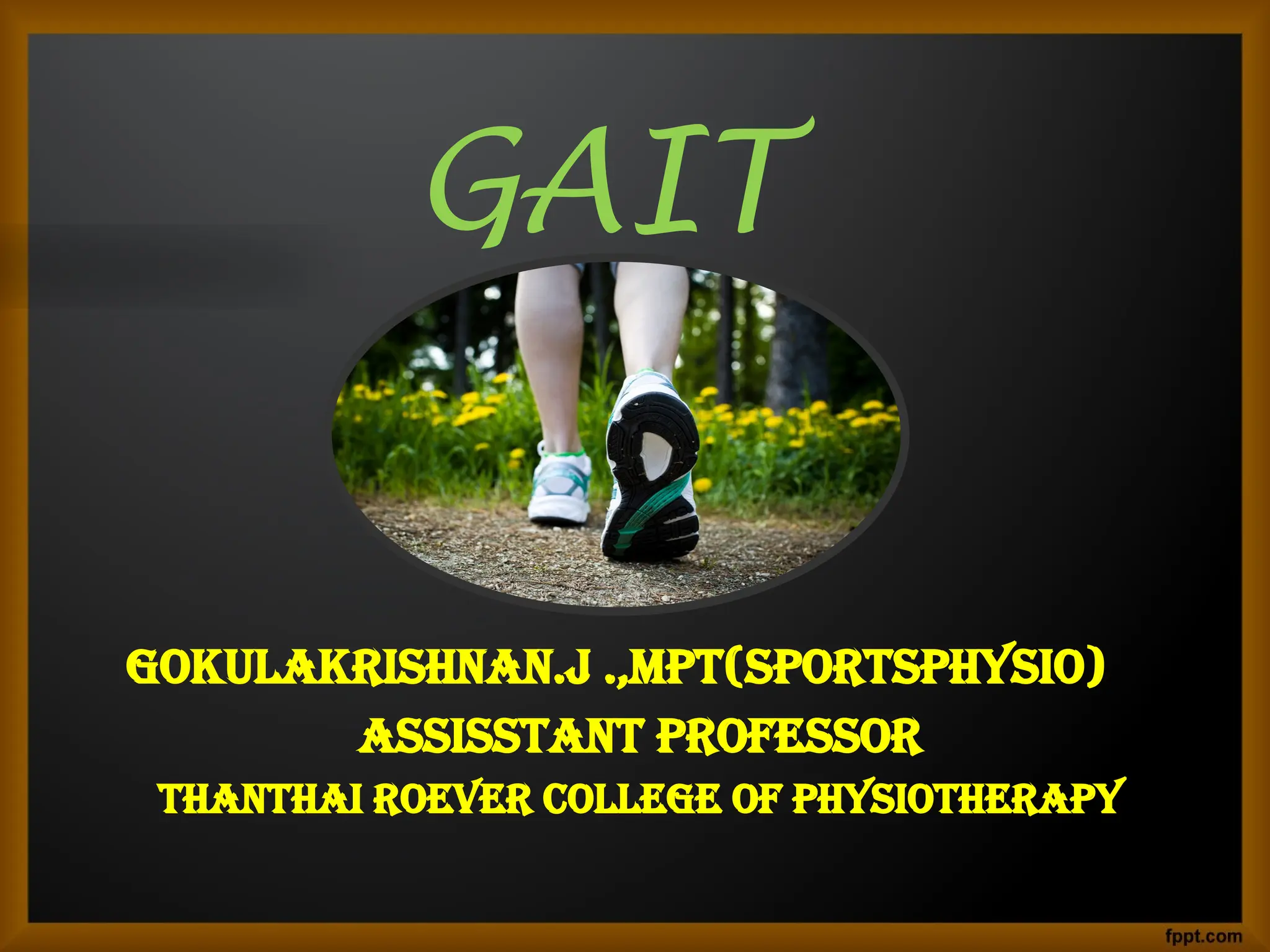
GAIT
GOKULAKRISHNAN.J .,MPT(Sportsphysio)
Assisstant Professor
THANTHAI ROEVER COLLEGE OF PHYSIOTHERAPY
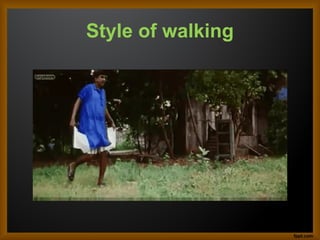
Style of walking
INTRODUCTION
• It is also called human locomotion.
• It is a style of walking pattern.
• The walking pattern or style may differ
from individual to individual.
• It depends on the age, sex, mood, of an
individual and may be due to some
diseases.
• The alternating movements of the lower
extremities essentially support and carry
along the head, arms, and trunk (HAT).
• HAT constitutes about 75% of total body
weight.
• The head & arms – 25 %
• The trunk – 50%
DEFINITION
• Human locomotion or gait, may be defined
as a translatory progression of the body as
a whole,produced by coordinated, rotatory
movementys of body segments
HISTORY
• In 384 – 322 BC aristotle can be attributed with
the earliest recorded commonts regarding the
manner in which humans walk.
• In 1608 – 1679 Giovanni Borelli further progress
was made through the experiments and theories
in human locomotion.
• In 1861 – 1917 Otto ficher was a german
mathematician who was the first to conduct a
three – dimensional gait analysis.
PURPOSE OF GAIT
1. Maintenance of support of the HAT .
2. Maintenance of upright posture and balance of the body.
3. Control of the foot trajectory to achieve safe ground
clearance and a gentle heel or toe landing.
4. Generation of mechanical energy to maintain the present
forward velocity or to increase the present forward velocity
or to increase the forward velocity.
5.Absorption of mechanical energy for shock absorbtion
and stability or to decrease the forward velocity of the body.
GAIT CYCLE
• It is a period of time from one heel strike to
next heel strike of the same limb.
• It consist of two phases,
• Stance phase – 60 %
• Swing phase – 40%
STANCE PHASE
The activity, which occurs during the foot
having the contact with the ground.
SWING PHASE
• The activity, which occurs during the foot
when is not hhaving the contact with the
ground.
COMPONENTS OF STANCE
PHASE (60%)
• Heel strike – 0-2%
• Foot flat – 2-10%
• Mid stance – 10-30%
• Heel off – 30-50%
• Toe off – 50-60%
COMPONENTS OF SWING
PHASE (40%)
• Acceleration – 60-73%
• Midswing – 73-87%
• Deceleration – 87-100%
DESCRIBTION OF
COMPONENTS
Heel strike
• Beginning of stance phase when the heel
contacts the ground
Foot flat
• It occurs immediately following heel strike.
It is the point at which the foot fully
contacts the floor
Mid stance
• It is the point at which the body passes
directly over the supporting extrimity
Heel off
• The point following midstance the heel of
the same extrimity leaves the ground.
TOE OFF
• The point following heel off when only the
toe of the same extrimity is leave contact
with the ground
ACCELERATION
• It begins once the toe leaves the ground &
continues untill mid – swing ,or the point at
which the swinging extrimity is directly
under the body
MID SWING
• It occurs approximately when the
reference extrimity passes directly under
the body.
• It extends from end of acceleration to the
beginning of deceleration.
DECLERATION
• It occurs after mid – swing. When the
reference extrimity is decelerating in
preparation for heel strike.
PARAMETERS OF GAIT
• Time and distance are two basic
parameters of gait.
1. Temporal ( time ) variables
2. Distance ( spatial ) variables
DISTANCE VARIABLE
• Stride length
• Step length
• Degree of toe out
TEMPORAL VARIABLES
• Single limb support time
• Double support time
• Step duration
• Stride duration
• Cadence
• Speed
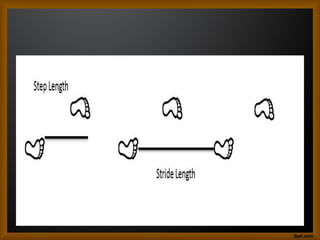
STEP LENGTH
• This is the distance between the heel
strike of one lower extrimity to the heel
strike of another extrimity.
STRIDE LENGTH
• This is the distance between the heel
strike of one lower extrimity to the heel
strike of the same lower extrimity once
again to the ground
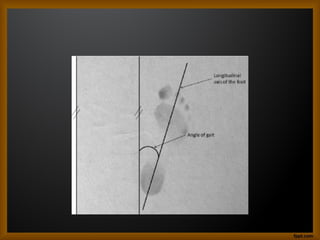
DEGREE OF TOE OUT
• It represents the angle of foot placement.
The lines intersecting the center of heel
and the second toe is called as foot angle.
• ▪ In normal walking the foot angle is 7 it
may decrese in fast walking
SINGLE LIMP SUPPORT TIME
• It is the period at which single limb
contacts the ground.
• The single limb support has been during
the reference extremities in the mid –
stance phase.
DOUBLE LIMB SUPPORT
TIME
• This is period at which both the lower
extrimities having contact with ground.
• The double limb support is possible
between heel-of or toe-off of the one
extrimity and the heel strike or foot flat of
another extrimity
STEP DURATION
• It is the time taken for completetion of one
step.
STRIDE DURATION
• It is the time taken for completion of heel
strike of one extrimity to the heel strike of
the same extrimity again
CADENCE
• It is the number of steps taken per minute .
cadence = no. of steps/min. s
• Normal cadence – 100 – 115 spm
SPEED
• Distance covered by the body per minutes.
Usually measured in m/s.
• Averge velocity = step length cadence
• Average speed = 80m/min
DETERMINANTS OF GAIT
• Displacement of center of gravity (COG).
• Factors responsible for minimizing
displacement of center of gravity.
CENTER OF GRAVITY
• It is an imaginary point at which all the
weight of the body is concentrated at a
given instant.
• Center of gravity lies 2 inches in front of
the second sacral vertebra
• Center of gravity follows vertical
displacement and horizontal displacement.
DISPLACEMENTS
• Rhythmic up & down movement. Highest
point – mid stance, lowest point– double
support average, displacement – 5cm vt
plane Hrz plane.
• Rhythmic side to side movement . lateral
limit – midstance average,displacement –
5cm Hz plane vt plane.
FACTORS RESPONIBLE FOR
DISPLACEMENT
Major detarminants
❖ Minor detarminants
MAJOR DETARMINANTS
• Pelvic rotation
• Pelvic lateral tilt
• Knee flexion during stance
• Ankle mechanism ( dorsiflexion )
• Foot mechanism ( plantarflexion )
• Step width
MINOR DITARMINANTS
• Trunk movement
• Swinging of arms
PELVIC ROTATION
• Rotation of pelvis in horizontal plane im
swing phase.
• Total of 8 degree decrease angle of hip
flexion & extension enables a longer
length without further lowering of center of
gravity.
PELVIC TILT
• The pelvis slopes downwards laterally
towards the leg which is in swing phase.
• Reduce the vertical movements of the
upper body and therby increase energy
efficiency.
• Decrease the displacement of center of
gravity
KNEE FLEXION DURING
STANCE
• As the hip joint passes over the foot during
the support phase, there is some flexion of
the knee.
• This reduces vertical movements at the
hip. Decrease the displacement of center
of gravity.
ANKLE MECHANISM
• Lengthen the leg at heel strike reduce the
lowering of center of gravity.
• Hence smoothen the curve of center of
gravity
FOOT MECHANISM
• Lengthen the leg at toe off as ankle moves
from dorsiflexion to planter flexion .
• Reduce the lowering of center of gravity,
hence smoothen the curve of center of
gravity.
ARMS AND TRUNK
• The trunk, arms and shoulders also rotate
to ensure balance upper limb
• swing opposite to stance leg to produce a
smooth balanced gait
FUNCTION OF
DETARMINANTS OF GAIT
• Increase the efficiency and smoothness of
gait.
• Decrease the vertical and lateral
displacement of center of gravity.
• Decrease the energy expenditure.
• Make gait more graceful.
THANK YOU

GAIT lecture notes by Dr.gokulakrishnan.

  • 1.
  • 2.
  • 3.
    INTRODUCTION • It isalso called human locomotion. • It is a style of walking pattern. • The walking pattern or style may differ from individual to individual. • It depends on the age, sex, mood, of an individual and may be due to some diseases.
  • 4.
    • The alternatingmovements of the lower extremities essentially support and carry along the head, arms, and trunk (HAT). • HAT constitutes about 75% of total body weight. • The head & arms – 25 % • The trunk – 50%
  • 5.
    DEFINITION • Human locomotionor gait, may be defined as a translatory progression of the body as a whole,produced by coordinated, rotatory movementys of body segments
  • 6.
    HISTORY • In 384– 322 BC aristotle can be attributed with the earliest recorded commonts regarding the manner in which humans walk. • In 1608 – 1679 Giovanni Borelli further progress was made through the experiments and theories in human locomotion. • In 1861 – 1917 Otto ficher was a german mathematician who was the first to conduct a three – dimensional gait analysis.
  • 7.
    PURPOSE OF GAIT 1.Maintenance of support of the HAT . 2. Maintenance of upright posture and balance of the body. 3. Control of the foot trajectory to achieve safe ground clearance and a gentle heel or toe landing. 4. Generation of mechanical energy to maintain the present forward velocity or to increase the present forward velocity or to increase the forward velocity. 5.Absorption of mechanical energy for shock absorbtion and stability or to decrease the forward velocity of the body.
  • 8.
    GAIT CYCLE • Itis a period of time from one heel strike to next heel strike of the same limb. • It consist of two phases, • Stance phase – 60 % • Swing phase – 40%
  • 9.
    STANCE PHASE The activity,which occurs during the foot having the contact with the ground.
  • 10.
    SWING PHASE • Theactivity, which occurs during the foot when is not hhaving the contact with the ground.
  • 11.
    COMPONENTS OF STANCE PHASE(60%) • Heel strike – 0-2% • Foot flat – 2-10% • Mid stance – 10-30% • Heel off – 30-50% • Toe off – 50-60%
  • 12.
    COMPONENTS OF SWING PHASE(40%) • Acceleration – 60-73% • Midswing – 73-87% • Deceleration – 87-100%
  • 13.
  • 14.
    Heel strike • Beginningof stance phase when the heel contacts the ground
  • 15.
    Foot flat • Itoccurs immediately following heel strike. It is the point at which the foot fully contacts the floor
  • 16.
    Mid stance • Itis the point at which the body passes directly over the supporting extrimity
  • 17.
    Heel off • Thepoint following midstance the heel of the same extrimity leaves the ground.
  • 18.
    TOE OFF • Thepoint following heel off when only the toe of the same extrimity is leave contact with the ground
  • 19.
    ACCELERATION • It beginsonce the toe leaves the ground & continues untill mid – swing ,or the point at which the swinging extrimity is directly under the body
  • 20.
    MID SWING • Itoccurs approximately when the reference extrimity passes directly under the body. • It extends from end of acceleration to the beginning of deceleration.
  • 21.
    DECLERATION • It occursafter mid – swing. When the reference extrimity is decelerating in preparation for heel strike.
  • 22.
    PARAMETERS OF GAIT •Time and distance are two basic parameters of gait. 1. Temporal ( time ) variables 2. Distance ( spatial ) variables
  • 23.
    DISTANCE VARIABLE • Stridelength • Step length • Degree of toe out
  • 24.
    TEMPORAL VARIABLES • Singlelimb support time • Double support time • Step duration • Stride duration • Cadence • Speed
  • 25.
    STEP LENGTH • Thisis the distance between the heel strike of one lower extrimity to the heel strike of another extrimity.
  • 26.
    STRIDE LENGTH • Thisis the distance between the heel strike of one lower extrimity to the heel strike of the same lower extrimity once again to the ground
  • 28.
    DEGREE OF TOEOUT • It represents the angle of foot placement. The lines intersecting the center of heel and the second toe is called as foot angle. • ▪ In normal walking the foot angle is 7 it may decrese in fast walking
  • 30.
    SINGLE LIMP SUPPORTTIME • It is the period at which single limb contacts the ground. • The single limb support has been during the reference extremities in the mid – stance phase.
  • 31.
    DOUBLE LIMB SUPPORT TIME •This is period at which both the lower extrimities having contact with ground. • The double limb support is possible between heel-of or toe-off of the one extrimity and the heel strike or foot flat of another extrimity
  • 32.
    STEP DURATION • Itis the time taken for completetion of one step.
  • 33.
    STRIDE DURATION • Itis the time taken for completion of heel strike of one extrimity to the heel strike of the same extrimity again
  • 34.
    CADENCE • It isthe number of steps taken per minute . cadence = no. of steps/min. s • Normal cadence – 100 – 115 spm
  • 35.
    SPEED • Distance coveredby the body per minutes. Usually measured in m/s. • Averge velocity = step length cadence • Average speed = 80m/min
  • 36.
    DETERMINANTS OF GAIT •Displacement of center of gravity (COG). • Factors responsible for minimizing displacement of center of gravity.
  • 37.
    CENTER OF GRAVITY •It is an imaginary point at which all the weight of the body is concentrated at a given instant. • Center of gravity lies 2 inches in front of the second sacral vertebra • Center of gravity follows vertical displacement and horizontal displacement.
  • 38.
    DISPLACEMENTS • Rhythmic up& down movement. Highest point – mid stance, lowest point– double support average, displacement – 5cm vt plane Hrz plane. • Rhythmic side to side movement . lateral limit – midstance average,displacement – 5cm Hz plane vt plane.
  • 39.
    FACTORS RESPONIBLE FOR DISPLACEMENT Majordetarminants ❖ Minor detarminants
  • 40.
    MAJOR DETARMINANTS • Pelvicrotation • Pelvic lateral tilt • Knee flexion during stance • Ankle mechanism ( dorsiflexion ) • Foot mechanism ( plantarflexion ) • Step width
  • 41.
    MINOR DITARMINANTS • Trunkmovement • Swinging of arms
  • 42.
    PELVIC ROTATION • Rotationof pelvis in horizontal plane im swing phase. • Total of 8 degree decrease angle of hip flexion & extension enables a longer length without further lowering of center of gravity.
  • 43.
    PELVIC TILT • Thepelvis slopes downwards laterally towards the leg which is in swing phase. • Reduce the vertical movements of the upper body and therby increase energy efficiency. • Decrease the displacement of center of gravity
  • 44.
    KNEE FLEXION DURING STANCE •As the hip joint passes over the foot during the support phase, there is some flexion of the knee. • This reduces vertical movements at the hip. Decrease the displacement of center of gravity.
  • 45.
    ANKLE MECHANISM • Lengthenthe leg at heel strike reduce the lowering of center of gravity. • Hence smoothen the curve of center of gravity
  • 46.
    FOOT MECHANISM • Lengthenthe leg at toe off as ankle moves from dorsiflexion to planter flexion . • Reduce the lowering of center of gravity, hence smoothen the curve of center of gravity.
  • 47.
    ARMS AND TRUNK •The trunk, arms and shoulders also rotate to ensure balance upper limb • swing opposite to stance leg to produce a smooth balanced gait
  • 48.
    FUNCTION OF DETARMINANTS OFGAIT • Increase the efficiency and smoothness of gait. • Decrease the vertical and lateral displacement of center of gravity. • Decrease the energy expenditure. • Make gait more graceful.
  • 49.