END FEEL
K.SOUNDARARAJAN
K. Soundararajan, SRIHER 1
• General concept
• End feel
• Types
• Goniometry
K. Soundararajan, SRIHER 2
GENERAL concept
• Passive ROM is determined by structure of joint
• Joint capsule limits the movements in particular direction
• Other limitation include muscle, skin , fascia, soft tissue
approximation, contact of joint surface
K. Soundararajan, SRIHER 3
End feel - meaning
• Type of structure that limits ROM has a characteristic feel , that
may be detected by examiner who is performing the passive
ROM
• This feeling , which is barrier to further motion at the end of a
passive ROM , is called End feel
K. Soundararajan, SRIHER 4
Definition
• One of the most important factors to investigate with passive
range-of-motion testing is the end feel. The end feel is the
quality of movement perceived by the practitioner at the very
end of the available range of motion. The end feel can reveal a
great deal about the nature of various pathologies.K. Soundararajan, SRIHER 5
Types of End feel
• Soft
• Firm
• Hard
K. Soundararajan, SRIHER 6
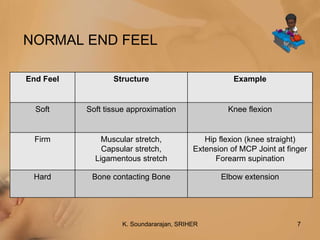
NORMAL END FEEL
End Feel Structure Example
Soft Soft tissue approximation Knee flexion
Firm Muscular stretch,
Capsular stretch,
Ligamentous stretch
Hip flexion (knee straight)
Extension of MCP Joint at finger
Forearm supination
Hard Bone contacting Bone Elbow extension
K. Soundararajan, SRIHER 7
SHOULDER FLEXION
Range of motion: 0-180
Patient’s position: supine lying
Goniometer positioning: Movable arm = long axis of humerus
Stable arm = parallel to the sternum
Fulcrum = greater tubercle of humerus
End feel = firm end feelK. Soundararajan, SRIHER 8
SHOULDER EXTENTION
Range of motion: 0-40
Patient’s position: prone lying
Goniometer position: Movable arm = long axis of humerus
Stable arm = parallel to midline
Fulcrum = greater tubercle of humerus
End feel = firm end feelK. Soundararajan, SRIHER 9
SHOULDER ABDUCTION & ADDUCTION
Range of motion: 0-180
Patient’s position: supine
Goniometer position: Moveable arm = long axis of humerus
Stable arm = in line with trunk
Fulcrum = acromion process
End feel = firm end feelK. Soundararajan, SRIHER 10
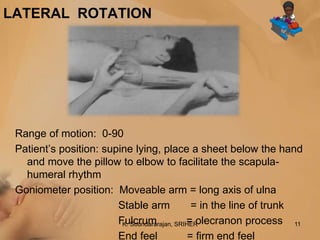
LATERAL ROTATION
Range of motion: 0-90
Patient’s position: supine lying, place a sheet below the hand
and move the pillow to elbow to facilitate the scapula-
humeral rhythm
Goniometer position: Moveable arm = long axis of ulna
Stable arm = in the line of trunk
Fulcrum = olecranon process
End feel = firm end feel
K. Soundararajan, SRIHER 11
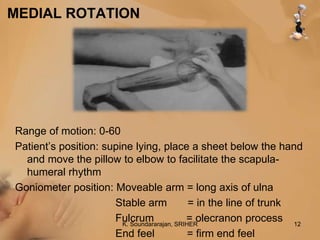
MEDIAL ROTATION
Range of motion: 0-60
Patient’s position: supine lying, place a sheet below the hand
and move the pillow to elbow to facilitate the scapula-
humeral rhythm
Goniometer position: Moveable arm = long axis of ulna
Stable arm = in the line of trunk
Fulcrum = olecranon process
End feel = firm end feel
K. Soundararajan, SRIHER 12
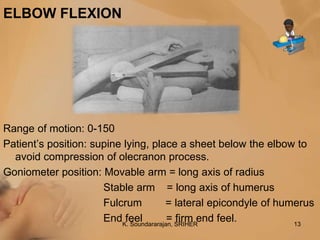
ELBOW FLEXION
Range of motion: 0-150
Patient’s position: supine lying, place a sheet below the elbow to
avoid compression of olecranon process.
Goniometer position: Movable arm = long axis of radius
Stable arm = long axis of humerus
Fulcrum = lateral epicondyle of humerus
End feel = firm end feel.K. Soundararajan, SRIHER 13
PRONATION
Range of motion: 0-90
Patient’s position: sitting with forearm placed on a couch in
midprone position, holding pen at folded hand. Place sheet
below the hand
Goniometer position:
Movable arm = perpendicular to ground / Parallel to Pen
Stable arm = at 90 degree / Perpendicular to ground
Fulcrum = styloid process of ulna / 3rd metacarpal bone
End feel = firm end feelK. Soundararajan, SRIHER 14
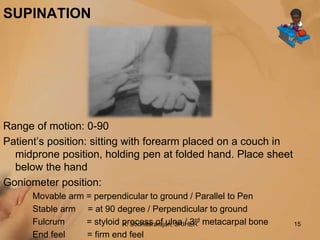
SUPINATION
Range of motion: 0-90
Patient’s position: sitting with forearm placed on a couch in
midprone position, holding pen at folded hand. Place sheet
below the hand
Goniometer position:
Movable arm = perpendicular to ground / Parallel to Pen
Stable arm = at 90 degree / Perpendicular to ground
Fulcrum = styloid process of ulna / 3rd metacarpal bone
End feel = firm end feel
K. Soundararajan, SRIHER 15
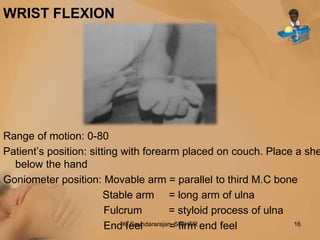
WRIST FLEXION
Range of motion: 0-80
Patient’s position: sitting with forearm placed on couch. Place a she
below the hand
Goniometer position: Movable arm = parallel to third M.C bone
Stable arm = long arm of ulna
Fulcrum = styloid process of ulna
End feel = firm end feelK. Soundararajan, SRIHER 16
WRIST EXTENTION
Range of motion: 0-70
Patient’s position: sitting with forearm placed on couch. Place a
sheet below the hand
Goniometer position: Movable arm = parallel to third M.C bone
Stable arm = long arm of ulna
Fulcrum = styloid process of ulna
End feel = firm end feelK. Soundararajan, SRIHER 17
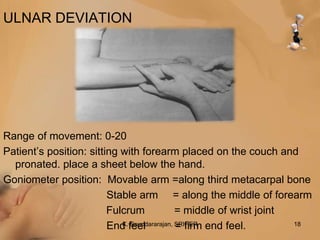
ULNAR DEVIATION
Range of movement: 0-20
Patient’s position: sitting with forearm placed on the couch and
pronated. place a sheet below the hand.
Goniometer position: Movable arm =along third metacarpal bone
Stable arm = along the middle of forearm
Fulcrum = middle of wrist joint
End feel = firm end feel.K. Soundararajan, SRIHER 18
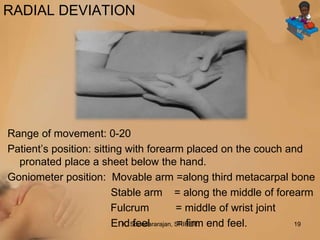
RADIAL DEVIATION
Range of movement: 0-20
Patient’s position: sitting with forearm placed on the couch and
pronated place a sheet below the hand.
Goniometer position: Movable arm =along third metacarpal bone
Stable arm = along the middle of forearm
Fulcrum = middle of wrist joint
End feel = firm end feel.K. Soundararajan, SRIHER 19
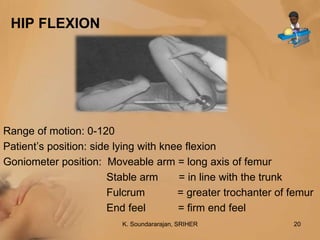
HIP FLEXION
Range of motion: 0-120
Patient’s position: side lying with knee flexion
Goniometer position: Moveable arm = long axis of femur
Stable arm = in line with the trunk
Fulcrum = greater trochanter of femur
End feel = firm end feel
K. Soundararajan, SRIHER 20
HIP EXTENTION
Range of motion: 0-30
Patient’s position: prone lying
Goniometer position: Movable arm =long axis of femur
Stable arm =in the line with trunk
Fulcrum = greater trochanter of femur
End feel = firm end feel
K. Soundararajan, SRIHER 21
HIP ABDUCTION
Range of motion: 0-45
Patient’s position: supine lying
Goniometer position: Movable arm = in the line with femur bone
Stable arm = imaginary line between two
ASIS
Fulcrum = ASIS
End feel = firm end feelK. Soundararajan, SRIHER 22
HIP ADDUCTION
Range of motion: 0-45
Patient’s position: supine lying
Goniometer position: Movable arm = in the line with femur bone
Stable arm = imaginary line between two
ASIS
Fulcrum = ASIS
End feel = firm end feelK. Soundararajan, SRIHER 23
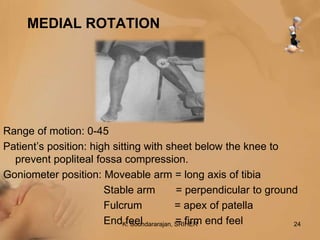
MEDIAL ROTATION
Range of motion: 0-45
Patient’s position: high sitting with sheet below the knee to
prevent popliteal fossa compression.
Goniometer position: Moveable arm = long axis of tibia
Stable arm = perpendicular to ground
Fulcrum = apex of patella
End feel = firm end feelK. Soundararajan, SRIHER 24
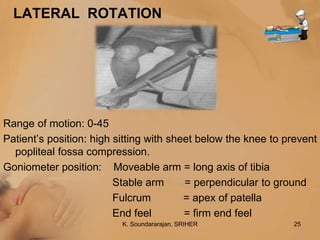
LATERAL ROTATION
Range of motion: 0-45
Patient’s position: high sitting with sheet below the knee to prevent
popliteal fossa compression.
Goniometer position: Moveable arm = long axis of tibia
Stable arm = perpendicular to ground
Fulcrum = apex of patella
End feel = firm end feel
K. Soundararajan, SRIHER 25
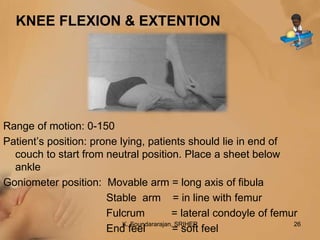
KNEE FLEXION & EXTENTION
Range of motion: 0-150
Patient’s position: prone lying, patients should lie in end of
couch to start from neutral position. Place a sheet below
ankle
Goniometer position: Movable arm = long axis of fibula
Stable arm = in line with femur
Fulcrum = lateral condoyle of femur
End feel = soft feel
K. Soundararajan, SRIHER 26
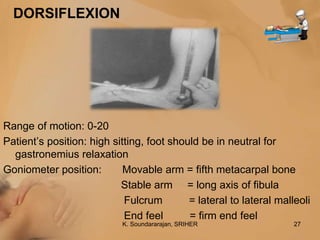
DORSIFLEXION
Range of motion: 0-20
Patient’s position: high sitting, foot should be in neutral for
gastronemius relaxation
Goniometer position: Movable arm = fifth metacarpal bone
Stable arm = long axis of fibula
Fulcrum = lateral to lateral malleoli
End feel = firm end feel
K. Soundararajan, SRIHER 27
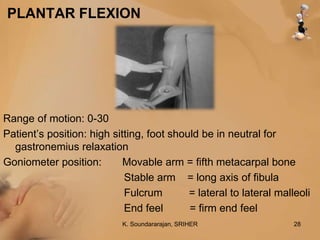
PLANTAR FLEXION
Range of motion: 0-30
Patient’s position: high sitting, foot should be in neutral for
gastronemius relaxation
Goniometer position: Movable arm = fifth metacarpal bone
Stable arm = long axis of fibula
Fulcrum = lateral to lateral malleoli
End feel = firm end feel
K. Soundararajan, SRIHER 28
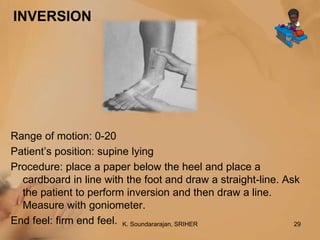
INVERSION
Range of motion: 0-20
Patient’s position: supine lying
Procedure: place a paper below the heel and place a
cardboard in line with the foot and draw a straight-line. Ask
the patient to perform inversion and then draw a line.
Measure with goniometer.
End feel: firm end feel. K. Soundararajan, SRIHER 29
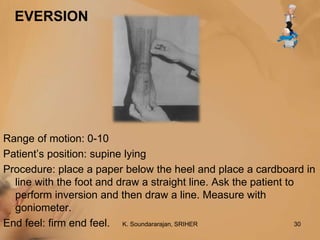
EVERSION
Range of motion: 0-10
Patient’s position: supine lying
Procedure: place a paper below the heel and place a cardboard in
line with the foot and draw a straight line. Ask the patient to
perform inversion and then draw a line. Measure with
goniometer.
End feel: firm end feel. K. Soundararajan, SRIHER 30
Reference
Measurement of Joint Motion A Guide to Goniometry ; Cynthia
C.Norkin, D.Joyce White; Japee ; 3rd edition.K. Soundararajan, SRIHER 31
K. Soundararajan, SRIHER 32
K. Soundararajan, SRIHER 33

End feel

  • 1.
  • 2.
    • General concept •End feel • Types • Goniometry K. Soundararajan, SRIHER 2
  • 3.
    GENERAL concept • PassiveROM is determined by structure of joint • Joint capsule limits the movements in particular direction • Other limitation include muscle, skin , fascia, soft tissue approximation, contact of joint surface K. Soundararajan, SRIHER 3
  • 4.
    End feel -meaning • Type of structure that limits ROM has a characteristic feel , that may be detected by examiner who is performing the passive ROM • This feeling , which is barrier to further motion at the end of a passive ROM , is called End feel K. Soundararajan, SRIHER 4
  • 5.
    Definition • One ofthe most important factors to investigate with passive range-of-motion testing is the end feel. The end feel is the quality of movement perceived by the practitioner at the very end of the available range of motion. The end feel can reveal a great deal about the nature of various pathologies.K. Soundararajan, SRIHER 5
  • 6.
    Types of Endfeel • Soft • Firm • Hard K. Soundararajan, SRIHER 6
  • 7.
    NORMAL END FEEL EndFeel Structure Example Soft Soft tissue approximation Knee flexion Firm Muscular stretch, Capsular stretch, Ligamentous stretch Hip flexion (knee straight) Extension of MCP Joint at finger Forearm supination Hard Bone contacting Bone Elbow extension K. Soundararajan, SRIHER 7
  • 8.
    SHOULDER FLEXION Range ofmotion: 0-180 Patient’s position: supine lying Goniometer positioning: Movable arm = long axis of humerus Stable arm = parallel to the sternum Fulcrum = greater tubercle of humerus End feel = firm end feelK. Soundararajan, SRIHER 8
  • 9.
    SHOULDER EXTENTION Range ofmotion: 0-40 Patient’s position: prone lying Goniometer position: Movable arm = long axis of humerus Stable arm = parallel to midline Fulcrum = greater tubercle of humerus End feel = firm end feelK. Soundararajan, SRIHER 9
  • 10.
    SHOULDER ABDUCTION &ADDUCTION Range of motion: 0-180 Patient’s position: supine Goniometer position: Moveable arm = long axis of humerus Stable arm = in line with trunk Fulcrum = acromion process End feel = firm end feelK. Soundararajan, SRIHER 10
  • 11.
    LATERAL ROTATION Range ofmotion: 0-90 Patient’s position: supine lying, place a sheet below the hand and move the pillow to elbow to facilitate the scapula- humeral rhythm Goniometer position: Moveable arm = long axis of ulna Stable arm = in the line of trunk Fulcrum = olecranon process End feel = firm end feel K. Soundararajan, SRIHER 11
  • 12.
    MEDIAL ROTATION Range ofmotion: 0-60 Patient’s position: supine lying, place a sheet below the hand and move the pillow to elbow to facilitate the scapula- humeral rhythm Goniometer position: Moveable arm = long axis of ulna Stable arm = in the line of trunk Fulcrum = olecranon process End feel = firm end feel K. Soundararajan, SRIHER 12
  • 13.
    ELBOW FLEXION Range ofmotion: 0-150 Patient’s position: supine lying, place a sheet below the elbow to avoid compression of olecranon process. Goniometer position: Movable arm = long axis of radius Stable arm = long axis of humerus Fulcrum = lateral epicondyle of humerus End feel = firm end feel.K. Soundararajan, SRIHER 13
  • 14.
    PRONATION Range of motion:0-90 Patient’s position: sitting with forearm placed on a couch in midprone position, holding pen at folded hand. Place sheet below the hand Goniometer position: Movable arm = perpendicular to ground / Parallel to Pen Stable arm = at 90 degree / Perpendicular to ground Fulcrum = styloid process of ulna / 3rd metacarpal bone End feel = firm end feelK. Soundararajan, SRIHER 14
  • 15.
    SUPINATION Range of motion:0-90 Patient’s position: sitting with forearm placed on a couch in midprone position, holding pen at folded hand. Place sheet below the hand Goniometer position: Movable arm = perpendicular to ground / Parallel to Pen Stable arm = at 90 degree / Perpendicular to ground Fulcrum = styloid process of ulna / 3rd metacarpal bone End feel = firm end feel K. Soundararajan, SRIHER 15
  • 16.
    WRIST FLEXION Range ofmotion: 0-80 Patient’s position: sitting with forearm placed on couch. Place a she below the hand Goniometer position: Movable arm = parallel to third M.C bone Stable arm = long arm of ulna Fulcrum = styloid process of ulna End feel = firm end feelK. Soundararajan, SRIHER 16
  • 17.
    WRIST EXTENTION Range ofmotion: 0-70 Patient’s position: sitting with forearm placed on couch. Place a sheet below the hand Goniometer position: Movable arm = parallel to third M.C bone Stable arm = long arm of ulna Fulcrum = styloid process of ulna End feel = firm end feelK. Soundararajan, SRIHER 17
  • 18.
    ULNAR DEVIATION Range ofmovement: 0-20 Patient’s position: sitting with forearm placed on the couch and pronated. place a sheet below the hand. Goniometer position: Movable arm =along third metacarpal bone Stable arm = along the middle of forearm Fulcrum = middle of wrist joint End feel = firm end feel.K. Soundararajan, SRIHER 18
  • 19.
    RADIAL DEVIATION Range ofmovement: 0-20 Patient’s position: sitting with forearm placed on the couch and pronated place a sheet below the hand. Goniometer position: Movable arm =along third metacarpal bone Stable arm = along the middle of forearm Fulcrum = middle of wrist joint End feel = firm end feel.K. Soundararajan, SRIHER 19
  • 20.
    HIP FLEXION Range ofmotion: 0-120 Patient’s position: side lying with knee flexion Goniometer position: Moveable arm = long axis of femur Stable arm = in line with the trunk Fulcrum = greater trochanter of femur End feel = firm end feel K. Soundararajan, SRIHER 20
  • 21.
    HIP EXTENTION Range ofmotion: 0-30 Patient’s position: prone lying Goniometer position: Movable arm =long axis of femur Stable arm =in the line with trunk Fulcrum = greater trochanter of femur End feel = firm end feel K. Soundararajan, SRIHER 21
  • 22.
    HIP ABDUCTION Range ofmotion: 0-45 Patient’s position: supine lying Goniometer position: Movable arm = in the line with femur bone Stable arm = imaginary line between two ASIS Fulcrum = ASIS End feel = firm end feelK. Soundararajan, SRIHER 22
  • 23.
    HIP ADDUCTION Range ofmotion: 0-45 Patient’s position: supine lying Goniometer position: Movable arm = in the line with femur bone Stable arm = imaginary line between two ASIS Fulcrum = ASIS End feel = firm end feelK. Soundararajan, SRIHER 23
  • 24.
    MEDIAL ROTATION Range ofmotion: 0-45 Patient’s position: high sitting with sheet below the knee to prevent popliteal fossa compression. Goniometer position: Moveable arm = long axis of tibia Stable arm = perpendicular to ground Fulcrum = apex of patella End feel = firm end feelK. Soundararajan, SRIHER 24
  • 25.
    LATERAL ROTATION Range ofmotion: 0-45 Patient’s position: high sitting with sheet below the knee to prevent popliteal fossa compression. Goniometer position: Moveable arm = long axis of tibia Stable arm = perpendicular to ground Fulcrum = apex of patella End feel = firm end feel K. Soundararajan, SRIHER 25
  • 26.
    KNEE FLEXION &EXTENTION Range of motion: 0-150 Patient’s position: prone lying, patients should lie in end of couch to start from neutral position. Place a sheet below ankle Goniometer position: Movable arm = long axis of fibula Stable arm = in line with femur Fulcrum = lateral condoyle of femur End feel = soft feel K. Soundararajan, SRIHER 26
  • 27.
    DORSIFLEXION Range of motion:0-20 Patient’s position: high sitting, foot should be in neutral for gastronemius relaxation Goniometer position: Movable arm = fifth metacarpal bone Stable arm = long axis of fibula Fulcrum = lateral to lateral malleoli End feel = firm end feel K. Soundararajan, SRIHER 27
  • 28.
    PLANTAR FLEXION Range ofmotion: 0-30 Patient’s position: high sitting, foot should be in neutral for gastronemius relaxation Goniometer position: Movable arm = fifth metacarpal bone Stable arm = long axis of fibula Fulcrum = lateral to lateral malleoli End feel = firm end feel K. Soundararajan, SRIHER 28
  • 29.
    INVERSION Range of motion:0-20 Patient’s position: supine lying Procedure: place a paper below the heel and place a cardboard in line with the foot and draw a straight-line. Ask the patient to perform inversion and then draw a line. Measure with goniometer. End feel: firm end feel. K. Soundararajan, SRIHER 29
  • 30.
    EVERSION Range of motion:0-10 Patient’s position: supine lying Procedure: place a paper below the heel and place a cardboard in line with the foot and draw a straight line. Ask the patient to perform inversion and then draw a line. Measure with goniometer. End feel: firm end feel. K. Soundararajan, SRIHER 30
  • 31.
    Reference Measurement of JointMotion A Guide to Goniometry ; Cynthia C.Norkin, D.Joyce White; Japee ; 3rd edition.K. Soundararajan, SRIHER 31
  • 32.
  • 33.