Fluid Mechanics
Biomechanics 5
Learning Objectives
 Be able to:
 Define friction, air resistance and drag
 Explain how a streamlined helmet reduces drag
with reference to laminar and turbulent air flow
 Explain the factors that effect drag and apply
them, using examples, to explain how a
cyclist, swimmer or skier can reduce the effects
of drag
When a solid surface of a body is
in contact, whilst in motion, with
a solid surface of another body
you will get …………………..
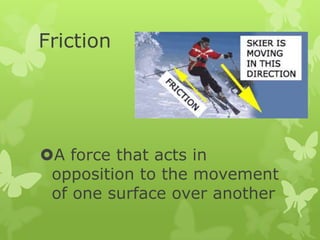
Friction

A force that acts in
opposition to the movement
of one surface over another
Friction
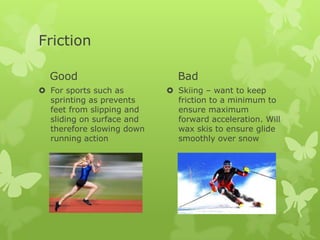
Good
 For sports such as
sprinting as prevents
feet from slipping and
sliding on surface and
therefore slowing down
running action

Bad
 Skiing – want to keep
friction to a minimum to
ensure maximum
forward acceleration. Will
wax skis to ensure glide
smoothly over snow
Types of Friction
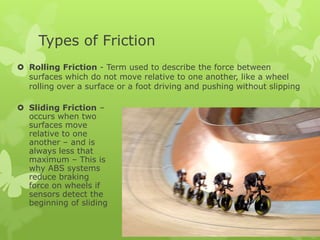
 Rolling Friction - Term used to describe the force between
surfaces which do not move relative to one another, like a wheel
rolling over a surface or a foot driving and pushing without slipping
 Sliding Friction –
occurs when two
surfaces move
relative to one
another – and is
always less that
maximum – This is
why ABS systems
reduce braking
force on wheels if
sensors detect the
beginning of sliding
But…………..
A solid moving through a fluid is referred to
differently
Fluid Friction
 Term applied to objects moving through fluids (gases or
liquids)

 The force acts in the opposite direction to the direction
of motion
 Often referred to as DRAG (in water and air) or AIR
RESISTANCE in air!
Fluid Friction

Fluid – a material that
deforms continuously and
permanently under the
application of a shearing
stress.
Definitions
Air resistance
 The force acting in the
opposite direction to the
motion of a body
travelling through air
 Depends on shape and
surface characteristics of
the body, cross-sectional
area and velocity of body

Drag
 The force produced by
the motion of a body
in fluid (water or air)
 Depends on same
points as air
resistance but also on
the type of fluid.
 Water – greater
density than air
 Water – harder to
push through
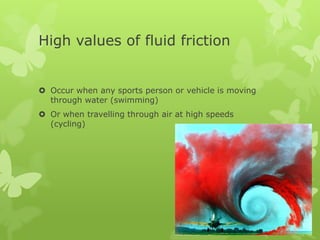
High values of fluid friction

 Occur when any sports person or vehicle is moving
through water (swimming)
 Or when travelling through air at high speeds
(cycling)
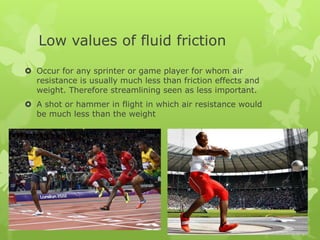
Low values of fluid friction
 Occur for any sprinter or game player for whom air
resistance is usually much less than friction effects and
weight. Therefore streamlining seen as less important.
 A shot or hammer in flight in which air resistance would
be much less than the weight
Exam Question
 Reducing drag is especially important in
both cycling and swimming.
 Discuss the factors that influence drag in sport
and examine strategies that are employed to
minimise effects.
Laminar Flow and Drag
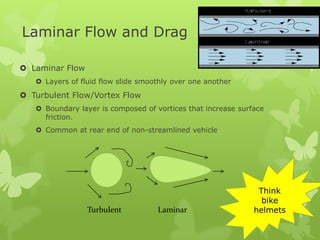
 Laminar Flow
 Layers of fluid flow slide smoothly over one another

 Turbulent Flow/Vortex Flow
 Boundary layer is composed of vortices that increase surface
friction.
 Common at rear end of non-streamlined vehicle

Turbulent

Laminar

Think
bike
helmets
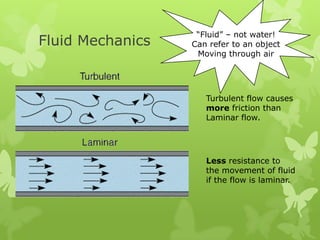
Fluid Mechanics

“Fluid” – not water!
Can refer to an object
Moving through air

Turbulent flow causes
more friction than
Laminar flow.

Less resistance to
the movement of fluid
if the flow is laminar.
Streamlining
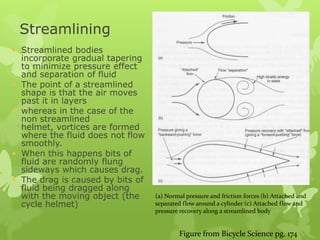
 Streamlined bodies








incorporate gradual tapering
to minimize pressure effect
and separation of fluid
The point of a streamlined
shape is that the air moves
past it in layers
whereas in the case of the
non streamlined
helmet, vortices are formed
where the fluid does not flow
smoothly.
When this happens bits of
fluid are randomly flung
sideways which causes drag.
The drag is caused by bits of
fluid being dragged along
with the moving object (the
cycle helmet)

(a) Normal pressure and friction forces (b) Attached and
separated flow around a cylinder (c) Attached flow and
pressure recovery along a streamlined body

Figure from Bicycle Science pg. 174
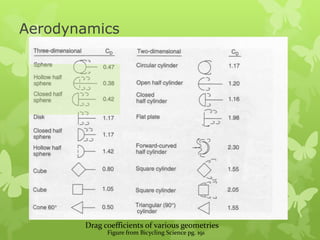
Aerodynamics

Drag coefficients of various geometries
Figure from Bicycling Science pg. 191
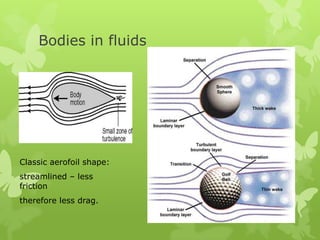
Bodies in fluids

Classic aerofoil shape:

streamlined – less
friction
therefore less drag.
Fluid Friction or drag
 http://www.livescience.com/21761-summer-olympicsscience-making-swimmers-faster-video.html
 http://www.livescience.com/21921-summer-olympicscience-london-s-pool-making-swimmers-fastervideo.html
 http://www.bbc.co.uk/learningzone/clips/windresistance-in-cycling/2180.html
 http://www.bbc.co.uk/learningzone/clips/chris-hoystrack-cycling-basics/5652.html
Factors affecting drag

Shape, surface characteristics
and position of the body
Cross-sectional area of the
body
Velocity of the body
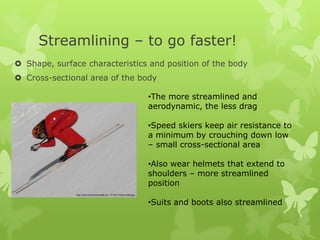
Streamlining – to go faster!
 Shape, surface characteristics and position of the body
 Cross-sectional area of the body
•The more streamlined and
aerodynamic, the less drag
•Speed skiers keep air resistance to
a minimum by crouching down low
– small cross-sectional area
•Also wear helmets that extend to
shoulders – more streamlined
position
•Suits and boots also streamlined
Tips to reduce drag in Cycling
 http://www.bikeradar.com/gear/article/technique-losethat-drag-875/

 TIP: get out of the wind using other riders wherever
possible
 TIP: keep clothing zipped up, relatively snug and adjust
it to the wind and heat
 TIP: lower spoke count drops drag, and lighter wheels
will make climbing easier too
 TIP: consider aero bars to make your ride more
comfortable and faster
 TIP: get low when you hit a head wind
1 BODY POSITION: 1 to 6 minutes. - Cost from £20 - Moving the torso into a flat
position, producing a lower head and flatter arms, significantly reduces frontal area without
buying much more than a new stem.
2 AEROBARS: 30sec to 2 minutes - Cost from £50 - Assuming the arms are
narrowed, torso position is easier to maintain and drag from the bars is reduced.
3 AERO HELMET: 30 to 120 seconds - Cost from £70 - Reducing vents and smoothing
airflow behind the rider's head is a significant drag reducer that can give you more than a
second per pound spent.
4 SKINSUIT: 30 to 60 seconds - Cost from £30 - Flapping pockets, rough material and bad
seam placement make run of the mill clothing un-aero. Skin-tight suits work, though the
exact figures are kept secret by the likes of Nike, Pearl Izumi and Descente.
5 FRONT WHEEL: 30sec to 60 seconds - Cost from £200 - Keeping air close to the rim as
opposed to air swirling around a box-shaped rim reduces drag. As does a reduced spoke
count to ideally 12 to 18.
6 AERO FRAME: 30sec to 2 minutes - Cost from £500 - Taking round tubes and giving them
an aero profile reduces drag. Reducing the seat tube or wrapping it around the rear
wheel, or just behind the front wheel, also works
7 FRONTMOUNTED AERO BOTTLE: 30sec to 60 seconds - Cost from £15 - Keeping the
rider's arms on the bars and not reaching for a bottle keeps drag low and allows power to
be applied constantly. Bottles behind the saddle will slow you down by 30-40 seconds.
8 REAR DISC WHEEL: 15 to 30 seconds - Cost from £500 - The effect is roughly half that of
a front wheel due to the frame shielding the wheel (Martin & Cobb). It may make you more
aerodynamic, but high winds can make handling tricky.
9 OVERSHOES:10 to 20 seconds - Cost from £15 - You can get some cheap speed with
tight rubberized Lycra shoe covers that take straps, vents and buckles out of the wind.
10 CONCEALED CABLES: 10-20 seconds approx. - Cost from none - Merely routing cables
through bars and into the appropriate frame hold can reduce drag.
http://www.bikeradar.com/gear/article/know-how-beating-the-wind-12090/
 http://www.sciencelearn.org.nz/Science-Stories/CyclingAerodynamics/Sci-Media/Video/Testing-aerodynamics-ofelite-cyclists
Exam Question
 Reducing drag is especially important in
both cycling and swimming.
 Discuss the factors that influence drag in sport
and examine strategies that are employed to
minimise effects.

Biomechanics 5 fluid dynamics

  • 1.
  • 2.
    Learning Objectives  Beable to:  Define friction, air resistance and drag  Explain how a streamlined helmet reduces drag with reference to laminar and turbulent air flow  Explain the factors that effect drag and apply them, using examples, to explain how a cyclist, swimmer or skier can reduce the effects of drag
  • 3.
    When a solidsurface of a body is in contact, whilst in motion, with a solid surface of another body you will get …………………..
  • 4.
    Friction A force thatacts in opposition to the movement of one surface over another
  • 5.
    Friction Good  For sportssuch as sprinting as prevents feet from slipping and sliding on surface and therefore slowing down running action Bad  Skiing – want to keep friction to a minimum to ensure maximum forward acceleration. Will wax skis to ensure glide smoothly over snow
  • 6.
    Types of Friction Rolling Friction - Term used to describe the force between surfaces which do not move relative to one another, like a wheel rolling over a surface or a foot driving and pushing without slipping  Sliding Friction – occurs when two surfaces move relative to one another – and is always less that maximum – This is why ABS systems reduce braking force on wheels if sensors detect the beginning of sliding
  • 7.
    But………….. A solid movingthrough a fluid is referred to differently
  • 8.
    Fluid Friction  Termapplied to objects moving through fluids (gases or liquids)  The force acts in the opposite direction to the direction of motion  Often referred to as DRAG (in water and air) or AIR RESISTANCE in air!
  • 9.
    Fluid Friction Fluid –a material that deforms continuously and permanently under the application of a shearing stress.
  • 10.
    Definitions Air resistance  Theforce acting in the opposite direction to the motion of a body travelling through air  Depends on shape and surface characteristics of the body, cross-sectional area and velocity of body Drag  The force produced by the motion of a body in fluid (water or air)  Depends on same points as air resistance but also on the type of fluid.  Water – greater density than air  Water – harder to push through
  • 11.
    High values offluid friction  Occur when any sports person or vehicle is moving through water (swimming)  Or when travelling through air at high speeds (cycling)
  • 12.
    Low values offluid friction  Occur for any sprinter or game player for whom air resistance is usually much less than friction effects and weight. Therefore streamlining seen as less important.  A shot or hammer in flight in which air resistance would be much less than the weight
  • 13.
    Exam Question  Reducingdrag is especially important in both cycling and swimming.  Discuss the factors that influence drag in sport and examine strategies that are employed to minimise effects.
  • 14.
    Laminar Flow andDrag  Laminar Flow  Layers of fluid flow slide smoothly over one another  Turbulent Flow/Vortex Flow  Boundary layer is composed of vortices that increase surface friction.  Common at rear end of non-streamlined vehicle Turbulent Laminar Think bike helmets
  • 15.
    Fluid Mechanics “Fluid” –not water! Can refer to an object Moving through air Turbulent flow causes more friction than Laminar flow. Less resistance to the movement of fluid if the flow is laminar.
  • 16.
    Streamlining  Streamlined bodies     incorporategradual tapering to minimize pressure effect and separation of fluid The point of a streamlined shape is that the air moves past it in layers whereas in the case of the non streamlined helmet, vortices are formed where the fluid does not flow smoothly. When this happens bits of fluid are randomly flung sideways which causes drag. The drag is caused by bits of fluid being dragged along with the moving object (the cycle helmet) (a) Normal pressure and friction forces (b) Attached and separated flow around a cylinder (c) Attached flow and pressure recovery along a streamlined body Figure from Bicycle Science pg. 174
  • 17.
    Aerodynamics Drag coefficients ofvarious geometries Figure from Bicycling Science pg. 191
  • 18.
    Bodies in fluids Classicaerofoil shape: streamlined – less friction therefore less drag.
  • 19.
    Fluid Friction ordrag  http://www.livescience.com/21761-summer-olympicsscience-making-swimmers-faster-video.html  http://www.livescience.com/21921-summer-olympicscience-london-s-pool-making-swimmers-fastervideo.html  http://www.bbc.co.uk/learningzone/clips/windresistance-in-cycling/2180.html  http://www.bbc.co.uk/learningzone/clips/chris-hoystrack-cycling-basics/5652.html
  • 20.
    Factors affecting drag Shape,surface characteristics and position of the body Cross-sectional area of the body Velocity of the body
  • 21.
    Streamlining – togo faster!  Shape, surface characteristics and position of the body  Cross-sectional area of the body •The more streamlined and aerodynamic, the less drag •Speed skiers keep air resistance to a minimum by crouching down low – small cross-sectional area •Also wear helmets that extend to shoulders – more streamlined position •Suits and boots also streamlined
  • 22.
    Tips to reducedrag in Cycling  http://www.bikeradar.com/gear/article/technique-losethat-drag-875/  TIP: get out of the wind using other riders wherever possible  TIP: keep clothing zipped up, relatively snug and adjust it to the wind and heat  TIP: lower spoke count drops drag, and lighter wheels will make climbing easier too  TIP: consider aero bars to make your ride more comfortable and faster  TIP: get low when you hit a head wind
  • 23.
    1 BODY POSITION:1 to 6 minutes. - Cost from £20 - Moving the torso into a flat position, producing a lower head and flatter arms, significantly reduces frontal area without buying much more than a new stem. 2 AEROBARS: 30sec to 2 minutes - Cost from £50 - Assuming the arms are narrowed, torso position is easier to maintain and drag from the bars is reduced. 3 AERO HELMET: 30 to 120 seconds - Cost from £70 - Reducing vents and smoothing airflow behind the rider's head is a significant drag reducer that can give you more than a second per pound spent. 4 SKINSUIT: 30 to 60 seconds - Cost from £30 - Flapping pockets, rough material and bad seam placement make run of the mill clothing un-aero. Skin-tight suits work, though the exact figures are kept secret by the likes of Nike, Pearl Izumi and Descente. 5 FRONT WHEEL: 30sec to 60 seconds - Cost from £200 - Keeping air close to the rim as opposed to air swirling around a box-shaped rim reduces drag. As does a reduced spoke count to ideally 12 to 18. 6 AERO FRAME: 30sec to 2 minutes - Cost from £500 - Taking round tubes and giving them an aero profile reduces drag. Reducing the seat tube or wrapping it around the rear wheel, or just behind the front wheel, also works 7 FRONTMOUNTED AERO BOTTLE: 30sec to 60 seconds - Cost from £15 - Keeping the rider's arms on the bars and not reaching for a bottle keeps drag low and allows power to be applied constantly. Bottles behind the saddle will slow you down by 30-40 seconds. 8 REAR DISC WHEEL: 15 to 30 seconds - Cost from £500 - The effect is roughly half that of a front wheel due to the frame shielding the wheel (Martin & Cobb). It may make you more aerodynamic, but high winds can make handling tricky. 9 OVERSHOES:10 to 20 seconds - Cost from £15 - You can get some cheap speed with tight rubberized Lycra shoe covers that take straps, vents and buckles out of the wind. 10 CONCEALED CABLES: 10-20 seconds approx. - Cost from none - Merely routing cables through bars and into the appropriate frame hold can reduce drag. http://www.bikeradar.com/gear/article/know-how-beating-the-wind-12090/
  • 24.
  • 25.
    Exam Question  Reducingdrag is especially important in both cycling and swimming.  Discuss the factors that influence drag in sport and examine strategies that are employed to minimise effects.