ARTHROKINEMATICS
Shweta kulkarni
For 2nd year B.P.Th
ARTHROKINEMATICS
1
OBJECTIVES
TYPES OF MOTIONS
CONVEX-CONCAVE RULE
ARTHROKINEMATICS
2
Arthrokinematics (accessory motions) is
used to refer movement between adjacent
joint surfaces.
Arthrokinematics or accessory motions
ARTHROKINEMATICS
3
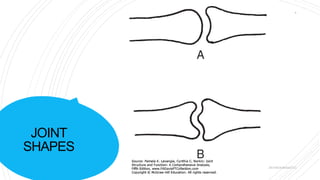
JOINT
SHAPES
ARTHROKINEMATICS
4
TYPES OF
MOTIONS
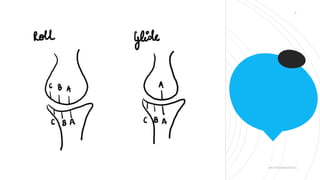
ROLL
SLIDE
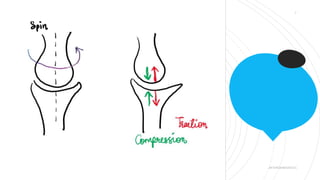
SPIN
COMPRESSION
TRACTION
ARTHROKINEMATICS
5
ARTHROKINEMATICS
6
ARTHROKINEMATICS
7
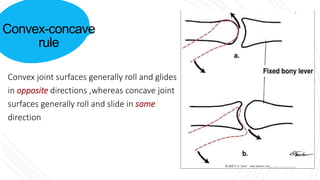
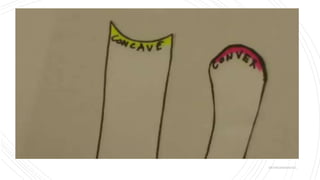
Convex-concave
rule
Convex joint surfaces generally roll and glides
in opposite directions ,whereas concave joint
surfaces generally roll and slide in same
direction
ARTHROKINEMATICS
8
Applied
aspect
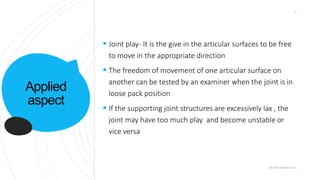
 Joint play- It is the give in the articular surfaces to be free
to move in the appropriate direction
 The freedom of movement of one articular surface on
another can be tested by an examiner when the joint is in
loose pack position
 If the supporting joint structures are excessively lax , the
joint may have too much play and become unstable or
vice versa
ARTHROKINEMATICS
9
10
ARTHROKINEMATICS
Q&A
 Arthrokinematics can be voluntarily isolated under normal conditions ? True
or false
 In spin there is rotation of a segment about a stationary mechanical axis ?
True or false
 _______ is the decrease in the joint space between bony partners.
 _________ is the longitudinal pull .
ARTHROKINEMATICS
11
ARTHROKINEMATICS
12

ARTHROKINEMATICS SK.pptx

Editor's Notes

  • #2 When listing all project collaborators, either use commas or bullets