Self-
Confidence
“The most consistent difference
between elite and less successful
athletes is that elite athletes
possess greater self-confidence”
(Gould et al.)
Self-Confidence
 A global term or general term
 “Belief that one has the internal resources,
particularly abilities, to achieve success”
 “Rooted in beliefs and expectations”
 (Advances in Sport Psychology, Thelma S. Horn, 2008)
Self-Efficacy
 Bandura put forward the notion that as people
become competent in particular skills and
situations they develop a feeling of self-
efficacy.
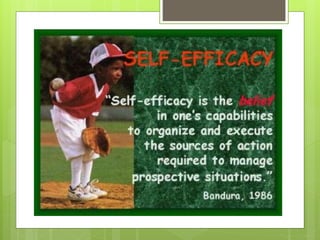
 Self-efficacy is self confidence in a specific
situation.
 The expectation that they will be competent
and successful in a particular task
 Self-efficacy can effect the choice of activity,
the amount of effort expended and persistence
at the task.
Self-Efficacy
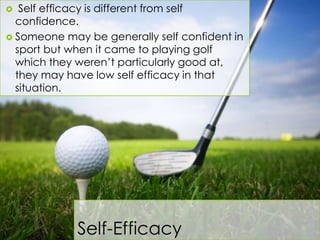
 Self efficacy is different from self
confidence.
 Someone may be generally self confident in
sport but when it came to playing golf
which they weren’t particularly good at,
they may have low self efficacy in that
situation.
Bandura Suggested:
People with High Self-Efficacy;
 Seek challenges – approach behaviour
 Attribute success to internal factors such
as ability and effort
 The above would elevate confidence
and increase expectation of success in
next challenge
 Where have we heard this type of
description before??
Bandura suggested:
People with low Self-Efficacy;
 Adopt avoidance behaviour
 Give up easily and become
anxious when task is difficult
 They attribute failure to internal
factors
 The above would decrease
confidence and reduce
expectation of success in next
challenge and induce learned
helplessness
Mmm,
where
have I
heard this
before?
Task
 Vealey’s Theory of Sport Confidence
 Bandura’s Theory of Self-efficacy
 Your table will be allocated a theory above to
investigate
 You are to produce a colourful and interesting
factsheet and prepare to teach another group
about your theory
 You will have 30min to prepare and 15 min to
produce your fact sheet
 Teaching your work will take 20 minutes and then
you will feedback to your table about what you
have learned (10 -15 min)
Bandura’s
Theory of Self-
Efficacy
………..in more detail
Task 1
 Write down 5 situations in sport where you
feel a low sense of self efficacy. How do
you account for these feelings of low self
confidence?
 E.g.s
 In football, a midfielder having to play in
goal.
 A male having to play in a netball game.
Factors Effecting Self-Efficacy
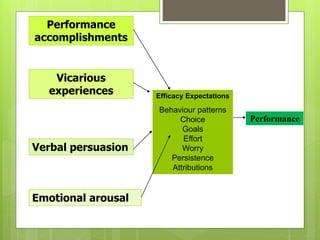
Our expectations of self-efficacy depend
on 4 types of information:
1. Performance accomplishments –
a) These probably have the strongest
influence on self confidence.
b) If success has been experienced in the
past, then feelings of self confidence are
likely to be high
Factors Effecting Self-Efficacy
2. Vicarious experiences –
a) This refers to what we have observed
before. (Better if performer is of same
ability level)
b) If we watch others perform and be
successful, then we are more likely to
experience high self efficacy.
Factors Effecting Self-Efficacy
3. Verbal persuasion –
a) If we are encouraged to try a particular
activity, our confidence in that situation
may increase.
Factors Effecting Self-Efficacy
4. Emotional arousal
a) Our perceptions of how aroused we are
can effect our confidence in a particular
situation.
Performance
Efficacy Expectations
Behaviour patterns
Choice
Goals
Effort
Worry
Persistence
Attributions
Performance
accomplishments
Emotional arousal
Vicarious
experiences
Verbal persuasion
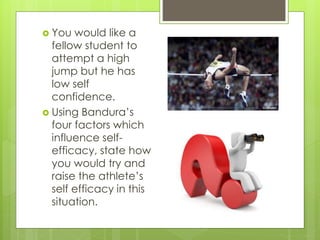
 You would like a
fellow student to
attempt a high
jump but he has
low self
confidence.
 Using Bandura’s
four factors which
influence self-
efficacy, state how
you would try and
raise the athlete’s
self efficacy in this
situation.
 Try to give him initial success by
lowering the bar to start with or
using some flexi rope
 Demonstrate how it can be
done, or if you are much better
than him, use someone of a
similar ability
 Verbally encourage the
athlete. Tell him that he should
‘have a go’. Tell him that to be
worried is a natural, very
positive response because it
prepares the body well
How do we increase our
Self-Efficacy? - Summary
Bandura’s Self Efficacy Theory
1. Previous Accomplishments
 Reminder of previous success in skill
(practical)
2. Vicarious Experiences
 Watching others perform the skill
3. Verbal Persuasion
 Convincing athlete of their ability to
perform the skill
4. Emotional Control
 Evaluation of physical state
Vealey’s Sport Specific
Model of Sport Confidence
Vealey defines sports confidence as
“the belief or degree of certainty
individuals possess about their ability
to be successful in sport.
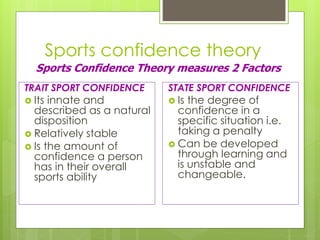
Sports confidence theory
TRAIT SPORT CONFIDENCE
 Its innate and
described as a natural
disposition
 Relatively stable
 Is the amount of
confidence a person
has in their overall
sports ability
STATE SPORT CONFIDENCE
 Is the degree of
confidence in a
specific situation i.e.
taking a penalty
 Can be developed
through learning and
is unstable and
changeable.
Sports Confidence Theory measures 2 Factors
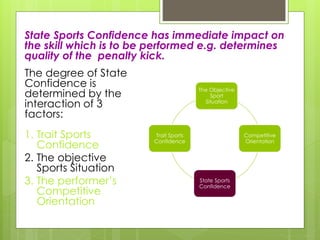
State Sports Confidence has immediate impact on
the skill which is to be performed e.g. determines
quality of the penalty kick.
The Objective
Sport
Situation
Competitive
Orientation
State Sports
Confidence
Trait Sports
Confidence
The degree of State
Confidence is
determined by the
interaction of 3
factors:
1. Trait Sports
Confidence
2. The objective
Sports Situation
3. The performer’s
Competitive
Orientation
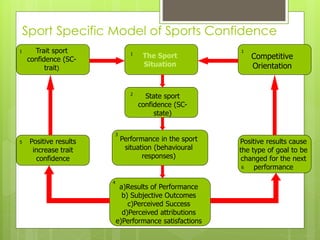
a)Results of Performance
b) Subjective Outcomes
c)Perceived Success
d)Perceived attributions
e)Performance satisfactions
Trait sport
confidence (SC-
trait)
The Sport
Situation
Competitive
Orientation
Positive results
increase trait
confidence
State sport
confidence (SC-
state)
Performance in the sport
situation (behavioural
responses)
Positive results cause
the type of goal to be
changed for the next
performance
1
1 1
2
3
4
5
6
Sport Specific Model of Sports Confidence
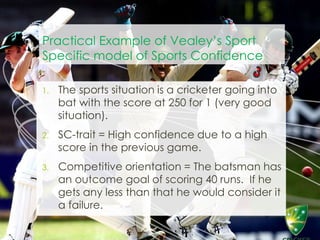
Practical Example of Vealey’s Sport
Specific model of Sports Confidence.
1. The sports situation is a cricketer going into
bat with the score at 250 for 1 (very good
situation).
2. SC-trait = High confidence due to a high
score in the previous game.
3. Competitive orientation = The batsman has
an outcome goal of scoring 40 runs. If he
gets any less than that he would consider it
a failure.
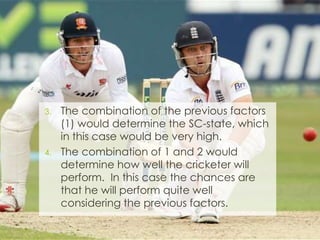
3. The combination of the previous factors
(1) would determine the SC-state, which
in this case would be very high.
4. The combination of 1 and 2 would
determine how well the cricketer will
perform. In this case the chances are
that he will perform quite well
considering the previous factors.
4. Depending on how well the cricketer performed
(3) the following factors will be evaluated after the
match.
a. Results of performance (was he successful or
not according to his goal)
b. Subjective outcome (How did other people rate
the performance)
c. Perceived Success (whether the goal was met
or not, did he feel like he succeeded?)
d. Perceived Attribution (Why did he perform well /
badly. Was it internal / external reasons
e. Performance satisfaction (Was he happy with
the performance)
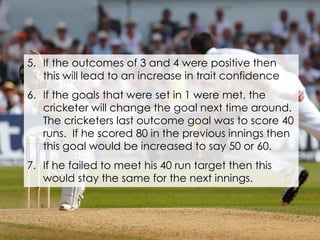
5. If the outcomes of 3 and 4 were positive then
this will lead to an increase in trait confidence
6. If the goals that were set in 1 were met, the
cricketer will change the goal next time around.
The cricketers last outcome goal was to score 40
runs. If he scored 80 in the previous innings then
this goal would be increased to say 50 or 60.
7. If he failed to meet his 40 run target then this
would stay the same for the next innings.
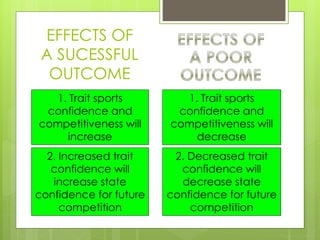
EFFECTS OF
A SUCESSFUL
OUTCOME
1. Trait sports
confidence and
competitiveness will
increase
2. Increased trait
confidence will
increase state
confidence for future
competition
1. Trait sports
confidence and
competitiveness will
decrease
2. Decreased trait
confidence will
decrease state
confidence for future
competition
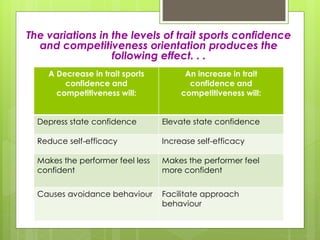
A Decrease in trait sports
confidence and
competitiveness will:
An increase in trait
confidence and
competitiveness will:
Depress state confidence Elevate state confidence
Reduce self-efficacy Increase self-efficacy
Makes the performer feel less
confident
Makes the performer feel
more confident
Causes avoidance behaviour Facilitate approach
behaviour
The variations in the levels of trait sports confidence
and competitiveness orientation produces the
following effect. . .
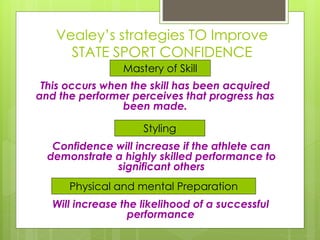
Vealey’s strategies TO Improve
STATE SPORT CONFIDENCE
Mastery of Skill
Styling
Physical and mental Preparation
This occurs when the skill has been acquired
and the performer perceives that progress has
been made.
Confidence will increase if the athlete can
demonstrate a highly skilled performance to
significant others
Will increase the likelihood of a successful
performance
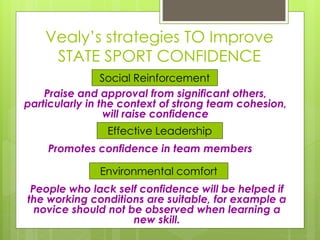
Vealy’s strategies TO Improve
STATE SPORT CONFIDENCE
Environmental comfort
Effective Leadership
Social Reinforcement
Praise and approval from significant others,
particularly in the context of strong team cohesion,
will raise confidence
Promotes confidence in team members
People who lack self confidence will be helped if
the working conditions are suitable, for example a
novice should not be observed when learning a
new skill.
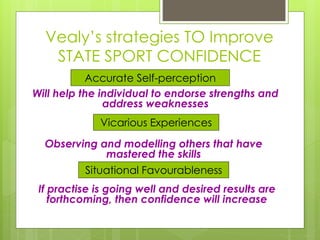
Vealy’s strategies TO Improve
STATE SPORT CONFIDENCE
Situational Favourableness
Vicarious Experiences
Accurate Self-perception
Will help the individual to endorse strengths and
address weaknesses
Observing and modelling others that have
mastered the skills
If practise is going well and desired results are
forthcoming, then confidence will increase
Self confidence/Efficacy links
to…………
Stress and anxiety
Being ‘in the Zone’
Achievement
motivation (Nach)
Summary sheet
Use the template provide to produce a summary
sheet including:
 Definitions of Self-confidence, self-efficacy and
sport confidence
 Bandura’s descriptions of people with high and
low self-efficacy
 Bandura’s model – applied to how to improve self-
efficacy
 Vealey’s model of sport confidence
 Explain all the terms of Vealey’s model
 Apply sporting example to terms
 Vealey’s strategies to improve confidence
Extended task
 You are the coach of an athlete who is returning
to training after a long period of injury and
rehabilitation. Discuss the strategies that could
be implemented to help the athlete to regain
confidence (6)
 How will developing Self-efficacy and self-
confidence affect an athlete’s achievement
motivation?
 And how would effect how it affect an athlete’s
attribution theory? (Use books and notes to
research)

Self confidence and self-efficacy 2013

  • 1.
    Self- Confidence “The most consistentdifference between elite and less successful athletes is that elite athletes possess greater self-confidence” (Gould et al.)
  • 2.
    Self-Confidence  A globalterm or general term  “Belief that one has the internal resources, particularly abilities, to achieve success”  “Rooted in beliefs and expectations”  (Advances in Sport Psychology, Thelma S. Horn, 2008)
  • 3.
    Self-Efficacy  Bandura putforward the notion that as people become competent in particular skills and situations they develop a feeling of self- efficacy.  Self-efficacy is self confidence in a specific situation.  The expectation that they will be competent and successful in a particular task  Self-efficacy can effect the choice of activity, the amount of effort expended and persistence at the task.
  • 4.
    Self-Efficacy  Self efficacyis different from self confidence.  Someone may be generally self confident in sport but when it came to playing golf which they weren’t particularly good at, they may have low self efficacy in that situation.
  • 6.
    Bandura Suggested: People withHigh Self-Efficacy;  Seek challenges – approach behaviour  Attribute success to internal factors such as ability and effort  The above would elevate confidence and increase expectation of success in next challenge  Where have we heard this type of description before??
  • 7.
    Bandura suggested: People withlow Self-Efficacy;  Adopt avoidance behaviour  Give up easily and become anxious when task is difficult  They attribute failure to internal factors  The above would decrease confidence and reduce expectation of success in next challenge and induce learned helplessness Mmm, where have I heard this before?
  • 8.
    Task  Vealey’s Theoryof Sport Confidence  Bandura’s Theory of Self-efficacy  Your table will be allocated a theory above to investigate  You are to produce a colourful and interesting factsheet and prepare to teach another group about your theory  You will have 30min to prepare and 15 min to produce your fact sheet  Teaching your work will take 20 minutes and then you will feedback to your table about what you have learned (10 -15 min)
  • 9.
  • 10.
    Task 1  Writedown 5 situations in sport where you feel a low sense of self efficacy. How do you account for these feelings of low self confidence?  E.g.s  In football, a midfielder having to play in goal.  A male having to play in a netball game.
  • 11.
    Factors Effecting Self-Efficacy Ourexpectations of self-efficacy depend on 4 types of information: 1. Performance accomplishments – a) These probably have the strongest influence on self confidence. b) If success has been experienced in the past, then feelings of self confidence are likely to be high
  • 12.
    Factors Effecting Self-Efficacy 2.Vicarious experiences – a) This refers to what we have observed before. (Better if performer is of same ability level) b) If we watch others perform and be successful, then we are more likely to experience high self efficacy.
  • 13.
    Factors Effecting Self-Efficacy 3.Verbal persuasion – a) If we are encouraged to try a particular activity, our confidence in that situation may increase.
  • 14.
    Factors Effecting Self-Efficacy 4.Emotional arousal a) Our perceptions of how aroused we are can effect our confidence in a particular situation.
  • 15.
  • 16.
     You wouldlike a fellow student to attempt a high jump but he has low self confidence.  Using Bandura’s four factors which influence self- efficacy, state how you would try and raise the athlete’s self efficacy in this situation.
  • 17.
     Try togive him initial success by lowering the bar to start with or using some flexi rope  Demonstrate how it can be done, or if you are much better than him, use someone of a similar ability  Verbally encourage the athlete. Tell him that he should ‘have a go’. Tell him that to be worried is a natural, very positive response because it prepares the body well
  • 18.
    How do weincrease our Self-Efficacy? - Summary Bandura’s Self Efficacy Theory 1. Previous Accomplishments  Reminder of previous success in skill (practical) 2. Vicarious Experiences  Watching others perform the skill 3. Verbal Persuasion  Convincing athlete of their ability to perform the skill 4. Emotional Control  Evaluation of physical state
  • 19.
    Vealey’s Sport Specific Modelof Sport Confidence Vealey defines sports confidence as “the belief or degree of certainty individuals possess about their ability to be successful in sport.
  • 20.
    Sports confidence theory TRAITSPORT CONFIDENCE  Its innate and described as a natural disposition  Relatively stable  Is the amount of confidence a person has in their overall sports ability STATE SPORT CONFIDENCE  Is the degree of confidence in a specific situation i.e. taking a penalty  Can be developed through learning and is unstable and changeable. Sports Confidence Theory measures 2 Factors
  • 21.
    State Sports Confidencehas immediate impact on the skill which is to be performed e.g. determines quality of the penalty kick. The Objective Sport Situation Competitive Orientation State Sports Confidence Trait Sports Confidence The degree of State Confidence is determined by the interaction of 3 factors: 1. Trait Sports Confidence 2. The objective Sports Situation 3. The performer’s Competitive Orientation
  • 22.
    a)Results of Performance b)Subjective Outcomes c)Perceived Success d)Perceived attributions e)Performance satisfactions Trait sport confidence (SC- trait) The Sport Situation Competitive Orientation Positive results increase trait confidence State sport confidence (SC- state) Performance in the sport situation (behavioural responses) Positive results cause the type of goal to be changed for the next performance 1 1 1 2 3 4 5 6 Sport Specific Model of Sports Confidence
  • 23.
    Practical Example ofVealey’s Sport Specific model of Sports Confidence. 1. The sports situation is a cricketer going into bat with the score at 250 for 1 (very good situation). 2. SC-trait = High confidence due to a high score in the previous game. 3. Competitive orientation = The batsman has an outcome goal of scoring 40 runs. If he gets any less than that he would consider it a failure.
  • 24.
    3. The combinationof the previous factors (1) would determine the SC-state, which in this case would be very high. 4. The combination of 1 and 2 would determine how well the cricketer will perform. In this case the chances are that he will perform quite well considering the previous factors.
  • 25.
    4. Depending onhow well the cricketer performed (3) the following factors will be evaluated after the match. a. Results of performance (was he successful or not according to his goal) b. Subjective outcome (How did other people rate the performance) c. Perceived Success (whether the goal was met or not, did he feel like he succeeded?) d. Perceived Attribution (Why did he perform well / badly. Was it internal / external reasons e. Performance satisfaction (Was he happy with the performance)
  • 26.
    5. If theoutcomes of 3 and 4 were positive then this will lead to an increase in trait confidence 6. If the goals that were set in 1 were met, the cricketer will change the goal next time around. The cricketers last outcome goal was to score 40 runs. If he scored 80 in the previous innings then this goal would be increased to say 50 or 60. 7. If he failed to meet his 40 run target then this would stay the same for the next innings.
  • 27.
    EFFECTS OF A SUCESSFUL OUTCOME 1.Trait sports confidence and competitiveness will increase 2. Increased trait confidence will increase state confidence for future competition 1. Trait sports confidence and competitiveness will decrease 2. Decreased trait confidence will decrease state confidence for future competition
  • 28.
    A Decrease intrait sports confidence and competitiveness will: An increase in trait confidence and competitiveness will: Depress state confidence Elevate state confidence Reduce self-efficacy Increase self-efficacy Makes the performer feel less confident Makes the performer feel more confident Causes avoidance behaviour Facilitate approach behaviour The variations in the levels of trait sports confidence and competitiveness orientation produces the following effect. . .
  • 29.
    Vealey’s strategies TOImprove STATE SPORT CONFIDENCE Mastery of Skill Styling Physical and mental Preparation This occurs when the skill has been acquired and the performer perceives that progress has been made. Confidence will increase if the athlete can demonstrate a highly skilled performance to significant others Will increase the likelihood of a successful performance
  • 30.
    Vealy’s strategies TOImprove STATE SPORT CONFIDENCE Environmental comfort Effective Leadership Social Reinforcement Praise and approval from significant others, particularly in the context of strong team cohesion, will raise confidence Promotes confidence in team members People who lack self confidence will be helped if the working conditions are suitable, for example a novice should not be observed when learning a new skill.
  • 31.
    Vealy’s strategies TOImprove STATE SPORT CONFIDENCE Situational Favourableness Vicarious Experiences Accurate Self-perception Will help the individual to endorse strengths and address weaknesses Observing and modelling others that have mastered the skills If practise is going well and desired results are forthcoming, then confidence will increase
  • 32.
    Self confidence/Efficacy links to………… Stressand anxiety Being ‘in the Zone’ Achievement motivation (Nach)
  • 33.
    Summary sheet Use thetemplate provide to produce a summary sheet including:  Definitions of Self-confidence, self-efficacy and sport confidence  Bandura’s descriptions of people with high and low self-efficacy  Bandura’s model – applied to how to improve self- efficacy  Vealey’s model of sport confidence  Explain all the terms of Vealey’s model  Apply sporting example to terms  Vealey’s strategies to improve confidence
  • 34.
    Extended task  Youare the coach of an athlete who is returning to training after a long period of injury and rehabilitation. Discuss the strategies that could be implemented to help the athlete to regain confidence (6)  How will developing Self-efficacy and self- confidence affect an athlete’s achievement motivation?  And how would effect how it affect an athlete’s attribution theory? (Use books and notes to research)