Biomechanics: kinetics
and kinematics
Presenter: Sana Rai  (MPT 1st Year) 
Guide: Dr. Suvarna Ganvir (PhD)
Department of Neurophysiotherapy
D.V.V.P.F’s College of Physiotherapy, Ahmednagar
OBJECTIVES
•Introduction to biomechanics
•Kinetics
•      -Types of forces
- Inertial forces
 -Work, energy and power
  -Friction
•Kinematics
         -Rotational and translational motion
          -Osteokinemetics and Arthrokinematics
 
 Basic Biomechanics 
 …the body as a living machine for locomotion… 
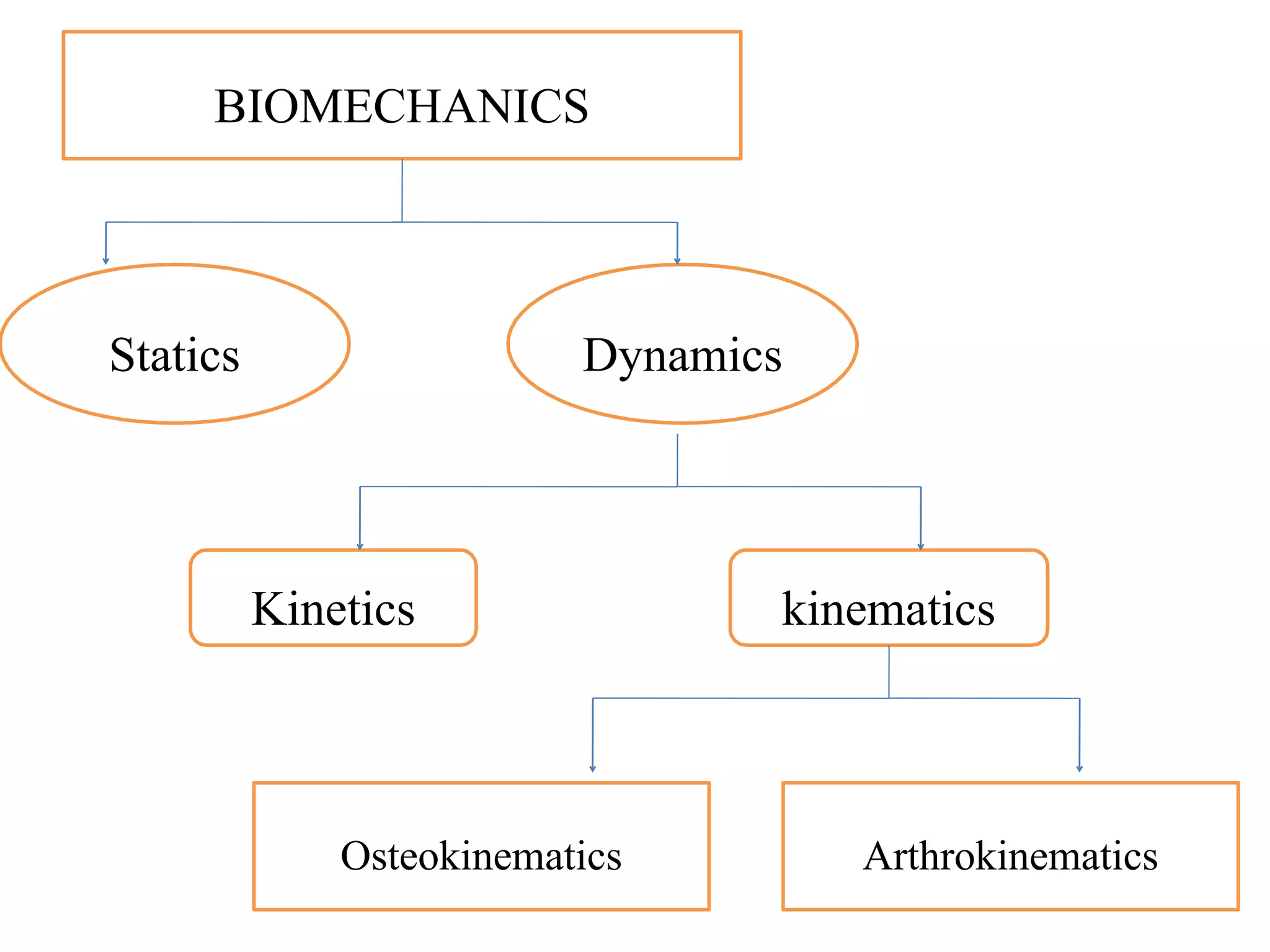
BIOMECHANICS
Statics Dynamics
Kinetics  kinematics
Osteokinematics  Arthrokinematics 
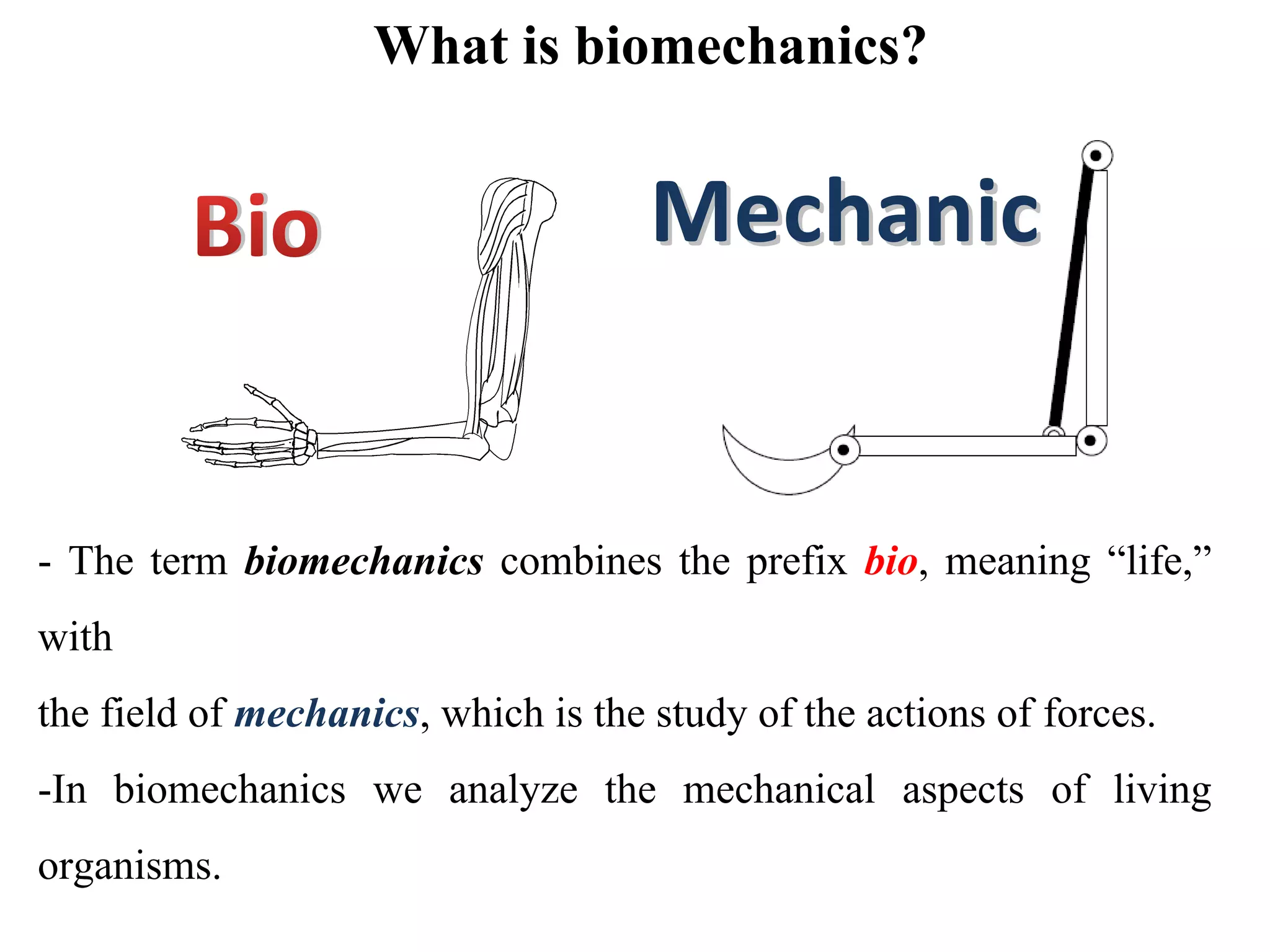
What is biomechanics?
Bio MechanicMechanic
- The term biomechanics combines the prefix bio, meaning “life,” 
with
the field of mechanics, which is the study of the actions of forces.
-In  biomechanics  we  analyze  the  mechanical  aspects  of  living 
organisms.
-  It  is  the  study  of  the  mechanics  as  it  relates  to  the 
functional and anatomical analysis of the human body. 
- Statics: involves all forces acting on the body being in 
balance, resulting in the body being in equilibrium. 
-Dynamics:  involves  the  study  of  systems  in  motion 
while  unbalanced  due  to  unequal  forces  acting  on  the 
body. 
v Mechanics :
- Dynamics-moving systems 
1. Kinetics- 
-  Examines  the  forces  acting  on  the  body 
during movement and the motion with respect 
to time and forces 
2.    Kinematics- 
- A branch of biomechanics that describes the 
motion of a body without regard to the forces 
that produce the motion 
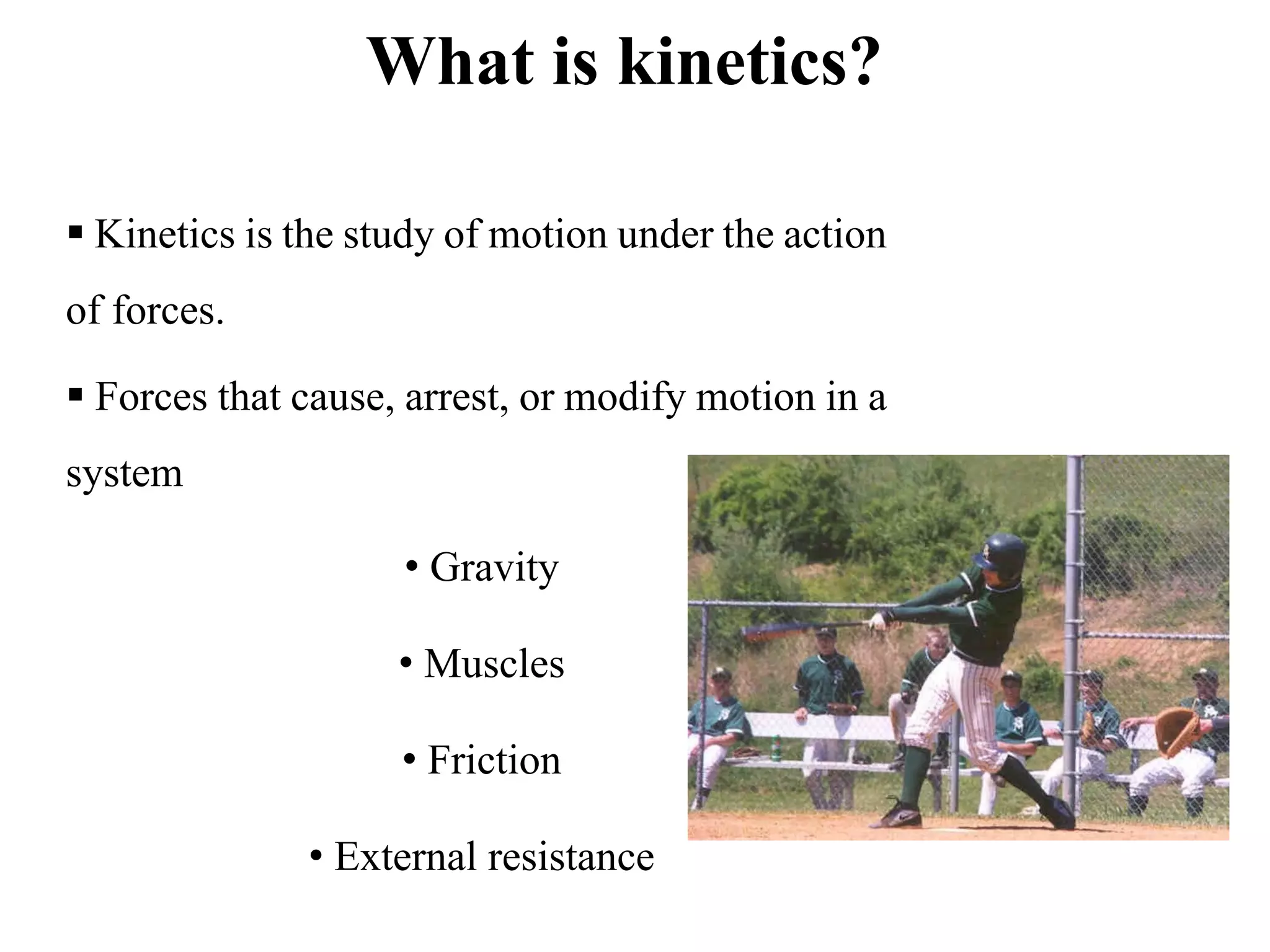
What is kinetics?
§ Kinetics is the study of motion under the action 
of forces.
§ Forces that cause, arrest, or modify motion in a 
system 
• Gravity 
• Muscles 
• Friction 
• External resistance 
vThe effect of forces on the body 
Ø Force 
- Any action or influence that moves a body or influences the movement of a 
body 
- Forces “control” movement of the body 
INTERNAL EXTERNAL
Muscle contraction  Gravity 
Tension from ligaments  An external load 
Muscle lengthening  A  therapist  applying  resistance  or  a    free-
weight for resistance training 
Forces
- A force is describe as a push or pull exerted by one object or 
substance on another.
- Whether a body or body segments is in motion or at rest depends 
on the forces exerted on that body.
- Any  two objects make contact, they will either push on each other 
or pull on each other with some magnitude of forces.
- Force = (mass)(acceleration)
- The unit of force in the SI unit is the newton (N) the unit in the US 
system is the pounds(Ib) 
 
- Excessive tissue deformation due to mechanical 
loading may result from
• Tension (stretching or strain)
• Compression and distraction
• Shear
• Bending
• Torsion (twisting)
Tension
- Tension stress (or tensile stress) occurs when two forces pull on 
an object in opposite directions so as to stretch it and make it 
longer and thinner. 
-The primary load a muscle experiences is a tension load.
-When the muscle contracts it pulls on the tendons at both ends, 
which stretch a little. So the tendons are under tensile stress.
Compression force
- Compression pushes or presses an object so as to make it 
shorter and thicker.
-Tension and compression stress are both sometimes 
referred to as axial stress because the forces act along a 
structure's longitudinal axis.
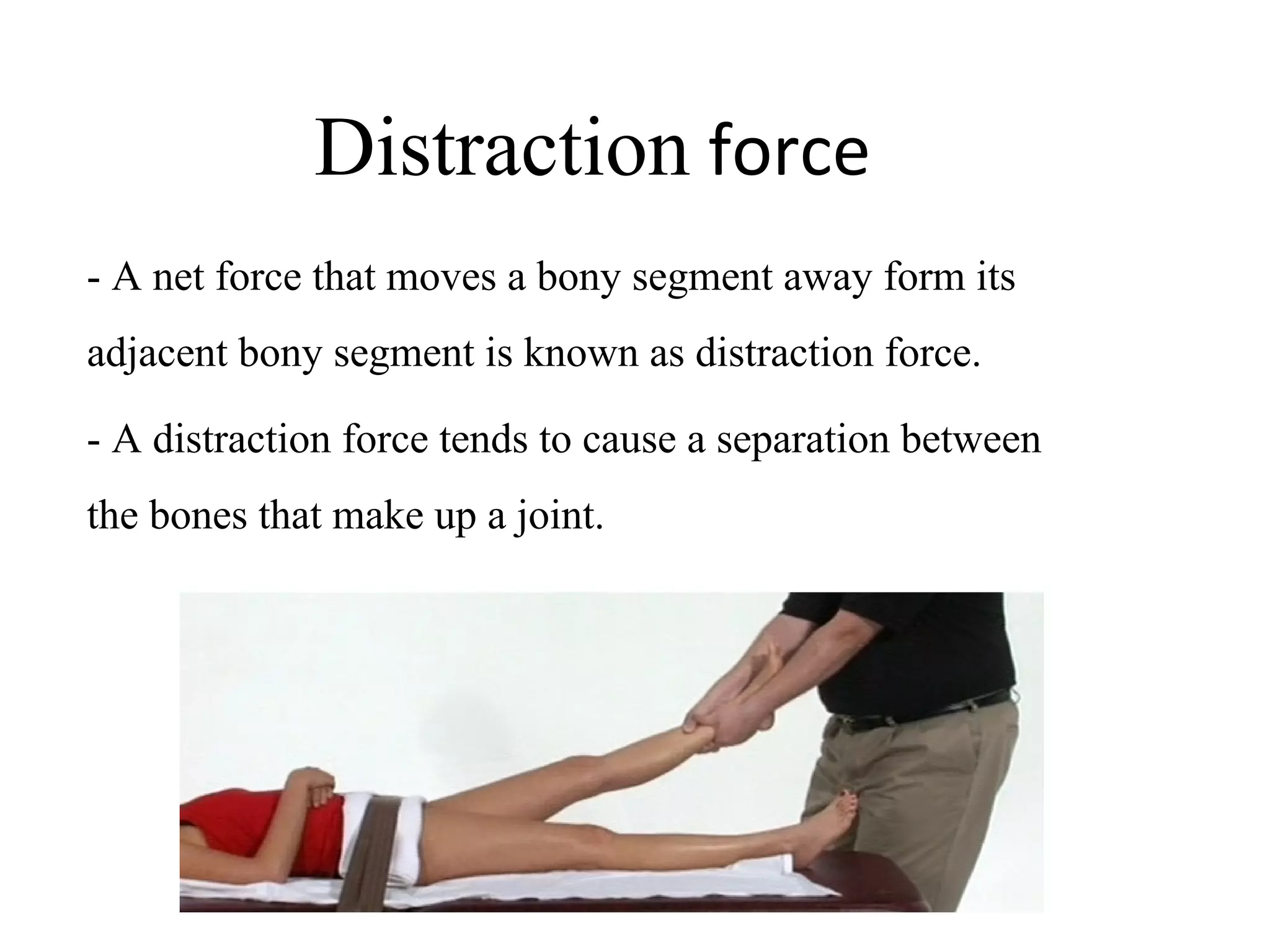
Distraction force
- A net force that moves a bony segment away form its 
adjacent bony segment is known as distraction force.
- A distraction force tends to cause a separation between 
the bones that make up a joint.
Shear force
-Shear force is two forces acting parallel to each other but in 
opposite directions so that one part of the object is moved or 
displaced relative to another part.
- Shear causes two objects to slide over one another  this results, in 
friction.
- If one vertebra is being caused to slide relative to another then 
there is a shear stress between them.
Bending and Torsion
-Bending is a loading mode results in the generation of 
maximum tensile forces on the convex surface of the bent 
member and maximum compressive forces on the 
concave side.
- Torsion is when forces acting on a structure cause a 
twist about its longitudinal axis.
Torque
-  The  strength  of  rotation  produced  by  a 
force couple is known as torque.
- The internal and external forces acting at 
a joint 
- The rotational equivalent of force 
-Torque(τ ) = (MA) x (F)
          
Mechanics :
•Mass 
- Amount of matter that a body contains.
•Inertia 
- Property of matter that causes it to resist any change of 
its motion in either speed or direction.
Inertial Forces
- Kinematics and kinetics are bound by Newton’s second 
law, which states that the external force (f) on an object is 
proportional to the product of that object’s mass (m) and 
linear acceleration (a): f = ma
-Mass is a measure of inertia.
-Resistance to a change in motion.
Work, Energy, and Power
-  Work  is  defined  as  the  force  required  to  move  an  object  a 
certain distance (work = force x distance) 
 - The standard unit of work in the metric system is a joule(J; 
newton x meter).
- Power is defined as the rate of work is being done
(power = work/time).
-  The  standard  unit  of  power  is  a  watt  (W;  watt=newton   
meter/second).
- The energy of a system refers to its capacity to perform
work.
-  Energy  has  the  same  unit  as  work  (J)  and  can  be 
divided into potential and kinetic energy.
- While potential energy refers to stored energy, kinetic 
energy is the energy of motion.
Friction
-A force that is developed by two surfaces.
- Frictional forces can prevent the motion of an object 
when it is at rest and resist the movement of an object 
when it is in motion.
- The values for the coefficient of friction depend on 
several  parameters,  such  as  the  composition  and 
roughness of the two surfaces in contact.
What is kinematics
-  kinematics is defined as the study of motion without 
regard to the forces that cause that motion.
-Involves the time, space, and mass aspects of a moving 
system.
- The description of motion :
• Osteokinematics: the manner in which bones move 
• Arthrokinematics: movements occurring between joint 
surfaces.
Kinematics - Types of Motion
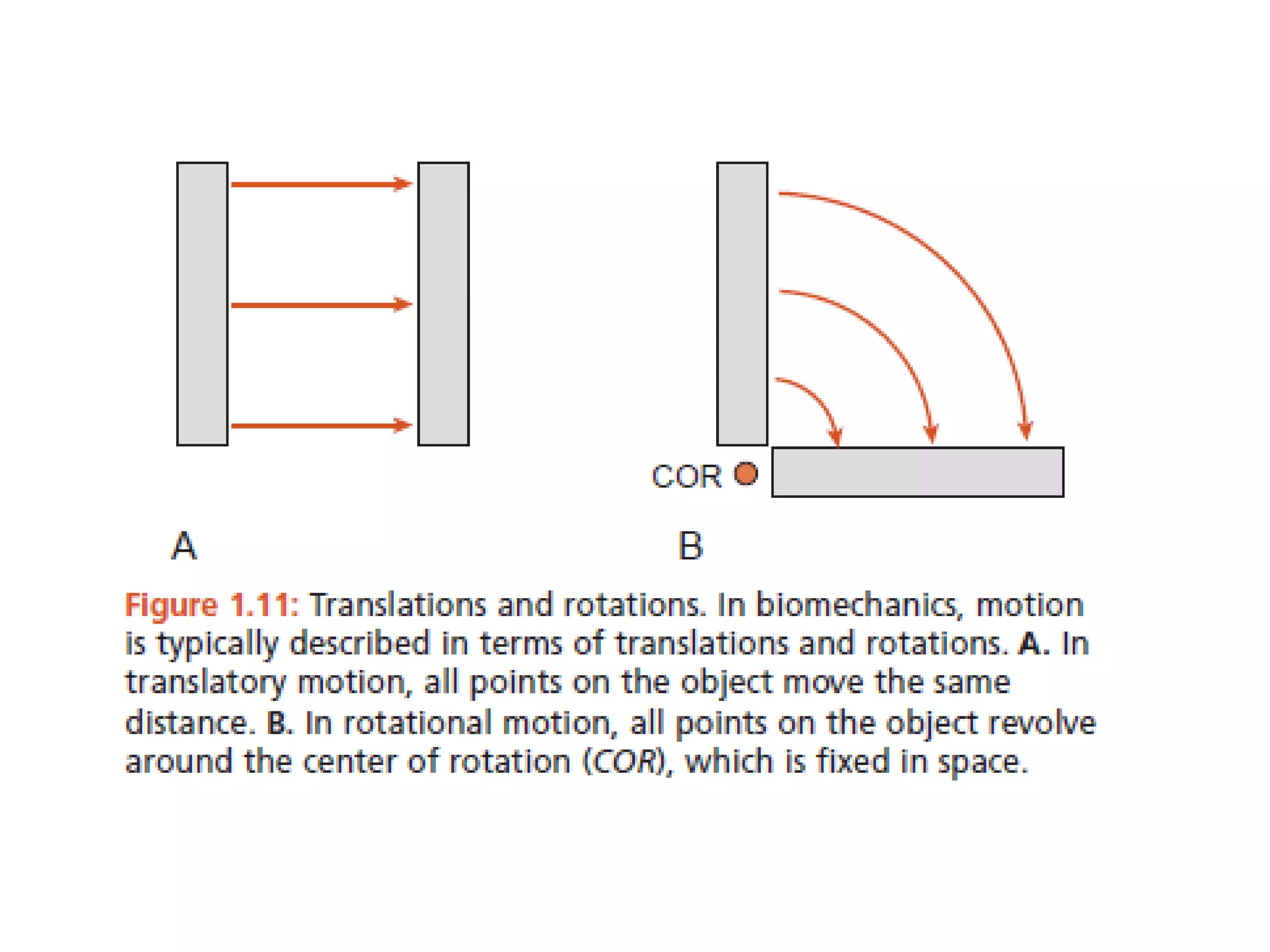
Ø Translatory – Movement of a body in which all of its 
parts move in the same direction and distance and at the 
same speed 
1.  Rectilinear  motion  =  straight  line  motions  (sliding 
surfaces) 
2. Curvilinear motion = curved line of motion (the motion 
of a ball when tossed) 
ØRotatory motion
- The arc of motion around a fixed axis of rotation or a 
“pivot point” .
- Joints have “pivot points” which are used as reference 
points  from  which  to  measure  the  range  of  motion 
(ROM) of that joint.
Osteokinematics
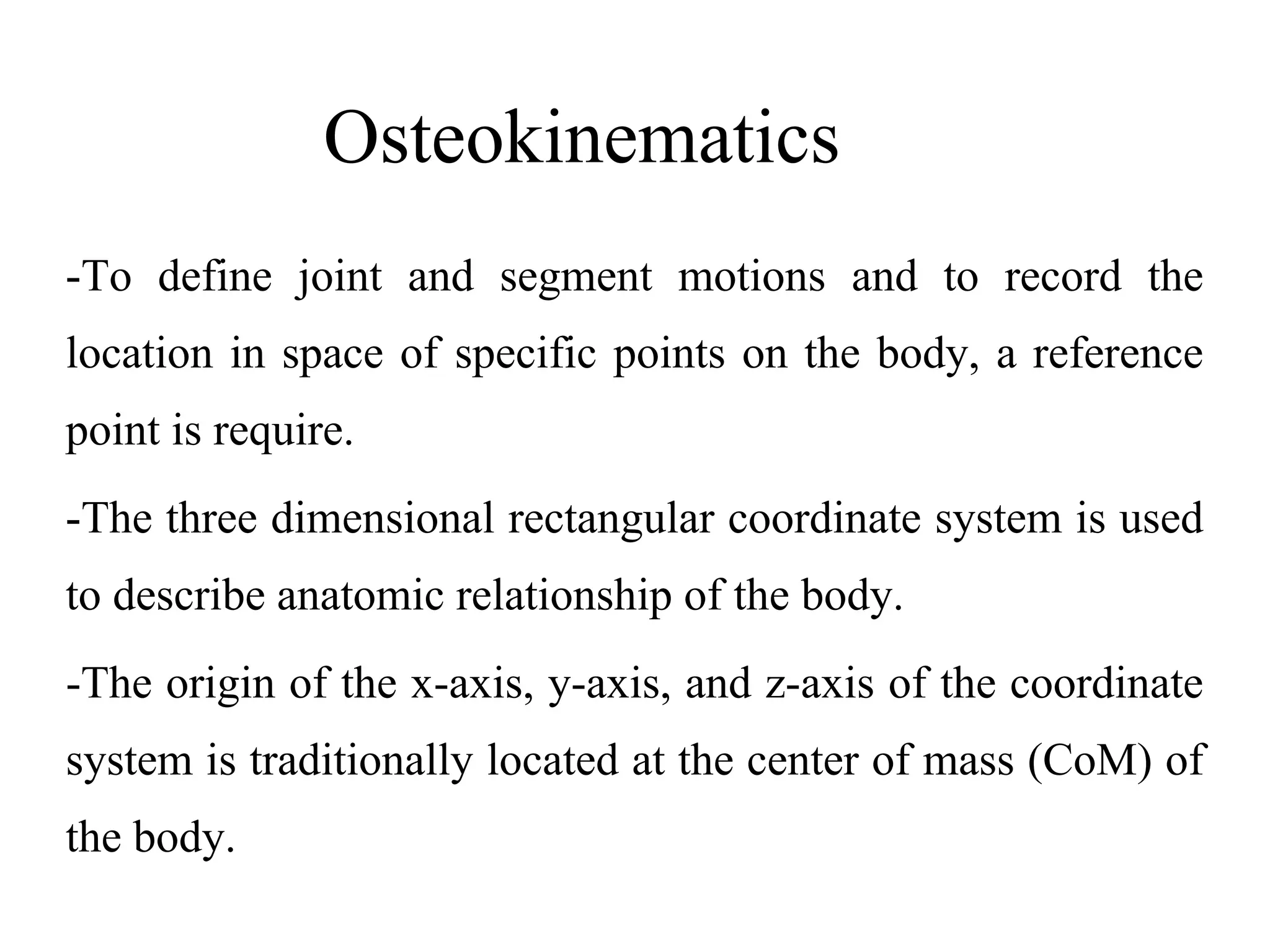
-To  define  joint  and  segment  motions  and  to  record  the 
location in space of specific points on the body, a reference 
point is require.
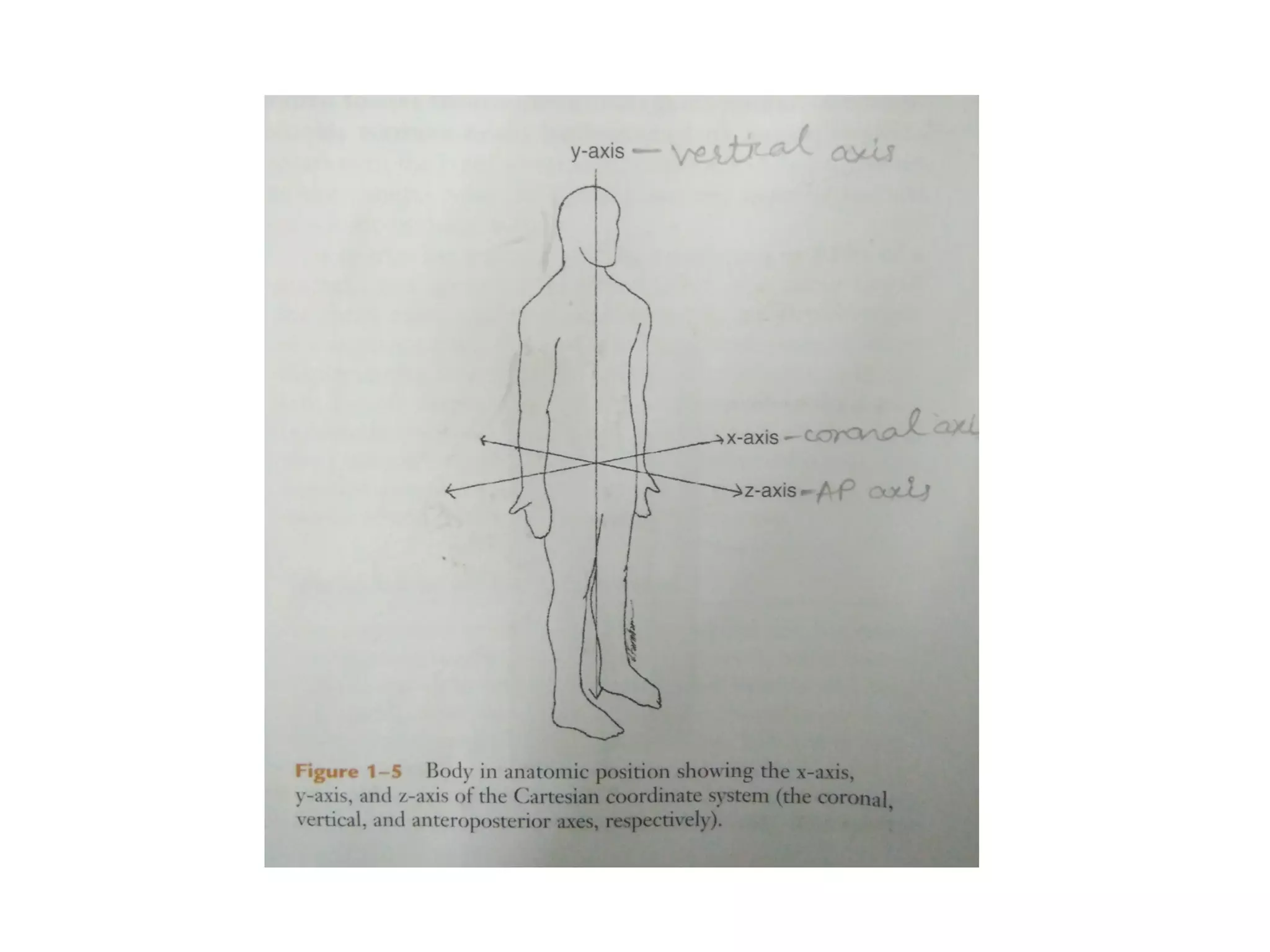
-The three dimensional rectangular coordinate system is used 
to describe anatomic relationship of the body.
-The origin of the x-axis, y-axis, and z-axis of the coordinate 
system is traditionally located at the center of mass (CoM) of 
the body. 
- The option for movements of a segment are also 
referred to as degrees of freedom.
- Three imaginary planes are arranged perpendicular to 
each other through the body, with their axes intersecting 
at the center of gravity of the body.
- These planes are called the cardinal planes of the body.
Motion of bones through a range of motion relative to 
the 3 cardinal planes of the body and around the axis in 
that joint 
Planes: 
• Frontal or Coronal 
• Sagittal or Median 
• Horizontal or Transverse 
Osteokinematics: Fundamental Motions 
Arthrokinematics 
- Manner in which adjoining joint surfaces 
move in relation to each other or how they fit 
together 
- helps to improve the movement of the joint 
Ø Parts may move in:
•The same direction 
•The opposite direction 
Fundamental Movements: Joint 
Surfaces 
- Roll 
 Multiple points maintain contact 
throughout the motion 
- Slide 
A single point on one surface contacts 
multiple points throughout the motion 
- Spin 
A single point on one surface rotates on a 
single point on the other surface 
Roll & Slide Mechanics 
Ø Convex on Concave 
- When a convex joint surface moves on a concave joint 
surface 
- The roll and slide occur in opposite directions 
ØConcave on Convex 
- When a concave joint surface moves about a stationary 
convex joint surface 
 - the roll and slide occur in the same direction 
Summary
EFFECT OF FATIGUE ON KNEE KINETICS AND 
KINEMATICS IN STOP-JUMP TASKS
Jonathan D. Chappell
Background: Altered motor control strategies in landing and 
jumping maneuvers are a potential mechanism of noncontact 
anterior cruciate ligament injury. There are biomechanical 
differences between male and female athletes in the landing phase 
of stop jump tasks. Fatigue is a risk factor in musculoskeletal 
injuries.
Hypothesis: Lower extremity muscle fatigue alters the knee 
kinetics and kinematics during the landing phase of 3 stop-jump
tasks and increases an athlete’s risk of anterior cruciate ligament 
injury.
Study Design: Controlled laboratory study.
Methods: Three-dimensional videography and force plate data 
were collected for 20 recreational athletes (10 male and 10
female athletes) performing 3 stop-jump tasks before and after 
completing a fatigue exercise. Knee joint angles and resultant
forces and moments were calculated.
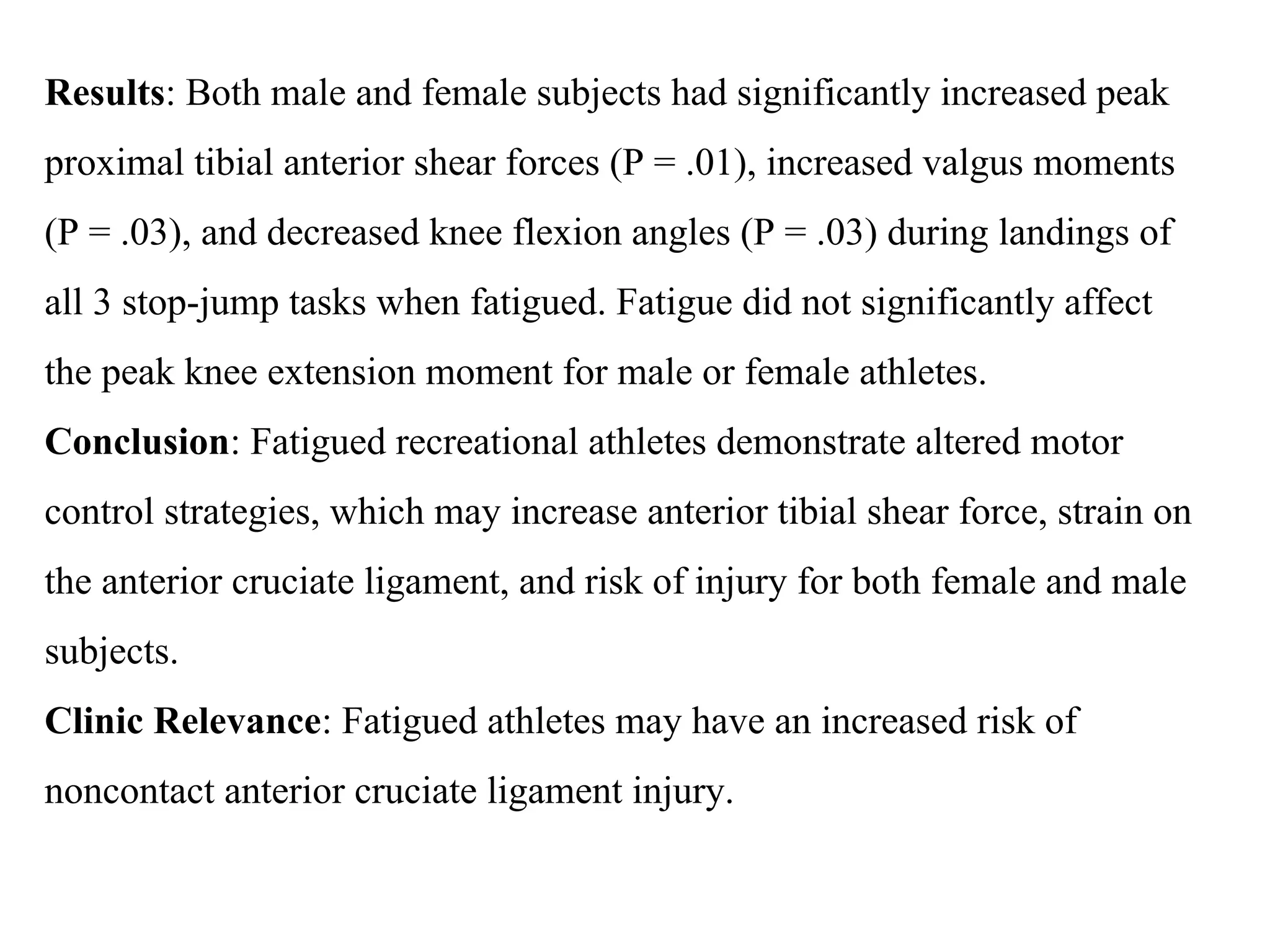
Results: Both male and female subjects had significantly increased peak 
proximal tibial anterior shear forces (P = .01), increased valgus moments 
(P = .03), and decreased knee flexion angles (P = .03) during landings of 
all 3 stop-jump tasks when fatigued. Fatigue did not significantly affect 
the peak knee extension moment for male or female athletes.
Conclusion: Fatigued recreational athletes demonstrate altered motor 
control strategies, which may increase anterior tibial shear force, strain on 
the anterior cruciate ligament, and risk of injury for both female and male 
subjects.
Clinic Relevance: Fatigued athletes may have an increased risk of 
noncontact anterior cruciate ligament injury.
References
1. KINESOLOGY The mechanics and pathomechanics of human movement
2nd edition  By- Carlo A.Oatis.
2. BRUNNSTROM’S clinical kinesiology 5th edition by- Laura K. Smith, 
Elizabeth L. Weiss, L. Don Lehmkuhl
3. JOINT STRUCTURE AND FUNCTION A Comprehensive analysis
5th edition  By- Pamela K. Levangie , Cynthia C. Norkin.
Kinetics and kinematics

Kinetics and kinematics