Opportunities and Pathways
Talent Identification and
Development
What is Talent ID
• Process of identifying potential sports
talent in young people
• Provide supportive pathways to reach
potential
• An Art and science!
• Involves integrating scientific knowledge &
assessment alongside more traditional
coaching
Its not that simple!
What are we looking for?
Write a list of 10 things
High levels of physical and mental attributes
– Fitness
– Coordination
– Power
– Speed
– Stamina
– Balance
– Agility
– Technique
– Tactical Awareness
– Desire
– Determination
– Mental toughness
– Commitment
Talent ID varies between sports
• Closed Loop Sports
– Rowing
– Canoeing
– Cycling
– Swimming
– Weight Lifting
• Open Loop Sports
– Football
– Rugby
– Basketball
– Tennis
– Hockey
http://www.youtube.com/watch?v=vzelKQHh5w4
With your partner….discuss..
• What are the differences between
closed and open loop sports?
• (come up with 5 differences)
• Is Talent ID more accurate in Closed
loop sports or Open loop sports?
• (at least one reason yes and one
reason no)
Talent ID – Scientific Approach
• A series of rigorous assessments and
filters
• Detects individuals with “higher probability”
of podium success (UK Sport, 2009)
• Works best for sports that are repetitive
(perhaps closed) in nature (little reliance
on individual flair needed in „open‟ sports)
Talent ID in East Germany
• A front runner in Talent ID
• Highly successful sporting nation
• Tool for raising the profile of their country
at Olympics etc
• Talent ID became integral part of school
sport
East Germany – 1970s
• Tested all their young children for sporting
ability
• Then basically factory farmed them into
athletes using drugs as a matter of course.
• Had horrendous medical consequences
• Despite having been condemned it did
produce what East Germany wanted –
• From 1972 to 1988 - won 384 Olympic
medals
East Germany 1970
• All children were screened for potential at
the age of seven
• Results were analysed
• Children invited to attend regular training
• At the age of ten children were transferred
to sports boarding school with links to elite
clubs
• 6 hours sport - 2 hours academic
East Germany
• On graduation they went to one of eight
national centres to continue their
development
• Facilities
• Coaches
• Sport Science and technology
Minus the drugs - this model is used the world over –
in one form or another!
Talent Identification in Australia
• AIS (Australian Institute of Sport) Similar
to the East German high performance
centres
• Poor performance at Montreal Olympics in
1978
• Government review of elite sports system
• Outcome: Central focus for identifying and
nurturing talent
Australia
• AIS opened in 1981
• Scholarships to over 600 elite athletes in
32 sports
• Top class facilities/coaches/medical etc
• A further 7 satellite institutes
• Developed „Sport Search‟
• A bank of fitness and basic body
measurements to identify a best fit sport
for individuals
Australian Sports Search Scheme:
• Part of nation wide 2 year talent search in every high
school in the build up to the Sydney Olympics in 2000
• Tested every young person in its schools for athletic
potential
• Millions of Dollars into supporting the resulting athletes,
first at a local level in schools and then Nationally by
training the best of them in the ideal surroundings of the
Australian Institute with the best of everything.
• Successful but only considered elitist (2% invited)
• The result was 4th in the medal table in Sydney and a
sports development programme that the world wanted to
follow.
Life at AIS…..
• http://www.youtube.com/watch?v=uoex69
WF3WQ
What about us…..
Individual NGBs
• International squad management
– responsible for talent identification
– development of athletes for the U16, U18, U21 and
senior men's and women's England squads.
– Nominated Country (NC) for Great Britain Hockey
Limited (GBHL) and together with Scotland and
Wales, prepare athletes to qualify and compete as
Great Britain for the Olympic Games.
Single System
• The Single System is the
development pathway for
players, coaches and officials
of all ages and abilities to
reach their full potential.
• It is based on Long Term
Athlete Development (LTAD)
principles that put the
participant at the centre of all
decisions, with extensive
scientific research that has
been widely accepted by the
majority of other major sports
within England
Individual NGBs – other roles
• Strategic Direction and Leadership
• Playing of the sport - Comps/Leagues - It also ensures
that an appropriate disciplinary code is in place and ensures that there is a
development pathway for players.
• Best Practice Knowledge Transfer
• Interface with external bodies e.g Sport
England, UK Sport, The Youth Sports Trust, the Central Council for
Physical Recreation (CCPR), and scUK, Federation of International
Hockey (FIH), and the European Hockey Federation (EHF).
• Marketing and sponsorship
Source:
http://www.englandhockey.co.uk/page.asp?section=1152&sectionTitle=What+We+Do
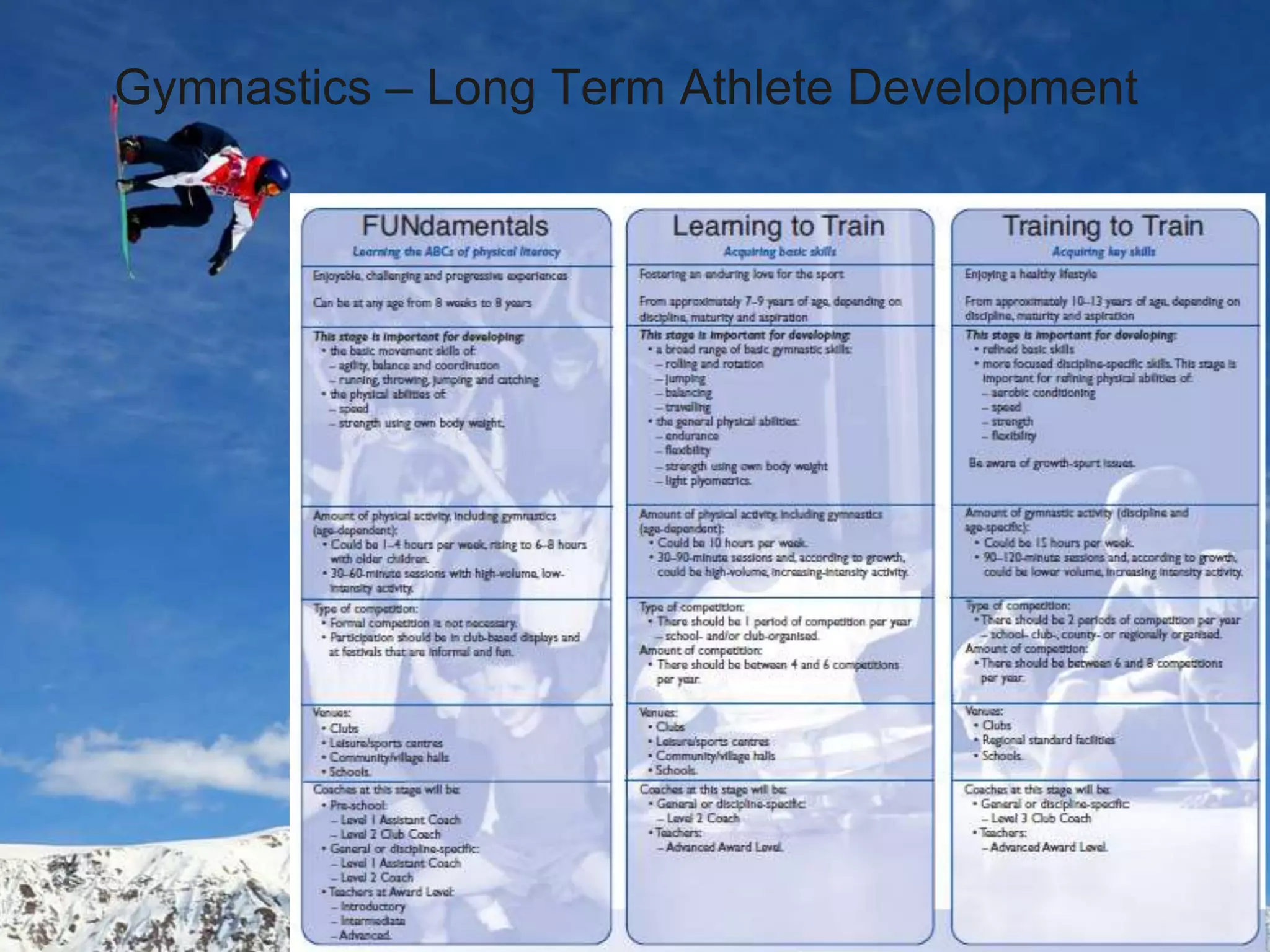
Gymnastics – Long Term Athlete Development
• British Gymnastics have employed regional Performance Pathway Co-ordinators
» Clinics tailored to each discipline (aimed at all clubs) - Will target
region‟s most promising gymnasts – 9-14years old – work on elite grades
• Improve the quality and quantity of Regional Squad opportunities, by widening
the base of the talent pool and improving the quality within it. Aim to provide talented gymnasts
with access to additional high quality training environments in preparation for regional
representation at National Competitions.
• Performance Pathway Coaches appointed by the National Coaching Teams, will have
the responsibility of delivering and connecting content and standards from the World Class
Programme down to gymnasts and coaches at a local level.
• The programme will take a phased approach over a 4 year period between 2013 – 2017.
• 2013-14 Men‟s Artistic and Women‟s Artistic
• 2014-15 Trampolining and Acrobatics
• 2015-16 Tumbling and Rhythmic
• 2016-17 Aerobics and Disabilities
Talent Id - NGBs funded by…..
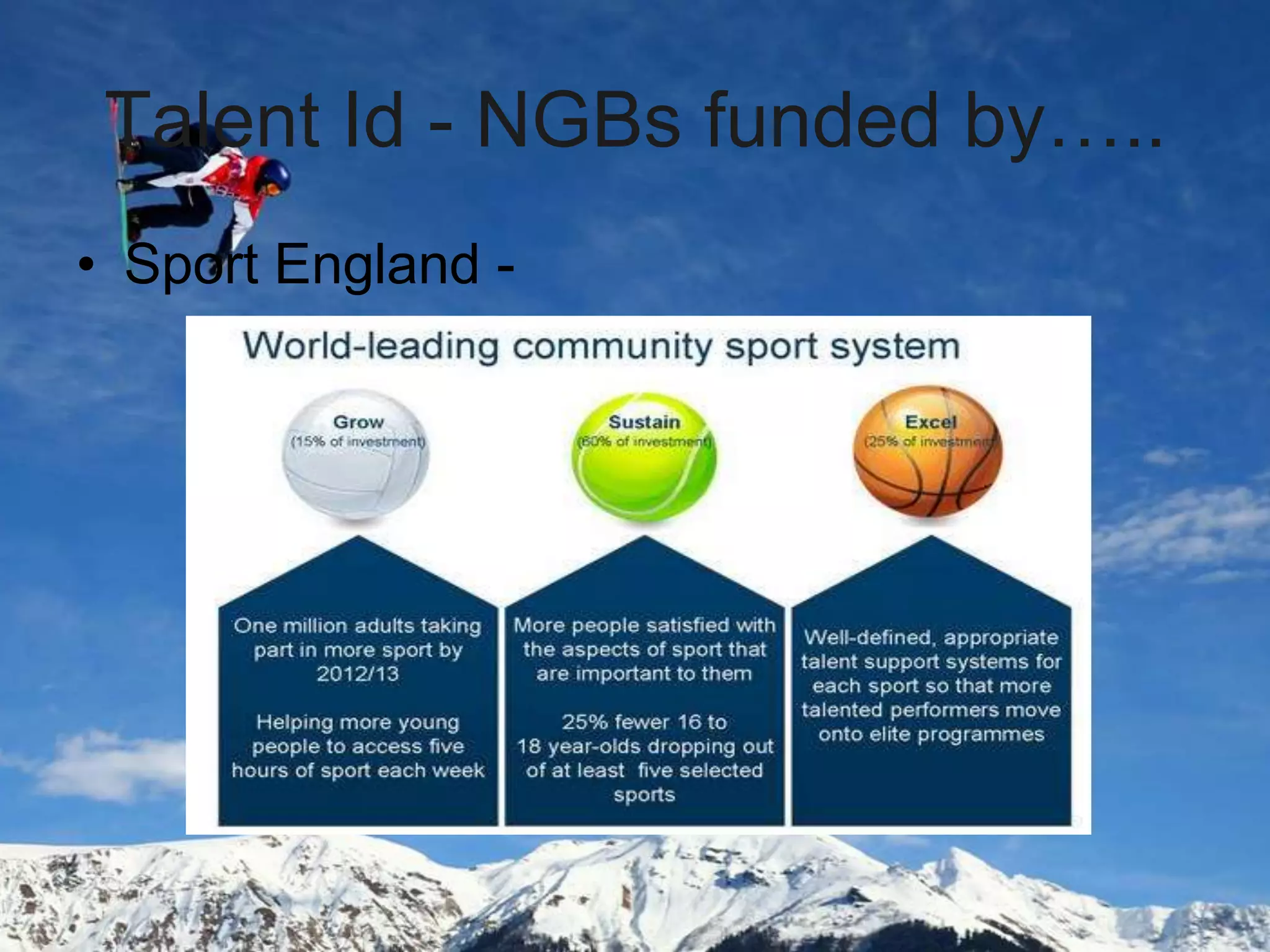
• Sport England -
Talent Id – NGBs funded by
• UK Sport
– using the no compromise approach
– World Class Performance Pathway
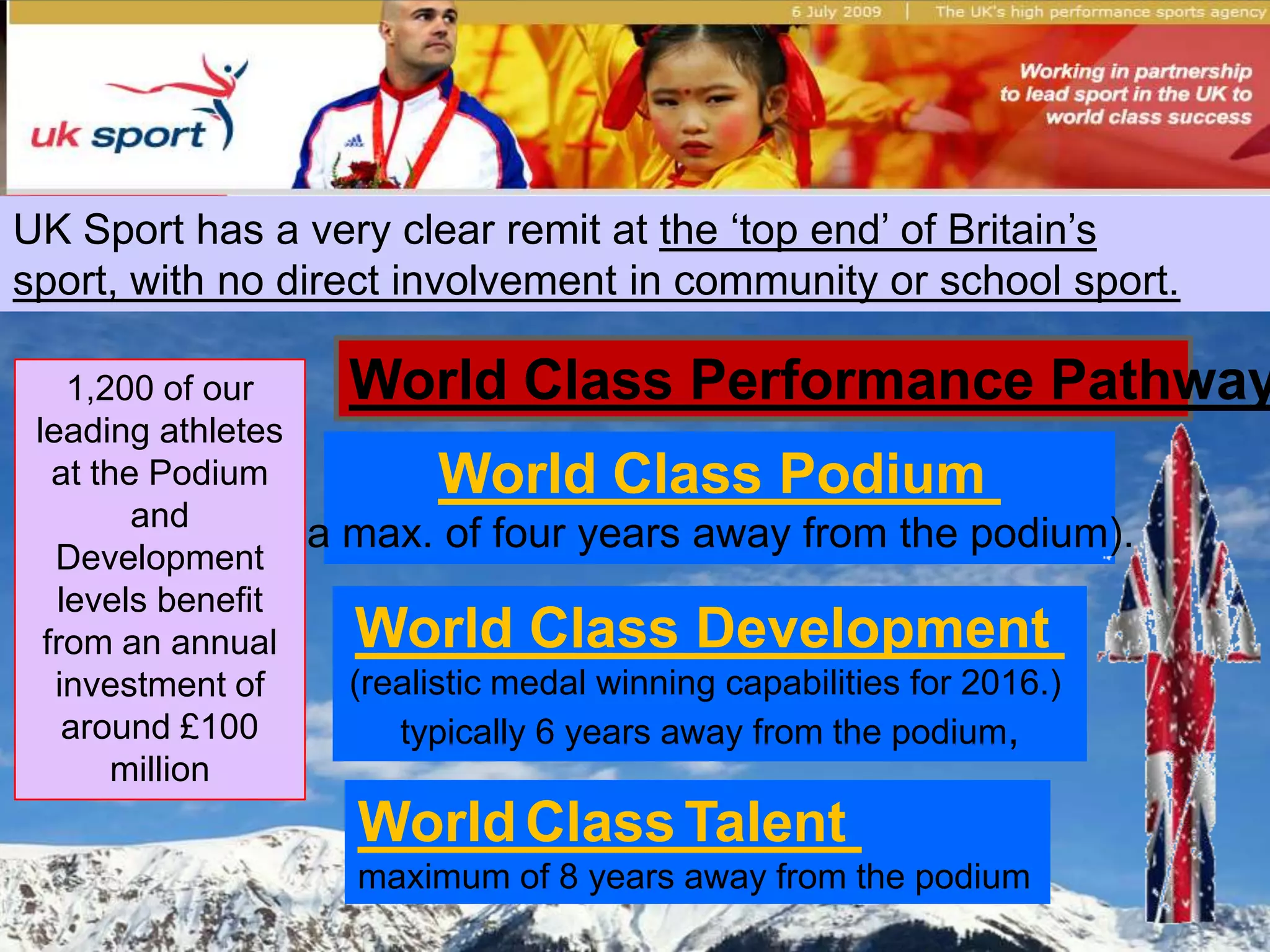
World Class Podium
(a max. of four years away from the podium).
UK Sport has a very clear remit at the „top end‟ of Britain‟s
sport, with no direct involvement in community or school sport.
1,200 of our
leading athletes
at the Podium
and
Development
levels benefit
from an annual
investment of
around £100
million
World Class Development
(realistic medal winning capabilities for 2016.)
typically 6 years away from the podium,
WorldClass Talent
maximum of 8 years away from the podium
World Class Performance Pathway
Olympic Specific ID progs.
• Sporting Giants
• Tall and Talented
• Pitch to Podium
• Girls4Gold
• Talent 2012:Fighting Chance
• Organised by UK Sport and EIS – UK
Talent Team
What the specification says..
• Talent identification and development initiatives.
• The concept of talent in sport and links with
methods of identifying talent from other countries
(for example, SportsSearch in Australia and
state-sponsored identification programmes of
the former East Germany).
• The structure of the World Class Performance
Pathway
Socio-Cultural and economic factors
that affect opportunity, participation,
provision, attitudes and values
• Finance/Income
• Leisure Time
• Time Management
• Education
• Physical Education
• Resources
• Family
• Peer Pressure
• Role Models
• Facilities
• Transport

Talent id australia east germany uk 2014

  • 1.
    Opportunities and Pathways TalentIdentification and Development
  • 2.
    What is TalentID • Process of identifying potential sports talent in young people • Provide supportive pathways to reach potential • An Art and science! • Involves integrating scientific knowledge & assessment alongside more traditional coaching
  • 3.
    Its not thatsimple! What are we looking for? Write a list of 10 things
  • 4.
    High levels ofphysical and mental attributes – Fitness – Coordination – Power – Speed – Stamina – Balance – Agility – Technique – Tactical Awareness – Desire – Determination – Mental toughness – Commitment
  • 5.
    Talent ID variesbetween sports • Closed Loop Sports – Rowing – Canoeing – Cycling – Swimming – Weight Lifting • Open Loop Sports – Football – Rugby – Basketball – Tennis – Hockey http://www.youtube.com/watch?v=vzelKQHh5w4
  • 6.
    With your partner….discuss.. •What are the differences between closed and open loop sports? • (come up with 5 differences) • Is Talent ID more accurate in Closed loop sports or Open loop sports? • (at least one reason yes and one reason no)
  • 7.
    Talent ID –Scientific Approach • A series of rigorous assessments and filters • Detects individuals with “higher probability” of podium success (UK Sport, 2009) • Works best for sports that are repetitive (perhaps closed) in nature (little reliance on individual flair needed in „open‟ sports)
  • 8.
    Talent ID inEast Germany • A front runner in Talent ID • Highly successful sporting nation • Tool for raising the profile of their country at Olympics etc • Talent ID became integral part of school sport
  • 9.
    East Germany –1970s • Tested all their young children for sporting ability • Then basically factory farmed them into athletes using drugs as a matter of course. • Had horrendous medical consequences • Despite having been condemned it did produce what East Germany wanted – • From 1972 to 1988 - won 384 Olympic medals
  • 10.
    East Germany 1970 •All children were screened for potential at the age of seven • Results were analysed • Children invited to attend regular training • At the age of ten children were transferred to sports boarding school with links to elite clubs • 6 hours sport - 2 hours academic
  • 11.
    East Germany • Ongraduation they went to one of eight national centres to continue their development • Facilities • Coaches • Sport Science and technology Minus the drugs - this model is used the world over – in one form or another!
  • 12.
    Talent Identification inAustralia • AIS (Australian Institute of Sport) Similar to the East German high performance centres • Poor performance at Montreal Olympics in 1978 • Government review of elite sports system • Outcome: Central focus for identifying and nurturing talent
  • 13.
    Australia • AIS openedin 1981 • Scholarships to over 600 elite athletes in 32 sports • Top class facilities/coaches/medical etc • A further 7 satellite institutes • Developed „Sport Search‟ • A bank of fitness and basic body measurements to identify a best fit sport for individuals
  • 14.
    Australian Sports SearchScheme: • Part of nation wide 2 year talent search in every high school in the build up to the Sydney Olympics in 2000 • Tested every young person in its schools for athletic potential • Millions of Dollars into supporting the resulting athletes, first at a local level in schools and then Nationally by training the best of them in the ideal surroundings of the Australian Institute with the best of everything. • Successful but only considered elitist (2% invited) • The result was 4th in the medal table in Sydney and a sports development programme that the world wanted to follow.
  • 15.
    Life at AIS….. •http://www.youtube.com/watch?v=uoex69 WF3WQ
  • 16.
  • 17.
    Individual NGBs • Internationalsquad management – responsible for talent identification – development of athletes for the U16, U18, U21 and senior men's and women's England squads. – Nominated Country (NC) for Great Britain Hockey Limited (GBHL) and together with Scotland and Wales, prepare athletes to qualify and compete as Great Britain for the Olympic Games.
  • 18.
    Single System • TheSingle System is the development pathway for players, coaches and officials of all ages and abilities to reach their full potential. • It is based on Long Term Athlete Development (LTAD) principles that put the participant at the centre of all decisions, with extensive scientific research that has been widely accepted by the majority of other major sports within England
  • 19.
    Individual NGBs –other roles • Strategic Direction and Leadership • Playing of the sport - Comps/Leagues - It also ensures that an appropriate disciplinary code is in place and ensures that there is a development pathway for players. • Best Practice Knowledge Transfer • Interface with external bodies e.g Sport England, UK Sport, The Youth Sports Trust, the Central Council for Physical Recreation (CCPR), and scUK, Federation of International Hockey (FIH), and the European Hockey Federation (EHF). • Marketing and sponsorship Source: http://www.englandhockey.co.uk/page.asp?section=1152&sectionTitle=What+We+Do
  • 20.
    Gymnastics – LongTerm Athlete Development
  • 21.
    Gymnastics – LongTerm Athlete Development
  • 22.
    • British Gymnasticshave employed regional Performance Pathway Co-ordinators » Clinics tailored to each discipline (aimed at all clubs) - Will target region‟s most promising gymnasts – 9-14years old – work on elite grades • Improve the quality and quantity of Regional Squad opportunities, by widening the base of the talent pool and improving the quality within it. Aim to provide talented gymnasts with access to additional high quality training environments in preparation for regional representation at National Competitions. • Performance Pathway Coaches appointed by the National Coaching Teams, will have the responsibility of delivering and connecting content and standards from the World Class Programme down to gymnasts and coaches at a local level. • The programme will take a phased approach over a 4 year period between 2013 – 2017. • 2013-14 Men‟s Artistic and Women‟s Artistic • 2014-15 Trampolining and Acrobatics • 2015-16 Tumbling and Rhythmic • 2016-17 Aerobics and Disabilities
  • 24.
    Talent Id -NGBs funded by….. • Sport England -
  • 25.
    Talent Id –NGBs funded by • UK Sport – using the no compromise approach – World Class Performance Pathway
  • 26.
    World Class Podium (amax. of four years away from the podium). UK Sport has a very clear remit at the „top end‟ of Britain‟s sport, with no direct involvement in community or school sport. 1,200 of our leading athletes at the Podium and Development levels benefit from an annual investment of around £100 million World Class Development (realistic medal winning capabilities for 2016.) typically 6 years away from the podium, WorldClass Talent maximum of 8 years away from the podium World Class Performance Pathway
  • 27.
    Olympic Specific IDprogs. • Sporting Giants • Tall and Talented • Pitch to Podium • Girls4Gold • Talent 2012:Fighting Chance • Organised by UK Sport and EIS – UK Talent Team
  • 28.
    What the specificationsays.. • Talent identification and development initiatives. • The concept of talent in sport and links with methods of identifying talent from other countries (for example, SportsSearch in Australia and state-sponsored identification programmes of the former East Germany). • The structure of the World Class Performance Pathway
  • 29.
    Socio-Cultural and economicfactors that affect opportunity, participation, provision, attitudes and values • Finance/Income • Leisure Time • Time Management • Education • Physical Education • Resources • Family • Peer Pressure • Role Models • Facilities • Transport