Basics Of Vehicle Aerodynamics
Sant Longowal Institute Of Engg. & Technology
(Deemed University)
Presented By:-
Aikam Sharma
Shubham Kumar
Abhijeet Singh
Submitted To:-
Prof. Md. Majid
โ€ข Aerodynamics is the way air moves around things.
โ€ข Study of the properties of moving air and the interaction between the air
and solid bodies moving through it.
Aerodynamics
Automotive Aerodynamics
โ€ข Study of the Aerodynamics of road vehicles
โ€ข Aims at reducing drag,wind noise,minimizing noise
emission, and preventing undesired lift forces
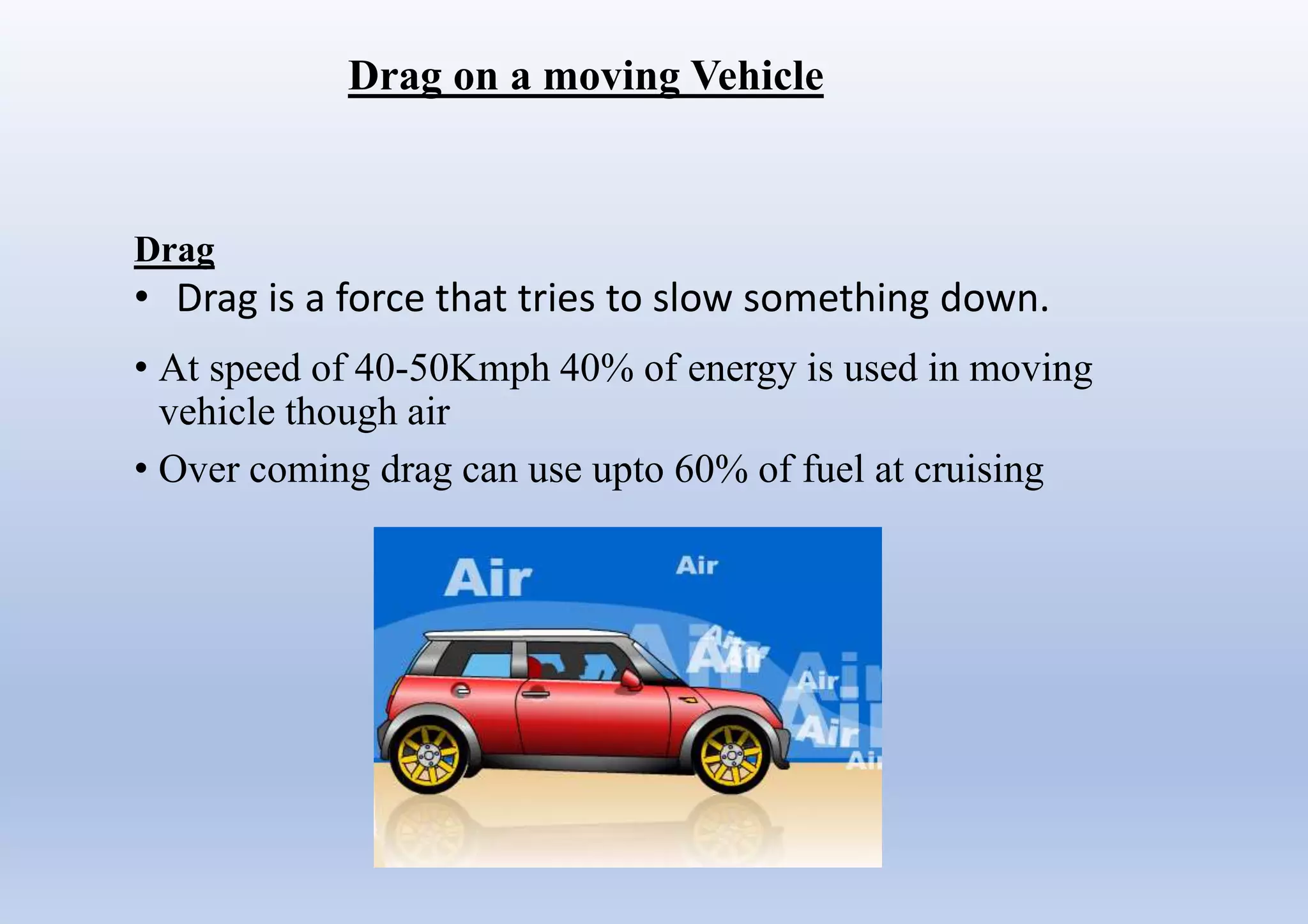
Drag on a moving Vehicle
โ€ข At speed of 40-50Kmph 40% of energy is used in moving
vehicle though air
โ€ข Over coming drag can use upto 60% of fuel at cruising
Drag
โ€ข Drag is a force that tries to slow something down.
Objectives of improvement of flow past vehicle bodies:
โ€ข Reduction of fuel consumption
โ€ข More favourable comfort characteristics (mud deposition
on body, noise, ventilating and cooling of passenger
compartment)
โ€ข Improvement of driving characteristics (stability,
handling)
Influence Of Flow Characteristics On The Operation Of
Vehicles
Vehicle Aerodynamics Includes Three Interacting Flow
Fields:
โ€ข flow past vehicle body
โ€ข flow past vehicle components (wheels, heat exchanger,
brakes, windshield)
โ€ข flow in passenger compartment
Approaches In Vehicle Aerodynamics
โ€ข 1900-1920 Adaptation of
shapes from other fields
Airship
Torpedo
Boot
Approaches In Vehicle Aerodynamics 2
1920-1970 Adaptation of results of airplane and airship
development: streamlining
Jรกray experimental cars
Air Resistance
โ€ข Air resistance= Cd ร— Area ร— V2
Cd is Drag coefficient
Area represents the frontal area
V is relative velocity of vehicle and fluid (here air)
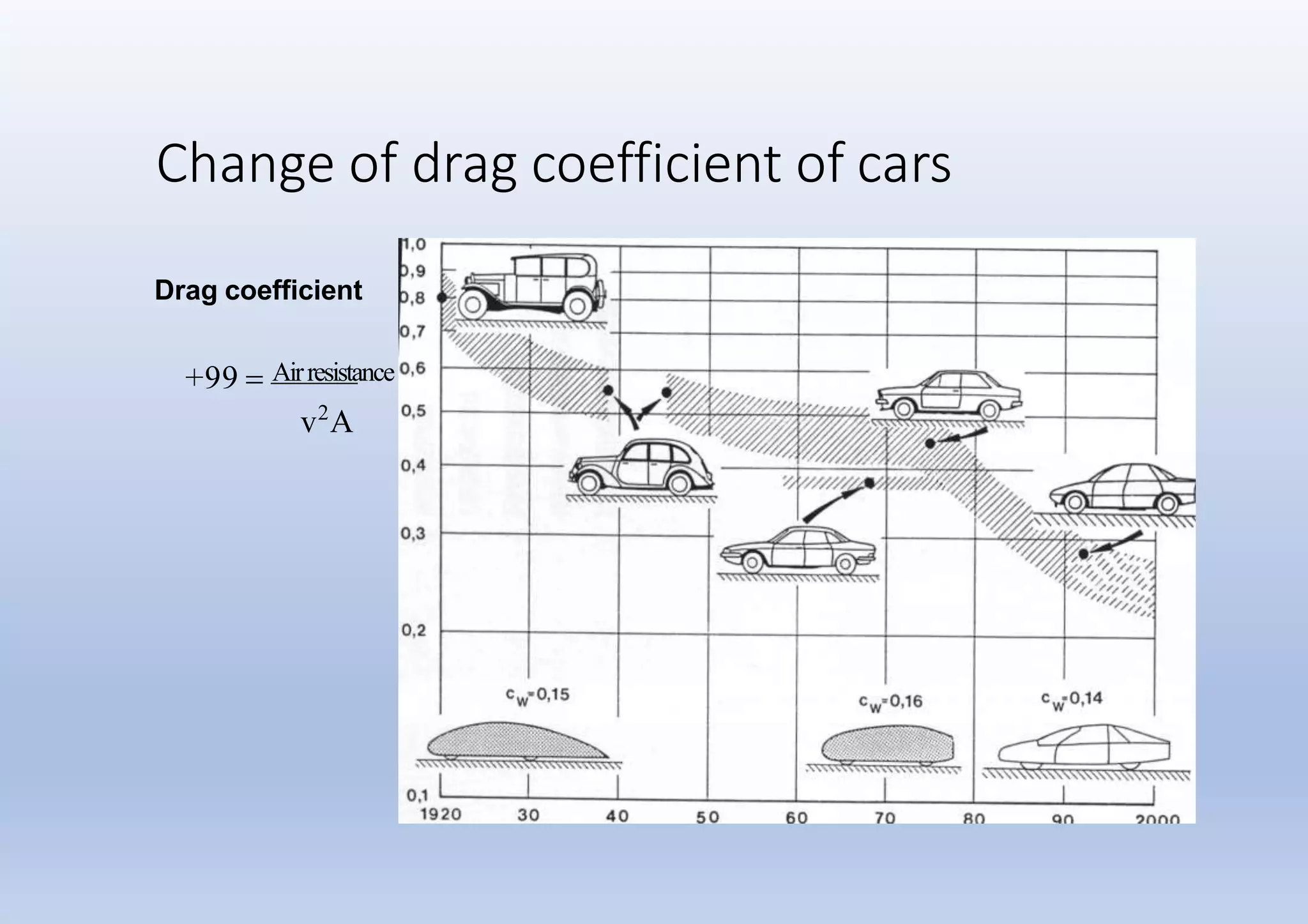
Change of drag coefficient of cars
v2
A
Airresistance+99 ๏€ฝ
Drag coefficient
Characteristics of flow past vehicle bodies
Classification of flow
field: Flow past Vehicle
Body
โ€ข front,
โ€ข side walls and roof,
โ€ข in underbody gap,
โ€ข behind the rear wall (wake).
Aerodynamic forces and viscosity
In case of inviscid flow ๏ด=0 (no shear
the resultant
of pressure forces is 0. (In case of cylinder
symmetrical flow field.)
So Faer = 0
A
stresses exist) and ๏€ญ ๏ƒฒp dA ๏€ฝ 0
In case of viscous flow ๏ด ๏‚น 0 (shear
(the
resultant of pressure fA
orces is different
from 0). In case of cylinder non-
symmetrical flow field.
So Faer ๏‚น 0
stresses exist) and ๏€ญ ๏ƒฒp dA ๏‚น 0
Cause of drag forces at streamlined and bluff
bodies
Streamlined bodies are
characterized by attached flow.
The share of pressure forces in
drag force (component of
aerodynamic force parallel to
undisturbed flow) is small. Drag is
caused mainly by shear stresses.
Since shear forces are small cD is
relatively small.
Bluff bodies are characterized by
boundary layer separation and
separation bubbles. Drag is caused
mainly by pressure forces, since
p-p0๏€พ๏€พ ๏ด cD is relatively big.
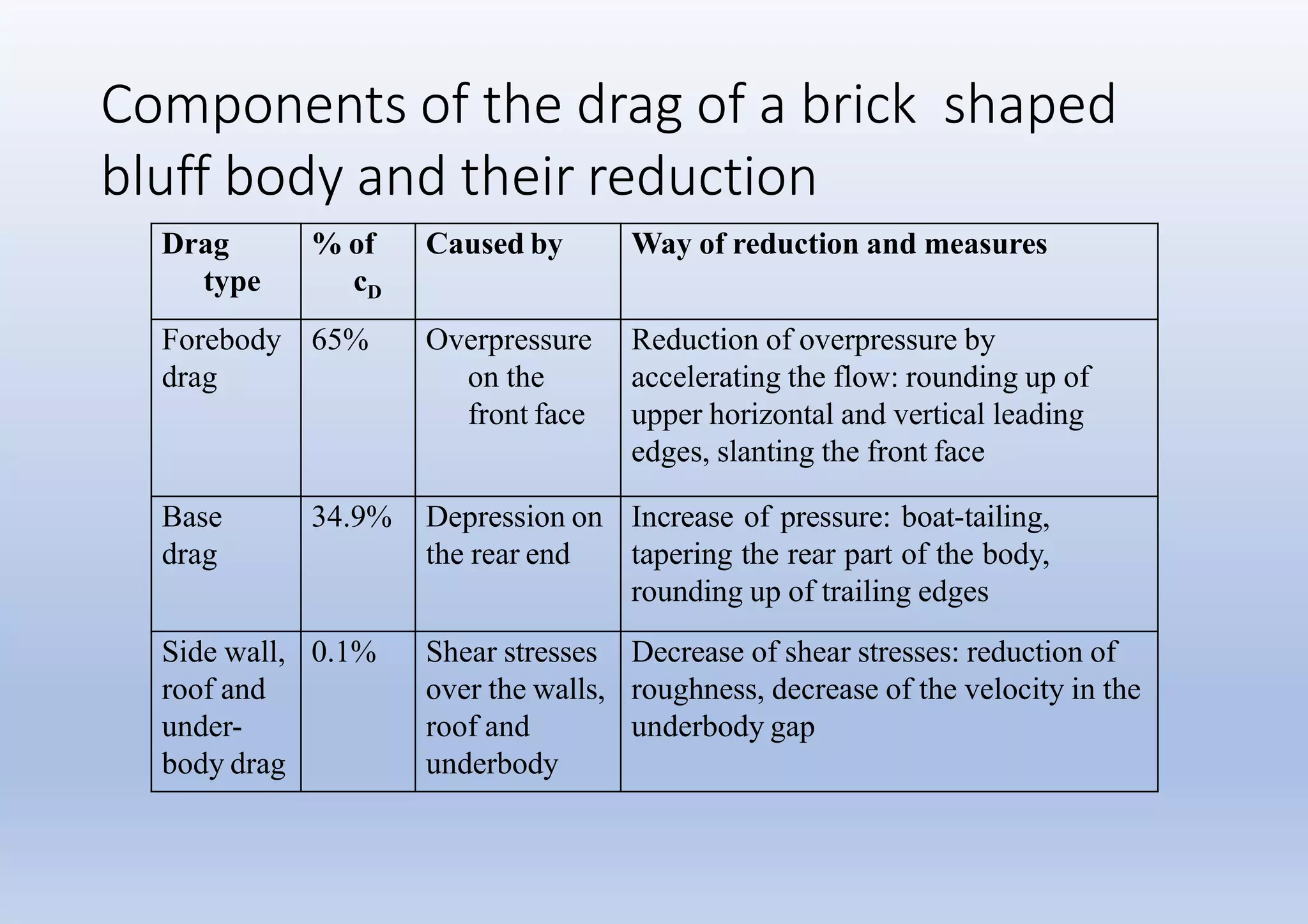
Components of the drag of a brick shaped
bluff body and their reduction
Drag
type
% of
cD
Caused by Way of reduction and measures
Forebody
drag
65% Overpressure
on the
front face
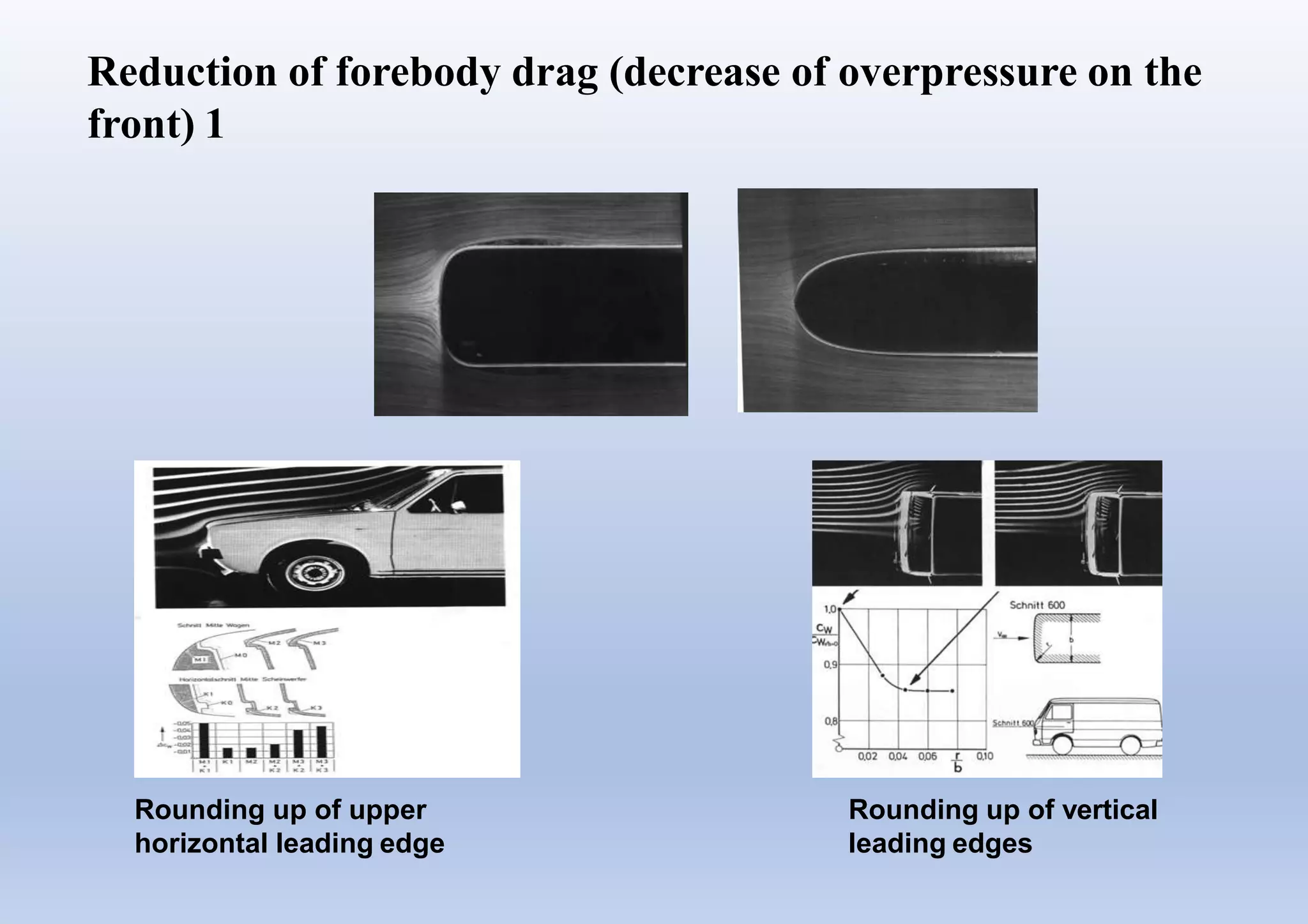
Reduction of overpressure by
accelerating the flow: rounding up of
upper horizontal and vertical leading
edges, slanting the front face
Base
drag
34.9% Depression on
the rear end
Increase of pressure: boat-tailing,
tapering the rear part of the body,
rounding up of trailing edges
Side wall,
roof and
under-
body drag
0.1% Shear stresses
over the walls,
roof and
underbody
Decrease of shear stresses: reduction of
roughness, decrease of the velocity in the
underbody gap
Reduction of forebody drag (decrease of overpressure on the
front) 1
Rounding up of upper
horizontal leading edge
Rounding up of vertical
leading edges
Reduction of forebody drag (decrease of
overpressure on the front) 2
Changing the shape of the front end
Conclusions:
a) The most significant drag reduction can be achieved by
rounding up the vertical and upper horizontal leading
edges on the front face.
b) Relatively small amendments can result considerable
drag reduction.
Reduction of base drag (increase of pressure on the
rear end) 1
Curvature of streamlines
indicates depression
Tapering the rear end (boat tailing) results in
considerable drag reduction
Reduction of side wall, roof and underbody drag
(decrease of shear stresses)
Conclusions
a)Roof and side wall drag can be reduced by reduction
of roughness of the wall (no protruding parts, frames)
b)Underbody drag can be reduced by reducing the
roughness (covering) and reducing the velocity in
underbody gap (tight underbody gap, front spoiler )
Wind Tunnel
Researchers use wind tunnels to learn more about how air
interacts with vehicles. NASA uses wind tunnels to test scale
models of aircraft and spacecraft. Some wind tunnels are big
enough to hold full-size versions of vehicles. The wind
tunnel moves air around an object, making it seem like the object
is really flying.
Demonstrations
Conclusion
Optimisation of vehicle bodies results in
โ€ข considerable reduction of fuel consumption
โ€ข improvement of comfort characteristics and
โ€ข more favourable driving characteristics of
ground vehicles.
Basics of vehicle aerodynamics

Basics of vehicle aerodynamics

  • 1.
    Basics Of VehicleAerodynamics Sant Longowal Institute Of Engg. & Technology (Deemed University) Presented By:- Aikam Sharma Shubham Kumar Abhijeet Singh Submitted To:- Prof. Md. Majid
  • 2.
    โ€ข Aerodynamics isthe way air moves around things. โ€ข Study of the properties of moving air and the interaction between the air and solid bodies moving through it. Aerodynamics Automotive Aerodynamics โ€ข Study of the Aerodynamics of road vehicles โ€ข Aims at reducing drag,wind noise,minimizing noise emission, and preventing undesired lift forces
  • 3.
    Drag on amoving Vehicle โ€ข At speed of 40-50Kmph 40% of energy is used in moving vehicle though air โ€ข Over coming drag can use upto 60% of fuel at cruising Drag โ€ข Drag is a force that tries to slow something down.
  • 4.
    Objectives of improvementof flow past vehicle bodies: โ€ข Reduction of fuel consumption โ€ข More favourable comfort characteristics (mud deposition on body, noise, ventilating and cooling of passenger compartment) โ€ข Improvement of driving characteristics (stability, handling) Influence Of Flow Characteristics On The Operation Of Vehicles Vehicle Aerodynamics Includes Three Interacting Flow Fields: โ€ข flow past vehicle body โ€ข flow past vehicle components (wheels, heat exchanger, brakes, windshield) โ€ข flow in passenger compartment
  • 5.
    Approaches In VehicleAerodynamics โ€ข 1900-1920 Adaptation of shapes from other fields Airship Torpedo Boot
  • 6.
    Approaches In VehicleAerodynamics 2 1920-1970 Adaptation of results of airplane and airship development: streamlining Jรกray experimental cars
  • 7.
    Air Resistance โ€ข Airresistance= Cd ร— Area ร— V2 Cd is Drag coefficient Area represents the frontal area V is relative velocity of vehicle and fluid (here air)
  • 9.
    Change of dragcoefficient of cars v2 A Airresistance+99 ๏€ฝ Drag coefficient
  • 10.
    Characteristics of flowpast vehicle bodies Classification of flow field: Flow past Vehicle Body โ€ข front, โ€ข side walls and roof, โ€ข in underbody gap, โ€ข behind the rear wall (wake).
  • 11.
    Aerodynamic forces andviscosity In case of inviscid flow ๏ด=0 (no shear the resultant of pressure forces is 0. (In case of cylinder symmetrical flow field.) So Faer = 0 A stresses exist) and ๏€ญ ๏ƒฒp dA ๏€ฝ 0 In case of viscous flow ๏ด ๏‚น 0 (shear (the resultant of pressure fA orces is different from 0). In case of cylinder non- symmetrical flow field. So Faer ๏‚น 0 stresses exist) and ๏€ญ ๏ƒฒp dA ๏‚น 0
  • 12.
    Cause of dragforces at streamlined and bluff bodies Streamlined bodies are characterized by attached flow. The share of pressure forces in drag force (component of aerodynamic force parallel to undisturbed flow) is small. Drag is caused mainly by shear stresses. Since shear forces are small cD is relatively small. Bluff bodies are characterized by boundary layer separation and separation bubbles. Drag is caused mainly by pressure forces, since p-p0๏€พ๏€พ ๏ด cD is relatively big.
  • 13.
    Components of thedrag of a brick shaped bluff body and their reduction Drag type % of cD Caused by Way of reduction and measures Forebody drag 65% Overpressure on the front face Reduction of overpressure by accelerating the flow: rounding up of upper horizontal and vertical leading edges, slanting the front face Base drag 34.9% Depression on the rear end Increase of pressure: boat-tailing, tapering the rear part of the body, rounding up of trailing edges Side wall, roof and under- body drag 0.1% Shear stresses over the walls, roof and underbody Decrease of shear stresses: reduction of roughness, decrease of the velocity in the underbody gap
  • 14.
    Reduction of forebodydrag (decrease of overpressure on the front) 1 Rounding up of upper horizontal leading edge Rounding up of vertical leading edges
  • 15.
    Reduction of forebodydrag (decrease of overpressure on the front) 2 Changing the shape of the front end Conclusions: a) The most significant drag reduction can be achieved by rounding up the vertical and upper horizontal leading edges on the front face. b) Relatively small amendments can result considerable drag reduction.
  • 16.
    Reduction of basedrag (increase of pressure on the rear end) 1 Curvature of streamlines indicates depression Tapering the rear end (boat tailing) results in considerable drag reduction
  • 17.
    Reduction of sidewall, roof and underbody drag (decrease of shear stresses) Conclusions a)Roof and side wall drag can be reduced by reduction of roughness of the wall (no protruding parts, frames) b)Underbody drag can be reduced by reducing the roughness (covering) and reducing the velocity in underbody gap (tight underbody gap, front spoiler )
  • 18.
    Wind Tunnel Researchers usewind tunnels to learn more about how air interacts with vehicles. NASA uses wind tunnels to test scale models of aircraft and spacecraft. Some wind tunnels are big enough to hold full-size versions of vehicles. The wind tunnel moves air around an object, making it seem like the object is really flying.
  • 19.
  • 22.
    Conclusion Optimisation of vehiclebodies results in โ€ข considerable reduction of fuel consumption โ€ข improvement of comfort characteristics and โ€ข more favourable driving characteristics of ground vehicles.