EVALUATION OF
HEALTH STATUS
& MONITORING OF EXERCISE PROGRAMMES AND PHYSIOLOGICAL
TESTING
HEALTH SCREENING
www.A6training.co.uk
HOW MANY METHODS OF HEALTH SCREENING CAN
YOU THINK OF IN TWO MINUTES?
2:001:591:581:571:561:551:541:531:521:511:501:491:481:471:461:451:441:431:421:411:401:391:381:371:361:351:341:331:321:311:301:291:281:271:261:251:241:231:221:211:201:191:181:171:161:151:141:131:121:111:101:091:081:071:061:051:041:031:021:011:000:590:580:570:560:550:540:530:520:510:500:490:480:470:460:450:440:430:420:410:400:390:380:370:360:350:340:330:320:310:300:290:280:270:260:250:240:230:220:210:200:190:180:170:160:150:140:130:120:110:100:090:080:070:060:050:040:030:020:01End
METHODS OF HEALTH SCREENING
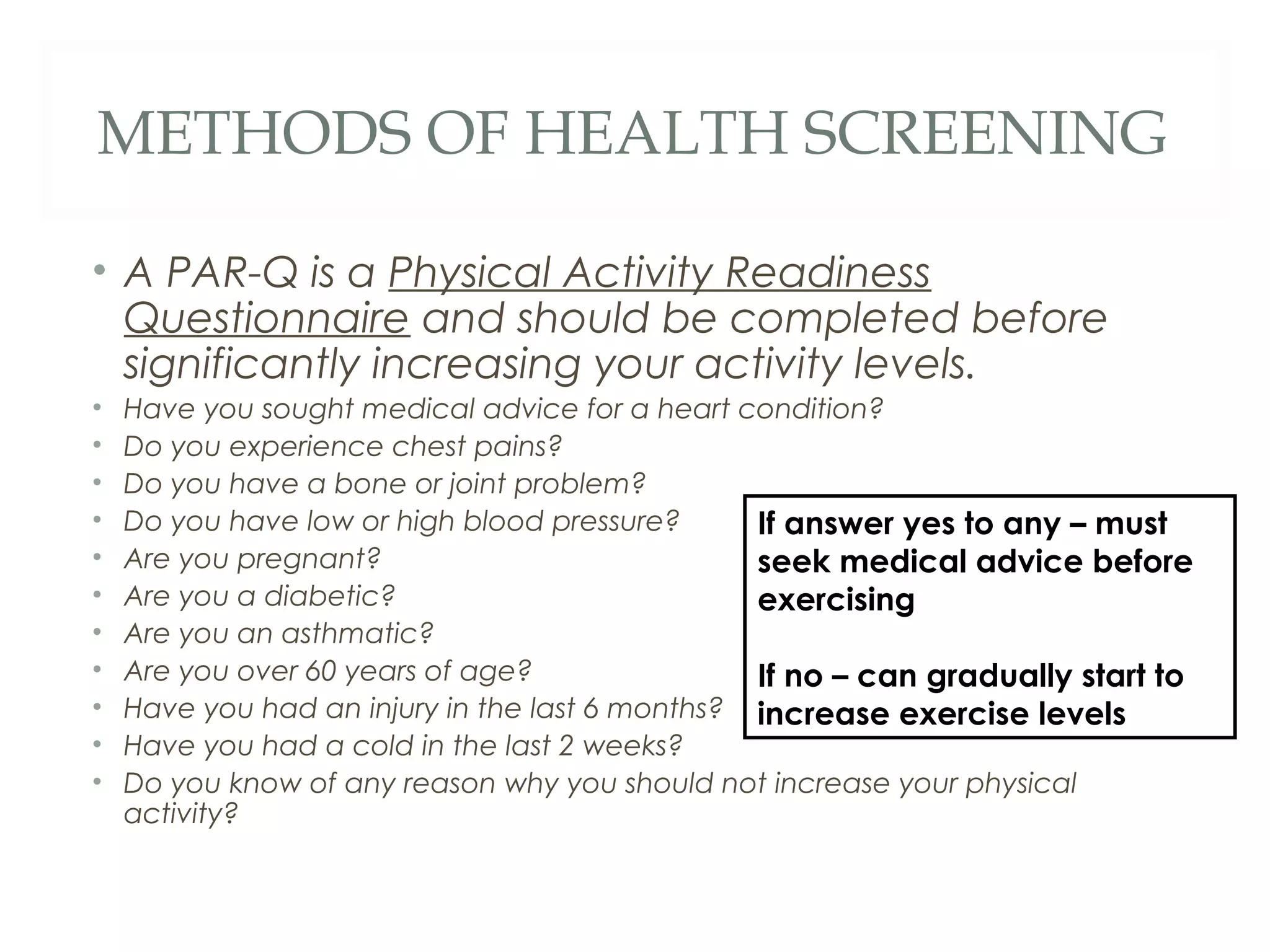
• A PAR-Q is a Physical Activity Readiness
Questionnaire and should be completed before
significantly increasing your activity levels.
• Have you sought medical advice for a heart condition?
• Do you experience chest pains?
• Do you have a bone or joint problem?
• Do you have low or high blood pressure?
• Are you pregnant?
• Are you a diabetic?
• Are you an asthmatic?
• Are you over 60 years of age?
• Have you had an injury in the last 6 months?
• Have you had a cold in the last 2 weeks?
• Do you know of any reason why you should not increase your physical
activity?
If answer yes to any – must
seek medical advice before
exercising
If no – can gradually start to
increase exercise levels
METHODS OF HEALTH SCREENING
• Many companies (including the NHS) offer Health
Screening to give you a full picture of your current
state of health and your long-term health
prospects.
• E.g.
METHODS OF HEALTH SCREENING
• Medical and lifestyle questionnaire
• Dietary assessment
• BMI Guide to healthy living
• Personalised medical report and recommendations
• Lifestyle consultation with nurse
• Consultation with doctor
METHODS OF HEALTH SCREENING
• Measurements –
• Blood pressure ,
• Body composition
(height, weight, hip
to waist, BMI and
body fat
percentage)
• Blood Tests –
• Cholesterol profile,
• Diabetes
• Other Investigations
–
• Cardiovascular risk
score
Urine analysis (3 tests
for diabetes infection
and kidney function),
• Blood in stool test
(Over 45) (may
indicate bowel
cancer)
Resting ECG
METHODS OF HEALTH SCREENING
Female specific tests
• Breast cancer awareness
• Breast examination
• Mammography (Over 40
if selected)
• Cervical cancer
screening (including HPV
if clinically appropriate)
Male specific tests
• Testicular cancer
awareness
• Testicular examination
• Prostate cancer blood
test (Over 50 if
selected)
BUILDS ON LIFESTYLE CHOICES LAST YEAR
HEALTH OF THE NATION
Health of the nation – what you need to know..
•Current concerns and trends in relation to physical fitness,
obesity and cardiac problems
•Influences on health – notion of personal autonomy and
external factors influencing lifestyle choices
•Health promotion and regulation. Exercise adherence.
•Policies and initiatives
•Body and self image – naturalist and constructionist views
of the body and the role of the media.
Reduction in Physical Fitness levels is due to:
 
More TV viewing and video games
Reduction in PE at school
Urban environments discouraging physical
activity
Decline in children walking and cycling to school
But should we simply allow people to be as fit
or unfit as they choose? (notion of personal
autonomy/choice)
Body image/Self-image - How does the media
affect this?
1 in 4 11-15 year olds is classified as obese in
England
Increase in Obesity levels is due to:
•Lack of activity - Positive Energy balance
•Fast food
•Wrong sort of food – not a balanced diet
• Coronary heart disease is the single most
common cause of death in the UK
• Overall CHD is estimated to cost the UK
economy £30.7 billion a year
•
• The majority of CHD is potentially
preventable.
Exercise raises
basal Metabolic
rate so maintains
negative energy
balance so
reduces weight.
Also raises
metabolic rate for
up to 5 hours after
exercise
Helps control
blood
insulin/glucose
levels
Lowers blood pressure and
keeps arterioles flexible so
reducing hypertension and
risk of Heart attack/stroke
Increases HDL Cholesterol
so reducing fatty build up
in arteries
Exercise Maintains
bone density
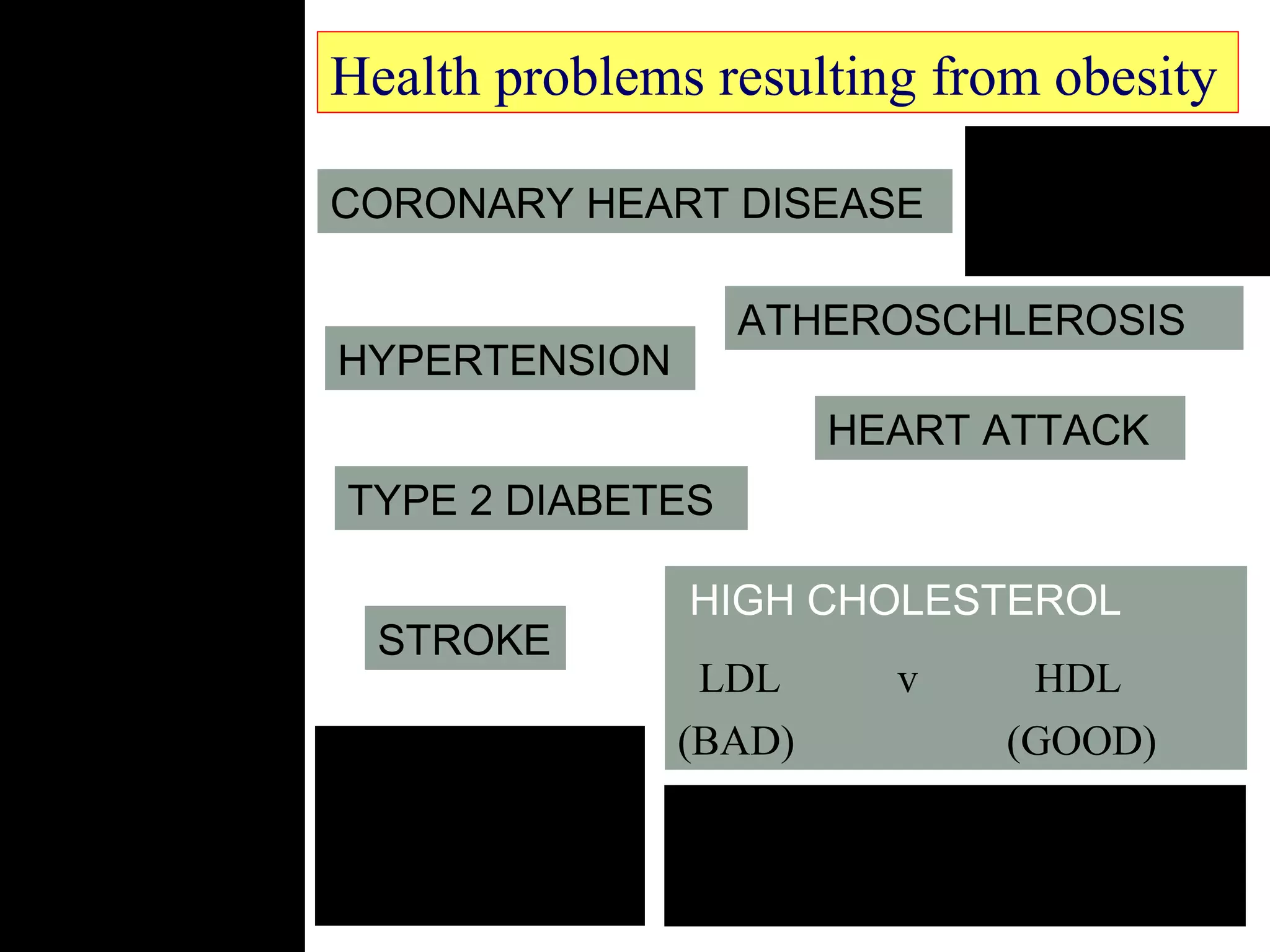
Health problems resulting from obesity
CORONARY HEART DISEASE
ATHEROSCHLEROSIS
HYPERTENSION
HEART ATTACK
TYPE 2 DIABETES
HIGH CHOLESTEROL
LDL v HDL
(BAD) (GOOD)
STROKE
Has responsibility for the state of the nation’s health
and promoting healthy lifestyles –
Smoking, drinking, exercise promotion and healthy
eating
Page 3 onwards of student notes
PE AND THE NATIONAL CURRICULUM
• What are the aims of the national curriculum?
• Structure of the National Curriculum?
• Use the textbooks and hand outs to make notes on
this – and be prepared to discuss.
Exercise Adherence – sticking to your exercise plan
 
Fifty percent of those who begin an exercise program
will drop out within six months. (New Years
resolutions)
We can help ourselves to stick to exercise programmes by:
• Decide where you are going to exercise best. (at home or at the gym
or pool etc.) – avoid distractions
•Choose activities you enjoy and keep the sessions short to start with.
•Set realistic goals and write out your goals somewhere in full view.
•Monitor your progress
•Establish a routine so physical activity becomes a habit
•Find an exercise partner then you are less likely to let each other
down.
EXAM QUESTIONS
• Each group has an exam question
• As a group you will try and construct a rough outline
to the question on the flipchart paper
• You will compare this with the mark scheme
• Plan a presentation on how to answer this question
and the key aspects of the topics covered that you
need to know
• You will present this in Tuesday’s lesson

Health screening and health of the nation 2015

  • 1.
  • 2.
    & MONITORING OFEXERCISE PROGRAMMES AND PHYSIOLOGICAL TESTING HEALTH SCREENING
  • 3.
    www.A6training.co.uk HOW MANY METHODSOF HEALTH SCREENING CAN YOU THINK OF IN TWO MINUTES? 2:001:591:581:571:561:551:541:531:521:511:501:491:481:471:461:451:441:431:421:411:401:391:381:371:361:351:341:331:321:311:301:291:281:271:261:251:241:231:221:211:201:191:181:171:161:151:141:131:121:111:101:091:081:071:061:051:041:031:021:011:000:590:580:570:560:550:540:530:520:510:500:490:480:470:460:450:440:430:420:410:400:390:380:370:360:350:340:330:320:310:300:290:280:270:260:250:240:230:220:210:200:190:180:170:160:150:140:130:120:110:100:090:080:070:060:050:040:030:020:01End
  • 4.
    METHODS OF HEALTHSCREENING • A PAR-Q is a Physical Activity Readiness Questionnaire and should be completed before significantly increasing your activity levels. • Have you sought medical advice for a heart condition? • Do you experience chest pains? • Do you have a bone or joint problem? • Do you have low or high blood pressure? • Are you pregnant? • Are you a diabetic? • Are you an asthmatic? • Are you over 60 years of age? • Have you had an injury in the last 6 months? • Have you had a cold in the last 2 weeks? • Do you know of any reason why you should not increase your physical activity? If answer yes to any – must seek medical advice before exercising If no – can gradually start to increase exercise levels
  • 5.
    METHODS OF HEALTHSCREENING • Many companies (including the NHS) offer Health Screening to give you a full picture of your current state of health and your long-term health prospects. • E.g.
  • 6.
    METHODS OF HEALTHSCREENING • Medical and lifestyle questionnaire • Dietary assessment • BMI Guide to healthy living • Personalised medical report and recommendations • Lifestyle consultation with nurse • Consultation with doctor
  • 7.
    METHODS OF HEALTHSCREENING • Measurements – • Blood pressure , • Body composition (height, weight, hip to waist, BMI and body fat percentage) • Blood Tests – • Cholesterol profile, • Diabetes • Other Investigations – • Cardiovascular risk score Urine analysis (3 tests for diabetes infection and kidney function), • Blood in stool test (Over 45) (may indicate bowel cancer) Resting ECG
  • 8.
    METHODS OF HEALTHSCREENING Female specific tests • Breast cancer awareness • Breast examination • Mammography (Over 40 if selected) • Cervical cancer screening (including HPV if clinically appropriate) Male specific tests • Testicular cancer awareness • Testicular examination • Prostate cancer blood test (Over 50 if selected)
  • 9.
    BUILDS ON LIFESTYLECHOICES LAST YEAR HEALTH OF THE NATION
  • 10.
    Health of thenation – what you need to know.. •Current concerns and trends in relation to physical fitness, obesity and cardiac problems •Influences on health – notion of personal autonomy and external factors influencing lifestyle choices •Health promotion and regulation. Exercise adherence. •Policies and initiatives •Body and self image – naturalist and constructionist views of the body and the role of the media.
  • 11.
    Reduction in PhysicalFitness levels is due to:   More TV viewing and video games Reduction in PE at school Urban environments discouraging physical activity Decline in children walking and cycling to school But should we simply allow people to be as fit or unfit as they choose? (notion of personal autonomy/choice) Body image/Self-image - How does the media affect this?
  • 12.
    1 in 411-15 year olds is classified as obese in England Increase in Obesity levels is due to: •Lack of activity - Positive Energy balance •Fast food •Wrong sort of food – not a balanced diet • Coronary heart disease is the single most common cause of death in the UK • Overall CHD is estimated to cost the UK economy £30.7 billion a year • • The majority of CHD is potentially preventable.
  • 13.
    Exercise raises basal Metabolic rateso maintains negative energy balance so reduces weight. Also raises metabolic rate for up to 5 hours after exercise Helps control blood insulin/glucose levels Lowers blood pressure and keeps arterioles flexible so reducing hypertension and risk of Heart attack/stroke Increases HDL Cholesterol so reducing fatty build up in arteries Exercise Maintains bone density
  • 14.
    Health problems resultingfrom obesity CORONARY HEART DISEASE ATHEROSCHLEROSIS HYPERTENSION HEART ATTACK TYPE 2 DIABETES HIGH CHOLESTEROL LDL v HDL (BAD) (GOOD) STROKE
  • 15.
    Has responsibility forthe state of the nation’s health and promoting healthy lifestyles – Smoking, drinking, exercise promotion and healthy eating Page 3 onwards of student notes
  • 16.
    PE AND THENATIONAL CURRICULUM • What are the aims of the national curriculum? • Structure of the National Curriculum? • Use the textbooks and hand outs to make notes on this – and be prepared to discuss.
  • 17.
    Exercise Adherence –sticking to your exercise plan   Fifty percent of those who begin an exercise program will drop out within six months. (New Years resolutions) We can help ourselves to stick to exercise programmes by: • Decide where you are going to exercise best. (at home or at the gym or pool etc.) – avoid distractions •Choose activities you enjoy and keep the sessions short to start with. •Set realistic goals and write out your goals somewhere in full view. •Monitor your progress •Establish a routine so physical activity becomes a habit •Find an exercise partner then you are less likely to let each other down.
  • 18.
    EXAM QUESTIONS • Eachgroup has an exam question • As a group you will try and construct a rough outline to the question on the flipchart paper • You will compare this with the mark scheme • Plan a presentation on how to answer this question and the key aspects of the topics covered that you need to know • You will present this in Tuesday’s lesson

Editor's Notes

  • #16   Has responsibility for the state of the nation’s health and promoting healthy lifestyles – Smoking, drinking, exercise promotion and healthy eating