Biological Classification
Dr Rama Kant Upadhyay
PGT Biology
KV 39 GTC, VARANASI
Terms
• Thallus: Plant body without true stem, root & Leaf.
▪ Halophiles: Organism living in salty areas.
▪ Plankton: Plants floating passively in water current.
▪ Chemosynthetic: Using chemical reactions as energy source.
▪ Heterotrophic:
▪ Pathogenic: Disease causing.
▪ Plasmodium: Main body of slime mould.
▪ Saprophyte:
▪ Parasite:
▪ Symbionts : Two organisms living together benifitting each other.
▪ Plasmogamy : Fusion of cytoplasm.
▪ Karyogamy : Fusion of nuclei.
▪ Dikaryon : A cell with two nuclei.
▪ Dikaryophase : Stage of fungus with dikaryotic cells.
▪ Isogamous : Morphologically identical gametes.
▪ Anisogamous : Morphologically non identical Gametes.
▪ Oogamous : Female gamete oosphere and Male gamete motile
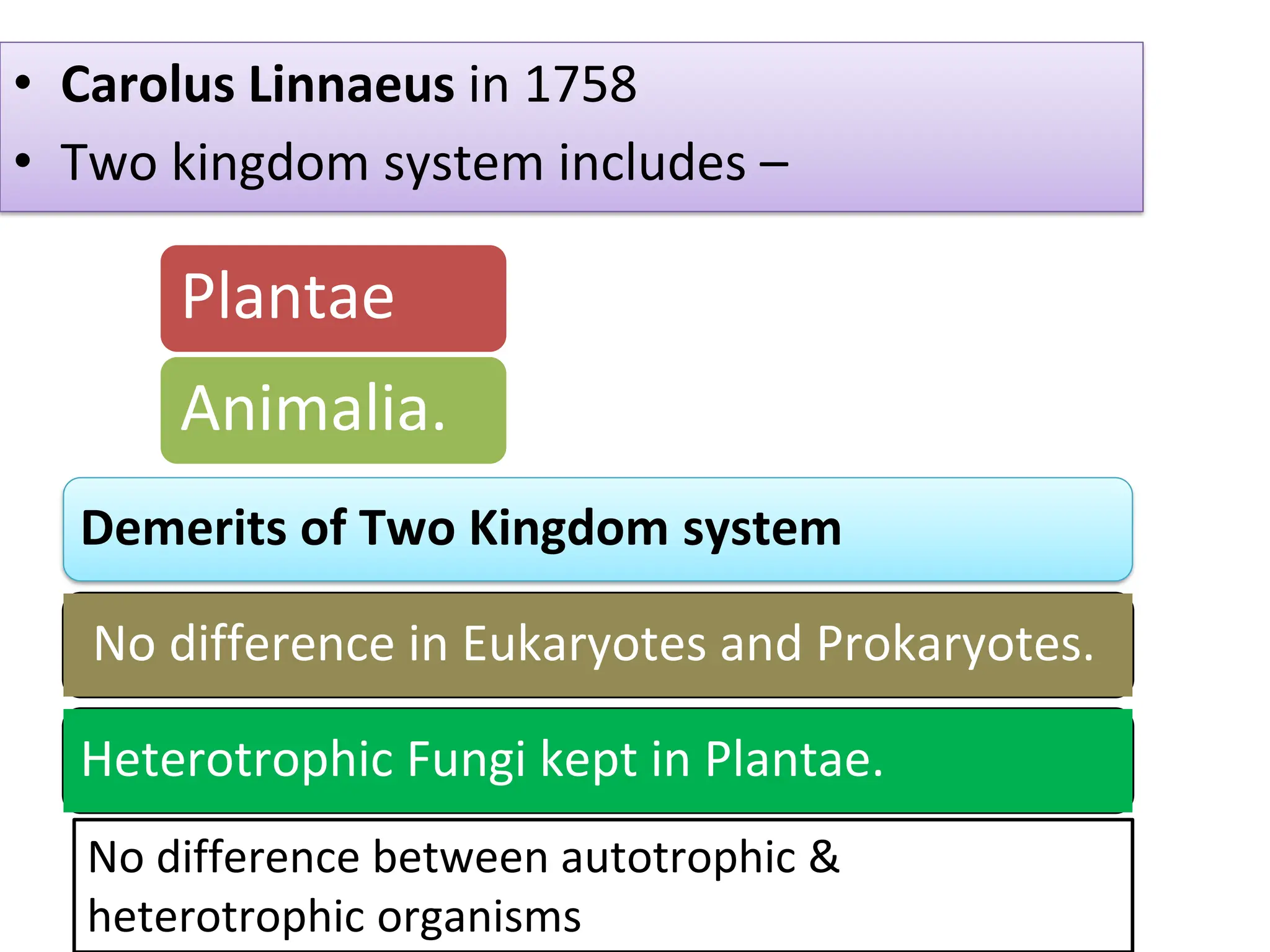
• Carolus Linnaeus in 1758
• Two kingdom system includes –
Demerits of Two Kingdom system
No difference in Eukaryotes and Prokaryotes.
Heterotrophic Fungi kept in Plantae.
Plantae
Animalia.
No difference between autotrophic &
heterotrophic organisms
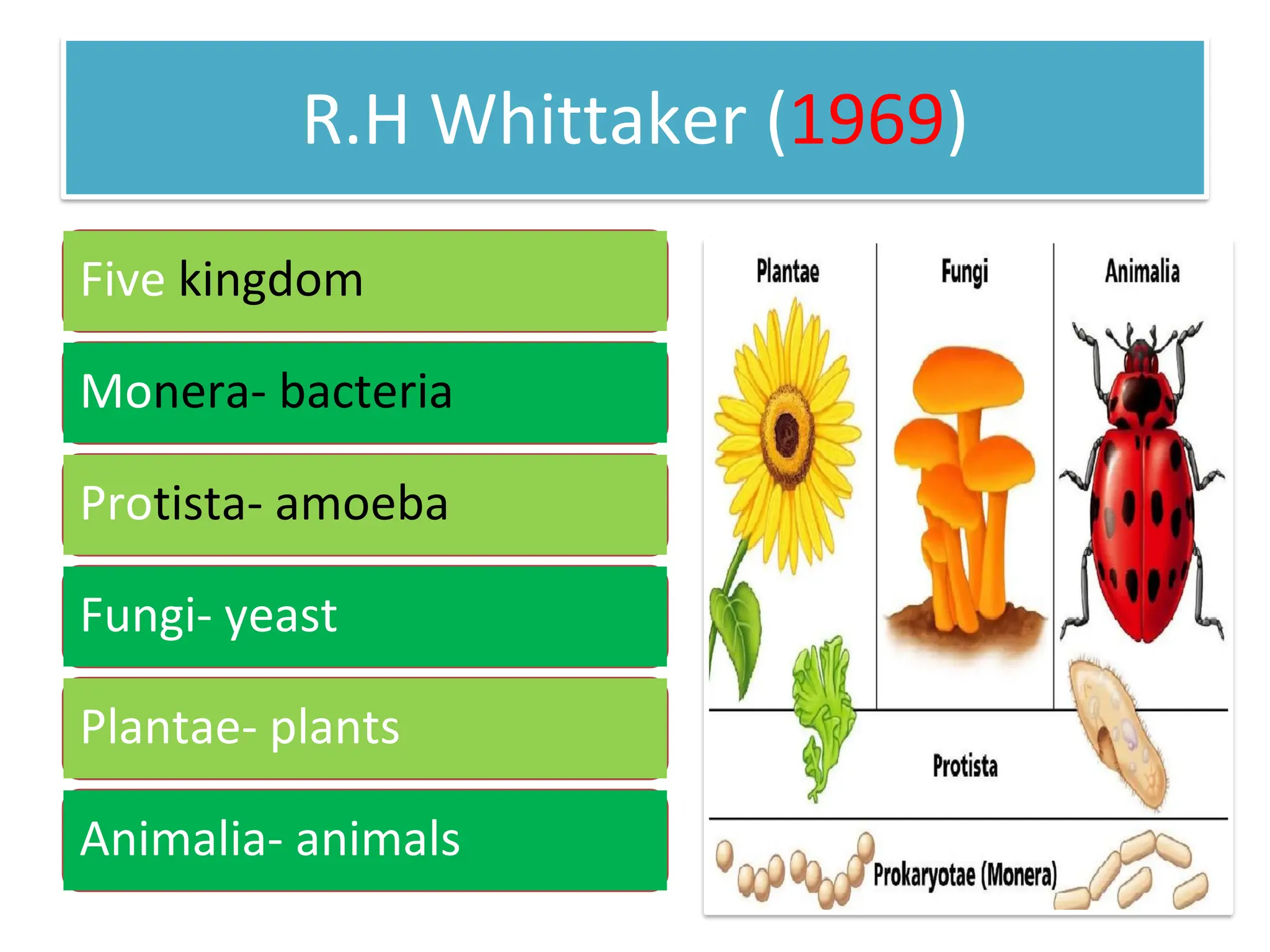
R.H Whittaker (1969)
Five kingdom
Monera- bacteria
Protista- amoeba
Fungi- yeast
Plantae- plants
Animalia- animals
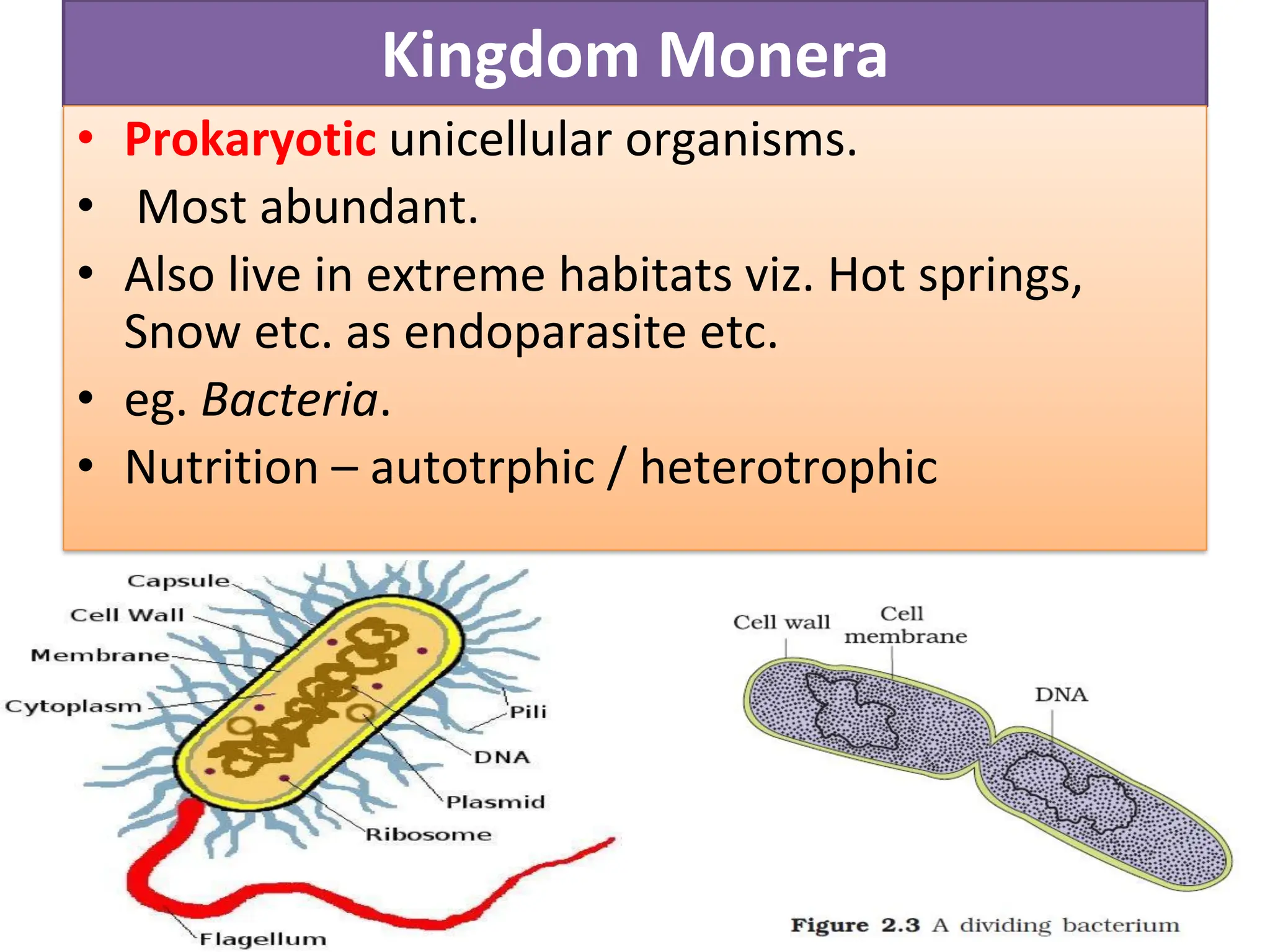
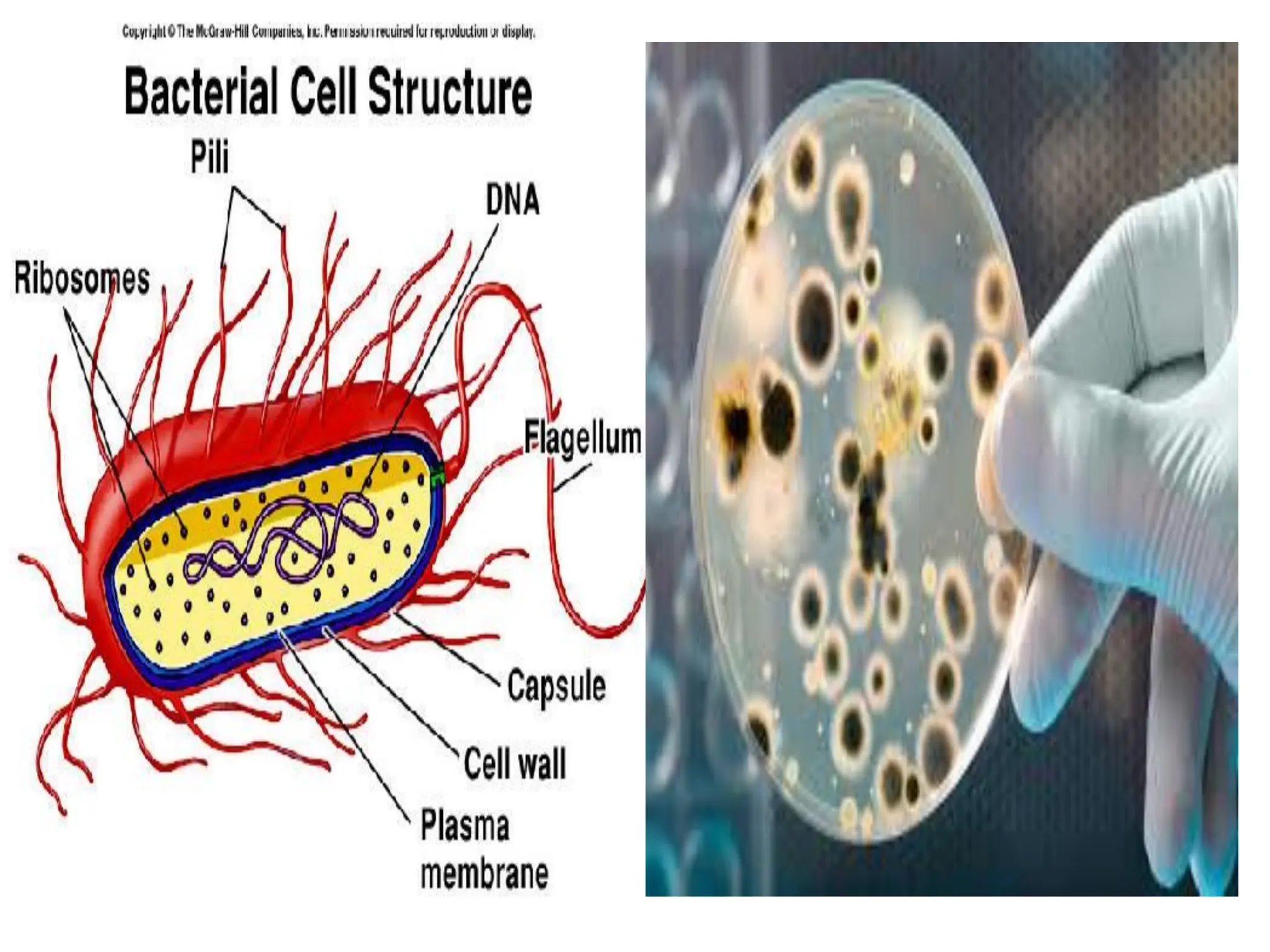
Kingdom Monera
• Prokaryotic unicellular organisms.
• Most abundant.
• Also live in extreme habitats viz. Hot springs,
Snow etc. as endoparasite etc.
• eg. Bacteria.
• Nutrition – autotrphic / heterotrophic
Bacteria shapes
Spherical Coccus
Rod-shaped Bacillus
Comma-shaped Vibrio
Spiral Spirillum
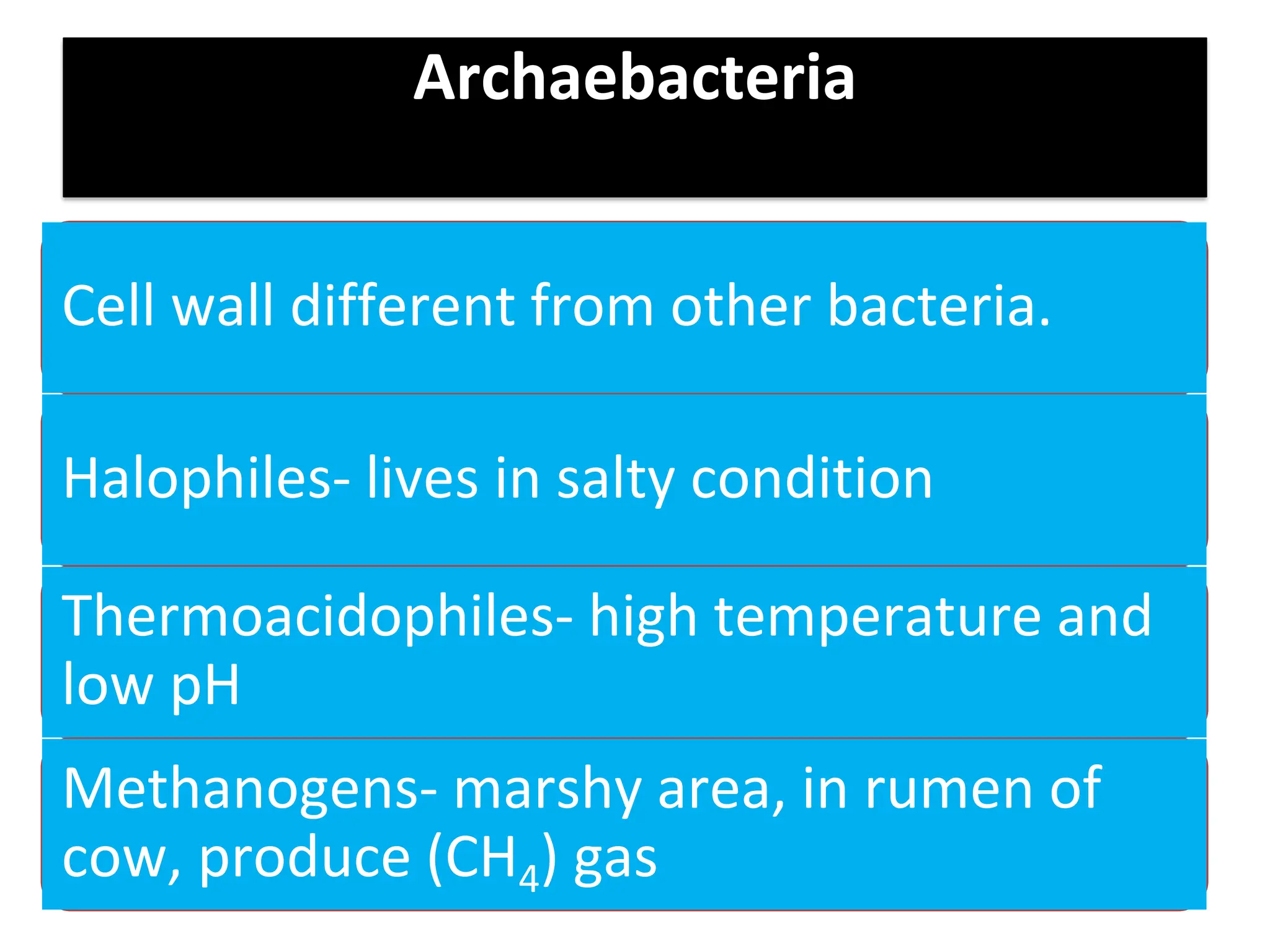
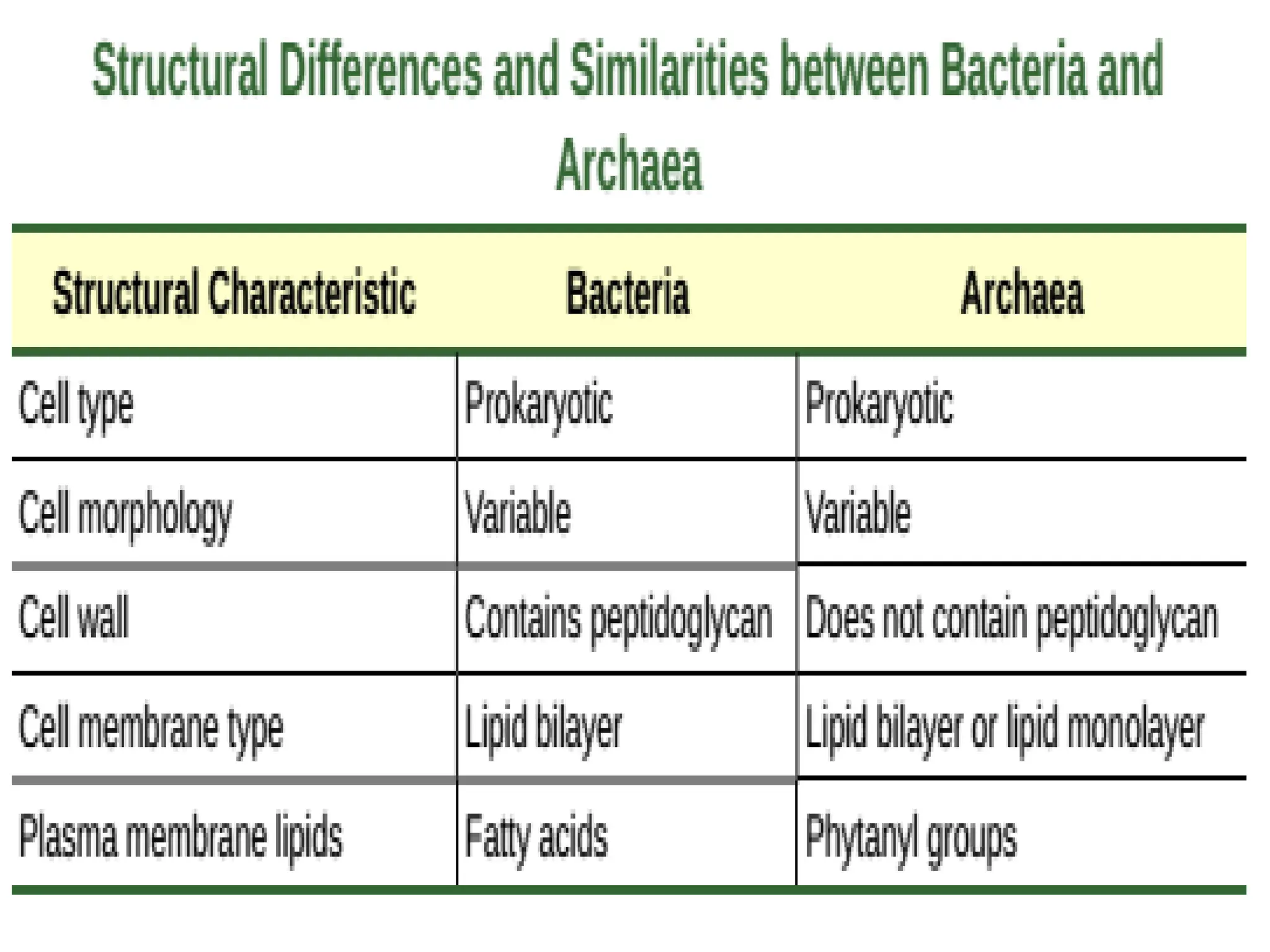
Archaebacteria
Cell wall different from other bacteria.
Halophiles- lives in salty condition
Thermoacidophiles- high temperature and
low pH
Methanogens- marshy area, in rumen of
cow, produce (CH4) gas
Eubacteria
True bacteria.
Rigid cell wall with or without flagellum.
Autotrophic Cyanobacteria
Heterotrophic bacteria
Photoautotrophic
Chemoautotrophic
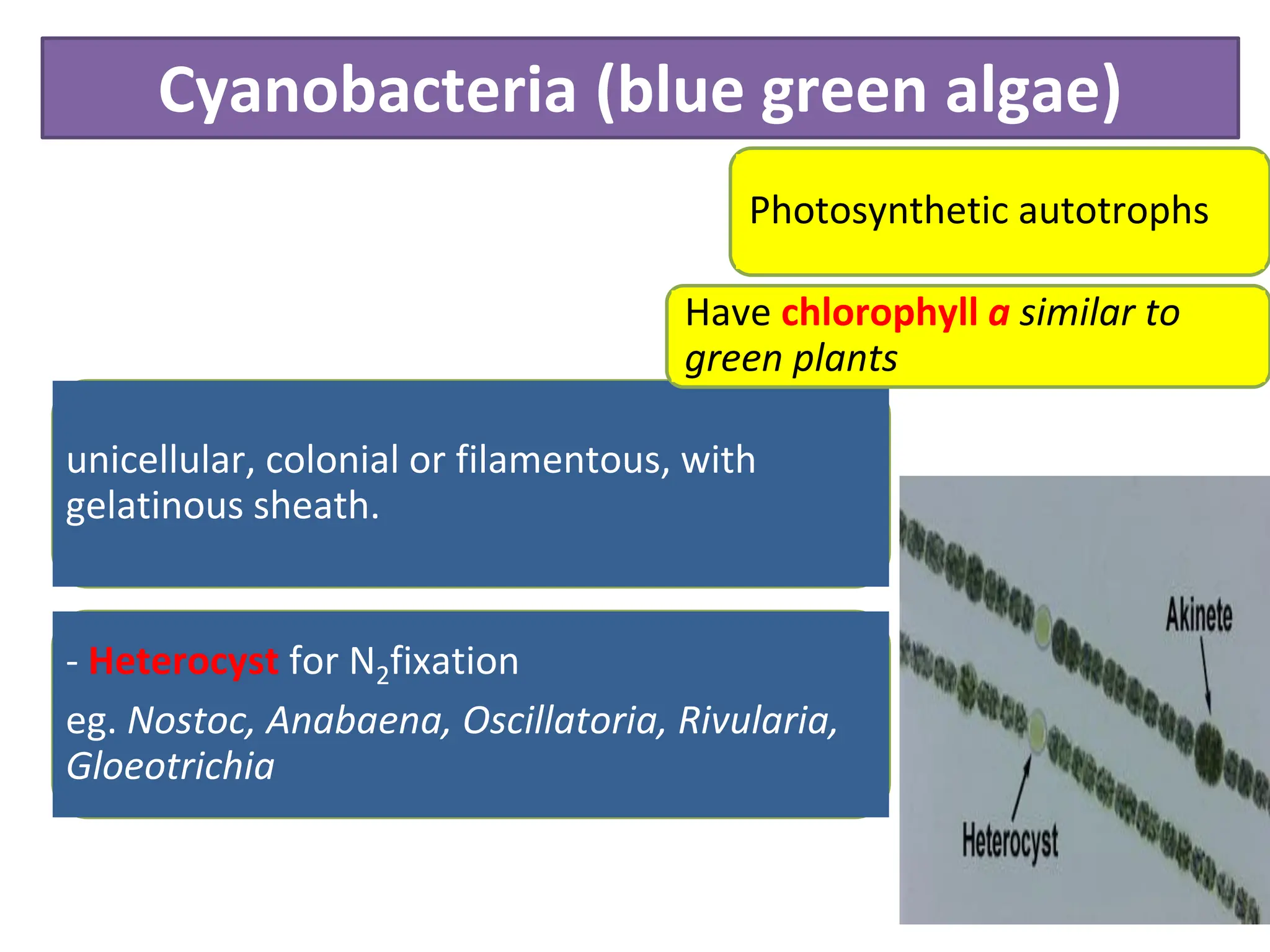
unicellular, colonial or filamentous, with
gelatinous sheath.
- Heterocyst for N2fixation
eg. Nostoc, Anabaena, Oscillatoria, Rivularia,
Gloeotrichia
Cyanobacteria (blue green algae)
Photosynthetic autotrophs
Have chlorophyll a similar to
green plants
Chroococcales
Microcystis
oscillatoria
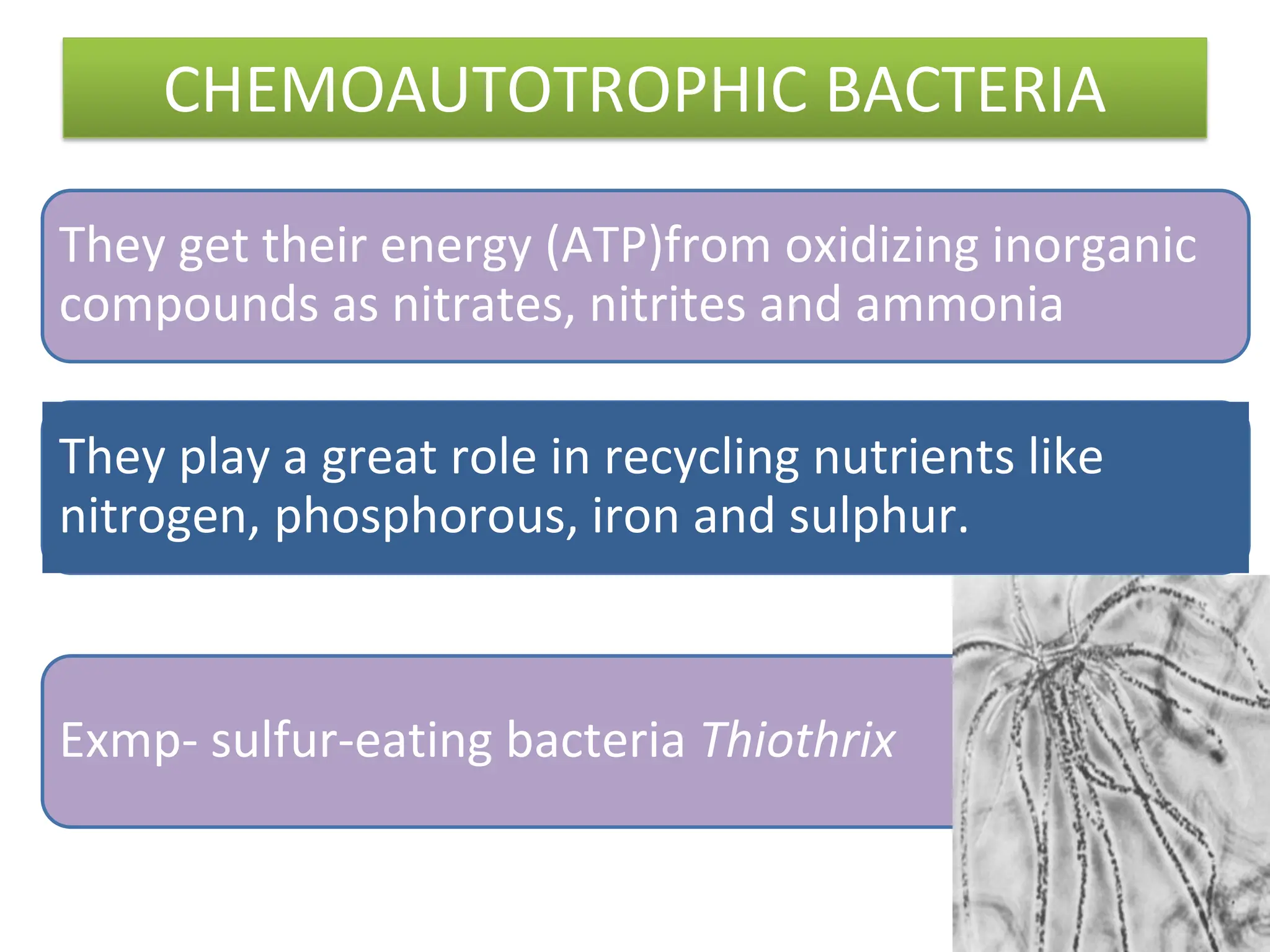
CHEMOAUTOTROPHIC BACTERIA
They get their energy (ATP)from oxidizing inorganic
compounds as nitrates, nitrites and ammonia
They play a great role in recycling nutrients like
nitrogen, phosphorous, iron and sulphur.
Exmp- sulfur-eating bacteria Thiothrix
Heterotrophic bacteria
• Obtain food from their environment
• Parasitic
• Symbiotic – Rhizobium
• Saprophytic
• Decomposers
• Useful- making curd from milk, production of
antibiotics, fixing nitrogen in legume roots, etc.
• Harmful – pathogens (causes disease)
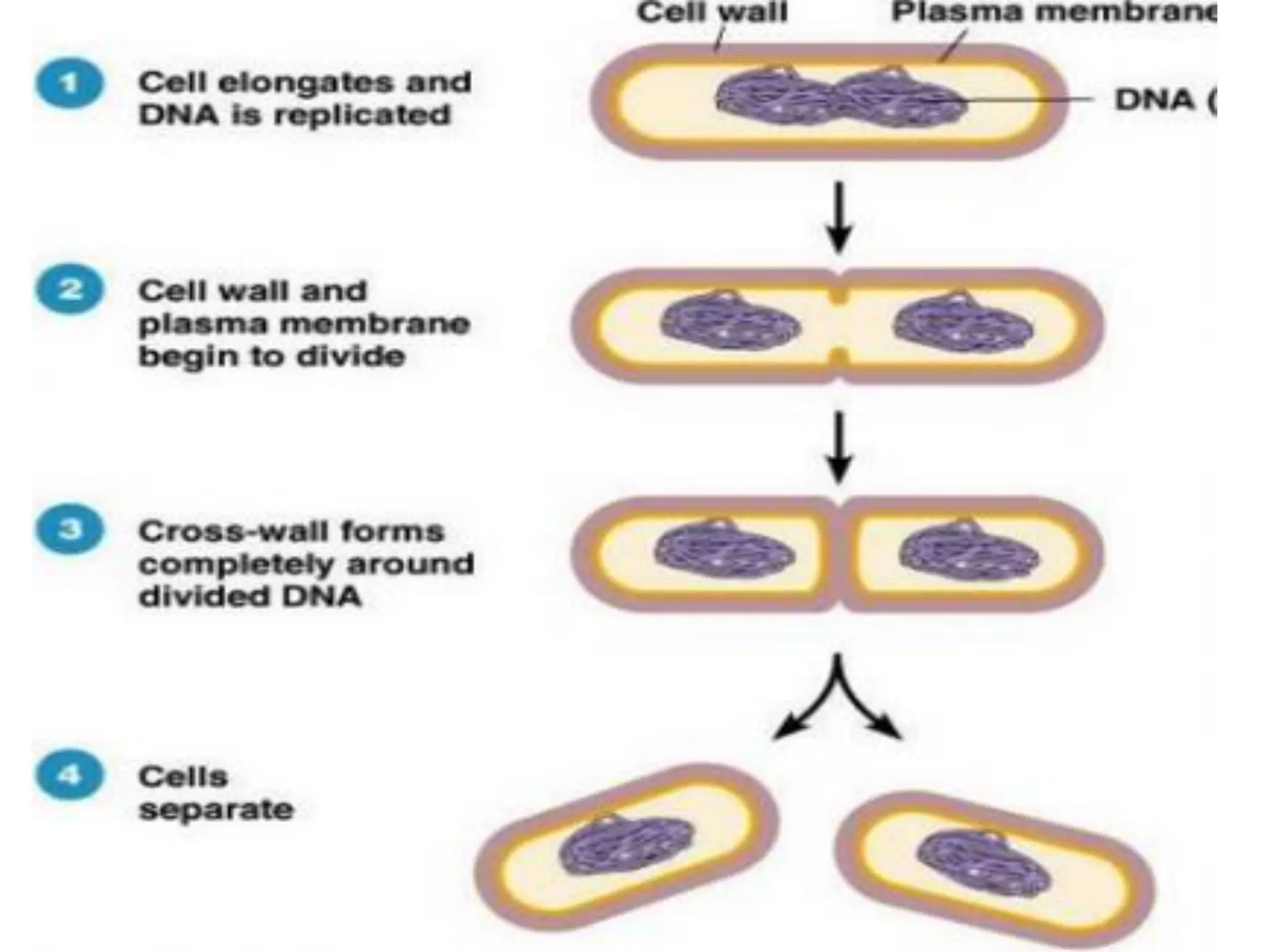
Reproduction in Bacteria
• Fission.
• Endospore
• Transduction
• Conjugartion
• Transformation
Transferring DNA piece from one bacterial
cell(+ strain) to other (- strain) (called cell
Transduction).
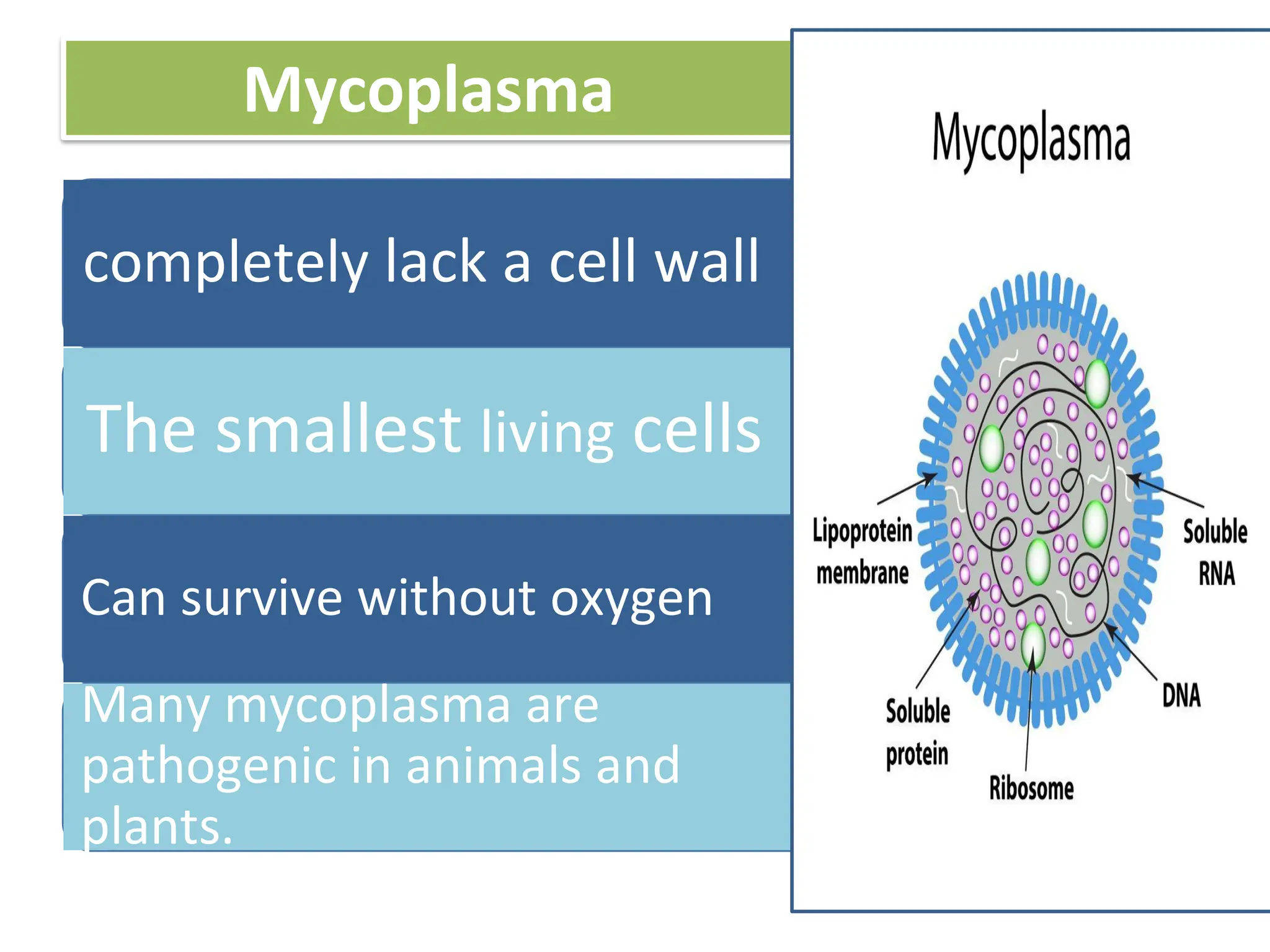
Mycoplasma
completely lack a cell wall
The smallest living cells
Can survive without oxygen
Many mycoplasma are
pathogenic in animals and
plants.
Kingdom Protista
• Unicellular eukaryotes.
• Primarily aquatic.
• Some have cilia and flagella.
• Reproduction- sexual / asexual both.
Crysophytes –Diatoms
Dinofagellates – Gonyaulax
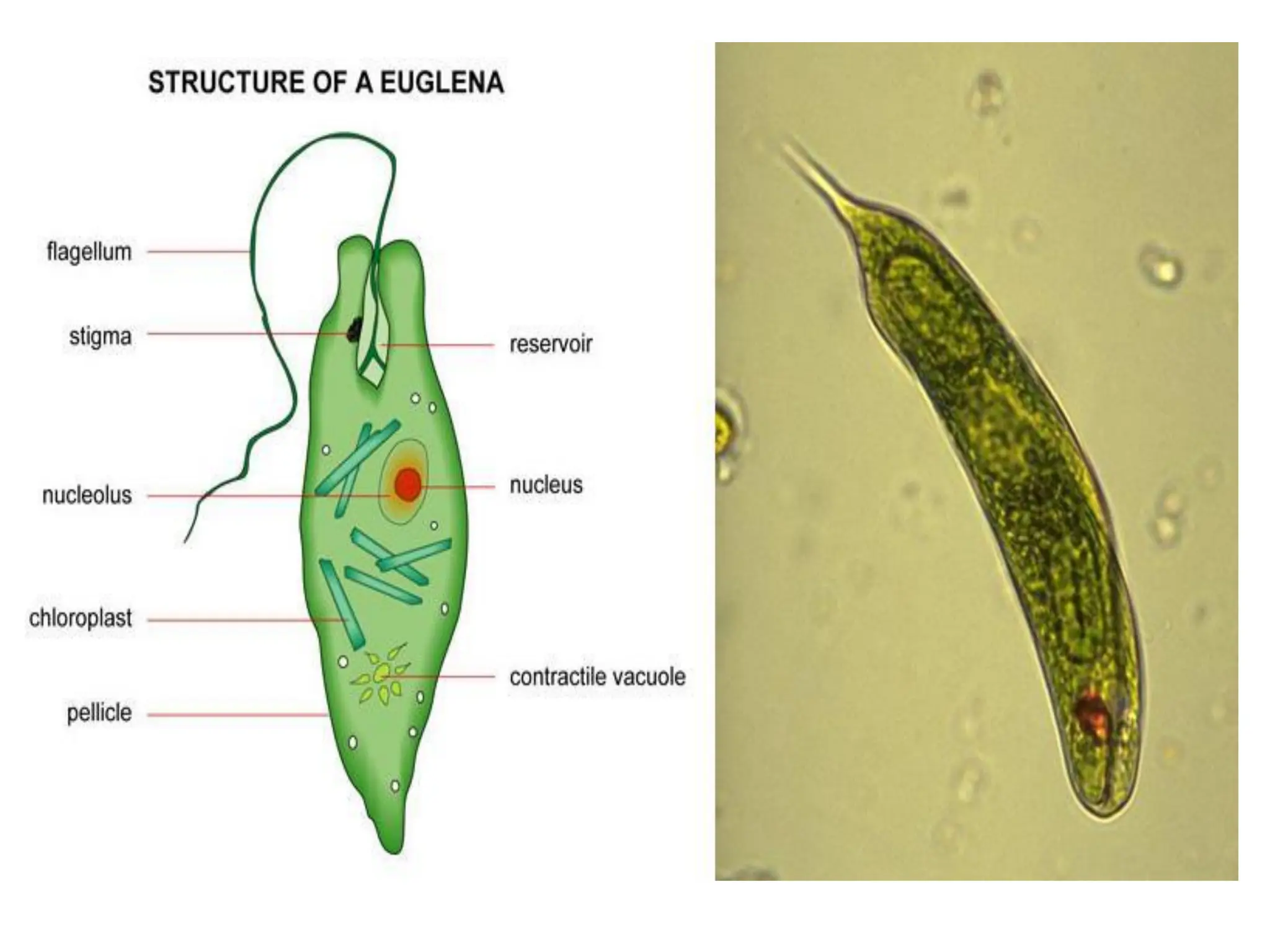
Euglenoids - Euglena
Slime moulds - Plasmodium
Protozoans - Amoeba
EUGLENA
Crysophytes
• Fresh water or marine
microscopic Planktons.
• - Mostly photosynthetic and
chief producer in ocean eg.
Diatoms and Golden algae
(Desmids).
• - Diatoms with cell walls in
two halves having Silica
(indestructible).
• - Diatomaceous earth is
formed by cell wall deposits
of Diatoms and used in
polishing, filtration of oils
and syrups, fire bricks and
explosives
Dinofagellates
Marine.
Photosynthetic yellow , green,
blue, brown or red in colour.
Cellulose plate on outer surface
mostly two flagella.
- Gonyaulax causes Red tides
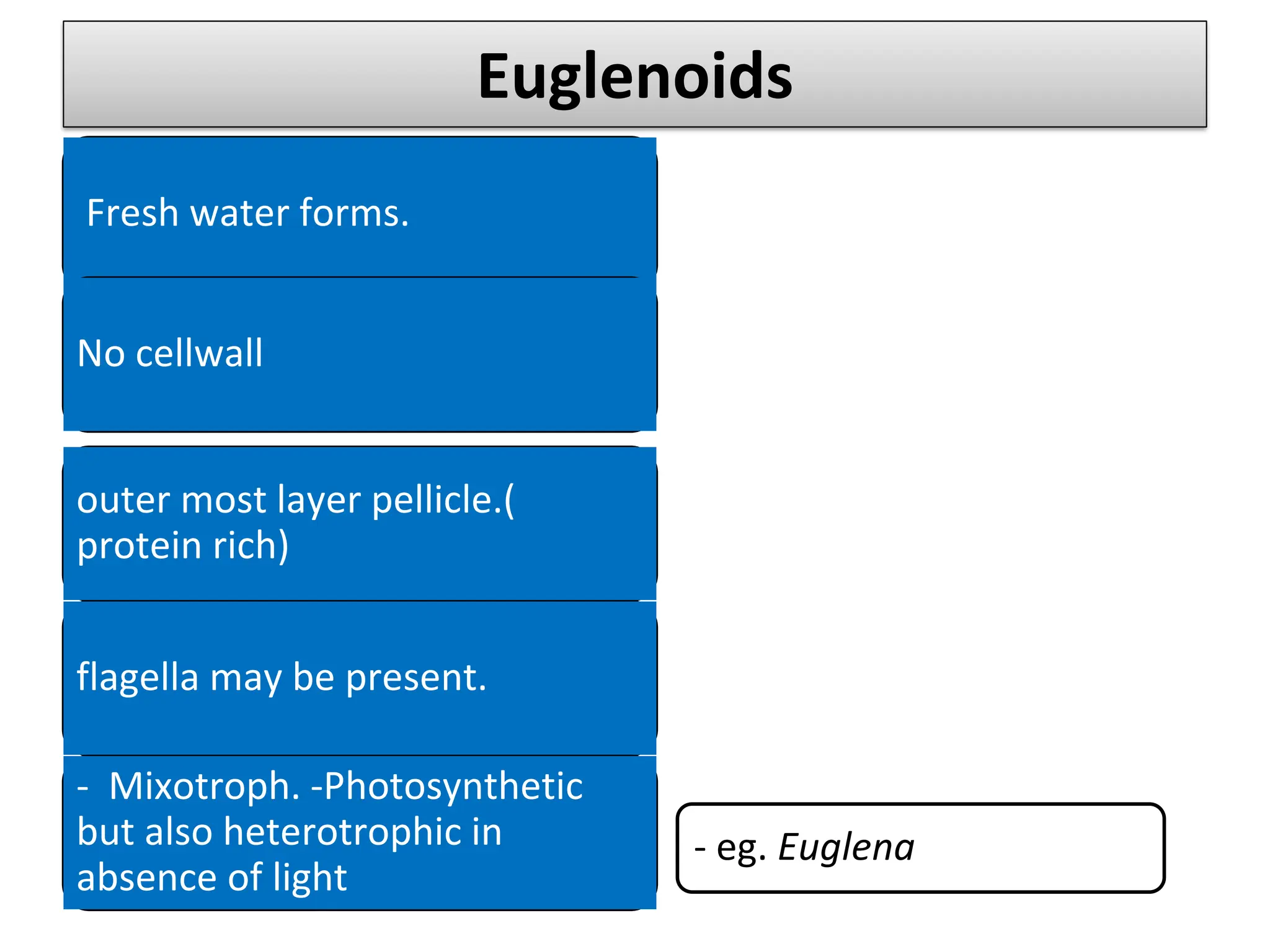
Euglenoids
Fresh water forms.
No cellwall
outer most layer pellicle.(
protein rich)
flagella may be present.
- Mixotroph. -Photosynthetic
but also heterotrophic in
absence of light
- eg. Euglena
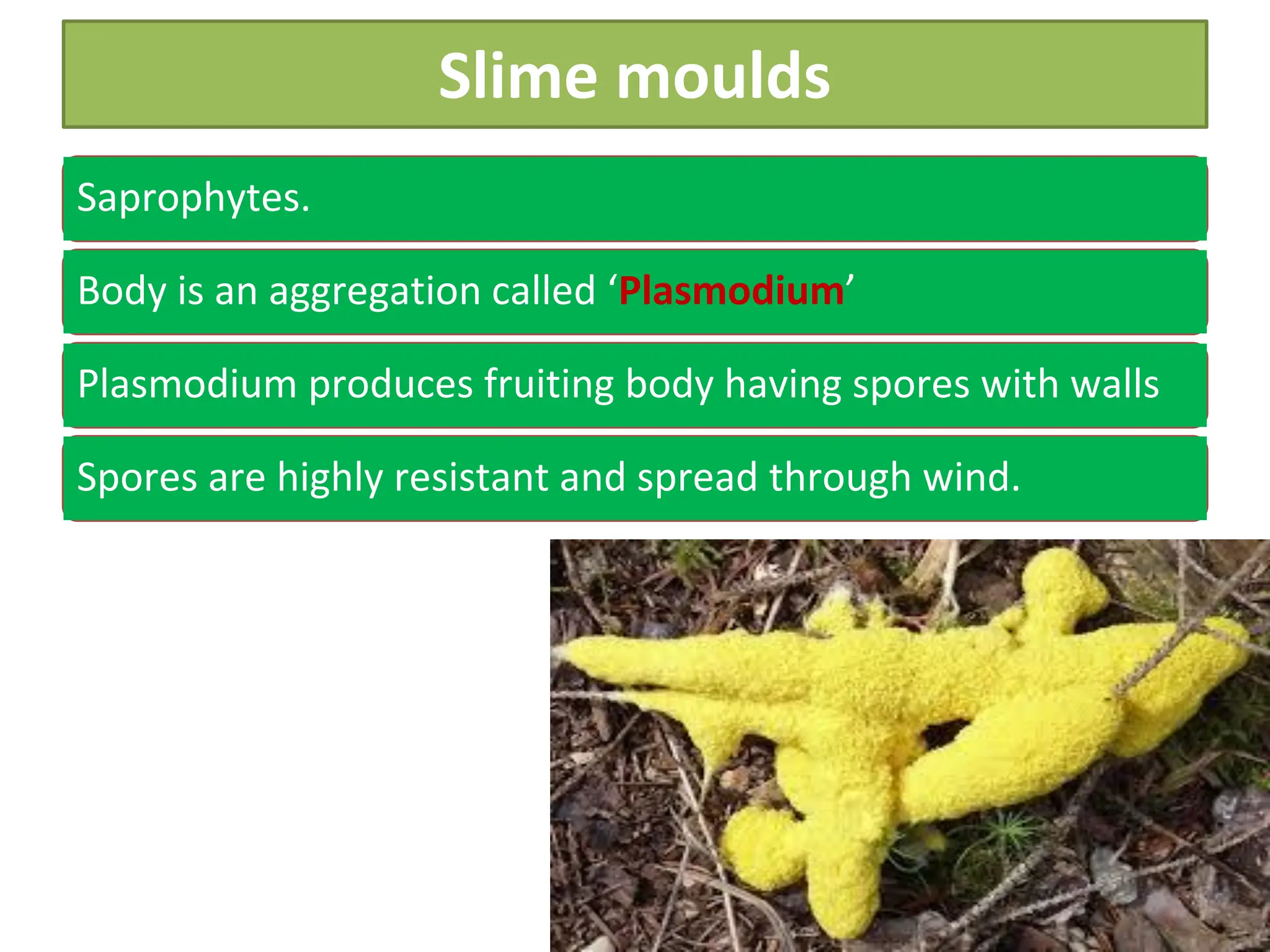
Slime moulds
Saprophytes.
Body is an aggregation called ‘Plasmodium’
Plasmodium produces fruiting body having spores with walls
Spores are highly resistant and spread through wind.
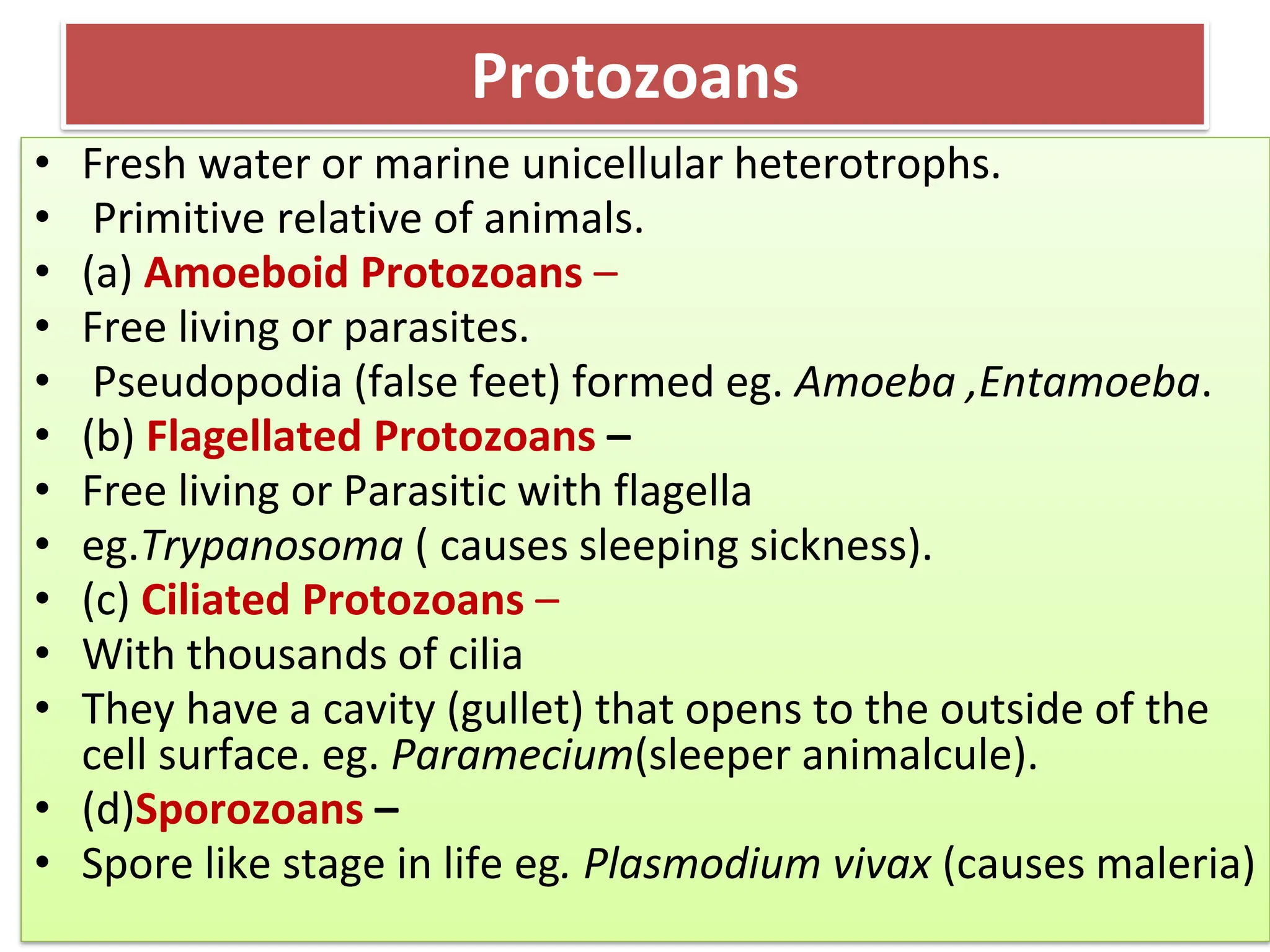
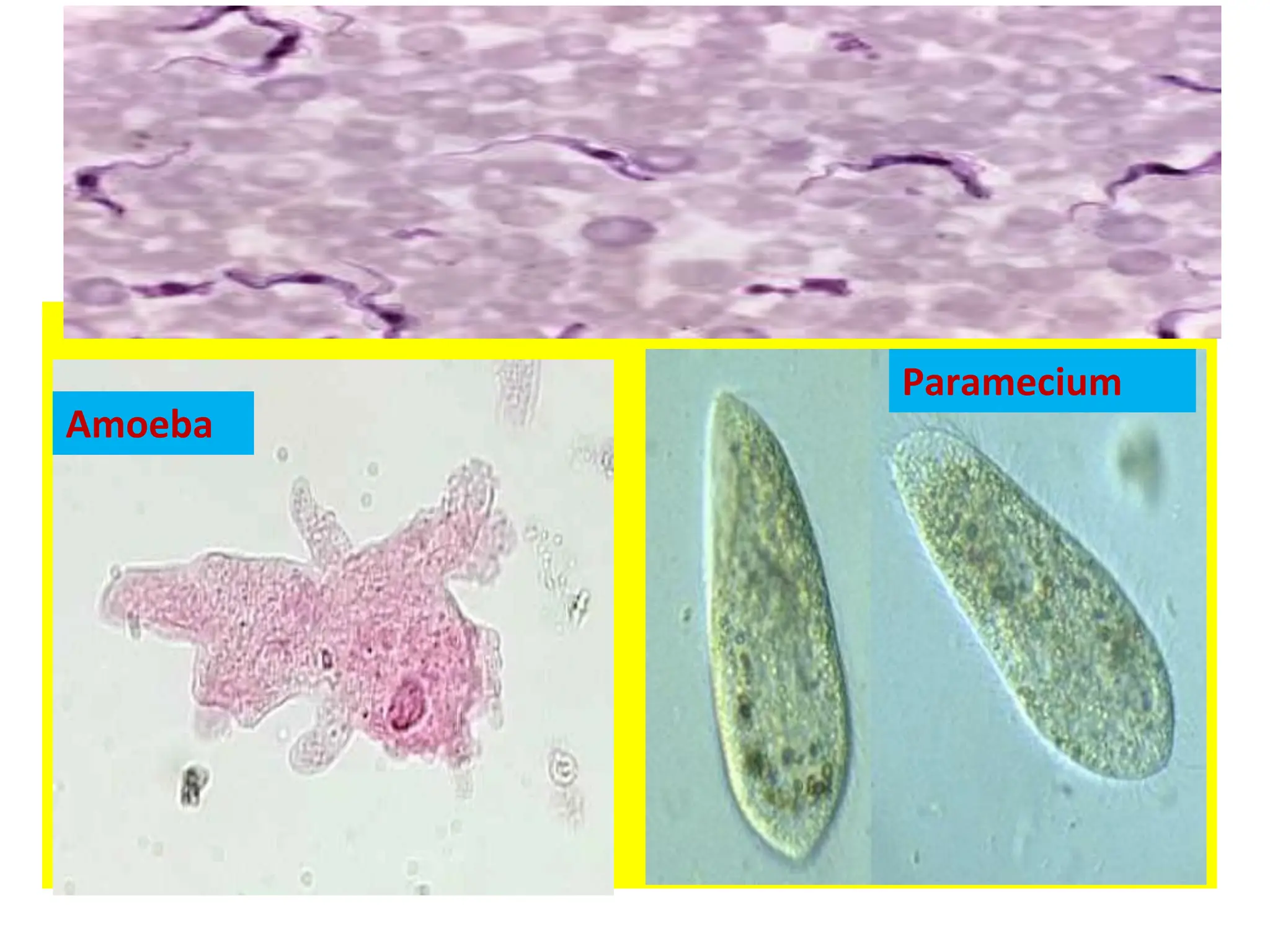
Protozoans
• Fresh water or marine unicellular heterotrophs.
• Primitive relative of animals.
• (a) Amoeboid Protozoans –
• Free living or parasites.
• Pseudopodia (false feet) formed eg. Amoeba ,Entamoeba.
• (b) Flagellated Protozoans –
• Free living or Parasitic with flagella
• eg.Trypanosoma ( causes sleeping sickness).
• (c) Ciliated Protozoans –
• With thousands of cilia
• They have a cavity (gullet) that opens to the outside of the
cell surface. eg. Paramecium(sleeper animalcule).
• (d)Sporozoans –
• Spore like stage in life eg. Plasmodium vivax (causes maleria)
Amoeba
Paramecium
Trypnosom
a
Kingdom Fungi
Fungi are a group of achlorophyllous, heterotrophic organisms with
cell wall without cellulose.
Saprophyte or Parasite or Symbiotic.
The cell walls of fungi are composed of chitin and
polysaccharides.
Prefer to grow in warm and humid places.
Unicellular (eg. Yeast) to multicellular filamentous body
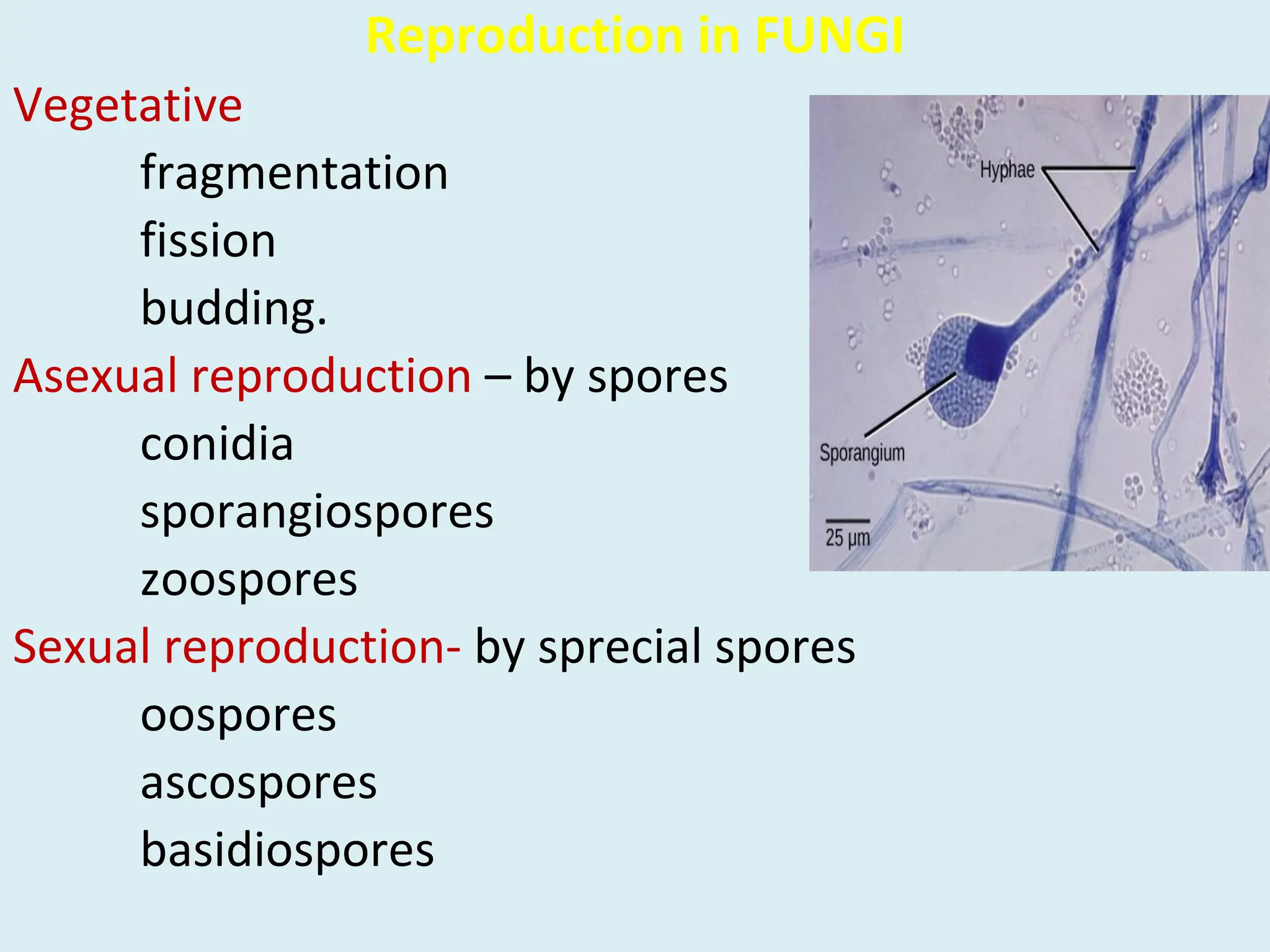
called mycelium.
One unit of mycelium called hypha .
Mycelia maybe coenocytic (no septum) or septate.
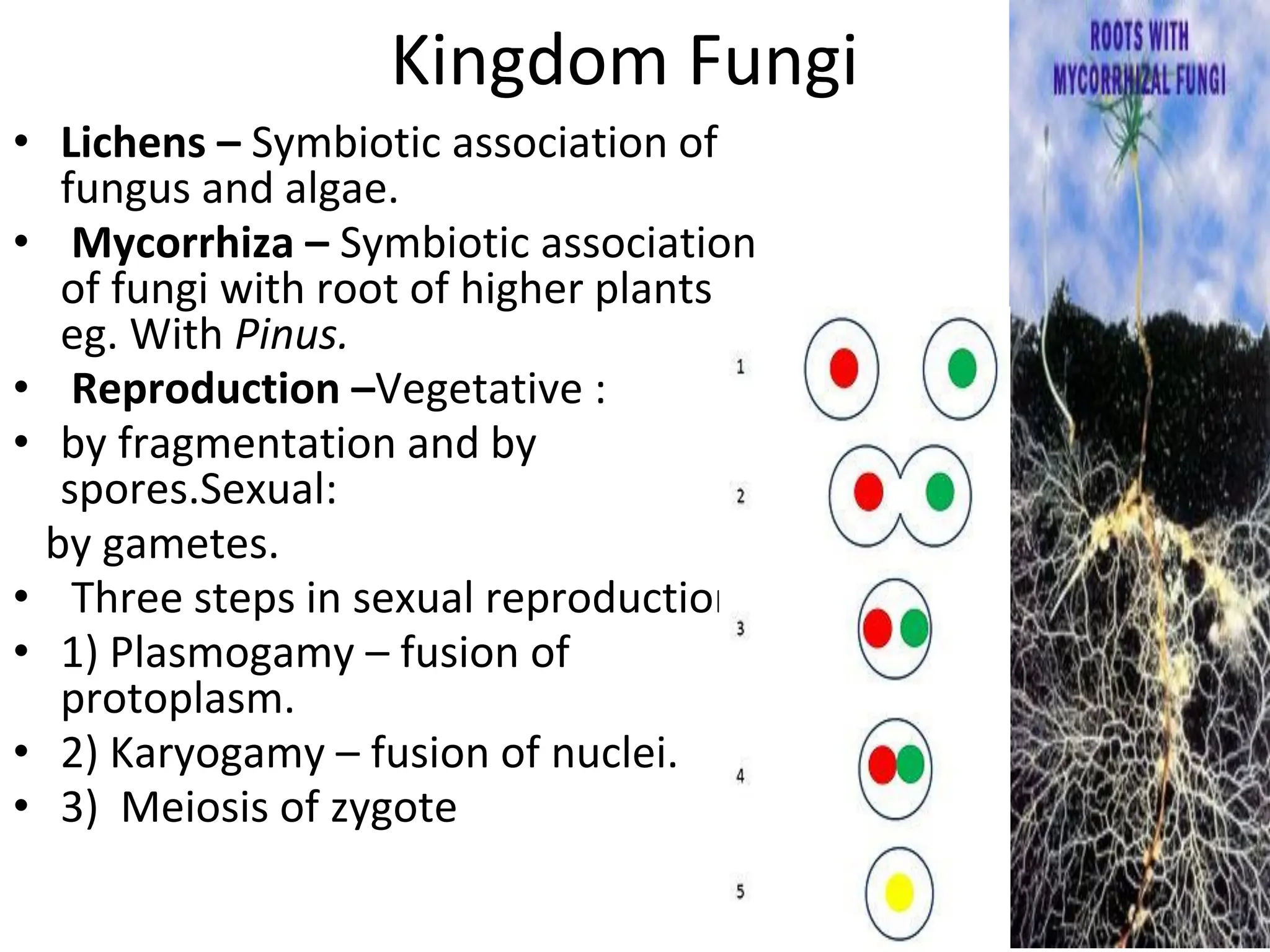
Kingdom Fungi
• Lichens – Symbiotic association of
fungus and algae.
• Mycorrhiza – Symbiotic association
of fungi with root of higher plants
eg. With Pinus.
• Reproduction –Vegetative :
• by fragmentation and by
spores.Sexual:
by gametes.
• Three steps in sexual reproduction
• 1) Plasmogamy – fusion of
protoplasm.
• 2) Karyogamy – fusion of nuclei.
• 3) Meiosis of zygote
Reproduction in FUNGI
Vegetative
fragmentation
fission
budding.
Asexual reproduction – by spores
conidia
sporangiospores
zoospores
Sexual reproduction- by sprecial spores
oospores
ascospores
basidiospores
SEXUAL REPRODUCTION IN FUNGI
STEPS
PLASMOGAMY - Fusion of protoplasms
between two motile or non-motile gametes
KAYOGAMY- Fusion of two nuclei called
Meiosis in zygote resulting in haploid spores.
In plasmogamy the two haploid and
compatible hyphae of fungus fuses and from
diploid cell.
Exception- some fungi (ascomycetes and
basidiomycetes) dikaryotic stage also
observed.
The diploid cell late form fruiting in which
reduction division occurs, leading to
formation of haploid spores
Kingdom Fungi
Phycomycetes
Ascomycets (sac fungi)
Basidiomycetes (club fungi)
Deuteromycetes (Fungi- imperfectil)
Phycomycetes
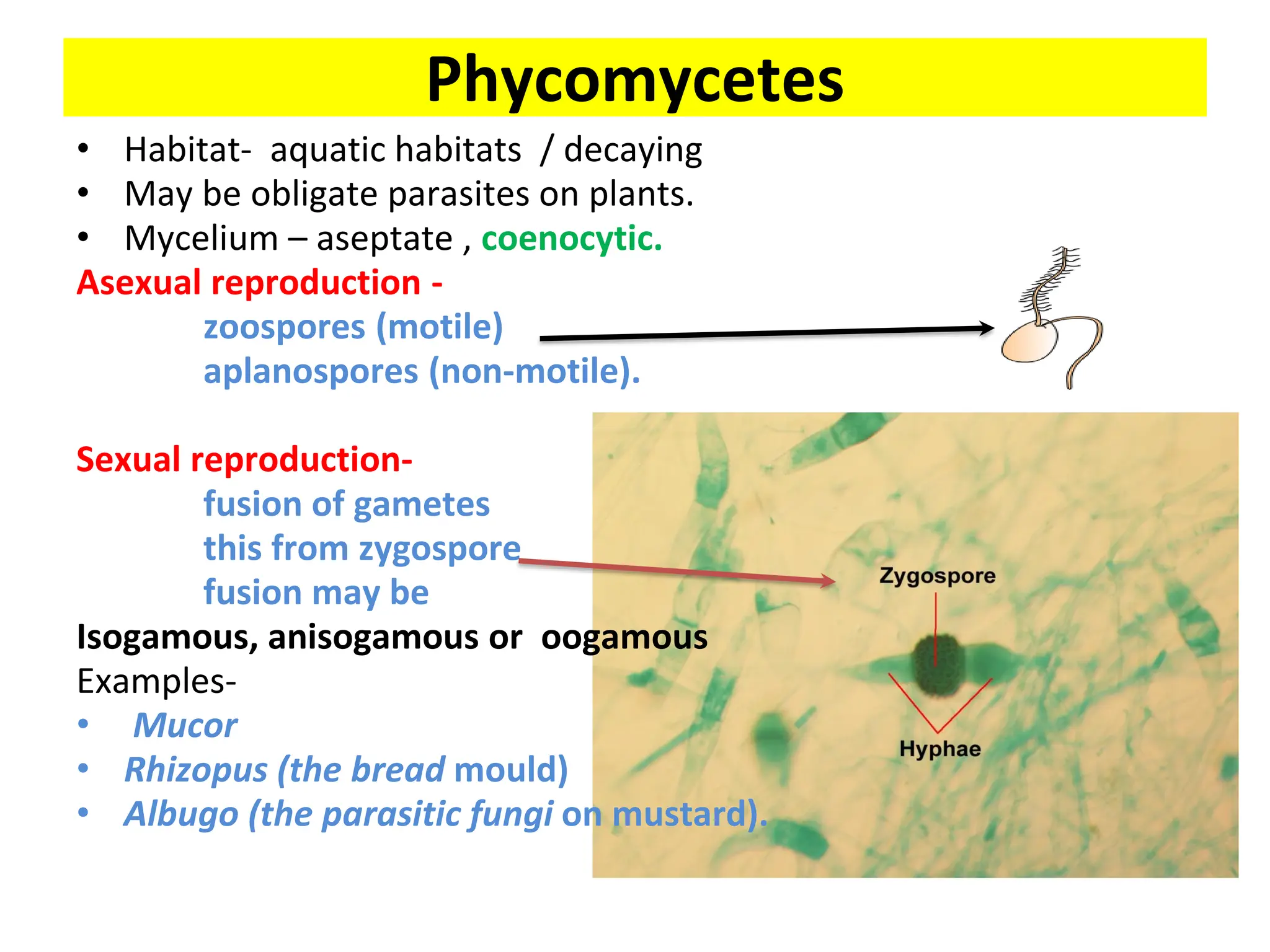
• Habitat- aquatic habitats / decaying
• May be obligate parasites on plants.
• Mycelium – aseptate , coenocytic.
Asexual reproduction -
zoospores (motile)
aplanospores (non-motile).
Sexual reproduction-
fusion of gametes
this from zygospore
fusion may be
Isogamous, anisogamous or oogamous
Examples-
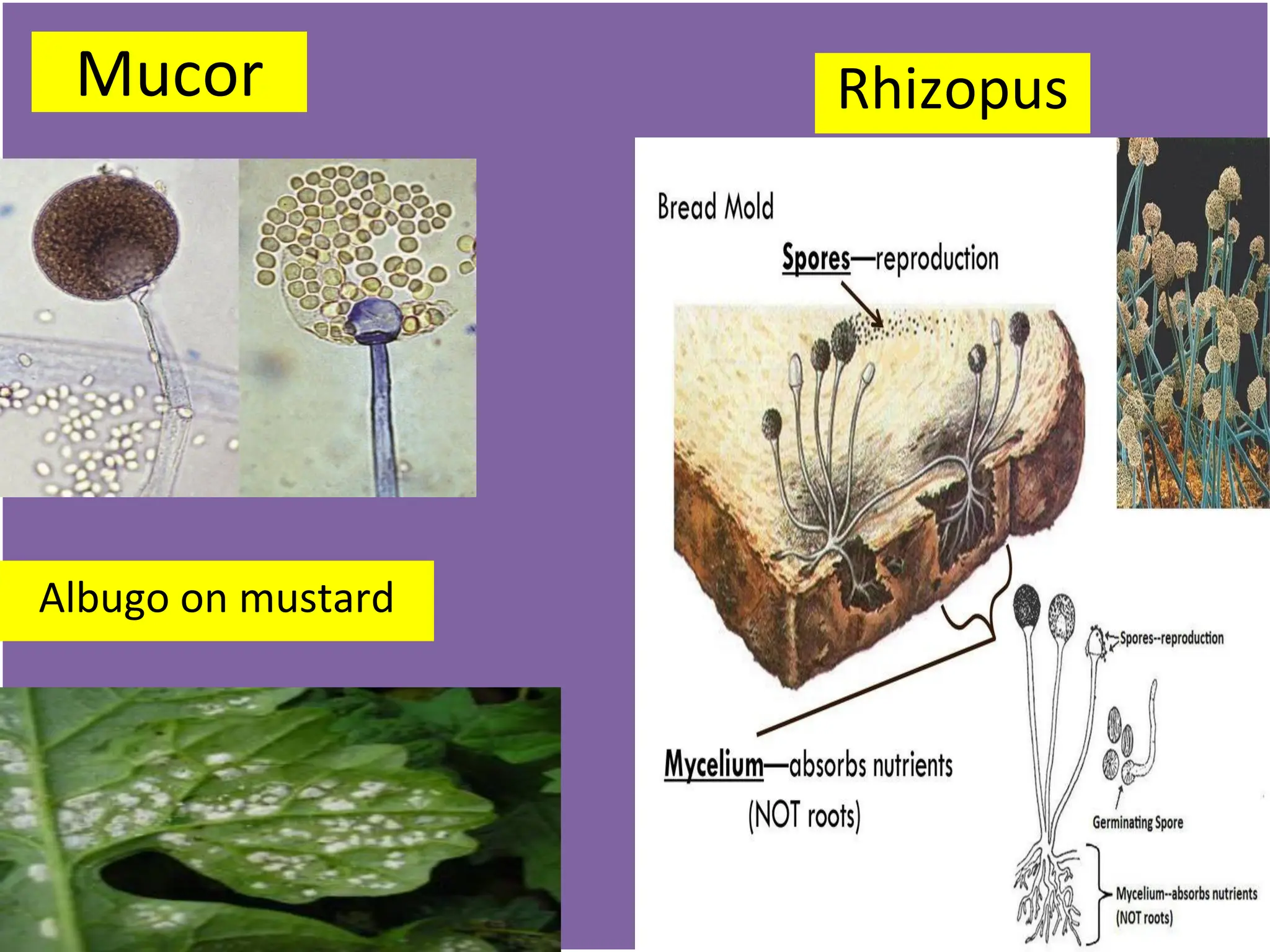
• Mucor
• Rhizopus (the bread mould)
• Albugo (the parasitic fungi on mustard).
Mucor Rhizopus
Albugo on mustard
Ascomycets (sac fungi)
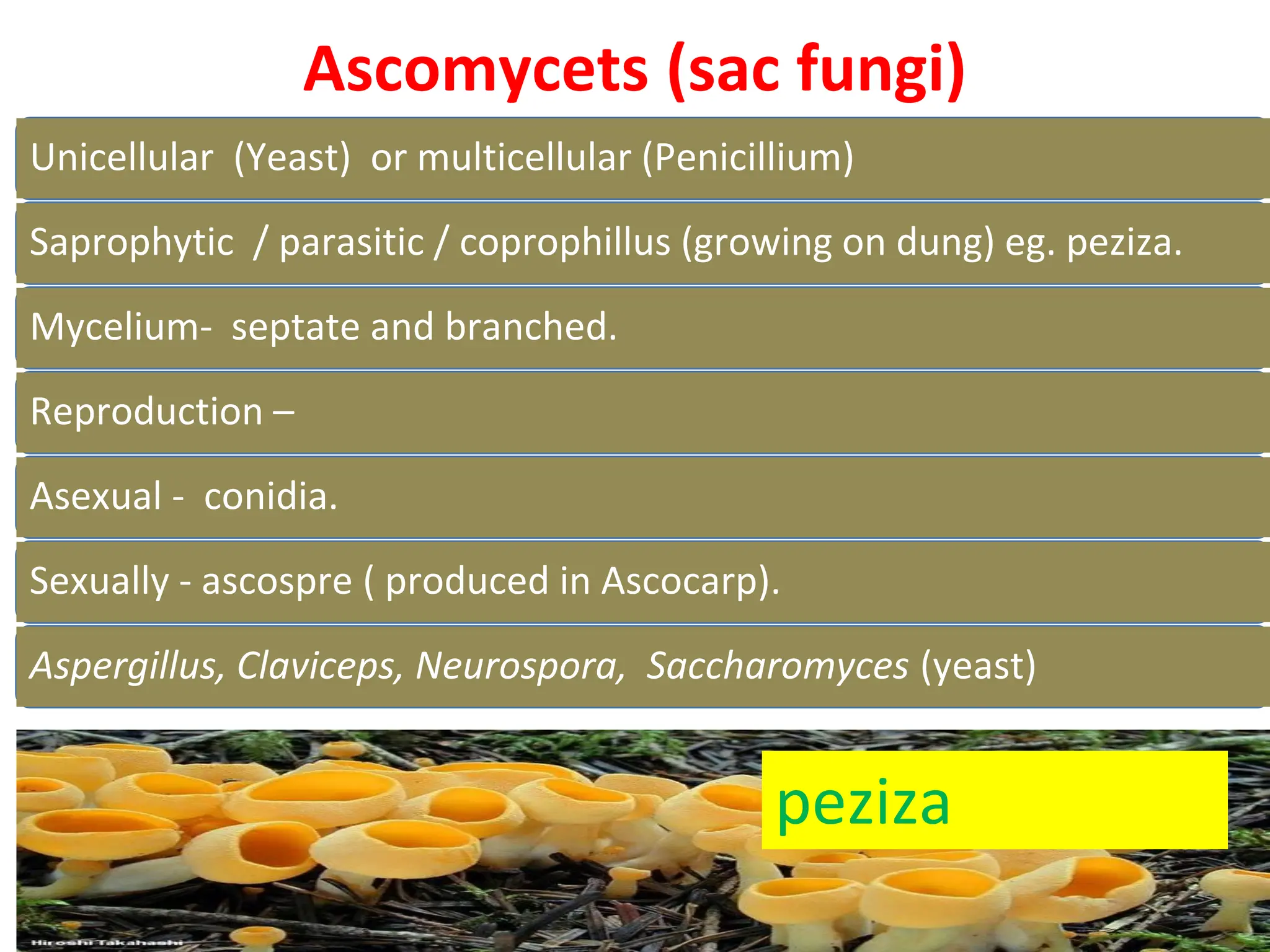
Unicellular (Yeast) or multicellular (Penicillium)
Saprophytic / parasitic / coprophillus (growing on dung) eg. peziza.
Mycelium- septate and branched.
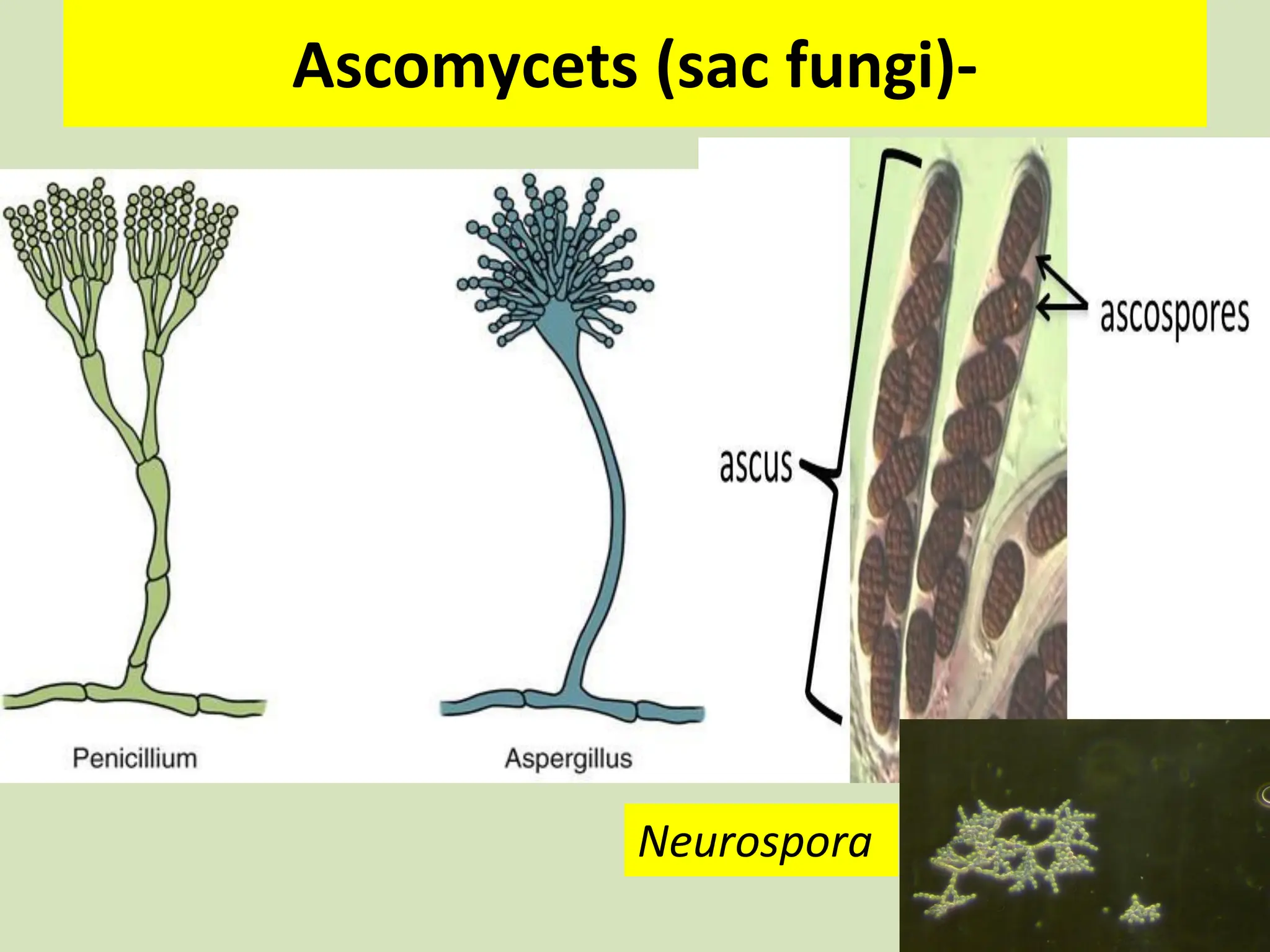
Reproduction –
Asexual - conidia.
Sexually - ascospre ( produced in Ascocarp).
Aspergillus, Claviceps, Neurospora, Saccharomyces (yeast)
peziza
Ascomycets (sac fungi)-
Neurospora
Basidiomycetes (club fungi)
Examples - Mushrooms, Bracket fungi or Puffballs.
Habitat- soil, on logs and tree stumps and in plant as parasites,
e.g., rusts and smuts.
Mycelium - branched and septate.
Asexual spores - are generally not found
Vegetative reproduction – fragmentation
Dikayon stage observed
Fruiting body – Basidiocarp / Basidium
Basidium - produces basidiospores exogenously
Agaricus (mushroom), Ustilago (smut) and Puccinia (rust fungus).
• Basidiomycetes (club fungi)
Pileus
Stripe
Gills
Leaf rust of whaet by Puccinia triticina
Covered smut of barley Ustilago hordei
Deuteromycetes (Fungi- imperfectil)
Only the Asexual or vegetative phases of these fungi are
known.
Saprophyte / parasite
Mycelium- septate, branched
Asexual spores - conidia.
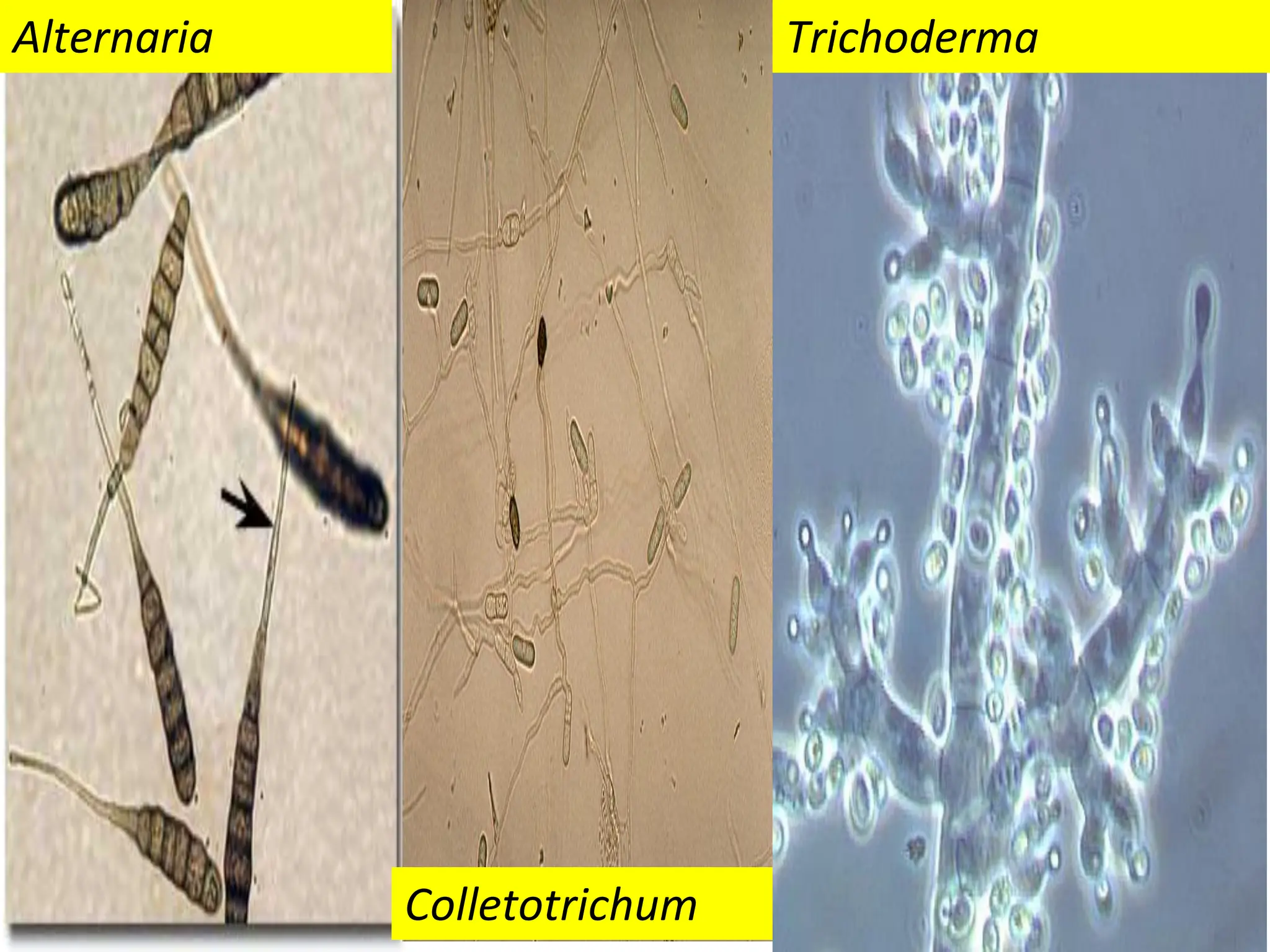
Alternaria, Colletotrichum and Trichoderma.
Alternaria
Colletotrichum
Trichoderma
Kingdom Plantae
• - Eukaryotic, chlorophyll bearing autotrophic
organisms.
• - Only few members partialheterotrophs eg.
Insectivorus plants (Bladder wort and Venus
flytrap).
• - Few parasites eg. Cuscuta
• - Reproduction – vegetative,asexual and
sexual.
• - Life cycle shows alternation of generation.
• - eg. Algae, Bryophytes,Pteridophyte,
Gymnosperms and Angiosperms.
Kingdom Animalia
Eukaryotic, Heterotrophic organisms.
No chloroplast and no cell wall.
Holozoic mode of nutrition .
Definite shape and size and capable of locomotion.
Reproduction – sexual in general
eg. frog, cockroach, cow, man etc.
Viruses, Viroids and Lichens –
• Viruses – Connecting link between living and non living.
• Non cellular, nucleoprotein
• Can reproduce within a host cell.
• Viruses which infect bacteria are called
bacteriophage.
• Tobacco Mosaic Virus (TMV)-
• Protein coat: - capsid consists of capsomers.
• Viral diseases- Mumps, Small pox, Herpes,
Influenza, AIDS etc.
Viroids
Viroids are the smallest
infectious pathogens
known.
They are composed solely of a
short strand of circular, single-
stranded RNA that has no
protein coating
May cause hepatitis D
Potato spindle tuber viroid
Lichens
Composite organisms.
Symbiotic association
Algae (Phycobiont)
Fungi (Mycobiont).
•Are pollution
indicators.
Summary
• Two kingdom classification
• Five kingdom classification
• Monera
• Protista
• Fungi
• Plantae
• Animalia
• Virus , Viroid
• Lichen
Biological Classification rk u.pdf Biology

Biological Classification rk u.pdf Biology

  • 1.
    Biological Classification Dr RamaKant Upadhyay PGT Biology KV 39 GTC, VARANASI
  • 2.
    Terms • Thallus: Plantbody without true stem, root & Leaf. ▪ Halophiles: Organism living in salty areas. ▪ Plankton: Plants floating passively in water current. ▪ Chemosynthetic: Using chemical reactions as energy source. ▪ Heterotrophic: ▪ Pathogenic: Disease causing. ▪ Plasmodium: Main body of slime mould. ▪ Saprophyte: ▪ Parasite: ▪ Symbionts : Two organisms living together benifitting each other. ▪ Plasmogamy : Fusion of cytoplasm. ▪ Karyogamy : Fusion of nuclei. ▪ Dikaryon : A cell with two nuclei. ▪ Dikaryophase : Stage of fungus with dikaryotic cells. ▪ Isogamous : Morphologically identical gametes. ▪ Anisogamous : Morphologically non identical Gametes. ▪ Oogamous : Female gamete oosphere and Male gamete motile
  • 3.
    • Carolus Linnaeusin 1758 • Two kingdom system includes – Demerits of Two Kingdom system No difference in Eukaryotes and Prokaryotes. Heterotrophic Fungi kept in Plantae. Plantae Animalia. No difference between autotrophic & heterotrophic organisms
  • 4.
    R.H Whittaker (1969) Fivekingdom Monera- bacteria Protista- amoeba Fungi- yeast Plantae- plants Animalia- animals
  • 5.
    Kingdom Monera • Prokaryoticunicellular organisms. • Most abundant. • Also live in extreme habitats viz. Hot springs, Snow etc. as endoparasite etc. • eg. Bacteria. • Nutrition – autotrphic / heterotrophic
  • 7.
    Bacteria shapes Spherical Coccus Rod-shapedBacillus Comma-shaped Vibrio Spiral Spirillum
  • 8.
    Archaebacteria Cell wall differentfrom other bacteria. Halophiles- lives in salty condition Thermoacidophiles- high temperature and low pH Methanogens- marshy area, in rumen of cow, produce (CH4) gas
  • 10.
    Eubacteria True bacteria. Rigid cellwall with or without flagellum. Autotrophic Cyanobacteria Heterotrophic bacteria Photoautotrophic Chemoautotrophic
  • 11.
    unicellular, colonial orfilamentous, with gelatinous sheath. - Heterocyst for N2fixation eg. Nostoc, Anabaena, Oscillatoria, Rivularia, Gloeotrichia Cyanobacteria (blue green algae) Photosynthetic autotrophs Have chlorophyll a similar to green plants
  • 12.
  • 13.
    CHEMOAUTOTROPHIC BACTERIA They gettheir energy (ATP)from oxidizing inorganic compounds as nitrates, nitrites and ammonia They play a great role in recycling nutrients like nitrogen, phosphorous, iron and sulphur. Exmp- sulfur-eating bacteria Thiothrix
  • 14.
    Heterotrophic bacteria • Obtainfood from their environment • Parasitic • Symbiotic – Rhizobium • Saprophytic • Decomposers • Useful- making curd from milk, production of antibiotics, fixing nitrogen in legume roots, etc. • Harmful – pathogens (causes disease)
  • 15.
    Reproduction in Bacteria •Fission. • Endospore • Transduction • Conjugartion • Transformation Transferring DNA piece from one bacterial cell(+ strain) to other (- strain) (called cell Transduction).
  • 18.
    Mycoplasma completely lack acell wall The smallest living cells Can survive without oxygen Many mycoplasma are pathogenic in animals and plants.
  • 19.
    Kingdom Protista • Unicellulareukaryotes. • Primarily aquatic. • Some have cilia and flagella. • Reproduction- sexual / asexual both. Crysophytes –Diatoms Dinofagellates – Gonyaulax Euglenoids - Euglena Slime moulds - Plasmodium Protozoans - Amoeba EUGLENA
  • 20.
    Crysophytes • Fresh wateror marine microscopic Planktons. • - Mostly photosynthetic and chief producer in ocean eg. Diatoms and Golden algae (Desmids). • - Diatoms with cell walls in two halves having Silica (indestructible). • - Diatomaceous earth is formed by cell wall deposits of Diatoms and used in polishing, filtration of oils and syrups, fire bricks and explosives
  • 21.
    Dinofagellates Marine. Photosynthetic yellow ,green, blue, brown or red in colour. Cellulose plate on outer surface mostly two flagella. - Gonyaulax causes Red tides
  • 22.
    Euglenoids Fresh water forms. Nocellwall outer most layer pellicle.( protein rich) flagella may be present. - Mixotroph. -Photosynthetic but also heterotrophic in absence of light - eg. Euglena
  • 24.
    Slime moulds Saprophytes. Body isan aggregation called ‘Plasmodium’ Plasmodium produces fruiting body having spores with walls Spores are highly resistant and spread through wind.
  • 25.
    Protozoans • Fresh wateror marine unicellular heterotrophs. • Primitive relative of animals. • (a) Amoeboid Protozoans – • Free living or parasites. • Pseudopodia (false feet) formed eg. Amoeba ,Entamoeba. • (b) Flagellated Protozoans – • Free living or Parasitic with flagella • eg.Trypanosoma ( causes sleeping sickness). • (c) Ciliated Protozoans – • With thousands of cilia • They have a cavity (gullet) that opens to the outside of the cell surface. eg. Paramecium(sleeper animalcule). • (d)Sporozoans – • Spore like stage in life eg. Plasmodium vivax (causes maleria)
  • 26.
  • 27.
    Kingdom Fungi Fungi area group of achlorophyllous, heterotrophic organisms with cell wall without cellulose. Saprophyte or Parasite or Symbiotic. The cell walls of fungi are composed of chitin and polysaccharides. Prefer to grow in warm and humid places. Unicellular (eg. Yeast) to multicellular filamentous body called mycelium. One unit of mycelium called hypha . Mycelia maybe coenocytic (no septum) or septate.
  • 29.
    Kingdom Fungi • Lichens– Symbiotic association of fungus and algae. • Mycorrhiza – Symbiotic association of fungi with root of higher plants eg. With Pinus. • Reproduction –Vegetative : • by fragmentation and by spores.Sexual: by gametes. • Three steps in sexual reproduction • 1) Plasmogamy – fusion of protoplasm. • 2) Karyogamy – fusion of nuclei. • 3) Meiosis of zygote
  • 30.
    Reproduction in FUNGI Vegetative fragmentation fission budding. Asexualreproduction – by spores conidia sporangiospores zoospores Sexual reproduction- by sprecial spores oospores ascospores basidiospores
  • 31.
    SEXUAL REPRODUCTION INFUNGI STEPS PLASMOGAMY - Fusion of protoplasms between two motile or non-motile gametes KAYOGAMY- Fusion of two nuclei called Meiosis in zygote resulting in haploid spores.
  • 32.
    In plasmogamy thetwo haploid and compatible hyphae of fungus fuses and from diploid cell. Exception- some fungi (ascomycetes and basidiomycetes) dikaryotic stage also observed. The diploid cell late form fruiting in which reduction division occurs, leading to formation of haploid spores
  • 34.
    Kingdom Fungi Phycomycetes Ascomycets (sacfungi) Basidiomycetes (club fungi) Deuteromycetes (Fungi- imperfectil)
  • 35.
    Phycomycetes • Habitat- aquatichabitats / decaying • May be obligate parasites on plants. • Mycelium – aseptate , coenocytic. Asexual reproduction - zoospores (motile) aplanospores (non-motile). Sexual reproduction- fusion of gametes this from zygospore fusion may be Isogamous, anisogamous or oogamous Examples- • Mucor • Rhizopus (the bread mould) • Albugo (the parasitic fungi on mustard).
  • 36.
  • 37.
    Ascomycets (sac fungi) Unicellular(Yeast) or multicellular (Penicillium) Saprophytic / parasitic / coprophillus (growing on dung) eg. peziza. Mycelium- septate and branched. Reproduction – Asexual - conidia. Sexually - ascospre ( produced in Ascocarp). Aspergillus, Claviceps, Neurospora, Saccharomyces (yeast) peziza
  • 38.
  • 39.
    Basidiomycetes (club fungi) Examples- Mushrooms, Bracket fungi or Puffballs. Habitat- soil, on logs and tree stumps and in plant as parasites, e.g., rusts and smuts. Mycelium - branched and septate. Asexual spores - are generally not found Vegetative reproduction – fragmentation Dikayon stage observed Fruiting body – Basidiocarp / Basidium Basidium - produces basidiospores exogenously Agaricus (mushroom), Ustilago (smut) and Puccinia (rust fungus).
  • 41.
    • Basidiomycetes (clubfungi) Pileus Stripe Gills
  • 42.
    Leaf rust ofwhaet by Puccinia triticina Covered smut of barley Ustilago hordei
  • 43.
    Deuteromycetes (Fungi- imperfectil) Onlythe Asexual or vegetative phases of these fungi are known. Saprophyte / parasite Mycelium- septate, branched Asexual spores - conidia. Alternaria, Colletotrichum and Trichoderma.
  • 44.
  • 45.
    Kingdom Plantae • -Eukaryotic, chlorophyll bearing autotrophic organisms. • - Only few members partialheterotrophs eg. Insectivorus plants (Bladder wort and Venus flytrap). • - Few parasites eg. Cuscuta • - Reproduction – vegetative,asexual and sexual. • - Life cycle shows alternation of generation. • - eg. Algae, Bryophytes,Pteridophyte, Gymnosperms and Angiosperms.
  • 46.
    Kingdom Animalia Eukaryotic, Heterotrophicorganisms. No chloroplast and no cell wall. Holozoic mode of nutrition . Definite shape and size and capable of locomotion. Reproduction – sexual in general eg. frog, cockroach, cow, man etc.
  • 47.
    Viruses, Viroids andLichens – • Viruses – Connecting link between living and non living. • Non cellular, nucleoprotein • Can reproduce within a host cell. • Viruses which infect bacteria are called bacteriophage. • Tobacco Mosaic Virus (TMV)- • Protein coat: - capsid consists of capsomers. • Viral diseases- Mumps, Small pox, Herpes, Influenza, AIDS etc.
  • 49.
    Viroids Viroids are thesmallest infectious pathogens known. They are composed solely of a short strand of circular, single- stranded RNA that has no protein coating May cause hepatitis D Potato spindle tuber viroid
  • 50.
    Lichens Composite organisms. Symbiotic association Algae(Phycobiont) Fungi (Mycobiont). •Are pollution indicators.
  • 51.
    Summary • Two kingdomclassification • Five kingdom classification • Monera • Protista • Fungi • Plantae • Animalia • Virus , Viroid • Lichen