(General Characteristics)
By
Hem Chander
Assistant Professor (Botany)
Career Point University Hamirpur (HP) 176041
hemchander78@gmail.com
• The division Oomycota, unlike the Chytridiomycota, is a
group of aquatic fungi that have cell walls composed
of cellulose and a diploid dominant lifecycle (=gametic
lifecycle).
• The mycelium is coenocytic and produce septa only to
separate the reproductive structures from the
assimilative portion of the thallus.
• Asexual reproduction is by zoospores that are
produced in zoosporangia.
• The zoospores produced are biflagellated with one
flagellum of the whiplash type and the other of the
tinsel type.
• Zoospores have flagella that are anisokont (unequal)
and heterokont (different) (straminipilous)
• The anteriorly directed flagellum bears two rows of
tubular tripartite hairs
• The posteriorly directed flagellum is a whiplash type
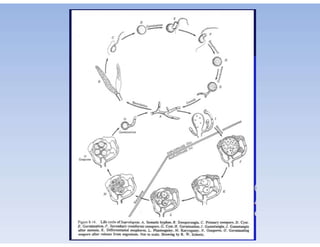
• Sexual reproduction is Oogamous.
• It is heterogamous and the male nuclei (=sperms) from
the antheridium are inserted into the eggs contained in
the oogonium .
• A swimming sperm is absent in the Oomycota.
• This type of sexual reproduction is referred to
as gametangial copulation.
• The eggs and sperms are products of meiosis and the
only parts of the life cycle that are haploid.
• Female gamete (oosphere) produced by an
oogonium
• Depending on taxon, there may be one to many
oospheres per oogonium
• Male gamete is produced by antheridium and
transferred to the oogonium by gametangial
contact and migration of male nuclei
• There are more than 500 species in the Oomycota.
These include the so-called water molds (e.g.
Saprolegnia) and downy mildews (e.g. Albugo).
• They are filamentous fungi which must absorb their
food from the surrounding water or soil, or may
invade the body of another organism to feed.
• As such, oomycetes play an important role in the
decomposition and recycling of decaying matter.
• Other parasitic species have caused much human
suffering through destruction of crops (e.g.
Phytophthora) and fish (e.g. Saprolegnia).
• Vegetative thallus filamentous, coenocytic, in some
groups unicellular
• Cell walls lacking chitin (except for a few taxa), made of
glucans & cellulose
• Asexual reproduction by biflagellate zoospores
• Sexual reproduction by oogonia (female) & antheridia
(male) - no motile gametes
• Sexual spore is the oospore
• Diploid life cycle
23. Oomycota.pdf
23. Oomycota.pdf

23. Oomycota.pdf

  • 1.
    (General Characteristics) By Hem Chander AssistantProfessor (Botany) Career Point University Hamirpur (HP) 176041 hemchander78@gmail.com
  • 2.
    • The divisionOomycota, unlike the Chytridiomycota, is a group of aquatic fungi that have cell walls composed of cellulose and a diploid dominant lifecycle (=gametic lifecycle). • The mycelium is coenocytic and produce septa only to • The mycelium is coenocytic and produce septa only to separate the reproductive structures from the assimilative portion of the thallus.
  • 3.
    • Asexual reproductionis by zoospores that are produced in zoosporangia. • The zoospores produced are biflagellated with one flagellum of the whiplash type and the other of the tinsel type. • Zoospores have flagella that are anisokont (unequal) • Zoospores have flagella that are anisokont (unequal) and heterokont (different) (straminipilous) • The anteriorly directed flagellum bears two rows of tubular tripartite hairs • The posteriorly directed flagellum is a whiplash type
  • 4.
    • Sexual reproductionis Oogamous. • It is heterogamous and the male nuclei (=sperms) from the antheridium are inserted into the eggs contained in the oogonium . • A swimming sperm is absent in the Oomycota. • A swimming sperm is absent in the Oomycota. • This type of sexual reproduction is referred to as gametangial copulation. • The eggs and sperms are products of meiosis and the only parts of the life cycle that are haploid.
  • 5.
    • Female gamete(oosphere) produced by an oogonium • Depending on taxon, there may be one to many oospheres per oogonium oospheres per oogonium • Male gamete is produced by antheridium and transferred to the oogonium by gametangial contact and migration of male nuclei
  • 6.
    • There aremore than 500 species in the Oomycota. These include the so-called water molds (e.g. Saprolegnia) and downy mildews (e.g. Albugo). • They are filamentous fungi which must absorb their food from the surrounding water or soil, or may invade the body of another organism to feed. invade the body of another organism to feed. • As such, oomycetes play an important role in the decomposition and recycling of decaying matter. • Other parasitic species have caused much human suffering through destruction of crops (e.g. Phytophthora) and fish (e.g. Saprolegnia).
  • 7.
    • Vegetative thallusfilamentous, coenocytic, in some groups unicellular • Cell walls lacking chitin (except for a few taxa), made of glucans & cellulose • Asexual reproduction by biflagellate zoospores • Asexual reproduction by biflagellate zoospores • Sexual reproduction by oogonia (female) & antheridia (male) - no motile gametes • Sexual spore is the oospore • Diploid life cycle