3
2
1
Powerpoint: Jean Aruel Pangilinan
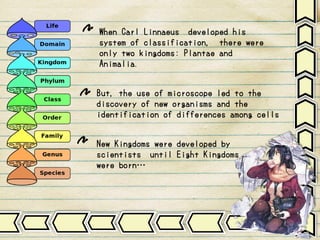
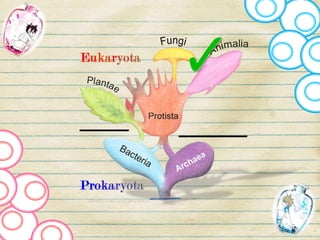
When Carl Linnaeus developed his
system of classification, there were
only two kingdoms: Plantae and
Animalia.
But, the use of microscope led to the
discovery of new organisms and the
identification of differences among cells
New Kingdoms were developed by
scientists until Eight Kingdoms
were born…
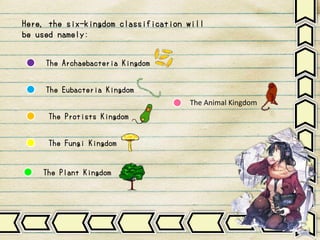
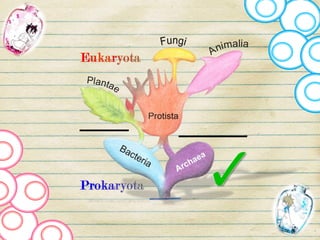
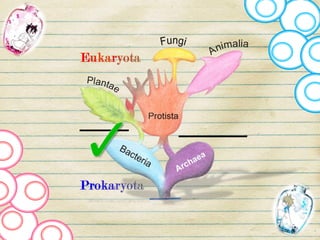
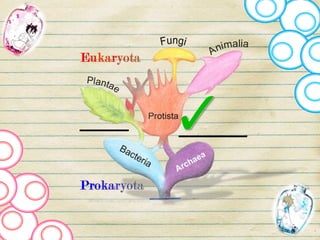
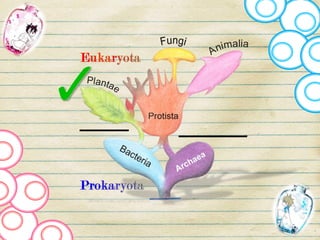
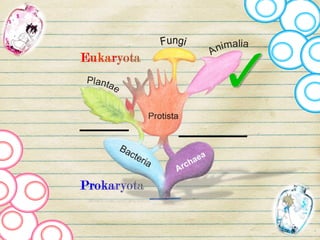
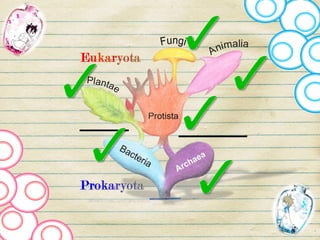
Here, the six-kingdom classification will
be used namely:
The Archaebacteria Kingdom
The Eubacteria Kingdom
The Protists Kingdom
The Fungi Kingdom
The Animal Kingdom
The Plant Kingdom
Buckle Up
Everyone!!!
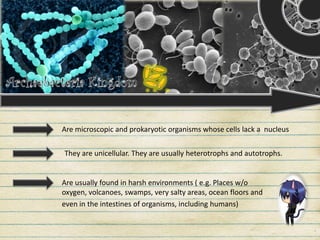
Are microscopic and prokaryotic organisms whose cells lack a nucleus
Are usually found in harsh environments ( e.g. Places w/o
oxygen, volcanoes, swamps, very salty areas, ocean floors and
even in the intestines of organisms, including humans)
They are unicellular. They are usually heterotrophs and autotrophs.
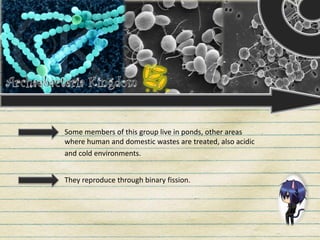
and cold environments.
Some members of this group live in ponds, other areas
where human and domestic wastes are treated, also acidic
They reproduce through binary fission.
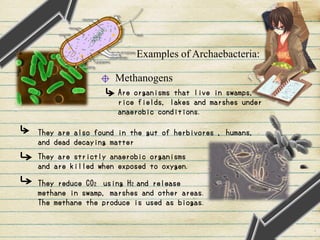
Examples of Archaebacteria:
Methanogens
Are organisms that live in swamps,
rice fields, lakes and marshes under
anaerobic conditions.
They are also found in the gut of herbivores , humans,
and dead decaying matter
They are strictly anaerobic organisms
and are killed when exposed to oxygen.
They reduce CO2 using H2 and release
methane in swamp, marshes and other areas.
The methane the produce is used as biogas.
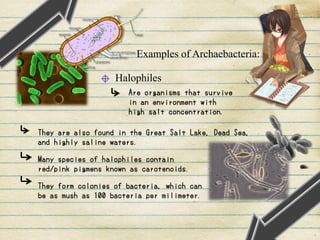
Examples of Archaebacteria:
Halophiles
Are organisms that survive
in an environment with
high salt concentration.
They are also found in the Great Salt Lake, Dead Sea,
and highly saline waters.
Many species of halophiles contain
red/pink pigmens known as carotenoids.
They form colonies of bacteria, which can
be as mush as 100 bacteria per milimeter.
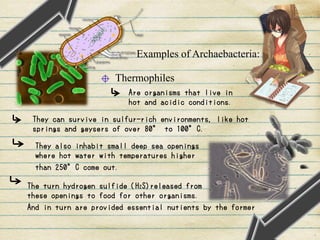
Examples of Archaebacteria:
Thermophiles
Are organisms that live in
hot and acidic conditions.
They can survive in sulfur-rich environments, like hot
springs and geysers of over 80° to 100°C.
They also inhabit small deep sea openings
where hot water with temperatures higher
than 250°C come out.
The turn hydrogen sulfide (H2S)released from
these openings to food for other organisms.
And in turn are provided essential nutients by the former
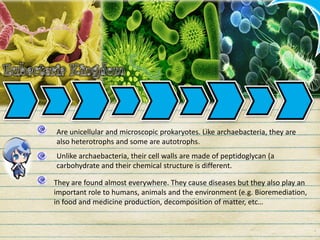
Are unicellular and microscopic prokaryotes. Like archaebacteria, they are
also heterotrophs and some are autotrophs.
Unlike archaebacteria, their cell walls are made of peptidoglycan (a
carbohydrate and their chemical structure is different.
They are found almost everywhere. They cause diseases but they also play an
important role to humans, animals and the environment (e.g. Bioremediation,
in food and medicine production, decomposition of matter, etc…
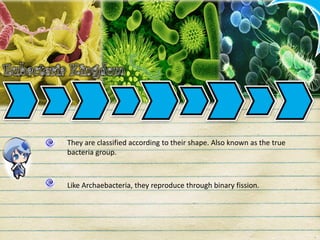
They are classified according to their shape. Also known as the true
bacteria group.
Like Archaebacteria, they reproduce through binary fission.
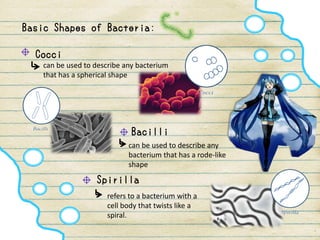
Basic Shapes of Bacteria:
Cocci
can be used to describe any bacterium
that has a spherical shape
Bacilli
can be used to describe any
bacterium that has a rode-like
shape
Spirilla
refers to a bacterium with a
cell body that twists like a
spiral.
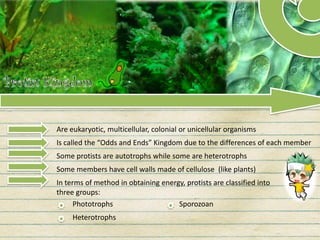
Are eukaryotic, multicellular, colonial or unicellular organisms
Is called the “Odds and Ends” Kingdom due to the differences of each member
Some members have cell walls made of cellulose (like plants)
In terms of method in obtaining energy, protists are classified into
three groups:
Some protists are autotrophs while some are heterotrophs
Phototrophs
Heterotrophs
Sporozoan
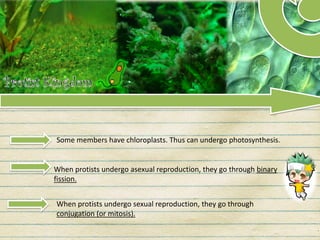
When protists undergo asexual reproduction, they go through binary
fission.
When protists undergo sexual reproduction, they go through
conjugation (or mitosis).
Some members have chloroplasts. Thus can undergo photosynthesis.
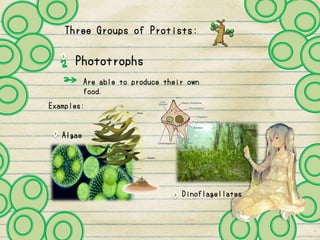
Three Groups of Protists:
Phototrophs
Are able to produce their own
food.
Examples:
Algae
Dinoflagellates
Three Groups of Protists:
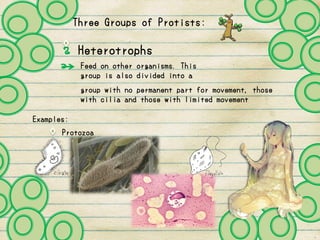
Heterotrophs
Feed on other organisms. This
group is also divided into a
Examples:
Protozoa
group with no permanent part for movement, those
with cilia and those with limited movement
Three Groups of Protists:
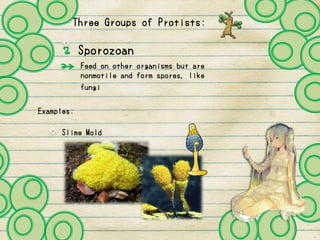
Sporozoan
Feed on other organisms but are
nonmotile and form spores, like
Examples:
Slime Mold
fungi
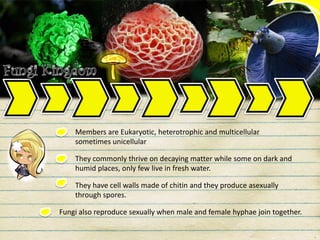
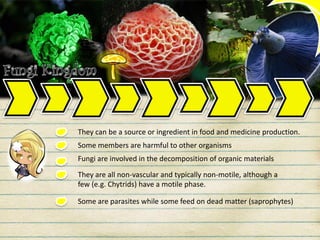
Members are Eukaryotic, heterotrophic and multicellular
sometimes unicellular
They commonly thrive on decaying matter while some on dark and
humid places, only few live in fresh water.
They have cell walls made of chitin and they produce asexually
through spores.
Fungi also reproduce sexually when male and female hyphae join together.
They can be a source or ingredient in food and medicine production.
Some members are harmful to other organisms
Fungi are involved in the decomposition of organic materials
They are all non-vascular and typically non-motile, although a
few (e.g. Chytrids) have a motile phase.
Some are parasites while some feed on dead matter (saprophytes)
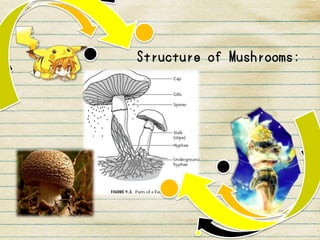
Structure of Mushrooms:
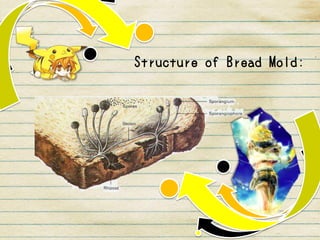
Structure of Bread Mold:
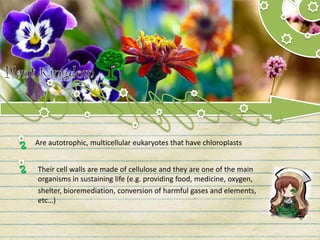
Are autotrophic, multicellular eukaryotes that have chloroplasts
Their cell walls are made of cellulose and they are one of the main
organisms in sustaining life (e.g. providing food, medicine, oxygen,
shelter, bioremediation, conversion of harmful gases and elements,
etc…)
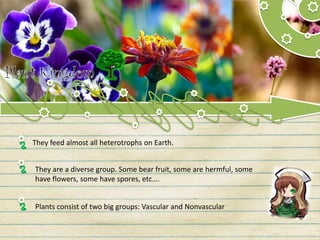
They feed almost all heterotrophs on Earth.
They are a diverse group. Some bear fruit, some are hermful, some
have flowers, some have spores, etc….
Plants consist of two big groups: Vascular and Nonvascular
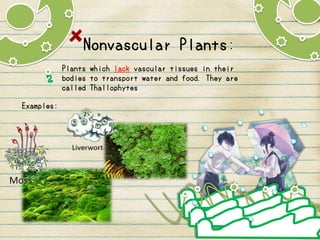
Nonvascular Plants
Plants which lack vascular tissues in their
bodies to transport water and food. They are
called Thallophytes
Examples:
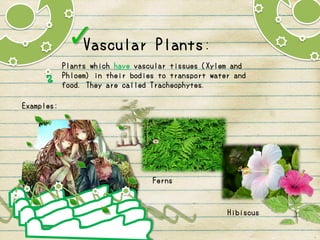
Vascular Plants
Plants which have vascular tissues (Xylem and
Phloem) in their bodies to transport water and
food. They are called Tracheophytes.
Examples:
Ferns
Hibiscus
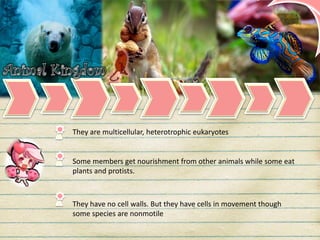
They are multicellular, heterotrophic eukaryotes
Some members get nourishment from other animals while some eat
plants and protists.
They have no cell walls. But they have cells in movement though
some species are nonmotile
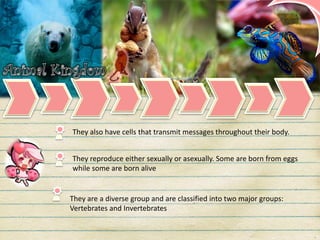
They also have cells that transmit messages throughout their body.
They reproduce either sexually or asexually. Some are born from eggs
while some are born alive
They are a diverse group and are classified into two major groups:
Vertebrates and Invertebrates
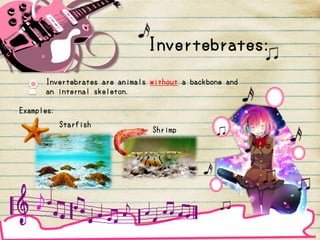
Invertebrates:
Invertebrates are animals without a backbone and
an internal skeleton.
Examples:
Starfish
Shrimp
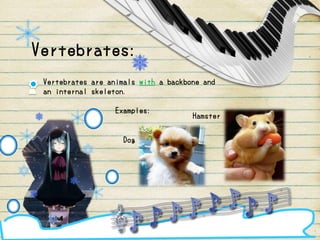
Vertebrates:
Vertebrates are animals with a backbone and
an internal skeleton.
Examples:
Dog
Hamster
That’s all!!!
Members:
Quote 4 today: “Someone’s
smile is made up from
one person’s smile”
-OSTER PROJECT-
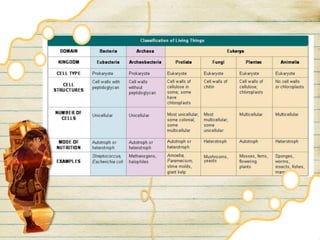
Classification of Life: Kingdom

Classification of Life: Kingdom

  • 1.
  • 2.
  • 3.
  • 4.
  • 5.
    When Carl Linnaeusdeveloped his system of classification, there were only two kingdoms: Plantae and Animalia. But, the use of microscope led to the discovery of new organisms and the identification of differences among cells New Kingdoms were developed by scientists until Eight Kingdoms were born…
  • 6.
    Here, the six-kingdomclassification will be used namely: The Archaebacteria Kingdom The Eubacteria Kingdom The Protists Kingdom The Fungi Kingdom The Animal Kingdom The Plant Kingdom
  • 7.
  • 9.
    Are microscopic andprokaryotic organisms whose cells lack a nucleus Are usually found in harsh environments ( e.g. Places w/o oxygen, volcanoes, swamps, very salty areas, ocean floors and even in the intestines of organisms, including humans) They are unicellular. They are usually heterotrophs and autotrophs.
  • 10.
    and cold environments. Somemembers of this group live in ponds, other areas where human and domestic wastes are treated, also acidic They reproduce through binary fission.
  • 11.
    Examples of Archaebacteria: Methanogens Areorganisms that live in swamps, rice fields, lakes and marshes under anaerobic conditions. They are also found in the gut of herbivores , humans, and dead decaying matter They are strictly anaerobic organisms and are killed when exposed to oxygen. They reduce CO2 using H2 and release methane in swamp, marshes and other areas. The methane the produce is used as biogas.
  • 12.
    Examples of Archaebacteria: Halophiles Areorganisms that survive in an environment with high salt concentration. They are also found in the Great Salt Lake, Dead Sea, and highly saline waters. Many species of halophiles contain red/pink pigmens known as carotenoids. They form colonies of bacteria, which can be as mush as 100 bacteria per milimeter.
  • 13.
    Examples of Archaebacteria: Thermophiles Areorganisms that live in hot and acidic conditions. They can survive in sulfur-rich environments, like hot springs and geysers of over 80° to 100°C. They also inhabit small deep sea openings where hot water with temperatures higher than 250°C come out. The turn hydrogen sulfide (H2S)released from these openings to food for other organisms. And in turn are provided essential nutients by the former
  • 15.
    Are unicellular andmicroscopic prokaryotes. Like archaebacteria, they are also heterotrophs and some are autotrophs. Unlike archaebacteria, their cell walls are made of peptidoglycan (a carbohydrate and their chemical structure is different. They are found almost everywhere. They cause diseases but they also play an important role to humans, animals and the environment (e.g. Bioremediation, in food and medicine production, decomposition of matter, etc…
  • 16.
    They are classifiedaccording to their shape. Also known as the true bacteria group. Like Archaebacteria, they reproduce through binary fission.
  • 17.
    Basic Shapes ofBacteria: Cocci can be used to describe any bacterium that has a spherical shape Bacilli can be used to describe any bacterium that has a rode-like shape Spirilla refers to a bacterium with a cell body that twists like a spiral.
  • 19.
    Are eukaryotic, multicellular,colonial or unicellular organisms Is called the “Odds and Ends” Kingdom due to the differences of each member Some members have cell walls made of cellulose (like plants) In terms of method in obtaining energy, protists are classified into three groups: Some protists are autotrophs while some are heterotrophs Phototrophs Heterotrophs Sporozoan
  • 20.
    When protists undergoasexual reproduction, they go through binary fission. When protists undergo sexual reproduction, they go through conjugation (or mitosis). Some members have chloroplasts. Thus can undergo photosynthesis.
  • 21.
    Three Groups ofProtists: Phototrophs Are able to produce their own food. Examples: Algae Dinoflagellates
  • 22.
    Three Groups ofProtists: Heterotrophs Feed on other organisms. This group is also divided into a Examples: Protozoa group with no permanent part for movement, those with cilia and those with limited movement
  • 23.
    Three Groups ofProtists: Sporozoan Feed on other organisms but are nonmotile and form spores, like Examples: Slime Mold fungi
  • 25.
    Members are Eukaryotic,heterotrophic and multicellular sometimes unicellular They commonly thrive on decaying matter while some on dark and humid places, only few live in fresh water. They have cell walls made of chitin and they produce asexually through spores. Fungi also reproduce sexually when male and female hyphae join together.
  • 26.
    They can bea source or ingredient in food and medicine production. Some members are harmful to other organisms Fungi are involved in the decomposition of organic materials They are all non-vascular and typically non-motile, although a few (e.g. Chytrids) have a motile phase. Some are parasites while some feed on dead matter (saprophytes)
  • 27.
  • 28.
  • 30.
    Are autotrophic, multicellulareukaryotes that have chloroplasts Their cell walls are made of cellulose and they are one of the main organisms in sustaining life (e.g. providing food, medicine, oxygen, shelter, bioremediation, conversion of harmful gases and elements, etc…)
  • 31.
    They feed almostall heterotrophs on Earth. They are a diverse group. Some bear fruit, some are hermful, some have flowers, some have spores, etc…. Plants consist of two big groups: Vascular and Nonvascular
  • 32.
    Nonvascular Plants Plants whichlack vascular tissues in their bodies to transport water and food. They are called Thallophytes Examples:
  • 33.
    Vascular Plants Plants whichhave vascular tissues (Xylem and Phloem) in their bodies to transport water and food. They are called Tracheophytes. Examples: Ferns Hibiscus
  • 35.
    They are multicellular,heterotrophic eukaryotes Some members get nourishment from other animals while some eat plants and protists. They have no cell walls. But they have cells in movement though some species are nonmotile
  • 36.
    They also havecells that transmit messages throughout their body. They reproduce either sexually or asexually. Some are born from eggs while some are born alive They are a diverse group and are classified into two major groups: Vertebrates and Invertebrates
  • 37.
    Invertebrates: Invertebrates are animalswithout a backbone and an internal skeleton. Examples: Starfish Shrimp
  • 38.
    Vertebrates: Vertebrates are animalswith a backbone and an internal skeleton. Examples: Dog Hamster
  • 41.
  • 42.
  • 43.
    Quote 4 today:“Someone’s smile is made up from one person’s smile” -OSTER PROJECT-