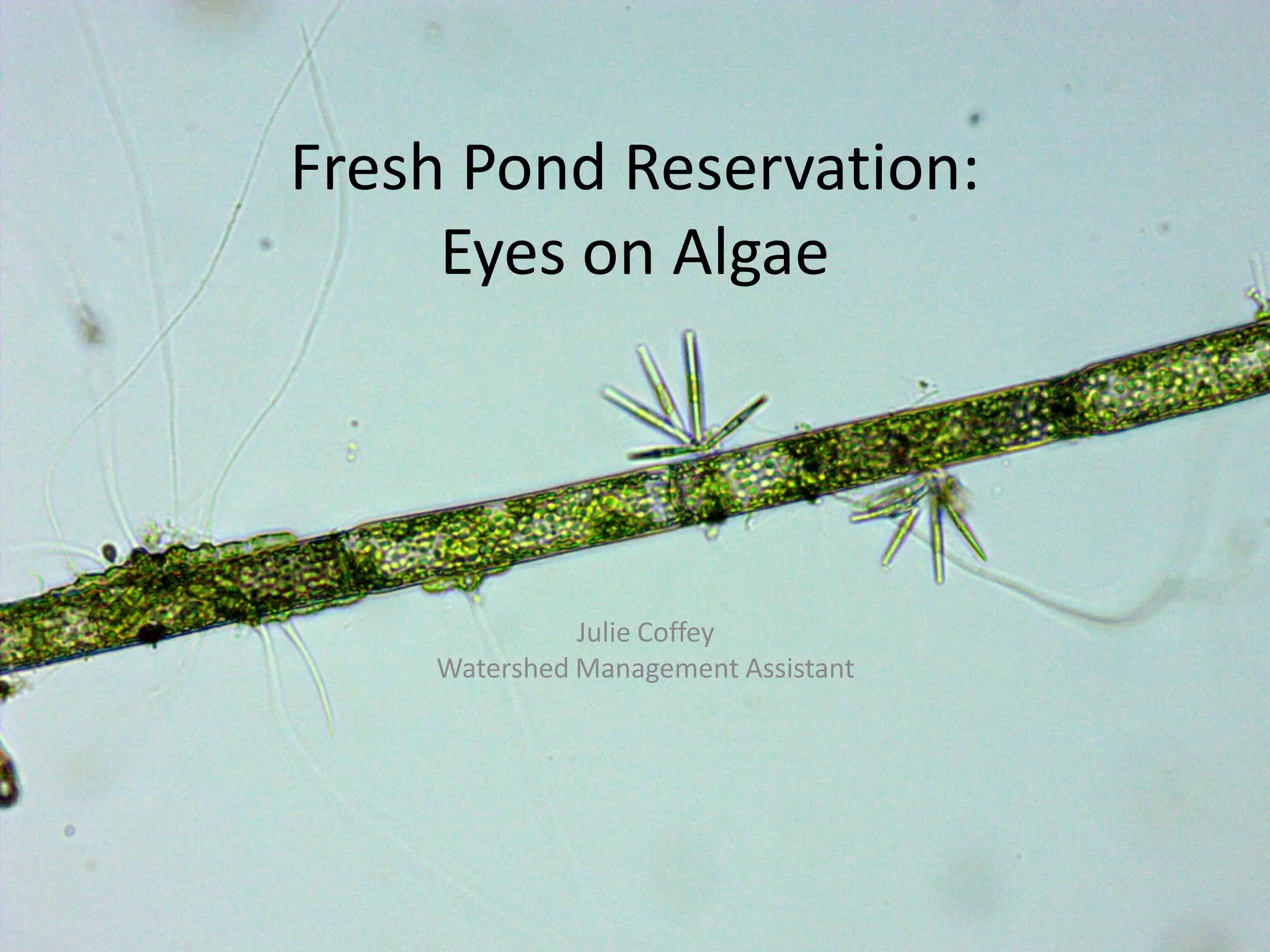
Fresh Pond Reservation:
Eyes on Algae
Julie Coffey
Watershed Management Assistant
Tonight’s objectives:
• Understand the importance of algae
• Learn how the Cambridge Water Department
is monitoring algae
• Discover some common genera of algae and
learn identifying features
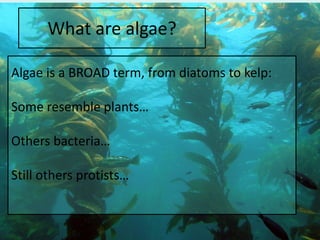
What are algae?
Algae is a BROAD term, from diatoms to kelp:
Some resemble plants…
Others bacteria…
Still others protists…
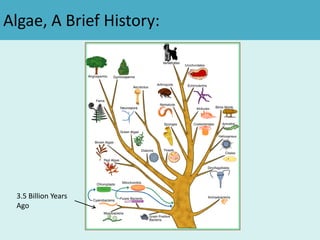
Algae, A Brief History:
3.5 Billion Years
Ago
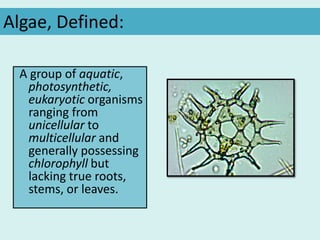
A group of aquatic,
photosynthetic,
eukaryotic organisms
ranging from
unicellular to
multicellular and
generally possessing
chlorophyll but
lacking true roots,
stems, or leaves.
Algae, Defined:
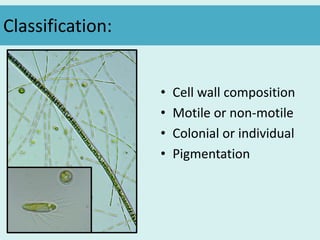
Classification:
• Cell wall composition
• Motile or non-motile
• Colonial or individual
• Pigmentation
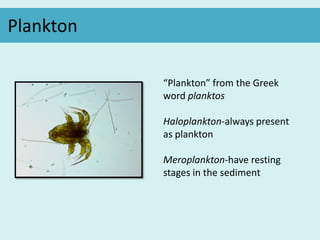
Plankton
“Plankton” from the Greek
word planktos
Haloplankton-always present
as plankton
Meroplankton-have resting
stages in the sediment
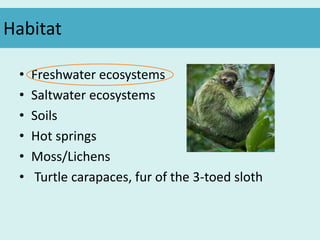
Habitat
• Freshwater ecosystems
• Saltwater ecosystems
• Soils
• Hot springs
• Moss/Lichens
• Turtle carapaces, fur of the 3-toed sloth
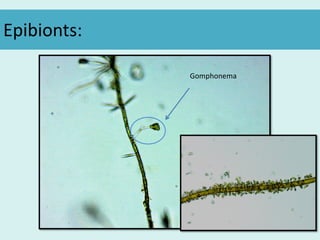
Epibionts:
Gomphonema
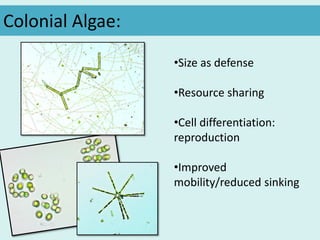
•Size as defense
•Resource sharing
•Cell differentiation:
reproduction
•Improved
mobility/reduced sinking
Colonial Algae:
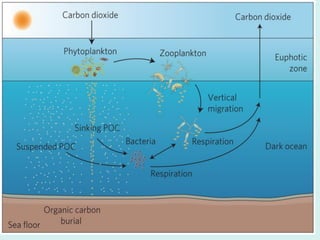
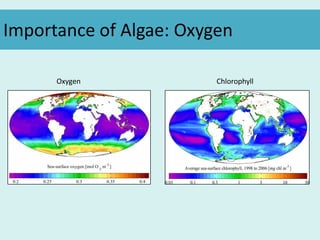
Importance of Algae: Oxygen
Oxygen Chlorophyll
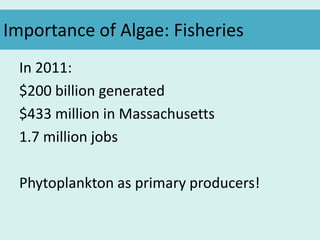
Importance of Algae: Fisheries
In 2011:
$200 billion generated
$433 million in Massachusetts
1.7 million jobs
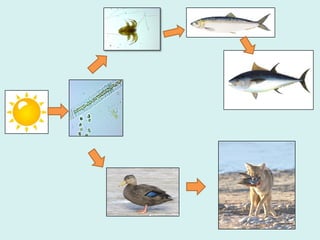
Phytoplankton as primary producers!
Importance of Algae: Fossil Fuels
Oceanic oil deposits
Biofuel potential
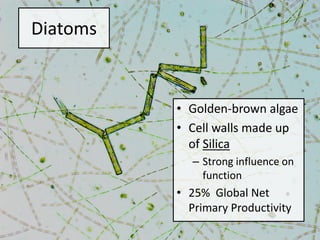
Diatoms
• Golden-brown algae
• Cell walls made up
of Silica
– Strong influence on
function
• 25% Global Net
Primary Productivity
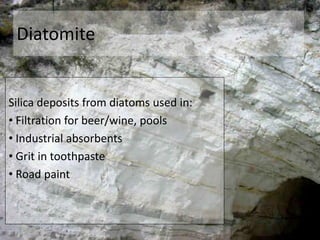
Diatomite
Silica deposits from diatoms used in:
• Filtration for beer/wine, pools
• Industrial absorbents
• Grit in toothpaste
• Road paint
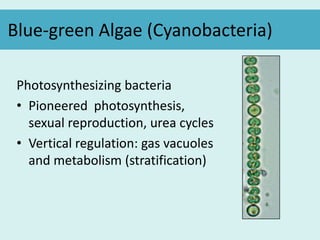
Blue-green Algae (Cyanobacteria)
Photosynthesizing bacteria
• Pioneered photosynthesis,
sexual reproduction, urea cycles
• Vertical regulation: gas vacuoles
and metabolism (stratification)
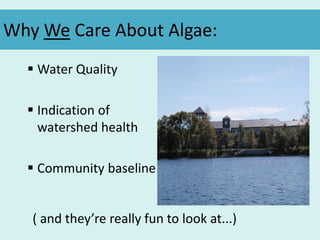
Why We Care About Algae:
ď‚§ Water Quality
ď‚§ Indication of
watershed health
ď‚§ Community baseline
( and they’re really fun to look at...)
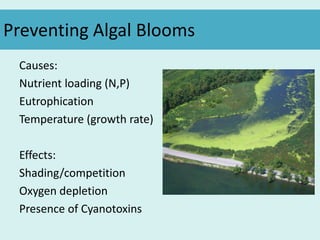
Preventing Algal Blooms
Causes:
Nutrient loading (N,P)
Eutrophication
Temperature (growth rate)
Effects:
Shading/competition
Oxygen depletion
Presence of Cyanotoxins
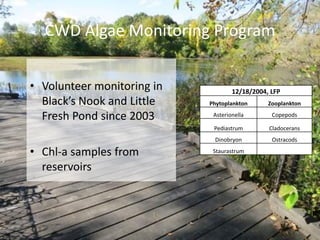
CWD Algae Monitoring Program
• Volunteer monitoring in
Black’s Nook and Little
Fresh Pond since 2003
• Chl-a samples from
reservoirs
12/18/2004, LFP
Phytoplankton Zooplankton
Asterionella Copepods
Pediastrum Cladocerans
Dinobryon Ostracods
Staurastrum
CWD Algae Program Goals
Weekly reservoir monitoring
–Identify and quantify populations
Continue reservation monitoring
–Analyze historical data for trends
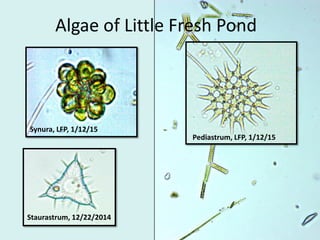
Algae of Little Fresh Pond
Pediastrum, LFP, 1/12/15
Synura, LFP, 1/12/15
Staurastrum, 12/22/2014
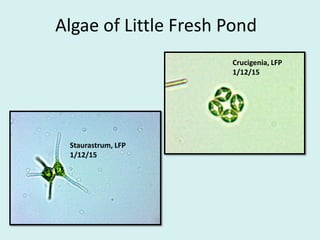
Staurastrum, LFP
1/12/15
Crucigenia, LFP
1/12/15
Algae of Little Fresh Pond
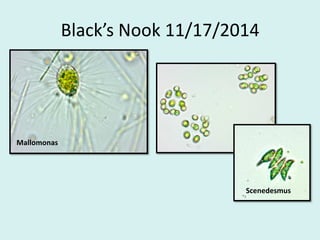
Black’s Nook 11/17/2014
Scenedesmus
Mallomonas
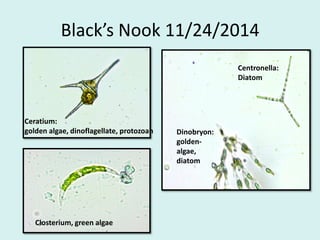
Black’s Nook 11/24/2014
Ceratium:
golden algae, dinoflagellate, protozoan
Closterium, green algae
Centronella:
Diatom
Dinobryon:
golden-
algae,
diatom
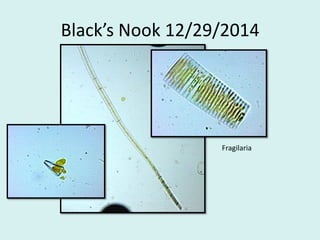
Black’s Nook 12/29/2014
Fragilaria
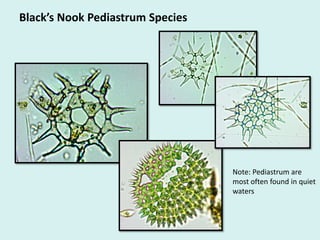
Black’s Nook Pediastrum Species
Note: Pediastrum are
most often found in quiet
waters
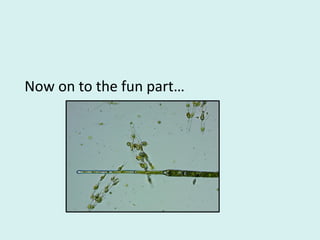
Now on to the fun part…
Additional Resources
Glossary of algal terms: http://westerndiatoms.colorado.edu/glossary
Algae pictures for ID: http://www.keweenawalgae.mtu.edu/
Detailed species descriptions: http://algaebase.org/search/genus/
Credits:
Kelp-http://www.geog.ucsb.edu/events/department-news/983/paper-by-libe-washburn-selected-as-an-agu-research-spotlight/
Sloth-https://animalartsdesignstudio.wordpress.com/2013/09/19/biomimicry-and-the-sloth/
Diatomite-http://pubs.usgs.gov/fs/2006/3044/fs-2006-3044.pdf, http://elkorose.schopine.com/vivian.html
Black duck-http://bna.birds.cornell.edu/bna/species/481/galleries/photos/RNB_American-Black-Duck-0007
Coyote-http://featheredphotography.com/blog/wp-content/uploads/2012/12/coyote-8829-ron-dudley.jpg
O2 production-https://scripps.ucsd.edu/biblio/algae-worlds-most-important-plants-introduction
Tree of life http://www.encognitive.com/node/10795
Cycle-Microbial control of the dark end of the biological pump, Herndl, G; Reinthaler,T
Herring: "Clupea harengus Gervais.flipped" by Gervais et Boulart, 1877 - flipped version of File:Clupea harengus Gervais.jpg - Les poissons Gervais,
H.. Licensed under Public Domain via Wikimedia Commons -
http://commons.wikimedia.org/wiki/File:Clupea_harengus_Gervais.flipped.jpg#mediaviewer/File:Clupea_harengus_Gervais.flipped.jpg
Bloom-http://www.clf.org/blog/tag/nutrient-pollution/
Algae age-http://www.ucmp.berkeley.edu/bacteria/cyanofr.html
Algal maps:http://askabiologist.asu.edu/explore/plankton, world ocean atlas via wikipedia

Algae Presentation

  • 1.
    Fresh Pond Reservation: Eyeson Algae Julie Coffey Watershed Management Assistant
  • 2.
    Tonight’s objectives: • Understandthe importance of algae • Learn how the Cambridge Water Department is monitoring algae • Discover some common genera of algae and learn identifying features
  • 3.
    What are algae? Algaeis a BROAD term, from diatoms to kelp: Some resemble plants… Others bacteria… Still others protists…
  • 4.
    Algae, A BriefHistory: 3.5 Billion Years Ago
  • 5.
    A group ofaquatic, photosynthetic, eukaryotic organisms ranging from unicellular to multicellular and generally possessing chlorophyll but lacking true roots, stems, or leaves. Algae, Defined:
  • 6.
    Classification: • Cell wallcomposition • Motile or non-motile • Colonial or individual • Pigmentation
  • 7.
    Plankton “Plankton” from theGreek word planktos Haloplankton-always present as plankton Meroplankton-have resting stages in the sediment
  • 8.
    Habitat • Freshwater ecosystems •Saltwater ecosystems • Soils • Hot springs • Moss/Lichens • Turtle carapaces, fur of the 3-toed sloth
  • 10.
  • 11.
    •Size as defense •Resourcesharing •Cell differentiation: reproduction •Improved mobility/reduced sinking Colonial Algae:
  • 12.
    Importance of Algae:Oxygen Oxygen Chlorophyll
  • 13.
    Importance of Algae:Fisheries In 2011: $200 billion generated $433 million in Massachusetts 1.7 million jobs Phytoplankton as primary producers!
  • 16.
    Importance of Algae:Fossil Fuels Oceanic oil deposits Biofuel potential
  • 17.
    Diatoms • Golden-brown algae •Cell walls made up of Silica – Strong influence on function • 25% Global Net Primary Productivity
  • 18.
    Diatomite Silica deposits fromdiatoms used in: • Filtration for beer/wine, pools • Industrial absorbents • Grit in toothpaste • Road paint
  • 19.
    Blue-green Algae (Cyanobacteria) Photosynthesizingbacteria • Pioneered photosynthesis, sexual reproduction, urea cycles • Vertical regulation: gas vacuoles and metabolism (stratification)
  • 20.
    Why We CareAbout Algae:  Water Quality  Indication of watershed health  Community baseline ( and they’re really fun to look at...)
  • 21.
    Preventing Algal Blooms Causes: Nutrientloading (N,P) Eutrophication Temperature (growth rate) Effects: Shading/competition Oxygen depletion Presence of Cyanotoxins
  • 22.
    CWD Algae MonitoringProgram • Volunteer monitoring in Black’s Nook and Little Fresh Pond since 2003 • Chl-a samples from reservoirs 12/18/2004, LFP Phytoplankton Zooplankton Asterionella Copepods Pediastrum Cladocerans Dinobryon Ostracods Staurastrum
  • 23.
    CWD Algae ProgramGoals Weekly reservoir monitoring –Identify and quantify populations Continue reservation monitoring –Analyze historical data for trends
  • 24.
    Algae of LittleFresh Pond Pediastrum, LFP, 1/12/15 Synura, LFP, 1/12/15 Staurastrum, 12/22/2014
  • 25.
  • 26.
  • 27.
    Black’s Nook 11/24/2014 Ceratium: goldenalgae, dinoflagellate, protozoan Closterium, green algae Centronella: Diatom Dinobryon: golden- algae, diatom
  • 28.
  • 29.
    Black’s Nook PediastrumSpecies Note: Pediastrum are most often found in quiet waters
  • 30.
    Now on tothe fun part…
  • 31.
    Additional Resources Glossary ofalgal terms: http://westerndiatoms.colorado.edu/glossary Algae pictures for ID: http://www.keweenawalgae.mtu.edu/ Detailed species descriptions: http://algaebase.org/search/genus/ Credits: Kelp-http://www.geog.ucsb.edu/events/department-news/983/paper-by-libe-washburn-selected-as-an-agu-research-spotlight/ Sloth-https://animalartsdesignstudio.wordpress.com/2013/09/19/biomimicry-and-the-sloth/ Diatomite-http://pubs.usgs.gov/fs/2006/3044/fs-2006-3044.pdf, http://elkorose.schopine.com/vivian.html Black duck-http://bna.birds.cornell.edu/bna/species/481/galleries/photos/RNB_American-Black-Duck-0007 Coyote-http://featheredphotography.com/blog/wp-content/uploads/2012/12/coyote-8829-ron-dudley.jpg O2 production-https://scripps.ucsd.edu/biblio/algae-worlds-most-important-plants-introduction Tree of life http://www.encognitive.com/node/10795 Cycle-Microbial control of the dark end of the biological pump, Herndl, G; Reinthaler,T Herring: "Clupea harengus Gervais.flipped" by Gervais et Boulart, 1877 - flipped version of File:Clupea harengus Gervais.jpg - Les poissons Gervais, H.. Licensed under Public Domain via Wikimedia Commons - http://commons.wikimedia.org/wiki/File:Clupea_harengus_Gervais.flipped.jpg#mediaviewer/File:Clupea_harengus_Gervais.flipped.jpg Bloom-http://www.clf.org/blog/tag/nutrient-pollution/ Algae age-http://www.ucmp.berkeley.edu/bacteria/cyanofr.html Algal maps:http://askabiologist.asu.edu/explore/plankton, world ocean atlas via wikipedia