Phylum Dinophyta
Dinoflagellates
Presented by:
Fasama Hilton Kollie
Lecturer, Department of Biology
Mother Patern College of Health Sciences February 25, 2019
∗ Overview of the phylum Dinophyta
∗ Characteristic of dinoflagellates
∗ Other Forms of life
∗ Algae bloom
∗ Biolumenescence
Lesson Outline
• Upon completion of this lesson, students will be able to;
1. Define the term Dinoflagellates
2. Describe the basic life processes of organism in the phylum
Dinophyta
3. Identify other live forms relevant to the study of dinoflagellates
4. Identify some ecological and economic importance of
dinoflagellates
Lesson Objectives
What are Dinoflagellates?
• Unicellular aquatic organisms bearing two dissimilar flagella and having
characteristics of both plants and animals
• From Greek dinos, meaning “whirling” and Latin flagellum "whip, scourge“
• Botanist treated them as a division of algae, named Pyrrophyta after the
bioluminescent forms
Overview of The Phylum Dinophyta
• Chlorophyll a, c and carotenoid
• Consist of 130 genera and appx. 3,000
living dinoflagellate species
• Examples include; Gonyaulax, Kerenia,
Noctiluca, Lingulodinium, Oxyrrhis,
Alexandriu, Dinopysis etc
• Many are microscopic and range from
15 – 40 microns in size
Overview Cont’d…
Noctiluca scintillans
Dinoflagellates Examples:
• 90% of all dinoflagellates are marine planktons
Characteristics: Habitat
• They are found dispersed in all
oceans and all ocean zones
• They exist in pelagic or benthic
zones or within host tissues.
Oceanic Zones:
• Each dinoflagellate has its own characteristic
shape
• Dinoflagellates have a complex cell covering
called an Amphiesma, composed of flattened
vesicles, called alveoli
• In most dinoflagellates, this covering
consists of cellulose plates referred to as
“armor” - THECA
• Other are “naked”
Characteristics: Structure
Dinoflagellate Structure
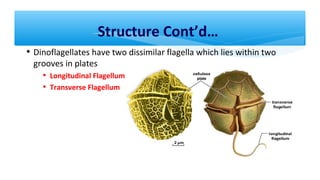
• Dinoflagellates have two dissimilar flagella which lies within two
grooves in plates
• Longitudinal Flagellum  
• Transverse Flagellum
Structure Cont’d…
• The cytoplasm of dinoflagellates contains typical eukaryotic organelles
• Dinoflagellates may also contain
one or several distinctive
organelles;
• Vacuole
• Pusule
• Cytostome
• Ocellus
• Dinokaryon
• Pyrenoid
• Plastids
Structure Cont’d…
Chloroplasts:
• Bound by three membranes and
contain chlorophyll a and c and
fucoxanthin, as well as other
accessory pigments
• Few have chloroplasts with
different pigmentation and
structure
Structure Cont’d…
• Locomote by two separate flagella;
longitudinal and transverse flagellum
• Flagella enable them to move in a lateral
circle around the equator of the organism
• In many forms, these are set into grooves
called the sulcus and cingulum
Characteristic: Locomotion
Representation of Dinoflagellates:
• Three nutritional strategies are seen in dinoglagellates;
• Phototrophy, Mixotrophy and Heterotrophy
• About half of all dinoflagellates species are photosynthetic or mixotrophic
• Some are predators and feed on bacteria, phytoplankton and smaller
dinoflagellates
• Some species establish symbiotic relationship with some invertebrates.
• Eg; zooxanthellae
Characteristic: Nutrition
• Zooxanthellae are endosymbionts of marine animals and protozoa
Zooxanthellae:
• Algae in the coral polyp produce
O2 and organic products for the
polyp
• Coral polyps produce CO2 for
the algae and it provides
protection in return
Anatomy of a
Coral Polyp
• Gas exchange occurs
directly through their cell
wall
• Amphiesma vesicle
Characteristic: Respiration
• Dinoflagellates are able to get rid of waste by the tiny holes that are
found in the cell wall
Characteristic: Excretion
• Dinoflagellates essentially have two means of reproduction
• Sexual division
• Asexual division
• Most are haploid and reproduce primarily by asexual cell division
(mitosis)
• This results in two identical copies of the dinoflagellate
Reproduction
• Sexual reproduction also occurs through fusion of two
individuals to form a zygote
• May remain mobile in typical dinoflagellate form
• May form a resting cyst, which later undergoes meiosis
to produce new haploid cells
Reproduction Cont’d…
• Dinoflagellates Bloom (Red tide)
• Saxitoxin
• Bioluminescence
Other Features of Dinoflagellates
• The rapid increase in the population of dinoflagellate in fresh water or
marine water system
• This is recognized by the discoloration in the water from their pigments
• Dinoflagellates cause a strange phenomenon called “Red Tide”
• Some dinoflagellates produce neurotoxins (Saxitoxin) harmful to marine
life
Dinoflagellate Blooms
Why should we humans be careful so much about dinoflagellates?
• The marine animals that feed on dinoflagellates consume the neurotoxins,
which can result in massive death in fish, shellfish, and any other marine life.
Dinoflagellate Blooms Cont’d…
• The emission of light by a living organism as a result
of a chemical reaction
• Enzyme-catalyzed reaction
• It’s an enzyme-mediated reaction
• Most marine light-emission is in the blue and green
light spectrum
• Eg: Dinoflagellates, angler fish and others
• Non-marine bioluminescence is less widely
distributed
• The two best-known forms of land
bioluminescence are fireflies and glow worms
Bioluminescence
Fig 1.1 Photinus
pyralis
Mechanism of Bioluminescence
In bioluminescence, a
luciferin produces light, and a
luciferase allows the light-
producing chemical reaction
to take place
In this reaction, the
luciferace acts as a catalyst
Mechanism of Bioluminescence Cont’d…
luciferase allows oxygen
to combine with the
luciferin
This reaction produces
photons of light…
BIOLUMINESCENCE CAUSED BY DINOFLAGELLATES
Vadhoo Island, Maldives
1. Dinoflagellate bioluminescence is also thought to act as a “burglar alarm” to
attract a secondary predator that threatens to eat the primary predator
2. Attracting mates
3. Communication
Function of Bioluminscence
Review Questions
1. What are dinoflagellates?
2. What is bioluminescence?
3. What is algae bloom?
4. Briefly describe dinoflagellates
Reference
• Nabors, Murray W., INTRODUCTION TO BOTANY. Copyright 2004 Pearson
Education, Inc., publishing as Benjamin Cummings, 1301 Sansome St., San
Francisco, CA 94111. www.aw-bc.com
• Ucsb Scienceline
http://www.scienceline.ucsb.edu/getkey.php?key=3231
Thank You
“The mark of a great man is one who knows when to set aside
the important things in order to accomplish the vital ones."
Brandon Sanderson

Phylum Dinophyta (Dinoflagellates)

  • 1.
    Phylum Dinophyta Dinoflagellates Presented by: FasamaHilton Kollie Lecturer, Department of Biology Mother Patern College of Health Sciences February 25, 2019
  • 2.
    ∗ Overview ofthe phylum Dinophyta ∗ Characteristic of dinoflagellates ∗ Other Forms of life ∗ Algae bloom ∗ Biolumenescence Lesson Outline
  • 3.
    • Upon completionof this lesson, students will be able to; 1. Define the term Dinoflagellates 2. Describe the basic life processes of organism in the phylum Dinophyta 3. Identify other live forms relevant to the study of dinoflagellates 4. Identify some ecological and economic importance of dinoflagellates Lesson Objectives
  • 4.
  • 5.
    • Unicellular aquaticorganisms bearing two dissimilar flagella and having characteristics of both plants and animals • From Greek dinos, meaning “whirling” and Latin flagellum "whip, scourge“ • Botanist treated them as a division of algae, named Pyrrophyta after the bioluminescent forms Overview of The Phylum Dinophyta
  • 6.
    • Chlorophyll a,c and carotenoid • Consist of 130 genera and appx. 3,000 living dinoflagellate species • Examples include; Gonyaulax, Kerenia, Noctiluca, Lingulodinium, Oxyrrhis, Alexandriu, Dinopysis etc • Many are microscopic and range from 15 – 40 microns in size Overview Cont’d… Noctiluca scintillans
  • 7.
  • 8.
    • 90% ofall dinoflagellates are marine planktons Characteristics: Habitat • They are found dispersed in all oceans and all ocean zones • They exist in pelagic or benthic zones or within host tissues.
  • 9.
  • 11.
    • Each dinoflagellatehas its own characteristic shape • Dinoflagellates have a complex cell covering called an Amphiesma, composed of flattened vesicles, called alveoli • In most dinoflagellates, this covering consists of cellulose plates referred to as “armor” - THECA • Other are “naked” Characteristics: Structure
  • 12.
  • 13.
    • Dinoflagellates havetwo dissimilar flagella which lies within two grooves in plates • Longitudinal Flagellum   • Transverse Flagellum Structure Cont’d…
  • 14.
    • The cytoplasmof dinoflagellates contains typical eukaryotic organelles • Dinoflagellates may also contain one or several distinctive organelles; • Vacuole • Pusule • Cytostome • Ocellus • Dinokaryon • Pyrenoid • Plastids Structure Cont’d…
  • 15.
    Chloroplasts: • Bound bythree membranes and contain chlorophyll a and c and fucoxanthin, as well as other accessory pigments • Few have chloroplasts with different pigmentation and structure Structure Cont’d…
  • 16.
    • Locomote bytwo separate flagella; longitudinal and transverse flagellum • Flagella enable them to move in a lateral circle around the equator of the organism • In many forms, these are set into grooves called the sulcus and cingulum Characteristic: Locomotion
  • 17.
  • 18.
    • Three nutritionalstrategies are seen in dinoglagellates; • Phototrophy, Mixotrophy and Heterotrophy • About half of all dinoflagellates species are photosynthetic or mixotrophic • Some are predators and feed on bacteria, phytoplankton and smaller dinoflagellates • Some species establish symbiotic relationship with some invertebrates. • Eg; zooxanthellae Characteristic: Nutrition
  • 19.
    • Zooxanthellae are endosymbionts of marine animals and protozoa Zooxanthellae: • Algaein the coral polyp produce O2 and organic products for the polyp • Coral polyps produce CO2 for the algae and it provides protection in return
  • 20.
  • 21.
    • Gas exchangeoccurs directly through their cell wall • Amphiesma vesicle Characteristic: Respiration
  • 22.
    • Dinoflagellates areable to get rid of waste by the tiny holes that are found in the cell wall Characteristic: Excretion
  • 23.
    • Dinoflagellates essentiallyhave two means of reproduction • Sexual division • Asexual division • Most are haploid and reproduce primarily by asexual cell division (mitosis) • This results in two identical copies of the dinoflagellate Reproduction
  • 24.
    • Sexual reproductionalso occurs through fusion of two individuals to form a zygote • May remain mobile in typical dinoflagellate form • May form a resting cyst, which later undergoes meiosis to produce new haploid cells Reproduction Cont’d…
  • 25.
    • Dinoflagellates Bloom(Red tide) • Saxitoxin • Bioluminescence Other Features of Dinoflagellates
  • 26.
    • The rapidincrease in the population of dinoflagellate in fresh water or marine water system • This is recognized by the discoloration in the water from their pigments • Dinoflagellates cause a strange phenomenon called “Red Tide” • Some dinoflagellates produce neurotoxins (Saxitoxin) harmful to marine life Dinoflagellate Blooms Why should we humans be careful so much about dinoflagellates?
  • 28.
    • The marineanimals that feed on dinoflagellates consume the neurotoxins, which can result in massive death in fish, shellfish, and any other marine life. Dinoflagellate Blooms Cont’d…
  • 30.
    • The emissionof light by a living organism as a result of a chemical reaction • Enzyme-catalyzed reaction • It’s an enzyme-mediated reaction • Most marine light-emission is in the blue and green light spectrum • Eg: Dinoflagellates, angler fish and others • Non-marine bioluminescence is less widely distributed • The two best-known forms of land bioluminescence are fireflies and glow worms Bioluminescence Fig 1.1 Photinus pyralis
  • 31.
    Mechanism of Bioluminescence Inbioluminescence, a luciferin produces light, and a luciferase allows the light- producing chemical reaction to take place In this reaction, the luciferace acts as a catalyst
  • 32.
    Mechanism of BioluminescenceCont’d… luciferase allows oxygen to combine with the luciferin This reaction produces photons of light…
  • 33.
    BIOLUMINESCENCE CAUSED BYDINOFLAGELLATES Vadhoo Island, Maldives
  • 39.
    1. Dinoflagellate bioluminescenceis also thought to act as a “burglar alarm” to attract a secondary predator that threatens to eat the primary predator 2. Attracting mates 3. Communication Function of Bioluminscence
  • 40.
    Review Questions 1. Whatare dinoflagellates? 2. What is bioluminescence? 3. What is algae bloom? 4. Briefly describe dinoflagellates
  • 41.
    Reference • Nabors, MurrayW., INTRODUCTION TO BOTANY. Copyright 2004 Pearson Education, Inc., publishing as Benjamin Cummings, 1301 Sansome St., San Francisco, CA 94111. www.aw-bc.com • Ucsb Scienceline http://www.scienceline.ucsb.edu/getkey.php?key=3231
  • 42.
    Thank You “The markof a great man is one who knows when to set aside the important things in order to accomplish the vital ones." Brandon Sanderson

Editor's Notes

  • #6 Single cell eukaryotic organisms of aquatic ecosystem with two dissimilar flagella Important component of marine and freshwater phytoplankton They have characteristics of both Animals and plants CHARACTERISTICS: Plant - possess chloroplast for photosynthesis Animals – flagellated Whirling: Rotation [characterized by rapid movement round and round] Whip: beat PYRROPHYTA: A division or other category of algae comprising yellowish-green to golden-brown algae that are mostly unicellular and biflagellate, that form starch, starchy compounds, or oil as food reserves, and that include the dinoflagellates and cryptomonads Pyrrophyta (from the Greek pyrrhos, meaning flames, and phyton, meaning plant)
  • #7 About 130 genera Approximately 3,000 extant species Second most largest unicellular division with many species after Bacillariophyta, 5,600 Largest; Chlorophyta 7,500 The largest, Noctiluca, can be up to 2mm in diameter
  • #9 Pelagic- inhabiting the upper layers of the open sea. Benthic zone - the ecological region at the lowest level of a body of water such as an ocean, lake, or stream, including the sediment surface and some sub-surface layers.
  • #10 Pelagic: [Euphotic/Limnetic zone] It is the volume of water where the rate of photosynthesis is greater than the rate of respiration by phytoplankton Epipelagic Mesopelagic Bathypelagic Abyssolpelagic Aphotic zone: aphotic, zone is the region of perpetual darkness that lies beneath the photic zone and includes most of the ocean waters.
  • #12 Dinoflagellates show different sized and shapes depending on the species involves. Shapes is determined by the hard cellulose plate located in vesicles beneath the plasma membrane Dinoflagellates are surrounded by a complex covering called the amphiesma [Cortex] consists of outer and inner continuous membranes, and between which lie a series of flattened vesicles [alveoli/amphiesma vesicle] In armored forms, these vesicles contain the thecal plates [THECA] Athecate
  • #13 Epitheca : the outer or upper half Hypotheca: Lower half Cingulum A type of groove encircling the theca of dinoflagellates Transverse groove Sulcus a groove or furrow
  • #15 Pusule Specialized vacuole for osmoregulation Organelle of variable complexity which may be regarded as a specialized vacuole, opening through the cell surface usually in the flagellar area. Widely considered to be an osmoregulatory or buoyancy-regulating organelle. Only found in dinoflagellates. Ocellus: another term for eyespot
  • #16 Fucoxanthin: golden brown color Most photosynthetic species contain chlorophylls a and c, the carotenoid beta-carotene, and a group of xanthophylls that appears to be unique to dinoflagellates, typically peridinin, dinoxanthin, and diadinoxanthin.
  • #17 Groove is a long, narrow cut or depression, especially one made to guide motion or receive a corresponding ridge. Longitudinal groove/ depression – Sulcus Transverse groove – Cingulum
  • #18 Transverse flagellum is responsible for rotation/ spinning whiles moving Longitudinal flagellum is responsible for forward motion
  • #19 Mixotrophic or heterotrophic dinogflagellates absorb dissolved organic molecules or ingest food particles
  • #20 A yellowish-brown symbiotic dinoflagellate present in large numbers in the cytoplasm of many marine invertebrates. Tiny plant-like organisms called zooxanthellae live in the tissues of many animals, including some corals, anemones, and jellyfish, sponges, flatworms, mollusks and foraminifera. These microscopic algae capture sunlight and convert it into energy, just like plants, to provide essential nutrients to the corals. In exchange, they have a place to live inside the animal's body. But when the zooxanthellae are under stress, such as high temperatures, they will die or leave their host—a process known as bleaching.
  • #27 An algal bloom or algae bloom is a rapid increase or accumulation in the population of algae in freshwater or marine water systems, and is recognized by the discoloration in the water from their pigments What causes algae bloom: Excess amount of nutrients (particularly phosphorus and nitrate, ammonia, urea, nitrate ion, iron, silica, carbon) into waters and higher concentrations of these nutrients in water cause increased growth of algae and green plants Red tide is a term often used synonymously with HABs in marine coastal areas; however, the term is misleading since algal blooms can widely vary in color, and growth of algae is unrelated to the tides. The term algal bloom or harmful algal bloom has since replaced red tide as the appropriate description of this phenomenon. Red tide is associated with the dinoflagellates called - Karenia brevis NOT ALL ALGE BLOOM ARE HARMFUL Harmful Algae Bloom [HABs]: Harmful algal blooms (HABs) occur when colonies of algae—simple plants that live in the sea and freshwater—grow out of control while producing toxic or harmful effects on people, fish, shellfish, marine mammals, and birds. Harmful Algae Blooms: Is an uncontrollable increased in the amount of algae that cause negative impacts to other organisms via production natural toxins, mechanical damage or by other means. Effect of HABS: Leads to fish die Cities cutting off water or residents Lack of fisheries Lack of nature water ecosystem/polluction A bloom can block out the sunlight from other organisms, thus depleting oxygen levels in the water Poison secretion into the water [Saxitoxin]
  • #29 Saxitoxin: Saxitoxin (STX) is a potent neurotoxin and the best-known paralytic shellfish toxin (PST). Ingestion of saxitoxin by humans, usually by consumption of shellfish contaminated by toxic algal blooms, is responsible for the illness known as paralytic shellfish poisoning (PSP). What is PSP ? Paralytic shellfish poisoning (PSP) is a disease caused by eating shellfish containing paralytic shellfish toxins. Paralytic shellfish toxins are produced by some naturally occurring algae. Algae are consumed by shellfish including mussels, oysters, clams, pipis, scallops, abalone, rock lobster and crab. The toxins build up in their flesh or organs and can be dangerous to humans when eaten. What are the symptoms? Symptoms of PSP begin within minutes or up to 24 hours after eating shellfish. Initial symptoms include tingling and numbness around the mouth which can spread to the face, neck, arms and legs. Other symptoms include: nausea and vomiting weakness blurred vision change in temperature sensation loss of balance difficulty speaking or swallowing in severe cases difficulty breathing, paralysis and death can occur. Saxitoxin is a neurotoxin that acts as a selective sodium channel blocker.[15] One of the most potent known natural toxins, it acts on the voltage-gated sodium channels of neurons, preventing normal cellular function and leading to paralysis. Microcystins, a neurotoxin which destroys nerve tissue of mammals.
  • #31 Bioluminescence, or the ability of an organism to create light, is one of nature’s most amazing phenomena Bioluminescence is the production and emission of light by a living organism It is a form of chemiluminescence Emission of light due to a chemical reaction In this reaction chemical energy is converted into light energy Bioluminescence occurs widely in marine vertebrates and invertebrates
  • #32 Chemical reaction in bioluminescence involves some light-emitting molecule and an enzyme Light-emitting molecule [Luciferin] Enzyme [Luciferase] Bioluminescence is a "cold light." Cold light means less than 20% of the light generates thermal radiation, or heat.
  • #33 It is generated by an enzyme-catalyzed chemoluminescence reaction, wherein the pigment luciferin is oxidised by the enzyme luciferas
  • #34 officially the Republic of Maldives, is an Asian country, located in the Indian Ocean, situated in the Arabian Sea It lies southwest of Sri Lanka and India, about 1,000 kilometres (620 mi) from the Asian continent