REPRODUCTION IN VOLVOX
Presented to Madam Rabia Saba
Presented by Farhana Sheikh
BS-BOT-F17-R03
Contents
• Types of reproduction.
• Asexual reproduction.
• Sexual reproduction.
• References.
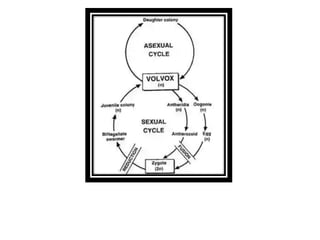
Types of reproduction in volvox
• Asexual reproduction .
• Sexual reproduction .
Asexual Reproduction
• Some cell at posterior side of colony become
reproductive.
• Reproductive cells are called gonidia.
 characters of gonidia.
1. Enlarge up to ten times.
2. Lose eye spot.
3. Pyrenoid increase in number.
• Divisions in gonidia.
1. First division is longitudnal form two cells.
2. Second devision is also longuitudnal forming
four cells.
3. Third longitudnal division produce eight cells.
• Plakea stage
Eight cells arranged in curved plate like
structure called plakea stage.
• Each cell of plakea stage divide longitudnally
forming sixteen cells in a sherical shape.
• Phialopore.
• The sphere is open at exterior side as a small
aperture called phialopore.
• This pore help in inversion of colony.
• Inversion of colony.
• It start with the formation of constriction on
the opposite side of the phialopore.
• The cells at the posterior end are pushed
inside and whole structure comes out of the
phialopore .
• The phialopore gets closed and form anterior
parts of colony.
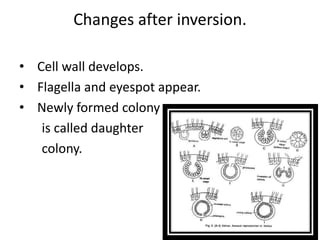
Changes after inversion.
• Cell wall develops.
• Flagella and eyespot appear.
• Newly formed colony
is called daughter
colony.
Sexual reproduction
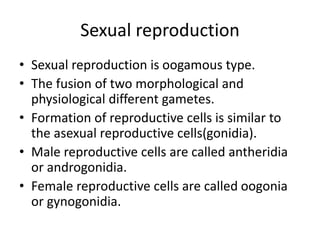
• Sexual reproduction is oogamous type.
• The fusion of two morphological and
physiological different gametes.
• Formation of reproductive cells is similar to
the asexual reproductive cells(gonidia).
• Male reproductive cells are called antheridia
or androgonidia.
• Female reproductive cells are called oogonia
or gynogonidia.
Stages of sexual reproduction.
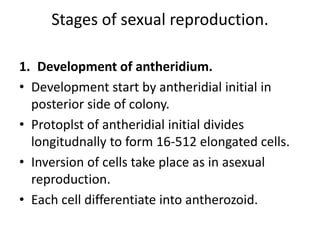
1. Development of antheridium.
• Development start by antheridial initial in
posterior side of colony.
• Protoplst of antheridial initial divides
longitudnally to form 16-512 elongated cells.
• Inversion of cells take place as in asexual
reproduction.
• Each cell differentiate into antherozoid.
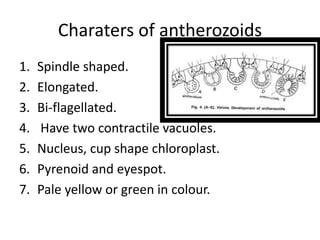
Charaters of antherozoids
1. Spindle shaped.
2. Elongated.
3. Bi-flagellated.
4. Have two contractile vacuoles.
5. Nucleus, cup shape chloroplast.
6. Pyrenoid and eyespot.
7. Pale yellow or green in colour.
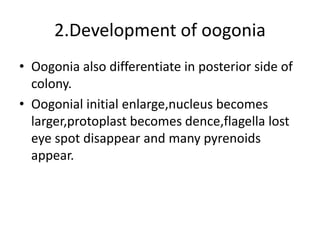
2.Development of oogonia
• Oogonia also differentiate in posterior side of
colony.
• Oogonial initial enlarge,nucleus becomes
larger,protoplast becomes dence,flagella lost
eye spot disappear and many pyrenoids
appear.
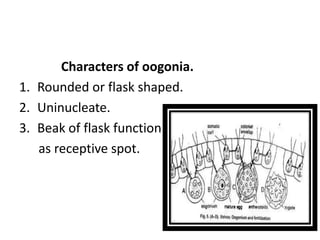
Characters of oogonia.
1. Rounded or flask shaped.
2. Uninucleate.
3. Beak of flask function
as receptive spot.
3.Fertilization in volvox.
• The antherozoids swim on the surface of
water and reach the oogonia through
chemotactic response.
• Some enter in the oogonia through the
receptive spot.
• Plasmogamy and karyogamy take place and
result in the formation of diploid zygote.
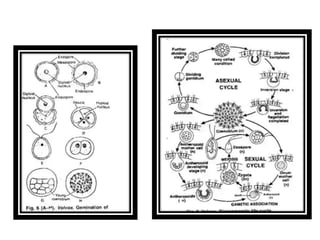
4.Germination of zygote.
• The dormant zygote germinate on getting
favourable conditions.
• The development of new colony from the
zygote is different in different volvox species.
References
• Text book of botany
paper A for B.Sc
The End

Reproduction in volvox

  • 2.
    REPRODUCTION IN VOLVOX Presentedto Madam Rabia Saba Presented by Farhana Sheikh BS-BOT-F17-R03
  • 3.
    Contents • Types ofreproduction. • Asexual reproduction. • Sexual reproduction. • References.
  • 4.
    Types of reproductionin volvox • Asexual reproduction . • Sexual reproduction .
  • 5.
    Asexual Reproduction • Somecell at posterior side of colony become reproductive. • Reproductive cells are called gonidia.  characters of gonidia. 1. Enlarge up to ten times. 2. Lose eye spot. 3. Pyrenoid increase in number.
  • 6.
    • Divisions ingonidia. 1. First division is longitudnal form two cells. 2. Second devision is also longuitudnal forming four cells. 3. Third longitudnal division produce eight cells.
  • 7.
    • Plakea stage Eightcells arranged in curved plate like structure called plakea stage. • Each cell of plakea stage divide longitudnally forming sixteen cells in a sherical shape. • Phialopore. • The sphere is open at exterior side as a small aperture called phialopore. • This pore help in inversion of colony.
  • 8.
    • Inversion ofcolony. • It start with the formation of constriction on the opposite side of the phialopore. • The cells at the posterior end are pushed inside and whole structure comes out of the phialopore . • The phialopore gets closed and form anterior parts of colony.
  • 9.
    Changes after inversion. •Cell wall develops. • Flagella and eyespot appear. • Newly formed colony is called daughter colony.
  • 10.
    Sexual reproduction • Sexualreproduction is oogamous type. • The fusion of two morphological and physiological different gametes. • Formation of reproductive cells is similar to the asexual reproductive cells(gonidia). • Male reproductive cells are called antheridia or androgonidia. • Female reproductive cells are called oogonia or gynogonidia.
  • 11.
    Stages of sexualreproduction. 1. Development of antheridium. • Development start by antheridial initial in posterior side of colony. • Protoplst of antheridial initial divides longitudnally to form 16-512 elongated cells. • Inversion of cells take place as in asexual reproduction. • Each cell differentiate into antherozoid.
  • 12.
    Charaters of antherozoids 1.Spindle shaped. 2. Elongated. 3. Bi-flagellated. 4. Have two contractile vacuoles. 5. Nucleus, cup shape chloroplast. 6. Pyrenoid and eyespot. 7. Pale yellow or green in colour.
  • 13.
    2.Development of oogonia •Oogonia also differentiate in posterior side of colony. • Oogonial initial enlarge,nucleus becomes larger,protoplast becomes dence,flagella lost eye spot disappear and many pyrenoids appear.
  • 14.
    Characters of oogonia. 1.Rounded or flask shaped. 2. Uninucleate. 3. Beak of flask function as receptive spot.
  • 15.
    3.Fertilization in volvox. •The antherozoids swim on the surface of water and reach the oogonia through chemotactic response. • Some enter in the oogonia through the receptive spot. • Plasmogamy and karyogamy take place and result in the formation of diploid zygote.
  • 16.
    4.Germination of zygote. •The dormant zygote germinate on getting favourable conditions. • The development of new colony from the zygote is different in different volvox species.
  • 19.
    References • Text bookof botany paper A for B.Sc
  • 20.