


PREPARED BY: PARTH
M.PHARM SEM-I (Q . A)
GUIDED BY : Ms.TANVI PANDYA


DEPARTMENT OF Q. A
A.P.M.C.COLLEGE OF PHARMACY
HIMMATNAGAR
CONTENT
 Introduction
 Need for Bioequivalence studies
 Importance of Bioequivalence studies
 Criteria for Establishing a bioequivalence requirement
 Types of Bioequivalence studies
 Design of Bioequivalence studies
 Evaluation of Bioequivalence study
 Clinical significance
 References
INTRODUCTION
DEFINITIONS:
 Bioavailability:
  Bioavailability means the rate and extent to which the active
  ingredient or active moiety is absorbed from a drug product and
  becomes available at the site of action.
 Equivalence:
  It is a relative term that compares drug products with respect to a
  specific characteristic or function or to a defined set of standards.
  There are several types of equivalences:
   • Chemical equivalence: It indicates that two or more drug
      products contain the same labeled chemical substance as an
      active ingredient in the same amount.
 Pharmaceutical equivalence: This term implies that two or more
  drug products are identical in strength, quality, purity, content
  uniformity and disintegration and dissolution characteristics. They
  may, however differ in containing different excipients.
 Bioequivalence: denotes that the drug substance in two or more
  identical dosage forms, reaches the systemic circulation at the same
  relative rate and to the same relative extent i.e. their plasma
  concentration-time profiles will be identical without significant
  statistical differences. When statistically significant differences are
  observed in the bioavailability of two or more drug products, bio-in
  equivalence is indicated.
• Therapeutic Equivalence: This term indicates that two or more
  drug products that contain the same therapeutically active
  ingredient elicit identical pharmacological effects and can control
  the disease to the same extent.
NEED FOR BIOEQUIVALENCE STUDIES
 New product is intended to be a substitute for an approved
  medicinal product as a pharmaceutical equivalent or alternative
 To ensure clinical performance of such drug products
 Bioequivalence studies are conducted if there is:
    A risk of bio-in equivalence and/or
    A risk of pharmacotherapeutics failure or diminished clinical
     safety
    In vivo bioavailability / bioequivalence studies and in vitro
     dissolution testing recommended to applicants intending to
     submit Investigational new drug application (INDs)New drug
     applications (NDAs)Abbreviated new drug applications
     (ANDAs) for conventional and extended release dosage forms
     administered orally.
 In conditions where a suitable method for determining active
 drug is not available, an indirect indication of bioavailability
 and bioequivalence by comparing the pharmacodynamic
 responses of the formulations may be possible
IMPORTANCE OF BIOEQUIVALANCE STUDIES
 To evaluate the absolute bioavailability of dosage form compared
    with reference dosage forms.
   Dose proportionality study to determine if bioavailability
    parameters are linear over proposed dosage range.
   Intra/inter subject variability
   Intervention study to examine effect of e.g. Food and concomitant
    medication.
   Dosage form proportionality study to determine if equipotent drug
    treatments administered at different dose strength of the market
    form produce equivalent drug bioavailability.
   Bioequivalence study needed as a result of changes in the
    formulation or manufacturing processes.
CRITERIA FOR ESTABLISHING A BIOEQUIVALENCE
REQUIREMENT
 Evidence from well-controlled clinical trials, or controlled
  observations in patients and bioequivalence studies :
    Various drug products do not give comparable therapeutic
       effects are not bioequivalent drug products.
    Narrow therapeutic ratio and minimum effective concentration
       in the blood.
    Serious adverse effects
 Physicochemical:
    Low solubility in water.
    Dissolution rate slow
    Particle size and surface area of the active drug ingredient
 Structural forms dissolves poorly.
     High ratio of excipients.
     Hydrophilic or hydrophobic excipients and lubricants
•   Pharmacokinetic:
      GI tract or localized site.
      Degree of absorption poor
TYPES OF BIOEQUIVALANCE STUDIES
 In vivo:
1. Oral immediate-release products with systemic action
   Indicated for serious conditions requiring assured response.
   Narrow therapeutic margin.
   Absorption <70%
   Unfavorable physiochemical properties.
   Bioavailability problems.
2. Non-oral immediate-release products.
3. Modified-release products with systemic action.
 In vitro:
  Dissolution study can be used in lieu of in vivo bioequivalence
  under certain circumstance, called as biowaivers.
1. The drug product differs only in strength of the active substance
   it contains, provided all of the conditions hold-
    Pharmacokinetics linear.
    Qualitative composition same.
    Ratio between active substance and the excipients are same.
    Same manufacturer and same production site.
    Bioavailability or bioequivalence study performed with the
       original product.
2. Slightly reformulated or manufacturing method slightly modified
   by the original manufacturer.
3. Meets all of the following requirements-
    Solution or solublised form
    Active ingredient in the same concentration
    No excipients
    Topical administration
    Oral administration
    By inhalation as a gas or vapour.
DESIGN OF BIOEQUIVALENCE STUDIES
DESIGN:
 The design and evaluation of well-controlled bioequivalence
  studies require cooperative input from
  pharmacokineticists, statisticians, clinicians, bioanalytical
  chemists, and others.
 The basic design for a bioequivalence study is determined by:
    The scientific questions to be answered,
    The nature of the reference material and the dosage form to be
     tested,
    The availability of analytical methods, and
    Benefit–risk and ethical considerations with regard to testing
     in humans. For some generic drugs, the FDA offers general
     guidelines for conducting these studies.
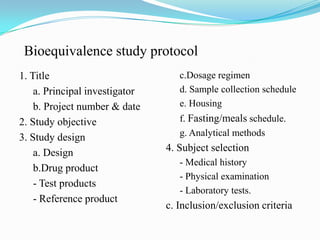
Bioequivalence study protocol
1. Title                           c.Dosage regimen
    a. Principal investigator      d. Sample collection schedule
    b. Project number & date       e. Housing
2. Study objective                 f. Fasting/meals schedule.
3. Study design                    g. Analytical methods

    a. Design                   4. Subject selection
                                   - Medical history
    b.Drug product
                                   - Physical examination
    - Test products
                                   - Laboratory tests.
    - Reference product
                                c. Inclusion/exclusion criteria
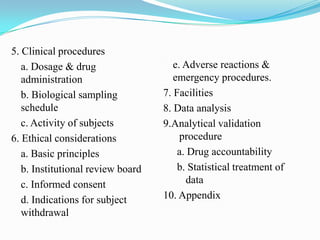
5. Clinical procedures
   a. Dosage & drug                   e. Adverse reactions &
   administration                     emergency procedures.
   b. Biological sampling          7. Facilities
   schedule                        8. Data analysis
   c. Activity of subjects         9.Analytical validation
6. Ethical considerations               procedure
   a. Basic principles                 a. Drug accountability
   b. Institutional review board       b. Statistical treatment of
   c. Informed consent                   data
   d. Indications for subject      10. Appendix
   withdrawal
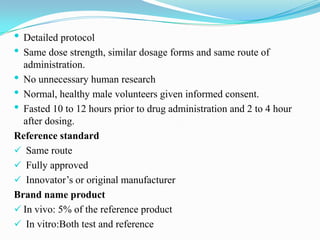
• Detailed protocol
• Same dose strength, similar dosage forms and same route of
  administration.
• No unnecessary human research
• Normal, healthy male volunteers given informed consent.
• Fasted 10 to 12 hours prior to drug administration and 2 to 4 hour
  after dosing.
Reference standard
 Same route
 Fully approved
 Innovator’s or original manufacturer
Brand name product
 In vivo: 5% of the reference product
 In vitro:Both test and reference
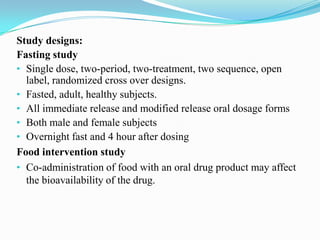
Study designs:
Fasting study
• Single dose, two-period, two-treatment, two sequence, open
  label, randomized cross over designs.
• Fasted, adult, healthy subjects.
• All immediate release and modified release oral dosage forms
• Both male and female subjects
• Overnight fast and 4 hour after dosing
Food intervention study
• Co-administration of food with an oral drug product may affect
  the bioavailability of the drug.
Multiple dose
• Multiple dose, steady state, randomized, two-treatment, two-
  way, crossover study.
• Adult and healthy subject
• Three consecutive trough concentration on three consecutive days
Types of test designs
1.Completely randomized designs
  All treatments( factor levels) are randomly allocated among all
  Experimental subjects.
Method of randomization : label all subjects with the same number
  digits. Randomly select non-repeating numbers.
Advantages:-
 Easy to construct.
 Any number of treatments & subjects.
    Easy & simple to analyses.
Disadvantages:-
    Best suited for relatively few treatments.
    All subjects must be as homogenous


2. Randomized block designs
Subjects are sorted into homogenous groups called blocks.

Method of randomization: Subjects having similar background
 characteristics are formed as blocks.
Then treatments are randomized within each block, just like the
  simple randomization.
Advantages:-
    Effective & systemic way of grouping.
    Any number of treatments or replications.
    Different treatments need not have equal sample size.
    Statistical analysis simple & easy to construct.
    Spoiled results, the design is easy to construct.
Disadvantages:-
    More complex analysis
    Degrees of freedom of experimental error are not as large as
     with a completely randomised design.
Repeated measures, cross-over & carry-over designs:-
• Same subject serves as a block.
• Repeated measures on each subject we get the design name
  “repeated measures design”
• The administration of two or more treatments one after the other in
  a specified or random order to the same group of patients is called
  a crossover design or change-over design
• Carry over effects
• Wash out period
Advantages:
    Good precision for comparing treatments
    Economic on subjects
Disadvantages:
    Order-effect.
    Carry over effect.
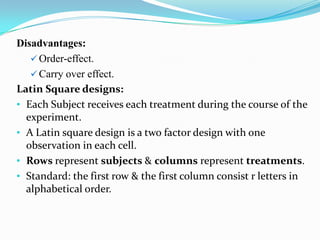
Latin Square designs:
• Each Subject receives each treatment during the course of the
  experiment.
• A Latin square design is a two factor design with one
  observation in each cell.
• Rows represent subjects & columns represent treatments.
• Standard: the first row & the first column consist r letters in
  alphabetical order.
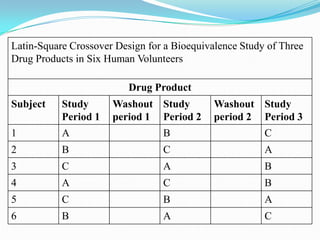
Latin-Square Crossover Design for a Bioequivalence Study of Three
Drug Products in Six Human Volunteers

                          Drug Product
Subject    Study      Washout Study          Washout Study
           Period 1   period 1 Period 2      period 2 Period 3
1          A                     B                      C
2          B                     C                      A
3          C                     A                      B
4          A                     C                      B
5          C                     B                      A
6          B                     A                      C
Advantages:
    Minimizes inter-subject variability, Intra-subject variability &
     time effect.
    Formulation variables.
Disadvantages:-
    Degrees of freedom for experiments error larger than
     necessary.
    More complex.
    Wash out period very long
Evaluation of bioequivalence studies
Analytical method
• Accuracy, precision and specificity.
• More than one analytical method not be valid.
• Data presented in both tabulated and graphical form
• Plasma drug concentration versus time curve for each drug
  product and each subject.
Pharmacokinetic evaluation of the data
• Single dose study:AUC0-t ,AUC0-∞,Tmax and Tmax.
• Multiple dose studies:AUC0-t,Tmax,Cmax,Cmin and percent
  fluctuation[100*(Cmax-Cmin)/Cmin].
Statistical evaluation of the data
• No statistical difference between the bioavailability of the test
  product & the reference product.
• Bell- shaped curve
• Log values resembles more closely a normal distribution
Analysis of variance(ANOVA)
• No significance difference.
• AUC0-24,AUC0-∞, Tmax & Cmax
• Evaluate variability in subjects , treatment groups, study
  period, formulation & other variables.
• Variability in the data is large then two drug products are
  bioequivalent.
• Statistically significant, If p≤0.05
• P- level of Statistical significance.
• If p> 0.05 the difference between the two drug products are not
  statistically significant.
• To detect small differences between the test products, a power
  test is performed.
• Sample size, variability of the data & desired level of
  significance.
• Power is set at 0.80 with an α=0.2 & a level of significance of
  0.05.
Two one-sided tests procedure
• Confidence interval approach.
• Greater 20%.
• 90% confidence limits.
• Student’s t-distribution of the data.
• within 20%.
• Lower 90% confidence interval for the ratio of means cannot
  be less than 0.80 & the upper 90% confidence interval for the
  ratio of the means cannot be greater than 1.20.
• Log transformed data , 90% confidence interval is set at 80 to
  125%.
• Confidence limits termed the bioequivalence interval.
• No-statistical differences between the mean AUC & Cmax
  parameters.
• 90% confidence intervals for AUC & Cmax values of the test
  drug product should not be less than 0.80(80%) nor greater
  than 1.25(125%) of the reference product based on log-
  transformed data.
CLINICAL SIGNIFICANCE
 Clinical interpretation is important in evaluating the results of
    a bioequivalence study.
   Differences of less than 20% in AUC & Cmax between drug
    products are unlikely to be clinically significant in patients.
   A small, statistically significant difference if the study well
    controlled & the number of subjects is sufficiently large.
   Above MEC & do not reach the MTC.
   Elderly or patients.
    Normal healthy volunteers.
   Minimize product to product variability by different
    manufactures & lot to lot variability with a single manufacture.
REFERENCES
 Leon Shargel; Andrew B.C Yu, Applied Bio pharmaceutics and
  pharmacokinetics, Fourth edition,pp 256-271.
 D.M.Brahmankar, Sunil b. jaiswal, Biopharmaceutics and
  Pharmacokinetics, A Treatise, second edition, vallabh
  prakashan,pp336-344.
thanks

Bioequivalence 112070804009

  • 1.
    PREPARED BY: PARTH M.PHARMSEM-I (Q . A) GUIDED BY : Ms.TANVI PANDYA DEPARTMENT OF Q. A A.P.M.C.COLLEGE OF PHARMACY HIMMATNAGAR
  • 2.
    CONTENT  Introduction  Needfor Bioequivalence studies  Importance of Bioequivalence studies  Criteria for Establishing a bioequivalence requirement  Types of Bioequivalence studies  Design of Bioequivalence studies  Evaluation of Bioequivalence study  Clinical significance  References
  • 3.
    INTRODUCTION DEFINITIONS:  Bioavailability: Bioavailability means the rate and extent to which the active ingredient or active moiety is absorbed from a drug product and becomes available at the site of action.  Equivalence: It is a relative term that compares drug products with respect to a specific characteristic or function or to a defined set of standards. There are several types of equivalences: • Chemical equivalence: It indicates that two or more drug products contain the same labeled chemical substance as an active ingredient in the same amount.
  • 4.
     Pharmaceutical equivalence:This term implies that two or more drug products are identical in strength, quality, purity, content uniformity and disintegration and dissolution characteristics. They may, however differ in containing different excipients.  Bioequivalence: denotes that the drug substance in two or more identical dosage forms, reaches the systemic circulation at the same relative rate and to the same relative extent i.e. their plasma concentration-time profiles will be identical without significant statistical differences. When statistically significant differences are observed in the bioavailability of two or more drug products, bio-in equivalence is indicated. • Therapeutic Equivalence: This term indicates that two or more drug products that contain the same therapeutically active ingredient elicit identical pharmacological effects and can control the disease to the same extent.
  • 5.
    NEED FOR BIOEQUIVALENCESTUDIES  New product is intended to be a substitute for an approved medicinal product as a pharmaceutical equivalent or alternative  To ensure clinical performance of such drug products  Bioequivalence studies are conducted if there is:  A risk of bio-in equivalence and/or  A risk of pharmacotherapeutics failure or diminished clinical safety  In vivo bioavailability / bioequivalence studies and in vitro dissolution testing recommended to applicants intending to submit Investigational new drug application (INDs)New drug applications (NDAs)Abbreviated new drug applications (ANDAs) for conventional and extended release dosage forms administered orally.
  • 6.
     In conditionswhere a suitable method for determining active drug is not available, an indirect indication of bioavailability and bioequivalence by comparing the pharmacodynamic responses of the formulations may be possible
  • 7.
    IMPORTANCE OF BIOEQUIVALANCESTUDIES  To evaluate the absolute bioavailability of dosage form compared with reference dosage forms.  Dose proportionality study to determine if bioavailability parameters are linear over proposed dosage range.  Intra/inter subject variability  Intervention study to examine effect of e.g. Food and concomitant medication.  Dosage form proportionality study to determine if equipotent drug treatments administered at different dose strength of the market form produce equivalent drug bioavailability.  Bioequivalence study needed as a result of changes in the formulation or manufacturing processes.
  • 8.
    CRITERIA FOR ESTABLISHINGA BIOEQUIVALENCE REQUIREMENT  Evidence from well-controlled clinical trials, or controlled observations in patients and bioequivalence studies :  Various drug products do not give comparable therapeutic effects are not bioequivalent drug products.  Narrow therapeutic ratio and minimum effective concentration in the blood.  Serious adverse effects  Physicochemical:  Low solubility in water.  Dissolution rate slow  Particle size and surface area of the active drug ingredient
  • 9.
     Structural formsdissolves poorly.  High ratio of excipients.  Hydrophilic or hydrophobic excipients and lubricants • Pharmacokinetic:  GI tract or localized site.  Degree of absorption poor
  • 10.
    TYPES OF BIOEQUIVALANCESTUDIES  In vivo: 1. Oral immediate-release products with systemic action  Indicated for serious conditions requiring assured response.  Narrow therapeutic margin.  Absorption <70%  Unfavorable physiochemical properties.  Bioavailability problems. 2. Non-oral immediate-release products. 3. Modified-release products with systemic action.
  • 11.
     In vitro: Dissolution study can be used in lieu of in vivo bioequivalence under certain circumstance, called as biowaivers. 1. The drug product differs only in strength of the active substance it contains, provided all of the conditions hold-  Pharmacokinetics linear.  Qualitative composition same.  Ratio between active substance and the excipients are same.  Same manufacturer and same production site.  Bioavailability or bioequivalence study performed with the original product. 2. Slightly reformulated or manufacturing method slightly modified by the original manufacturer.
  • 12.
    3. Meets allof the following requirements-  Solution or solublised form  Active ingredient in the same concentration  No excipients  Topical administration  Oral administration  By inhalation as a gas or vapour.
  • 13.
    DESIGN OF BIOEQUIVALENCESTUDIES DESIGN:  The design and evaluation of well-controlled bioequivalence studies require cooperative input from pharmacokineticists, statisticians, clinicians, bioanalytical chemists, and others.  The basic design for a bioequivalence study is determined by:  The scientific questions to be answered,  The nature of the reference material and the dosage form to be tested,  The availability of analytical methods, and  Benefit–risk and ethical considerations with regard to testing in humans. For some generic drugs, the FDA offers general guidelines for conducting these studies.
  • 14.
    Bioequivalence study protocol 1.Title c.Dosage regimen a. Principal investigator d. Sample collection schedule b. Project number & date e. Housing 2. Study objective f. Fasting/meals schedule. 3. Study design g. Analytical methods a. Design 4. Subject selection - Medical history b.Drug product - Physical examination - Test products - Laboratory tests. - Reference product c. Inclusion/exclusion criteria
  • 15.
    5. Clinical procedures a. Dosage & drug e. Adverse reactions & administration emergency procedures. b. Biological sampling 7. Facilities schedule 8. Data analysis c. Activity of subjects 9.Analytical validation 6. Ethical considerations procedure a. Basic principles a. Drug accountability b. Institutional review board b. Statistical treatment of c. Informed consent data d. Indications for subject 10. Appendix withdrawal
  • 16.
    • Detailed protocol •Same dose strength, similar dosage forms and same route of administration. • No unnecessary human research • Normal, healthy male volunteers given informed consent. • Fasted 10 to 12 hours prior to drug administration and 2 to 4 hour after dosing. Reference standard  Same route  Fully approved  Innovator’s or original manufacturer Brand name product  In vivo: 5% of the reference product  In vitro:Both test and reference
  • 17.
    Study designs: Fasting study •Single dose, two-period, two-treatment, two sequence, open label, randomized cross over designs. • Fasted, adult, healthy subjects. • All immediate release and modified release oral dosage forms • Both male and female subjects • Overnight fast and 4 hour after dosing Food intervention study • Co-administration of food with an oral drug product may affect the bioavailability of the drug.
  • 18.
    Multiple dose • Multipledose, steady state, randomized, two-treatment, two- way, crossover study. • Adult and healthy subject • Three consecutive trough concentration on three consecutive days Types of test designs 1.Completely randomized designs All treatments( factor levels) are randomly allocated among all Experimental subjects. Method of randomization : label all subjects with the same number digits. Randomly select non-repeating numbers. Advantages:-  Easy to construct.
  • 19.
     Any numberof treatments & subjects.  Easy & simple to analyses. Disadvantages:-  Best suited for relatively few treatments.  All subjects must be as homogenous 2. Randomized block designs Subjects are sorted into homogenous groups called blocks. Method of randomization: Subjects having similar background characteristics are formed as blocks.
  • 20.
    Then treatments arerandomized within each block, just like the simple randomization. Advantages:-  Effective & systemic way of grouping.  Any number of treatments or replications.  Different treatments need not have equal sample size.  Statistical analysis simple & easy to construct.  Spoiled results, the design is easy to construct. Disadvantages:-  More complex analysis  Degrees of freedom of experimental error are not as large as with a completely randomised design.
  • 21.
    Repeated measures, cross-over& carry-over designs:- • Same subject serves as a block. • Repeated measures on each subject we get the design name “repeated measures design” • The administration of two or more treatments one after the other in a specified or random order to the same group of patients is called a crossover design or change-over design • Carry over effects • Wash out period Advantages:  Good precision for comparing treatments  Economic on subjects
  • 22.
    Disadvantages:  Order-effect.  Carry over effect. Latin Square designs: • Each Subject receives each treatment during the course of the experiment. • A Latin square design is a two factor design with one observation in each cell. • Rows represent subjects & columns represent treatments. • Standard: the first row & the first column consist r letters in alphabetical order.
  • 23.
    Latin-Square Crossover Designfor a Bioequivalence Study of Three Drug Products in Six Human Volunteers Drug Product Subject Study Washout Study Washout Study Period 1 period 1 Period 2 period 2 Period 3 1 A B C 2 B C A 3 C A B 4 A C B 5 C B A 6 B A C
  • 24.
    Advantages:  Minimizes inter-subject variability, Intra-subject variability & time effect.  Formulation variables. Disadvantages:-  Degrees of freedom for experiments error larger than necessary.  More complex.  Wash out period very long
  • 25.
    Evaluation of bioequivalencestudies Analytical method • Accuracy, precision and specificity. • More than one analytical method not be valid. • Data presented in both tabulated and graphical form • Plasma drug concentration versus time curve for each drug product and each subject. Pharmacokinetic evaluation of the data • Single dose study:AUC0-t ,AUC0-∞,Tmax and Tmax. • Multiple dose studies:AUC0-t,Tmax,Cmax,Cmin and percent fluctuation[100*(Cmax-Cmin)/Cmin].
  • 26.
    Statistical evaluation ofthe data • No statistical difference between the bioavailability of the test product & the reference product. • Bell- shaped curve • Log values resembles more closely a normal distribution Analysis of variance(ANOVA) • No significance difference. • AUC0-24,AUC0-∞, Tmax & Cmax • Evaluate variability in subjects , treatment groups, study period, formulation & other variables. • Variability in the data is large then two drug products are bioequivalent. • Statistically significant, If p≤0.05 • P- level of Statistical significance.
  • 27.
    • If p>0.05 the difference between the two drug products are not statistically significant. • To detect small differences between the test products, a power test is performed. • Sample size, variability of the data & desired level of significance. • Power is set at 0.80 with an α=0.2 & a level of significance of 0.05.
  • 28.
    Two one-sided testsprocedure • Confidence interval approach. • Greater 20%. • 90% confidence limits. • Student’s t-distribution of the data. • within 20%. • Lower 90% confidence interval for the ratio of means cannot be less than 0.80 & the upper 90% confidence interval for the ratio of the means cannot be greater than 1.20. • Log transformed data , 90% confidence interval is set at 80 to 125%.
  • 29.
    • Confidence limitstermed the bioequivalence interval. • No-statistical differences between the mean AUC & Cmax parameters. • 90% confidence intervals for AUC & Cmax values of the test drug product should not be less than 0.80(80%) nor greater than 1.25(125%) of the reference product based on log- transformed data.
  • 30.
    CLINICAL SIGNIFICANCE  Clinicalinterpretation is important in evaluating the results of a bioequivalence study.  Differences of less than 20% in AUC & Cmax between drug products are unlikely to be clinically significant in patients.  A small, statistically significant difference if the study well controlled & the number of subjects is sufficiently large.  Above MEC & do not reach the MTC.  Elderly or patients.  Normal healthy volunteers.  Minimize product to product variability by different manufactures & lot to lot variability with a single manufacture.
  • 31.
    REFERENCES  Leon Shargel;Andrew B.C Yu, Applied Bio pharmaceutics and pharmacokinetics, Fourth edition,pp 256-271.  D.M.Brahmankar, Sunil b. jaiswal, Biopharmaceutics and Pharmacokinetics, A Treatise, second edition, vallabh prakashan,pp336-344.
  • 32.